
A complete issue · 48 pages · 1924
Life — June 5, 1924
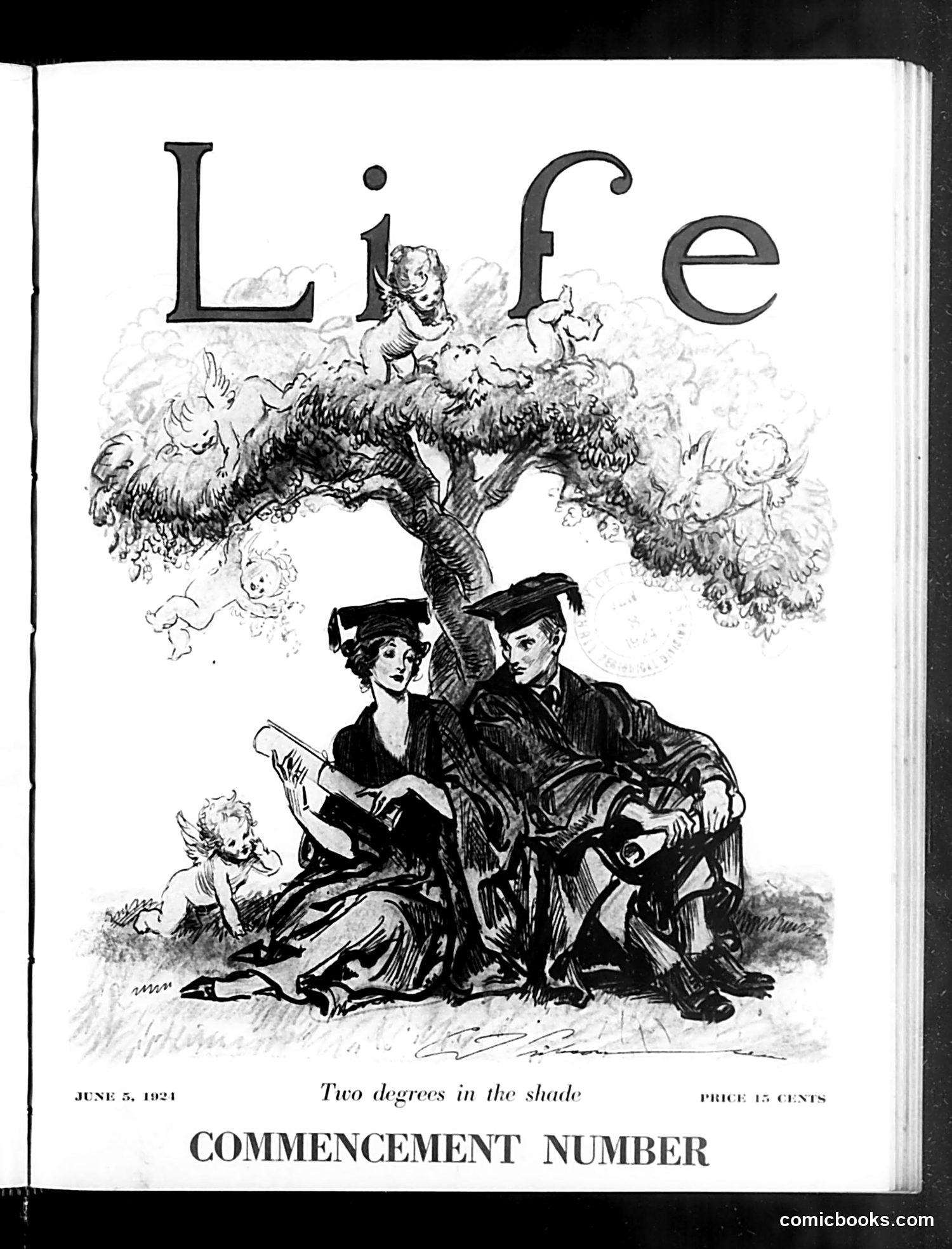
This is a "Commencement Number" cover for Life magazine's June 5, 1921 issue, priced at 15 cents. The illustration depicts two well-dressed adults (a woman and man in formal attire) sitting beneath a large tree with cherubs or cupids playing in its branches above them. The subtitle reads "Two degrees in the shade." The joke appears to be a pun on "degrees"—playing on both academic degrees (appropriate for a commencement issue) and temperature degrees. The phrase "two degrees in the shade" suggests a hot summer day, while the cherubs and romantic setting imply the "degrees" of romance or love. The satire gently mocks the leisurely summer lifestyle following graduation, contrasting academic achievement with youthful romance and idleness.
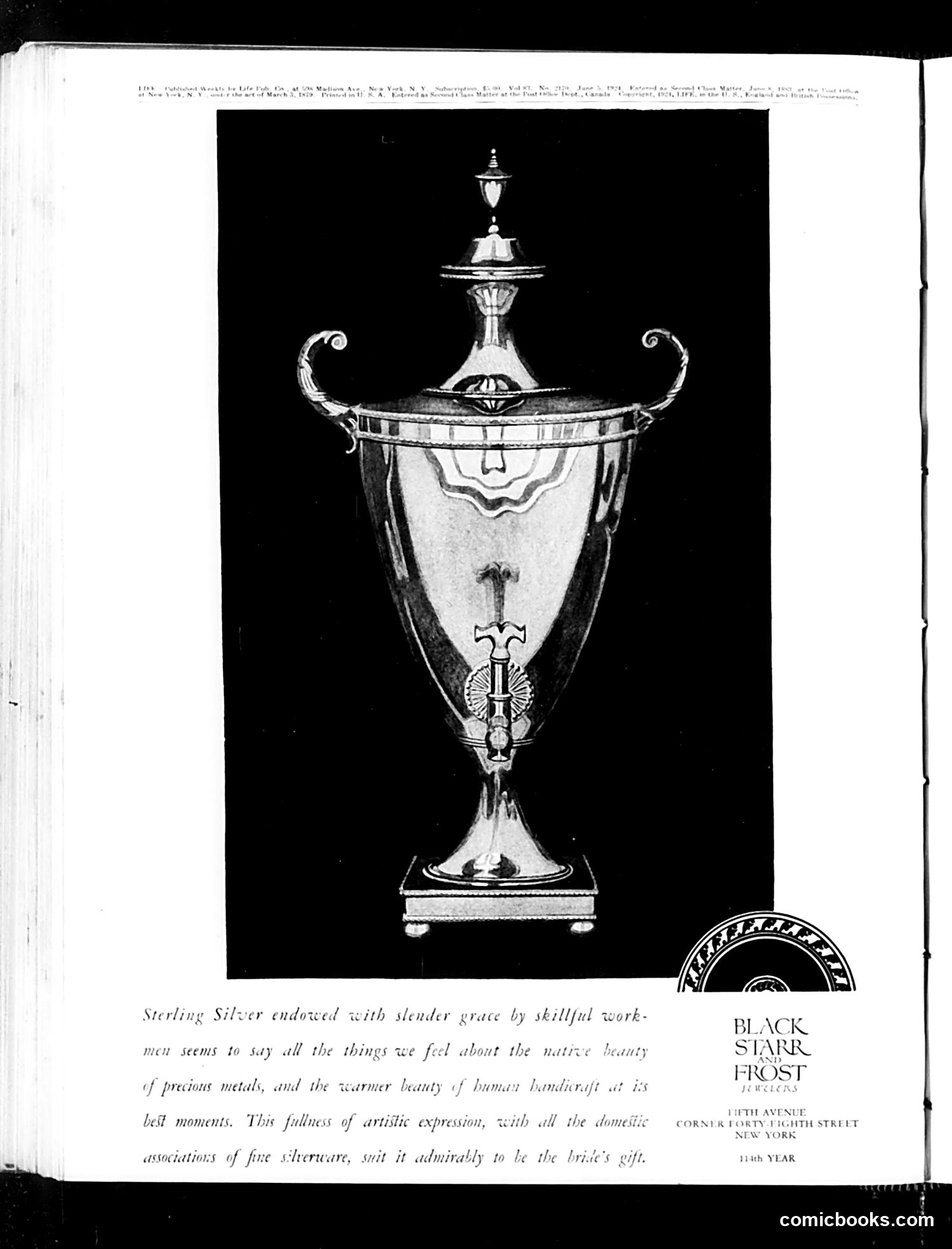
This page is **not a political cartoon** but rather an **advertisement for Black Starr & Frost**, a luxury silverware and jewelry company located on Fifth Avenue in New York (their 118th year in business). The image shows an ornate sterling silver urn or trophy with decorative handles, lid, and classical design elements. The accompanying text—written in elegant, italicized prose—uses flowery language to market fine silverware as embodying "native beauty of precious metal" and "the warmer beauty of human handicraft." It's framed as a gift suggestion, particularly for brides, emphasizing that such pieces represent both artistic expression and domestic refinement. This is straightforward luxury product marketing rather than satire or political commentary.

This page is **not a cartoon or satirical content** — it's a **product advertisement** for the Hupmobile automobile, made by the Hupp Motor Car Corporation of Detroit, Michigan. The ad uses technical diagrams and comparison tables to argue that Hupmobile cars possess quality features ("clutch release bearing," "annular ball bearing," "roller bearings") comparable to much more expensive vehicles. The headline claims "Quality Identical With Highest-Priced Cars." This is straightforward automotive marketing from the early 20th century, emphasizing mechanical superiority to justify the car's price point to potential buyers. There is no political satire, caricature, or social commentary present — merely a manufacturer's detailed technical pitch.
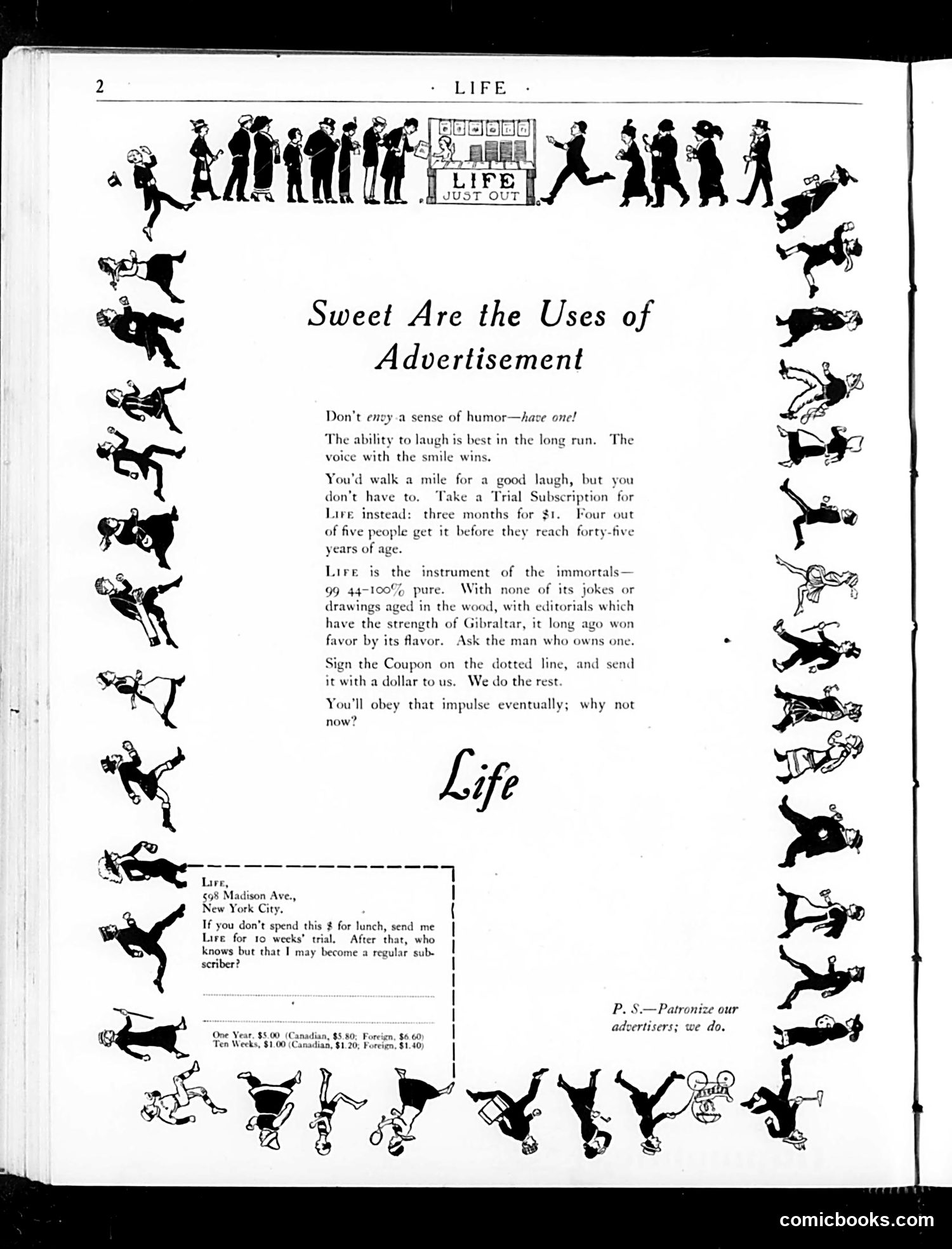
This page is primarily **an advertisement for Life magazine itself**, disguised as satirical content. The central article, "Sweet Are the Uses of Advertisement," is a self-promotional piece encouraging subscriptions. The illustrated border—dozens of silhouetted figures in exaggerated poses of falling, tumbling, and comedic physical mishaps—represents the humorous content readers can expect from Life. This visual style was typical of early 20th-century American humor magazines. The text plays on the magazine's appeal: Life promises laughter and entertainment superior to competitors. It references subscribers receiving the magazine before "forty-five years of age," suggesting Life caters to a younger, hipper audience. The coupon at bottom invites trial subscriptions for $1 (three months), with the confident assertion that readers will become regular subscribers.
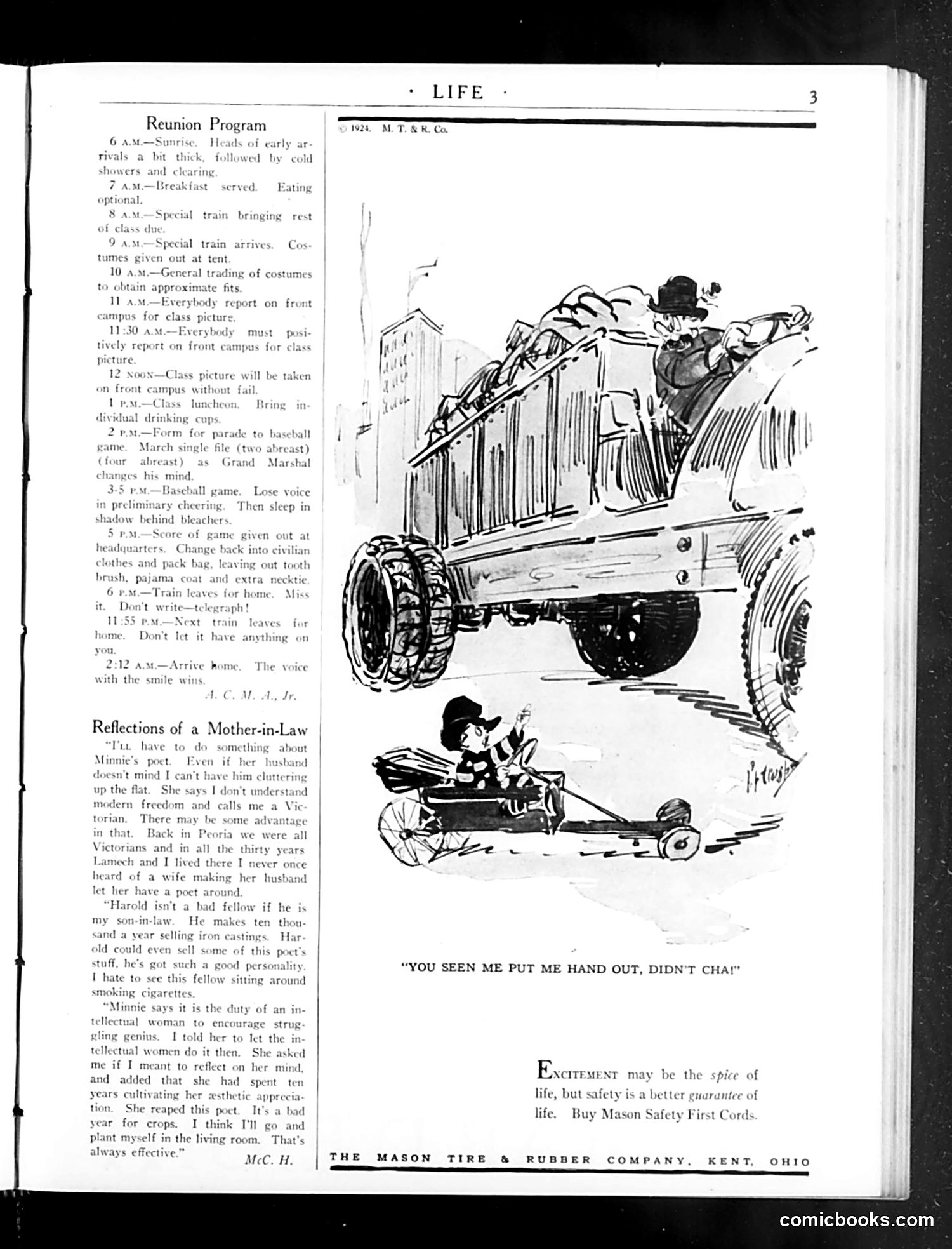
This page contains two distinct elements: **Top Illustration**: A humorous sketch (signed "Cesare") depicting a car overloaded with costumed passengers precariously stacked on top, with a small child in a toy vehicle below. The caption reads "YOU SEEN ME PUT ME HAND OUT, DIDN'T CHA!" This appears to be satirizing unsafe driving practices and overcrowding—likely referencing the era's cavalier attitudes toward vehicle safety and the common practice of transporting multiple passengers unsafely. **Text Column**: An article titled "Reflections of a Mother-in-Law" discussing an intellectual woman's frustration with her son-in-law Harold, a poet-turned-businessman making money in iron castings rather than pursuing literature. **Bottom**: A Mason Tire & Rubber Company advertisement emphasizing safety. The page juxtaposes satire about reckless driving with an advertisement promoting safety—an ironic contrast typical of period publications.
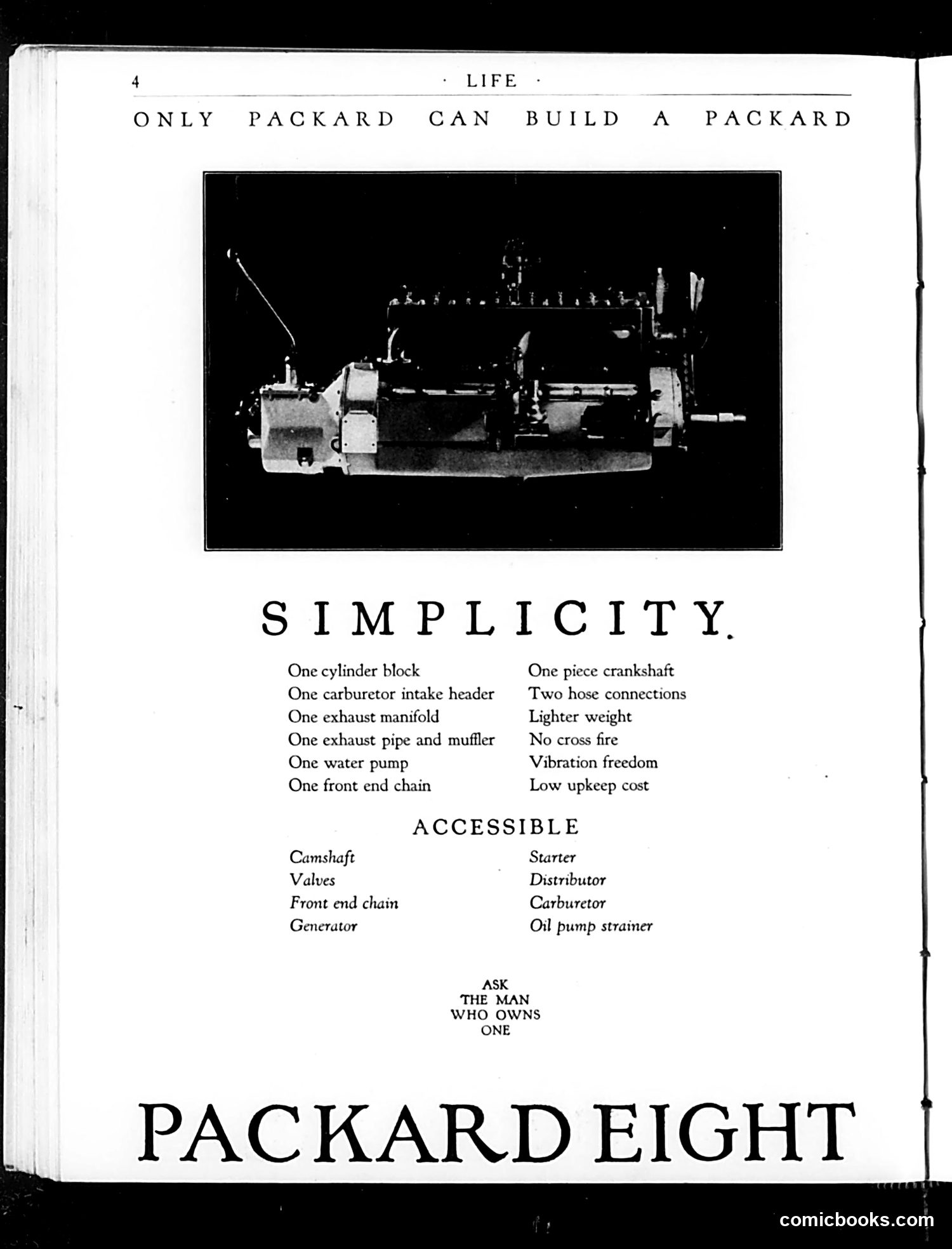
This is a **Packard automobile advertisement**, not political satire. The page promotes the Packard Eight car model through engineering claims rather than humor or social commentary. The advertisement emphasizes manufacturing simplicity and reliability: a single-cylinder block, one crankshaft, minimal components. Below the engine diagram, text lists design features (lightweight, low vibration, accessible maintenance) marketed as advantages. The slogan "ONLY PACKARD CAN BUILD A PACKARD" asserts brand superiority through manufacturing exclusivity. The "ACCESSIBLE" section lists easily-maintained components. This represents typical early-automotive advertising strategy: convincing consumers of technical superiority and practical ownership benefits. The Packard Eight was a luxury vehicle, and this ad targets educated buyers interested in mechanical details rather than styling or status symbols.
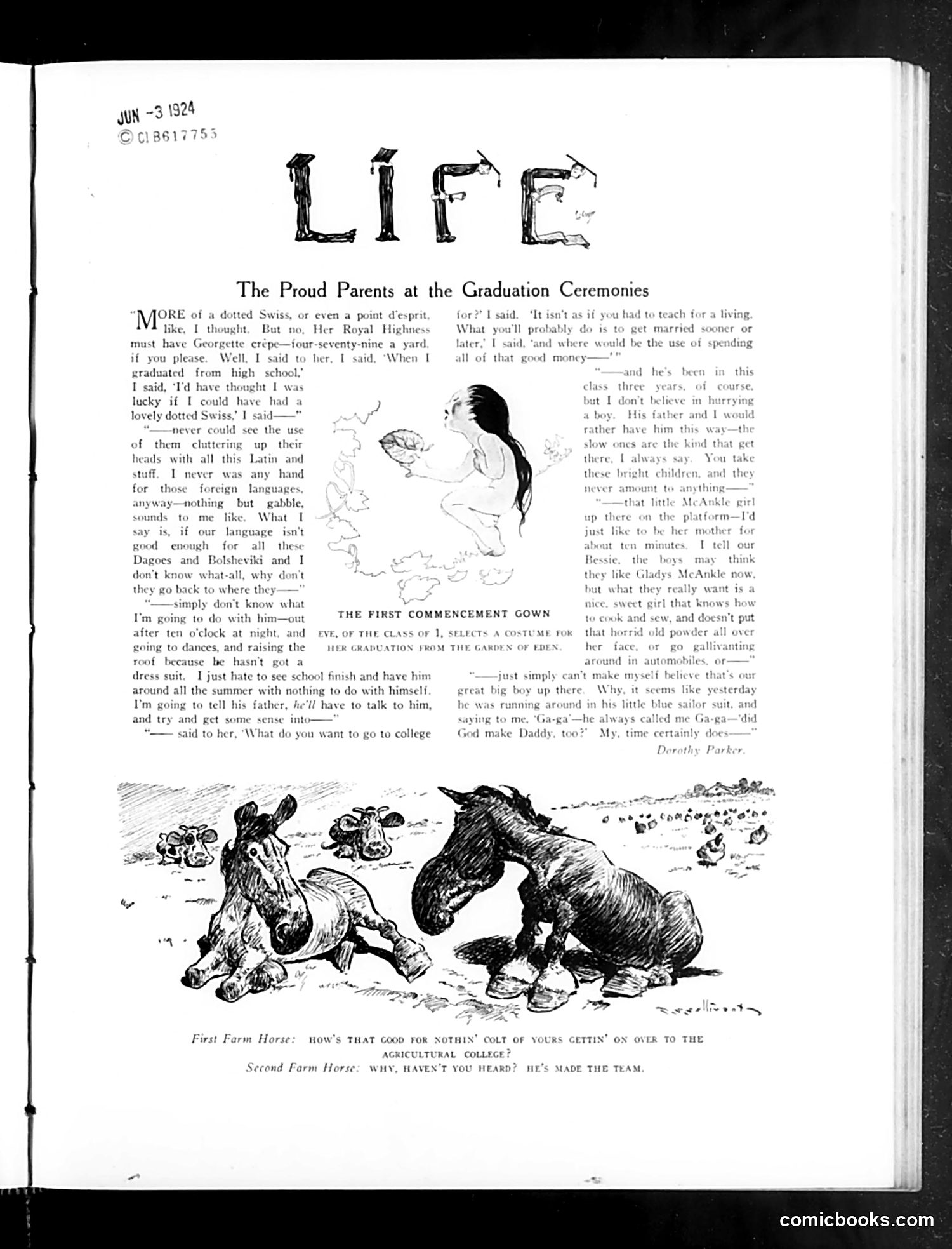
This 1924 *Life* magazine piece satirizes parental attitudes toward children's education and career prospects. The main article features a mother's monologue boasting about her son's graduation, revealing class anxieties: she brags he won't need "Latin and stuff" or languages, emphasizing practical concerns like marriage prospects and not "wasting" money on college. The bottom cartoon depicts two farm horses discussing a third horse being sent to "agricultural college," with one commenting he's "made the team"—a humorous deflation of educational achievement, suggesting the "college" experience is no more sophisticated than farm life. Together, these pieces mock both pretentious parental expectations and the limited, materialistic reasons many parents valued education in the 1920s.
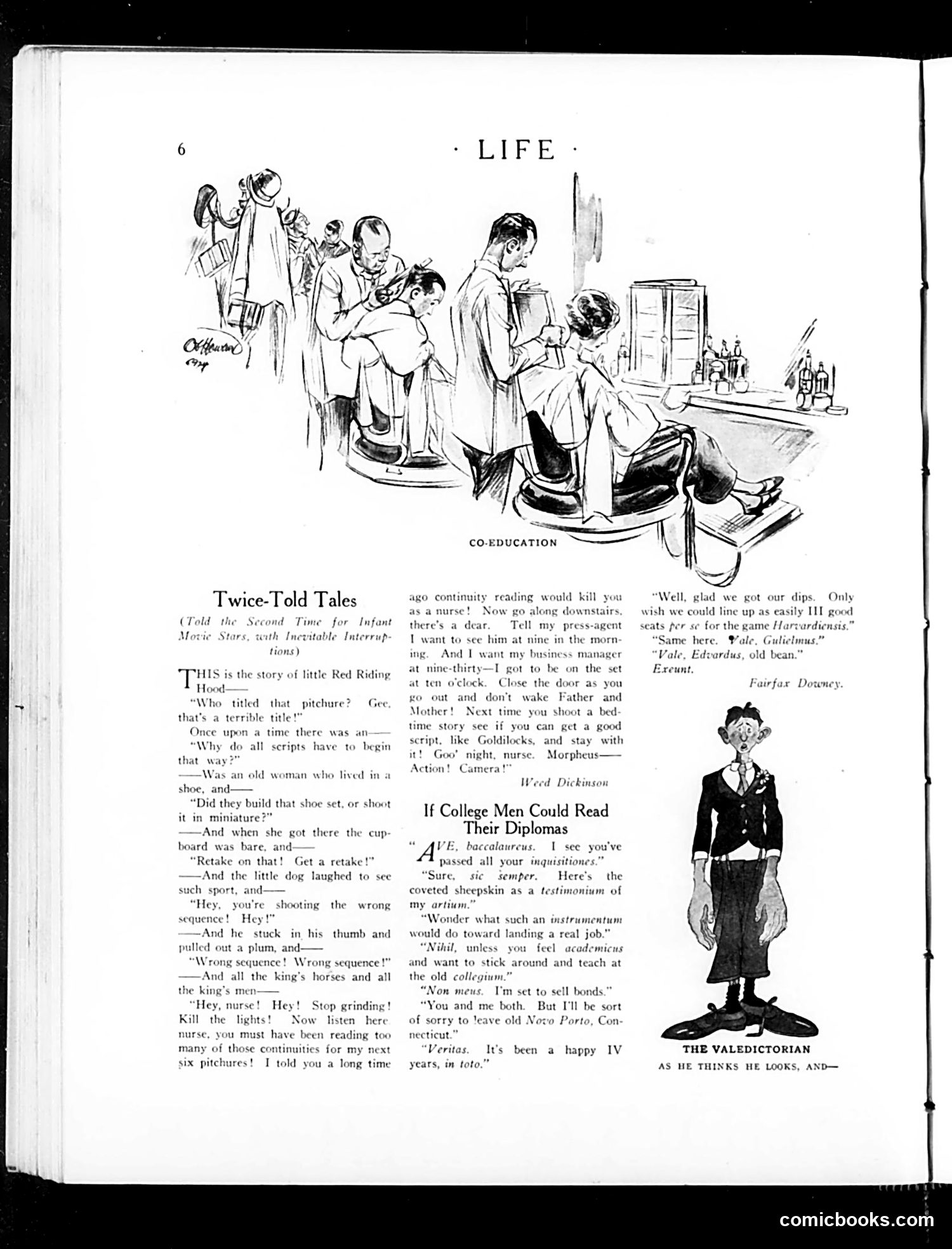
This page contains satirical commentary on education and gender roles in early 20th-century America. The top illustration, labeled "Co-Education," depicts a medical or scientific classroom where male and female students study together—still a relatively novel and controversial arrangement. Below, "Twice-Told Tales" mocks the nursery rhyme "Little Red Riding Hood" through absurdist retellings, satirizing how stories get distorted through repetition. "If College Men Could Read Their Diplomas" presents a "Valedictorian" figure whose diploma uses Latin phrases to humorously critique higher education's pretentiousness and questionable practical value. The satire suggests that college graduates don't actually understand the grandiose language legitimizing their degrees, and that academic credentials often don't translate to real-world competence or honest employment prospects.
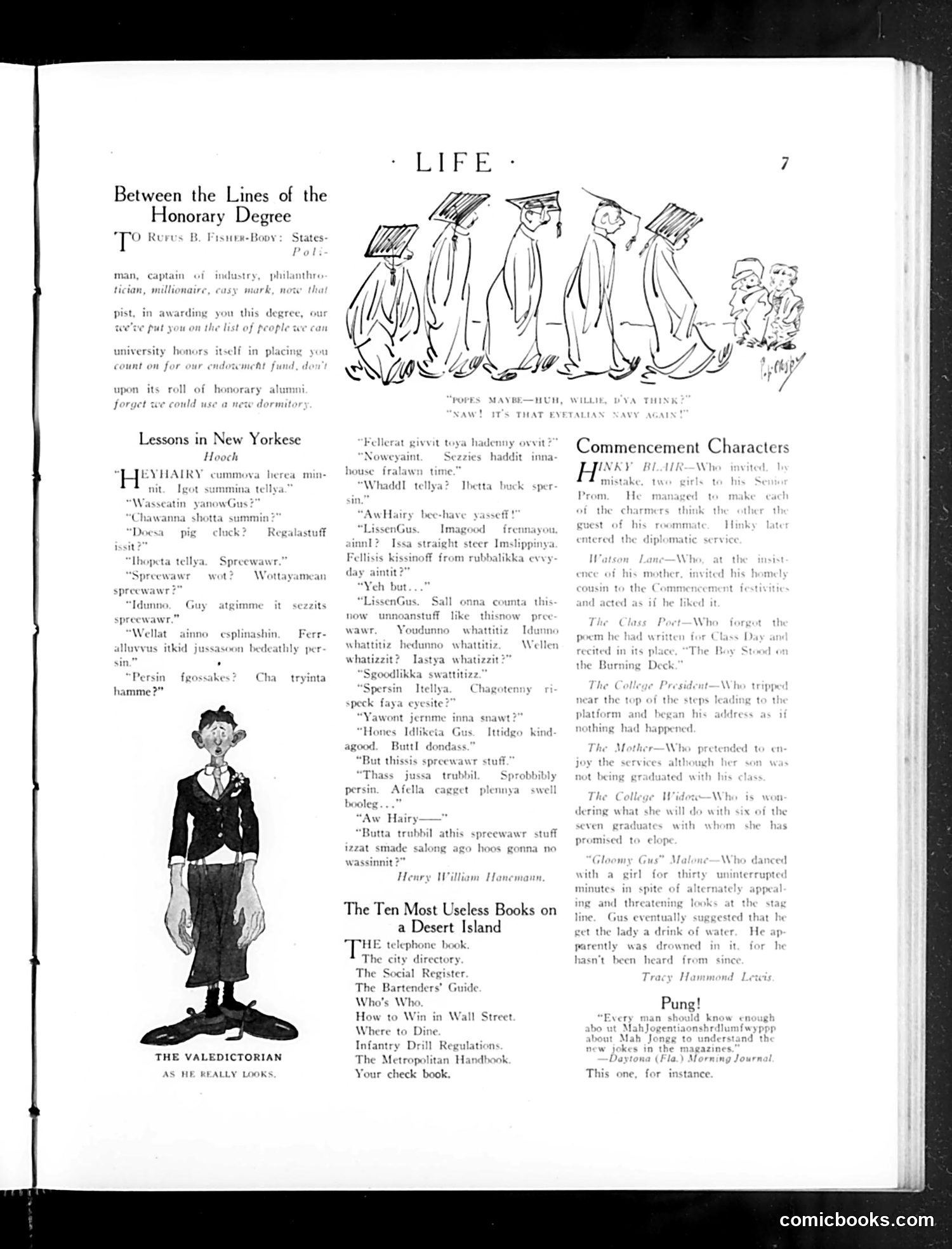
This page from *Life* magazine contains several distinct pieces of humor: **Top cartoon**: Shows graduates in academic robes walking away from commencement, with the caption "Toya's maybe—huh, Willie. D'ya think?" The joke appears to mock the meaninglessness of honorary degrees—the text above addresses "Rufus B. Fisher-Body" (likely a wealthy industrialist), noting that the university places his name on its "roll of honorary alumni" to court his financial support. The graduates' casual dismissal suggests the degrees lack genuine value. **"The Valedictorian"**: An illustration of a formally dressed man labeled as "THE VALEDICTORIAN AS HE REALLY LOOKS"—presumably satirizing the gap between the dignified ideal and reality. **"Ten Most Useless Books on a Desert Island"**: A humorous list mocking impractical reference books (city directories, bartenders' guides, etc.) with no survival value—straightforward satire of urban irrelevance. The overall theme critiques academic pretension and commercial interests in education.
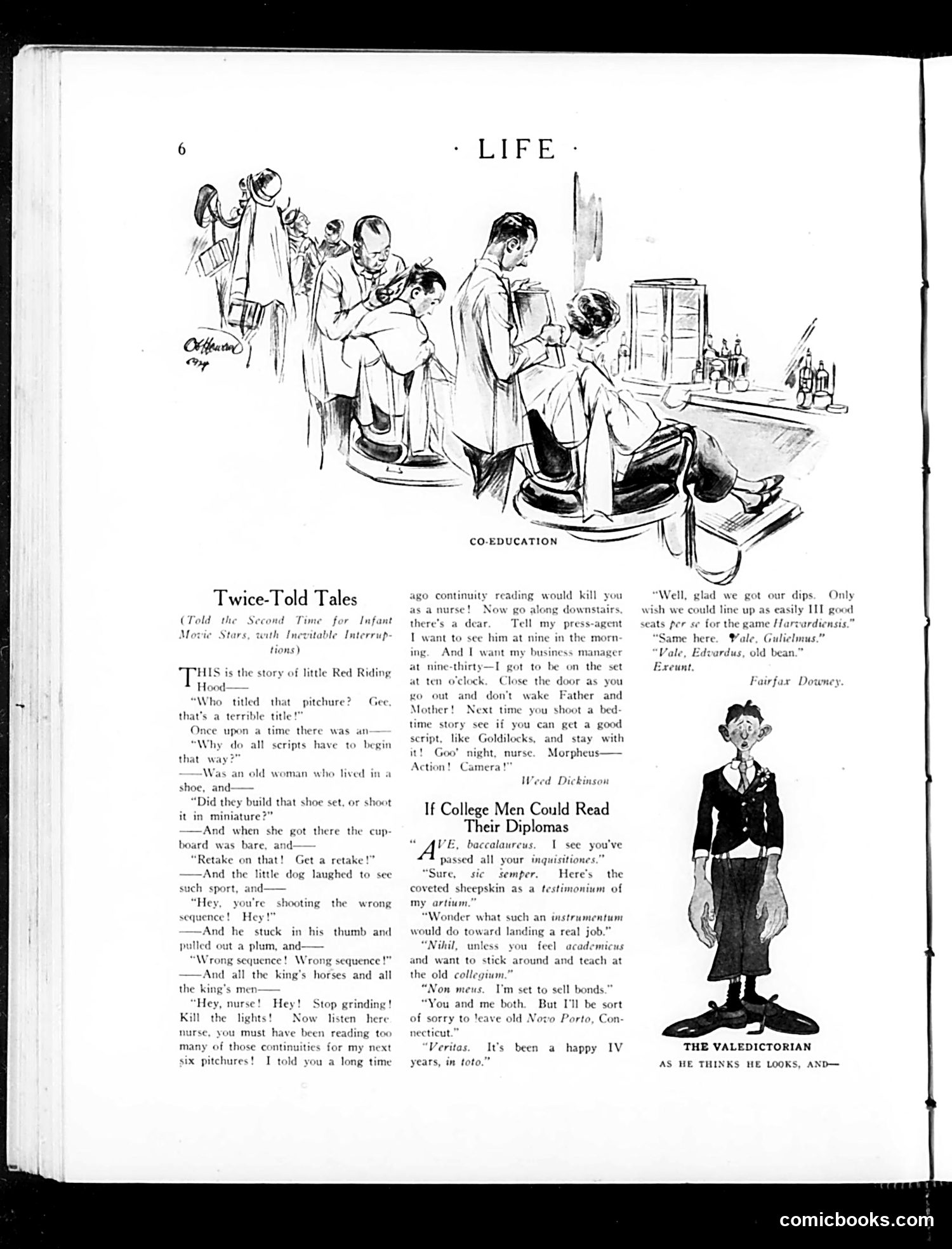
This page contains two satirical pieces from *Life* magazine: **Top illustration ("Co-Education"):** Shows a doctor's office scene with male and female patients waiting together, satirizing the social novelty of coeducation (mixed-gender education) in early 20th-century America. The humor derives from the then-scandalous idea of young men and women sharing educational spaces. **"Twice-Told Tales":** A humorous retelling of "Little Red Riding Hood" with absurdist interruptions—the narrator keeps being interrupted by people making ridiculous requests (shooting wrong sequences, grinding lights). It's meta-comedy poking fun at theatrical productions and their chaotic behind-the-scenes management. **"If College Men Could Read Their Diplomas":** Mock-Latin translations of diploma phrases, satirizing the pretentiousness of classical education and suggesting college credentials are meaningless. The "Valedictorian" caricature on the right completes this education-themed issue.
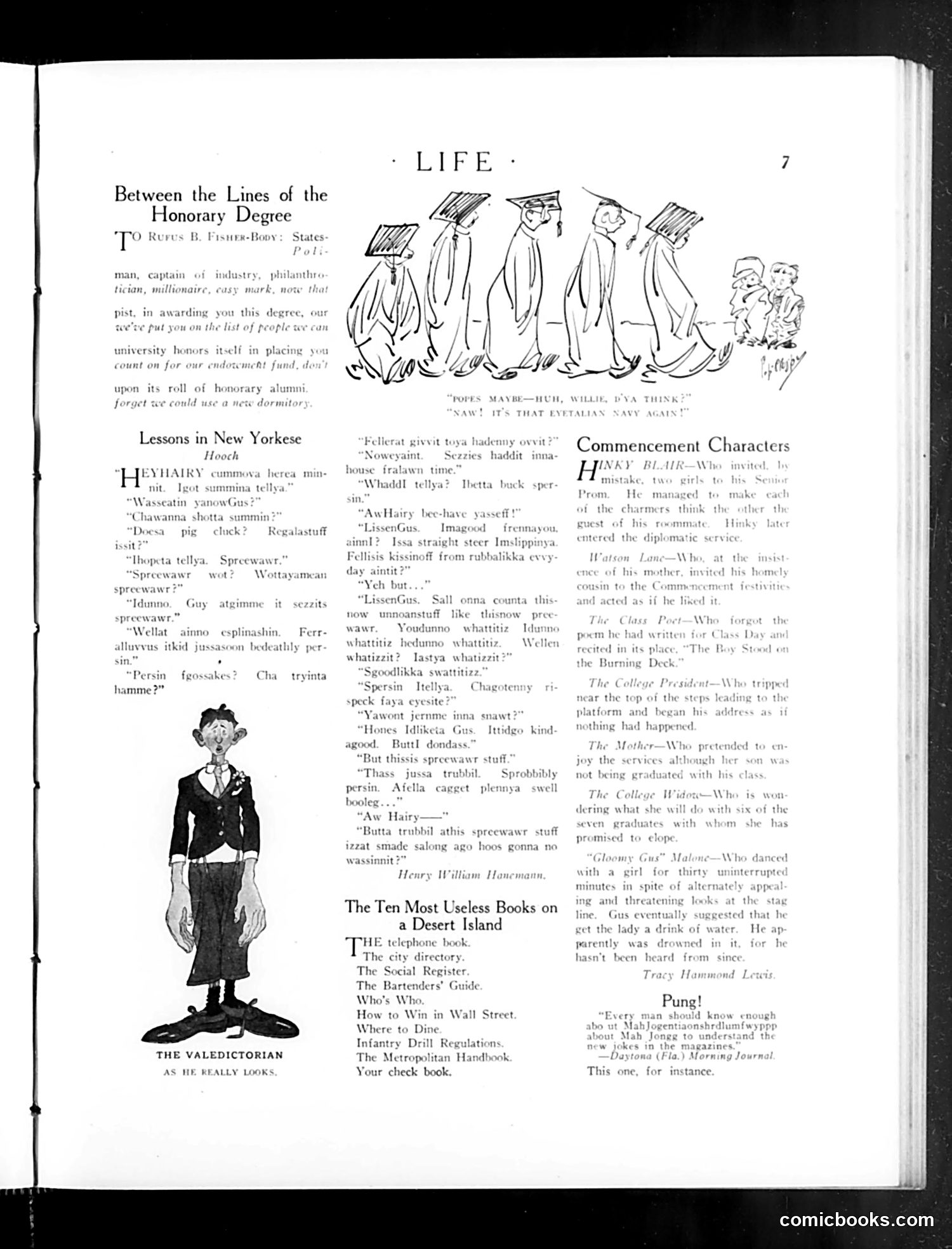
This *Life* magazine page contains satirical humor about academic commencement ceremonies. The top cartoon shows graduates in robes trudging along, with one saying "Port's maybe—huh, Willie, d'ya think?" and another responding "Naw! It's that eyetalian navy again!"—mocking graduates' pretentious, vague conversation. The "Lessons in New Yorkese" section parodies immigrant New York accents through deliberately mangled phrases ("Sprecawar" for "spread-ware," etc.), reflecting early 20th-century American anxiety about non-English speakers. "Commencement Characters" satirizes predictable ceremony archetypes: the student who forgot his poem, the clumsy college president, the disengaged mother. The illustration of "The Valedictorian as He Really Looks" contrasts formal ceremony with reality—showing an awkward, unprepossessing young man rather than the noble ideal. The humor reflects contemporary class and immigrant anxieties in American society.
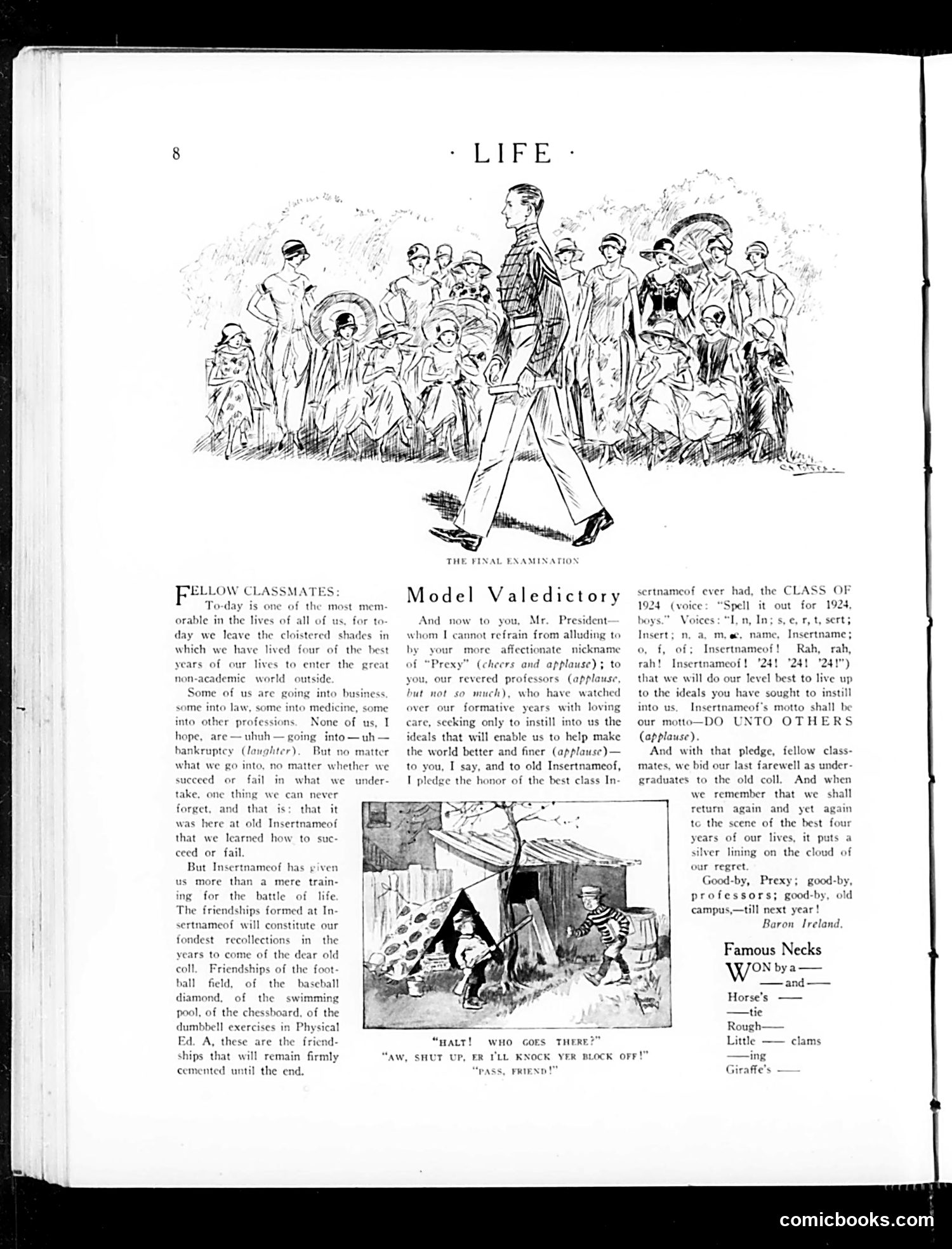
This page presents a valedictory address to the graduating class of 1924. The main illustration shows a military or authority figure addressing a gathered group of students and civilians—"The Final Examination," as captioned. The text is a humorous farewell speech using military/hierarchical language ("Mr. President," "Insernmaof's motto"), mixing formal academic sentiment with satirical jabs. References to "old campus," "Physical Ed," baseball, and football suggest this is a college commencement. The small cartoon below depicts students or soldiers saying "Halt! Who goes there?"—likely satirizing rigid institutional discipline versus youthful freedom. The right column lists humorous "Famous Necks" (horse types: "Rough," "Little clams," "Giraffe's"), suggesting visual jokes about physical characteristics, though the specific satire remains unclear without additional context.
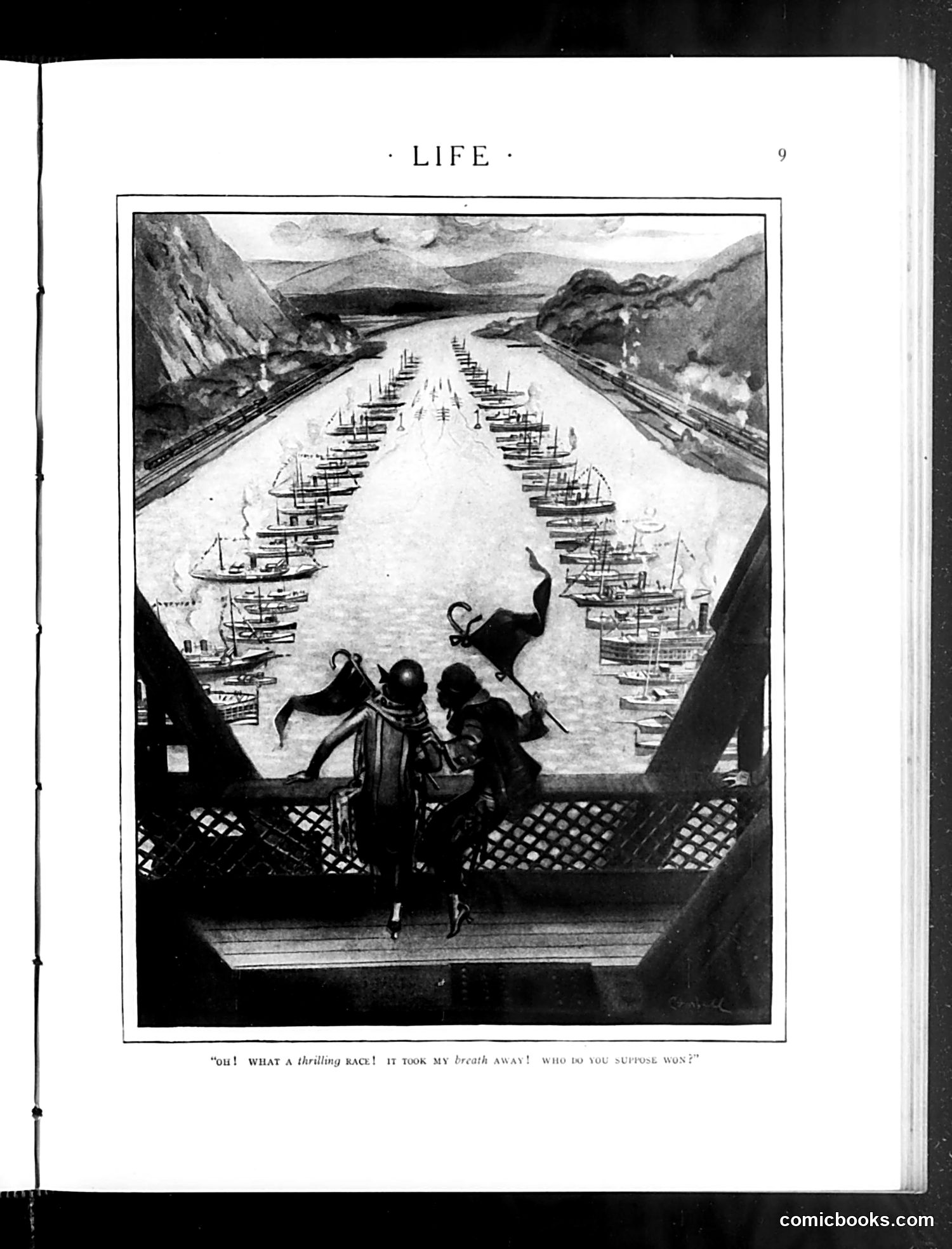
This is a satirical illustration from *Life* magazine showing a dramatic river scene. Two figures in the foreground, silhouetted against a railing, observe a vast harbor filled with military vessels arranged in precise rows. The caption reads: "OH! WHAT A *thrilling race*! IT TOOK MY *breath away*! WHO DO YOU SUPPOSE WON?" The satire appears to mock naval military buildups or naval races—likely referencing early 20th-century competition between nations (particularly Britain and Germany) to expand their fleets. The ironic tone suggests criticism of militarization as mere spectacle or entertainment, while the densely packed warships emphasize the scale of the arms race. The observers treat this weapons display as exciting spectacle rather than addressing its serious geopolitical implications—a common satirical critique of public indifference to military escalation.
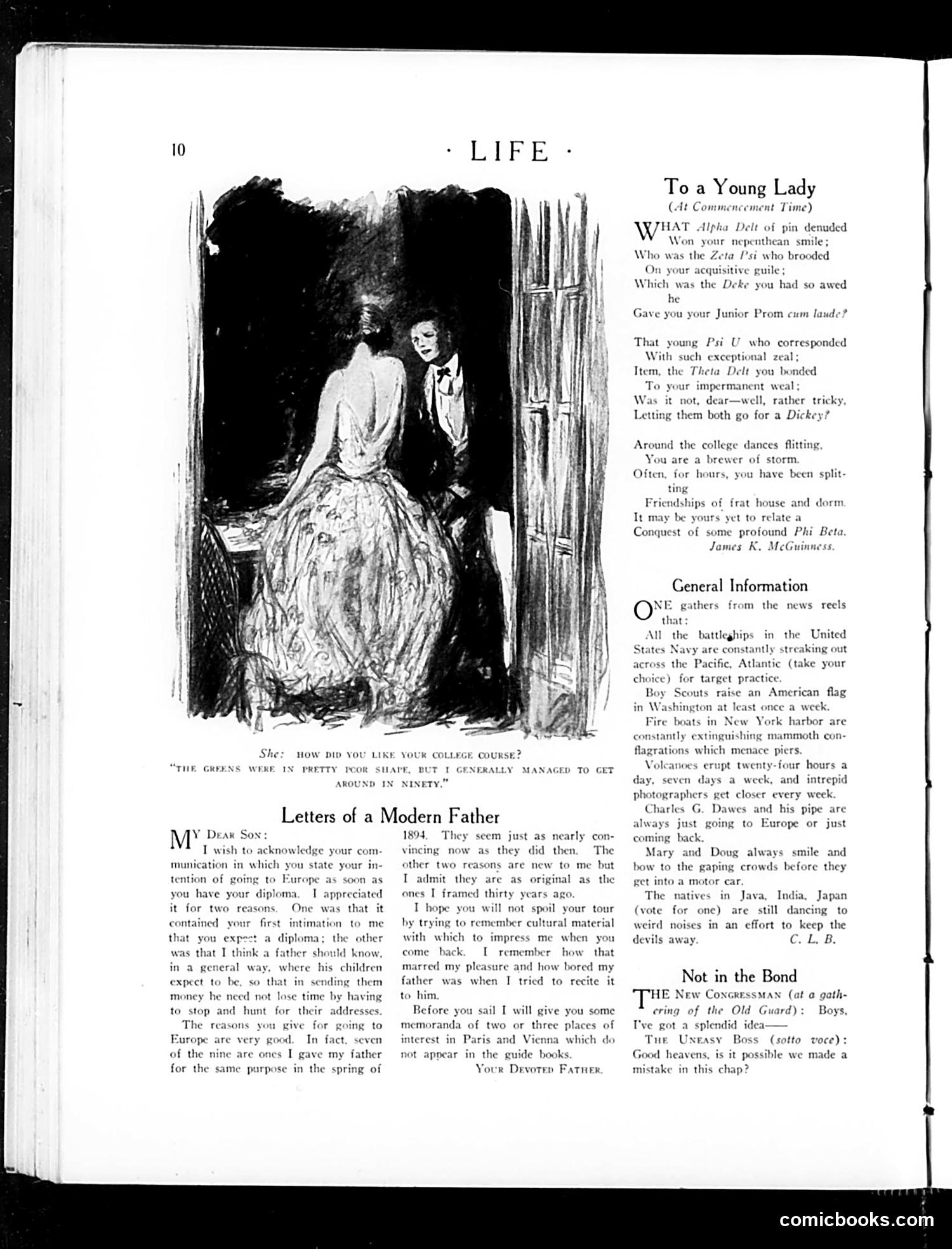
The main illustration depicts a young woman in an elegant gown speaking with a man at what appears to be a doorway—captioned "She: How did you like your college course? The Greens were in pretty good shape, but I generally managed to get around in ninety." This is a golf joke. "The Greens" and "managed to get around in ninety" are references to golf course terminology, not academics. The humor derives from the woman discussing her college experience using golf language, suggesting she spent more time on the golf course than in actual studies—a satirical comment on wealthy young women's priorities during this era. The page also contains "Letters of a Modern Father" and other period content addressing contemporary social topics around education and travel.
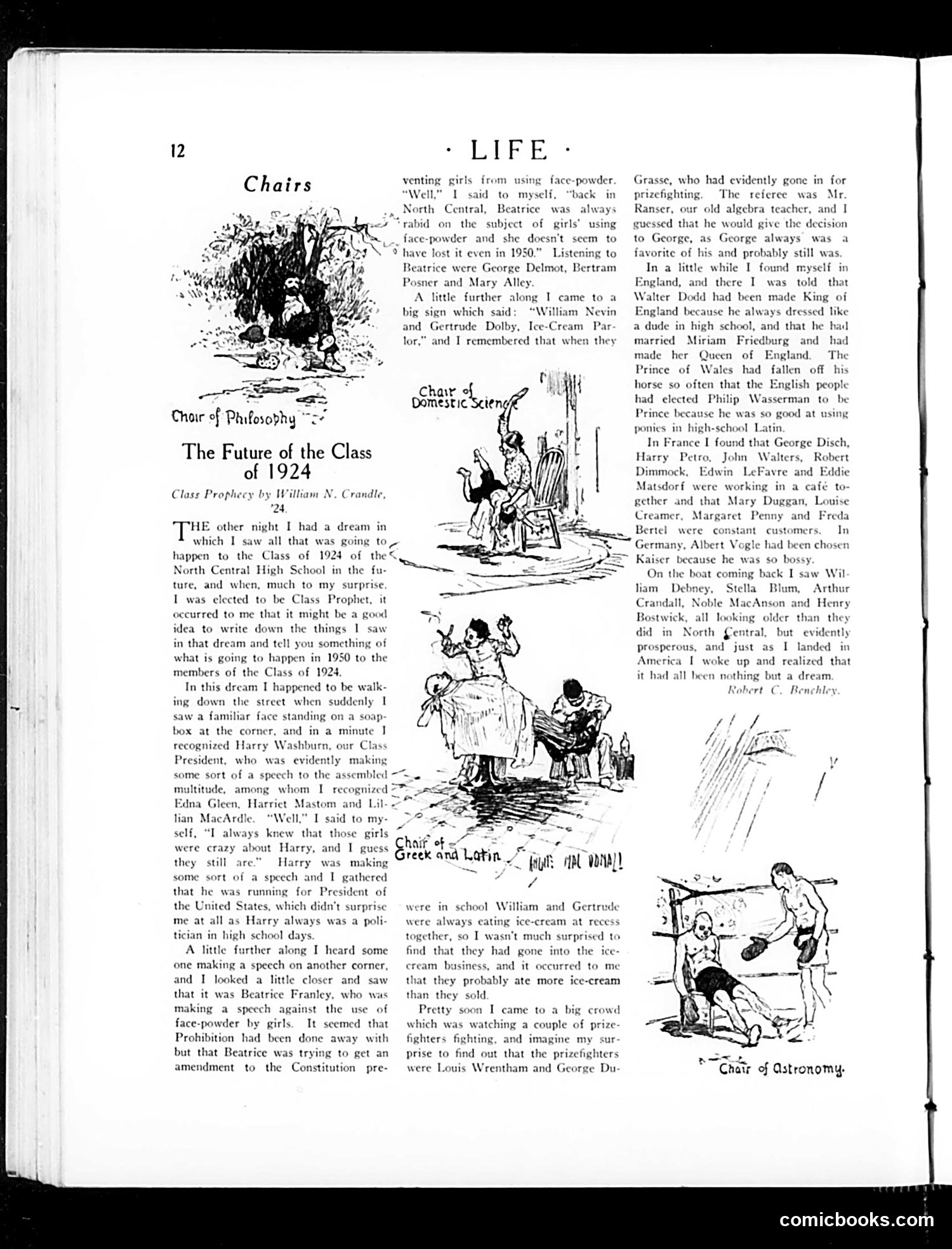
This satirical piece imagines a 1950 reunion for North Central High School's class of 1924. The author, Robert C. Benchley, humorously chronicles what became of classmates, using exaggerated character sketches. The illustrated "chairs" represent different academic/social groups: Philosophy, Domestic Science, Greek and Latin, and Astronomy. Each depicts stereotypical student types through period caricature. The satire mocks 1920s social conventions—girls using face powder (scandalous for the era), political ambitions, prohibition enforcement, and career trajectories. References to real-seeming names (William Nevin, Gertrudge Dolby) and mundane fates (ice-cream business, becoming Kaiser) create absurdist humor by treating ordinary lives with mock-serious prophecy. The piece satirizes both youthful idealism and the banality of adult outcomes.
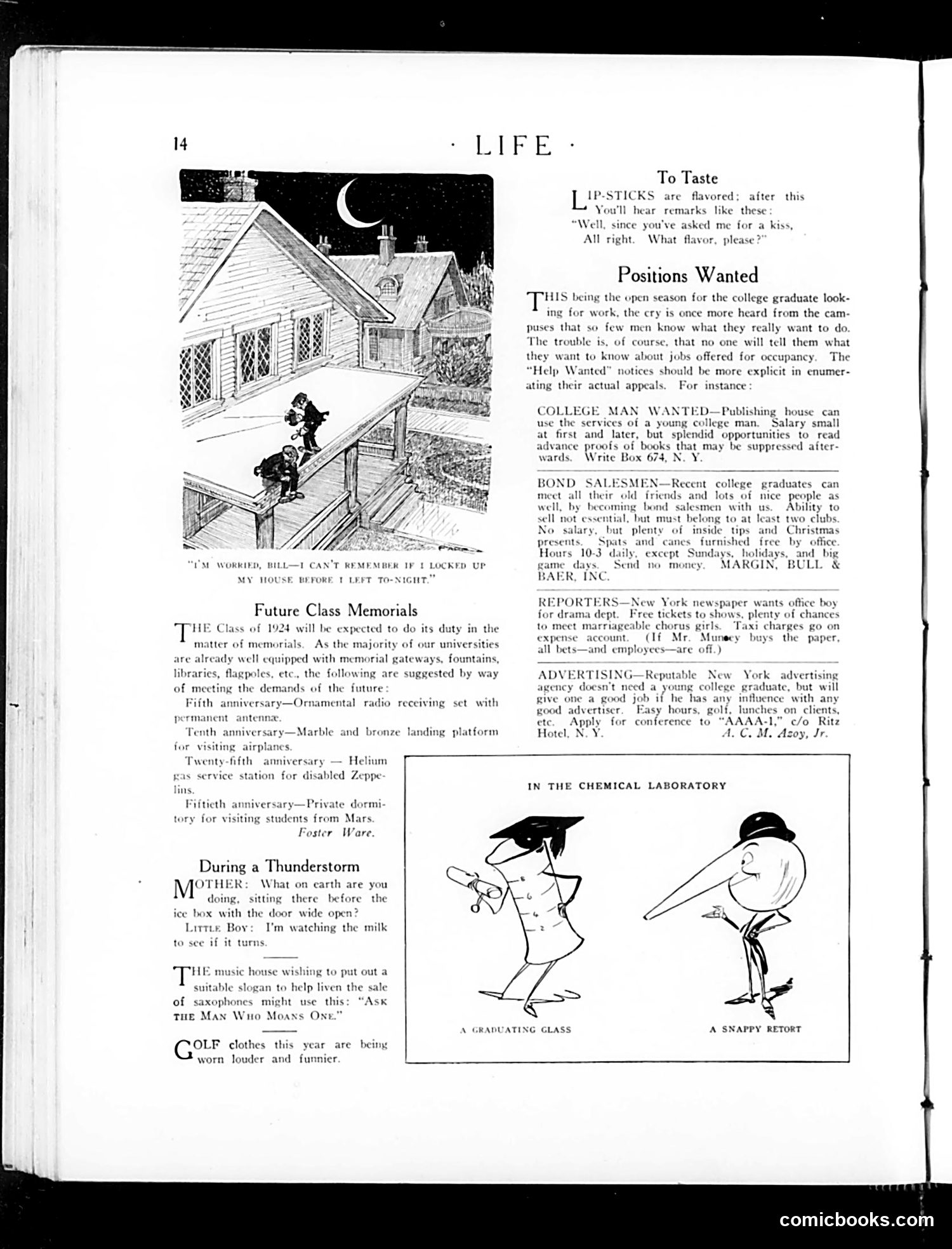
This page satirizes **job market disappointment for college graduates** during the 1920s. The "Positions Wanted" section mockingly rewrites help-wanted ads to reveal their actual (unappealing) terms: a publishing house offers low pay and "opportunities to read advance proofs"; bond salesmen get "no salary, but plenty of inside tips"; reporters meet "marriageable chorus girls" at their own expense; advertisers hire only through personal connections. The humor targets both **employers' dishonesty** and the **emptiness of post-college job prospects**—graduates discover advertised opportunities are either exploitative or meaningless. The cartoon at bottom left shows a figure in academic robes appearing confused or distressed, labeled "A Graduating Class," paired with "A Snappy Retort" (a bird in military helmet), suggesting graduates face a bewildering, even hostile world. The broader context: post-WWI economic instability made entry-level work precarious and poorly compensated despite educational credentials.
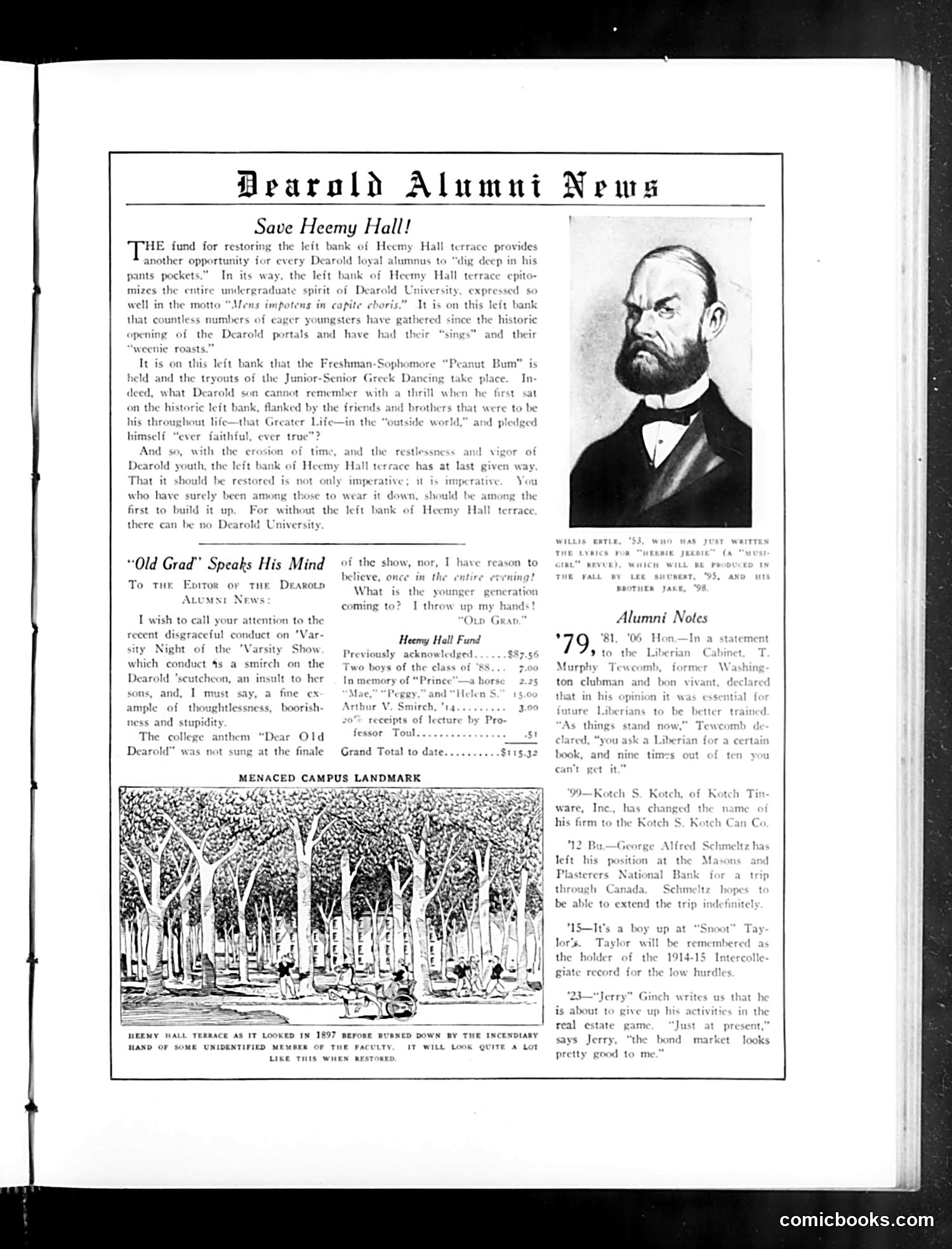
This page from *Life* magazine features alumni news from what appears to be a fictional university called "Dearold." The main content includes: **"Save Heemy Hall!"** — A fundraising appeal urging alumni to restore the left bank of Heemy Hall terrace, described as emblematic of undergraduate spirit. The piece uses nostalgic language about student traditions ("sings," "weenie roasts," Greek dancing) to encourage donations. **"Old Grad Speaks His Mind"** — A letter complaining about "disgraceful conduct" at a recent Varsity Show on "Sivity Night," calling it "a smirch on Dearold." The complaint suggests rowdy student behavior. **The illustration** shows Heemy Hall terrace as it "looked in 1897 before burned down by the incendiary hand of some unidentified member of the faculty." **Alumni Notes** — Brief updates on graduates' activities and career moves. The satire appears gentle, poking fun at alumni nostalgia, fundraising appeals, and generational complaints about declining student behavior—themes likely recognizable to *Life's* educated readership.
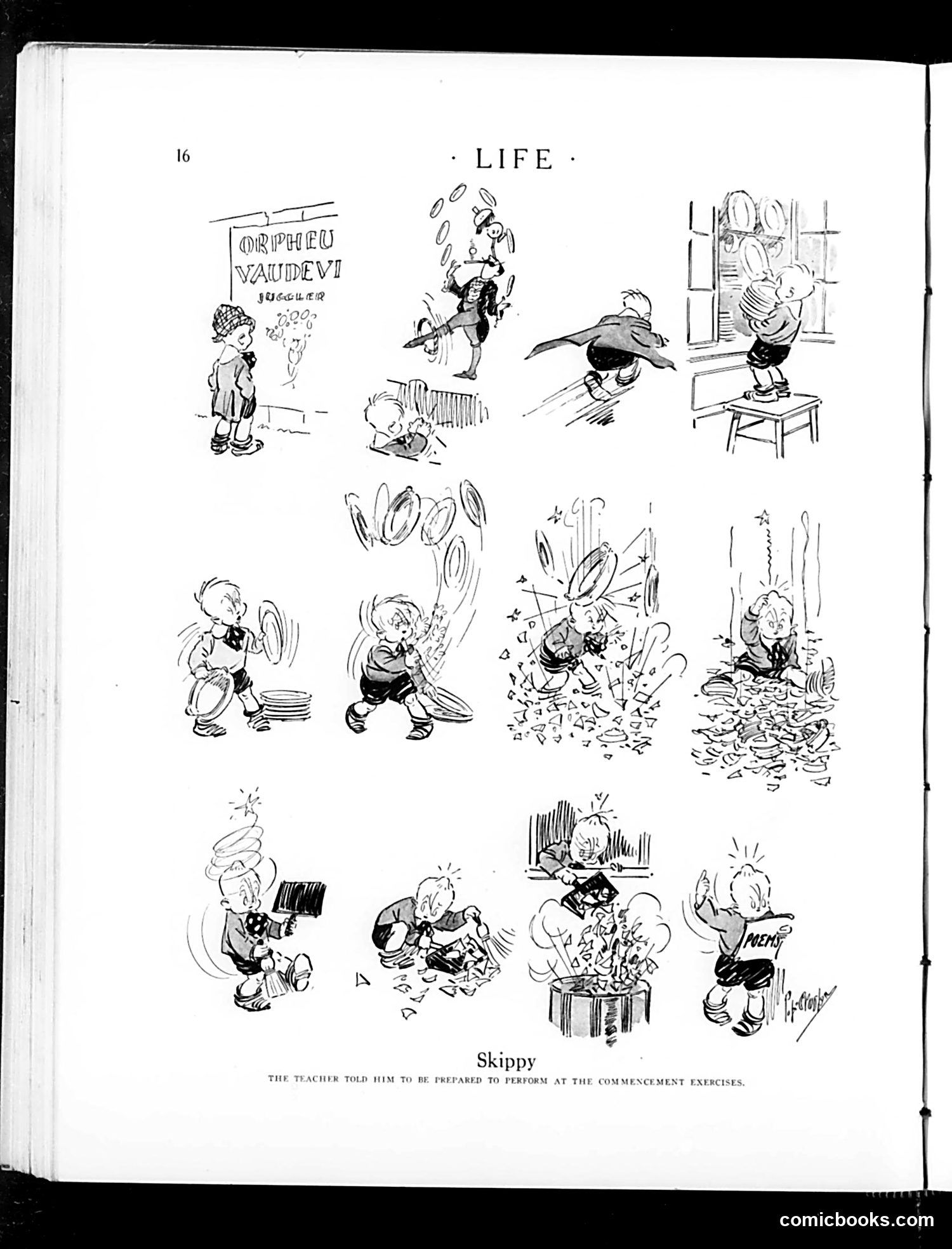
This page presents a series of comic vignettes titled "Skippy," featuring a young boy character. The caption explains: "THE TEACHER TOLD HIM TO BE PREPARED TO PERFORM AT THE COMMENCEMENT EXERCISES." The humor derives from a classic setup: Skippy is given an assignment to prepare a performance for his school's graduation ceremony. The sequential panels show his increasingly chaotic attempts—juggling plates, throwing food, creating mess and mayhem—clearly demonstrating he's unprepared and panicking as the event approaches. The joke plays on childhood anxiety about performing under pressure and the contrast between what teachers expect (organized preparation) and what actually happens (comedic disaster). The character's name "Skippy" itself suggests evasiveness, fitting his inability to properly prepare for the assignment.
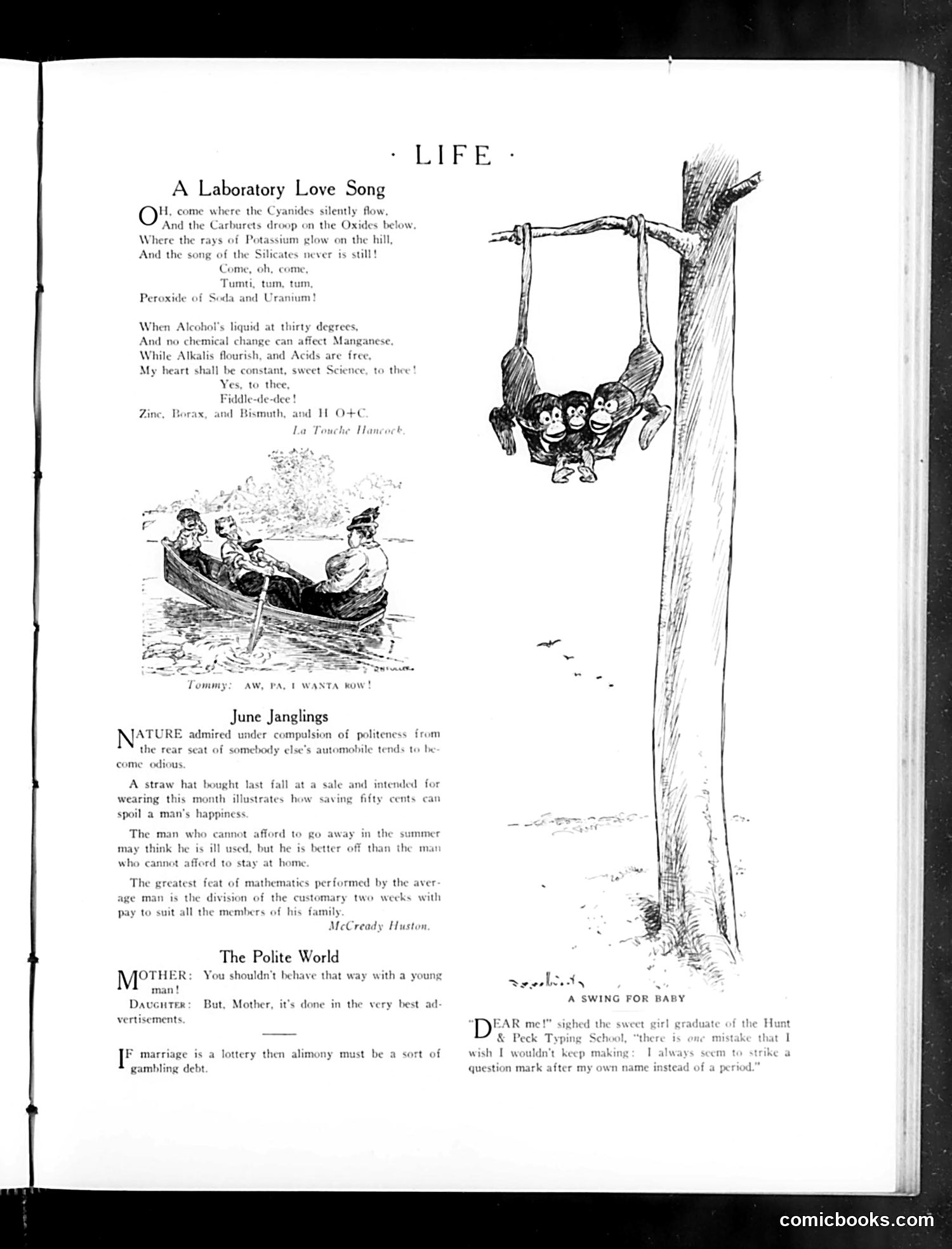
This page from *Life* magazine contains early-20th-century humor satirizing both scientific romance and social conventions. **"A Laboratory Love Song"**: A parody love poem addressing Chemistry itself as a romantic partner, listing chemical compounds (Cyanides, Peroxides, Uranium) as objects of affection. The joke mocks overly earnest scientific enthusiasm and pedantic romanticism—treating lab chemicals with the passion usually reserved for human lovers. The refrain "Fiddle-de-dee!" undercuts any seriousness. **"June Janglings"**: Witty aphorisms mocking middle-class life—forced nature appreciation via car rides, poorly chosen hat purchases, vacation budgeting, and family financial strain. **"The Polite World"**: A brief satirical exchange where a daughter defends improper behavior toward a young man by claiming "it's done in the very best advertisements"—mocking how advertising normalizes dubious social conduct. **"A Swing for Baby"**: A pun-based joke about punctuation obsession and typing school graduates. Throughout, the magazine targets pretension, conformity to advertising culture, and the absurdities of modern domestic life.
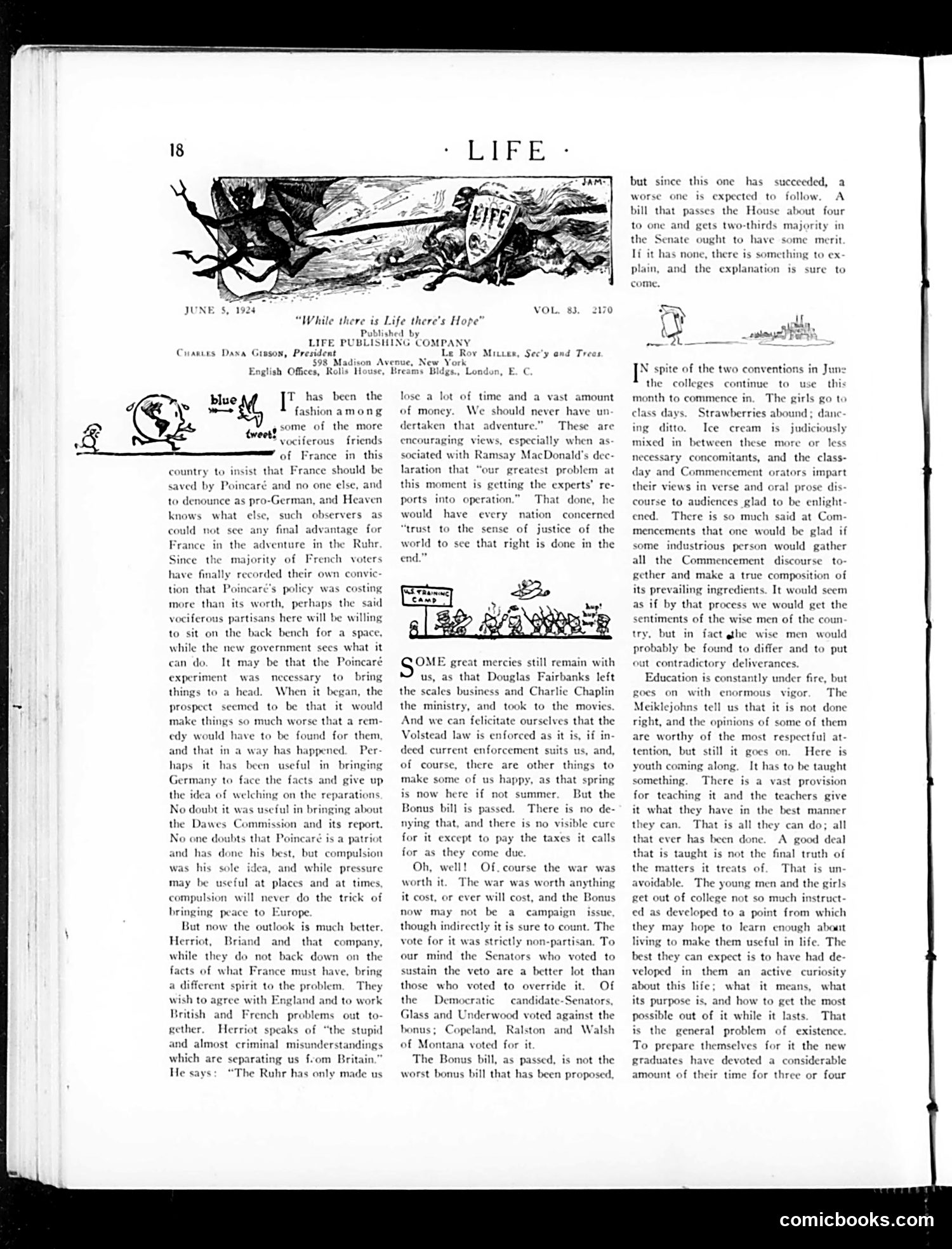
This June 5, 1924 Life magazine page critiques French politics and American policy. The main article discusses **Raymond Poincaré's failed Ruhr occupation policy**—a French military intervention to force German reparations payments. American supporters of Poincaré had defended the costly adventure, but French voters rejected it, electing new leadership under **Herriot and Briand**, who favored cooperative diplomacy with Britain and the **Dawes Plan** (experts' reports on reparations). The piece sardonically celebrates minor good news (Fairbanks and Chaplin leaving their previous careers for film; Prohibition enforcement) while criticizing the newly-passed **Veterans' Bonus Bill**, passed overwhelmingly despite President Coolidge's veto. The author notes senators who voted to sustain the veto were "better" than those overriding it, warning worse bonus bills will likely follow. The overall tone suggests frustration with American political pressure supporting French militarism and with domestic spending on veteran benefits during uncertain economic times.
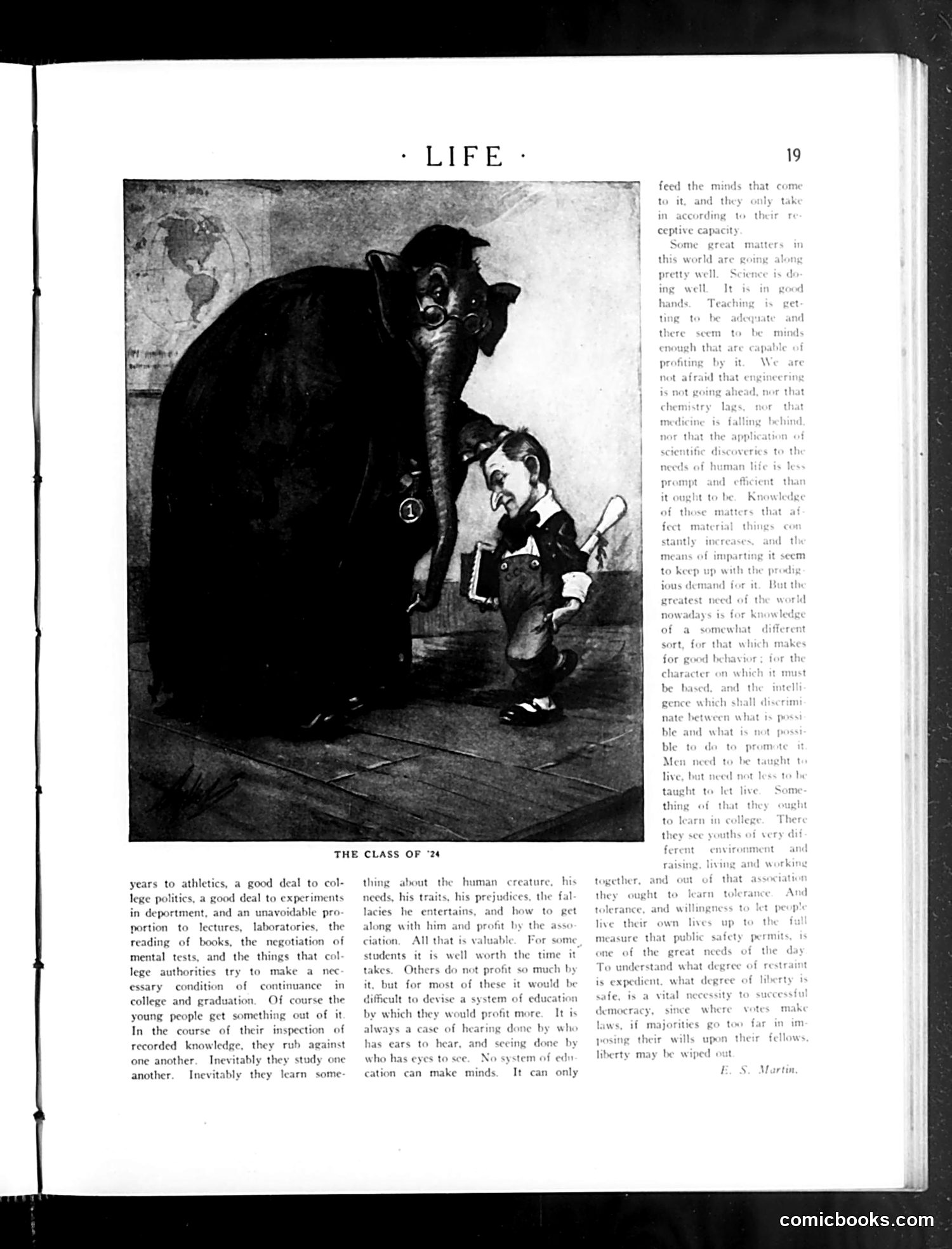
This illustration depicts **"The Class of '24"** — a satirical commentary on college education circa 1924. The image shows a large, menacing figure (representing either a college administrator, tradition, or the educational establishment itself) looming over a small, cowering student in formal attire. The accompanying text critiques how colleges prioritize athletics, politics, and administrative requirements over genuine intellectual development. The point of the satire is that the educational system intimidates and constrains young people rather than liberating their minds — the massive figure literally overshadows the vulnerable student. The joke is darkly humorous: despite colleges' claims to educate, they actually "make minds" through conformity and fear rather than genuine learning. This reflects 1920s anxieties about whether American higher education genuinely served students' intellectual growth or merely processed them through institutional machinery.
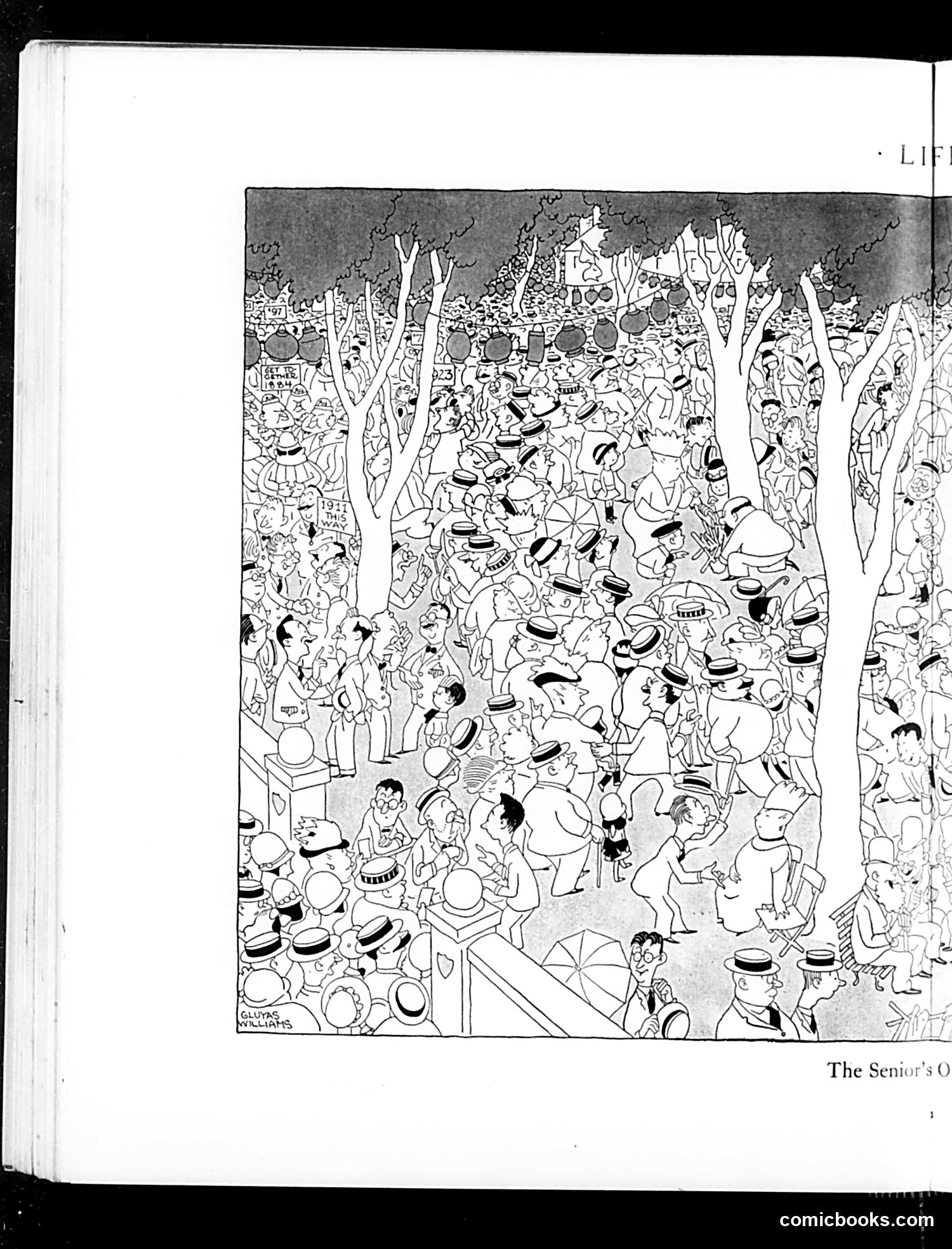
This is a crowded outdoor scene—likely a park or public gathering—drawn by Gluydas Williams (signature visible, lower left). The cartoon depicts dozens of people wearing straw hats and formal attire, creating visual chaos through density and repetition. The title "The Senior's O[utting]" (partially visible) suggests this illustrates a senior class excursion or social event. The humor appears to derive from the overwhelming crowd and visual confusion—a commentary on overpopulation, overcrowding at public venues, or the difficulty of managing large groups. The specific satirical target remains unclear without the full caption, but the exaggerated density and identical hats suggest social satire about conformity or mass behavior in American leisure activities.
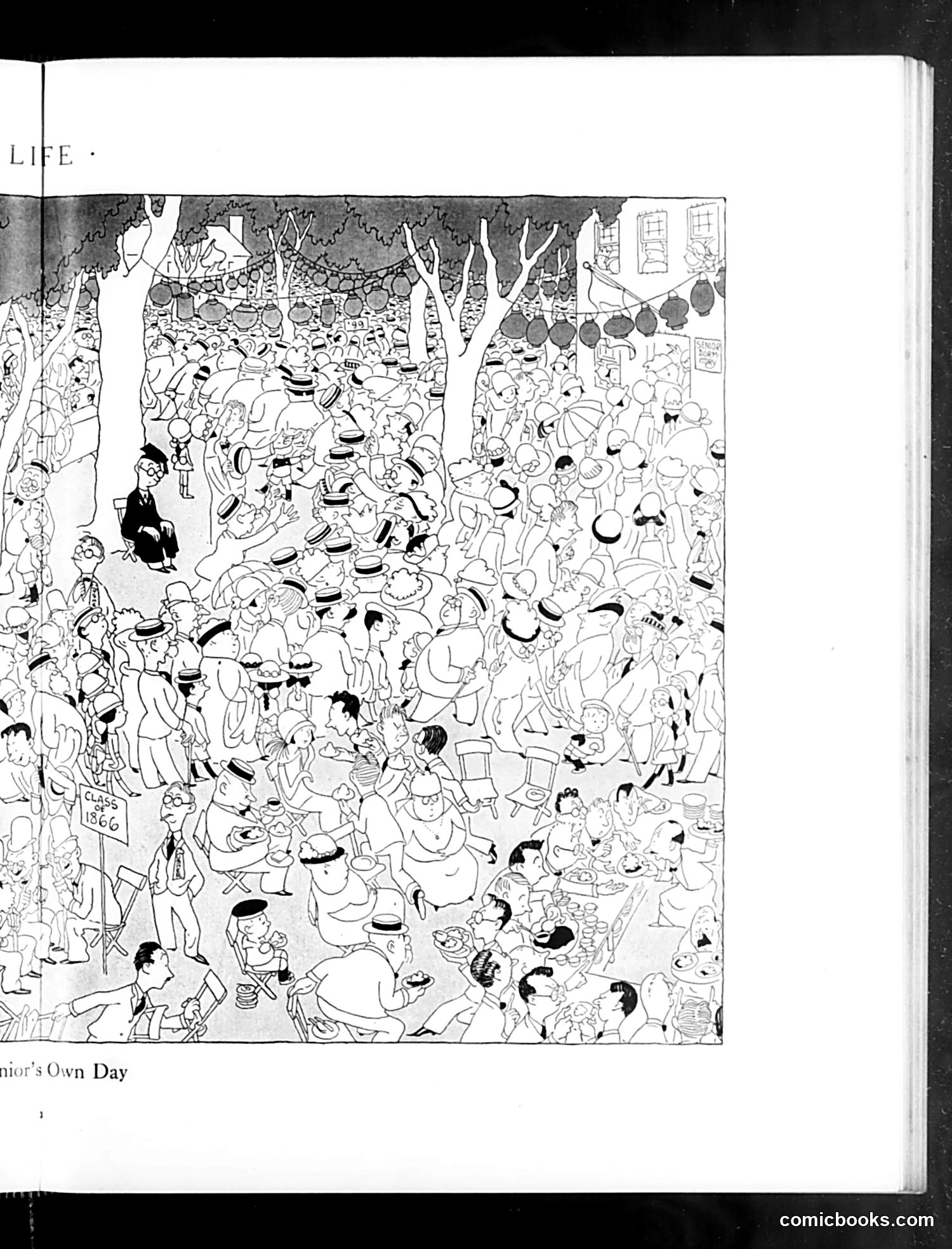
This is a crowded, densely-packed cartoon depicting what appears to be a school or social gathering labeled "Senior's Own Day" (visible at bottom). The scene shows dozens of figures wearing hats (fedoras and bowlers, typical of early-20th-century fashion), engaged in various activities in what looks like an outdoor venue with trees and a building. The satire likely mocks the chaos, pretension, or absurdity of a senior class celebration or similar formal event. The sheer visual density—with overlapping figures, hats, and activities—emphasizes confusion or crowding. Without clearer identifying details or captions for specific figures, the humor appears to rest on the general satirical observation of how such "dignified" occasions devolve into chaotic social scenes, a common Life magazine theme.
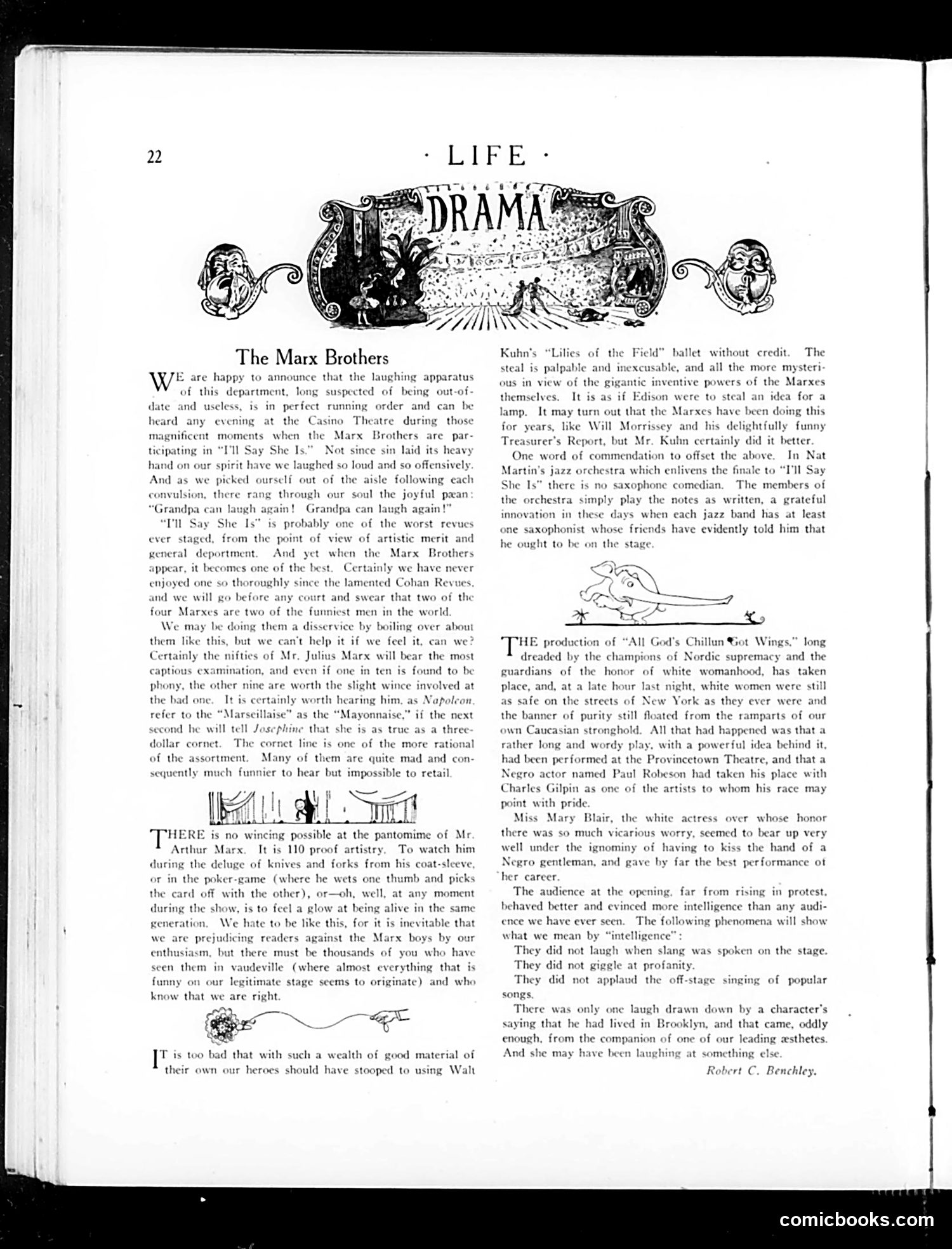
This 1922 Life article celebrates the Marx Brothers' stage show "I'll Say She Is" at the Casino Theatre, praising their physical comedy and improvisation as genuinely hilarious despite the show's poor material. The critic specifically admires Julius Marx's wordplay (calling the "Marseillaise" the "Mayonnaise") and Arthur Marx's pantomime. However, the piece also includes a notable criticism: the Marxes incorporated a ballet from Walt Kuhn's "Lilies of the Field" without credit, which the writer calls "palpable and inexcusable"—comparable to Edison stealing an idea. The page also references another theatrical production, "All God's Chillun Got Wings," which had sparked controversy among "champions of Nordic supremacy" due to its interracial content, though the reviewer suggests New York society remained undisturbed by it.
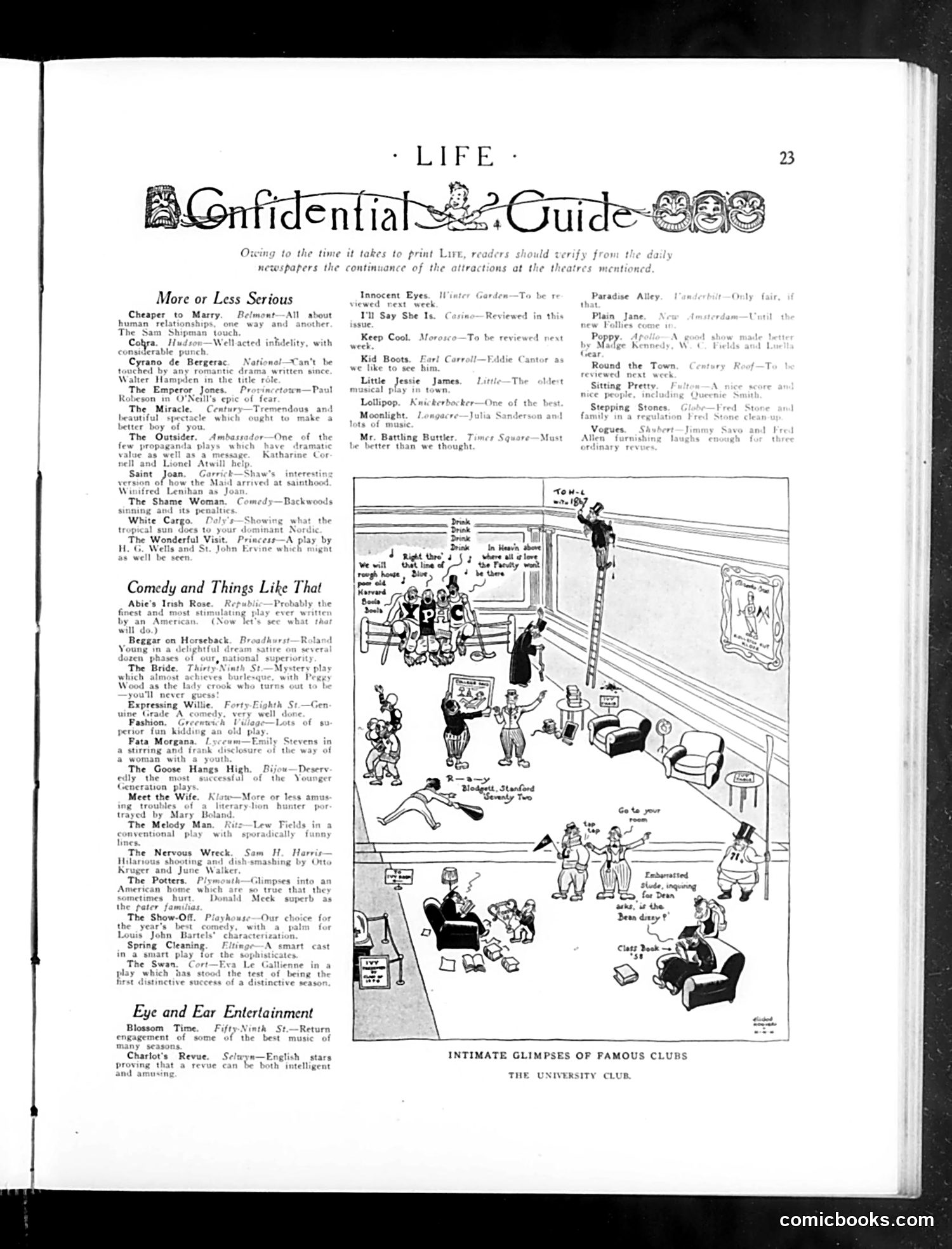
This page is primarily a **theater and entertainment guide** listing Broadway shows and nightlife venues from what appears to be the 1920s. The left column reviews current plays categorized as "More or Less Serious," "Comedy and Things Like That," and "Eye and Ear Entertainment"—shows like *Abie's Irish Rose*, *The Goose Hangs High*, and musical revues. The **cartoon illustration** on the right depicts "Intimate Glimpses of Famous Clubs: The University Club," showing a crowded, chaotic scene of well-dressed patrons socializing, dining, and entertaining themselves in what appears to be an exclusive men's club. The humor lies in the contrast between the club's presumably dignified reputation and the boisterous, undignified behavior depicted—people lounging casually, scattered about in various states of leisure and revelry. This is essentially a **society/lifestyle guide** satirizing the nightlife and clubs frequented by New York's upper classes during the Jazz Age.
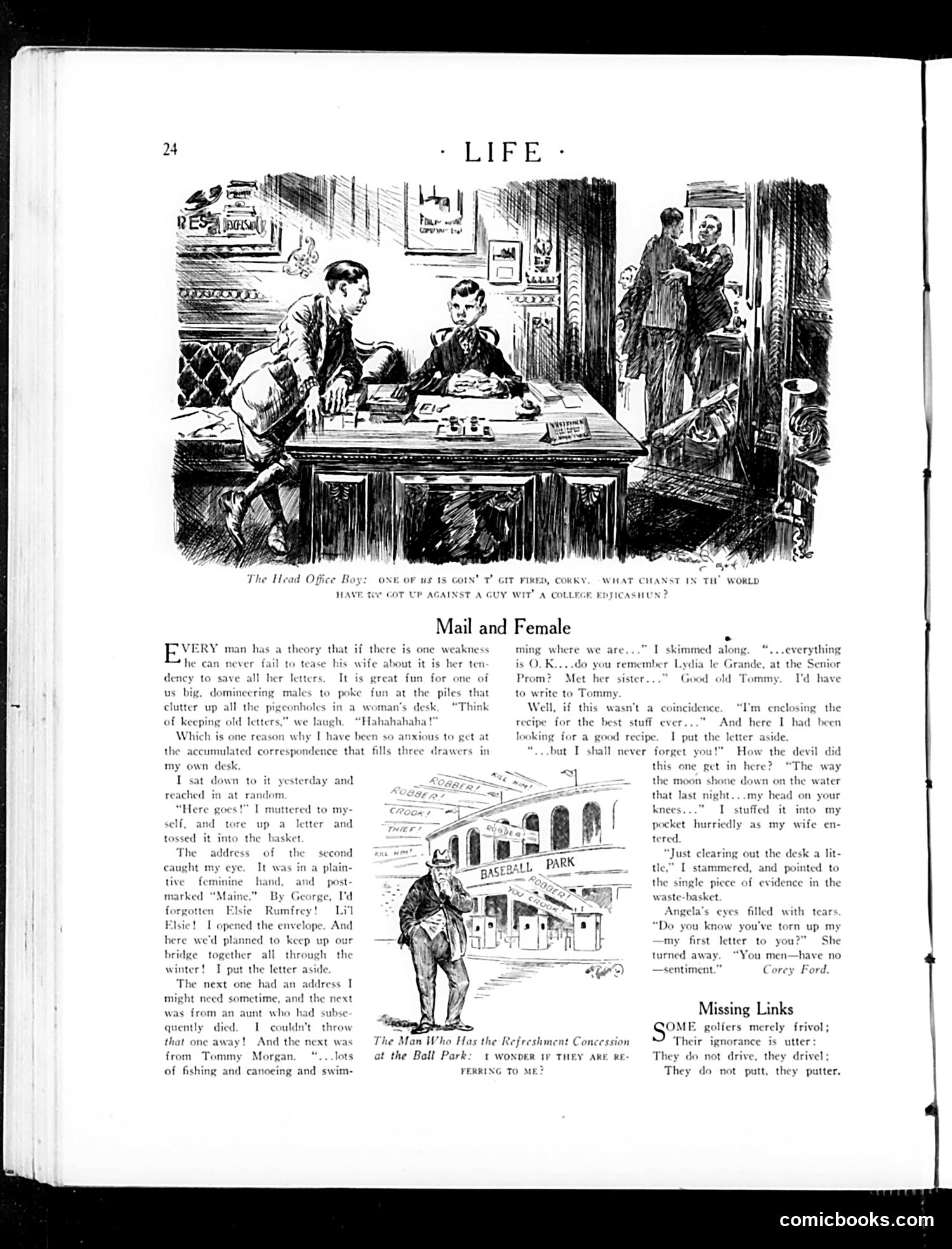
This page from *Life* magazine contains two distinct pieces of humor: **"The Head Office Boy"** (top cartoon): A boss and junior employee discuss an impending firing. The junior employee's anxiety suggests that competing against a college-educated rival makes his position precarious. The satire mocks early 20th-century class anxieties about education as a career prerequisite—even entry-level positions faced competition from the formally educated. **"Mail and Female"** (main article by Correy Ford): A married man discovers his wife has preserved old love letters, including one from a former flame named Elsie. His panicked attempts to destroy the letter backfire when his wife reveals it was actually *her* first letter to *him*—a comedic twist about marital misunderstanding and the dangers of assuming guilt. **"Missing Links"** (bottom): A brief joke about golfers who "drivel" instead of "drive" and "putter" incorrectly—a play on golfing terminology suggesting incompetence. The overall page satirizes gender dynamics and workplace/social hierarchies typical of the era.
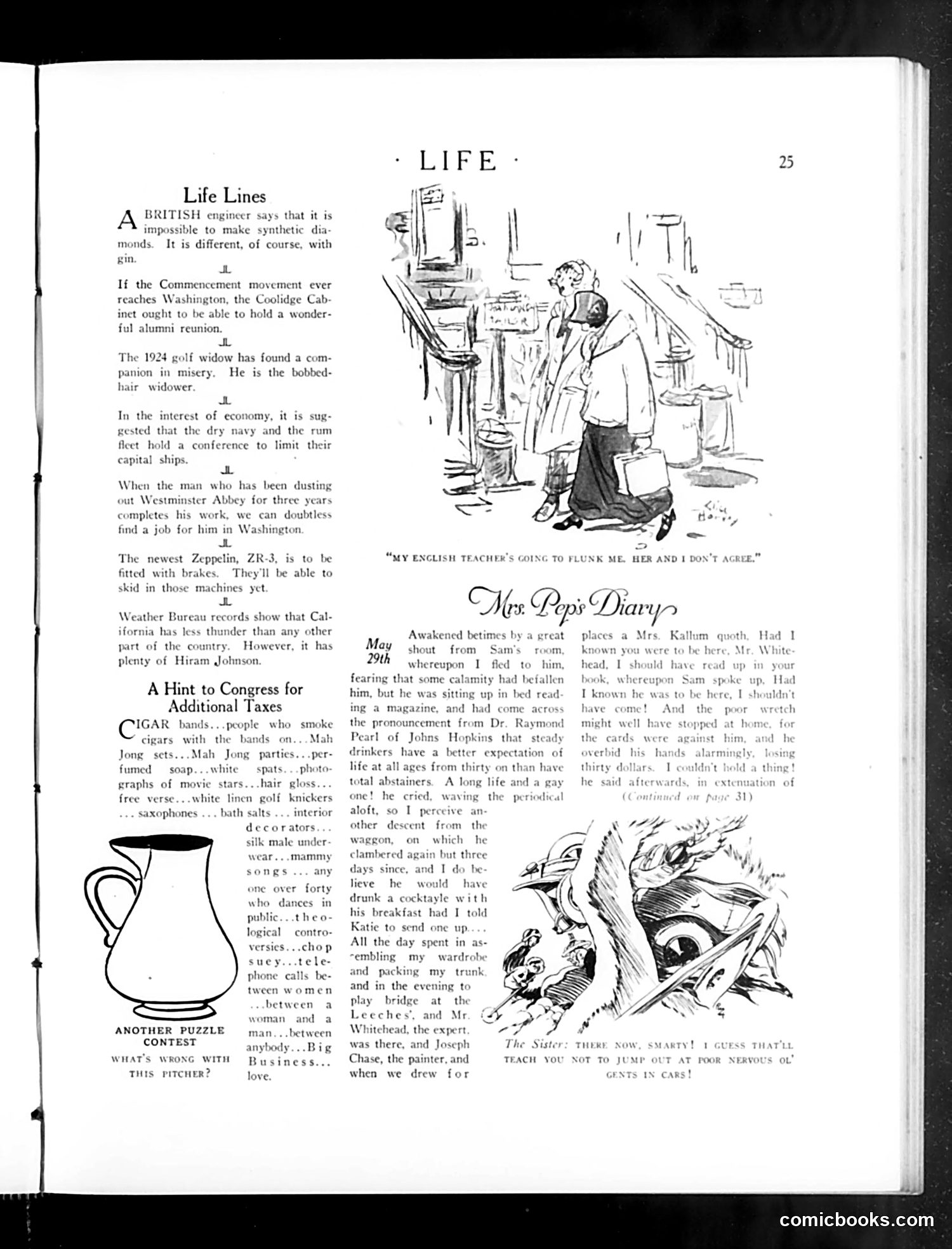
This page from *Life* magazine (dated May 29th, based on the diary entry) contains several satirical elements typical of 1920s American humor: **"Life Lines"** presents brief, punchy jokes about current events: mocking British engineering claims, poking fun at President Coolidge's cabinet as worthy of an "alumni reunion," and joking about the "bobbed-hair widower" (a reference to the modern "flapper" era where women cut their hair short—scandalously). **The main cartoon** depicts a woman being flunked by her English teacher, with the caption "My English Teacher's Going to Flunk Me. Her and I Don't Agree"—the joke being the student's grammatical error ("Her and I" instead of "She and I") while complaining about being failed for poor English. **"Mrs. Pep's Diary"** is a gossipy social column narrating weekend social activities among the leisure class—bridge parties, guests, romantic entanglements—typical society-page humor mocking upper-class life. The page reflects 1920s preoccupations: Prohibition ("dry navy"), modern youth culture, educational standards, and high-society social life.
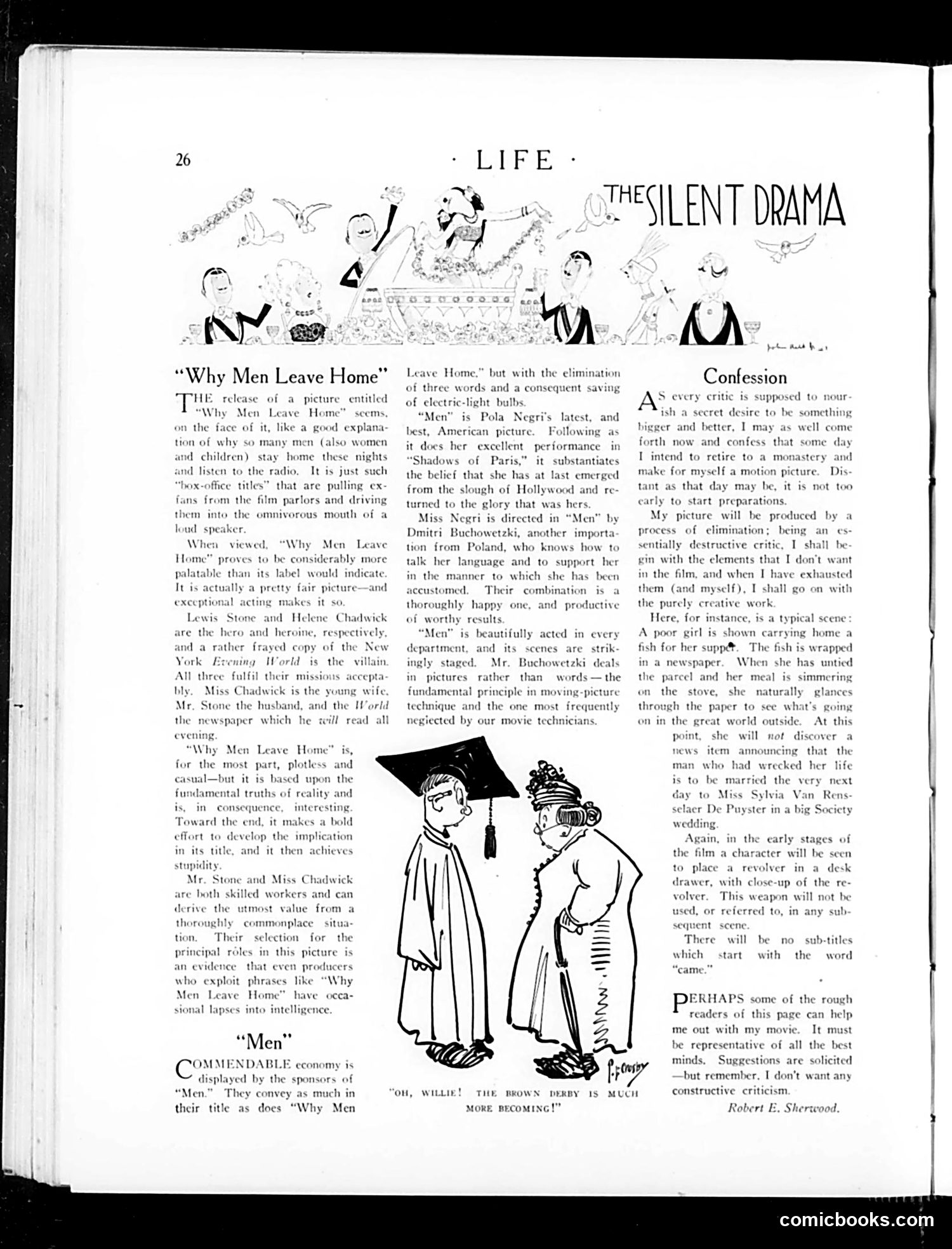
This page from *Life* magazine discusses silent films of the early 1920s. The main cartoon illustrates a scene from "Why Men Leave Home," showing two figures in period dress with the caption "Oh, Willie! The brown derby is much more becoming!" The page critiques two films: "Why Men Leave Home" (starring Lewis Stone and Helene Chadwick) and "Men" (directed by Dmitri Buchowetzki, featuring Polish actress Pola Negri). The reviews praise both as competent despite formulaic plots, noting they rely on visual storytelling rather than dialogue—essential for silent cinema. The "Confession" section by Robert E. Sherwood humorously describes his intended film-making approach: elimination of unwanted elements until only the "purely creative work" remains. He provides example scenes, including an absurdly melodramatic moment where a poor girl discovers her life-wrecker's wedding announcement while unwrapping fish. The humor targets both silent film conventions and their tendency toward overwrought, coincidence-driven narratives.
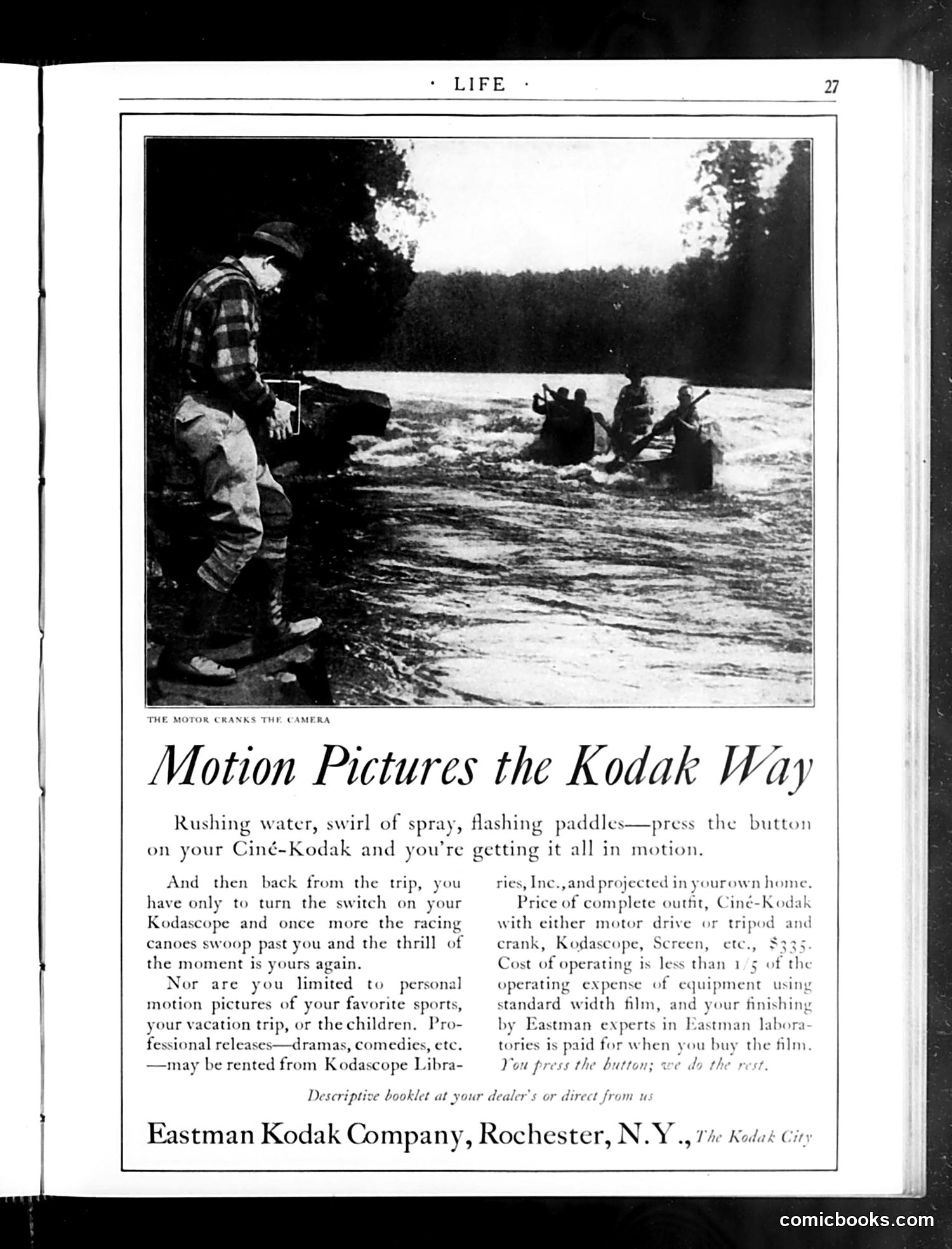
This is a **product advertisement**, not satire or political commentary. It promotes Eastman Kodak's home motion picture system—the Ciné-Kodak camera and Kodascope projector. The photograph shows a man operating a movie camera on a riverbank while others paddle canoes, illustrating the product's practical use for capturing recreational activities. The ad emphasizes convenience: users can film their own "favorite sports" and vacation trips, then project them at home by simply turning a switch. The marketing pitch highlights affordability (complete outfit for $335) and low operating costs. The phrase "You press the button; we do the rest" references Kodak's famous advertising slogan, positioning the company as making photography/cinematography accessible to ordinary consumers rather than professionals. For modern readers, this represents early consumer-grade motion picture technology—comparable to today's smartphone video capability—being marketed as exciting, democratic innovation for domestic use.
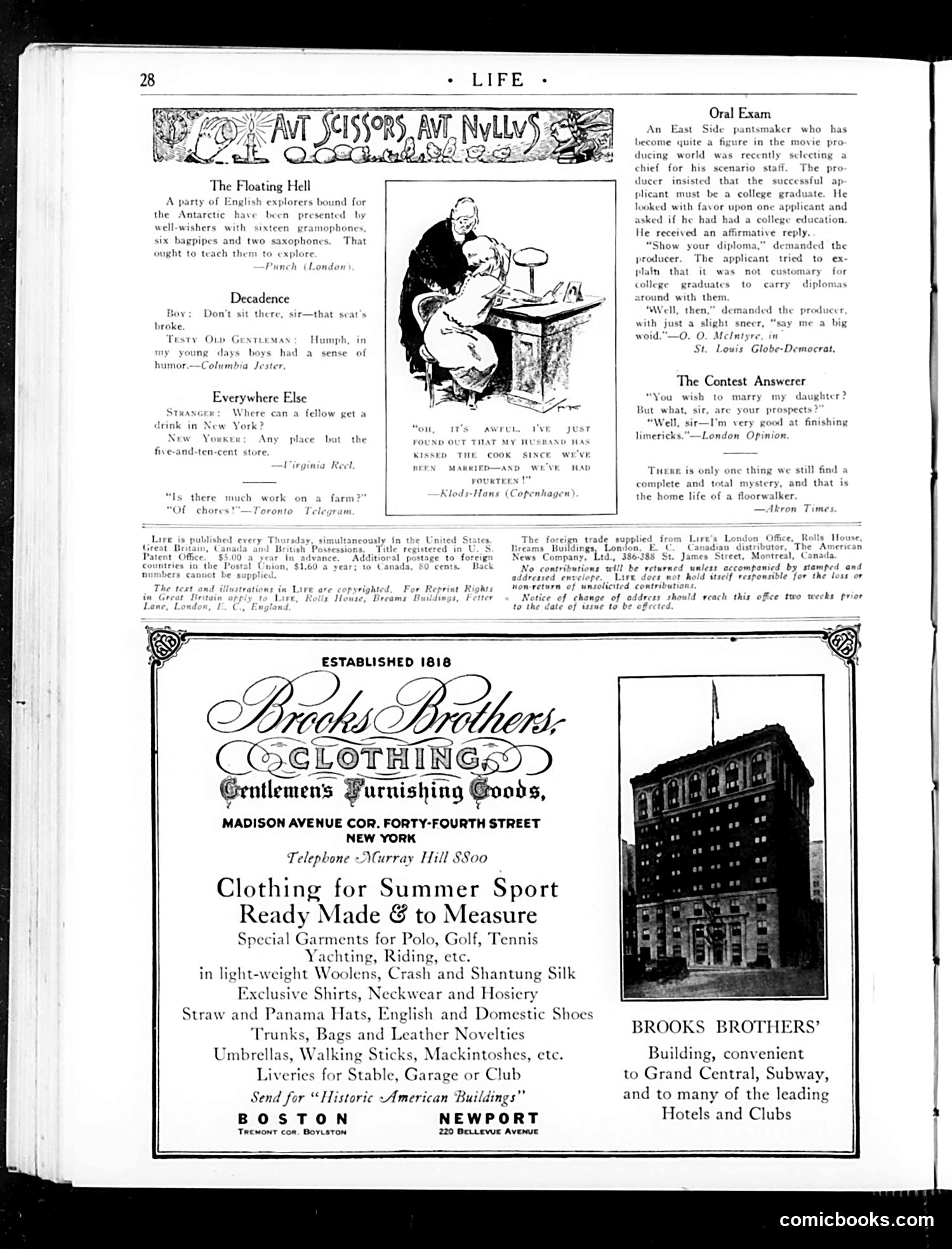
This page contains three brief satirical jokes and a large Brooks Brothers advertisement. **The cartoons:** 1. **"The Floating Hell"** mocks British explorers preparing for Arctic exploration by sarcastically suggesting that bagpipes and saxophones (instruments associated with noise and discomfort) will "teach them to explore"—implying these gifts will make the journey miserable. 2. **"Decadence"** contrasts generational attitudes: an older man criticizes a younger boy for not standing when a lady enters, lamenting that youth have lost proper manners. 3. **"Everywhere Else"** and "The Contest Answerer" are brief exchanges joking about New York drinking laws (Prohibition-era reference, likely), and a suitor's inability to do anything but write limericks. The page is primarily an **advertisement** for Brooks Brothers clothing, established 1818, emphasizing their Madison Avenue location and range of summer sportswear options. The satirical content is minor filler typical of Life's format.
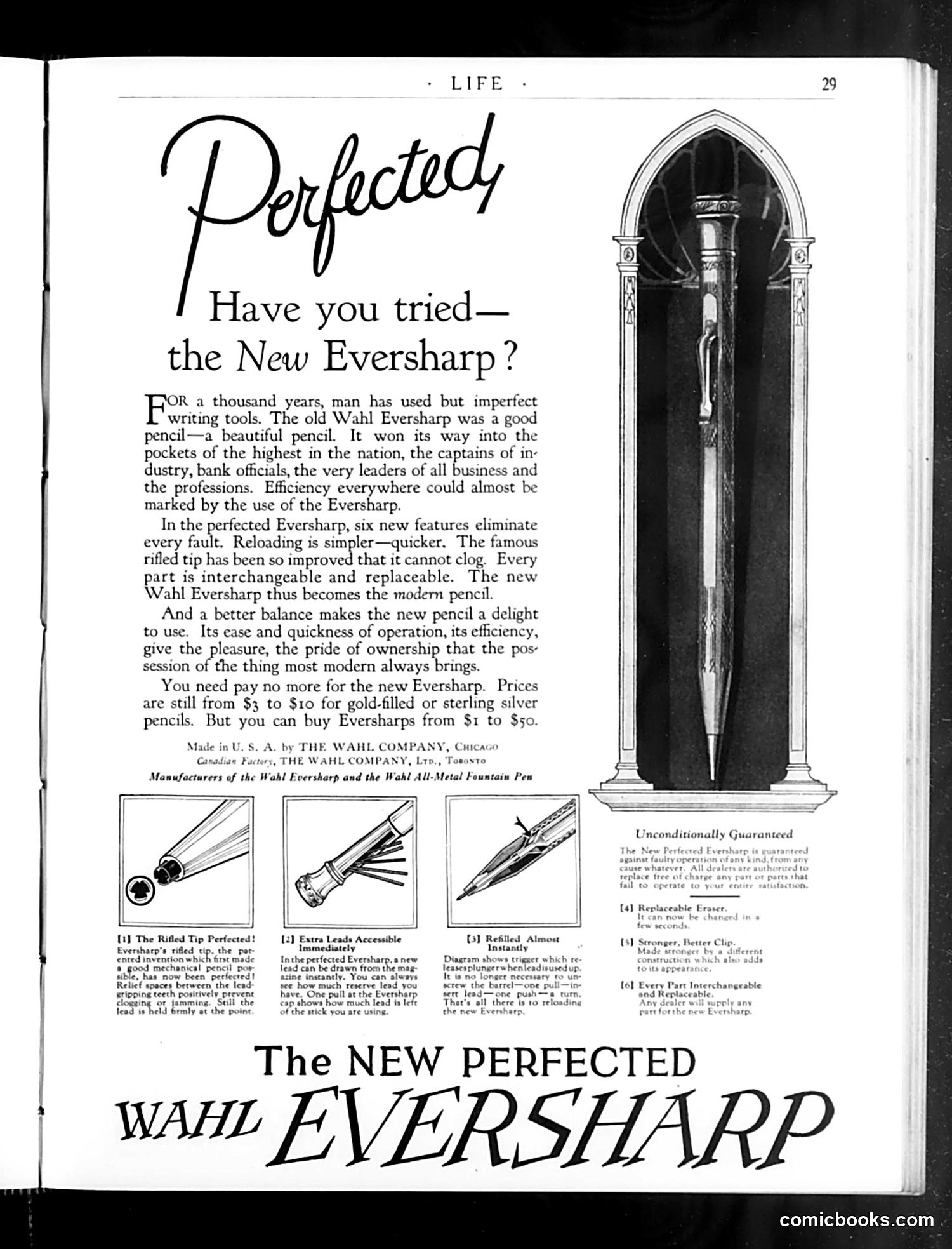
This is a **full-page advertisement**, not a cartoon or satire. It promotes the Wahl Eversharp mechanical pencil, a luxury writing instrument. The ad claims the "perfected" Eversharp represents progress—positioning it as the modern solution to centuries of "imperfect writing tools." It appeals to status and efficiency, noting the pencil is favored by "captains of industry, bank officials, the very leaders of all business and the professions." Six improvements are highlighted: easier reloading, unclogging rifled tip, interchangeable parts, better balance, and stronger clip. The copy emphasizes both luxury (gold-filled/sterling silver options at $3-$10) and accessibility (basic models from $1). The ornate architectural frame on the right suggests refinement and permanence. This reflects early 20th-century marketing that tied consumer products to aspiration and professional success. There is **no political satire or social commentary** present—this is straightforward product promotion typical of *Life* magazine's advertising content.
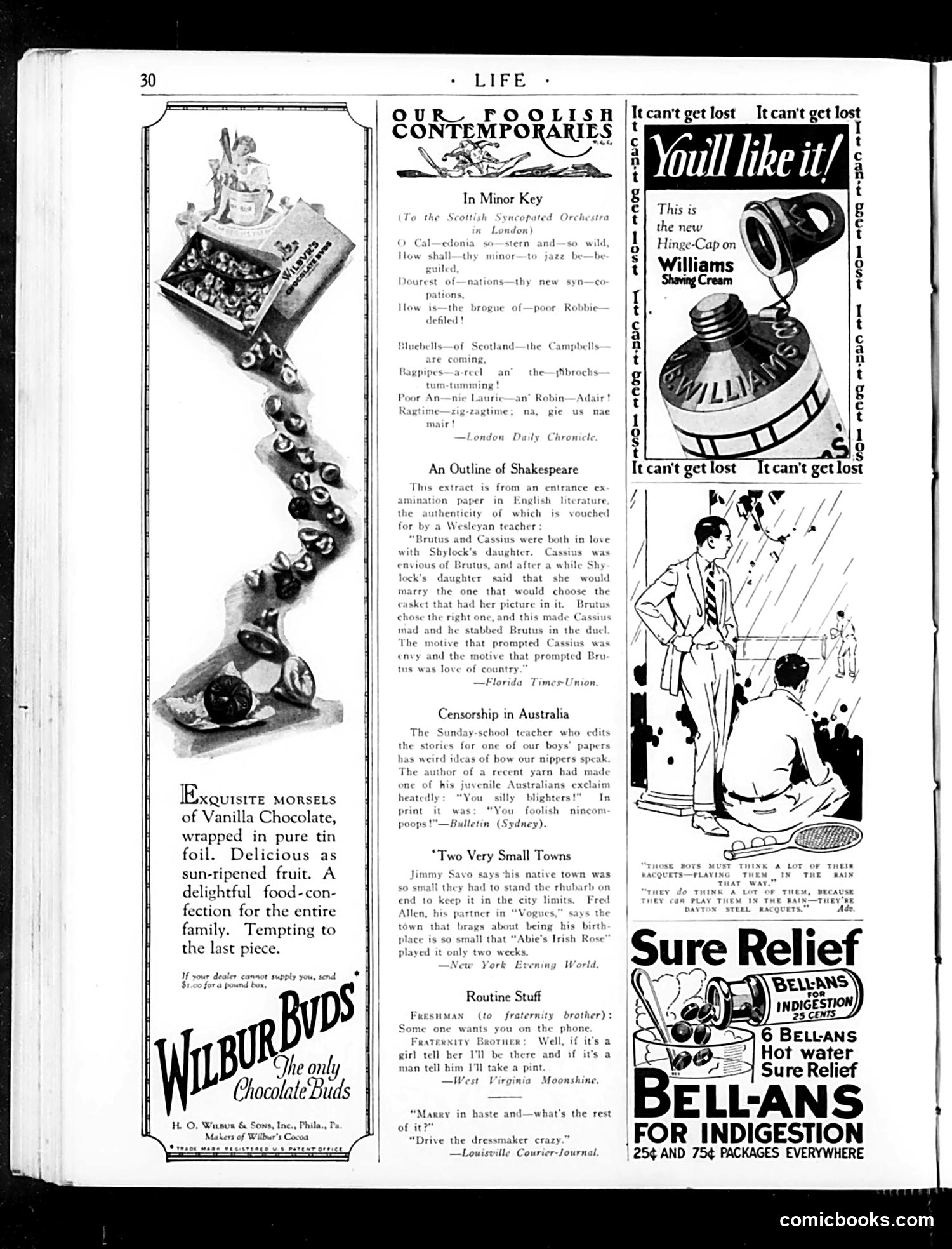
This page from *Life* combines satirical humor columns with period advertisements. The main content includes: **"Our Foolish Contemporaries"** — A satirical section quoting absurd statements from contemporary newspapers, presented as examples of public foolishness. The "In Minor Key" section mocks Scottish stereotypes through exaggerated dialect and references. **Literary/Educational Content** — An "Outline of Shakespeare" offers a simplified, somewhat ridiculous summary of a Shakespeare plot, likely mocking oversimplified education. **"Routine Stuff"** — A joke about fraternity behavior and a separate quip about dressmakers, representing mild social humor. **Censorship in Australia** — A brief comment on Australian educators censoring children's literature for language. The advertisements (Wilbur Buds chocolate, Williams shaving cream, Bell-Ans antacid) are typical period products. This page represents *Life*'s editorial formula: satirizing contemporary culture and public discourse through humor and commentary, alongside commercial messages.
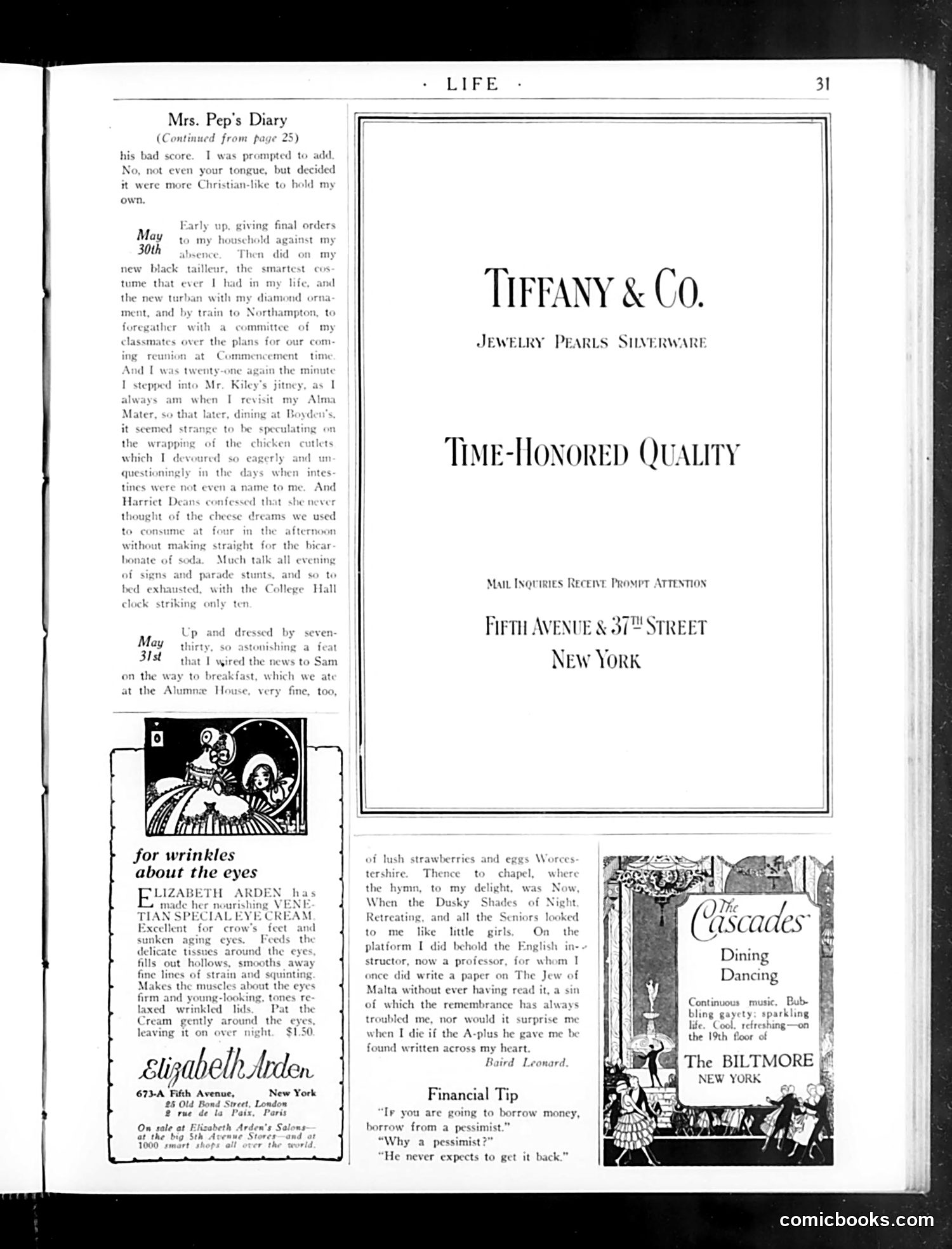
This page is primarily **advertising with a diary column**, not political satire. **Mrs. Pep's Diary** (left) is a society column describing a wealthy woman's May activities—preparing for a class reunion, attending chapel, and dining at fashionable establishments. The tone is gently satirical of upper-class life and pretension, particularly the diarist's reminiscence about bluffing her way through a college paper on "The Jew of Malta" without reading it. **Advertisements** dominate: Tiffany & Co. (jewelry), Elizabeth Arden (eye cream), and The Biltmore Hotel (dining/dancing). These target affluent readers. **The "Financial Tip"** is a light joke: borrowing from a pessimist is advantageous because they won't expect repayment—dark humor about debt and human nature. There are **no political cartoons** on this page. The satire is social rather than political—gently mocking wealth, vanity, and educated pretension rather than addressing current events or political figures.
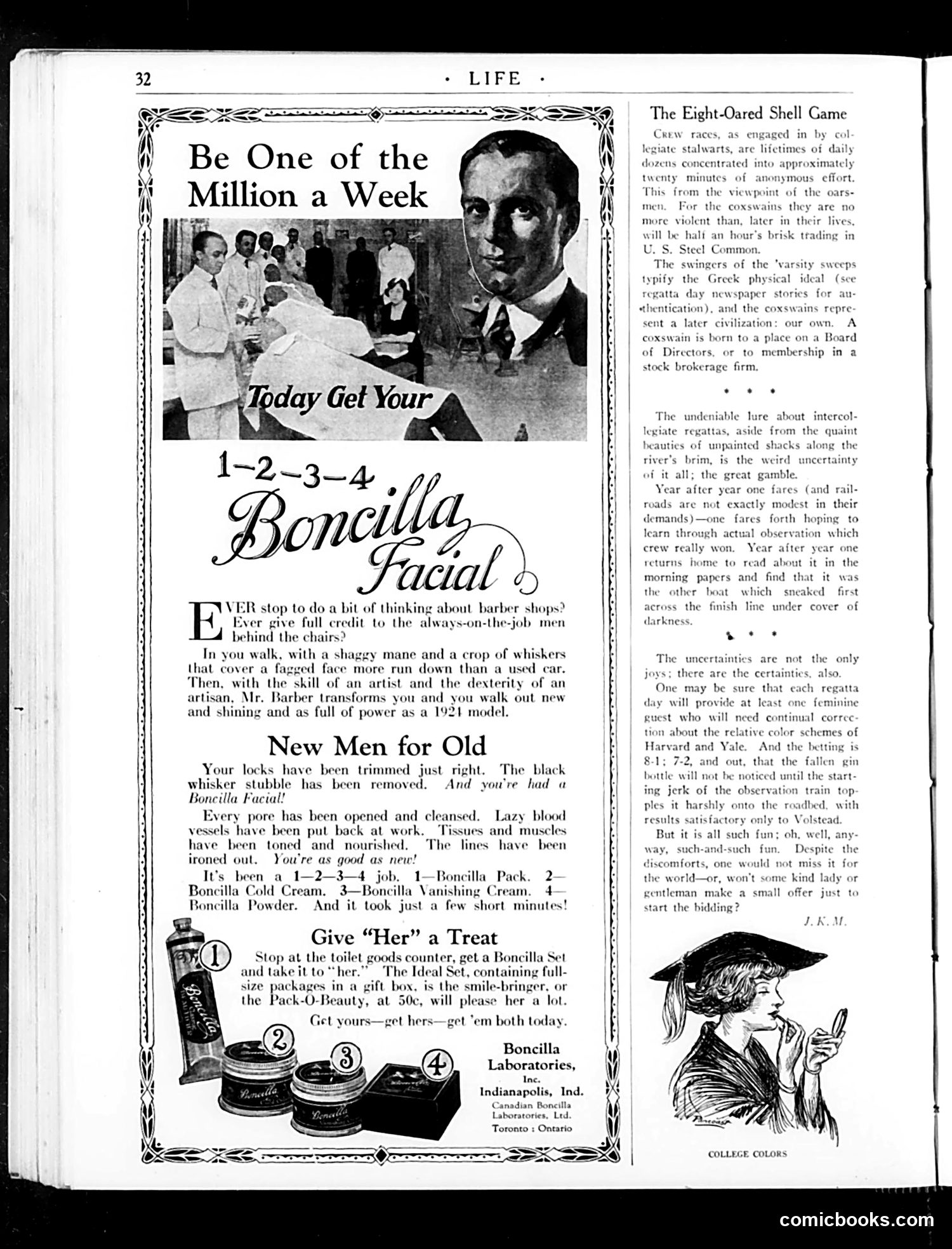
This page contains two distinct elements: **Left side:** A Boncilla cosmetics advertisement disguised as editorial content. It humorously presents a barber's transformation of an unkempt man into a polished "1921 model" through a four-step grooming process (Boncilla Pack, Cold Cream, Vanishing Cream, Powder). The satire lies in treating mundane grooming like industrial production—a commentary on 1920s modernization and consumerism. **Right side:** An essay titled "The Eight-Oared Shell Game" critiques collegiate rowing competitions. The satire contrasts rowers (representing classical Greek ideals) with coxswains (representing modern capitalist society—"Board of Directors" members). The piece mocks the uncertainty and gambling nature of regattas while gently poking fun at spectators, particularly women who need "correction about the relative color schemes of Harvard and Yale." The tone is lighthearted social commentary on upper-class collegiate traditions and their pretensions.
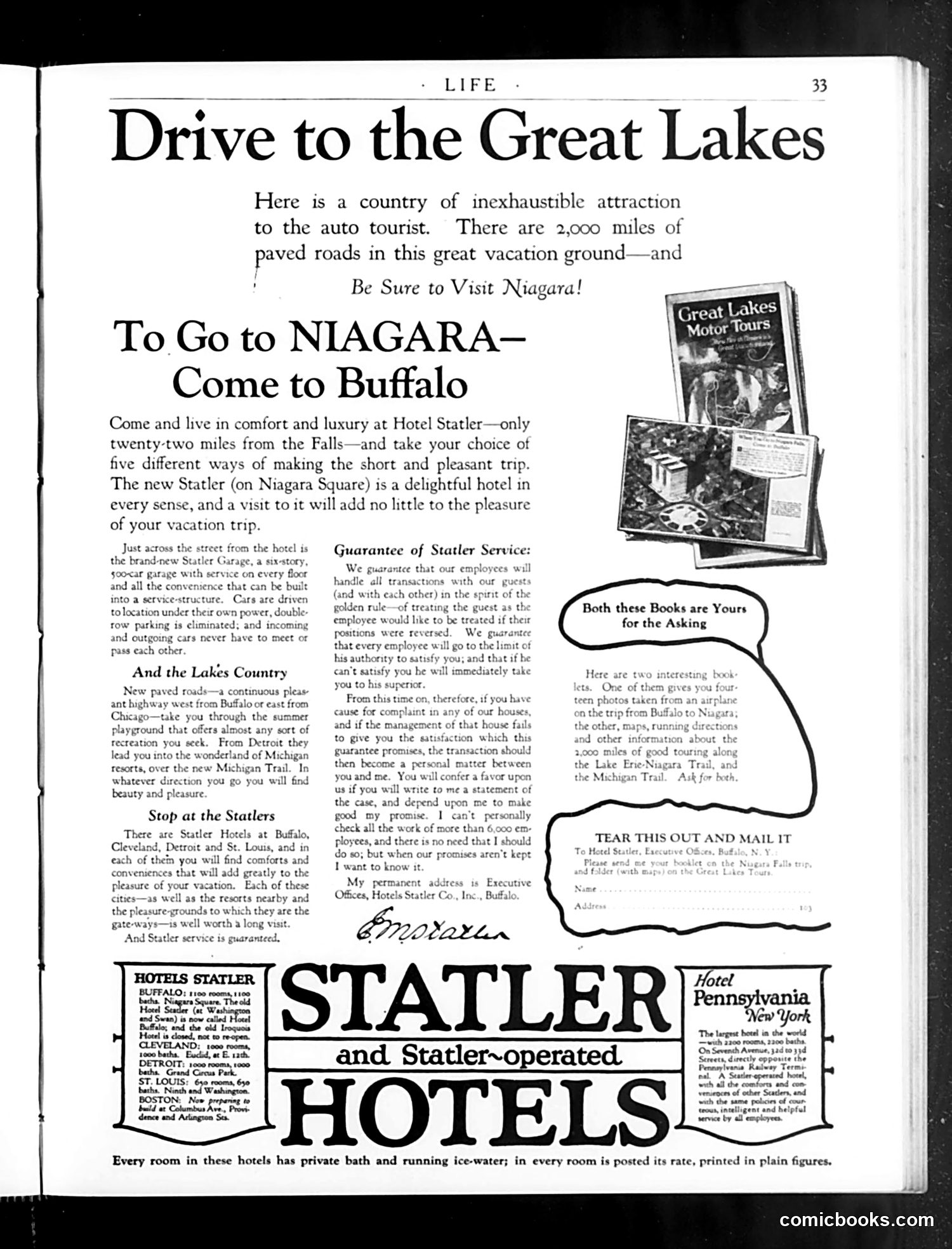
This page is **primarily advertising**, not satire or political commentary. It promotes Statler Hotels' expansion into the Great Lakes tourism market, capitalizing on the early automobile era's popularity. **Key content:** - Promotes Buffalo's Hotel Statler (22 miles from Niagara Falls) as a base for Great Lakes auto tourism - Highlights 2,000 miles of paved roads available to tourists - Features a new multi-story garage with innovative double-row parking—a selling point for the automobile-dependent tourist - Lists Statler locations across major American cities (Buffalo, Cleveland, Detroit, St. Louis, Boston, Pennsylvania) - Includes a "Guarantee of Statler Service" promising courteous employee treatment and satisfaction **Historical context:** This appears to be from the 1920s-early 1930s, when automobile tourism and hotel infrastructure expansion were booming industries. The emphasis on modern amenities (private baths, posted rates, service guarantees) reflects how hotels competed for middle-class travelers. There is **no political satire** on this page—it is straightforward period advertising.
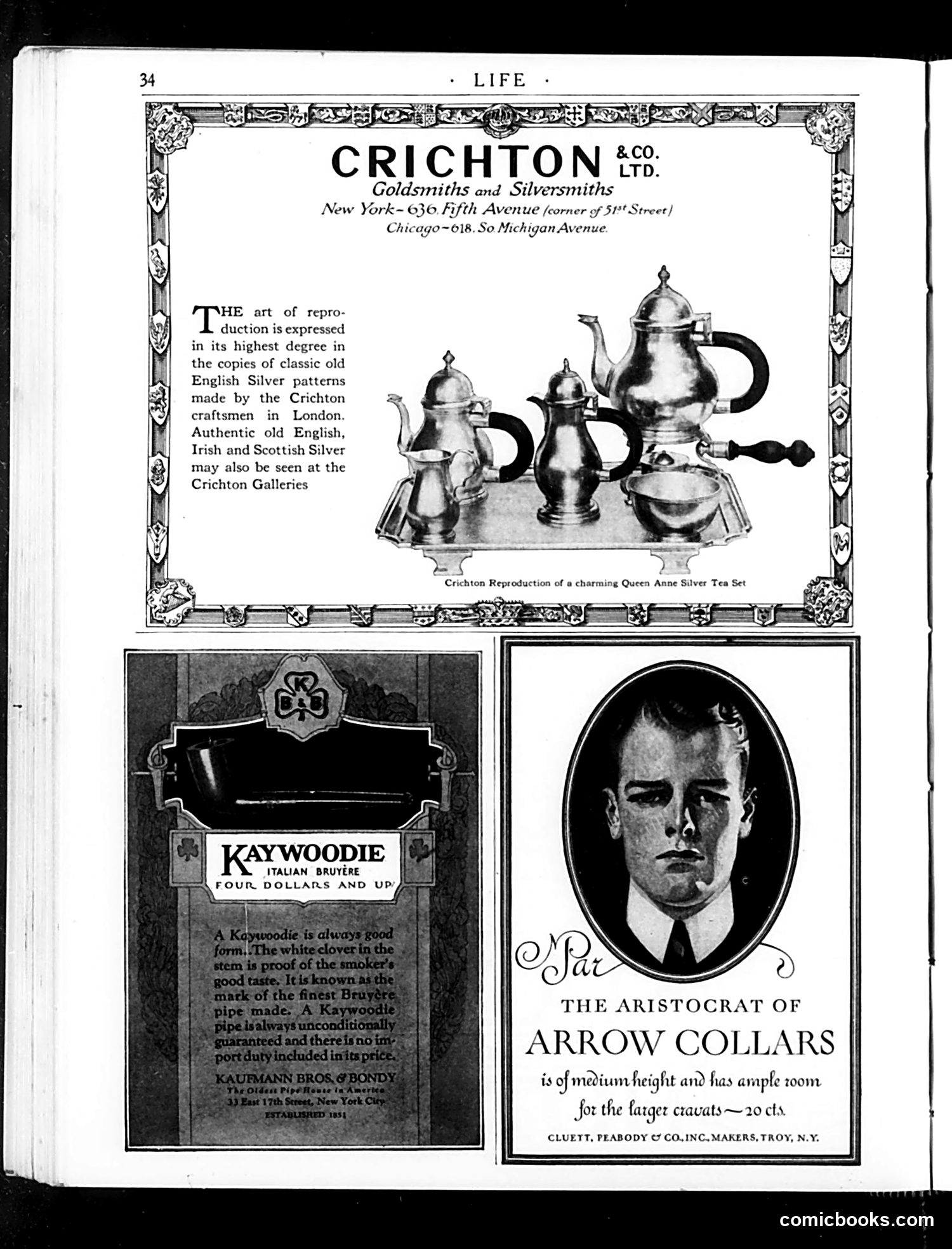
This page is primarily **advertising, not satire or political commentary**. It contains three separate ads: 1. **Crichton & Co.** (top): A luxury goldsmiths/silversmiths firm advertising reproductions of classic English silver tea sets and serving pieces, with locations in New York and Chicago. 2. **Kaywoodie Pipes** (bottom left): Advertising Italian briar pipes for "four dollars and up," emphasizing quality and unconditional guarantee. 3. **Arrow Collars** (bottom right): Featuring a portrait of a well-dressed man promoting "Arrow Collars" as an aristocratic fashion choice, noting they accommodate larger neckties at 20 cents. These are straightforward product advertisements typical of *Life* magazine's commercial content during this era. There is no political message, caricature, or satirical commentary visible—just marketing aimed at affluent, fashionable male consumers.
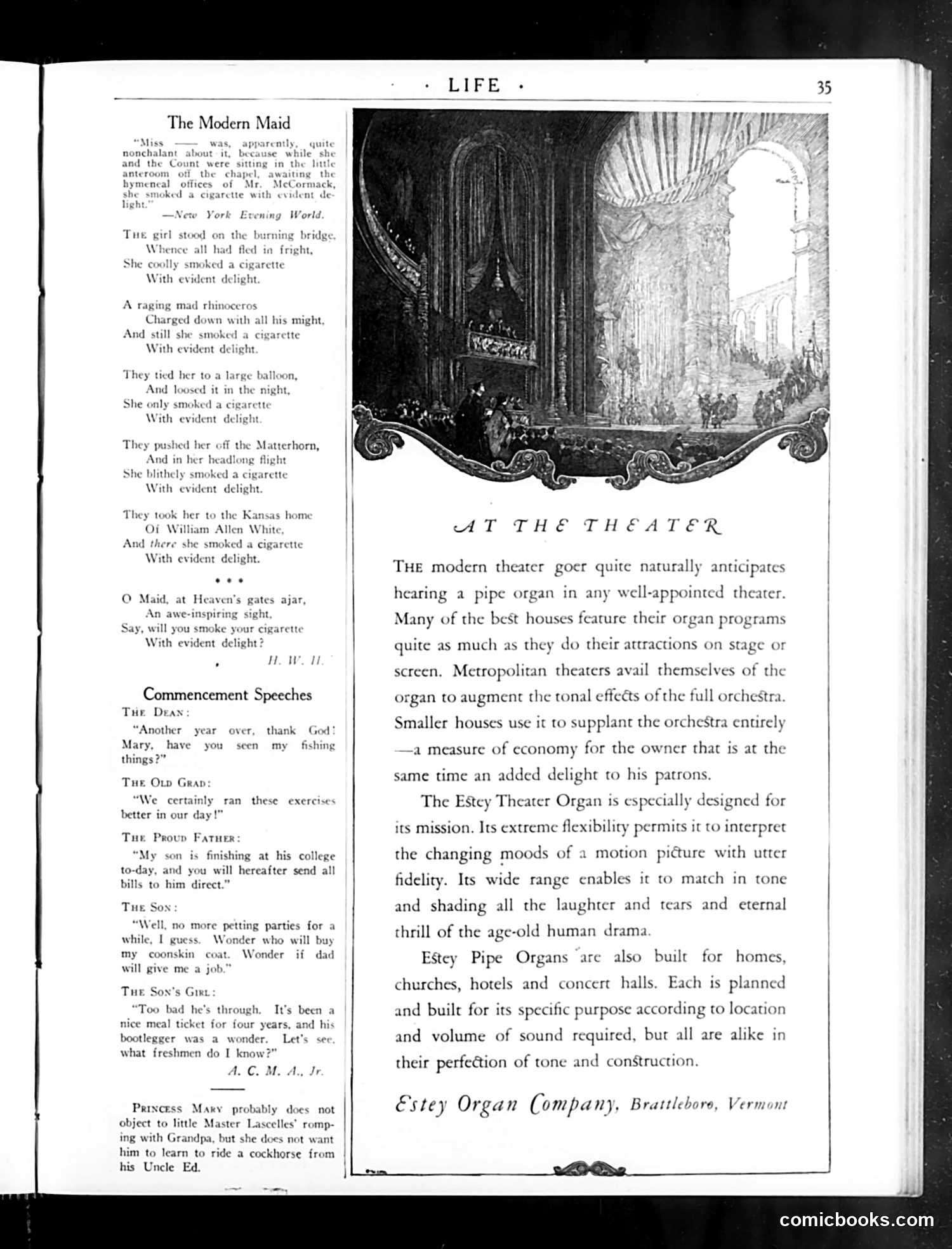
This poem satirizes the "modern woman" of the 1920s, specifically her newfound boldness in smoking cigarettes publicly—then considered scandalous behavior. The joke escalates absurdly: a woman smokes while standing on a burning bridge, after being tied to a hot air balloon, at the Matterhorn, and even in Kansas at William Allen White's home. In each scenario, she calmly smokes "with evident delight." The satire targets both changing social norms (women's increasing independence and rejection of Victorian propriety) and perhaps the shock value itself—suggesting society's pearl-clutching over women's smoking is overblown. The final stanza implies even entering Heaven won't stop her. The accompanying "Commencement Speeches" section offers complementary social commentary on post-WWI attitudes: graduation, changing gender dynamics, and economic uncertainty among youth. The page also contains an advertisement for Estey Theater Organs (unrelated to the satire).
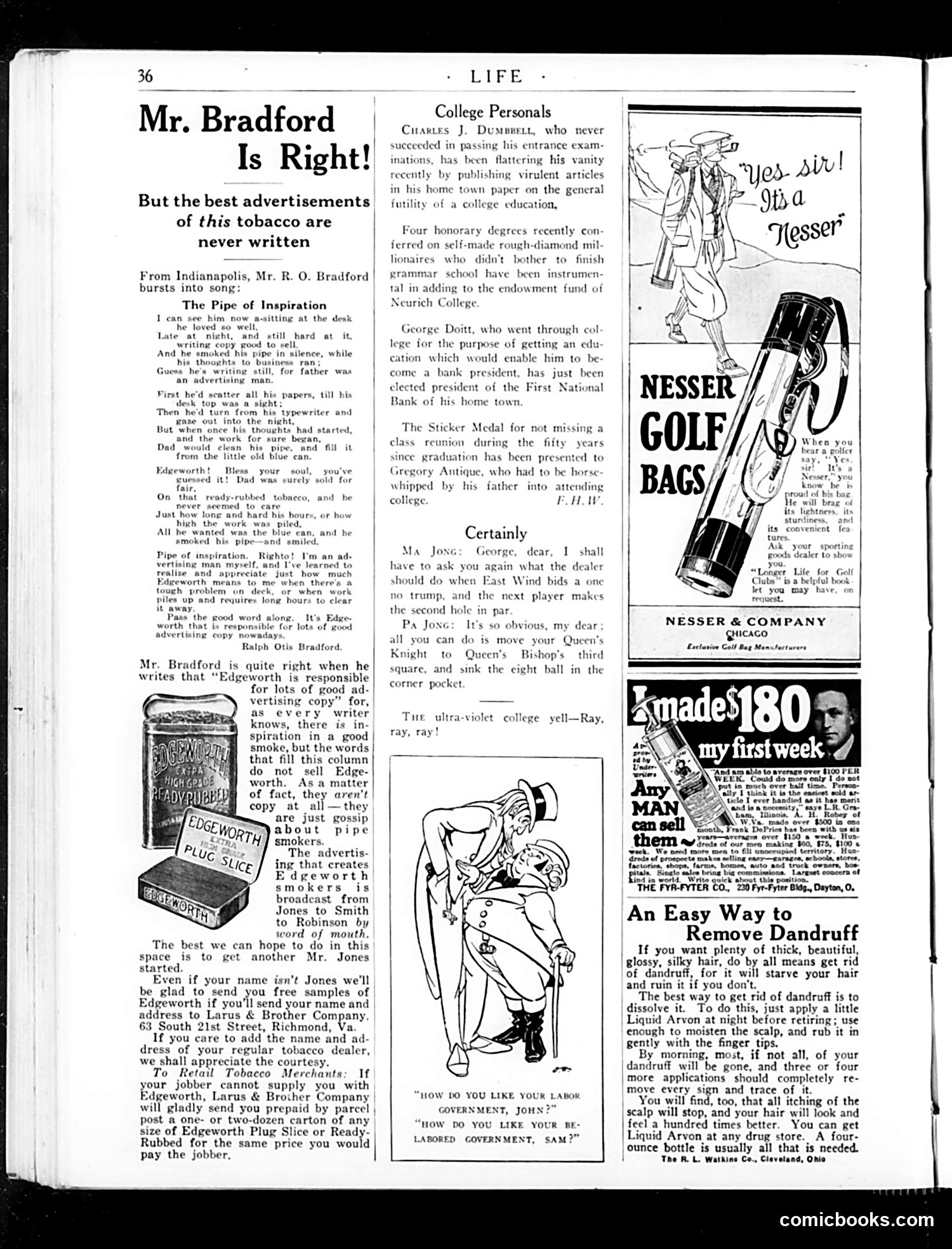
This page satirizes American attitudes toward education and self-made success. The main article mocks Charles J. Dumbell, who failed his college entrance exam but now publishes articles attacking college education's value—a hypocritical position Life ridicules. The "College Personals" section extends this critique: it highlights how self-made businessmen without formal education receive honorary degrees and praise (George Doitt becomes bank president despite attending college merely for credentials), while genuinely educated people struggle. The satire suggests American society irrationally celebrates rough-diamond millionaires who didn't finish grammar school, while undervaluing actual education. The cartoon showing a man struggling with golf and bridge terminology reinforces the theme: even wealthy, successful men lack cultured refinement. The page also includes advertisements (Nesser Golf Bags, Emades products, dandruff solution), reflecting Life's commercial nature, but the editorial content clearly critiques American anti-intellectualism and the paradoxical veneration of uneducated business success.
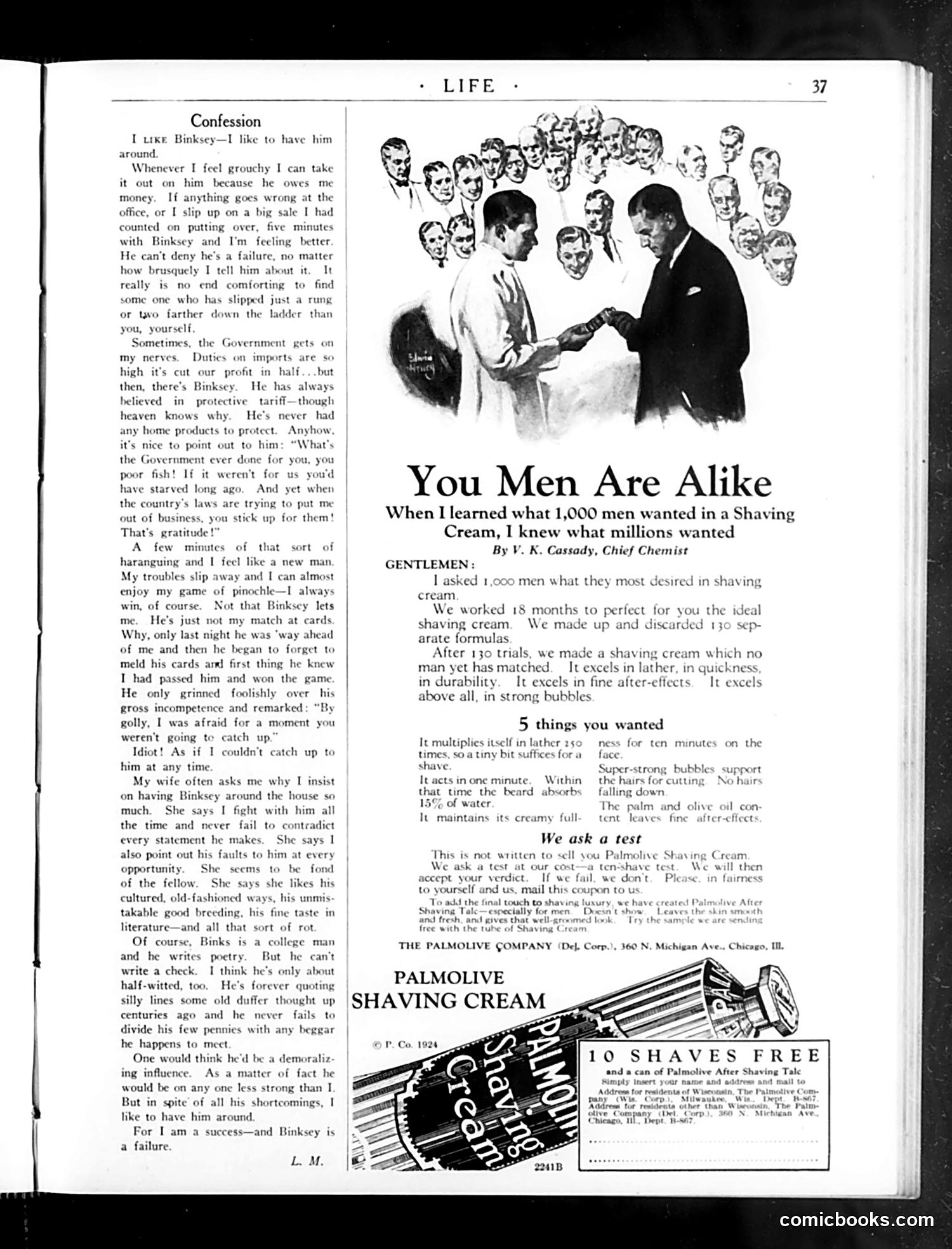
**The Main Content:** This page contains two distinct pieces from *Life* magazine (circa 1924): 1. **"Confession" (left)**: A satirical essay about a successful man who keeps an unsuccessful friend named "Binksey" around specifically to feel superior to him. The narrator uses Binksey as an emotional punching bag—belittling him about his poverty, failed business prospects, and lack of worldly success. The dark humor lies in the narrator's self-awareness that he's using this friendship solely to boost his own ego. His wife likes Binksey for his actual character (cultured, kind, poetic), but the narrator values him only as proof of his own superiority. 2. **"You Men Are Alike"**: A Palmolive Shaving Cream advertisement claiming scientific legitimacy—the copywriter surveyed 1,000 men and tested 130 formulas to create the "ideal" product. It's typical early-20th-century advertising that invokes research and expertise to justify premium pricing. **The Satire:** The pairing suggests mockery of how people—like the narrator and advertisers—manipulate others or exploit manufactured consensus to feel superior or justify choices.
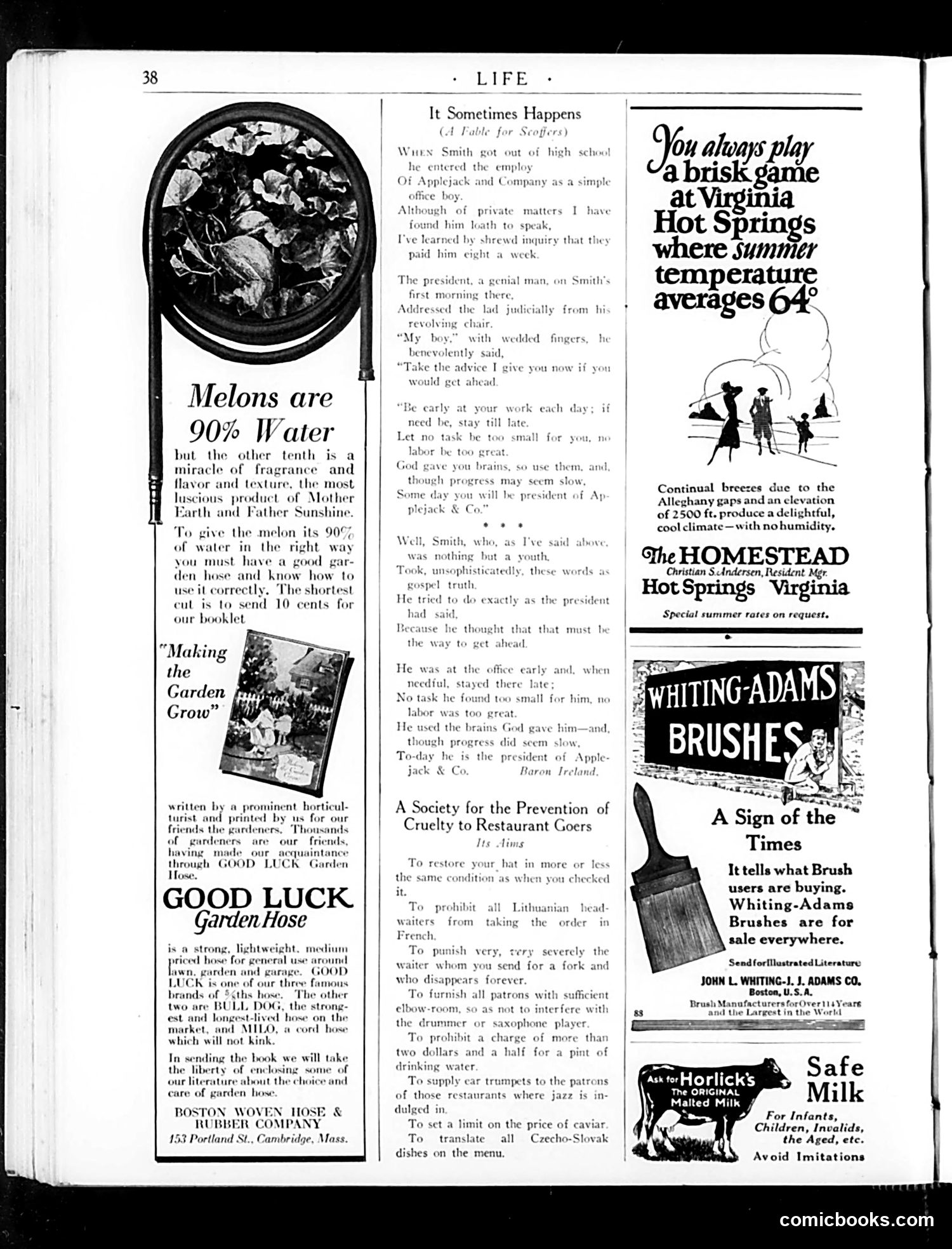
This page mixes advertisements with satirical content typical of *Life* magazine's humor. **The main cartoon** appears to be "A Society for the Prevention of Cruelty to Restaurant Goers," which lists absurd "aims" mocking common dining annoyances of the era: hat-check services losing hats, Lithuanian waiters taking orders in French, waiters disappearing when summoned, noisy jazz bands, and overpriced caviar. The satire targets restaurant pretension and poor service—complaints that would resonate with early 20th-century diners. **"It Sometimes Happens"** is a morality tale about young Smith, hired as an office boy, who succeeds by taking a company president's advice: work hard, use your brain, show up early. He becomes president—a conventional success story, likely mocking either naive optimism or serving as earnest inspirational fare. The remainder consists of period advertisements for garden hoses, brushes, malted milk, and a resort—standard magazine filler with no satirical content visible.
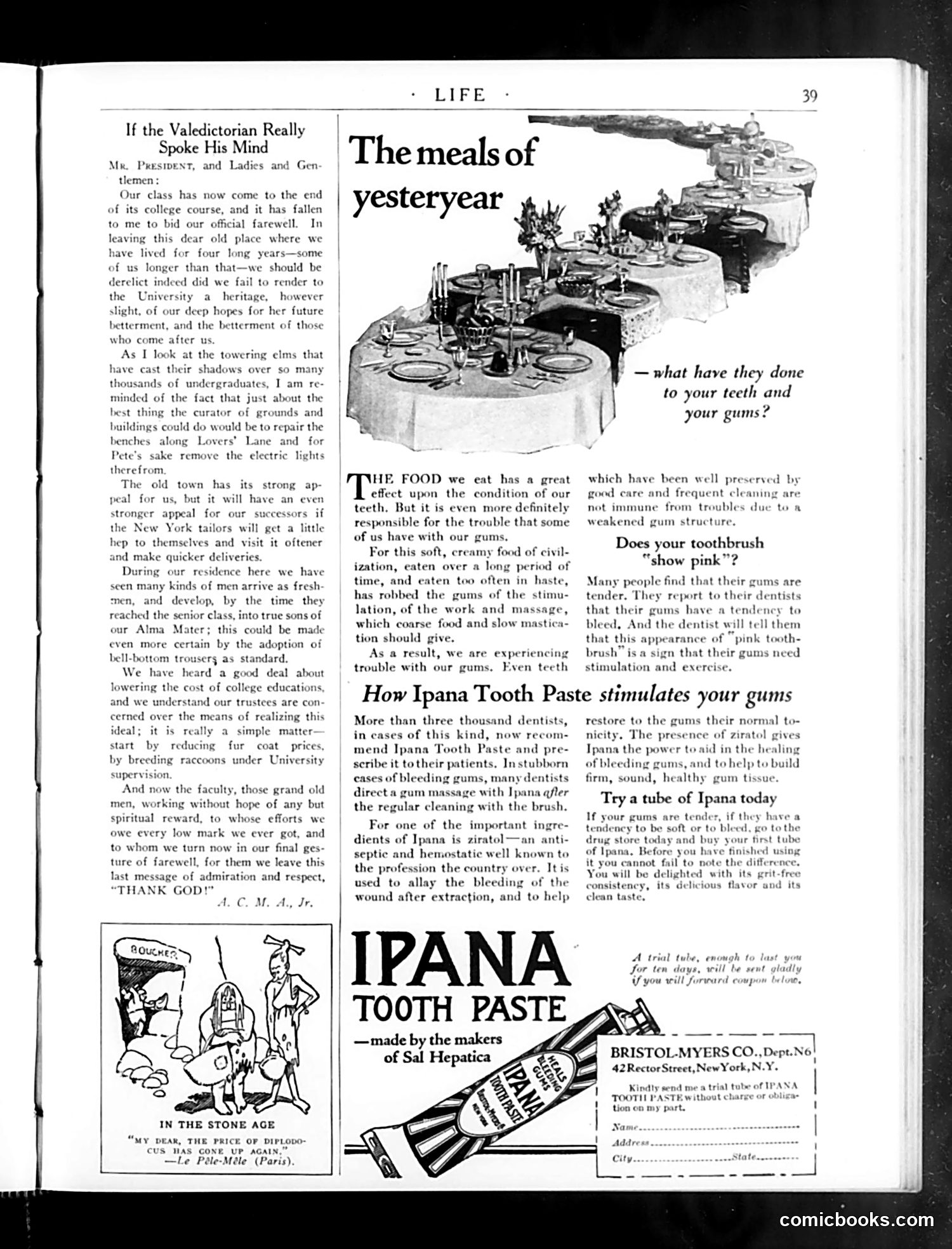
This page contains **satirical commentary on college life** alongside a toothpaste advertisement. ## The Cartoon/Editorial Content: The main piece is a mock "valedictorian speech" that uses ironic understatement to critique university conditions. The speaker ostensibly praises the institution while actually highlighting its problems: broken benches, poor maintenance ("the curator of grounds and buildings could do would be to repair the benches"), and faculty paid so little they work "without hope of any but spiritual reward." The humor relies on the contrast between formal farewell speech conventions and the speaker's barely-concealed complaints about cost-cutting and neglect. ## The Small Cartoon: The bottom illustration references price inflation, captioning a prehistoric couple with "My dear, the price of diplodocus has gone up again"—a joke about how even ancient, long-extinct things cost more, satirizing general economic inflation. ## Context: This reflects post-WWI era concerns about rising college costs and institutional maintenance, packaged as humorous undergraduate complaints.
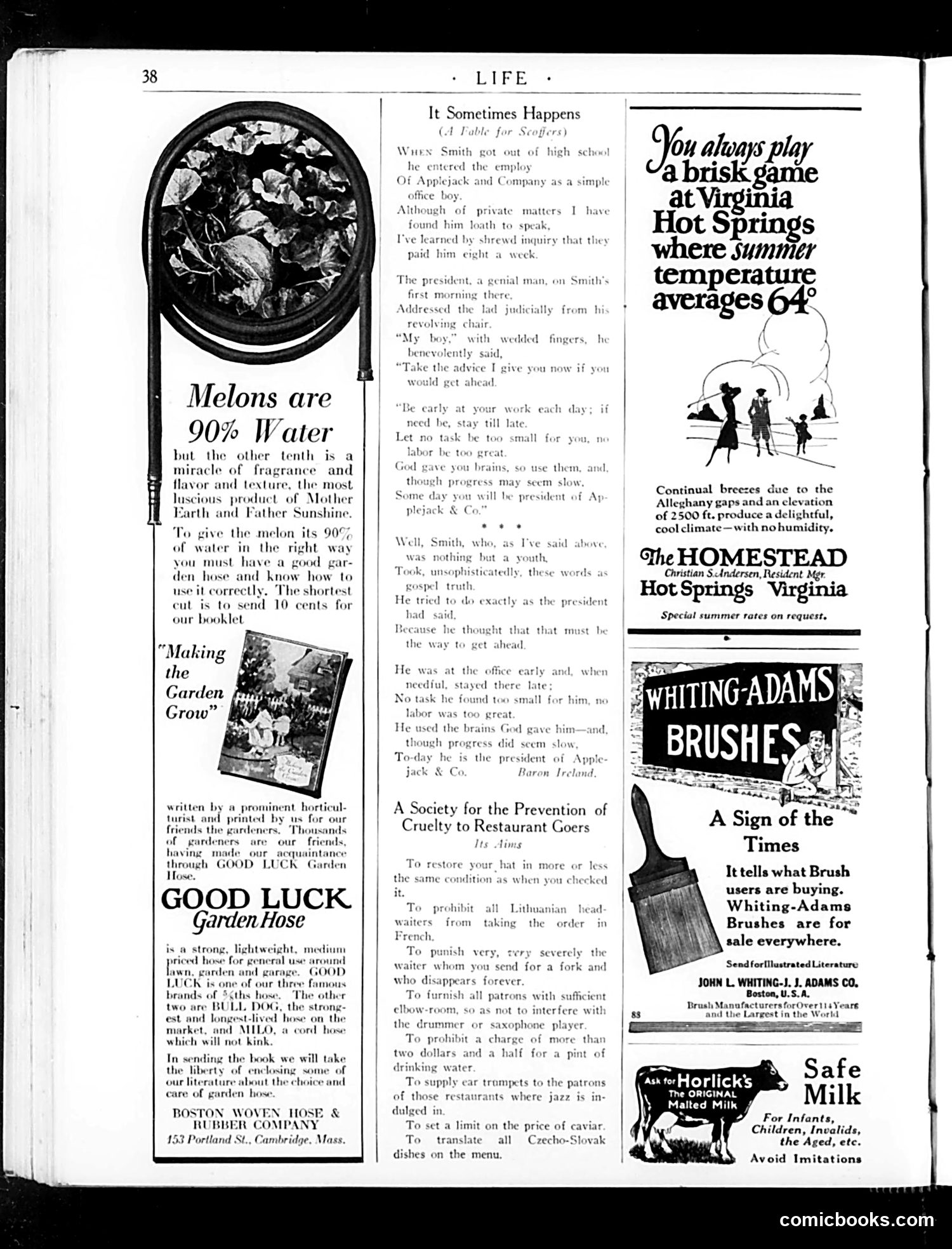
This page contains two satirical pieces and period advertisements. **"It Sometimes Happens"** is a morality tale satirizing naive workplace ambition. Young Smith, hired as an office boy, receives fatherly advice from the company president to work hard and use his God-given brains. Smith follows this advice literally—arriving early, staying late, accepting all tasks—yet the satire's point (though the ending is partially obscured) appears to be that sincere effort and obedience don't guarantee success in the real business world, contrary to the president's platitudes. **"A Society for the Prevention of Cruelty to Restaurant Goers"** mocks pretentious dining establishments of the era through absurdist "bylaws." It ridicules common annoyances: Lithuanian waiters speaking French, excessive caviar prices, loud jazz music, and incomprehensible Czech dishes. The satire targets both restaurants' affectations and diners' complaints about modern dining customs—a commentary on class anxiety and changing American leisure culture. The surrounding advertisements (garden hose, brushes, milk) are period commercial content unrelated to the satire.
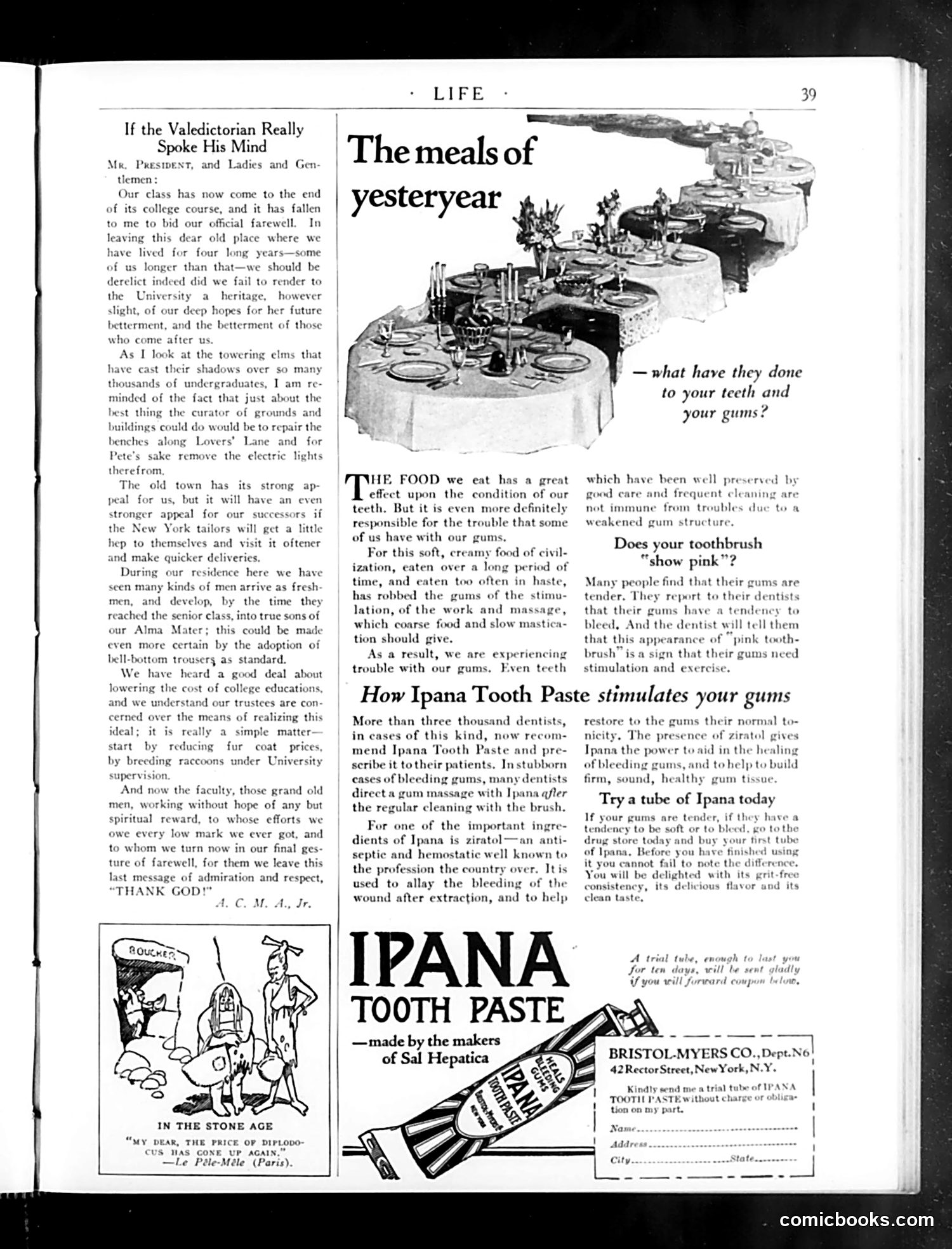
This page combines editorial satire with product advertising, typical of early 20th-century Life magazine. **The Satire:** The lead article presents a mock "Valedictorian's Speech" where a college graduate speaks candidly about his institution's flaws—poor bench maintenance, unnecessary electric lights in romantic areas, high educational costs. The humor lies in the irreverent honesty: instead of platitudes, he offers practical (and absurd) suggestions like breeding raccoons to lower fur coat prices. A companion cartoon riffs on this theme, showing a Stone Age couple discussing inflated prices ("diplodocus has gone up again"), satirizing both inflation concerns and the timelessness of economic worry. **The Advertisement:** The bulk of the page promotes Ipana Tooth Paste, exploiting contemporary anxiety about gum disease. The ad claims refined, soft modern foods have weakened gums through lack of stimulation, requiring their product containing "ziratol" (an antiseptic) to restore health. This reflects 1920s-era concerns about civilization's physical costs and the emerging market for pharmaceutical solutions to everyday problems. The juxtaposition—frivolous satire alongside serious health marketing—captures Life's dual purpose as both humor magazine and advertising vehicle.
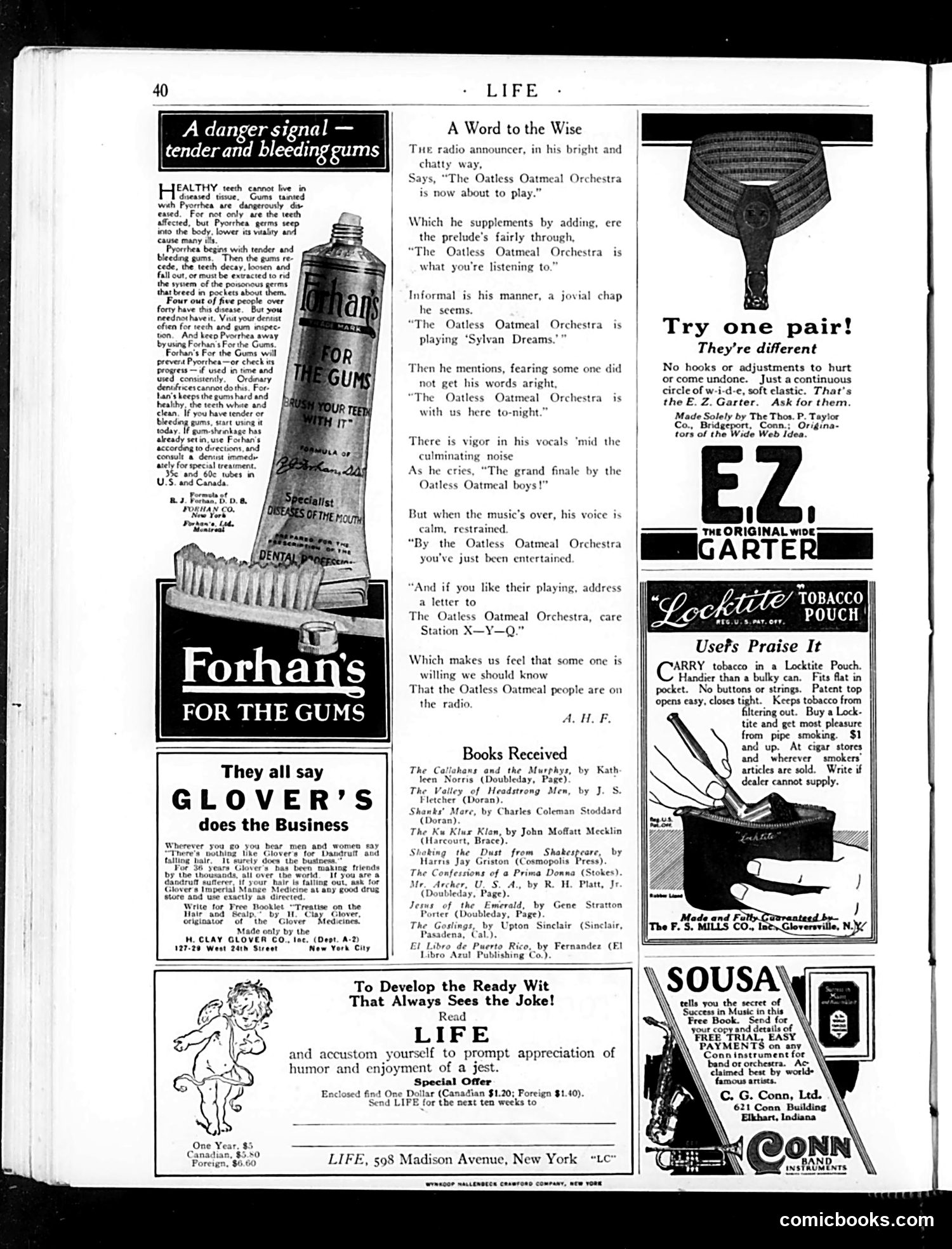
This page is primarily **advertising**, with one satirical piece worth noting: ## "A Word to the Wise" (Center Column) This is a humorous critique of **radio advertising repetition**. The unnamed satirist (A.H.F.) mocks a radio announcer who obsessively repeats the sponsor's name—"The Oatless Oatmeal Orchestra"—multiple times during a broadcast. The joke satirizes the emerging advertising practice of hammering brand names into listeners' heads through constant repetition on radio, a new mass medium of the 1920s. The exaggerated redundancy ("is now about to play," "is what you're listening to," "is playing," "is with us here to-night") demonstrates how annoying and transparent such advertising felt to contemporary audiences. ## Advertisements The remainder features period product ads: Forhan's toothpaste (for pyorrhea/gum disease), Glover's hair treatment, E.Z. garters, Locktite tobacco pouches, and Sousa instruments—typical consumer goods marketed in this era.
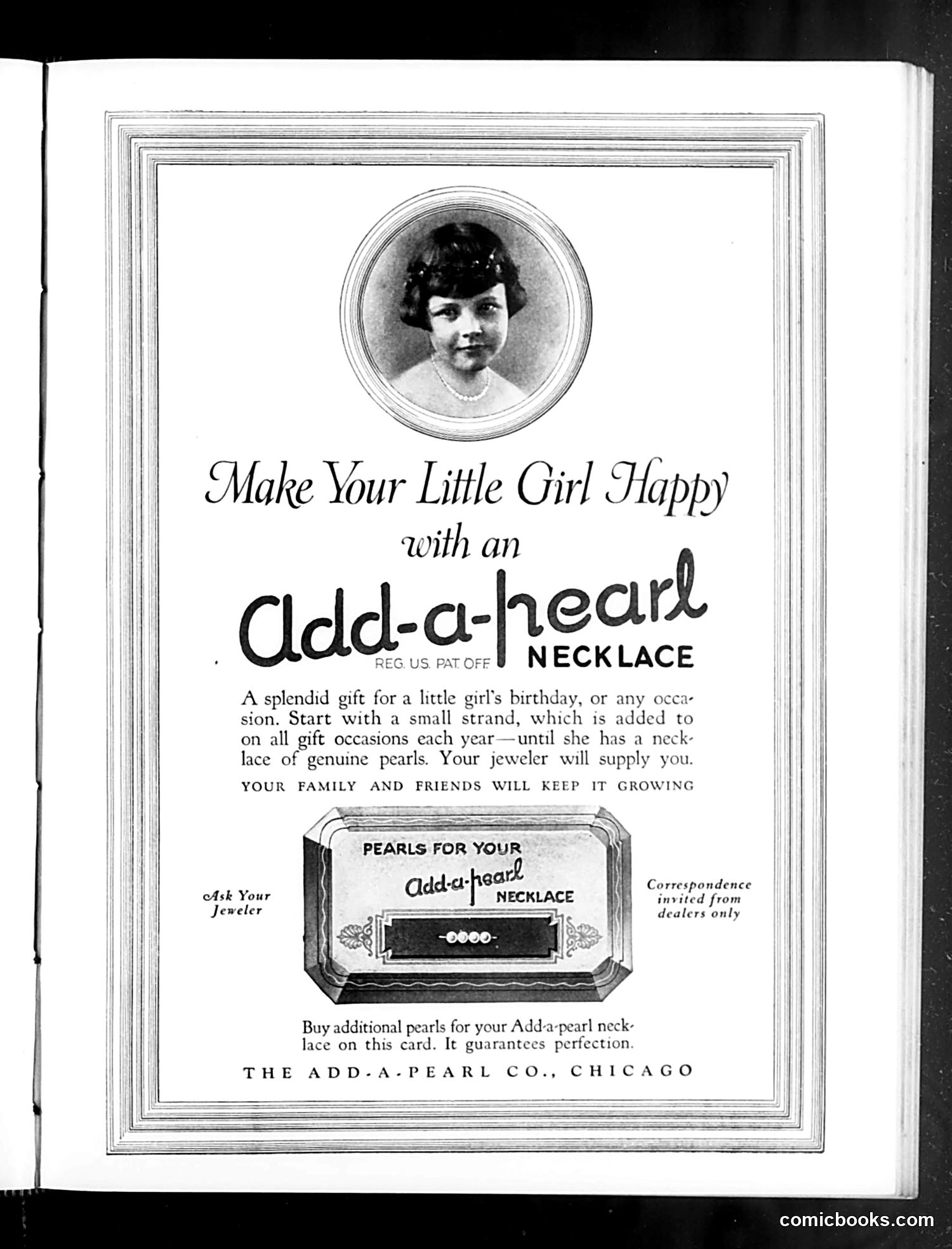
This is not a cartoon or satire—it's a straightforward advertisement for the Add-a-Pearl necklace, a real jewelry product from the Add-a-Pearl Company in Chicago. The page features a circular portrait photograph of a young girl at the top and promotes a gift concept where parents start with a small pearl strand on a daughter's birthday, then add additional pearls on subsequent gift occasions until she accumulates a complete necklace of genuine pearls. The ad emphasizes that "your family and friends will keep it growing," positioning it as a long-term investment gift. Customers could purchase additional pearls through their jeweler using the enclosed card. This represents early 20th-century consumer marketing targeting affluent families.
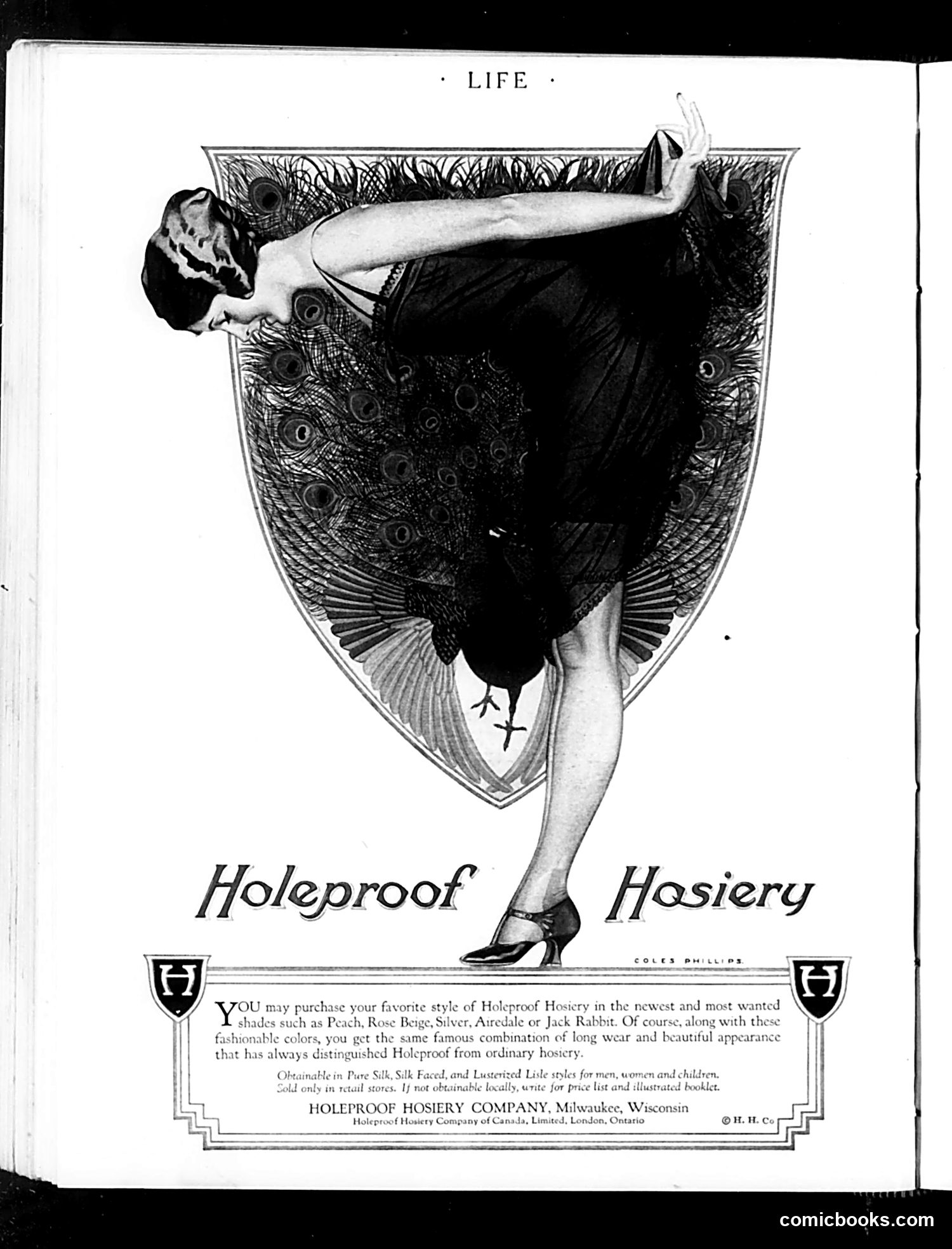
This is a **full-page advertisement** for Holeproof Hosiery, not political satire. The illustration shows a woman in 1920s style dress lifting her skirt to display stockings featuring a peacock design—a visual pun playing on the product name and the peacock's famous display of feathers. The ad copy emphasizes that Holeproof hosiery comes in fashionable colors (Peach, Rose, Nile, Silver, Aviedale, Jack Rabbit) and promises durability ("long wear and beautiful appearance"). It notes availability in silk and silk-faced options for men, women, and children. The artist is credited as **Coles Phillips**, a prominent commercial illustrator of the era known for his fashion advertising work. This represents typical 1920s product marketing: using humor, attractive imagery, and clever wordplay to sell consumer goods.