
Life, 1924-06-05 · page 22 of 48
Life — June 5, 1924 — page 22: what you’re looking at
What you’re looking at
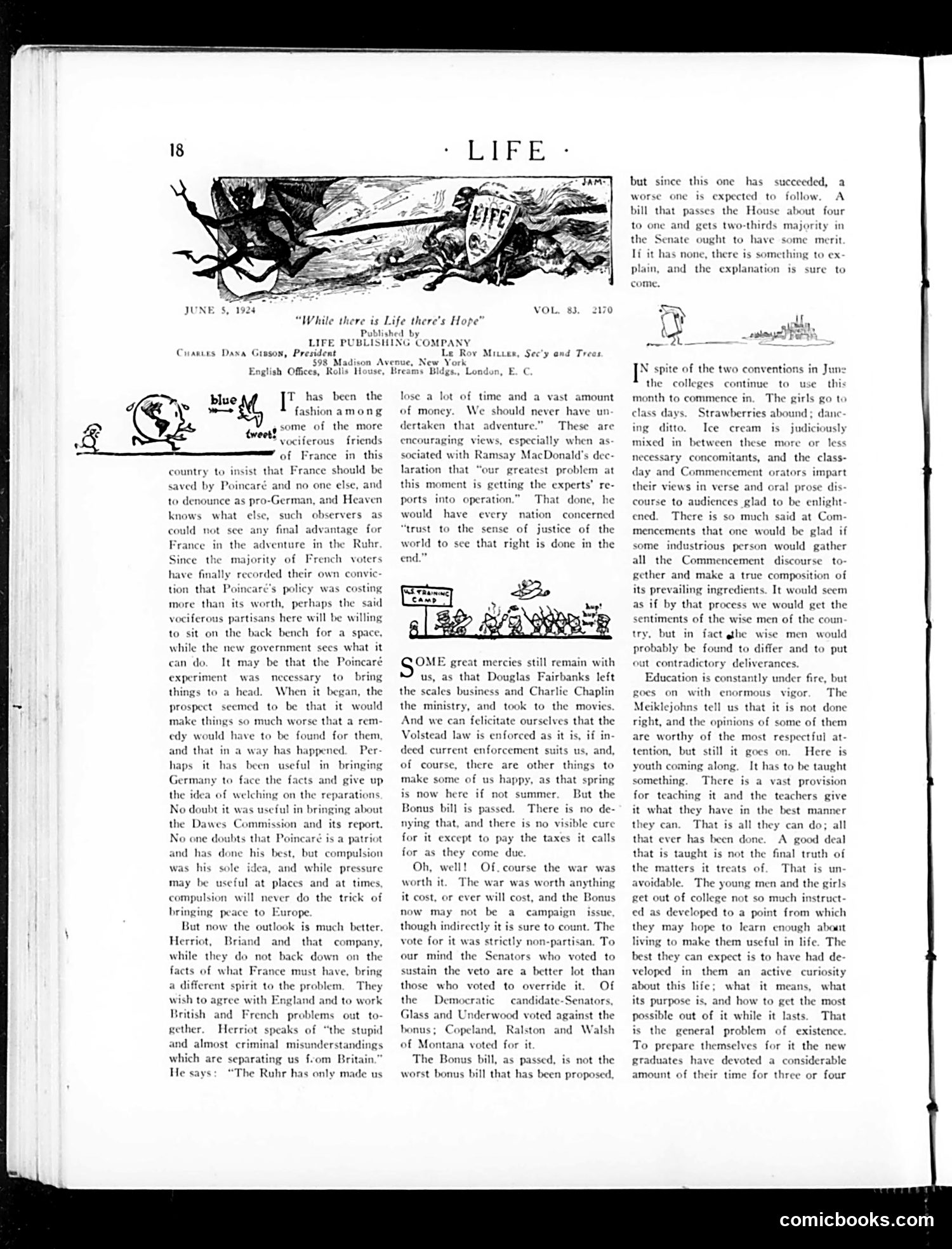
This June 5, 1924 Life magazine page critiques French politics and American policy. The main article discusses **Raymond Poincaré's failed Ruhr occupation policy**—a French military intervention to force German reparations payments. American supporters of Poincaré had defended the costly adventure, but French voters rejected it, electing new leadership under **Herriot and Briand**, who favored cooperative diplomacy with Britain and the **Dawes Plan** (experts' reports on reparations). The piece sardonically celebrates minor good news (Fairbanks and Chaplin leaving their previous careers for film; Prohibition enforcement) while criticizing the newly-passed **Veterans' Bonus Bill**, passed overwhelmingly despite President Coolidge's veto. The author notes senators who voted to sustain the veto were "better" than those overriding it, warning worse bonus bills will likely follow. The overall tone suggests frustration with American political pressure supporting French militarism and with domestic spending on veteran benefits during uncertain economic times.
📄 Transcribed text from this page (OCR, searchable)
Machine-transcribed from the original scan — historical spelling and the odd misread are preserved.
“While there is Life there's Hope’ Published by LIFE PUBLISHING COMPANY Cranes Dana Grason, President $98 Madison Av Le Rov Miter, Sec’y and Trees New York English Offices, Rolls House, Breams Bldgs., London, E. ( iv has been the fashion among some of the more MG — o g tweets cciferous friends of France in this country to insist that France should be saved by Poincaré and no one else, and to denounce as pro-German, and Heaven knows what else, such observers as could not see any final advantage for France in the adventure in the Ruhr Since majority of French voters have finally recorded their own convic tion that Poincaré’s policy was costing more than its worth, perhaps the said vociferous partisans here will be willing to sit on the back bench for a space, while the new government sees what it It may be that the Poincaré experiment was necessary to bring things to a head. When it began, the prospect seemed to be that it would can do. make things so much worse that a rem: edy would have to be found for them: and that in a way has happened. Per- haps it has been useful in bringing Germany to face the facts and give up the idea of welching on the reparations No doubt it was useful in bringing about the Dawes Commission and its report. y one doubts that Poincaré is a patriot and has done his best, but compulsion was his sole and while pressure may be useful at places and at times, compulsion will never do the trick of bringing peace to Europe But now the outlook is much better. Herriot, Briand and that company, while they do not back down on the facts of what France must have, bring a different spirit to the problem. They wish to agree with England and to work British and French problems out to- gether. Herriot speaks of “the stupid and almost criminal misunderstandings which are separating us feom Britain.” He says “The Ruhr has only made us lose a lot of time and a vast amount of money. We should never have un dertaken that adventure.” These are encouraging views, especially when as sociated with Ramsay MacDonald's dec laration that “our greatest problem at this moment is getting the experts’ re- ports into operation.” That done, he would have every nation concerned “trust to the sense of justice of the world to see that right is done in the end.” OME great mercies still remain with us, as that Douglas Fairbanks left the scales business and Charlie Chaplin the ministry, and took to the movies And we can felicitate ourselves that the Volstead law is enforced as it is, if in- deed current enforcement suits us, and, of course, there are other things to make some of us happy, as that spring But the Bonus bill is passed. There is no de- is now here if not summer, nying that, and there is no visible cure for it except to pay the taxes it calls for as they come due. Oh, well! Of. course the war was worth it. The war was worth anything it cost, or ever will cost, and the Bonus now may not be a campaign issue though indirectly it is sure to count. The vote for it was strictly non-partisan. To our mind the Senators who voted to sustain the veto are a better lot than those who voted to override it. Of ndidate-Senators, Glass and Underwood voted against the bonus; Copeland, Ralston and Walsh of Montana voted for it The Bonus bill, as passed, is not the worst bonus bill that has been proposed. the Democratic but since this one has succeeded, a worse one is expected to follow. A bill that passes the House about four to one and gets two-thirds majority in the Senate ought to have some merit Ii it has none, there is something to ex plain, and the explanation is sure to come. colleges continue to use this month to commence in. The girls go to class days. Strawberries abound ; danc ing ditto. Ice cream is judiciously mixed in between these more or less necessary concomitants, and the class- day and Commencement orators impart their views in verse and oral prose dis course to audiences glad to be enlight ened. There is so much said at Com- mencements that one would be glad if some industrious person would gather all the Commencement discourse to- gether and make a true composition of its prevailing ingredients. It would seem as if by that process we would get the sentiments of the wise men of the coun try, but in fact ghe wise men would probably be found to differ and to put out contradictory deliverances. Education is constantly under fire, but goes on with enormous vigor. The Meiklejohns tell us that it is not done right, and the opinions of some of them are worthy the most respectful at- tention, but still it goes on. Here is youth coming along. It has to be taught something for teaching it and the teachers give There is a vast provision it what they have in the best manner they can. That is all they can do; all that ever has been done. A good deal that is taught is not the final truth of the matters it treats of. That is un avoidable. The young men and the girls get out of college not so much instruct- ed as developed to a point from which they may hope to learn enough about living make them useful in life. The best they can expect is to have had de- veloped in them an active curiosity about this life; what it means, what its purpose is, and how to get the most possible out of it while it lasts. That general problem existence, To prepare themselves for it the new graduates have devoted a considerable amount of their time for three or four comicbooks.com