
Life, 1924-06-05 · page 26 of 48
Life — June 5, 1924 — page 26: what you’re looking at
What you’re looking at
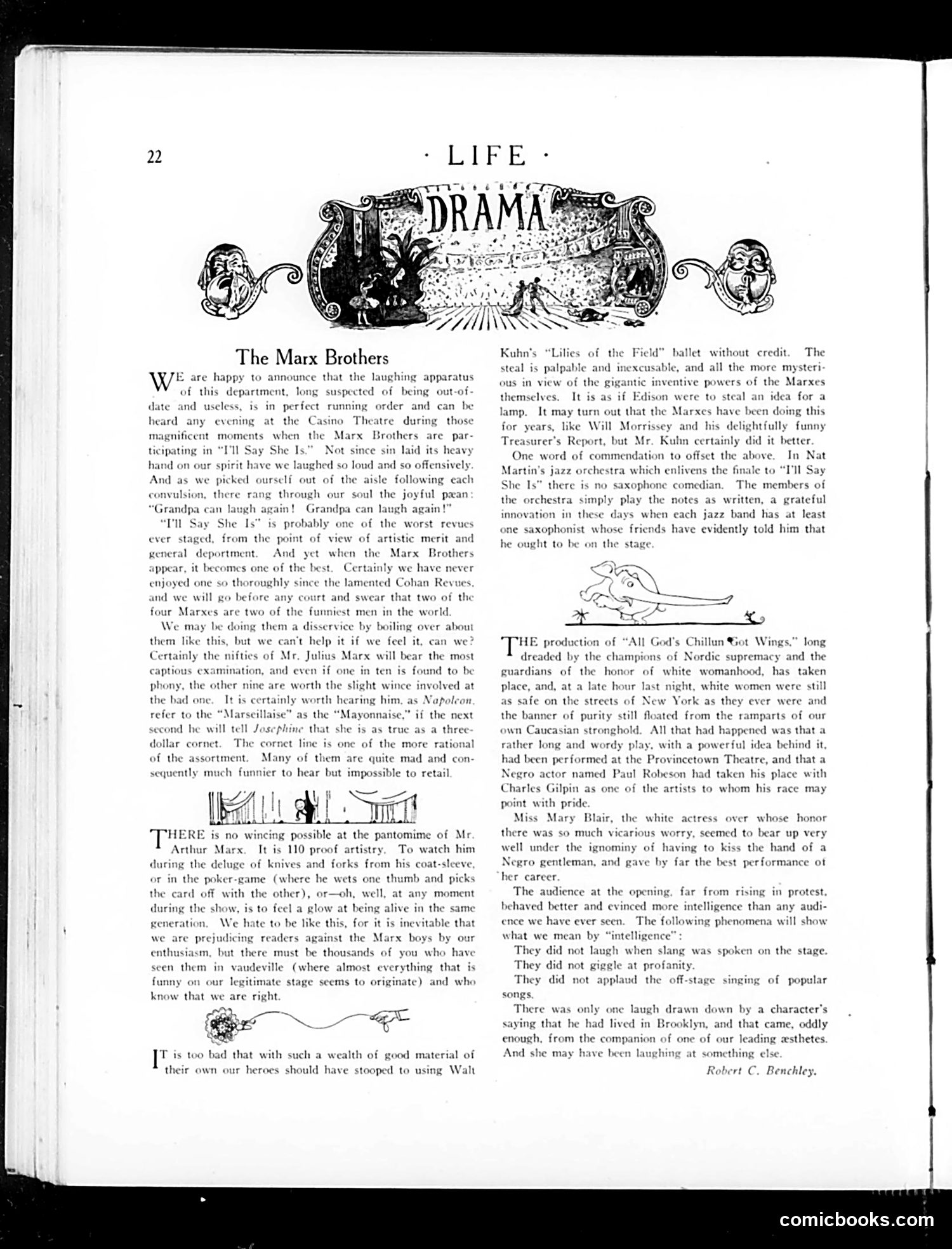
This 1922 Life article celebrates the Marx Brothers' stage show "I'll Say She Is" at the Casino Theatre, praising their physical comedy and improvisation as genuinely hilarious despite the show's poor material. The critic specifically admires Julius Marx's wordplay (calling the "Marseillaise" the "Mayonnaise") and Arthur Marx's pantomime. However, the piece also includes a notable criticism: the Marxes incorporated a ballet from Walt Kuhn's "Lilies of the Field" without credit, which the writer calls "palpable and inexcusable"—comparable to Edison stealing an idea. The page also references another theatrical production, "All God's Chillun Got Wings," which had sparked controversy among "champions of Nordic supremacy" due to its interracial content, though the reviewer suggests New York society remained undisturbed by it.
📄 Transcribed text from this page (OCR, searchable)
Machine-transcribed from the original scan — historical spelling and the odd misread are preserved.
The Marx Brothers 2 are happy to announce that the laughing apparatus this department, long suspected of being out-of date and useless, is in perfect running order and can be heard any evening at the Casino Theatre during those magnificent: moments when Marx Brothers are par- ticipating in “I'll Say She Is.” Not since sin laid its heavy hand on our spirit have we laughed so loud and so offensively And as we picked ourself out of the aisle following cach convulsion, there rang through our soul the joyful paan “Grandpa can laugh again! Grandpa can laugh again!” ‘Tl Say She Is” ever staged, from the point of view of artistic merit and is probably one of the worst revues general deportment. And yet when the Marx Brothers t appear, it becomes one of the best. Certainly we have never enjoyed one so thoroughly since the lamented Cohan Rev and we will go before any court and swear that two of the four Marxes are two of the funniest men in the world We may be doing them a disservice by boiling over about them like this, but we can't help it if we feel it, can we? Certainly the nifties of Mr. Julius Marx will bear the most captious examination, and even if one in ten is found to be phony, the other nine are worth the slight wince involved at the bad one. It is certainly worth hearing him. as Napoleon refer to the “Marseillaise” as the “Mayonnaise,” if the next second he will tell Josephine that she is as true as a three dollar cornet. The cornet line is one of the more rational of the assortment. Many of them are quite mad and con- sequently much funnier to hear but impossible to retail HERE is no wincing possible at the pantomime of Mr Arthur Marx. It is 110 proof artistry, To watch him during the deluge of knives and forks from his coat-sleeve or in the poker-game (where he wets one thumb and picks the card off with the other), or—oh, well, at any moment during the show, is to feel a glow at being alive in the same hate to be like this, for i we are prejudicing readers against the Marx boys by our generation, W. is inevitable that enthusiasm, but there must be thousands of you who have seen them in vaudeville (where almost everything that is funny on our legitimate stage seems to originate) and who know that we are right. I . is too bad that with such a wealth of good material of their own our heroes should have stooped to using Walt Kuhn's “Lilies of the Field” ballet without credit. The steal is palpable and inexcusable, and all the more mysteri us in view of the gigantic inventive powers of the Marxes It is as if Edison were to steal an idea for t that the Marxes have bec for years, like Will Morrissey and his delightfully funny remselves. lamp. It may tur doing this Treasurer's Report, but Mr. Kuhn certainly did it better f commendation to offset the above. In Nat eto “I'll Say The members of One word Martin's jazz orchestra which enlivens the fir She Is the orchestra simply play the there is no saxophone comedian tes as written, a grateful innovation in these days when each jazz band has at least one saxophonist whose friends have evidently told him that he ought to be on the stage HE production of “All God's Chillun Got Wings.” long dreaded by the champions of Nordic supremacy and the guardians of the honor of white womanhood, has taken ht, white women were still as safe on the streets of New York as they ever were and place, and, at a late hour last n the banner of purity still floated from the ramparts of our an stronghold. All that had happened was that a rather long and wordy play, with a powerful idea behind it had been performed at the Provincetown Theatre, and that a egro actor named Paul Robeson had taken his place with own Cauca Charles Gilpin as one of the artists to whom his race may point with pride Miss Mary Blair, the white actress over whose ho there was so much vicarious worry, seemed to bear up very well under the ignominy of having to kiss the hand of a Negro gentleman, and gave by far the best performance ot her career The audience at the opening, far from rising in protest. behaved better and evinced more intelligence than any audi- ence we have ever seen. The following phenomena will show what we mean by “intellig They did not laugh when slang was spoken on the stage. They did not giggle at profanity They did not applaud the off-stage singing of popular songs There was only one laugh drawn down by a character's ying that he nd that came, oddly ur leading wsthetes. ad lived in Brooklyn enough, from the companion of one of And she may have been la it something comicbooks.com