
Life, 1924-06-05 · page 30 of 48
Life — June 5, 1924 — page 30: what you’re looking at
What you’re looking at
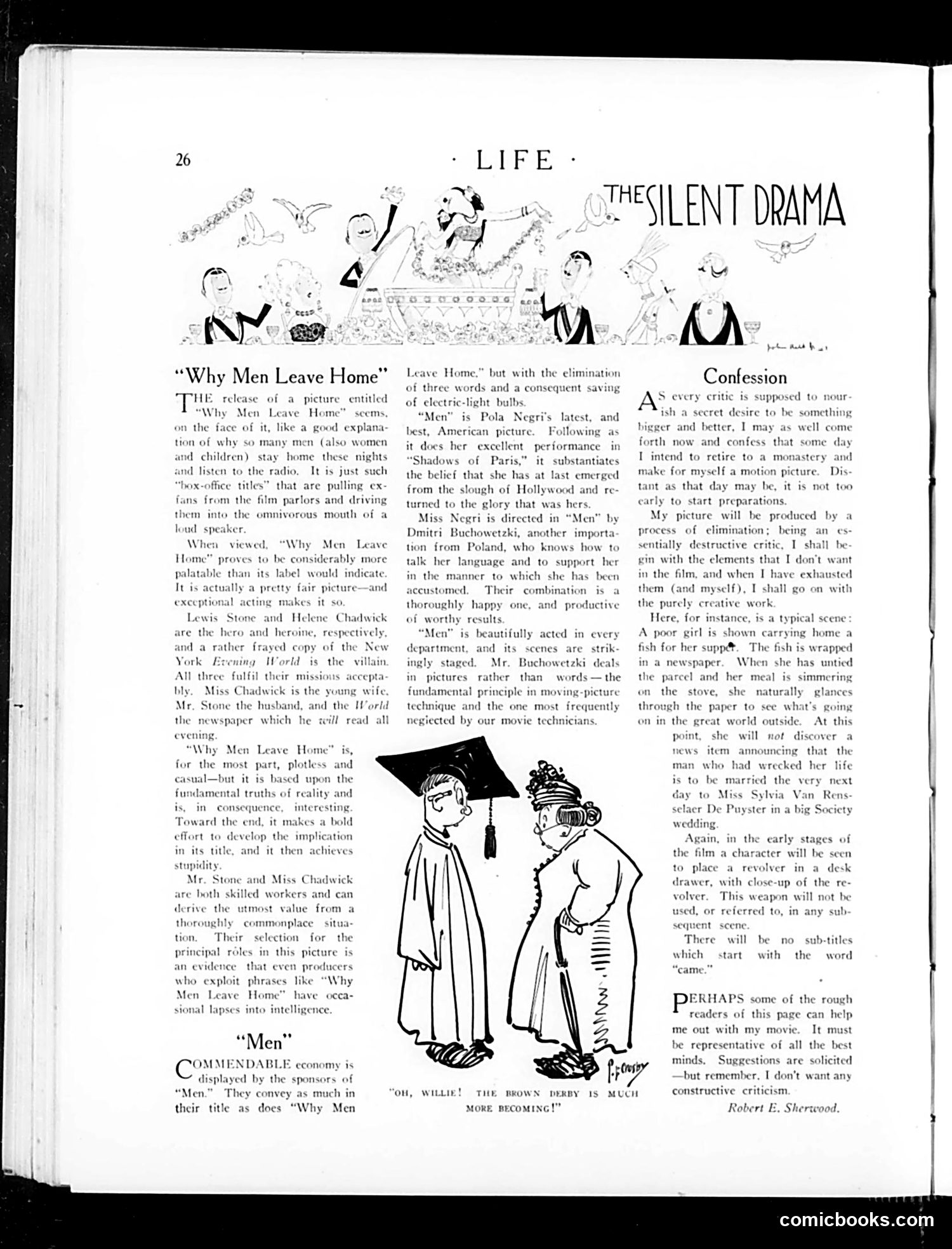
This page from *Life* magazine discusses silent films of the early 1920s. The main cartoon illustrates a scene from "Why Men Leave Home," showing two figures in period dress with the caption "Oh, Willie! The brown derby is much more becoming!" The page critiques two films: "Why Men Leave Home" (starring Lewis Stone and Helene Chadwick) and "Men" (directed by Dmitri Buchowetzki, featuring Polish actress Pola Negri). The reviews praise both as competent despite formulaic plots, noting they rely on visual storytelling rather than dialogue—essential for silent cinema. The "Confession" section by Robert E. Sherwood humorously describes his intended film-making approach: elimination of unwanted elements until only the "purely creative work" remains. He provides example scenes, including an absurdly melodramatic moment where a poor girl discovers her life-wrecker's wedding announcement while unwrapping fish. The humor targets both silent film conventions and their tendency toward overwrought, coincidence-driven narratives.
📄 Transcribed text from this page (OCR, searchable)
Machine-transcribed from the original scan — historical spelling and the odd misread are preserved.
“Why Men Leave Home” HE release of a “Why Men on the face of it, like a good explana tion of why picture entitled Leave Home” seems. so many men (also women and children) stay home these nights d listen to the radio, It is just such “box-office titles” that are pulling ex fans from the film parlors and driving them into the omnivorous mouth of a loud speaker When viewed, “Why Men Home” proves to be considerably more palatable than its label It is actually a pretty fair picture Helene Chadwick . respectively New would indicate and acting one and and heroi are the and a rather frayed copy of th York Evening World is the vi All three fulfil their missions accepta bly. Miss Chadwick is the young wife Mr. Stone the husband, and the Ho. the newspaper which will re evening, “Why Men Home” for the most part, plotless and Leave casual—but it is based upon th al truths of reality and interesting fundam is, in nsequence Toward the end, it makes a bold effort to its title, and develop the implication it then achieves spidity Mr. Stone and Miss Chadwick are both skilled workers and can derive t value from a thoroughly commonplace — situa tion. Their selection for the principal rdles in this picture is 1 even producers Why ocea- an evidence who exploit phrases like Men Hom sional lapses into intelligence. “Men” OMMENDABLE economy is displayed by the sponsors of “Men.” T their title as Leave have ey convey as much in “Why Men doe: of electri it does her “Shadows from the slough of Hollywood and re tu talk her language “Men” in the m accustomed. is Pola best, American. picture Pol who kr s how and to support nner to whi she has t Their combination thoroughly in technique and the “ou, worthy Men” pictures fundamental princi WILLIE happy one results is beautifully acted in every it, and its scenes are st Mr. Buchowetzki ¢ ly staged ted by our movie tec Negri's excellent of Paris,” 1 to the glory that was hers Miss Negri is directed in “Men” by Dmitri tion from rat moving THE BROWN DERBY MORE BECOMING!” but with the elimin: Home." of three words and a consequent sav latest, Following performance it substantiates the belief that she has at last emerged Buchowetzki, another importa and. productive words — the most frequently icians. 1s. MUCH “uM Confession AS every critic is ish a secret desire to v a hoe something r and better, I may as well come h now and confess that some day I intend to retire to a mona and make for myself a motion picture. Dis tant as that day may be, it is not too carly to start preparations. My picture will be produced by a process of elimin an es- sentially destructive I shall be gin with the elements that I don’t want in the film, and when I have exhausted them ( 1 myself), I shall go on with the purely creative work Here, for A poor girl is shown carrying home a fish The in a newspaper, When she has untied tance, is a typical scene for her suppé sh is wrapped the parcel neal is simmerin the stove, she naturally g what's go’ id At this h the paper to see the great wor! i point, she will not discover a news item announcing th the man who had wrecked her is to be married the very next Sylvia Van ster in a big § day to M selaer De F Again, in the early stages of the film a character will be seen to place a revolver in a desk drawer, with close-up of the re- volver. This weapon will not be used, or referred to, in any sub. There will be no sub-titles which start with the word “came.” ERHAPS some of the readers of thi e can help me out with my movie. It must be representative of all the best minds, Suggestions are solicited ‘but remember, I don’t want any constructive criticism. Robert E Sherw comicbooks.com