
A complete issue · 44 pages · 1923
Life — October 18, 1923
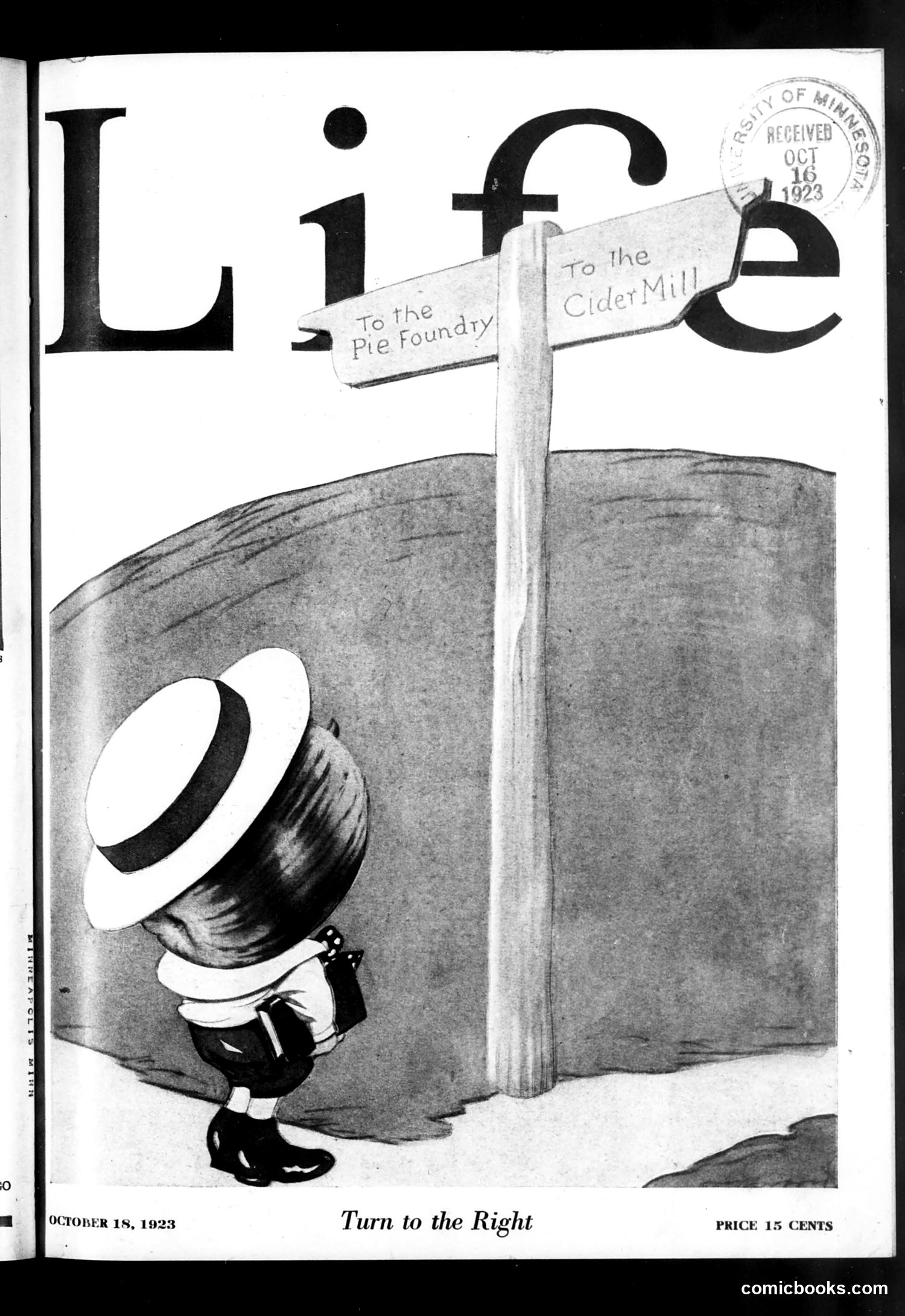
This is a visual pun playing on the phrase "turn to the right"—both literal directions and political positioning. A figure in a straw hat (appearing to be a working man or farmer) stands before a large wooden sign post with directional arms pointing to "the Pie Foundry" and "the Cider Mill." The cartoon likely satirizes political choices available to voters or citizens in 1923. The references to "Pie" and "Cider" suggest appealing but possibly empty promises or destinations—common metaphors for political rhetoric. The figure must "turn right" to reach these attractive-sounding places, parodying how ordinary people navigate competing political or economic options, perhaps satirizing contemporary political divisions or the allure of false economic solutions during the post-WWI period.
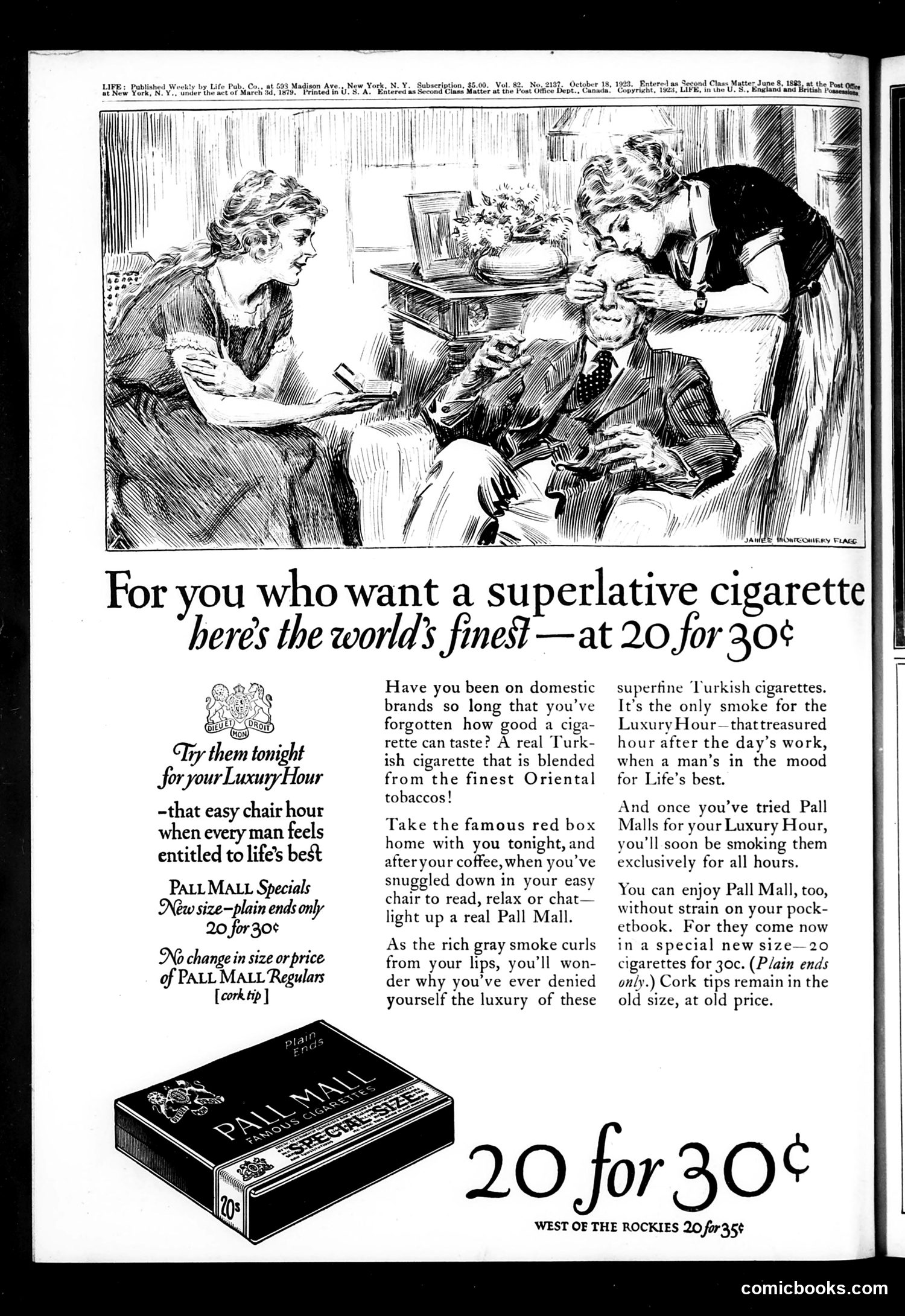
This page is primarily a **cigarette advertisement** for Pall Mall brand, not political satire. The illustration shows a domestic scene with two women applying cosmetics to a man's face while he relaxes in a chair—depicting the "Luxury Hour" the ad promotes. The ad targets male consumers by associating cigarette smoking with leisure, comfort, and domestic luxury. The pricing structure (20 cigarettes for 30 cents) highlights an affordable "special" new size. **Historical context**: This appears from the 1920s era when cigarette advertising freely marketed to the general public without health warnings. The "superlative cigarette" claim and Turkish tobacco references were typical marketing language of that period. No political meaning is evident—this is purely commercial advertising.
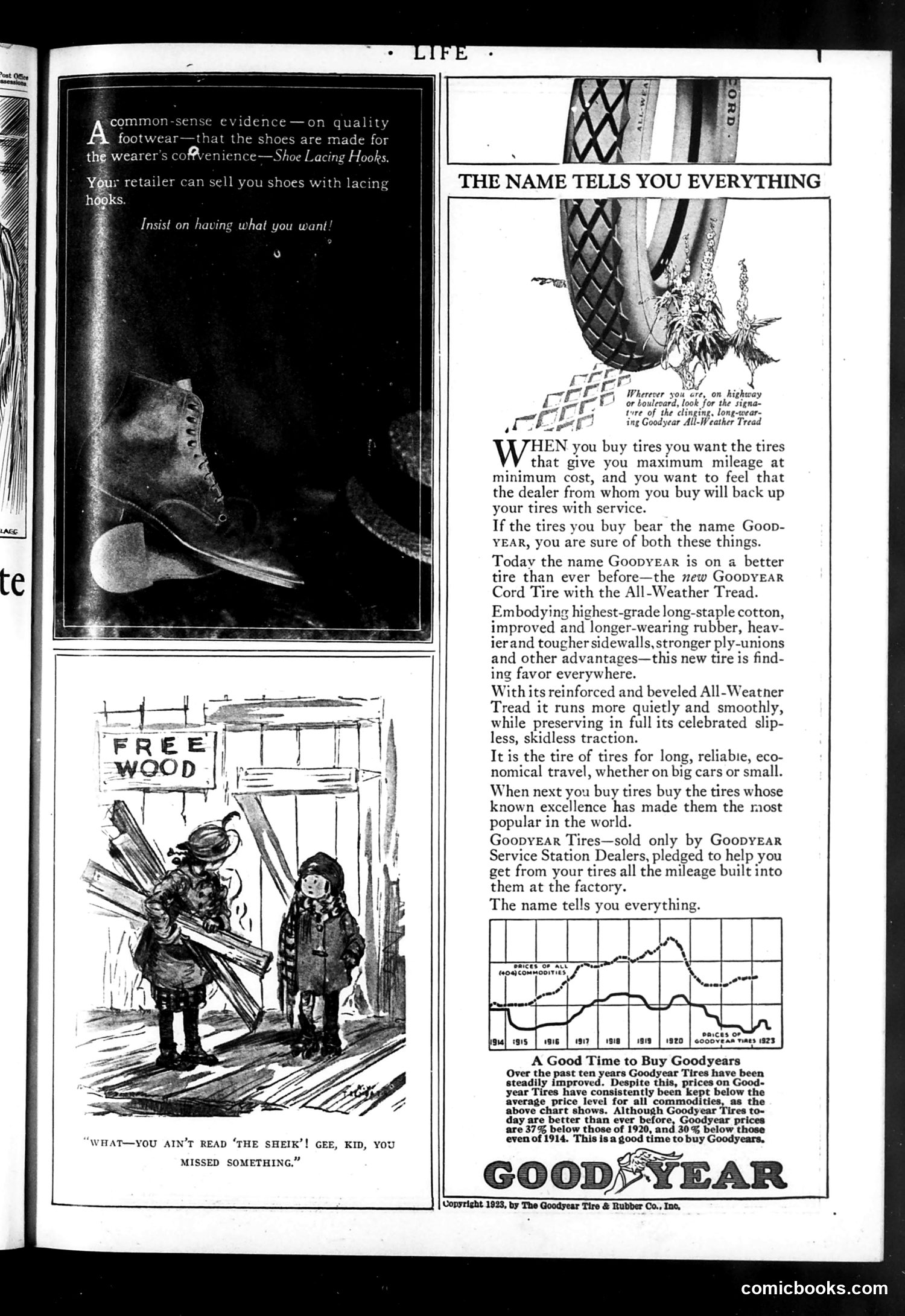
This page contains **primarily advertising**, not political satire. The left side features a Goodyear shoelace hook advertisement and a cartoon about free firewood with the caption "What—you ain't read 'The Sheik'? Gee, kid, you missed something." This references the popular 1921 film "The Sheik," using it as a humorous selling point—a common advertising technique that name-dropped trendy cultural products. The right side is a full Goodyear Tires advertisement. The main "joke" is marketing-based: emphasizing that the Goodyear brand name guarantees quality, reliability, and fair pricing. A chart shows tire prices declining over several years despite improvements, positioning Goodyear as both superior and economical. There is no political content here—this is pure commercial promotion from 1922.
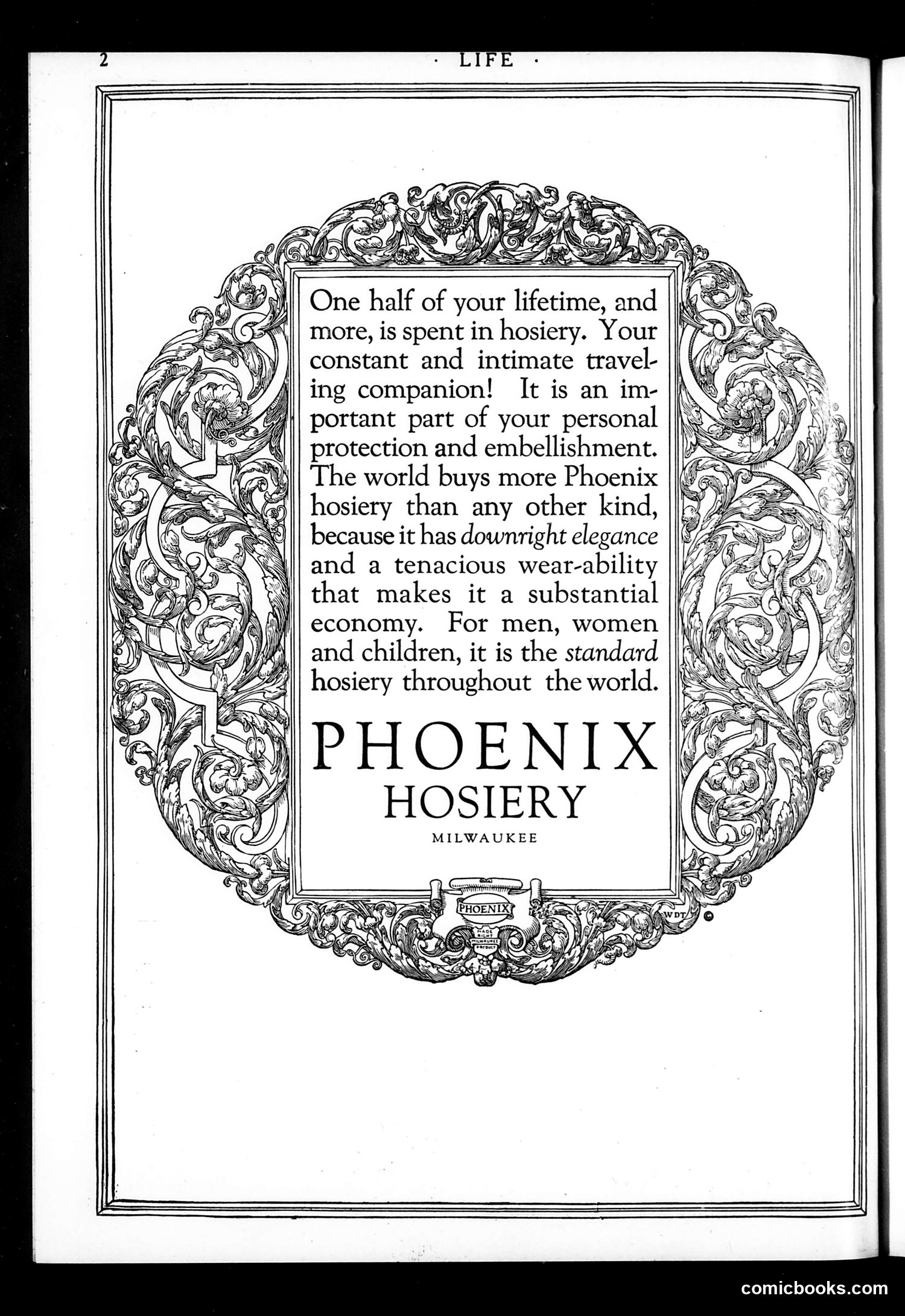
This page is **not satire or a political cartoon** — it's a straightforward commercial advertisement for Phoenix Hosiery, manufactured in Milwaukee. The ad uses ornate decorative framing typical of early-20th-century magazine design. The text makes marketing claims that hosiery is essential for "personal protection and embellishment" and that Phoenix brand outsells competitors due to its "downright elegance" and durability. It emphasizes universal appeal: "for men, women and children, it is the standard hosiery throughout the world." The rhetoric is hyperbolic by modern standards — claiming people spend "one half of your lifetime, and more" in hosiery — but this represents genuine period advertising strategy, not satire.
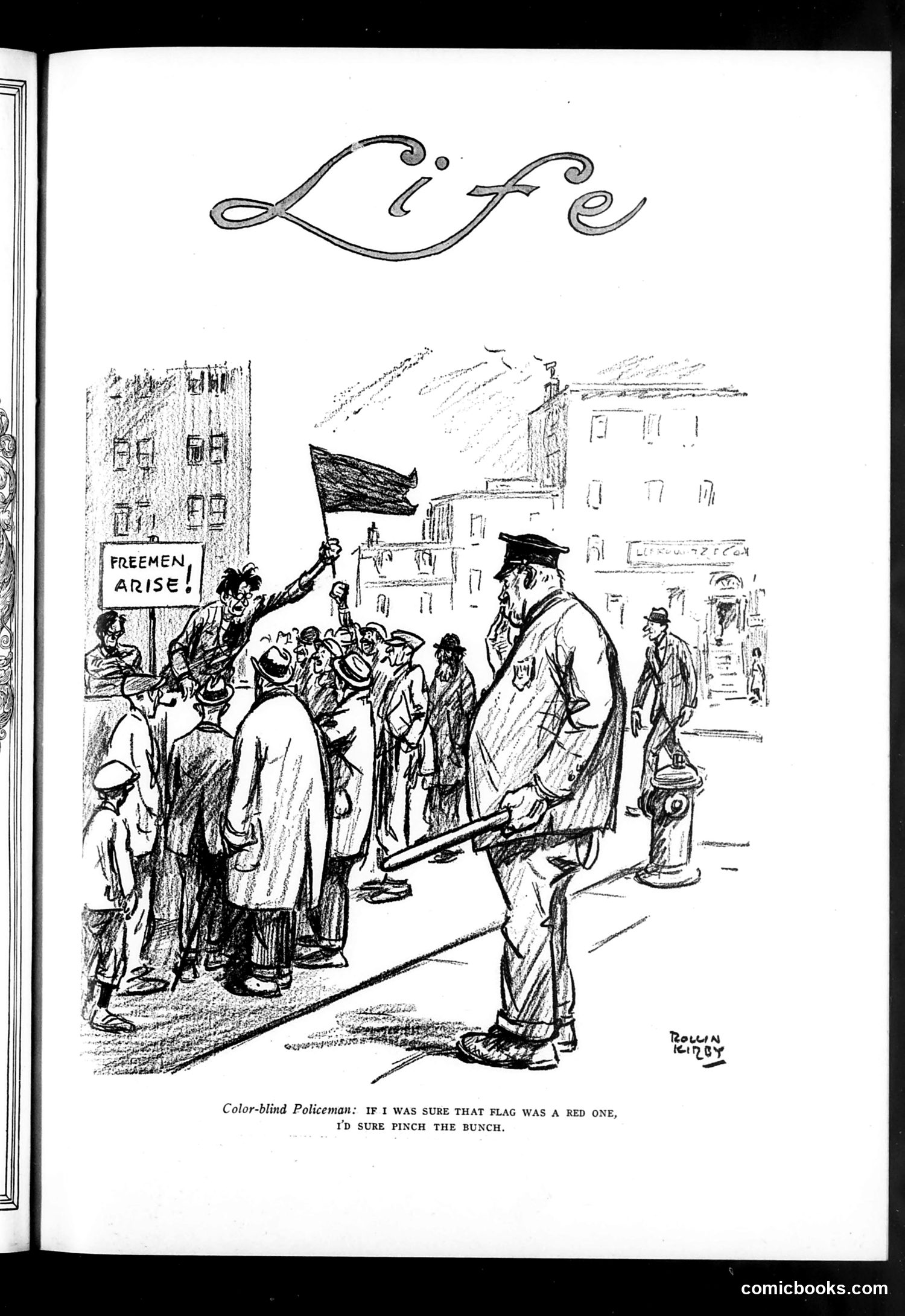
This cartoon satirizes police indifference or incompetence during civil unrest. A policeman stands passively watching a crowd gather around a sign reading "FREEMEN ARISE!" while someone waves what appears to be a revolutionary flag. The caption reads: "If I was sure that flag was a red one, I'd sure pinch the bunch." The joke targets the officer's claimed inability to identify the flag's color—a pretense for inaction. The satire suggests police deliberately ignore seditious activity or political upheaval by feigning uncertainty about details. The "color-blind" metaphor implies willful blindness to subversion. The cartoon likely reflects early 20th-century anxieties about labor unrest, socialism, or revolutionary movements, with police portrayed as either incompetent or complicit in allowing radical organizing.
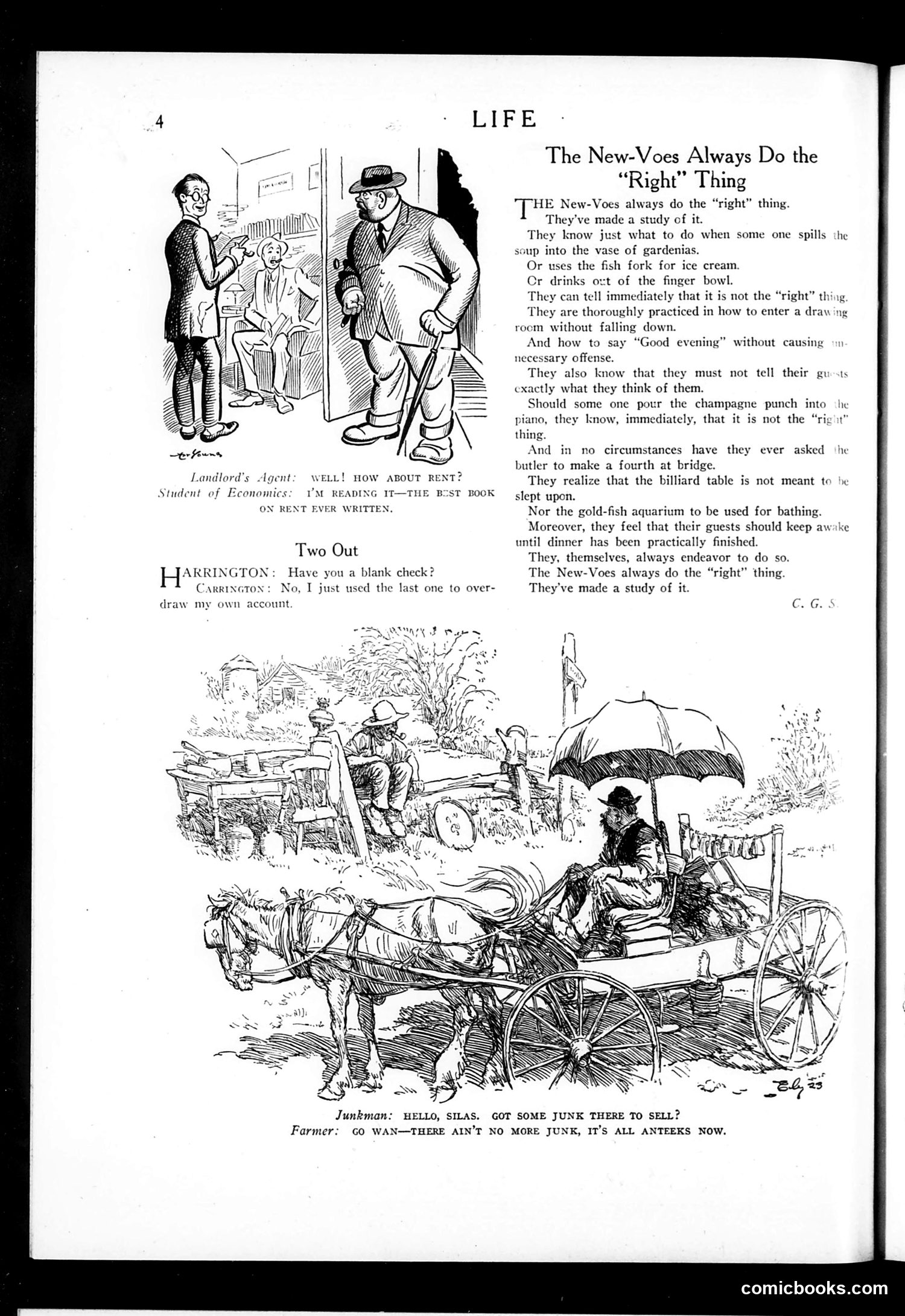
This page contains three separate humor pieces: 1. **"The New-Voes Always Do the 'Right' Thing"** - A satirical article mocking upper-class social pretension. It humorously catalogs etiquette rules the wealthy obsess over (using fish forks correctly, entering drawing rooms gracefully) while implying their actual behavior is often crude or inconsiderate. 2. **"Two Out"** - A brief joke where Carrington admits he used his last blank check to overdraw his account, playing on financial irresponsibility. 3. **"Junkman" cartoon** - Shows a farmer rejecting a junkman's offer, claiming "there ain't so more junk, it's all anteeks now"—likely a post-WWI satire about how Americans were treating old items as valuable antiques rather than discarding them as junk. The overall theme reflects early 20th-century American class anxieties and economic commentary.
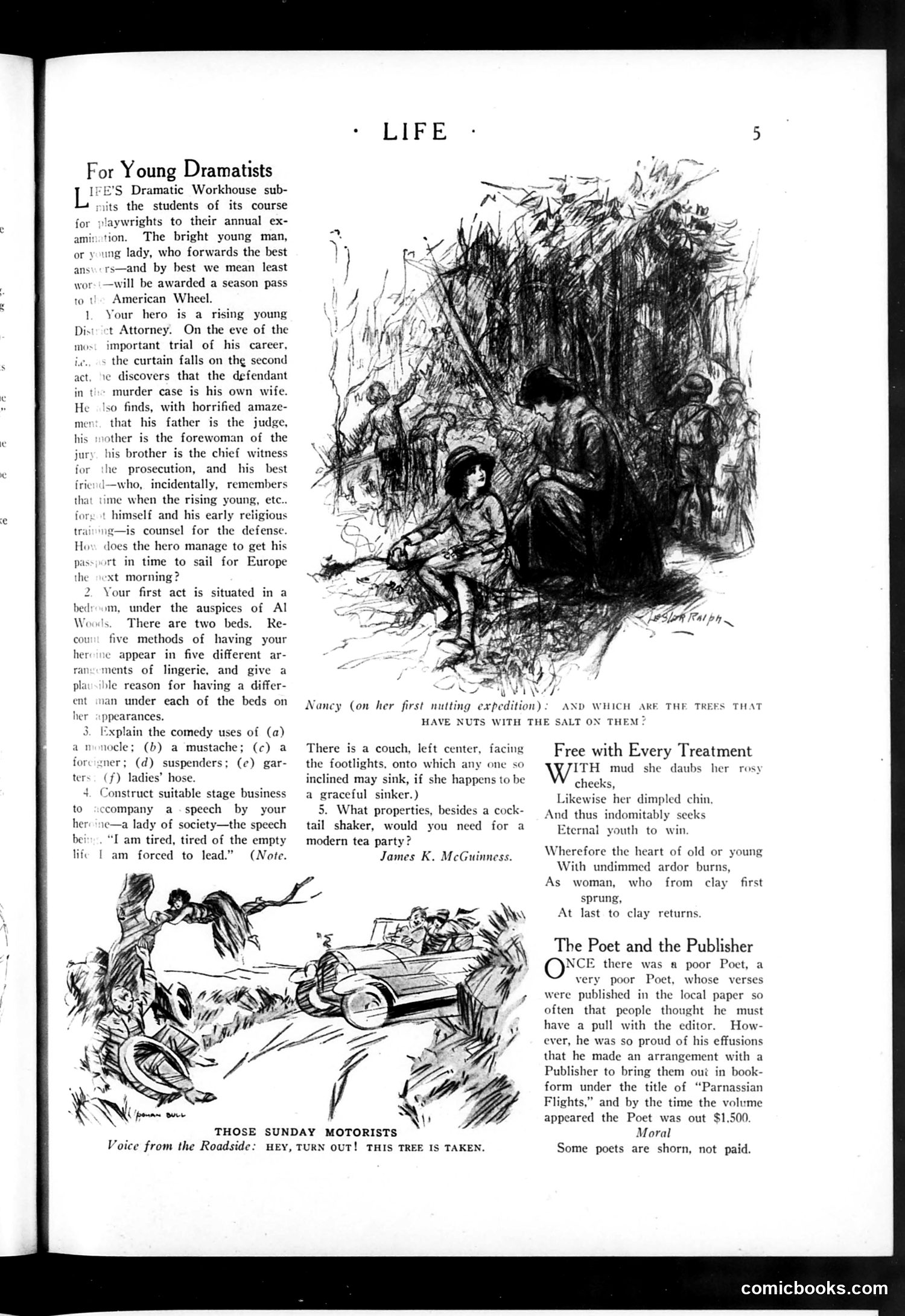
This cartoon satirizes early automobile culture, specifically reckless Sunday drivers. The sketch shows a chaotic collision scene with a car striking a tree, debris flying, and a voice from the roadside warning "HEY, TURN OUT! THIS TREE IS TAKEN." The humor targets wealthy leisured classes who drove automobiles recreationally on weekends ("Sunday motorists"), treating country roads as playgrounds while endangering others and property. The caption's sardonic tone—as if trees must be claimed like parking spots—mocks drivers' careless attitude toward both infrastructure and public safety. This reflects 1910s-era anxieties about automobiles as dangerous novelties operated by inexperienced, overconfident drivers more interested in speed and thrills than safety.
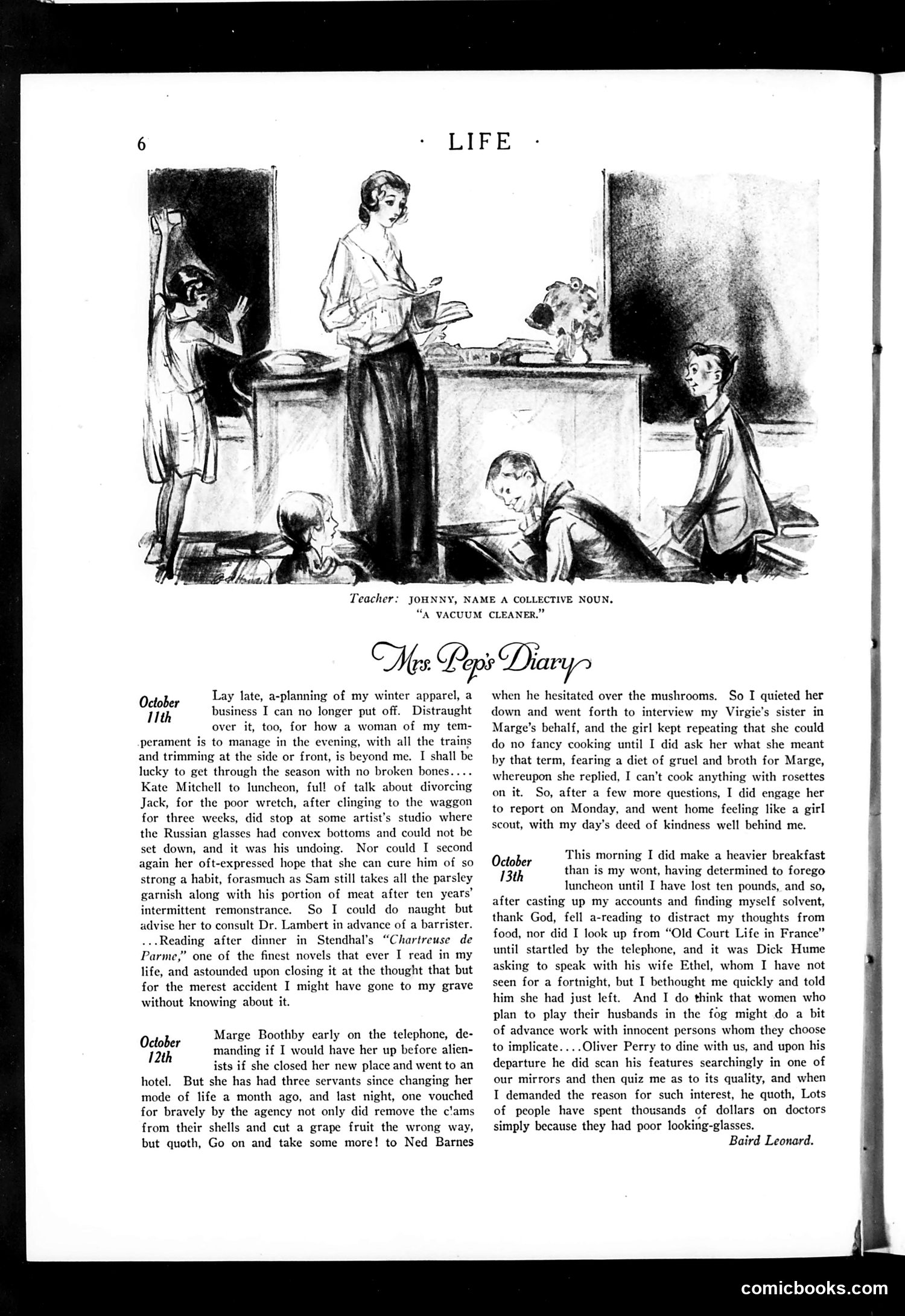
The cartoon at top satirizes a schoolteacher's attempt to modernize vocabulary instruction. The caption reads: "Teacher: JOHNNY, NAME A COLLECTIVE NOUN. 'A VACUUM CLEANER.'" This is a joke about linguistic innovation and domestic technology. The humor hinges on the child's literal interpretation—a vacuum cleaner is indeed a "collective" device that gathers/collects dirt. However, in grammar, "collective nouns" refer to words denoting groups of people or animals (like "flock" or "jury"), not machines. The satire appears directed at how new household technology was entering everyday language and domestic practice in this era, while also poking fun at either the child's cleverness or the absurdity of modern educational scenarios. The accompanying text is "Mrs. Pep's Diary," a domestic humor column with social commentary about housewives' lives.
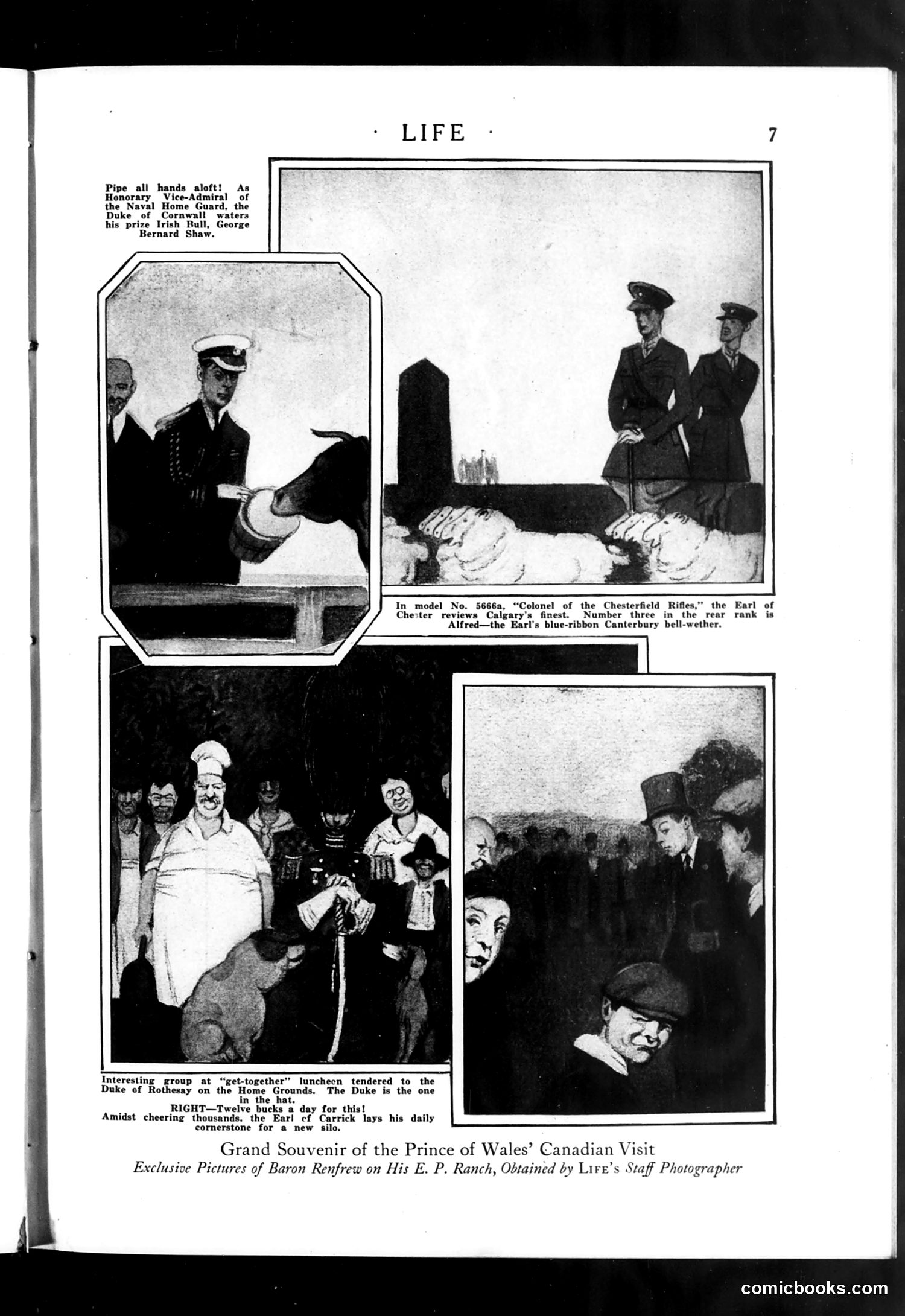
This page from *Life* magazine documents the Prince of Wales's Canadian visit, presenting "exclusive pictures" obtained by the magazine's photographer from Baron Renfrew's E.P. Ranch. The four photographs show: 1. **Top left**: A naval officer (likely the Prince) receiving or examining something 2. **Top right**: Two men in formal dress standing outdoors near what appears to be a castle or manor 3. **Bottom left**: A group at a "get-together" luncheon hosted by the Duke of Rothesay, with one figure notably large (possibly satirizing someone's appetite—the caption jokes "Twelve bucks a day for this!") 4. **Bottom right**: Close-up portraits of attendees The satire appears gentle, focusing on the contrast between formal royal protocol and casual ranch life, with mild humor about the social gathering's pretensions.
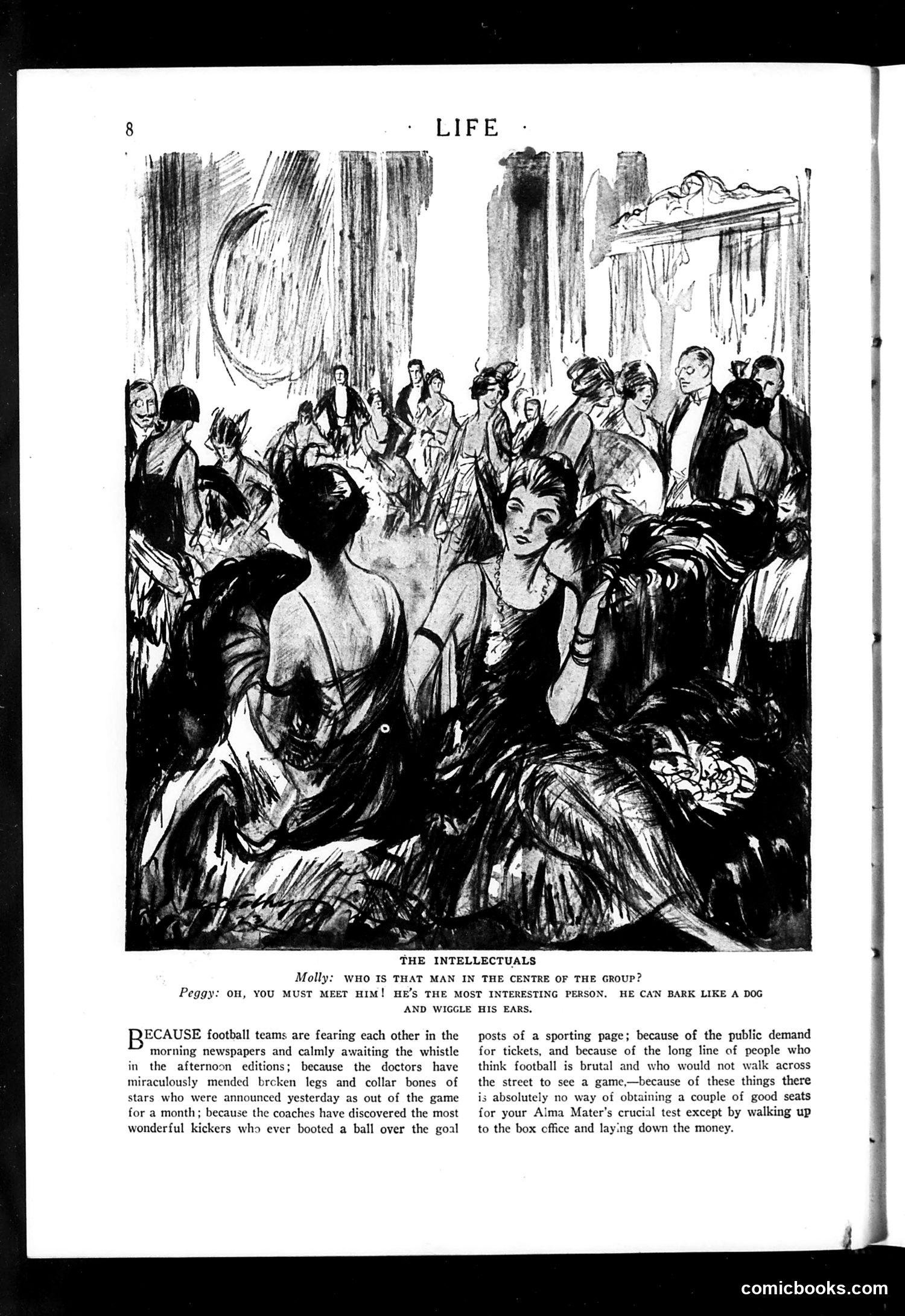
This satirical illustration depicts a crowded social gathering, likely at an upscale venue or salon. The caption presents a humorous dialogue between "Molly" and "Peggy" about an unnamed man in the center of the group, described as "the most interesting person" who can "bark like a dog and wiggle his ears." The accompanying text discusses why football has become so popular—citing broken bones, mended legs, public demand for tickets, and the sport's brutal reputation. The satire appears to mock how the fashionable intellectual crowd finds entertainment value in crude or primitive behavior, conflating this with genuine sophistication. The cartoon critiques how society's "intellectuals" celebrate trivial or base amusements as profound cultural moments.
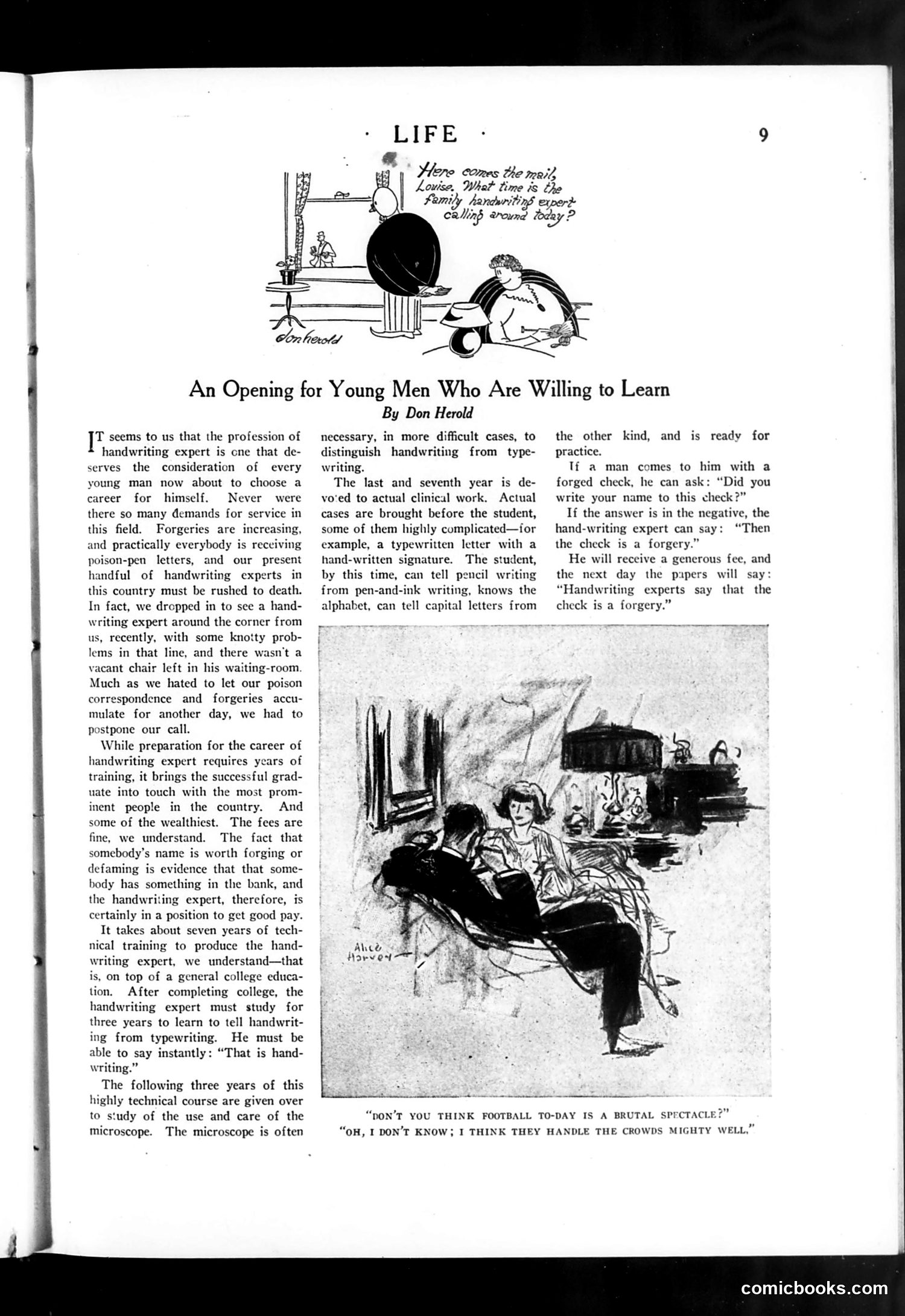
This page contains an article by Don Herald titled "An Opening for Young Men Who Are Willing to Learn" about careers in handwriting expertise and document authentication. The article discusses training requirements and the professional demand for such specialists. The cartoon at bottom depicts two men at a football stadium. One asks if football is "a brutal spectacle," and the other replies he doesn't know but thinks "they handle the crowds mightily well." The joke contrasts concern about violence *in* the sport with admiration for crowd *management*—redirecting the question from player safety to logistical efficiency. This appears to be early 20th-century social commentary, possibly satirizing misplaced priorities or public indifference to athlete welfare during a period when football was genuinely dangerous and largely unregulated.
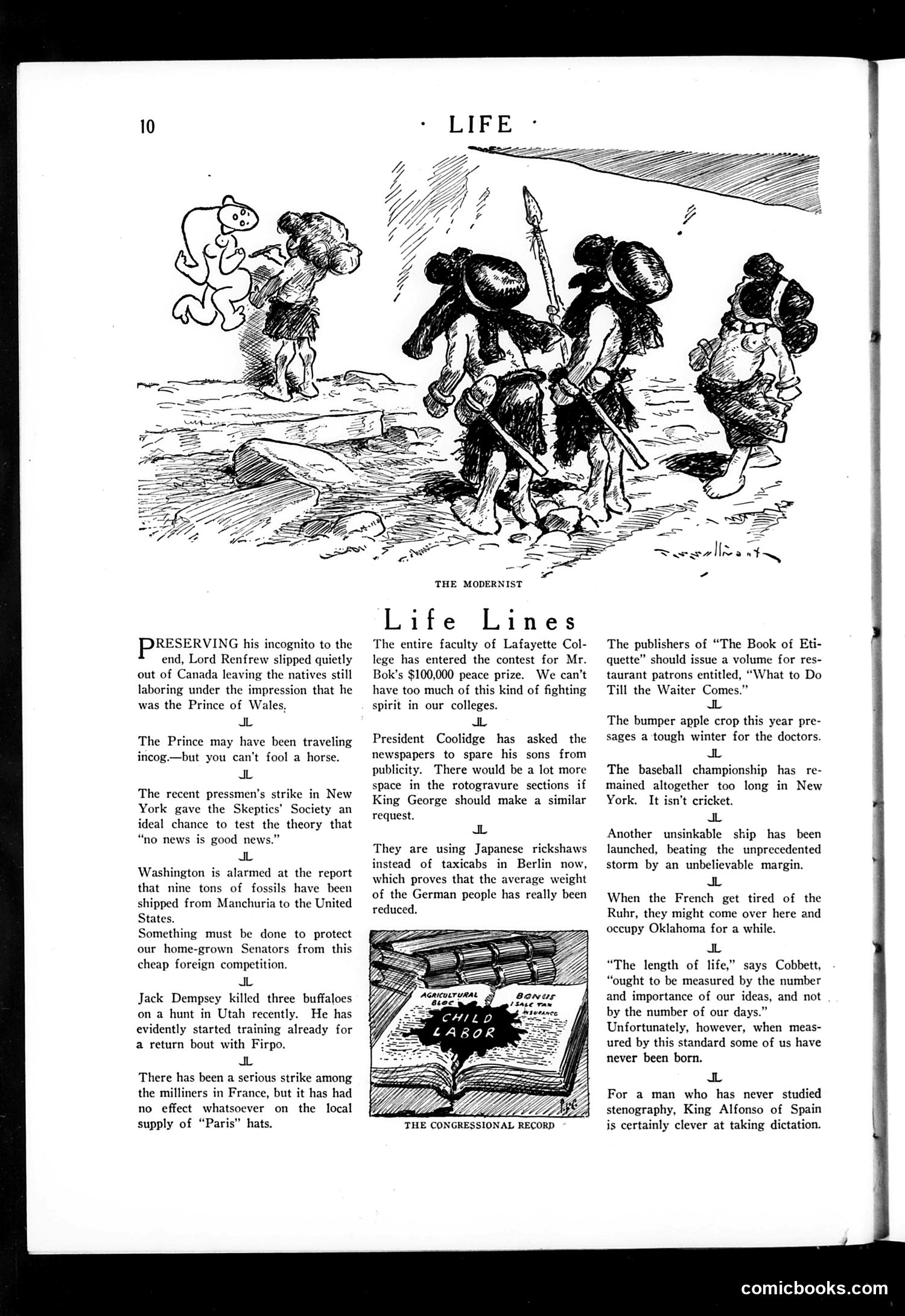
**The Main Cartoon ("The Modernist")** depicts what appears to be a figure in Western/cowboy attire encountering Native Americans in traditional dress with weapons and shields. The satire likely mocks early 20th-century "modernism" or progressive attitudes—suggesting that despite contemporary claims of civilization and progress, violence and primitive conflict persist. **The "Life Lines" section** contains brief satirical commentary on contemporary issues: the Prince of Wales traveling incognito, newspaper strikes, concerns about foreign goods, Jack Dempsey's hunting exploits, and labor disputes in France. **The Congressional Record cartoon** shows an open book labeled "Child Labor" contrasted with pages for "Agricultural" and "Domestic" concerns, satirizing government priorities regarding child labor legislation. The overall tone mocks contemporary American social and political contradictions.
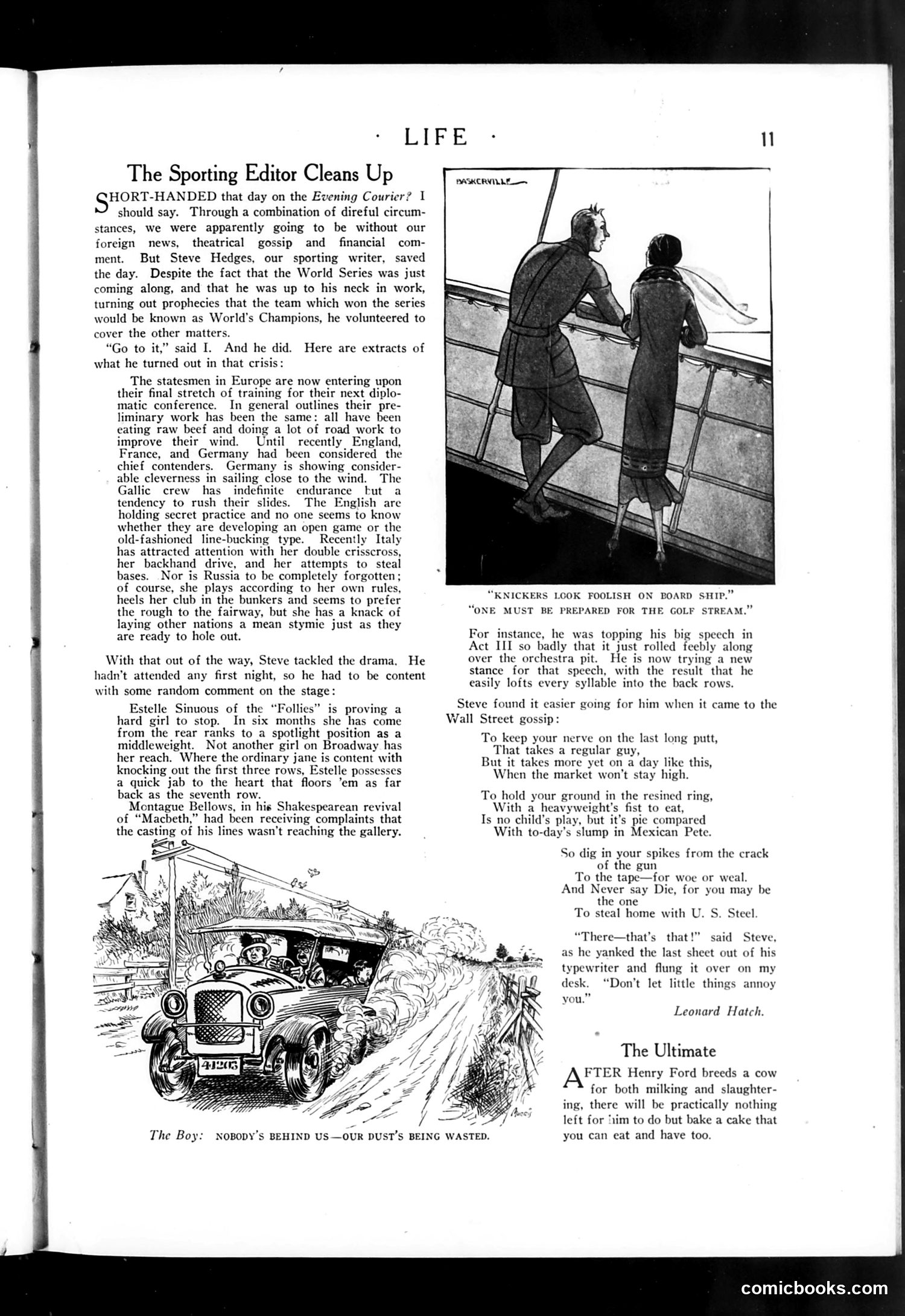
This page contains two separate pieces: **"The Sporting Editor Cleans Up"**: A prose article by Leonard Hatch describing how sports writer Steve Hedges covered various matters when the Evening Courier needed coverage during the World Series. The text humorously details diplomatic conferences in Europe and Wall Street gossip—satirizing how a busy journalist must scramble to cover unrelated topics outside his expertise. **"The Boy" cartoon**: Shows a vintage automobile kicking up dust on a rural road, captioned "NOBODY'S BEHIND US—OUR DUST'S BEING WASTED." This appears to be satire about wasteful excess or showing off—the humor lies in the driver's complaint that their impressive dust cloud has no audience to witness it. **"The Ultimate"**: A brief joke about Henry Ford breeding dual-purpose cows, suggesting efficiency-obsessed industrial culture.
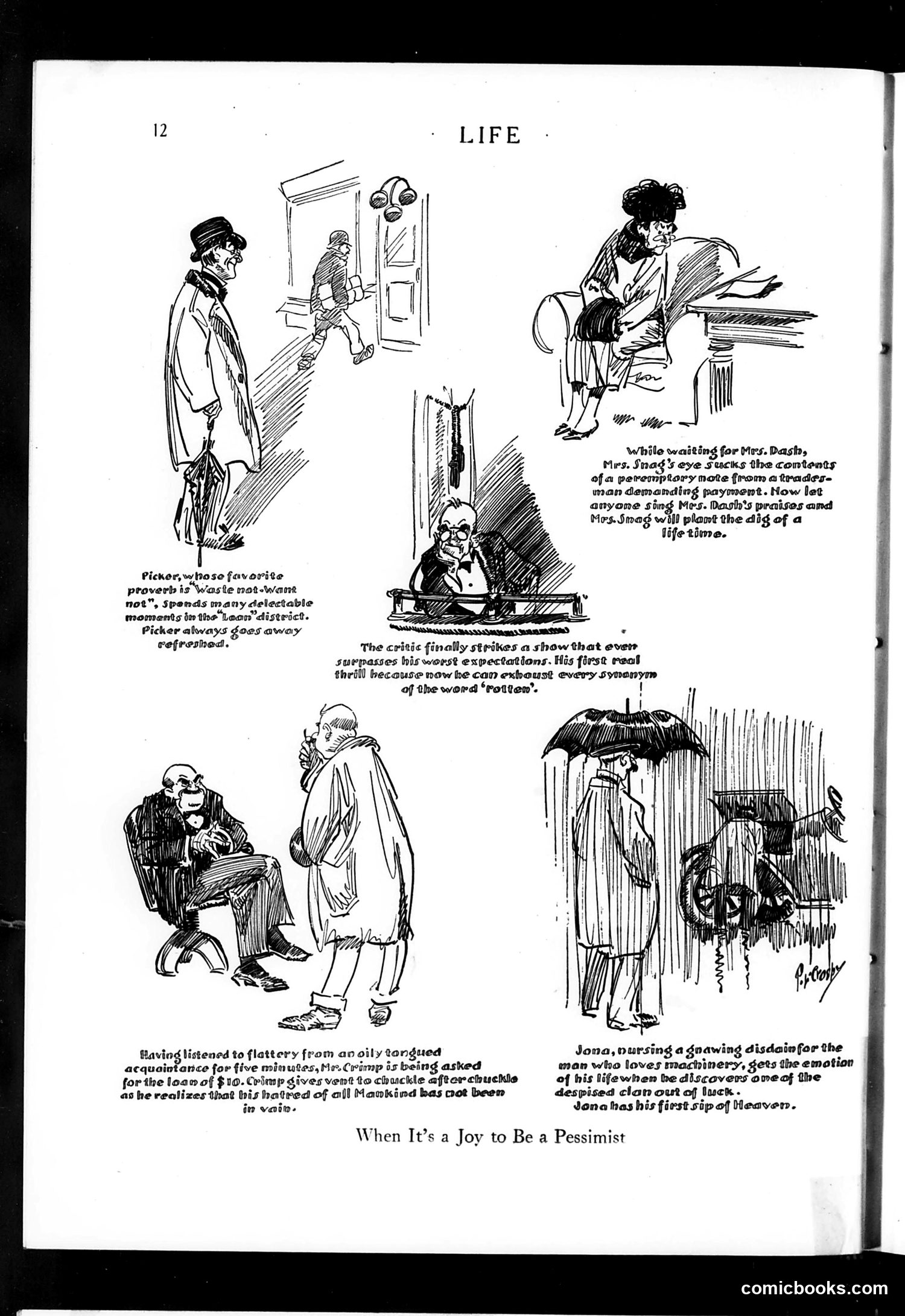
This satirical page depicts five scenarios celebrating pessimistic attitudes. Each cartoon shows someone whose gloomy expectations are rewarded: 1. **Pickwick** (upper left): A man whose favorite proverb is "waste not—want not" is refreshed when someone leaves. 2. **Mrs. Dash** (upper right): While waiting for her, a man with low expectations of her eye-work discovers she actually does the job well. 3. **The Critic** (center): A theater critic's pessimism about a show proves justified when it exceeds his worst expectations. 4. **Mr. Crimp** (lower left): His low expectations about losing money are rewarded. 5. **Jona** (lower right): A nurse caring for a gravely ill patient discovers unexpected recovery—defying pessimistic assumptions. The overall message satirizes how pessimists often experience pleasant surprises when reality exceeds their low expectations.
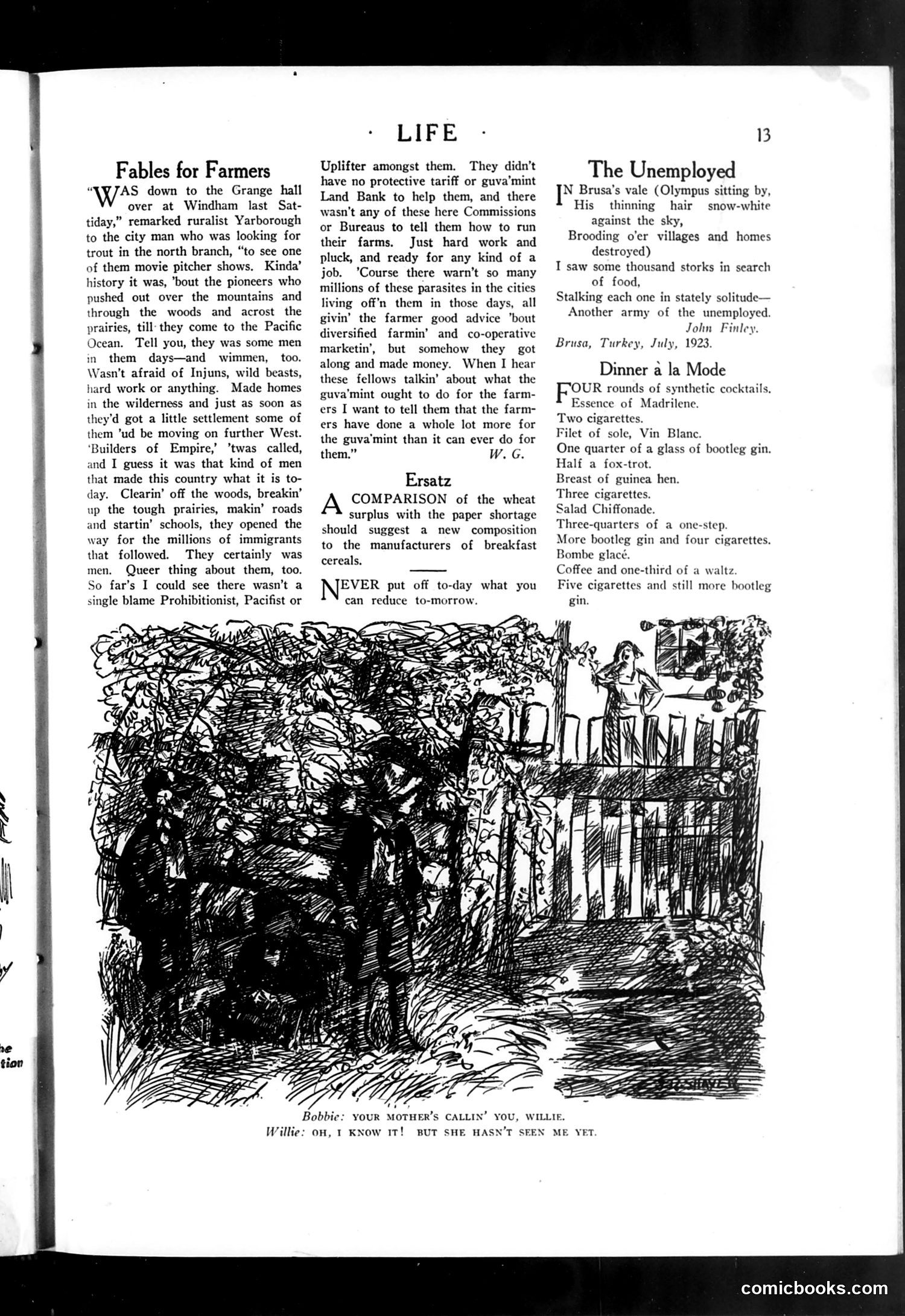
This page contains several distinct pieces of social commentary from 1923: **"Fables for Farmers"** (left column) criticizes federal agricultural policy. A rural narrator argues that government commissions and "Bureaus" offer farmers unhelpful advice about "diversified farmin'" and cooperative marketing, while farmers themselves have proven more economically successful through hard work. **"The Unemployed"** (right) presents a grim poem by John Finley about jobless men searching for food—reflecting post-WWI economic hardship. **The cartoon** (bottom) depicts a rural scene with a humorous domestic exchange: a child ("Bobbie") calls to his mother that "Willie" is outside, and Willie responds that his mother hasn't seen him yet. The joke appears to reference childhood mischief or truancy. The page overall reflects 1920s concerns: agricultural policy failures and urban unemployment.
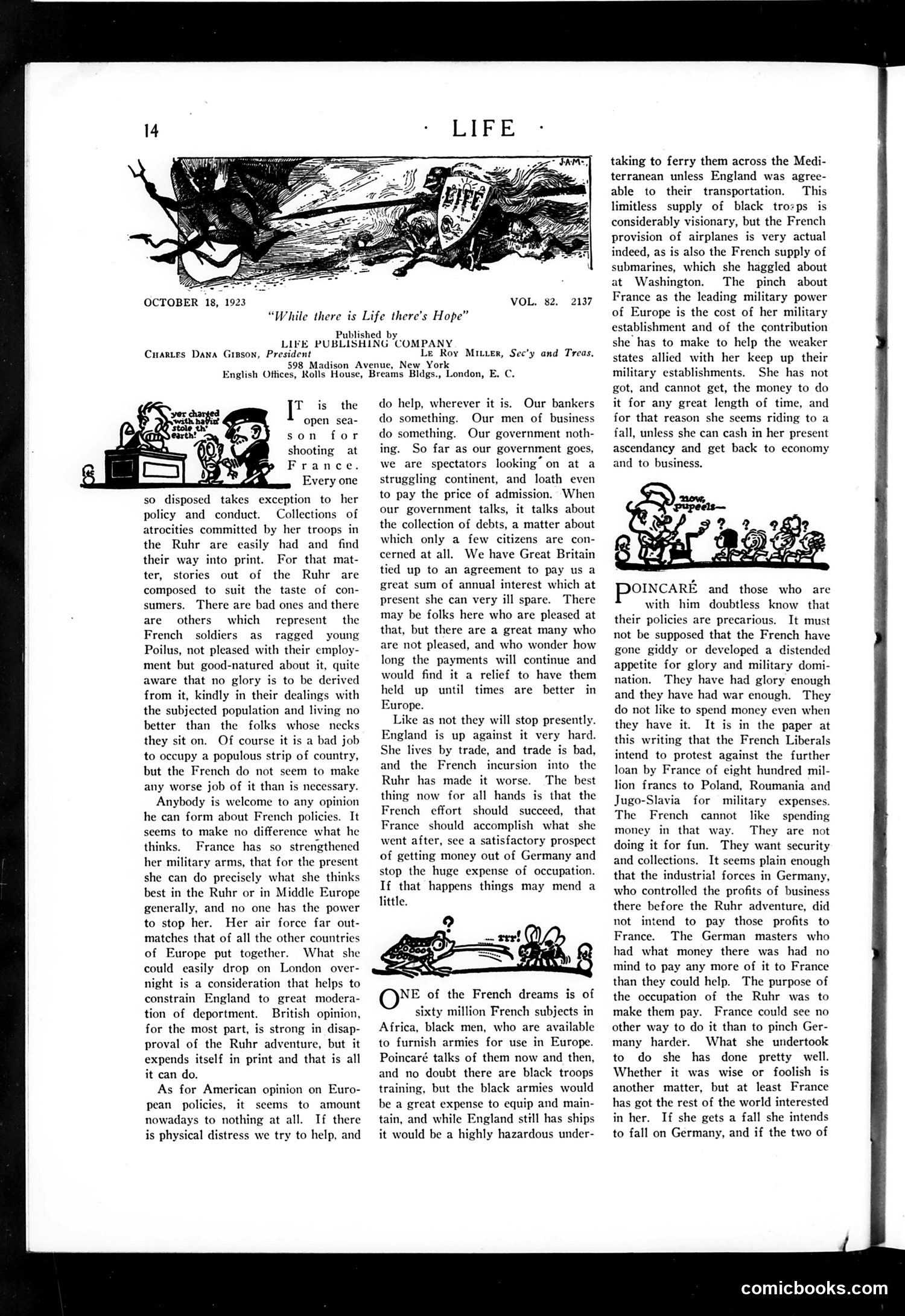
This page contains editorial commentary on post-WWI European politics, particularly French financial struggles and military expenses. The text criticizes France's expensive military establishment and her expectation that Britain and America should help fund it. The cartoons (appearing as small illustrations) depict figures in what appears to be political/financial distress—likely representing France or European nations dealing with war debts and reparations. The editorial argues France cannot afford her military costs alone and is pressuring allies for financial support, while also discussing France's colonial ambitions in Africa. The satire targets French diplomatic expectations and the broader difficulty of post-war European recovery and debt repayment among Allied nations. The text reflects American skepticism toward continuing European financial entanglements after WWI.
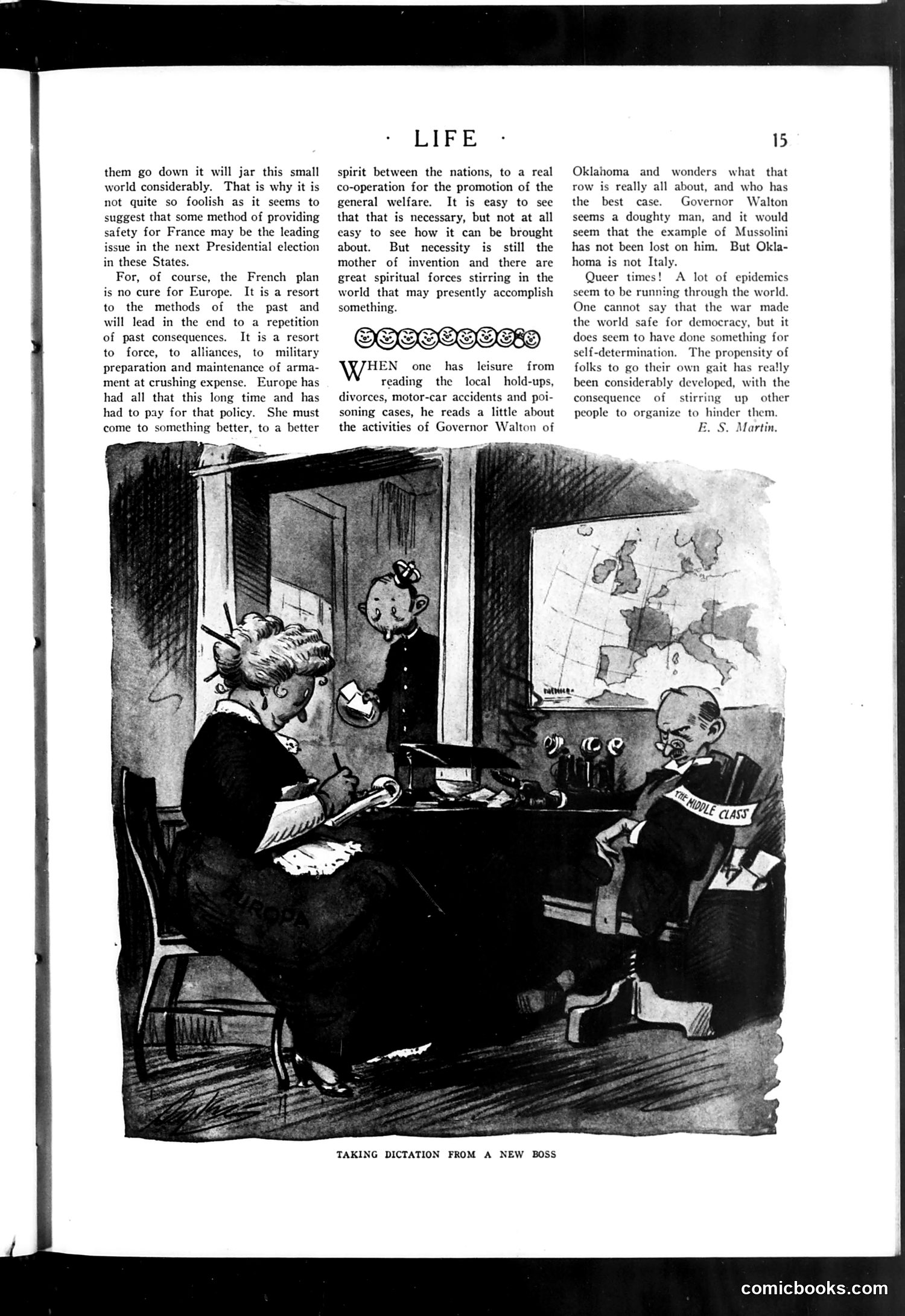
This cartoon satirizes the post-WWI political landscape. The image shows a woman (likely representing a European nation or the working class) taking dictation from a stern, clock-faced figure labeled "THE WORKING CLASS" — a personification of labor or socialist movements gaining political power after the war. The map on the wall suggests international affairs are being reshaped. The satire mocks how working-class movements and labor organizers were gaining unprecedented political influence in the 1920s, particularly in Europe. The humor derives from the role reversal: traditionally, workers took orders from bosses; now the political order is inverted, with "the working class" as the new authority figure issuing commands. The cartoon reflects contemporary anxieties about socialist and labor movements reshaping post-war governance.
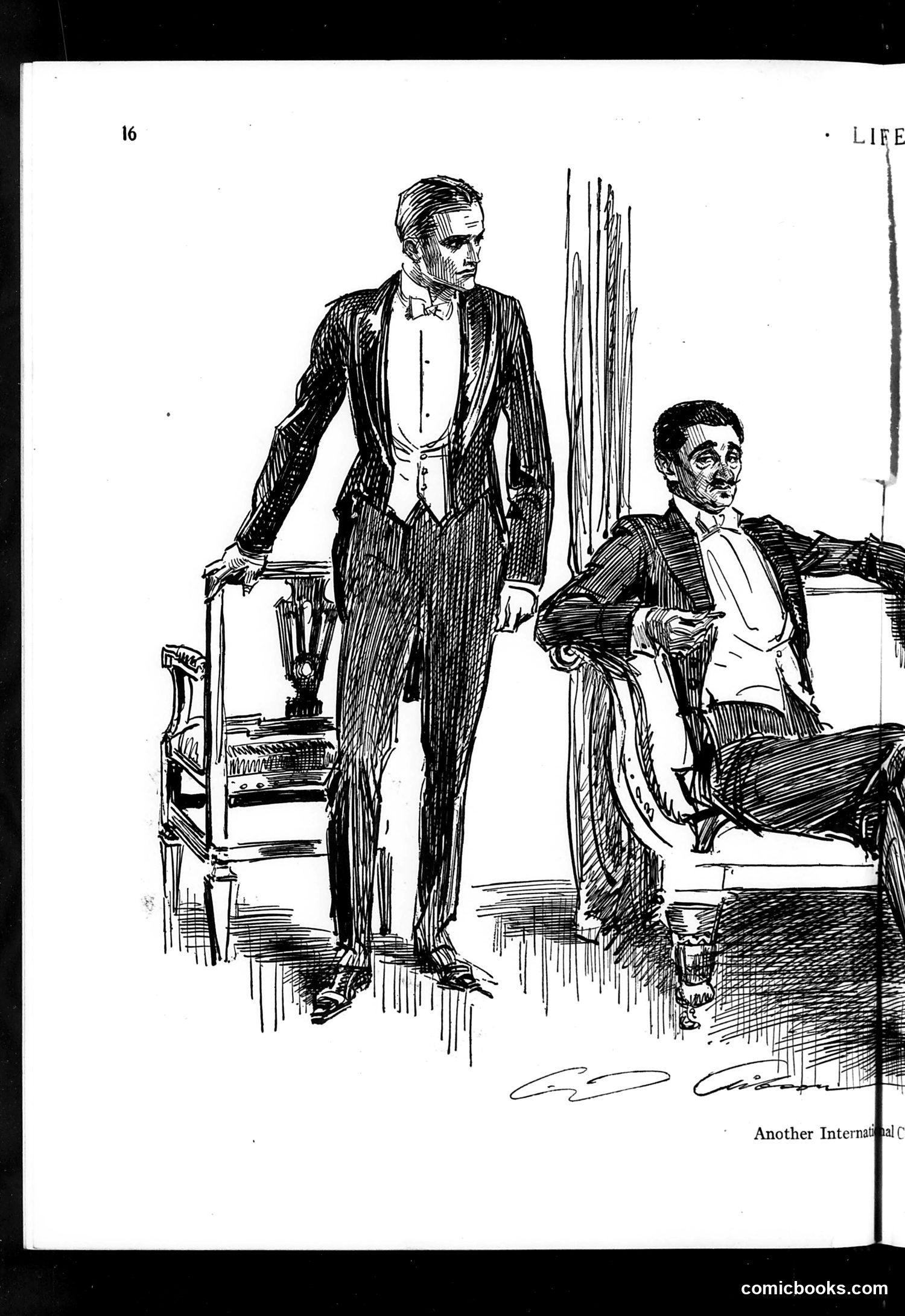
This page from *Life* magazine shows a formal interior scene with two well-dressed men in evening wear. The standing figure appears commanding and authoritative, while the seated figure seems deferential or subordinate. The incomplete caption reads "Another International..." suggesting this cartoon comments on international relations or diplomacy. The formal dress, interior setting, and body language suggest a power dynamic—possibly depicting diplomatic negotiations or political hierarchy between nations. However, without the complete caption or identifying context, I cannot definitively state which specific international figures or conflict this satirizes. The drawing style and formal composition are typical of early-20th-century *Life* magazine political commentary, but the specific historical reference remains unclear from the visible elements alone.
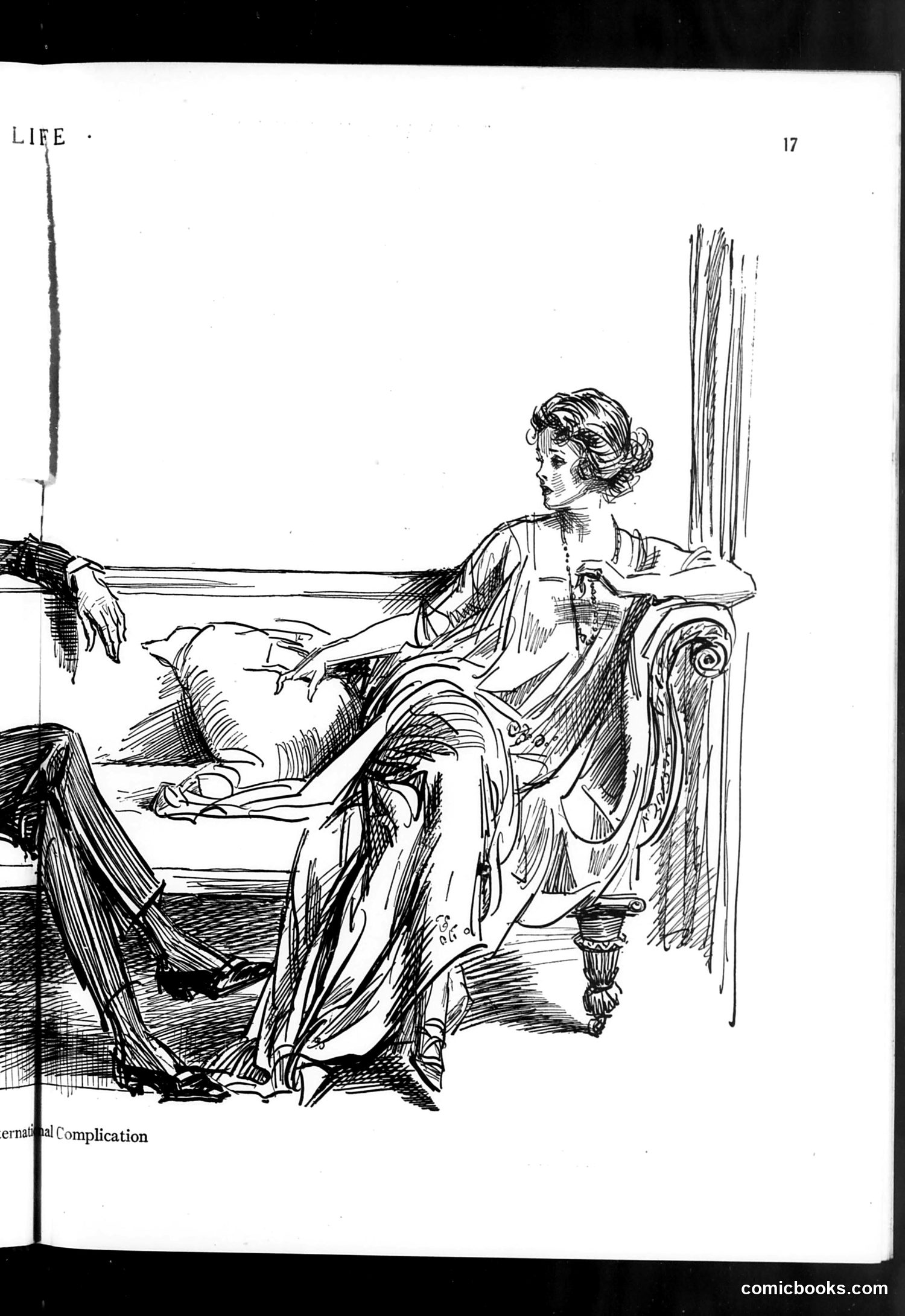
This page from *Life* magazine (page 17) appears to show a satirical scene titled "International Complication." The ink sketch depicts a woman in elegant early-20th-century dress reclining in a chair, while a man in formal attire sits nearby. The partial caption at bottom reads "ernatifhal Complication" (likely "International Complication"). The cartoon likely comments on diplomatic relations or romantic/romantic entanglement between nations—a common *Life* magazine trope where international affairs were depicted through social situations. The woman's relaxed, composed posture and the man's attentive presence suggest flirtation or complicated negotiations. However, without the complete caption or publication date visible, the specific political figures or international events referenced remain unclear.
This theater review discusses two 1923 Broadway revues: "The Nifties" (produced by Collier, Bernard, and Dillingham) and "Greenwich Village Follies" (by John Murray Anderson). The critic praises comedian William Collier's comedic talent over expensive production values, arguing that clever humor matters more than lavish scenery and costumes. The review playfully mocks "The Nifties" for attempting to compete with money-laden revues while operating on a tiny budget—using "oyster-crackers as legal tender." The piece also criticizes Anderson's prior revues for prioritizing spectacle over comedy, praising his recent shift toward vaudeville and burlesque acts for laughs. Specific performers are highlighted: acrobats William and Joe Mandell, dancers "The Two Briants" and Buster West, and comedians Tom Howard and Denman Maley. The underlying satire critiques Broadway's obsession with expensive production design at the expense of actual entertainment value—a debate relevant to 1920s theater economics.
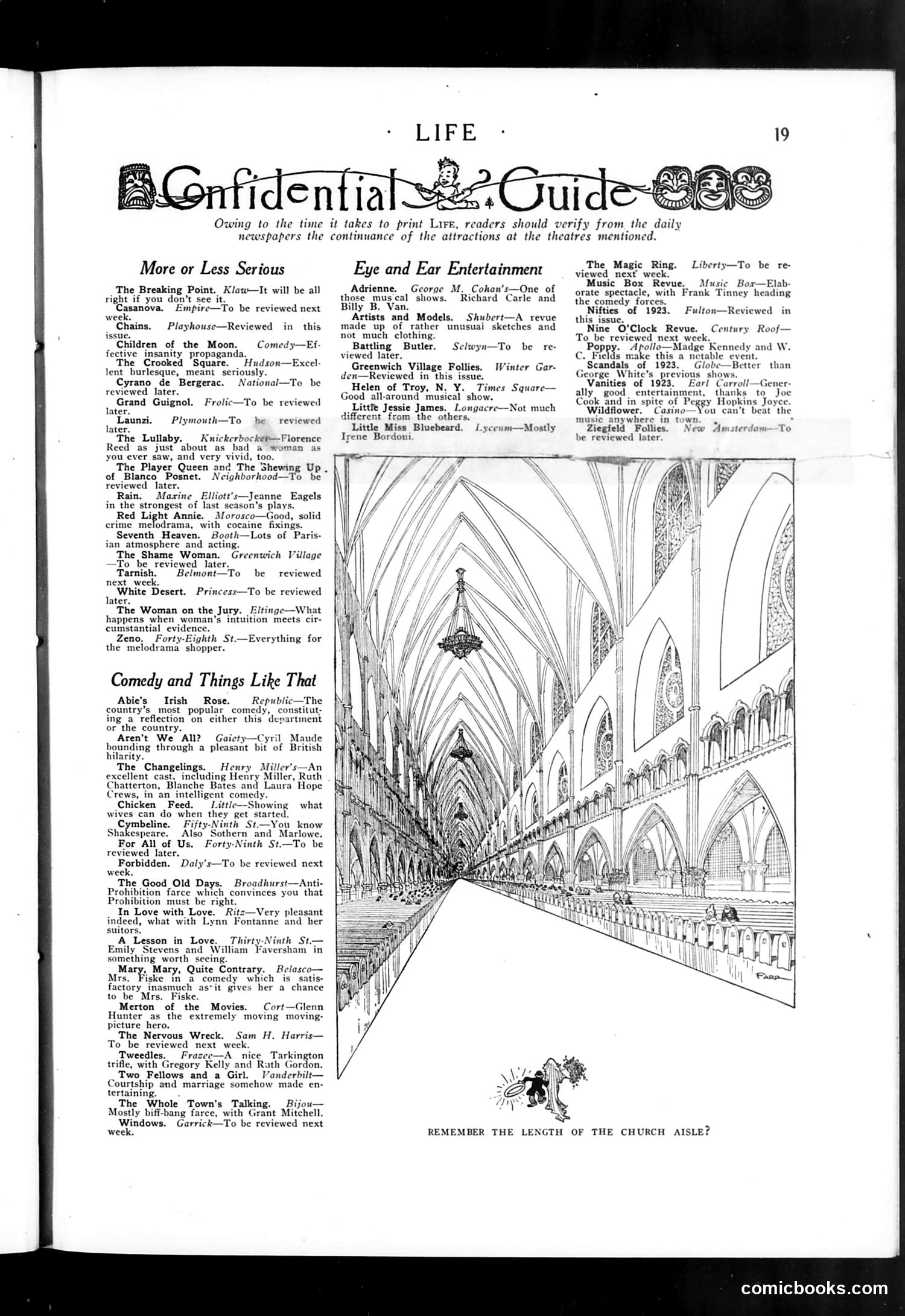
This page is a theater review guide listing Broadway productions currently running. The large architectural illustration depicts the interior of a grand cathedral or theater, emphasizing the scale and grandeur of theatrical venues of the era. The reviews are organized by category: "More or Less Serious" dramas, "Comedy and Things Like That," and "Eye and Ear Entertainment" (musicals and revues). The tone is witty and dismissive—critics describe plays with backhanded compliments ("excellent burlesque, meant seriously") and sardonic brevity. Notable entries include *Abie's Irish Rose* (called "the country's most popular comedy, constituting a reflection on either this decade or the country") and *The Good Old Days*, an "Anti-Prohibition farce which convinces you that Prohibition must be right"—suggesting the reviewer's skepticism about both the play's quality and contemporary temperance laws. The caption below the cathedral asks: "REMEMBER THE LENGTH OF THE CHURCH AISLE?"—likely a theatrical in-joke about dramatic pacing or romantic plot resolutions.
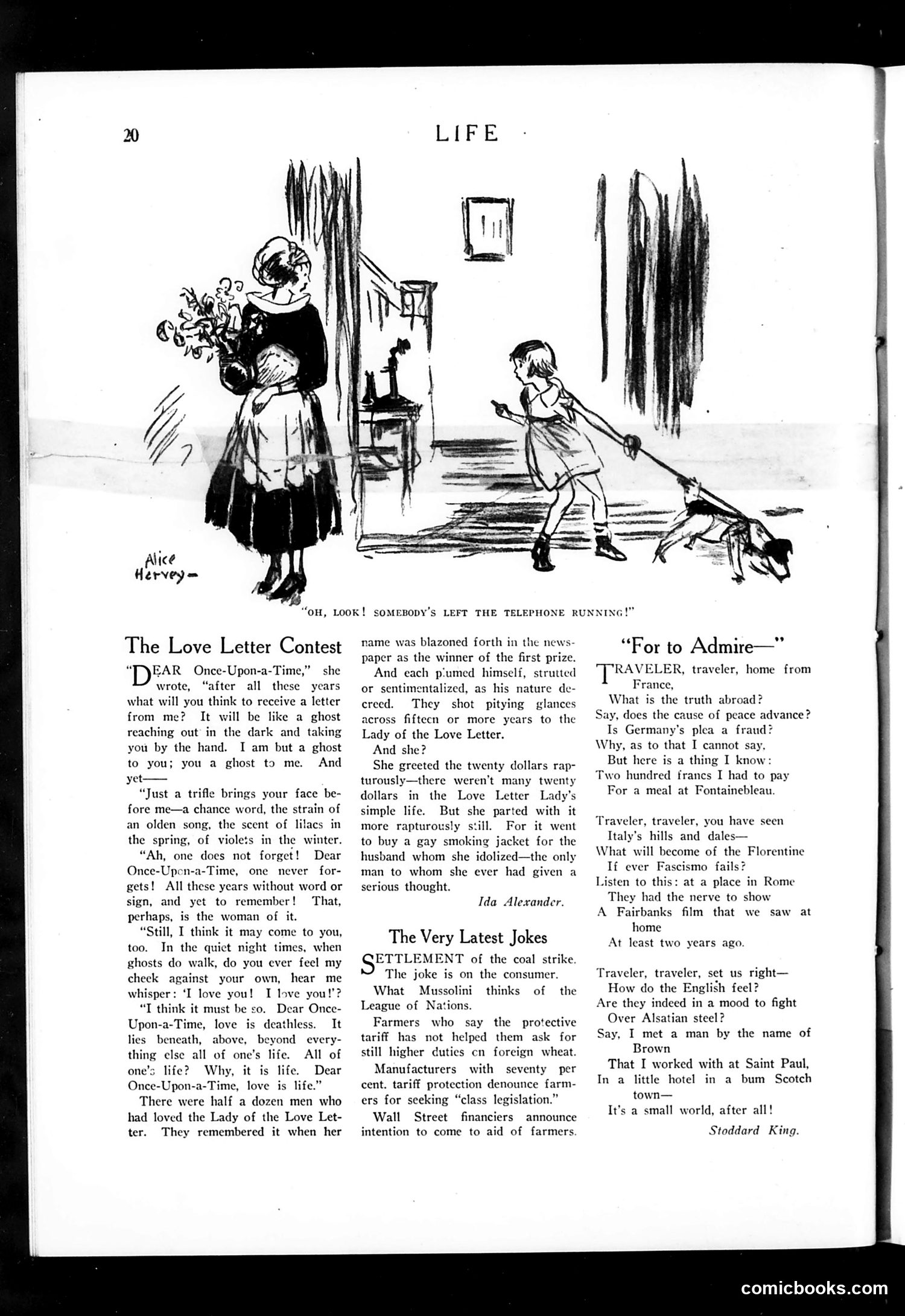
**The Cartoon** (top): Shows a woman, child, and dog in a home with a woman on the telephone. The caption "Oh, Look! Somebody's Left the Telephone Running!" depicts a common domestic scenario where someone has carelessly left a phone off the hook—a mundane but relatable mishap of the era. The humor lies in this everyday inconvenience. **"The Love Letter Contest"** (middle): A sentimental short story about a woman who won a contest with a romantic letter about lost love. The ironic twist: she uses the $20 prize to buy a smoking jacket for her husband—the only man she ever truly loved. It's a gentle satire on overwrought romanticism versus domestic reality. **"The Very Latest Jokes"** and **"For to Admire"** (right): Brief satirical items mocking contemporary issues—coal strikes, tariff hypocrisy, and a traveler's observations about European pricing and politics. These are light social commentary rather than pointed political satire. The page reflects 1920s American attitudes: nostalgia, domestic humor, and skepticism toward European affairs.
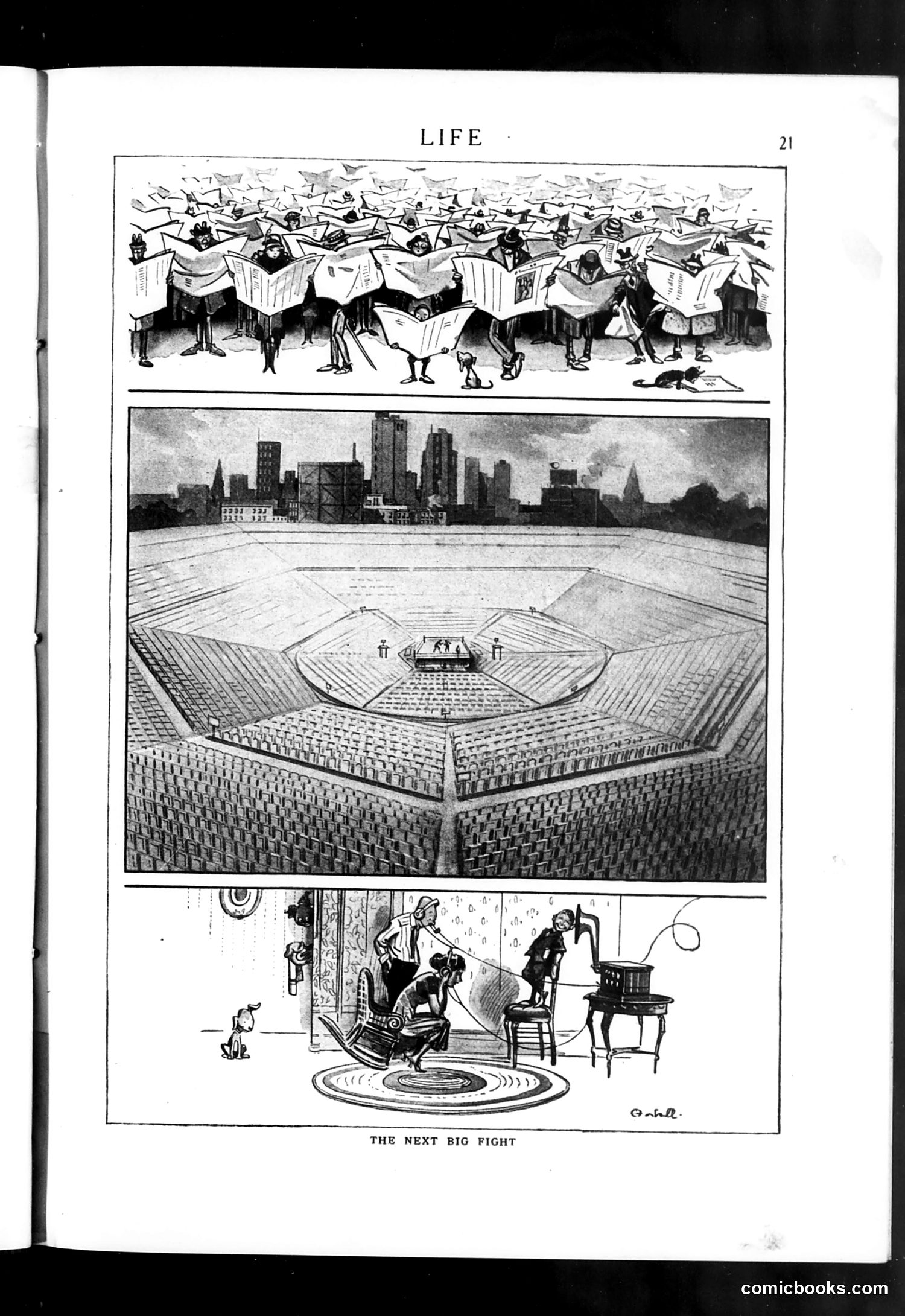
This page contains three satirical illustrations about boxing and sports culture. The top panel shows a crowd of spectators holding newspapers, suggesting media coverage of a major fight. The middle panel depicts a packed baseball stadium filled with spectators, with a city skyline in the background—likely representing the enormous public interest in sporting events. The bottom cartoon, titled "The Next Big Fight," shows people in a home gathered around what appears to be a radio or broadcast device, with one figure swinging at another. The joke satirizes how Americans obsess over boxing matches: the "next big fight" isn't necessarily in the ring, but rather domestic conflict being played out in ordinary homes, possibly fueled by heated discussion of sporting events or media sensationalism surrounding boxing.
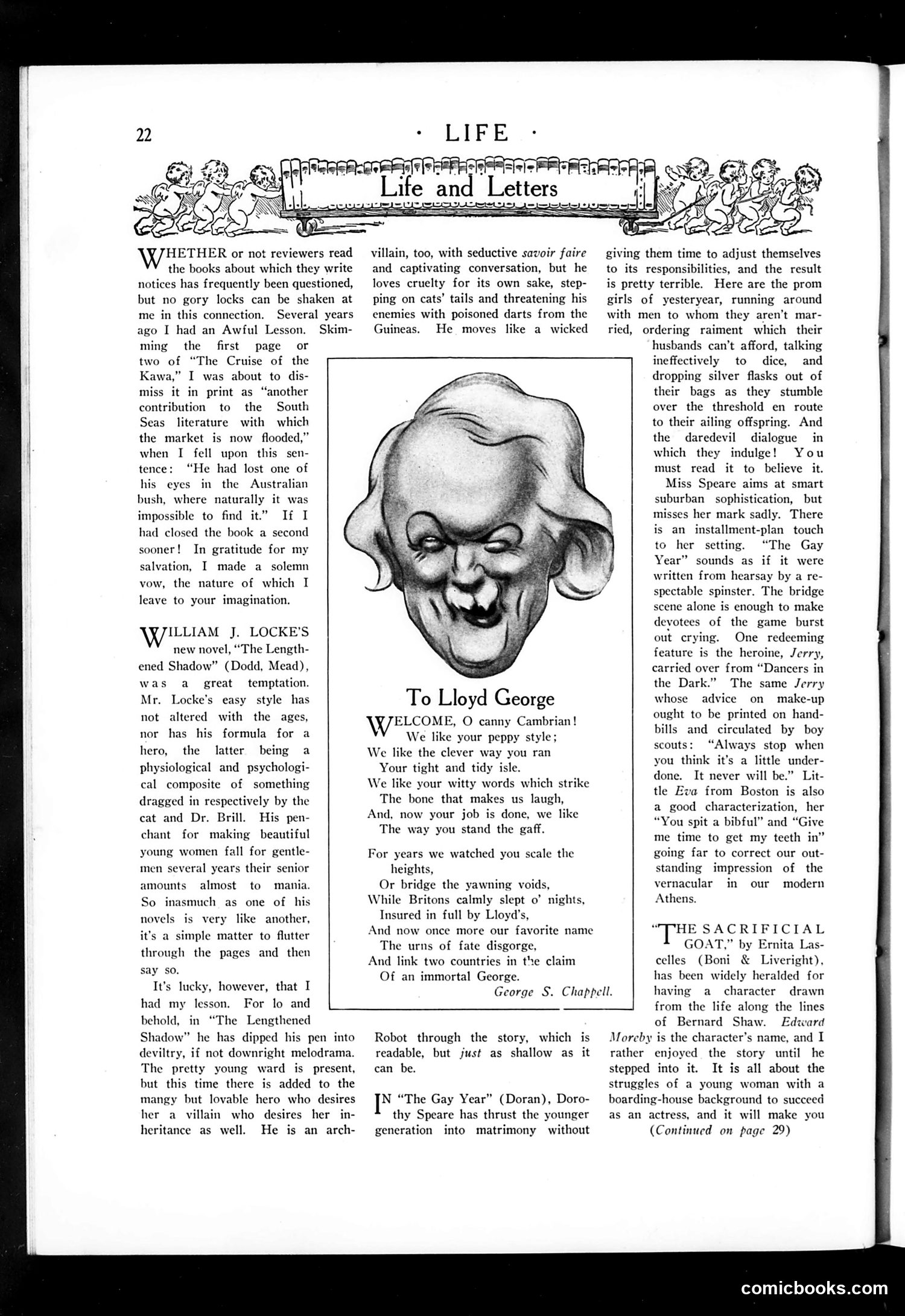
This page contains literary reviews and a political poem, not political cartoons. The single illustration is a grotesque face—likely decorative ornamentation rather than satire. The main content includes: 1. **A book review** discussing how reviewers sometimes don't read books carefully, illustrated by the author's near-dismissal of "The Cruise of the Kawa" before noticing a memorable detail. 2. **"To Lloyd George"** — a poem by George S. Chappell praising British Prime Minister David Lloyd George for his wartime leadership and domestic management ("scaling the heights," "bridging the yawning voids"). The poem celebrates him as a national hero while he apparently leaves office ("The urns of fate disgorge"). 3. **Additional book reviews** of contemporary novels, critiquing their characterization and dialogue as superficial or poorly executed. The page reflects early 20th-century American literary culture and British political admiration.
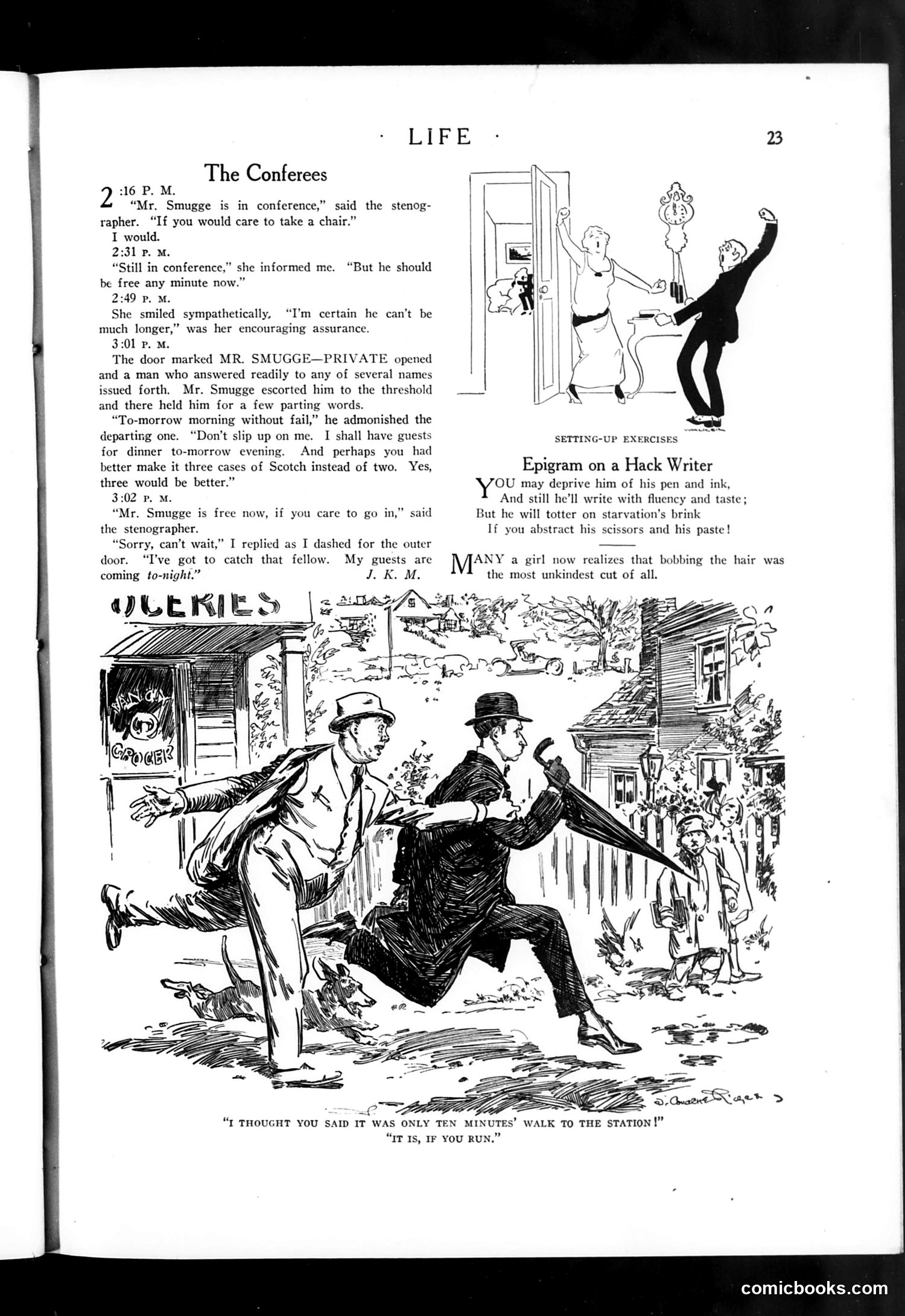
This page contains three distinct satirical pieces from *Life* magazine: **"The Conferees"** is a humorous short story mocking workplace culture and social pretension. Mr. Smugge, a businessman, keeps a visitor waiting for hours in his office while he conducts a "conference." When finally emerging, Smugge is revealed to be ordering liquor from a departing associate—not conducting legitimate business. The joke satirizes how people use the appearance of importance and busyness to inflate their status, and how this behavior spreads: the narrator, now wanting to seem important himself, rushes off claiming *he* has guests arriving, clearly imitating Smugge's pretentious behavior. **"Epigram on a Hack Writer"** mocks low-quality writers who rely on copying and pasting existing material rather than original composition—they're so dependent on scissors and paste that without these tools, they cannot function. **The bottom cartoon** references "bobbing" (cutting hair short), a controversial 1920s women's fashion trend. The joke suggests that women who adopted this style inflicted "the unkindest cut of all" upon themselves.
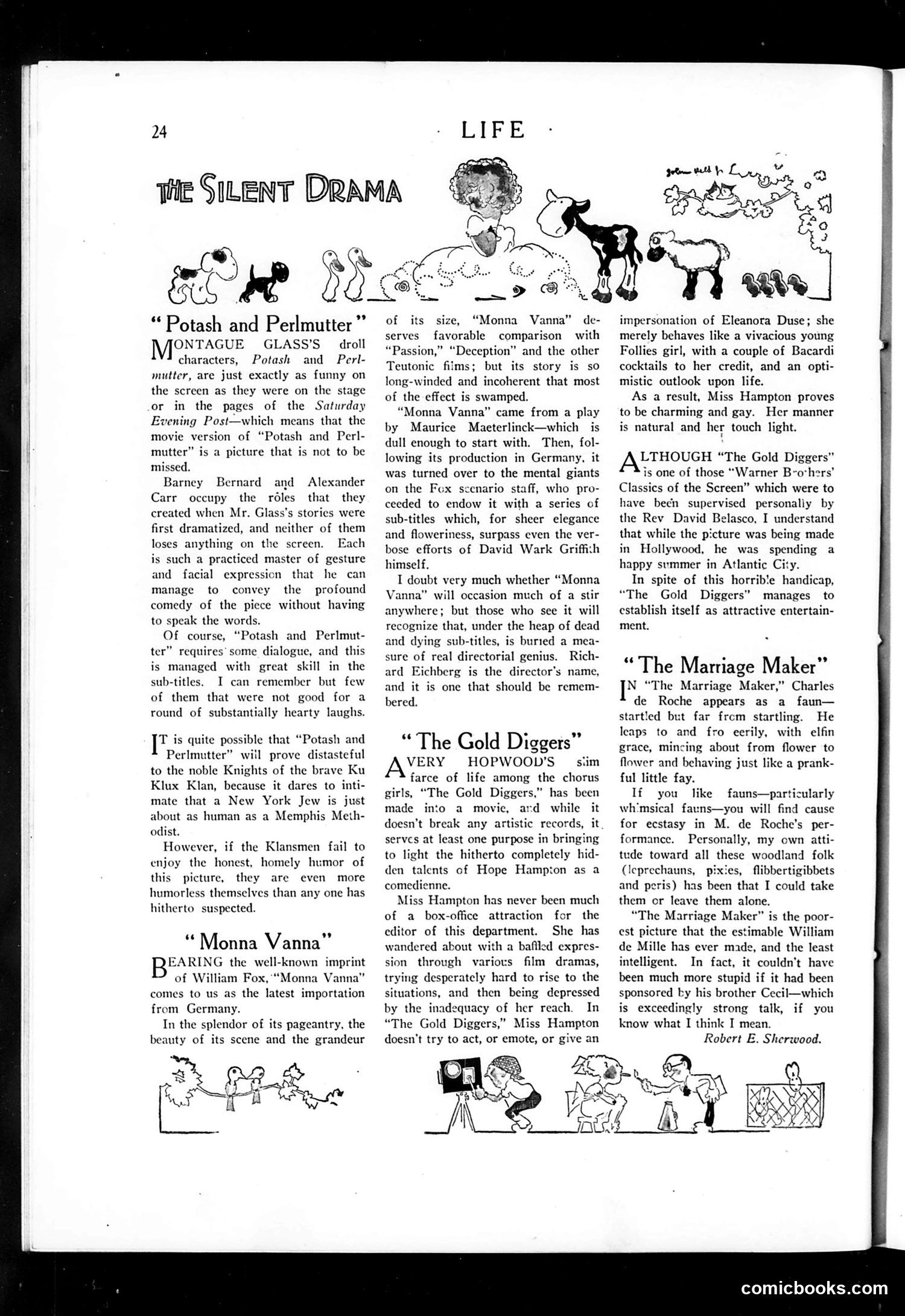
This page reviews four silent films. Key points: **"Potash and Perlmutter"**: An adaptation starring Barney Bernard and Alexander Carr, praised for physical comedy and witty intertitles. Notably, the reviewer mocks the Ku Klux Klan for potentially objecting to the film's premise—that a New York Jew is "just about as human as a Memphis Methodist"—suggesting the Klan's prejudice while using this criticism as implicit praise for the film's humanizing portrayal. **"Monna Vanna"**: A German import criticized for verbose intertitles that obscure decent direction by Richard Eichberg. **"The Gold Diggers"**: Adapted from Avery Hopwood's play about chorus girls. The reviewer credits the film's success to Hope Hampton's natural performance, where she simply "behaves like a vivacious young Follies girl" rather than attempting serious dramatic acting—implying her naturalness compensates for limited acting range. All reviews focus on how silent films use gesture, intertitles, and casting to convey meaning without dialogue.
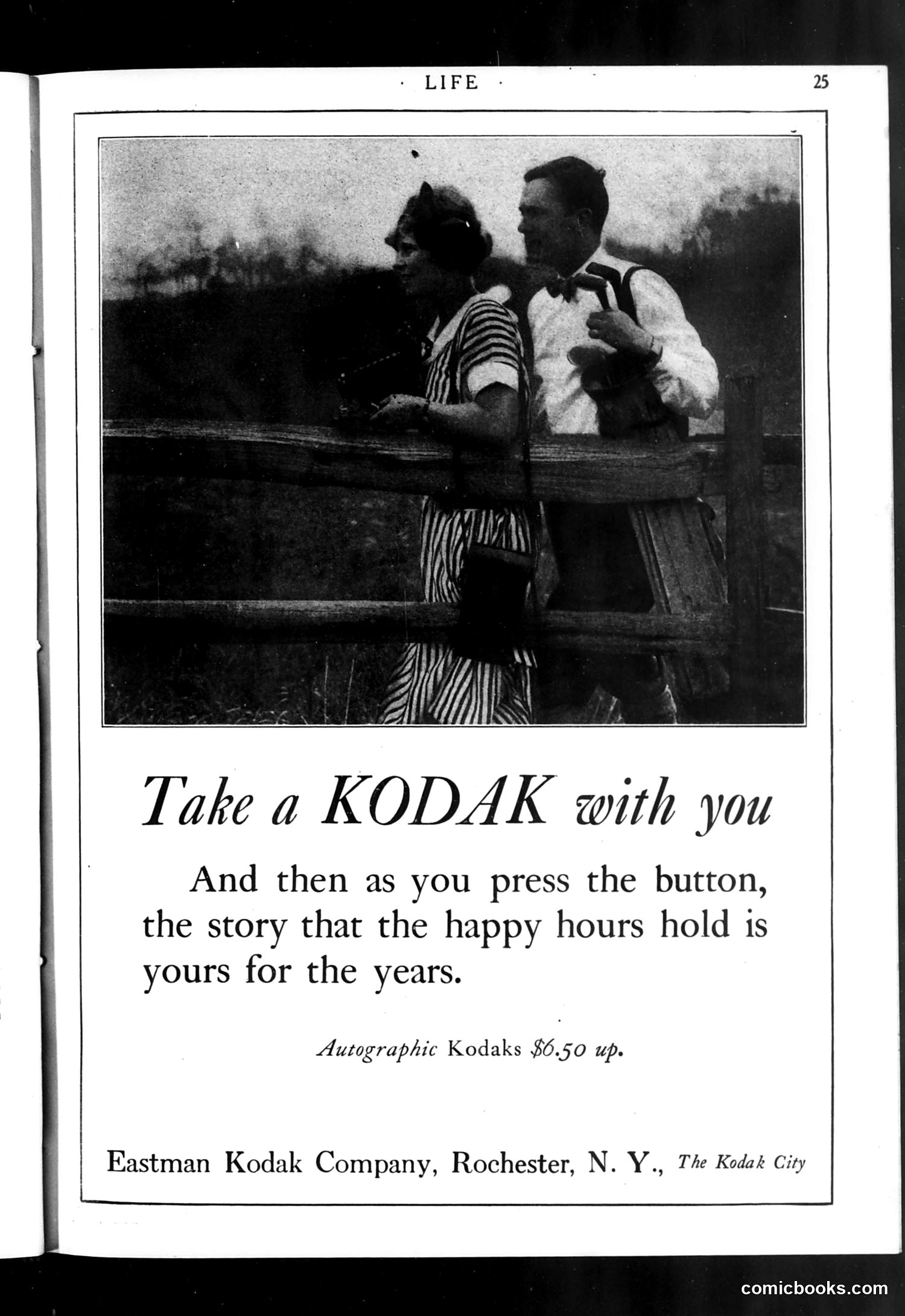
This is a Kodak camera advertisement, not political satire. The page shows a couple at a wooden fence in a rural setting, with the man in a vest and bow tie and the woman in striped clothing. The ad's message is straightforward: purchase an Autographic Kodak camera to preserve happy memories photographically. The tagline emphasizes that pressing the button captures moments "for the years"—a sentimental pitch to consumers about memory preservation. Autographic Kodaks cost $6.50 and up. The ad is from Eastman Kodak Company in Rochester, New York. This appears to be a commercial advertisement from Life magazine's pages rather than editorial cartoons or satirical content.
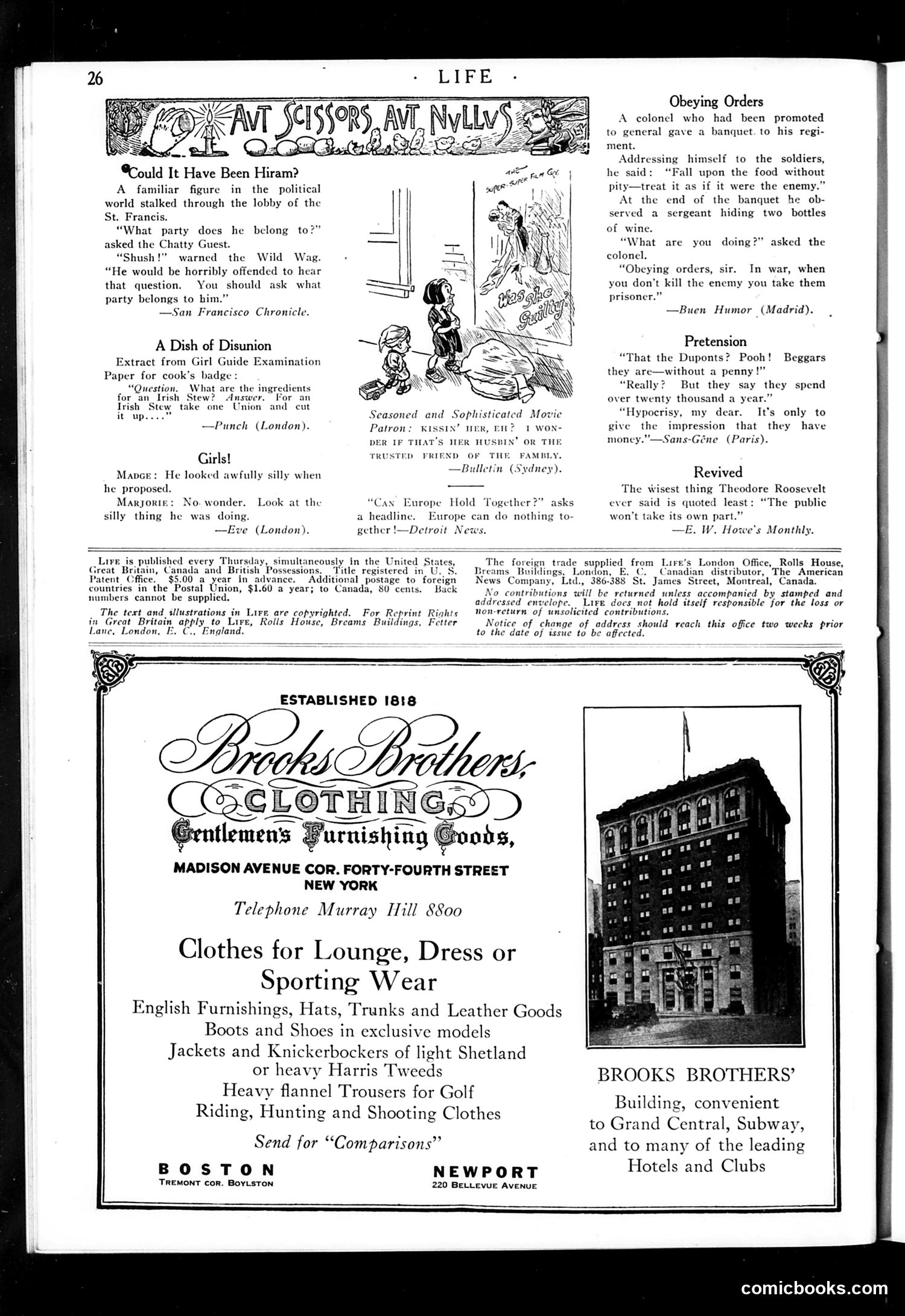
This page contains several brief satirical jokes drawn from international sources, reflecting early 20th-century humor: **"Could It Have Been Hiram?"** mocks a political figure's party ambiguity—a familiar lobby character is so politically non-committal that asking which party he belongs to would offend him. The satire targets political opportunism. **"A Dish of Disunion"** jokes about a Girl Guide cooking exam where "Union" is misspelled or misunderstood, creating absurdist humor about European political fragmentation (the headline "Can Europe Hold Together?" suggests post-WWI anxieties). **"Girls!"** and the **movie patron joke** are mild romantic/social humor about courtship and marital assumptions. **"Obeying Orders"** uses military logic for comedic effect: a sergeant hides wine, claiming he's following instructions to capture—not destroy—enemy resources. **"Pretension"** satirizes wealthy families performing poverty to seem modest. **"Revived"** quotes Theodore Roosevelt about public apathy, suggesting citizens won't advocate for themselves. The page is primarily advertising for Brooks Brothers clothing below these jokes.
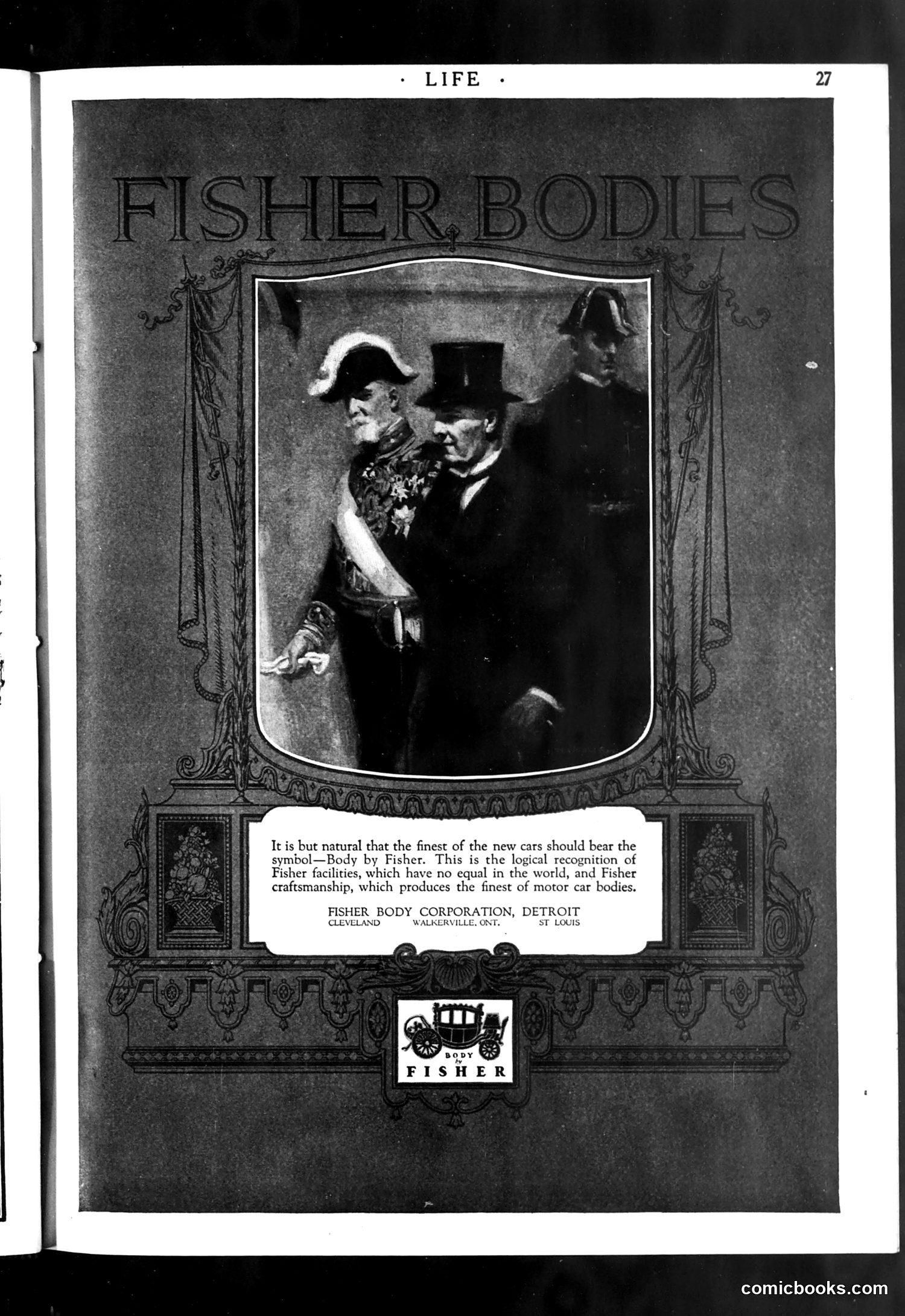
This is a **car advertisement**, not political satire. It promotes Fisher Body Corporation, a major automobile body manufacturer of the era. The image shows three formally dressed men (appearing to be business or political figures based on their attire—one in military dress with medals, one in a top hat) examining or discussing an automobile. The advertisement's message is straightforward corporate marketing: Fisher bodies represent quality and prestige, so "the finest of the new cars" naturally bear the Fisher name. This appeals to consumers by associating the product with excellence and status. The ornate decorative frame and formal presentation were typical advertising design of the early 20th century. There is no evident satire or political commentary—it's simply a period advertisement designed to convey luxury and craftsmanship.
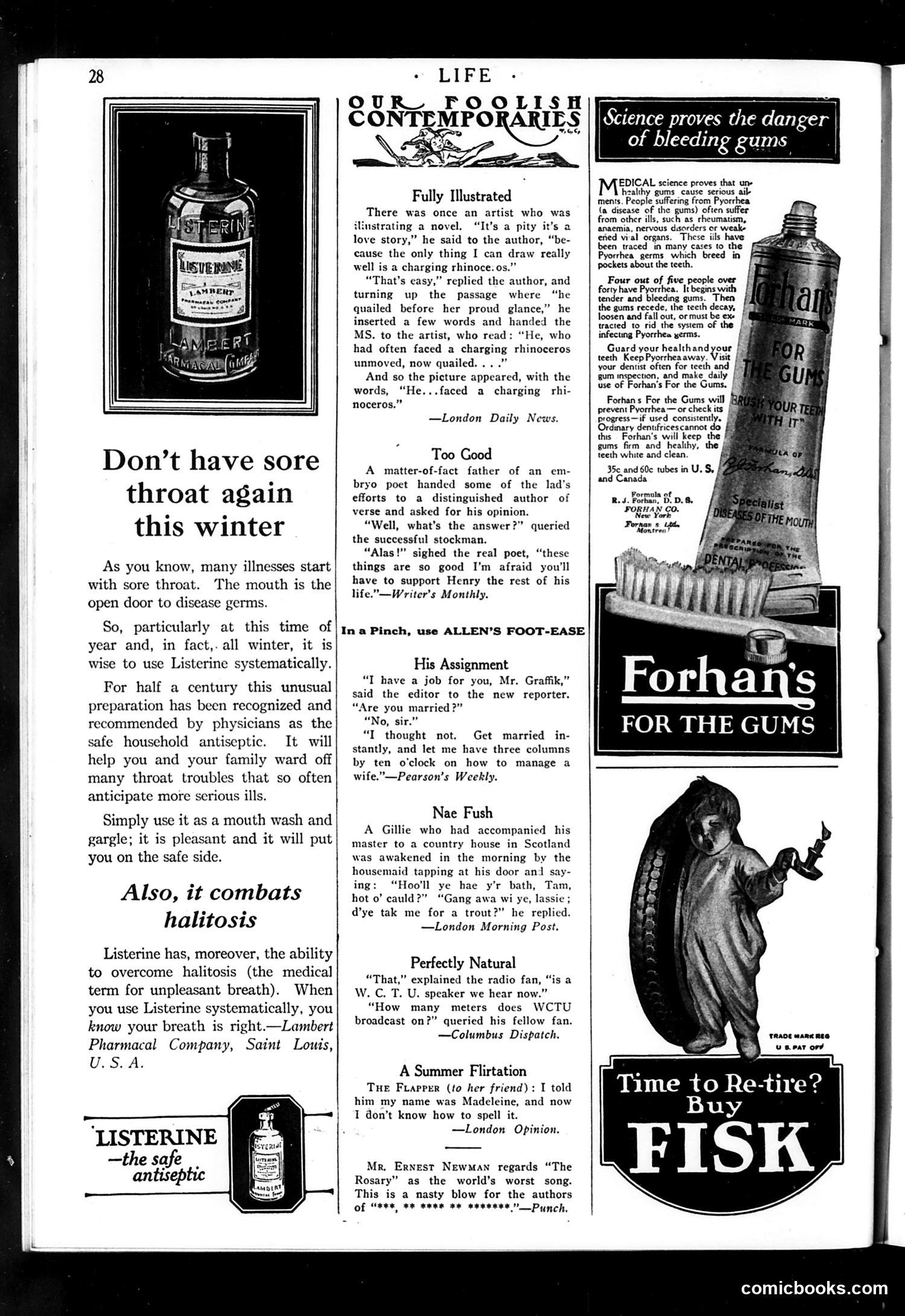
This page is primarily **advertising mixed with humorous anecdotes**—typical of Life magazine's format. The main content includes: **Advertisements:** - **Listerine** (left): A medicinal antiseptic marketed to prevent sore throats and "halitosis" (bad breath). The ad claims medical endorsement for winter health. - **Forhan's For the Gums** (right): Advertises treatment for bleeding gums and pyorrhea (gum disease), citing "medical science" warnings about serious health consequences. - **Fisk** (bottom right): Tire advertisement with period imagery. **Humorous Section ("Our Foolish Contemporaries"):** Brief satirical anecdotes lampooning various subjects: - An artist who can only draw charging rhinoceroses - A poet whose work is suspiciously good - A journalist assigned to write about managing wives - A Scottish worker mistaken for a fish - Radio listener confusion about broadcast meters **The satire** targets pretension, miscommunication, and social absurdities rather than specific political figures. This reflects Life's role as a general-audience humor magazine focused on everyday follies.
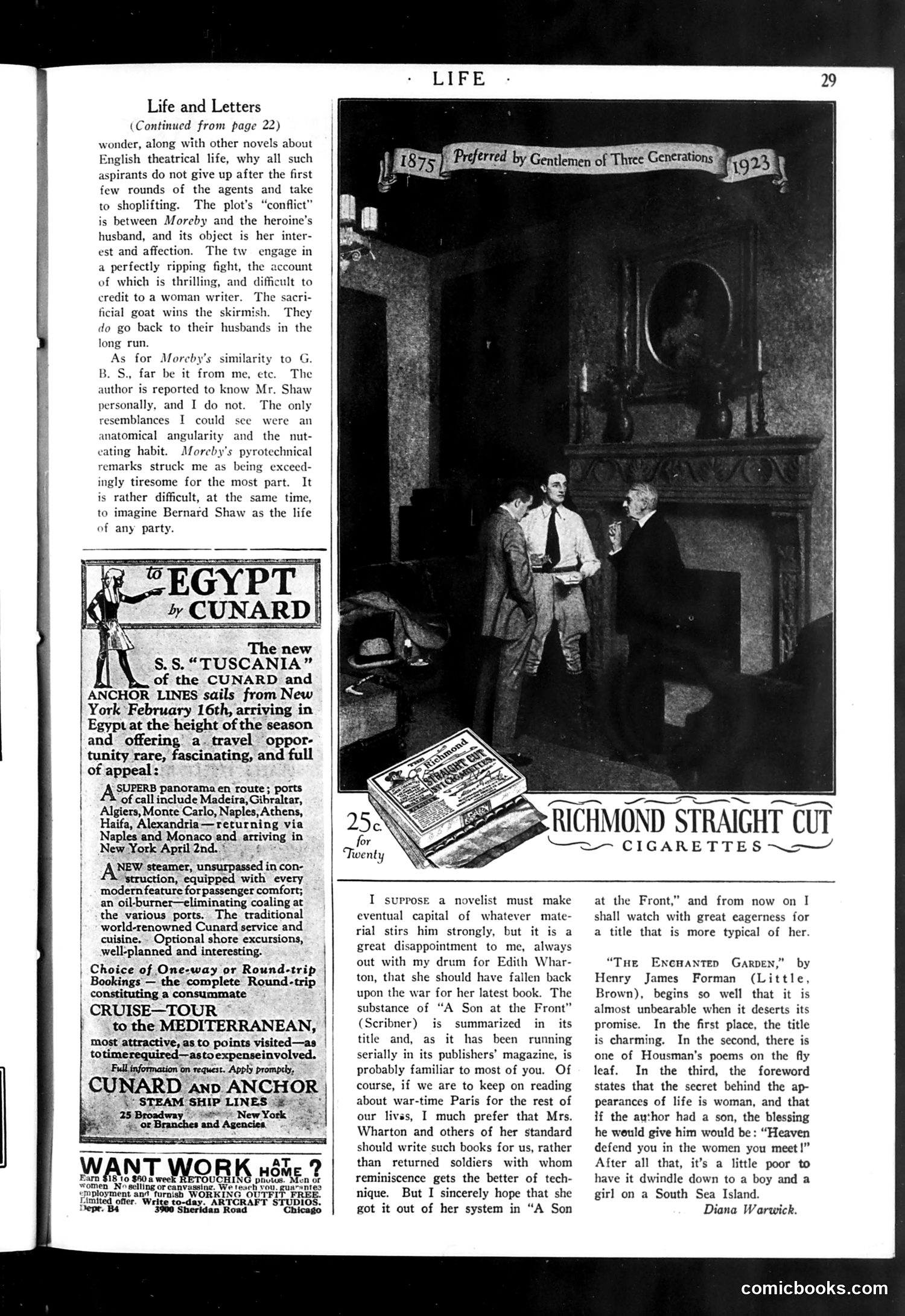
This page mixes **literary criticism** with **period advertising**. The main text reviews recent novels, including a dismissive critique of Edith Wharton's *"A Son at the Front"*—a WWI novel the reviewer finds disappointing because Wharton "fell back upon the war" rather than exploring fresher material. The critic also comments snidely on another novel with a character resembling George Bernard Shaw, finding his theatrical wit "tiresome." The **advertisements** promote luxury travel (Cunard steamship cruises to Egypt and the Mediterranean), Richmond cigarettes, and job listings—typical of 1920s American magazines targeting affluent readers. No political cartoons appear on this page. The "satire" is purely literary: the reviewer uses acerbic wit to critique authors' creative choices, particularly Wharton's reliance on wartime settings rather than innovative subjects. This reflects post-WWI cultural fatigue with war narratives.
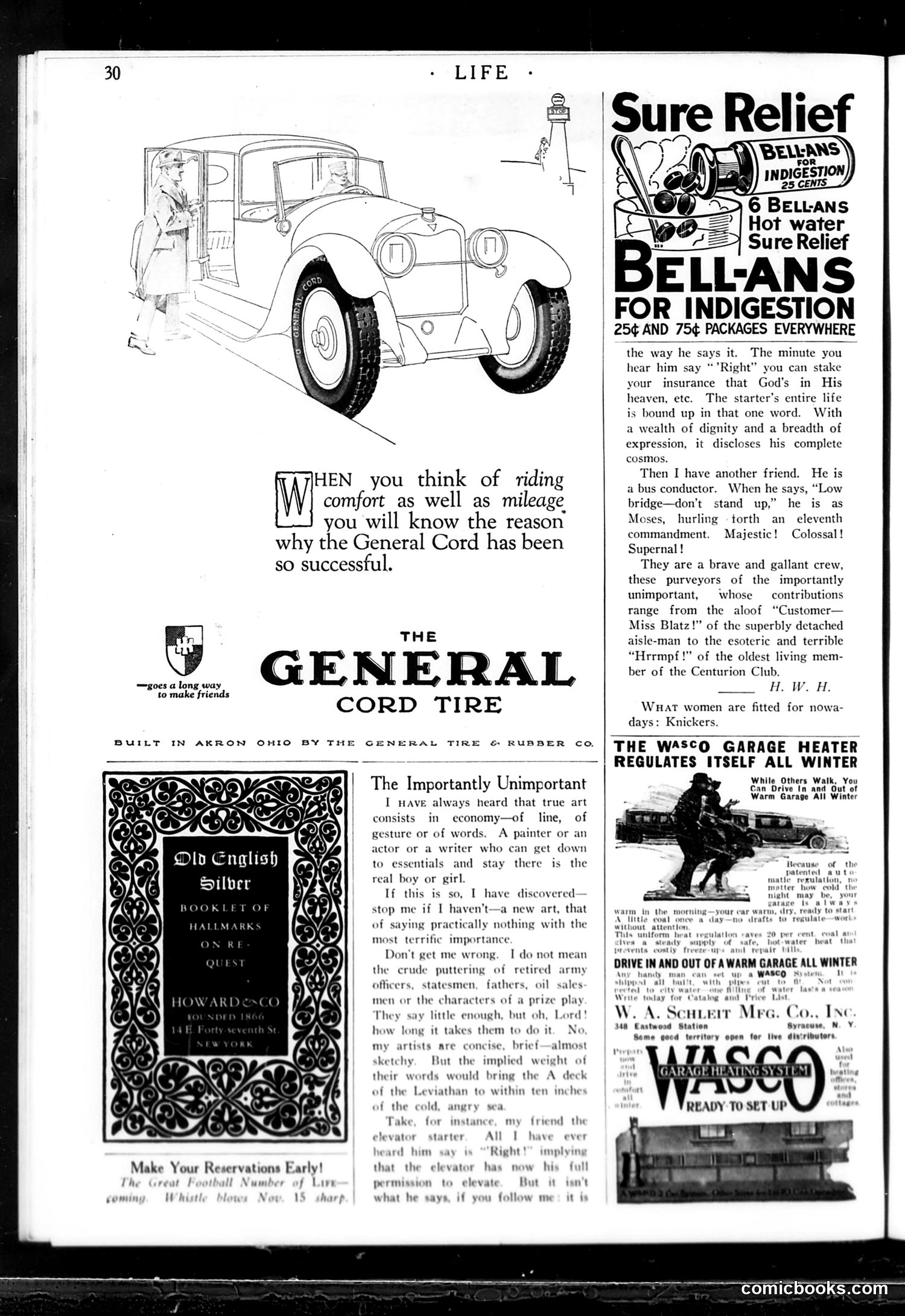
This page is primarily **advertising and lifestyle commentary** rather than political satire. The main content includes: **The General Cord Tire Advertisement** (center): A straightforward car ad emphasizing comfort and mileage, featuring an illustration of a 1920s automobile. **"The Importantly Unimportant" Essay** (left): A humorous piece satirizing working-class professionals—elevator starters, bus conductors—who speak with exaggerated authority using single words like "Right!" or commands like "Low bridge—don't stand up!" The satire mocks how these workers imbue mundane jobs with mock-grandiose dignity, comparing their pronouncements to biblical or Shakespearean declarations. **Surrounding Advertisements**: Bell-Ans antacid, Old English Silver hallmark booklet, and Wasco Garage Heater. **Caption Joke**: "What women are fitted for nowadays: Knickers"—a dated reference to women's practical sportswear becoming acceptable fashion. The page reflects 1920s attitudes toward working-class workers and emerging women's fashion rather than addressing major political events.
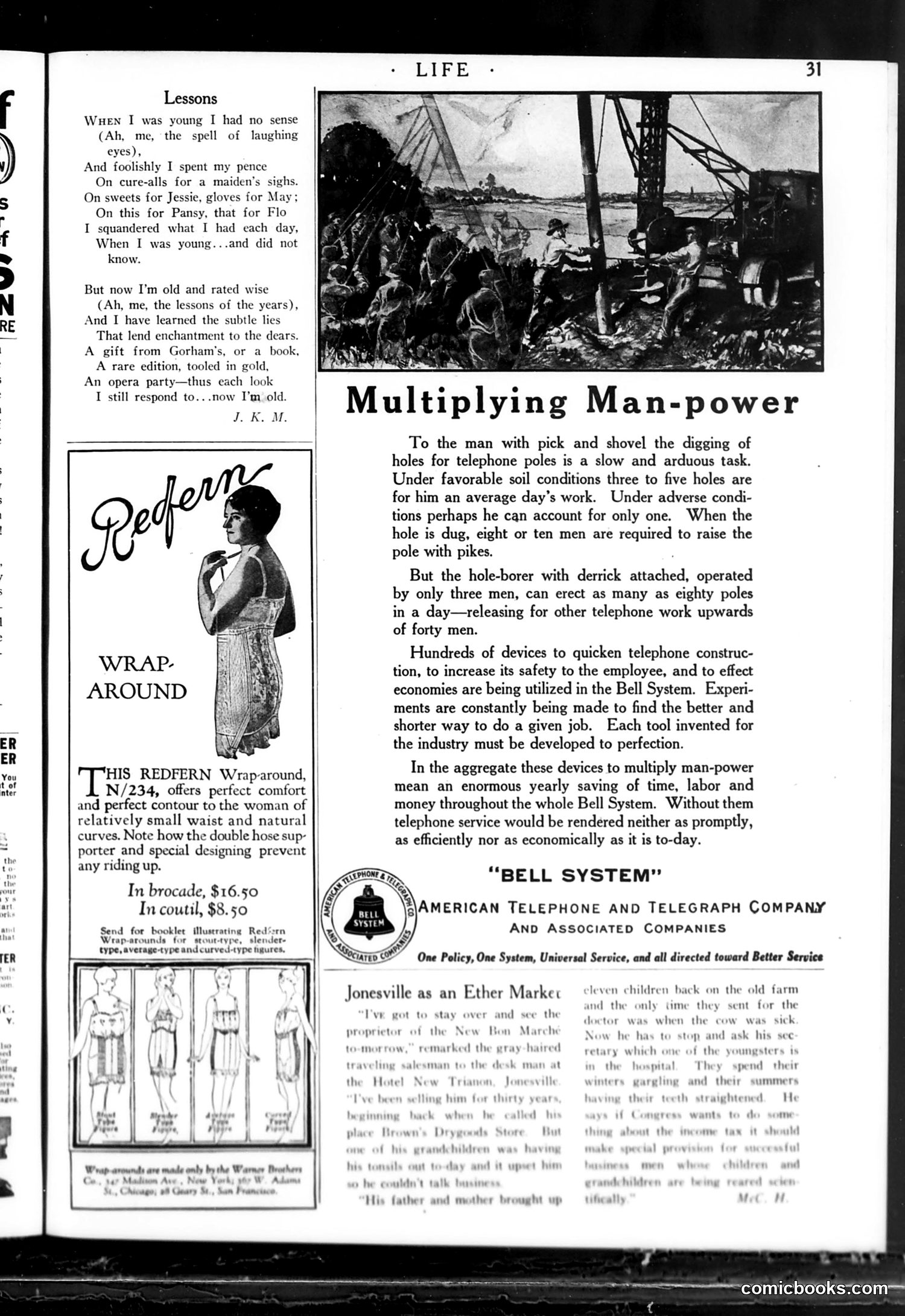
This page mixes satirical poetry, advertising, and corporate public relations content typical of early 20th-century Life magazine. **"Lessons" (poem):** A nostalgic reflection on youthful romantic foolishness versus aged wisdom. The speaker recalls wastefully spending money on gifts for multiple women ("Jessie," "May," "Pansy," "Flo"), then boasts he's now learned to impress women with more sophisticated, expensive gifts (Gorham's silverware, rare books, opera tickets). The satire targets male vanity and materialism disguised as maturity. **Redfern Wrap-Around corset ad:** A standard fashion advertisement for women's undergarments, emphasizing comfort and natural curves while maintaining a small waist—reflecting period beauty standards. **"Multiplying Man-power":** A Bell System corporate advertisement celebrating mechanized labor efficiency. It contrasts manual hole-digging (3-5 holes daily) with derrick-powered boring (80 poles daily with just three operators). The piece frames technological advancement as worker-friendly progress, though it implicitly celebrates how machines reduce labor needs. The page reflects pre-Depression industrial optimism and gendered consumer culture.
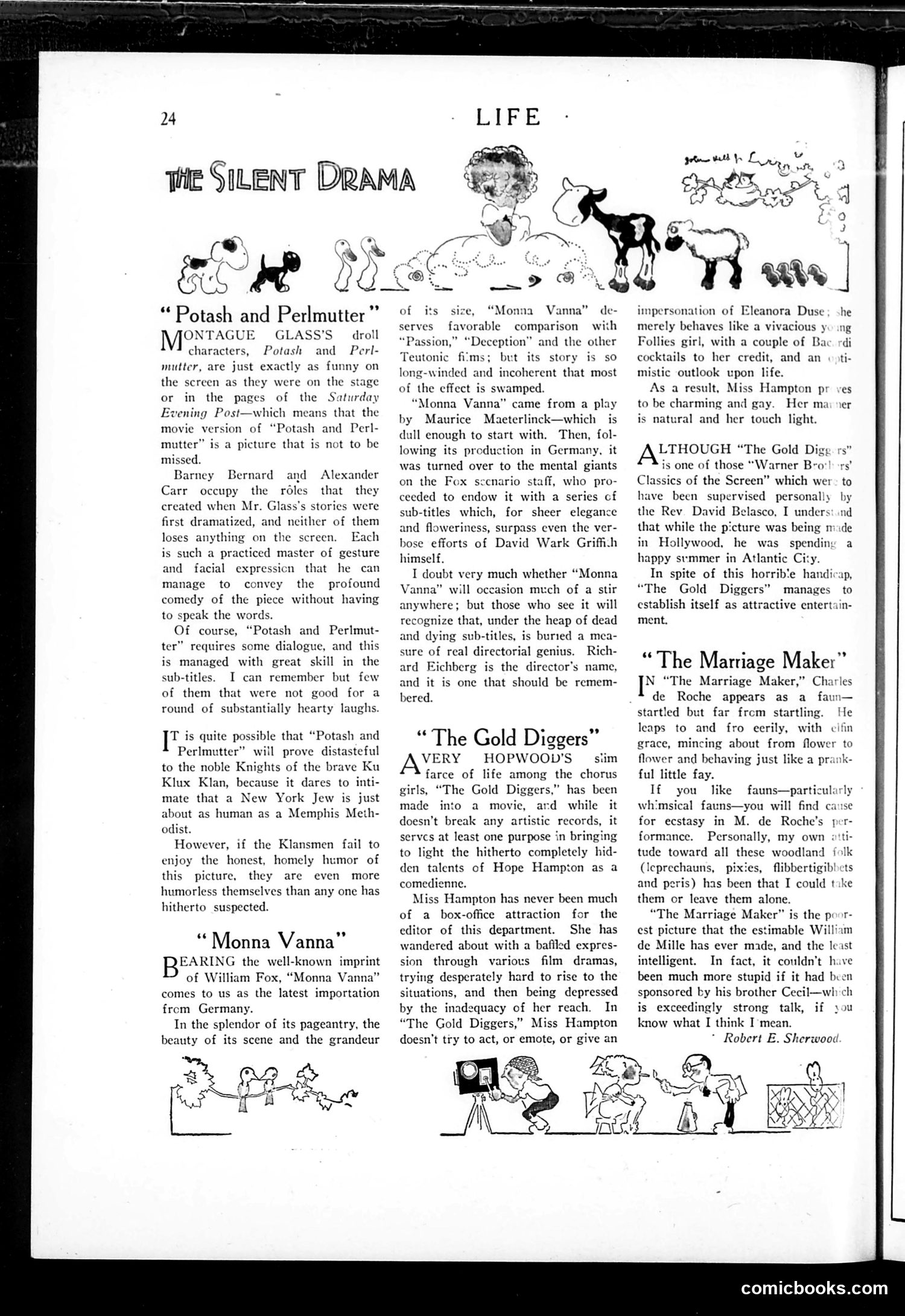
This page reviews four silent films, with particular satirical bite in the "Potash and Perlmutter" section. The reviewer notes the film's humor derives from its Jewish characters, then directly challenges the Ku Klux Klan—stating the movie "dares to intimate that a New York Jew is just about as human as a Memphis Methodist." This is sharp social commentary for the 1920s, when the KKK was resurgent and anti-Semitism widespread. The reviewer suggests Klansmen would find it offensive and uses that offense to mock their lack of humanity. Other reviews cover "Monna Vanna" (criticized for verbose subtitles obscuring decent direction), "The Gold Diggers" (praising Hope Hampton's natural performance), and mock "The Gold Diggers" as a supposed David Belasco production—while noting Belasco was vacationing in Atlantic City during filming, suggesting his "supervision" was fictional.
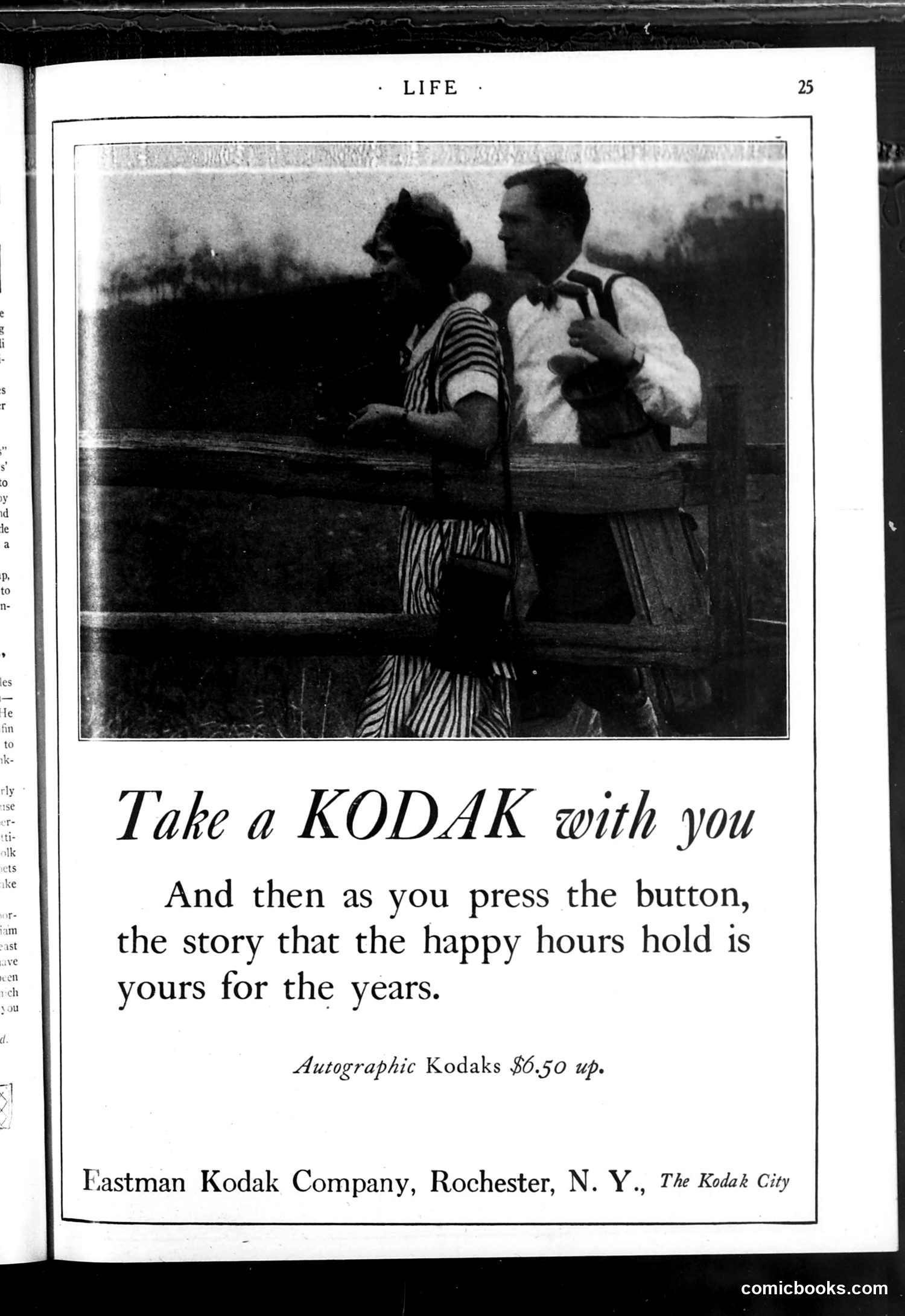
This is a **Kodak camera advertisement**, not political satire or a cartoon. The page shows a romantic couple at a fence in what appears to be a rural or pastoral setting. The ad's message is straightforward: taking photographs with Kodak cameras allows people to preserve cherished memories ("the story that the happy hours hold"). The advertisement emphasizes the camera's ease of use ("press the button") and accessibility through affordable pricing ("$6.50 up"). This reflects early 20th-century marketing that positioned photography as a consumer activity for ordinary people, not just professionals. There is no satire, political commentary, or hidden meaning—this is simply commercial promotion appearing in *Life* magazine's advertising pages.
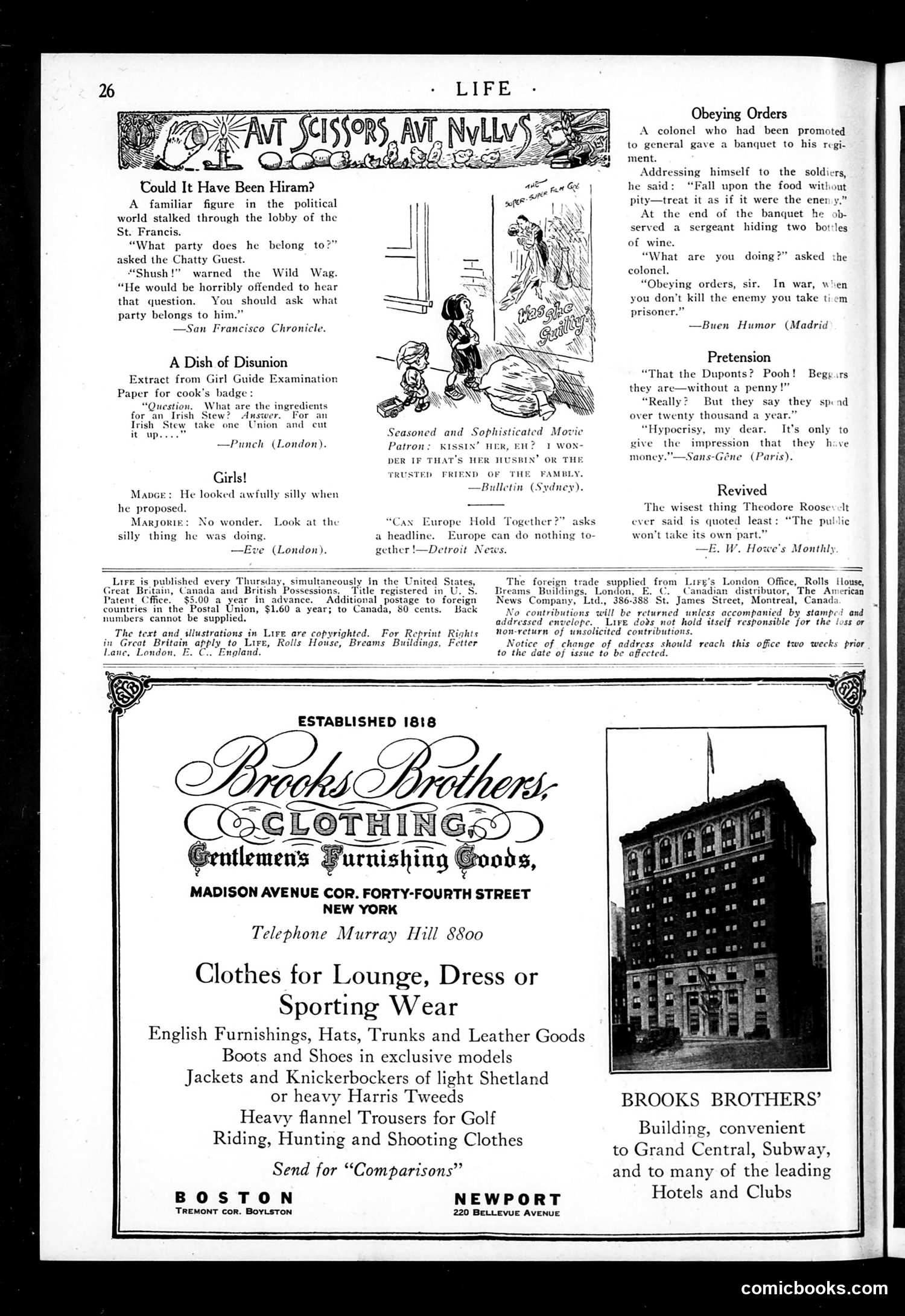
This page contains several brief satirical items typical of Life's humor section, plus advertising. **"Could It Have Been Hiram?"** mocks a San Francisco political figure whose party affiliation is unclear—the joke being that the person belongs to no consistent party, or that parties belong to *him* rather than vice versa. This reflects early 20th-century American concerns about political opportunism and shifting allegiances. **"Obeying Orders"** is a military joke: a newly promoted general tells soldiers to eat eagerly. A sergeant hiding wine bottles explains he's "obeying orders"—when you can't kill the enemy, you take prisoners—implying he's capturing the wine. The humor relies on literal interpretation of military language. **"Pretension"** satirizes wealthy families claiming poverty for social cachet—the Duponts deny spending money while obviously doing so. **"Revived"** quotes Theodore Roosevelt approvingly, suggesting the public lacks self-defense. The remainder is a Brooks Brothers clothing advertisement emphasizing gentlemen's formal and sporting wear, establishing the magazine's affluent target audience.
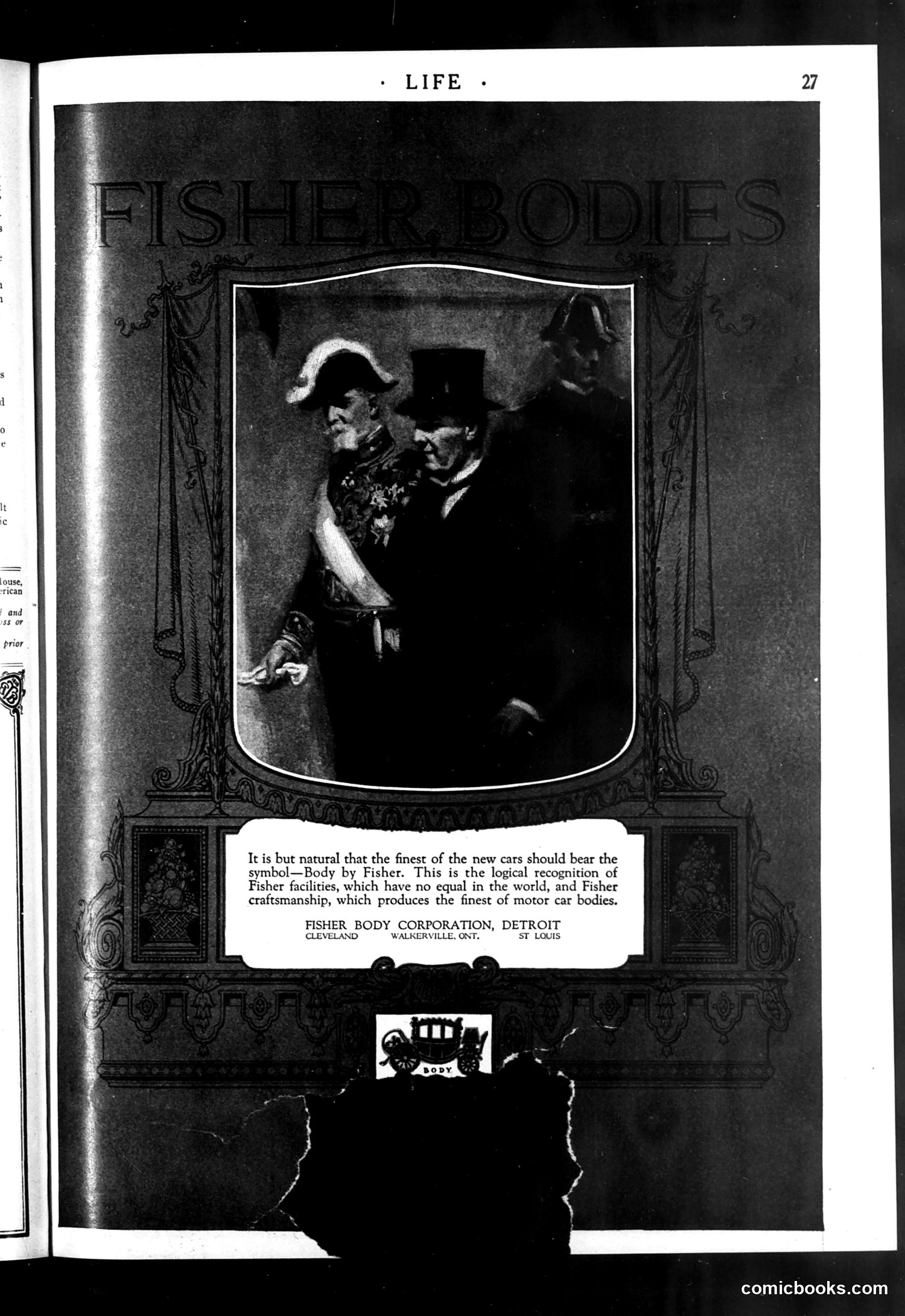
This is a **Fisher Body Corporation advertisement**, not political satire. The page promotes Fisher as the premier automobile body manufacturer of its era. The image shows two figures in formal attire (appearing to be military or diplomatic officials based on their decorative uniforms and hats) examining or discussing a vehicle, symbolizing prestige and quality approval. The accompanying text argues that fine new cars naturally bear Fisher bodies, positioning Fisher as the recognized standard for superior automotive craftsmanship. Fisher Body Corporation operated factories in Detroit, Cleveland, Walkerville (Ontario), and St. Louis. This advertisement leverages aspirational imagery—associating Fisher bodies with distinguished, authoritative figures—to establish the brand's dominance in the luxury automobile body market during the early automotive era.
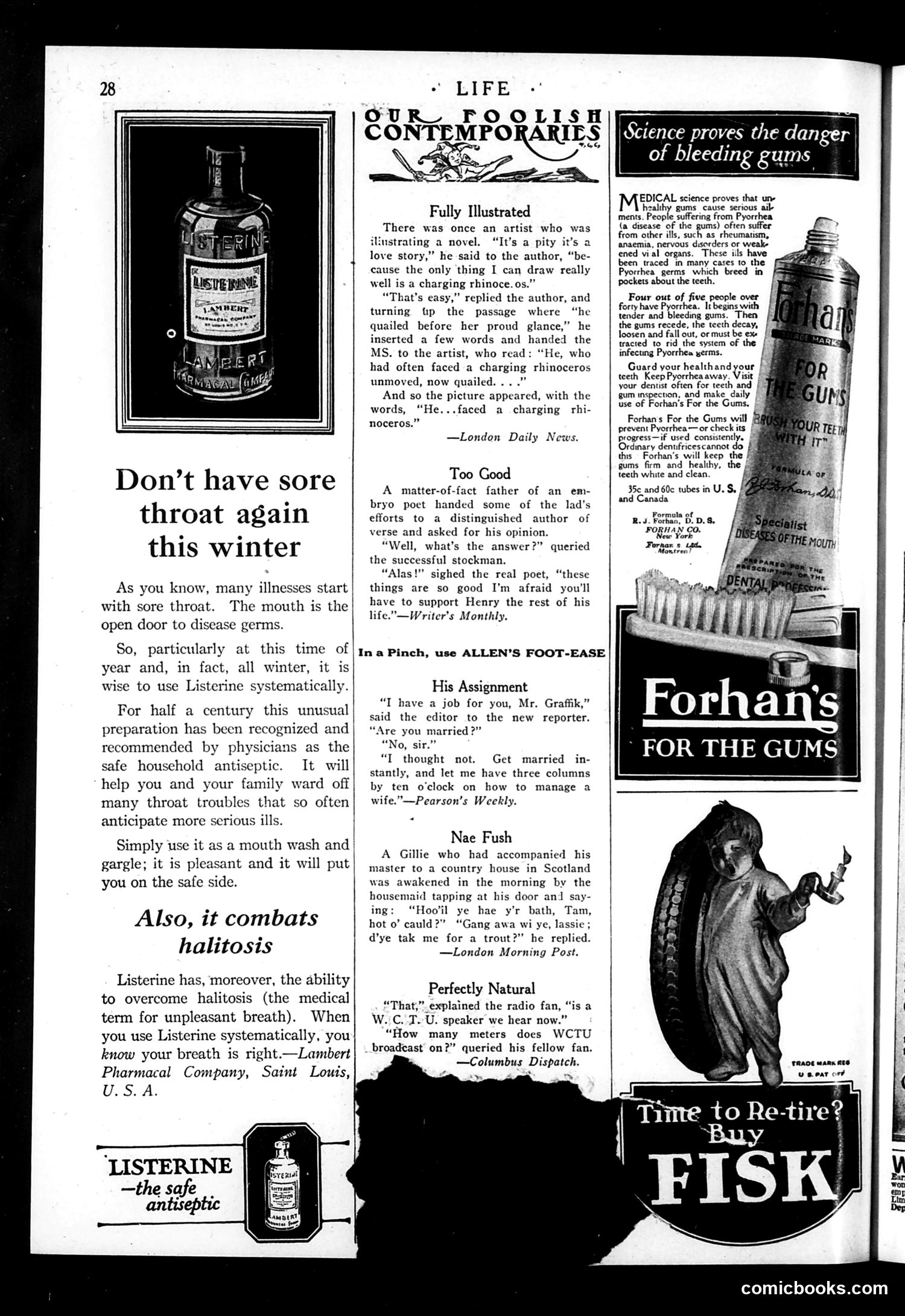
This page from *Life* magazine (a satirical publication) combines humor pieces with period advertisements. **The "Charging Rhinoceros" cartoon** (top center) satirizes artistic illustration. An artist claims he can only draw rhinoceroses well; the author obligingly rewrites a romantic scene ("quailed before her proud glance") to include a charging rhinoceros instead. The joke mocks both artistic limitation and the author's willingness to distort narrative for illustration convenience. **The other humor pieces** include: - "Too Good": A stockman shows verse to a poet, who sighs the work is so excellent the stockman must support the poet financially—inverting expected patronage. - "His Assignment": A newspaper editor assigns a bachelor reporter to get married instantly, then write three columns about managing a wife—absurdist workplace humor. - "Nae Fush": Scottish dialect humor about a servant refusing a bath, claiming he's not a trout. **The advertisements** (Listerine, Forhan's toothpaste, Fisk tires) are typical period endorsements emphasizing health and hygiene concerns now considered overblown or medically questionable.
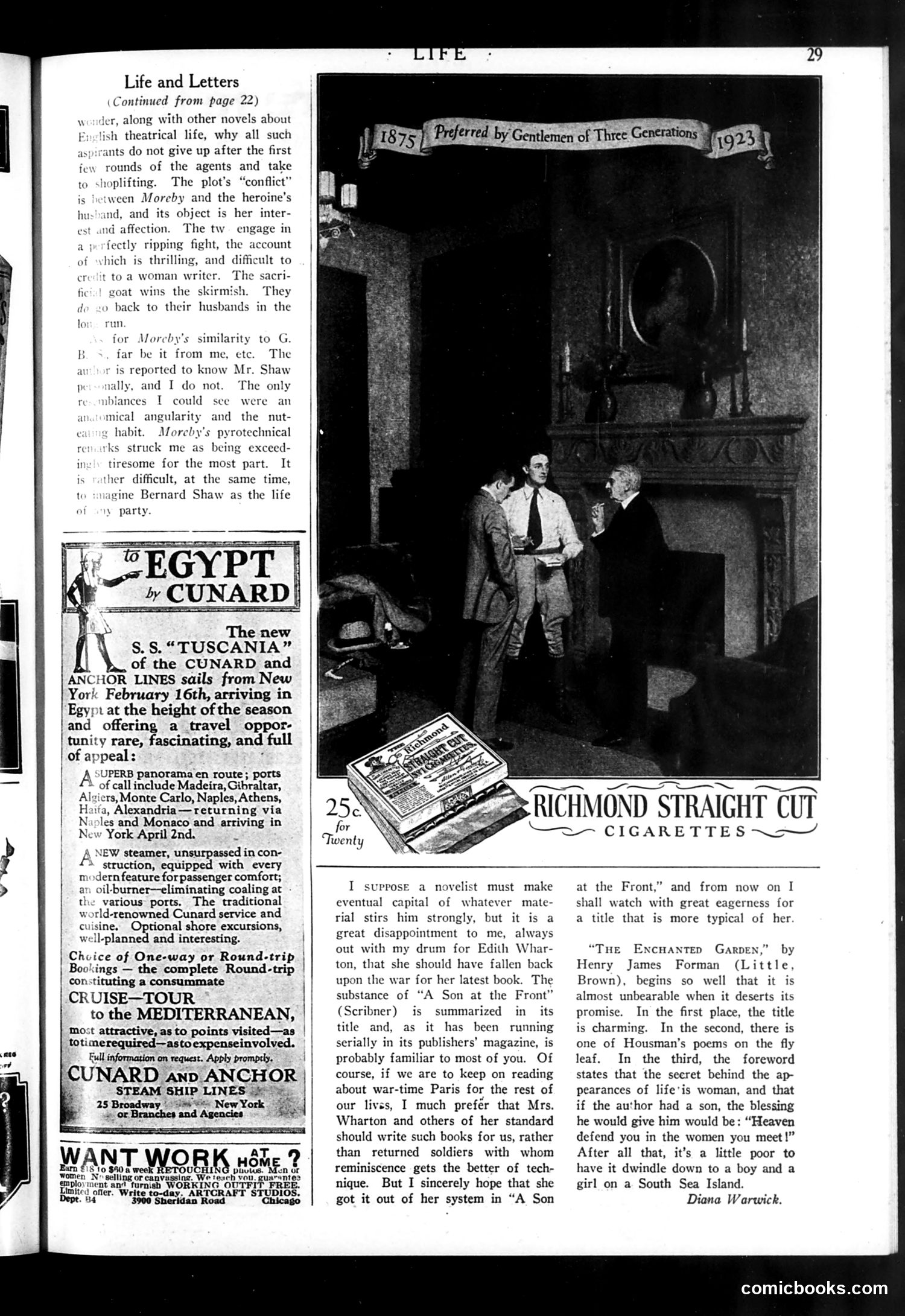
This page combines literary criticism with advertisements typical of 1920s Life magazine. The main content is **"Life and Letters,"** a book review column discussing contemporary novels, particularly works by Edith Wharton and Henry James Forman. The reviewer critiques Wharton's *"A Son at the Front,"* expressing disappointment that she returned to war-time subject matter rather than exploring new themes. The complaint reflects post-WWI fatigue with war narratives—a common sentiment in the early 1920s. The page also features period advertisements: Cunard cruise lines promoting Egyptian travel, Richmond Straight Cut cigarettes (with a theatrical photograph), and a work-from-home opportunity. The cartoon/photograph labeled "Richmond Straight Cut Cigarettes" appears to show two men in what seems a dramatic or comedic scene, typical of advertising imagery of the era that associated products with lifestyle and leisure. Overall, this is a standard Life magazine page blending literary commentary with commercial messaging aimed at educated, affluent readers.
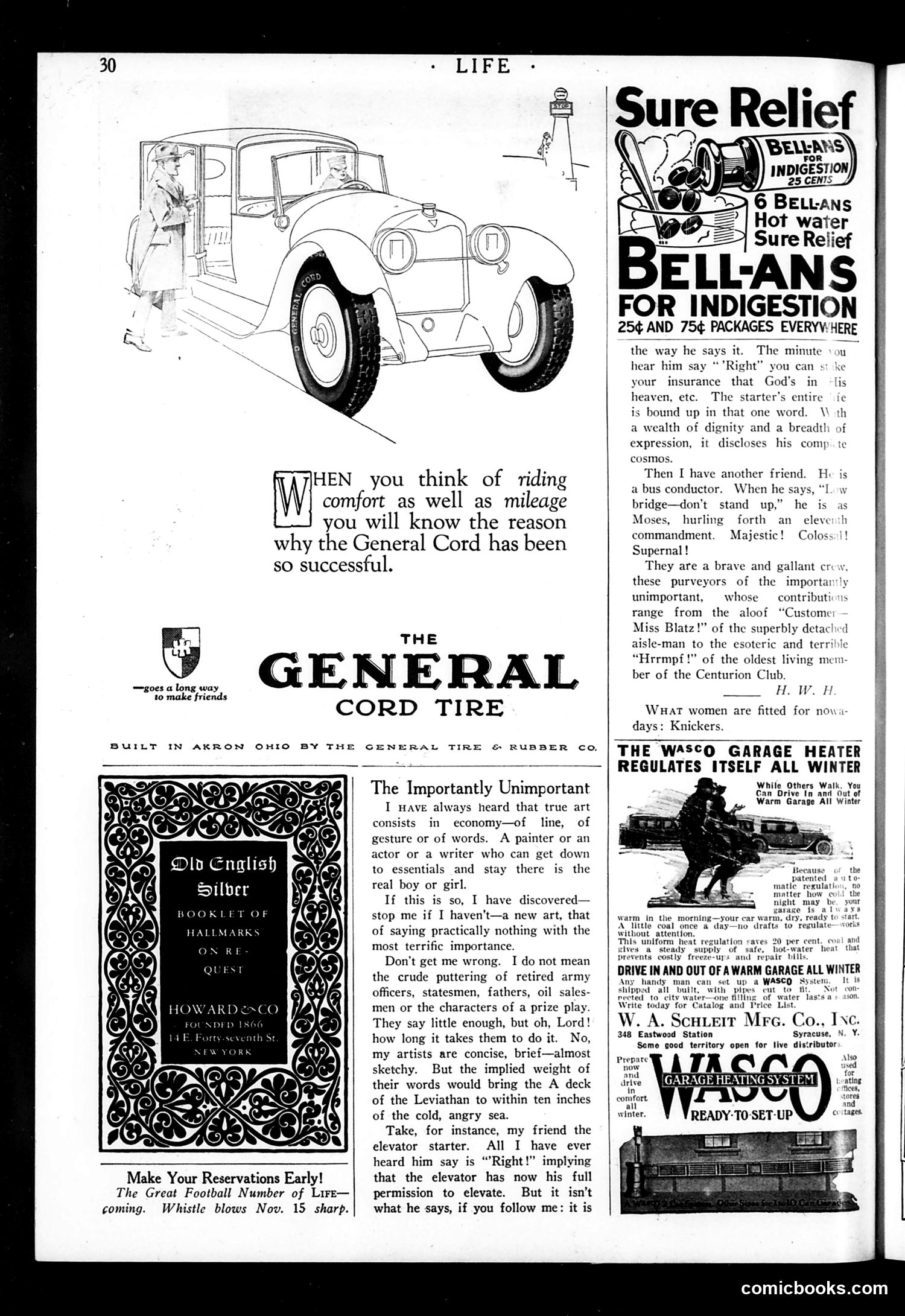
This page mixes automobile and product advertising with social commentary. The main content is **"The Importantly Unimportant,"** a humorous essay satirizing people in service positions—an elevator starter and bus conductor—who deliver mundane instructions with exaggerated gravity and dignity. The author humorously suggests these workers infuse ordinary phrases like "Right!" or "Don't stand up" with such portentous weight that they seem to invoke divine authority, despite saying practically nothing of substance. The advertisements include General Cord Tires, Bel-Ans indigestion relief, and a Wasco garage heater. A small note promotes Life's upcoming "Great Football Number" (November 15). The humor relies on observing early 20th-century working-class dignity—how ordinary laborers adopted an almost religious solemnity in performing humble duties, transforming routine commands into something grandiose. This reflects period class dynamics and the aspirations of service workers.
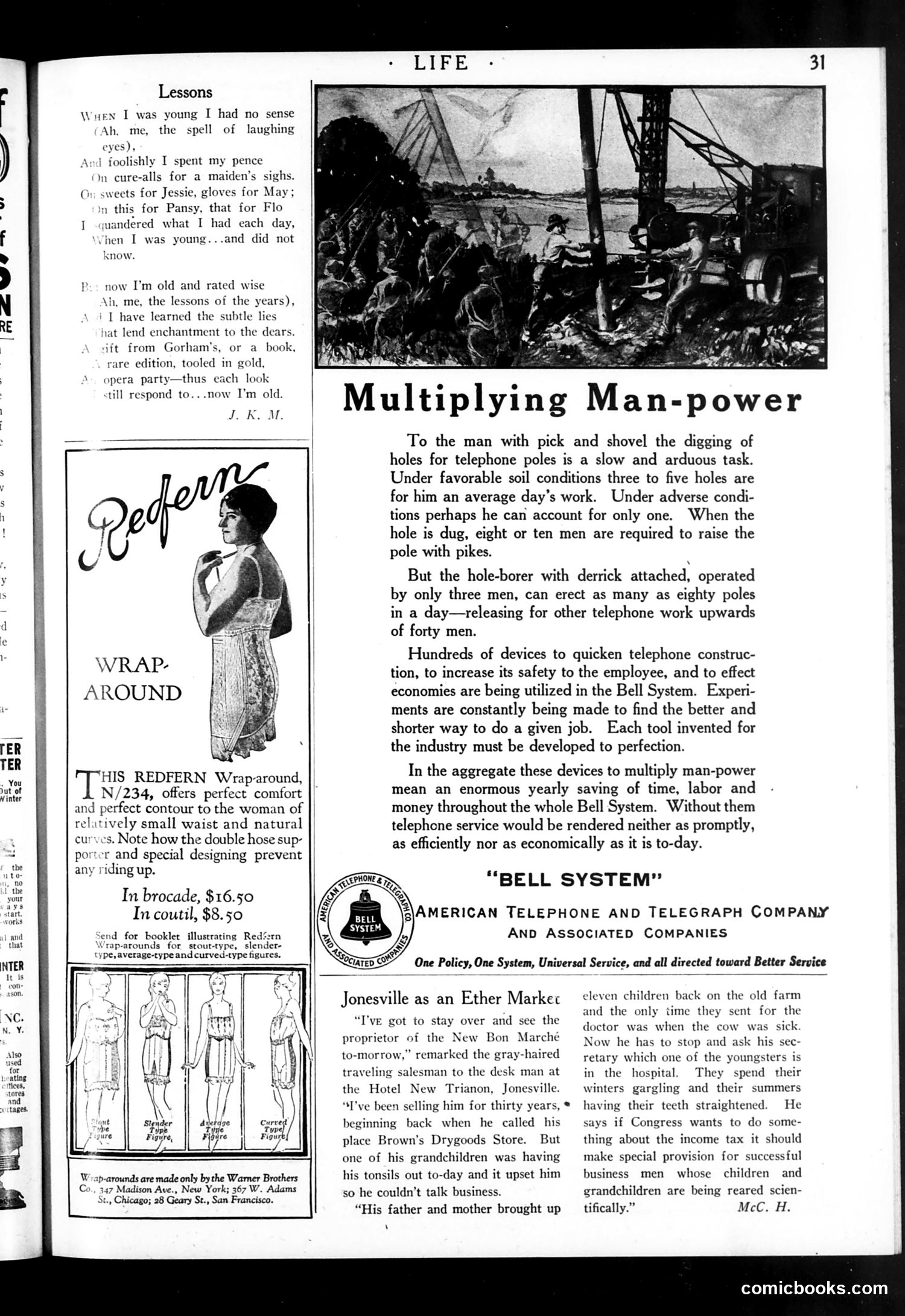
This page contains two distinct elements: 1. **"Lessons" Poem** (left): A nostalgic poem about aging, contrasting youthful ignorance with elder wisdom gained through life experience. 2. **Advertisement & Article** (right): A Redfern corset ad featuring a woman in a wrap-around design, alongside Bell System promotional content titled "Multiplying Man-power." The Bell article celebrates telephone infrastructure efficiency—describing how mechanical hole-boring equipment operated by three men can accomplish work that previously required eight to ten workers. This showcases early 20th-century industrial optimization and labor-saving technology as progress. Below is an unrelated story excerpt about a traveling salesman's family troubles. The page represents typical Life magazine content: literary, commercial advertising, and business promotion combined.
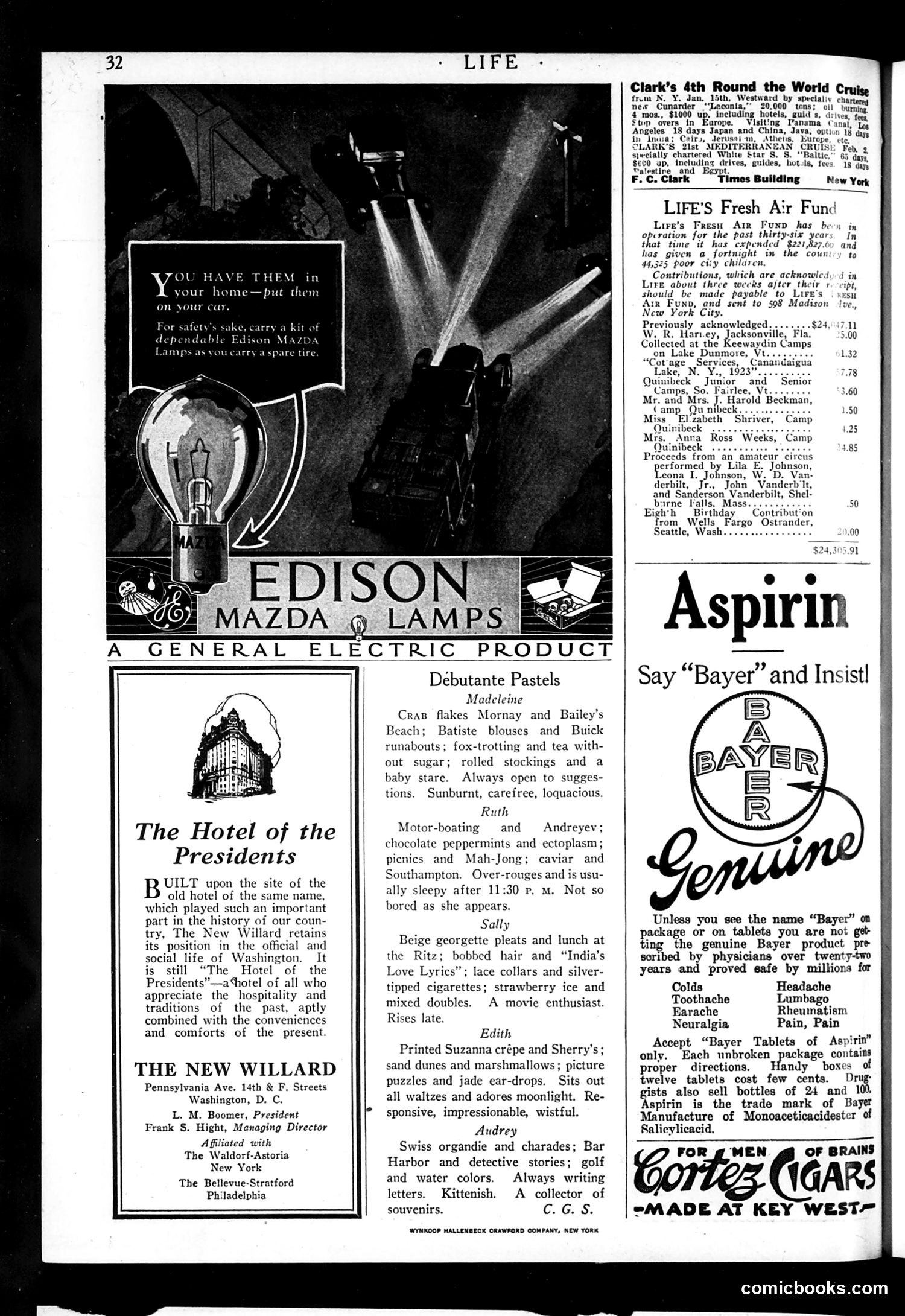
This page is primarily **advertising and social announcements** rather than political satire. The main content includes: 1. **Edison Mazda Lamps advertisement** (top left): A safety-focused ad urging readers to carry car lamps like spare tires. 2. **"Debutante Pastels" section** (center): Satirical character sketches of upper-class young women (Madeleine, Ruth, Sally, Edith, Audrey), mocking their leisure activities—fox-trotting, bobbed hair, rolled stockings, motor-boating, and casual wealth. This gently ridicules 1920s "flapper" culture and debutante society. 3. **Hotel and tourism advertisements**: The New Willard hotel in Washington and Clark's world cruises. 4. **Bayer Aspirin advertisement** (right): Emphasizing brand authenticity. 5. **Life's Fresh Air Fund** announcement: Charitable contributions for poor city children's summer outings. The debutante sketches represent the page's only comedic content—light mockery of privileged youth rather than serious political commentary.
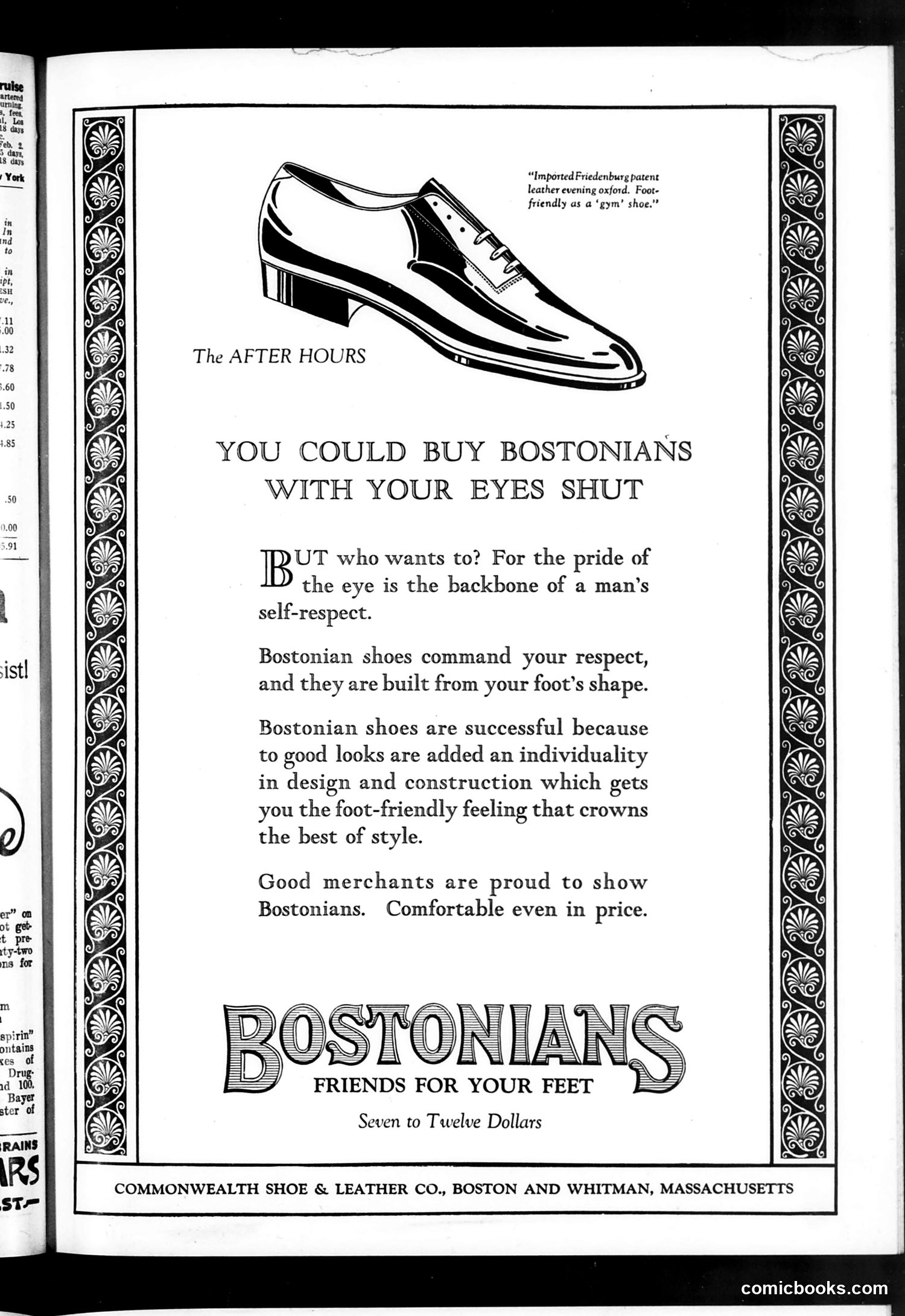
This is primarily a **shoe advertisement**, not a political cartoon. It's a full-page ad for Bostonians shoes by the Commonwealth Shoe & Leather Co. of Boston and Whitman, Massachusetts. **The "joke" or sales pitch:** The headline paradoxically claims you could buy Bostonians "with your eyes shut"—meaning they're so reliably good you don't need to inspect them carefully. The ad then subverts this by arguing the opposite: that *pride in appearance* matters, and these shoes deserve visual appreciation because they combine comfort with style. **The key selling points:** The shoes are described as foot-friendly (despite being dressy evening wear), individually designed, and reasonably priced ("Seven to Twelve Dollars"). **Context for modern readers:** This reflects early 20th-century consumer culture emphasizing that quality goods could be both fashionable and practical—a then-novel concept in men's footwear marketing.
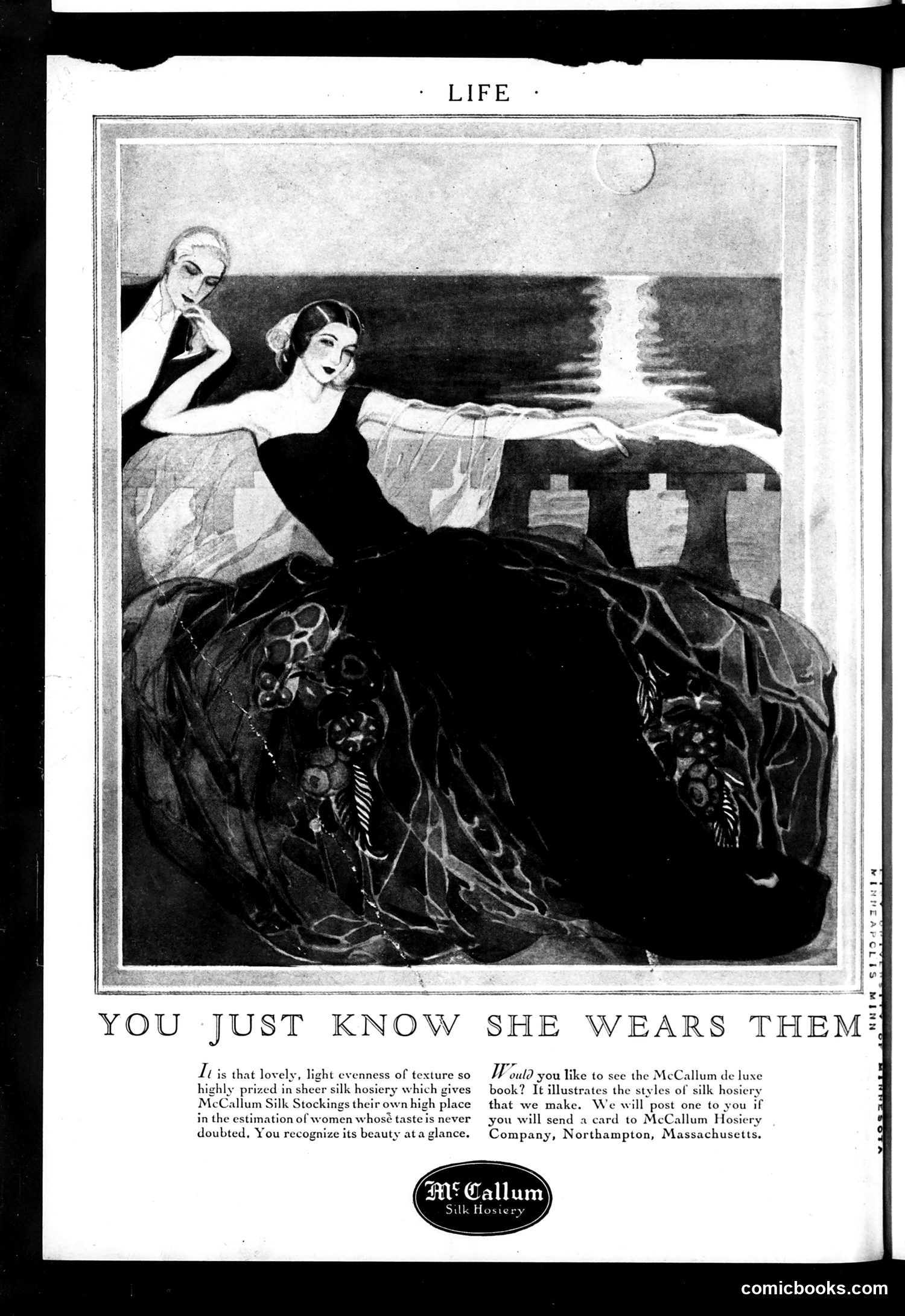
This is primarily a **fashion advertisement**, not political satire. It promotes McCallum Silk Stockings, a real hosiery company based in Northampton, Massachusetts. The image shows two stylishly dressed women in 1920s-era clothing reclining on a bed. The advertisement's appeal targets women of refined taste, emphasizing the "lovely, light evenness of texture" of silk hosiery as a marker of elegance and good judgment. The headline "YOU JUST KNOW SHE WEARS THEM" uses social inference as a selling technique—suggesting that quality silk stockings signal a woman's cultivated taste to observers. The ad invites interested readers to request a catalog illustrating various hosiery styles. This reflects early 20th-century consumer marketing aimed at middle-to-upper-class women, where intimate apparel quality became a visible (if subtle) status symbol. There is no political content or satire present on this page.