
Life, 1923-10-18 · page 20 of 44
Life — October 18, 1923 — page 20: what you’re looking at
What you’re looking at
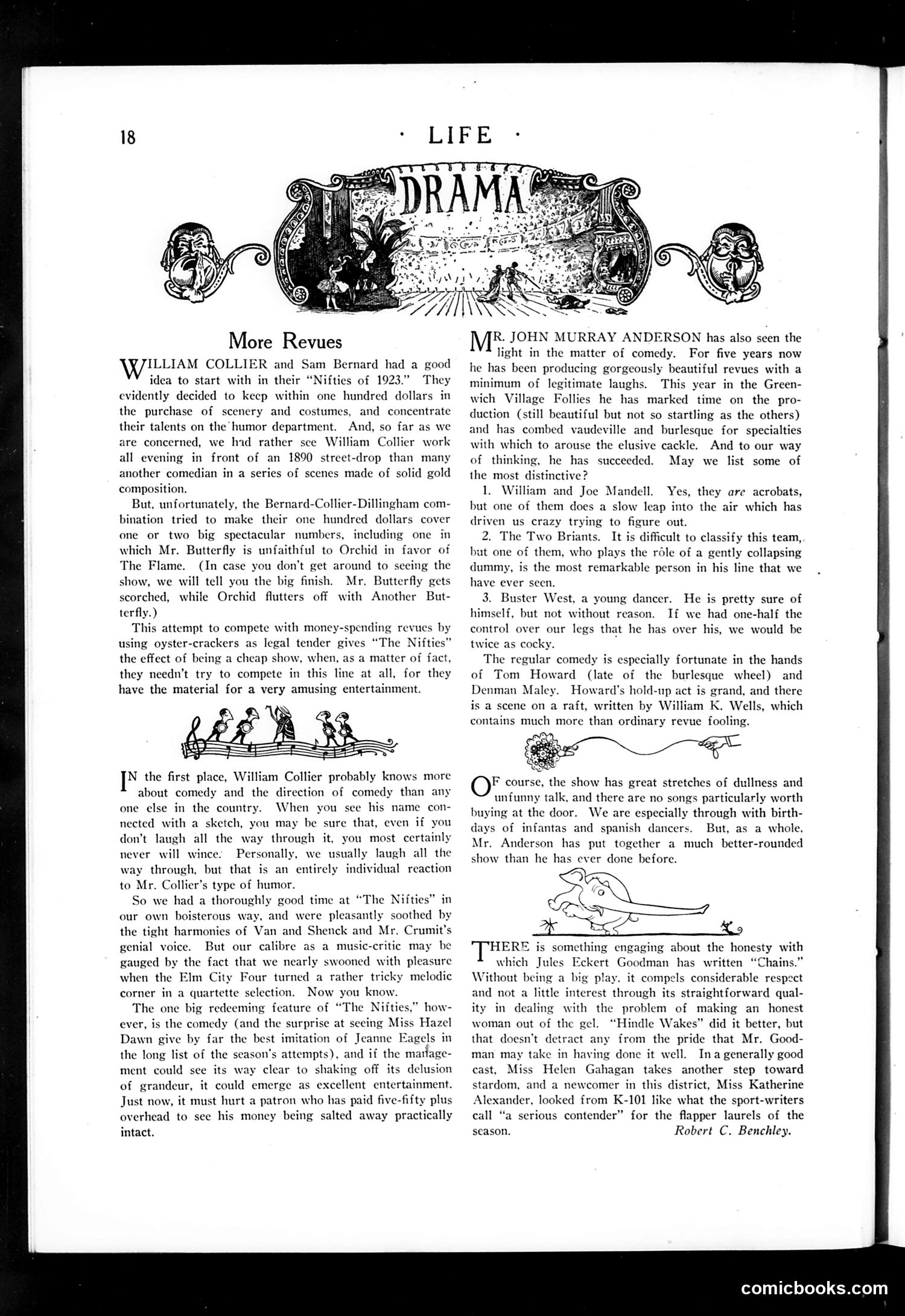
This theater review discusses two 1923 Broadway revues: "The Nifties" (produced by Collier, Bernard, and Dillingham) and "Greenwich Village Follies" (by John Murray Anderson). The critic praises comedian William Collier's comedic talent over expensive production values, arguing that clever humor matters more than lavish scenery and costumes. The review playfully mocks "The Nifties" for attempting to compete with money-laden revues while operating on a tiny budget—using "oyster-crackers as legal tender." The piece also criticizes Anderson's prior revues for prioritizing spectacle over comedy, praising his recent shift toward vaudeville and burlesque acts for laughs. Specific performers are highlighted: acrobats William and Joe Mandell, dancers "The Two Briants" and Buster West, and comedians Tom Howard and Denman Maley. The underlying satire critiques Broadway's obsession with expensive production design at the expense of actual entertainment value—a debate relevant to 1920s theater economics.
📄 Transcribed text from this page (OCR, searchable)
Machine-transcribed from the original scan — historical spelling and the odd misread are preserved.
More Revues ILLIAM COLLIER and Sam Bernard had a good idea to start with in their “Nifties of 1923.” They evidently decided to keep within one hundred dollars in the purchase of scenery and costumes, and concentrate their talents on the humor department. And, so far as we are concerned, we had rather sce William Collier work all evening in front of an 1890 street-drop than many another comedian in a series of scenes made of solid gold composition. But, unfortunately, the Bernard-Collier-Dillingham com- bination tried to make their one hundred dollars cover one or two big spectacular numbers, including one in which Mr. Butterfly is unfaithful to Orchid in favor of The Flame. (In case you don’t get around to seeing the show, we will tell you the big finish. Mr. Butterfly gets scorched, while Orchid flutters off with Another But- terfly.) This attempt to compete with money-spending revues by using oyster-crackers as legal tender gives “The ies the effect of being a cheap show, when a matter of fa they needn’t try to compete in this line at all, for they have the material for a very amusing entertainment. IX the first place, William Collier probably knows more about comedy and the direction of comedy than any When you see his name con- one else in the country. nected with a sketch, you may be sure that, even if you don’t laugh all the way through it, you most certainly never will wince: Personally, we usually laugh all the way through, but that is an entirely individual reaction to Mr. Collier’s type of humor. So we had a thoroughly good time at “The Nifties” in our own boisterous way, and were pleasantly soothed by the tight harmonies of Van and Shenck and Mr. Crumit’s genial voice. But our calibre as a music-critic may be gauged by the fact that we nearly swooned with pleasure when the Elm City Four turned a rather tri melodic corner in a quartette selection. Now you knoy The one big redeeming feature of ever, is the comedy (and the Dawn give by far the best imitation of Jeanne Eagels in the long list of the season's attempts), and if the matlage- ment could see its way clear to shaking off its delus of grandeur, it could emerge as excellent entertainment. Just now, it must hurt a patron who has paid five-fifty plus overhead to see his money being salted away practically intact. surprise at seeing Miss Hazel R. JOHN MURRAY ANDERSON has also seen the light in the matter of comedy. For five years now he has been producing gorgeously beautiful revues with a minimum of legitimate laughs. This year in the Green- wich Village Follies he has marked time on the pro- duction (still beautiful but not so startling as the others) and has combed vaudeville and burlesque for specialties with which to arouse the elusive cackle. And to our way of thinking, he has succeeded. May we list some of the most distinctive? 1, William and Joe Mandell. Yes, they are acrobats, but one of them does a slow leap into the air which has driven us crazy trying to figure out. 2. The Two Briants. It is difficult to classify this team, but one of them, who plays the rdle of a gently collapsing dummy, is the most remarkable person in his line that we have ever seen. 3. Buster West, a young dancer. He is pretty sure of himself, but not without reason. If we had one-half the control over our legs that he has over his, we would be twice as cocky. The regular comedy is especially fortunate in the hands of Tom Howard (late of the burlesque wheel) and Denman Maley. Howard's hold-up act is grand, and there is a scene on a raft, written by William K. Wells, which contains much more than ordinary revue fooling. F course, the show has great stretches of dullness and unfunny talk, and there are no songs particularly worth buying at the door. We are especially through with birth- days of infantas and spanish dancers. But, as a whole, Mr. Anderson has put together a much better-rounded show than he has ever done before. HERE is something engaging about the honesty with which Jules Eckert Goodman has written “Chains.” Without being a big play, it compels considerable respect and not a little interest through its straightforward qual- ity in dealing with the problem of making an honest woman out of the gel. “Hindle Wakes” did it better, but that doesn’t detract any from the pride that Mr. Good- man may take in having done it well. Ina generally good cast, Miss Helen Gahagan takes another step toward stardom, and a newcomer in this district, Miss Katherine Alexander, looked from K-101 like what the sport-writers call “a serious contender” for the flapper laurels of the season. Robert C. Benchley. comicbooks.com