
Life, 1923-10-18 · page 31 of 44
Life — October 18, 1923 — page 31: what you’re looking at
What you’re looking at
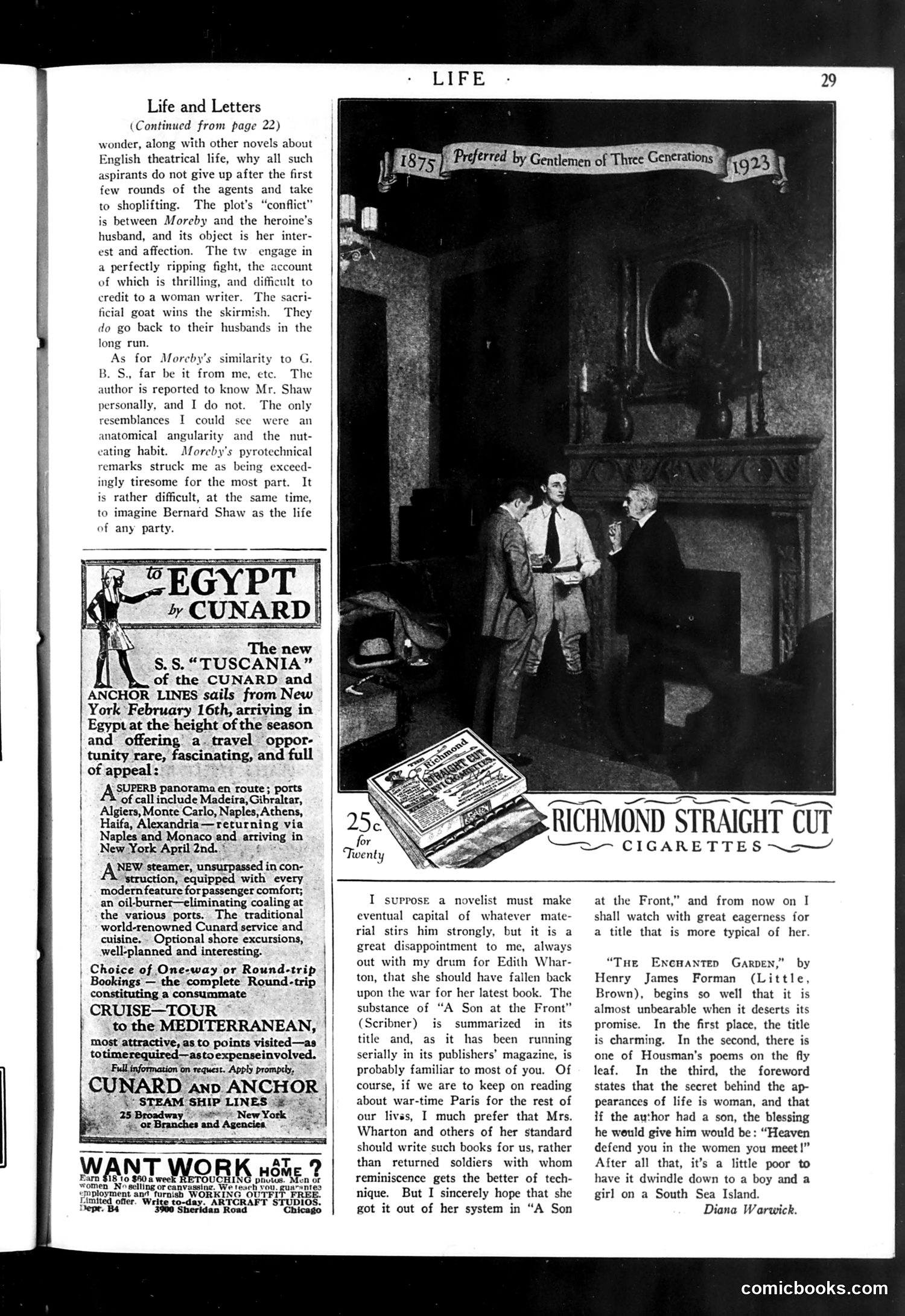
This page mixes **literary criticism** with **period advertising**. The main text reviews recent novels, including a dismissive critique of Edith Wharton's *"A Son at the Front"*—a WWI novel the reviewer finds disappointing because Wharton "fell back upon the war" rather than exploring fresher material. The critic also comments snidely on another novel with a character resembling George Bernard Shaw, finding his theatrical wit "tiresome." The **advertisements** promote luxury travel (Cunard steamship cruises to Egypt and the Mediterranean), Richmond cigarettes, and job listings—typical of 1920s American magazines targeting affluent readers. No political cartoons appear on this page. The "satire" is purely literary: the reviewer uses acerbic wit to critique authors' creative choices, particularly Wharton's reliance on wartime settings rather than innovative subjects. This reflects post-WWI cultural fatigue with war narratives.
📄 Transcribed text from this page (OCR, searchable)
Machine-transcribed from the original scan — historical spelling and the odd misread are preserved.
Life and Letters (Continued from page 22) wonder, along with other novels about English theatrical life, why all such aspirants do not give up after the first few rounds of the agents and take to shoplifting. The plot's “conflict” is between Moreby and the heroine's husband, and its object is her inter- est and affection. The tw engage in a perfectly ripping fight, the account of which is thrilling, and difficult to credit to a woman writer. The sacri- ficial goat wins the skirmish. They do go back to their husbands in the long run. As for Moreby’s similarity to G. B. S., far be it from me, ete. The author is reported to know Mr. Shaw onally, and I do not. The only resemblances I could see were an anatomical angularity and the nut- eating habit. Morcby's pyrotechnical remarks struck me as being exceed- ingly tiresome for the most part. It is rather difficult, at the same time, to imagine Bernard Shaw as the life of any party. S.S.“TUSCANIA” of the CUNARD and ANCHOR LINES sails from New York February 16th, arriving in Egyptat the height of the season and offering’ a. travel oppor- tunity rare, fascinating, and full of appeal: | pate n panorama en route; ports of call include Madeira, Gibraltar, Algiers, Monte Carlo, Naples, Athens, Haifa, Alexandria— returning via Naples and Monaco and eating in New York April 2nd..\ | NEW steamer, Ramat aned i in con- ‘struction, equipped with every modern feature for passenger comfort; an oil-burner—eliminating coaling at the various ports. The traditional world-renowned Cunard service and cuisine. - Optional shore excursions, well-planned and interesting. | Choice of One-way or Round-trip | | Bookings — the complete Round-trip | | constituting a consummate RICHMOND STRAIGHT CUT — > CIGARETTES ~~ I suppose a novelist must make eventual capital of whatever mate- rial stirs him strongly, but it is a great disappointment to me, always out with my drum for Edith Whar- ton, that she should have fallen back upon the war for her latest book. The CRUISE—TOUR substance of “A Son at the Front” to the MEDITERRANEAN, (Scribner) is summarized in its most attractive, as to points visited—as | title and, as it has been running at the Front,” and from now on I shall watch with great eagerness for a title that is more typical of her. “THe ENcHANTED GarDEN,” by Henry James Forman (Little, Brown), begins so well that it is almost unbearable when it deserts its promise. In the first place, the title is charming. In the second, there is totimerequired—astoexpenseinvolved. FidL information on request. Apply promptly, CUNARD anp ANCHOR "(STEAM SHIP LINES 25 Broadway | st" New York or and Agencies WANT. WO, BG uShe.2 serially in its publishers’ magazine, is probably familiar to most of you. Of course, if we are to keep on reading about war-time Paris for the rest of our livss, I much prefer that Mrs. Wharton and others of her standard should write such books for us, rather than returned soldiers with whom reminiscence gets the better of tech- one of Housman’s poems on the fly leaf. In the third, the foreword states that the secret behind the ap- pearances of life is woman, and that if the author had a son, the blessing he would give him would be: “Heaven defend you in the women you meet!” After all that, it’s a little poor to have it dwindle down to a boy and a ome No selling fi We tesch. ., a eee and arash WC oR Not nique. But I sincerely hope that she offer. es Depe. BA 3900 Sheridan got it out of her system in “A Son girl on a South Sea Island. Diana Warwick. comicbooks.com