
Life, 1923-10-18 · page 16 of 44
Life — October 18, 1923 — page 16: what you’re looking at
What you’re looking at
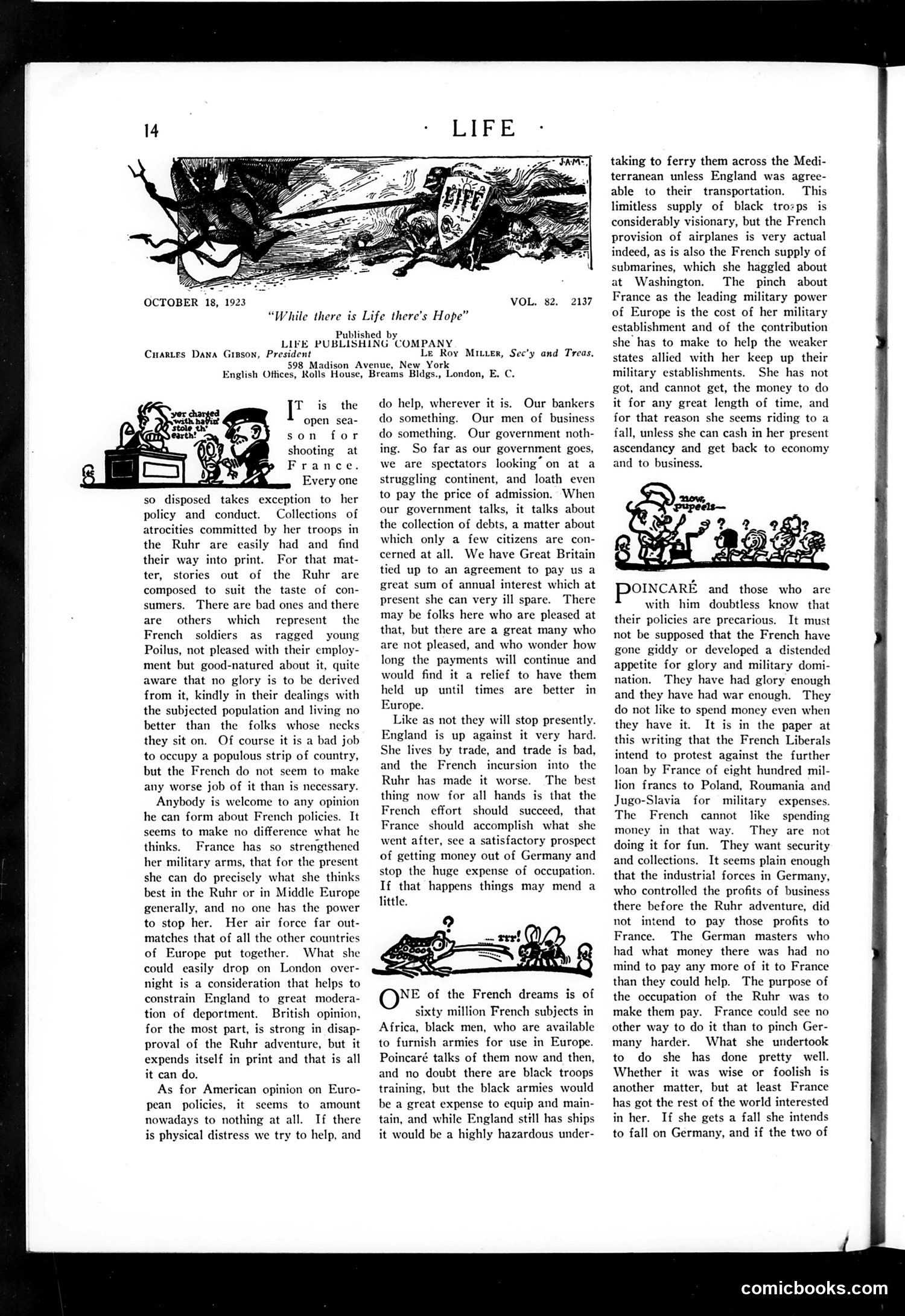
This page contains editorial commentary on post-WWI European politics, particularly French financial struggles and military expenses. The text criticizes France's expensive military establishment and her expectation that Britain and America should help fund it. The cartoons (appearing as small illustrations) depict figures in what appears to be political/financial distress—likely representing France or European nations dealing with war debts and reparations. The editorial argues France cannot afford her military costs alone and is pressuring allies for financial support, while also discussing France's colonial ambitions in Africa. The satire targets French diplomatic expectations and the broader difficulty of post-war European recovery and debt repayment among Allied nations. The text reflects American skepticism toward continuing European financial entanglements after WWI.
📄 Transcribed text from this page (OCR, searchable)
Machine-transcribed from the original scan — historical spelling and the odd misread are preserved.
OCTOBER 18, 1923 VOL. 82. 2137 “While there is Life there’s Hope” Published by LIFE PUBLISHING COMPANY Cuartes Dana Gipson, President 598 Madison Avenue, Le Roy Muer, Sec’y and Treas, New York English Offices, Rolls House, Breams Bldgs., London, E. C. r is the open sea- son for shooting at France. Every one so disposed takes exception to her policy and conduct. Collections of atrocities committed by her troops in the Ruhr are easily had and find their way into print. For that mat- ter, stories out of the Ruhr are composed to suit the taste of con- sumers. There are bad ones and there are others which represent the French soldiers as ragged young Poilus, not pleased with their employ: ment but good-natured about it, quite aware that no glory is to be derived from it, kindly in their dealings with the subjected population and living no better than the folks whose necks they sit on. Of course it is a bad job to occupy a populous strip of country, but the French do not seem to make any worse job of it than is necessary. Anybody is welcome to any opinion he can form about French policies. It seems to make no difference what he thinks. France has so strengthened her military arms, that for the present she can do precisely what she thinks best in the Ruhr or in Middle Europe generally, and no one has the power to stop her. Her air force far out- matches that of all the other countries of Europe put together. What she could easily drop on London over- night is a consideration that helps to constrain England to great modera- tion of deportment. British opinion, for the most part, is strong in disap- proval of the Ruhr adventure, but it expends itself in print and that is all it can do. As for American opinion on Euro- pean policies, it seems to amount nowadays to nothing at all. If there is physical distress we try to help, and do help, wherever it is. Our bankers do something. Our men of business do something. Our government noth- ing. So far as our government goes, we are spectators looking’ on at a struggling continent, and loath even to pay the price of admission. When our government talks, it talks about the collection of debts, a matter about which only a few citizens are con- cerned at all. We have Great Britain tied up to an agreement to pay us a great sum of annual interest which at present she can very ill spare. There may be folks here who are pleased at that, but there are a great many who are not pleased, and who wonder how long the payments will continue and would find it a relief to have them held up until times are better in Europe. Like as not they will stop presently. England is up against it very hard. She lives by trade, and trade is bad, and the French incursion into the Ruhr has made it worse. The best thing now for all hands is that the French effort should succeed, that France should accomplish what she went after, see a satisfactory prospect of getting money out of Germany and stop the huge expense of occupation. If that happens things may mend a little. NE of the French dreams is of sixty million French subjects in Africa, black men, who are available to furnish armies for use in Europe. Poincaré talks of them now and then, and no doubt there are black troops training, but the black armies would be a great expense to equip and main- tain, and while England still has ships it would be a highly hazardous under- taking to ferry them across the Medi- terranean unless England was agree- able to their transportation. Thi limitless supply of black trozps is considerably visionary, but the French provision of airplanes is very actual indeed, as is also the French supply of submarines, which she haggled about at Washington. The pinch about France as the leading military power of Europe is the cost of her military establishment and of the contribution she has to make to help the weaker states allied with her keep up their military establishments. She has not got, and cannot get, the money to do it for any great length of time, and for that reason she seems riding to a fall, unless she can cash in her present ascendancy and get back to economy and to business. OINCARE and those who are with him doubtless know that their policies are precarious. It must not be supposed that the French have gone giddy or developed a distended appetite for glory and military domi- nation. They have had glory enough and they have had war enough. They do not like to spend money even when they have it. It is in the paper at this writing that the French Liberals intend to protest against the further loan by France of eight hundred mil- lion francs to Poland, Roumania and Jugo-Slavia for military expen The French cannot like spending money in that way. They are not doing it for fun. They want security and collections. It seems plain enough that the industrial forces in Germany, who controlled the profits of business there before the Ruhr adventure, did not intend to pay those profits to France. The German masters who had what money there was had no mind to pay any more of it to France than they could help. The purpose of the occupation of the Ruhr was to make them pay. France could see no other way to do it than to pinch Ger- many harder. What she undertook to do she has done pretty well. Whether it was wise or foolish is another matter, but at least France has got the rest of the world interested in her. If she gets a fall she intends to fall on Germany, and if the two of comicbooks.com