
Life, 1923-10-18 · page 11 of 44
Life — October 18, 1923 — page 11: what you’re looking at
What you’re looking at
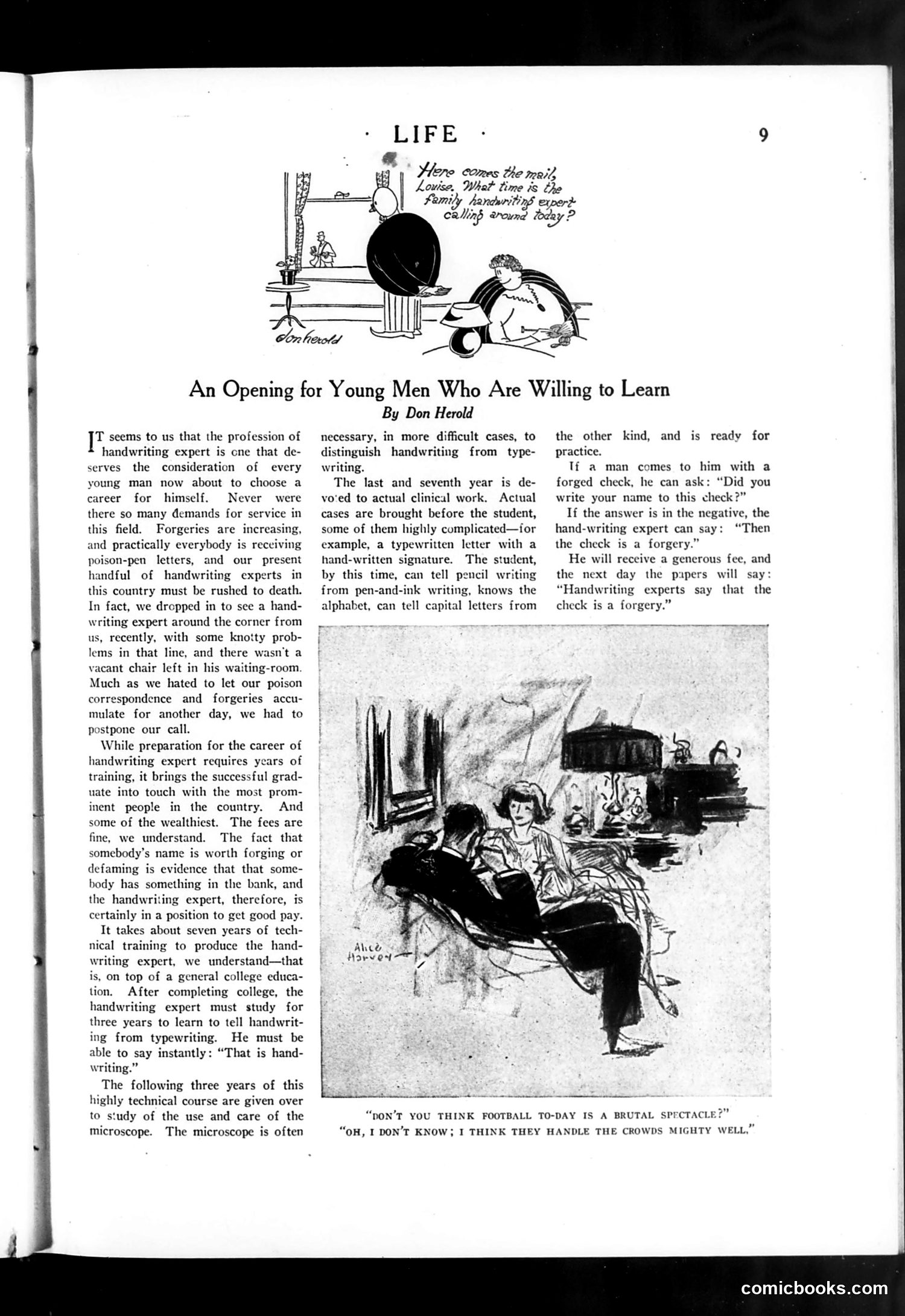
This page contains an article by Don Herald titled "An Opening for Young Men Who Are Willing to Learn" about careers in handwriting expertise and document authentication. The article discusses training requirements and the professional demand for such specialists. The cartoon at bottom depicts two men at a football stadium. One asks if football is "a brutal spectacle," and the other replies he doesn't know but thinks "they handle the crowds mightily well." The joke contrasts concern about violence *in* the sport with admiration for crowd *management*—redirecting the question from player safety to logistical efficiency. This appears to be early 20th-century social commentary, possibly satirizing misplaced priorities or public indifference to athlete welfare during a period when football was genuinely dangerous and largely unregulated.
📄 Transcribed text from this page (OCR, searchable)
Machine-transcribed from the original scan — historical spelling and the odd misread are preserved.
| LIFE # Femily handwrit Here comes the mRib, Louise, What time is the exper? ealing si ibeay > An Opening for Young Men Who Are Willing to Learn T seems to us that the profession of handwriting expert is one that de- serves the consideration of every young man now about to choose a career for himself. Never were there so many demands for service in this field. Forgeries are increasing, and practically everybody is receiving poison-pen letters, and our present handful of handwriting experts in this country must be rushed to death. In fact, we dropped in to see a hand- writing expert around the corner from us, recently, with some knotty prob- lems in that line, and there wasn’t a vacant chair left in his waiting-room. Much as we hated to let our poison correspondence and forgeries accu- mulate for another day, we had to postpone our call. While preparation for the career of handwriting expert requires years of training, it brings the successful grad- uate into touch with the most prom- inent people in the country. And some of the wealthiest. The fees are fine, we understand. The fact that somebody’s name is worth forging or defaming is evidence that that some- body has something in the bank, and the handwriting expert, therefore, is certainly in a position to get good pay. It takes about seven years of tech- nical training to produce the hand- writing expert, we understand—that is, on top of a general college educa- tion. After completing college, the handwriting expert must study for three years to learn to tell handwrit- ing from typewriting. He must be able to say instantly: “That is hand- writing.” The following three years of this highly technical course are given over to study of the use and care of the microscope. The microscope is often By Don Herold necessary, in more difficult cases, to distinguish handwriting from type- writing. The last and seventh year is de- vo'ed to actual clinical work. Actual cases are brought before the student, some of them highly complicated—ior example, a typewritten letter with a hand-written signature. The by this time, can tell pencil writing from pen-and-ink writing, knows the alphabet, can tell capital letters from Horve “DON’T YOU THINK FOOTBALL TO-DAY IS A BRUTAL SPFCTACLE “OH, I DON’T KNOW; I THINK THEY HANDLE THE CROWDS MIGHTY WELL,” the other kind, and is ready for practice. If a man comes to him with a forged check, he can ask: “Did you write your name to this check?” If the answer is in the negative, the hand-writing expert can say: “Then the check is a forgery.” He will receive a generous fee, and the next day the papers will say: “Handwriting experts say that the check is a forgery.” comicbooks.com