
Life, 1923-10-18 · page 15 of 44
Life — October 18, 1923 — page 15: what you’re looking at
What you’re looking at
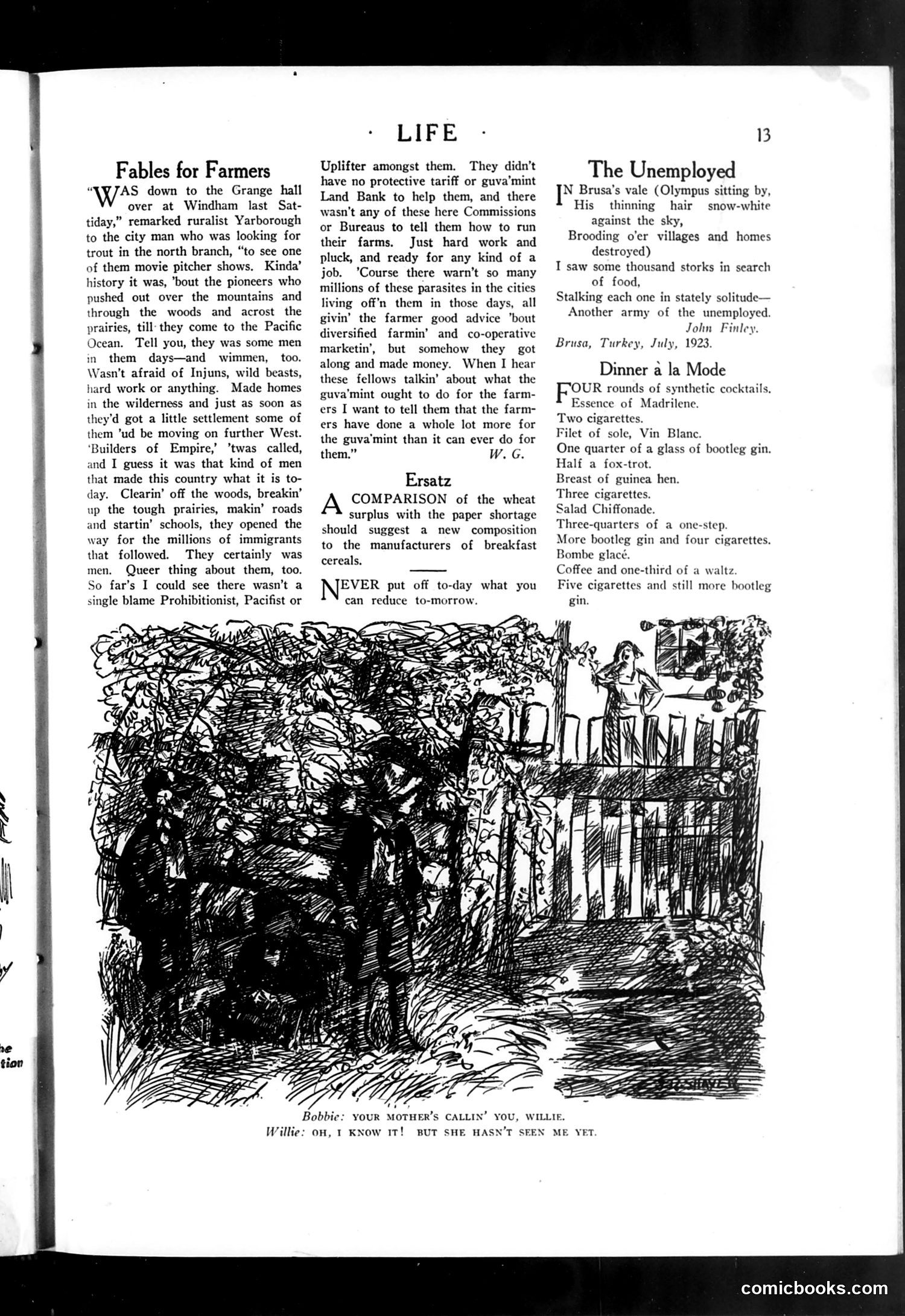
This page contains several distinct pieces of social commentary from 1923: **"Fables for Farmers"** (left column) criticizes federal agricultural policy. A rural narrator argues that government commissions and "Bureaus" offer farmers unhelpful advice about "diversified farmin'" and cooperative marketing, while farmers themselves have proven more economically successful through hard work. **"The Unemployed"** (right) presents a grim poem by John Finley about jobless men searching for food—reflecting post-WWI economic hardship. **The cartoon** (bottom) depicts a rural scene with a humorous domestic exchange: a child ("Bobbie") calls to his mother that "Willie" is outside, and Willie responds that his mother hasn't seen him yet. The joke appears to reference childhood mischief or truancy. The page overall reflects 1920s concerns: agricultural policy failures and urban unemployment.
📄 Transcribed text from this page (OCR, searchable)
Machine-transcribed from the original scan — historical spelling and the odd misread are preserved.
Fables for Farmers s ‘AS down to the Grange hall over at Windham last Sat- tiday,” remarked ruralist Yarborough to the city man who was looking for trout in the north branch, “to see one of them movie pitcher shows. Kinda’ history it was, ‘bout the pioneers who pushed out over the mountains and through the woods and acrost the prairies, till: they come to the Pacific Ocean. Tell you, they was some men in them days—and wimmen, too. Wasn't afraid of Injuns, wild beasts, hard work or anything. Made homes in the wilderness and just as soon as they’d got a little settlement some of them ’ud be moving on further West. ‘Builders of Empire,’ ’twas called, and I guess it was that kind of men that made this country what it is to- day. Clearin’ off the woods, breakin’ up the tough prairies, makin’ roads and startin’ schools, they opened the way for the millions of immigrants that followed. They certainly was men. Queer thing about them, too. So far’s I could see there wasn’t a single blame Prohibitionist, Pacifist or Bobbie Willie: on, 1 KNow IT! LIFE Uplifter amongst them. They didn’t have no protective tariff or guva’mint Land Bank to help them, and there wasn't any of these here Commissions or Bureaus to tell them how to run their farms. Just hard work and pluck, and ready for any kind of a job. ’Course there warn’t so many millions of these parasites in the cities living off'n them in those days, all givin’ the farmer good advice ‘bout diversified farmin’ and co-operative marketin’, but somehow they got along and made money. When I hear these fellows talkin’ about what the guva’mint ought to do for the farm- ers I want to tell them that the farm- ers have done a whole lot more for the guva'mint than it can ever do for them.” W. G. Ersatz COMPARISON of the wheat surplus with the paper shortage should suggest a new composition to the manufacturers of breakfast cereals, NEVER put off to-day what you can reduce to-morrow. 13 The Unemployed 8 Brusa’s vale (Olympus sitting by, His thinning hair snow-white against the sky, Brooding o'er villages and homes destroyed) I saw some thousand storks in search of food, Stalking each one in stately solitude— Another army of the unemployed. John Finley. Brusa, Turkey, July, 1923. Dinner a la Mode ‘OUR rounds of synthetic cocktails. Essence of Madrilene. Two cigarettes. Filet of sole, Vin Blanc. One quarter of a glass of bootleg gin. Half a fox-trot. Breast of guinea hen. Three cigarettes. Salad Chiffonade. Three-quarters of a one-step. More bootleg gin and four cigarettes. Bombe glacé. Coffee and one-third of a waltz. Five cigarettes and still more bootleg YOUR MOTHER’S CALLIN’ YOU, WILLIE. BUT SHE HASN’T SEEN ME YET comicbooks.com