
Life, 1923-10-18 · page 34 of 44
Life — October 18, 1923 — page 34: what you’re looking at
What you’re looking at
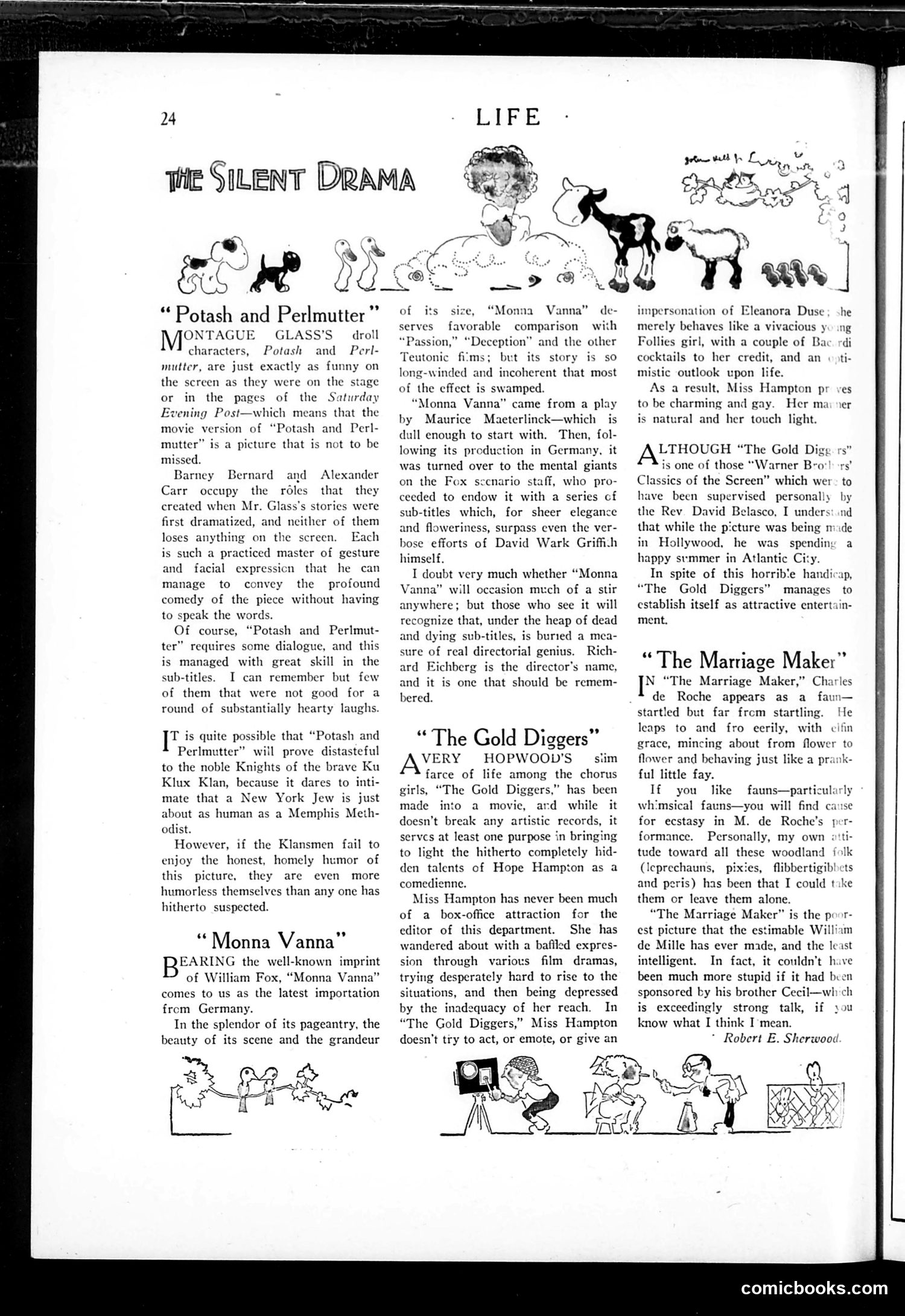
This page reviews four silent films, with particular satirical bite in the "Potash and Perlmutter" section. The reviewer notes the film's humor derives from its Jewish characters, then directly challenges the Ku Klux Klan—stating the movie "dares to intimate that a New York Jew is just about as human as a Memphis Methodist." This is sharp social commentary for the 1920s, when the KKK was resurgent and anti-Semitism widespread. The reviewer suggests Klansmen would find it offensive and uses that offense to mock their lack of humanity. Other reviews cover "Monna Vanna" (criticized for verbose subtitles obscuring decent direction), "The Gold Diggers" (praising Hope Hampton's natural performance), and mock "The Gold Diggers" as a supposed David Belasco production—while noting Belasco was vacationing in Atlantic City during filming, suggesting his "supervision" was fictional.
📄 Transcribed text from this page (OCR, searchable)
Machine-transcribed from the original scan — historical spelling and the odd misread are preserved.
24 “Potash and Perlmutter’ ONTAGUE- GLASS'S | droll characters, Potash and Perl- mutter, are just exactly as funny on the screen as they were on the stage or in the pages of the Saturday Evening Post—which means that the movie version of “Potash and Perl- mutter” is a picture that is not to be missed. Barney Bernard and Alexander Carr occupy the rdles that they created when Mr. Glass’s stories were first dramatized, and neither of them loses anything on the is such a practiced master of gesture and facial expressicn that he can manage to convey the profound comedy of the piece without having to speak the words Of course, “Potash and Perlmut- ter” requires some dialogue, and this is managed with great skill in the sub-titles. of them that were not good for a round of substantially hearty laughs. creen. Each I can remember but few T is quite possible that “Potash and Perlmutter” will prove distasteful to the noble Knights of the brave Ku Klux Klan, because it dares to inti- mate that a New York Jew is just about as human as a Memphis Meth- odist. However, if the Klansmen fail to enjoy the honest, homely humor of this picture, they are even more humorless themselves than any one has hitherto suspected. ” “Monna Vanna ARING the well-known imprint of William Fox, “Monna Vanna” comes to us as the latest importation from Germany. In the splendor of its pageantry, the beauty of its scene and the grandeur of its size, “Monna Vanna” de- serves favorable comparison with “Passion,” “Deception” and the other fiims; but its story is so long-winded and incoherent that most of the effect is swamped. “Monna Vanna” came from a play by Maurice Maeterlinck—which is dull enough to start with. Then, fol- lowing its production in Germa it was turned over to the mental giants on the Fox sccnario staff, who pro- ceeded to endow it with a series cf sub-titles which, for sheer elegance and floweriness, surpass even the ver- bose efforts of David Wark Griffi.h himself. I doubt very much whether “Monna Vanna” will occasion much of a stir anywhere; but those who see it will recognize that, under the heap of dead and dying sub-titles, is buried a mea- sure of real directorial genius. Rich- ard Eichberg is the director's name, and it is one that should be remem- bered. “ The Gold Diggers” VERY HOPWOOD'S © siim farce of life among the chorus girls, “The Gold Diggers,” has been made into a movie, ard while it doesn’t break any artistic records, it servcs at least one purpose in bringing to light the hitherto completely hid- den talents of Hope Hampton as a comedienne. Miss Hampton has never been much of a box-office attraction for the editor of this department. She has wandered about with a bafiled expres- sion through various film dramas, trying desperately hard to rise to the situations, and then being depressed by the inadequacy of her reach. In “The Gold Diggers,” Miss Hampton doesn’t try to act, or emote, or OE an Teutonic impersonation of Eleanora Duse; she merely behaves like a vivacious y. ing Follies girl, with a couple of Bac rdi cocktails to her credit, and an « oti- mistic outlook upon life. As a result, Miss Hampton pr ves to be charming and gay. Her mai ver is natural and her touch light. LTHOUGH “The Gold D: iB is one of those “Warner Bro'! rs’ Classics of the Screen” which wer. to have been supervised personally by the Rev David Belasco, I unders: ind that while the picture was being made in Hollywood, he was spending a happy stmmer in Atlantic City. In spite of this horrib‘e handicap, “The Gold Diggers” manages to establish itself as attractive entertain- ment. “The Marriage Maker” N “The Marriage Maker,” Cha de Roche appears as a fat startled but far from startling. He Ieaps to and fro eerily, with cifin grace, mincing about from flower to flower and behaving just like a pré ful little fay. If you like fauns—particularly whimsical fauns—you will find cause for ecstasy in M. de Roche's per- formance. Personally, my own »tti- tude toward all these woodland folk (leprechauns, pixies, flibbertigibhets and peris) has been that I could tike them or leave them alone. “The Marriage Maker” is the poor- est picture that the estimable William de Mille has ever made, and the least intelligent. In fact, it couldn't have been much more stupid if it had been sponsored by his brother Cecil—wh ch is exceedingly strong talk, if you know what I think I mean. * Robert E. Sherwood. o Be comicbooks.com