
A complete issue · 36 pages · 1923
Life — October 11, 1923
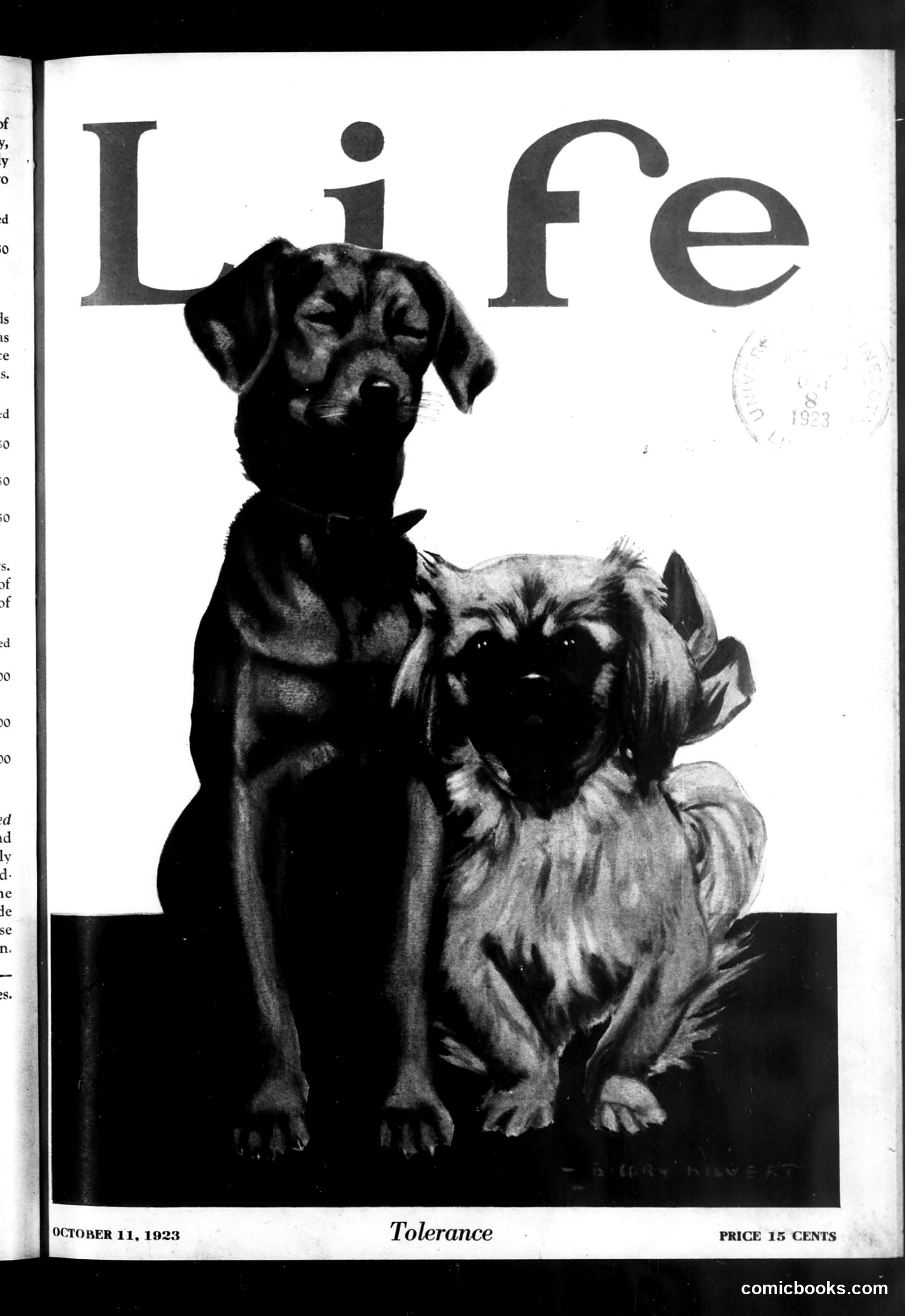
This cartoon illustrates the concept of "Tolerance" through two dogs of different breeds standing together. The larger dog (appearing to be a Labrador or similar breed) stands beside a smaller, longer-haired breed (possibly a Pekingese or similar toy breed). The juxtaposition suggests that tolerance means accepting those who are different—in this case, different physical types. In 1923 America, this likely carried broader social commentary about accepting people of different races, nationalities, or social classes during a period of significant immigration debates and social tension. The simple, wordless visual metaphor of dogs coexisting peacefully made an accessible argument for acceptance and harmony despite visible differences.
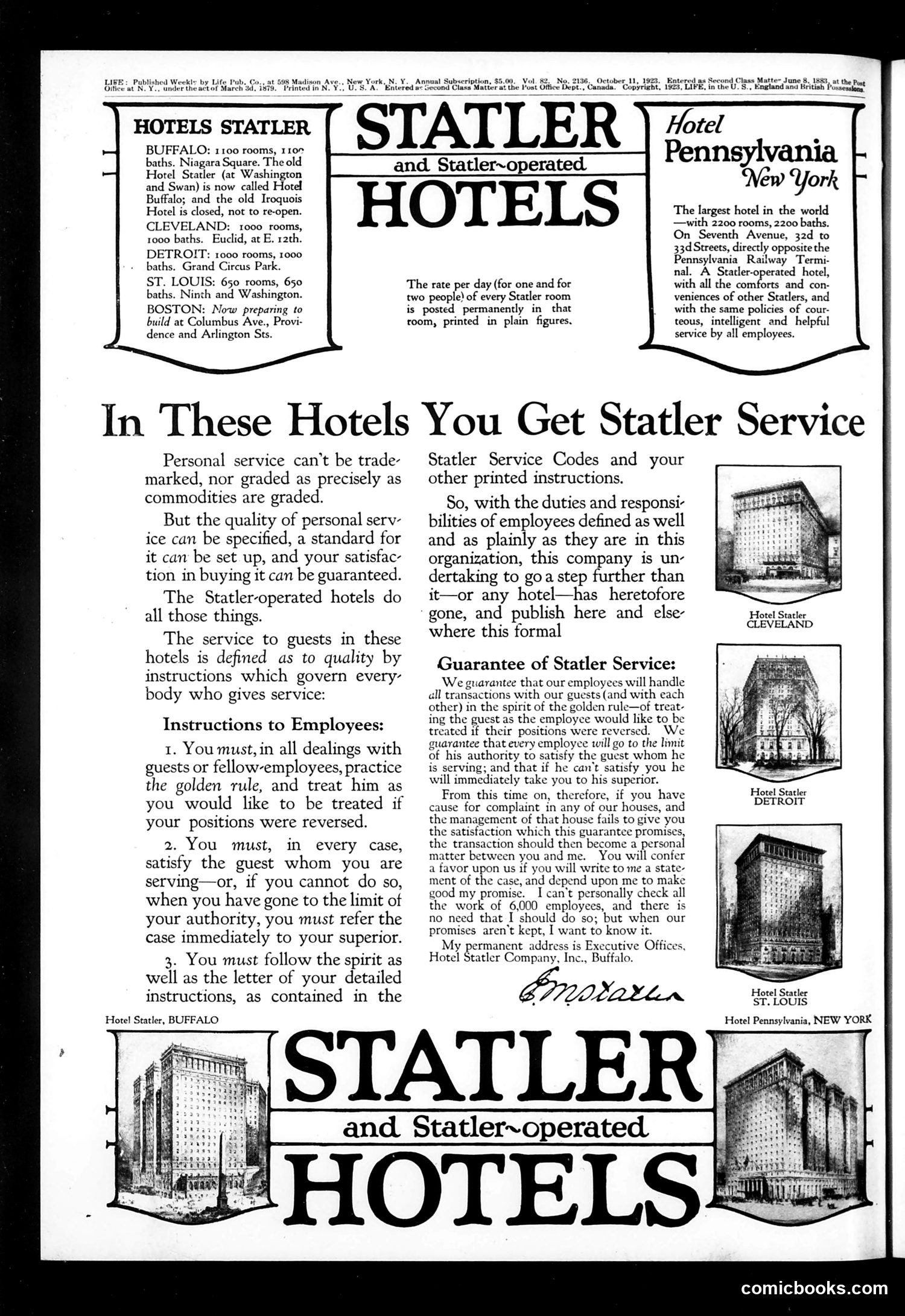
This page is **primarily advertising**, not satire or political commentary. It's a 1925 advertisement for Statler Hotels, a major American hotel chain operating properties in Buffalo, Cleveland, Detroit, St. Louis, and Boston, with a new location opening in New York. The ad promotes "Statler Service"—a standardized approach to hospitality. It emphasizes employee training through three instructions: treating guests by the "golden rule," satisfying guest needs within authority limits, and following detailed service codes. The inclusion of a personal guarantee from what appears to be the company founder reinforces quality assurance. The multiple hotel photographs showcase the chain's scale and architectural prominence. This reflects early-20th-century corporate branding strategy—using consistent service standards as a competitive differentiator in the hospitality industry.
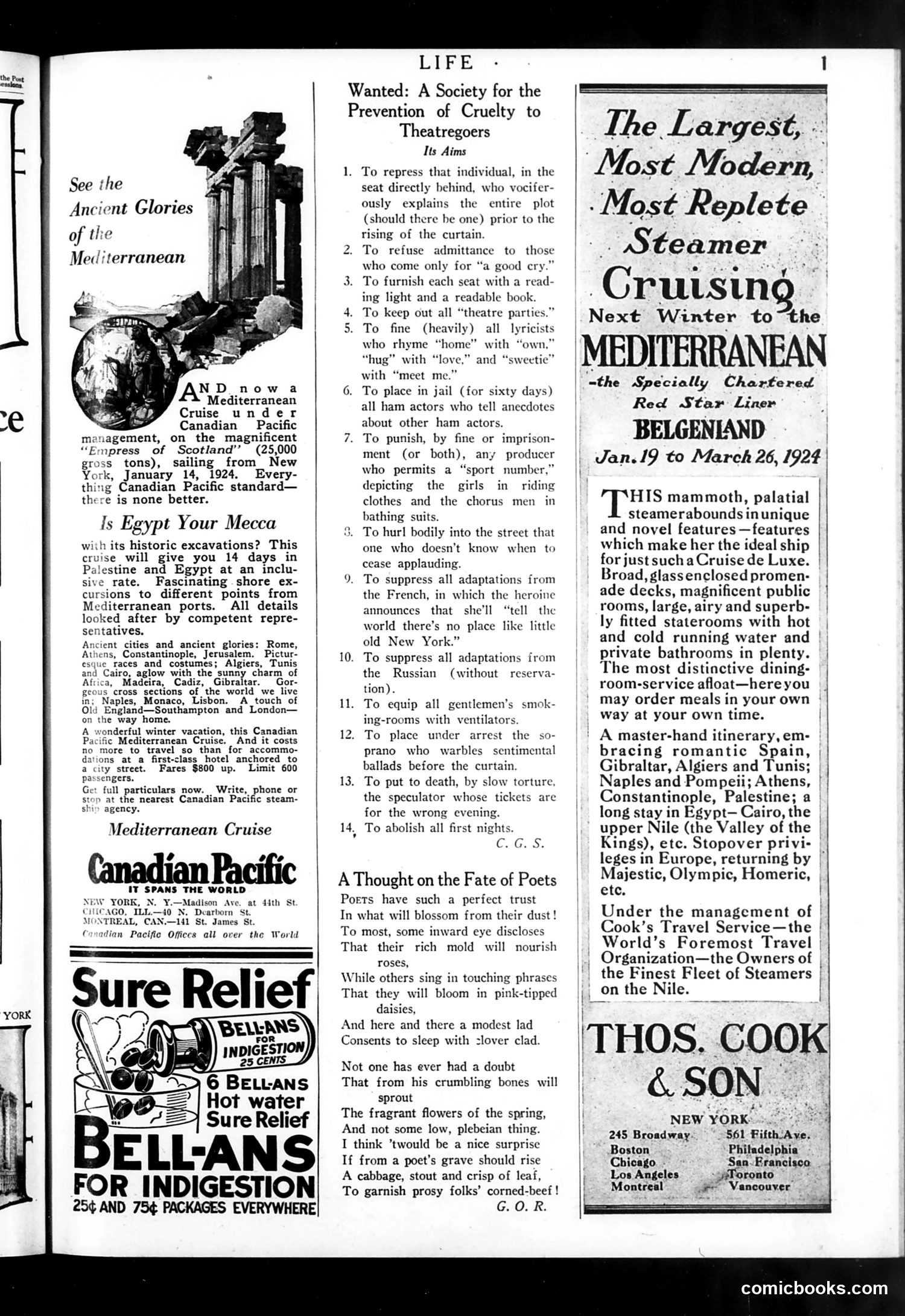
This page is primarily **advertising and travel content**, not political satire. The main elements are: 1. **Mediterranean cruise ads** (Canadian Pacific, Red Star Liner Belgianland, Thos. Cook & Son) promoting luxury winter voyages to Egypt, Greece, and the Mediterranean—typical 1920s travel marketing. 2. **A "Society for the Prevention of Cruelty to Theatregoers"** satirical list mocking common theater annoyances: people who talk, rhyme with songs, wear sport numbers to opening nights, and create other disruptions. This is gentle social satire about theater etiquette, not political commentary. 3. **"A Thought on the Fate of Poets"**—a literary poem (signed G.O.R. and C.G.S.) offering whimsical musings about poets and nature. 4. **Bell-Ans antacid advertisement** for indigestion relief. The page reflects 1920s consumer culture and middle-class leisure concerns rather than political critique.
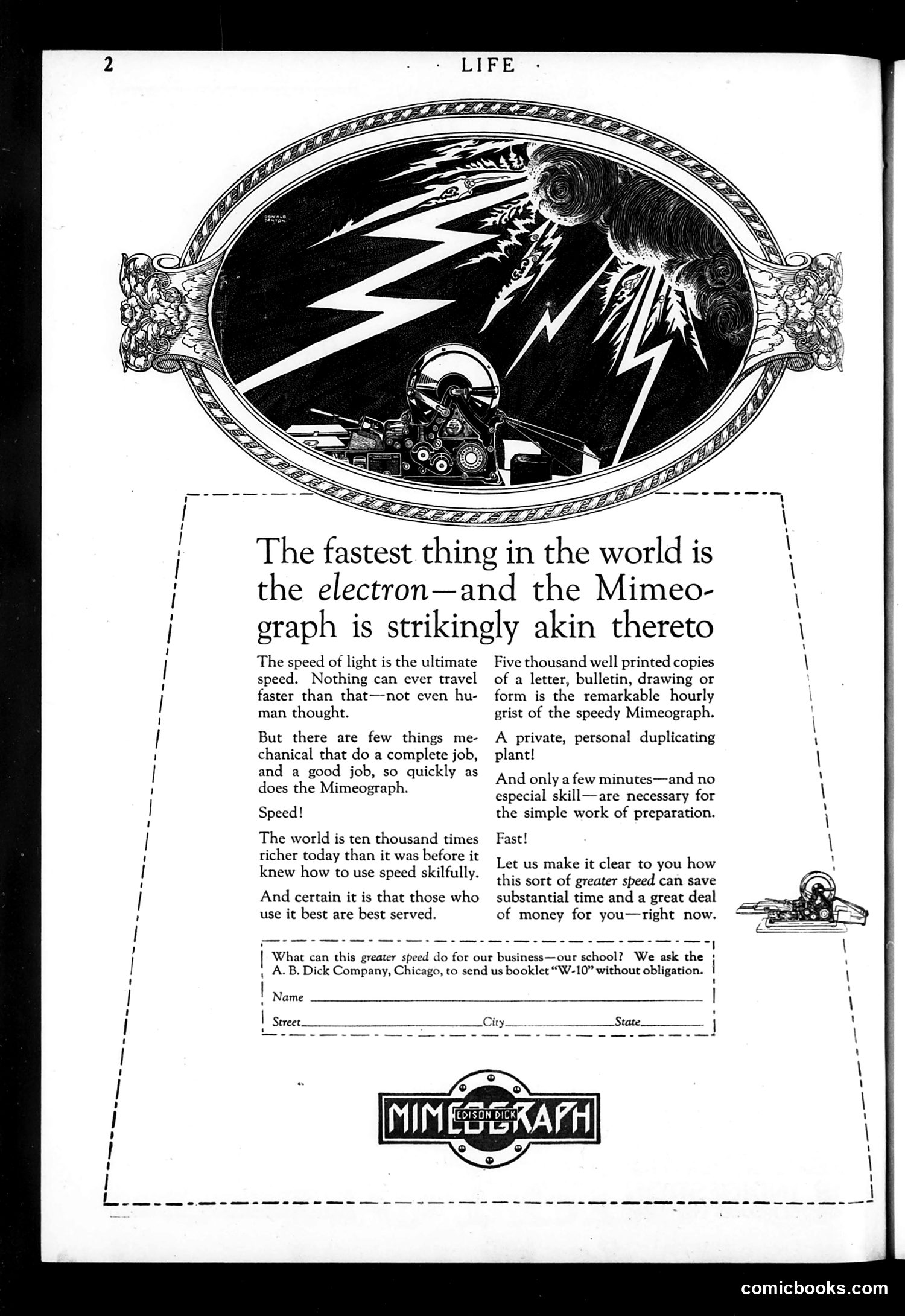
This is primarily a **commercial advertisement** for the Mimeograph machine, not political satire. The page appears in *Life* magazine's advertising section. The advertisement uses a dramatic illustration of **lightning bolts and an airplane** to metaphorically compare the Mimeograph's speed to "the fastest thing in the world"—the electron and speed of light. The pitch emphasizes **labor-saving efficiency**: the machine can produce 5,000 copies quickly without special skill, targeting businesses and schools. The ad argues this "greater speed" saves "substantial time and money." The cartoon elements are purely illustrative marketing devices, not social commentary. This reflects early-20th-century advertising's embrace of technological progress as a selling point, appealing to readers' desire for modern efficiency.
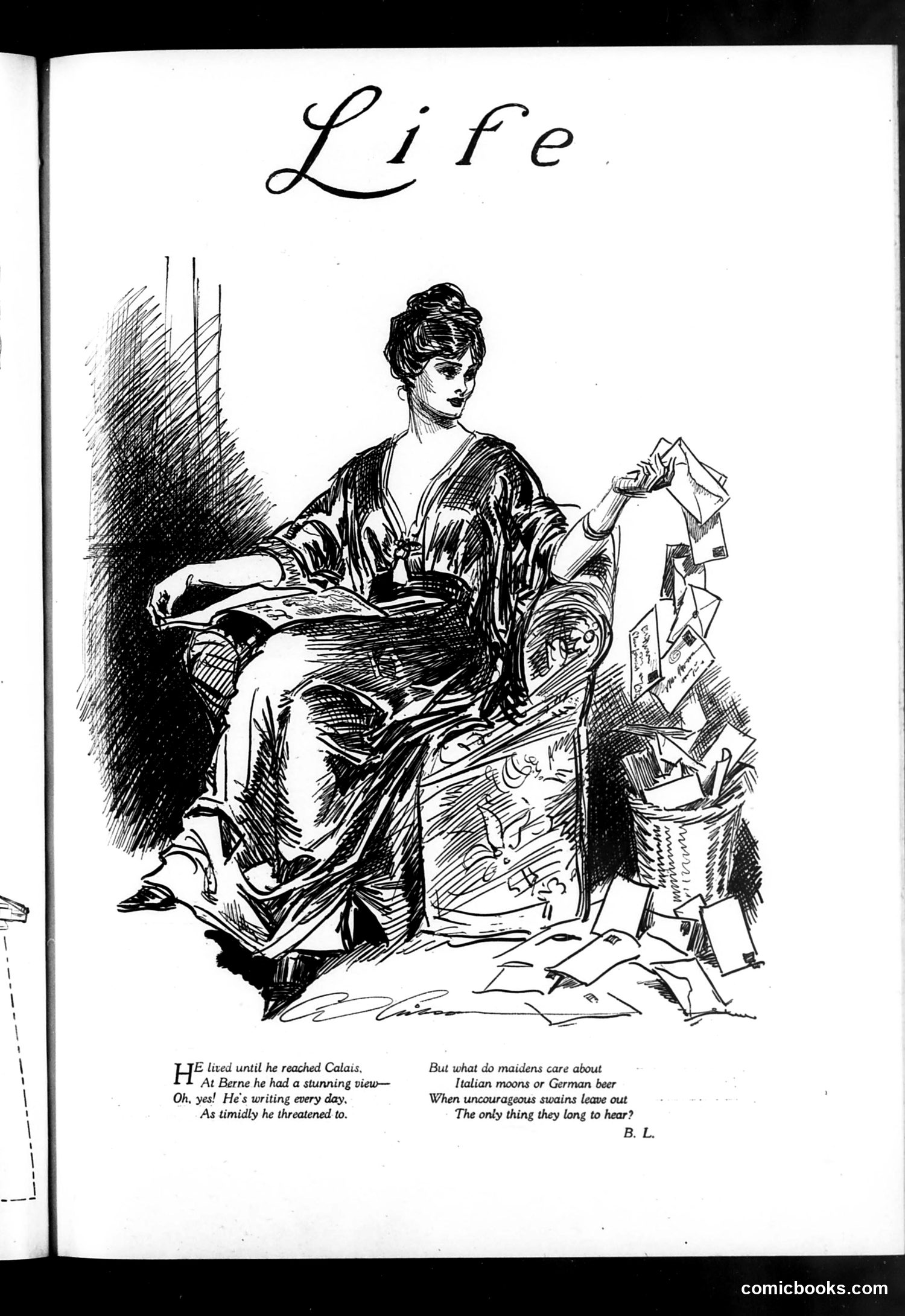
This illustration satirizes a prolific male writer (the piece notes he writes "every day"). The woman seated represents his patient wife or partner, surrounded by scattered manuscripts and correspondence. The satire critiques both the writer's obsessive productivity and the indifference of female admirers to his work. The poem's second stanza mocks romantic idealization: maidens care nothing for Italian moons or German beer when "unconcerned swains" (indifferent suitors) produce writing. The joke suggests women ignore literary output in favor of actual romantic attention. The signature "B.L." indicates the artist. This represents early-20th-century satirical commentary on literary ambition, gender dynamics, and the disconnect between artistic dedication and romantic success. The visual humor emphasizes masculine literary labor versus feminine disinterest.
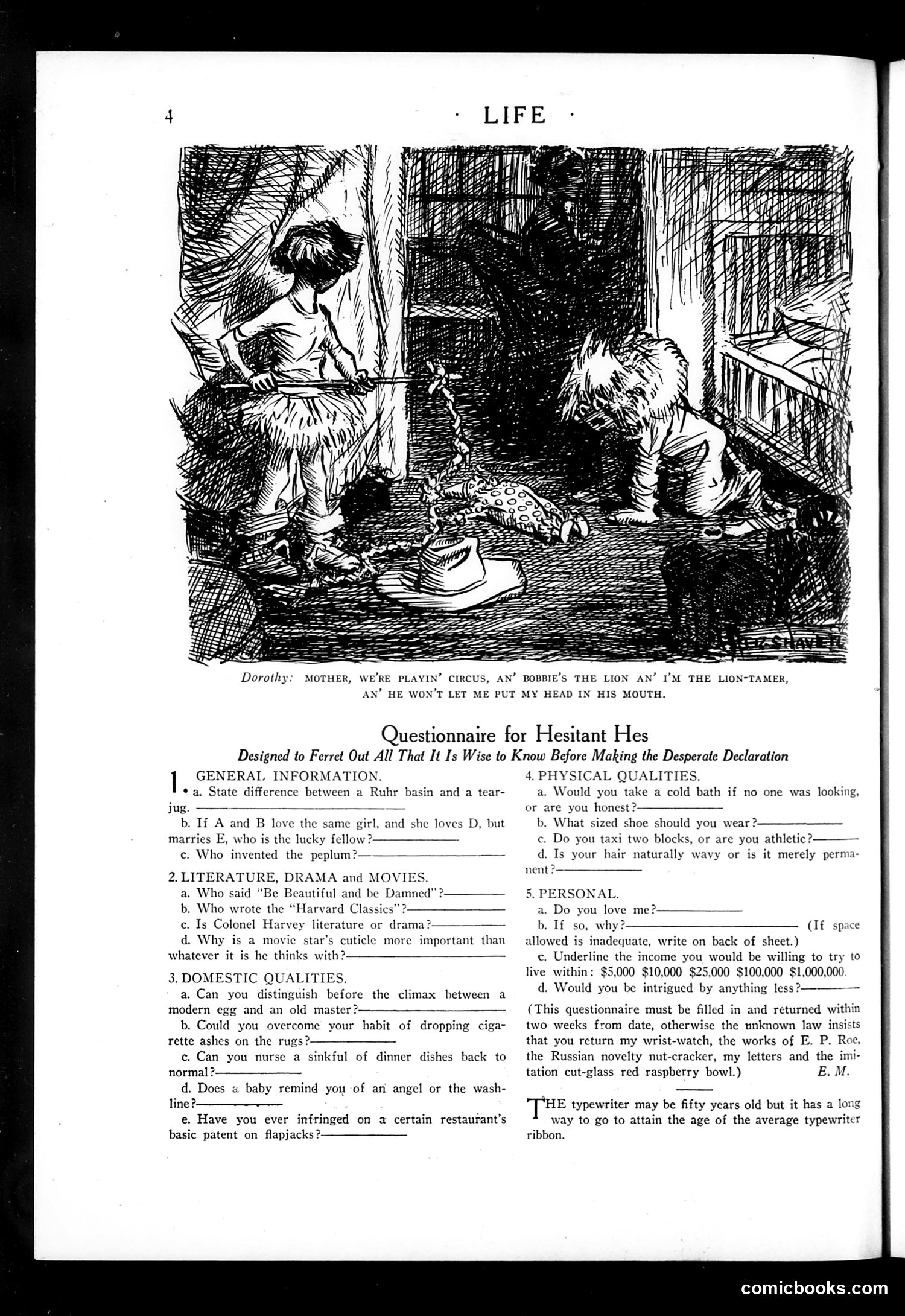
This page contains a sketch depicting children playing circus games and a humorous "Questionnaire for Hesitant Hes" — a satirical marriage-readiness test for men considering engagement. The cartoon shows children role-playing: one child acts as a lion-tamer while another plays a lion. Dorothy addresses her mother, insisting the "lion" won't harm her despite the playful danger. The questionnaire below mockingly interrogates male marriage prospects on practical matters: domestic habits (egg-cooking, cigar ash cleanup), personal hygiene, financial capacity, and emotional suitability. The satire suggests men often avoid marriage due to superficial concerns or lack of self-knowledge about their compatibility. The closing quip about typewriter ribbons appears unrelated, possibly a magazine filler joke.
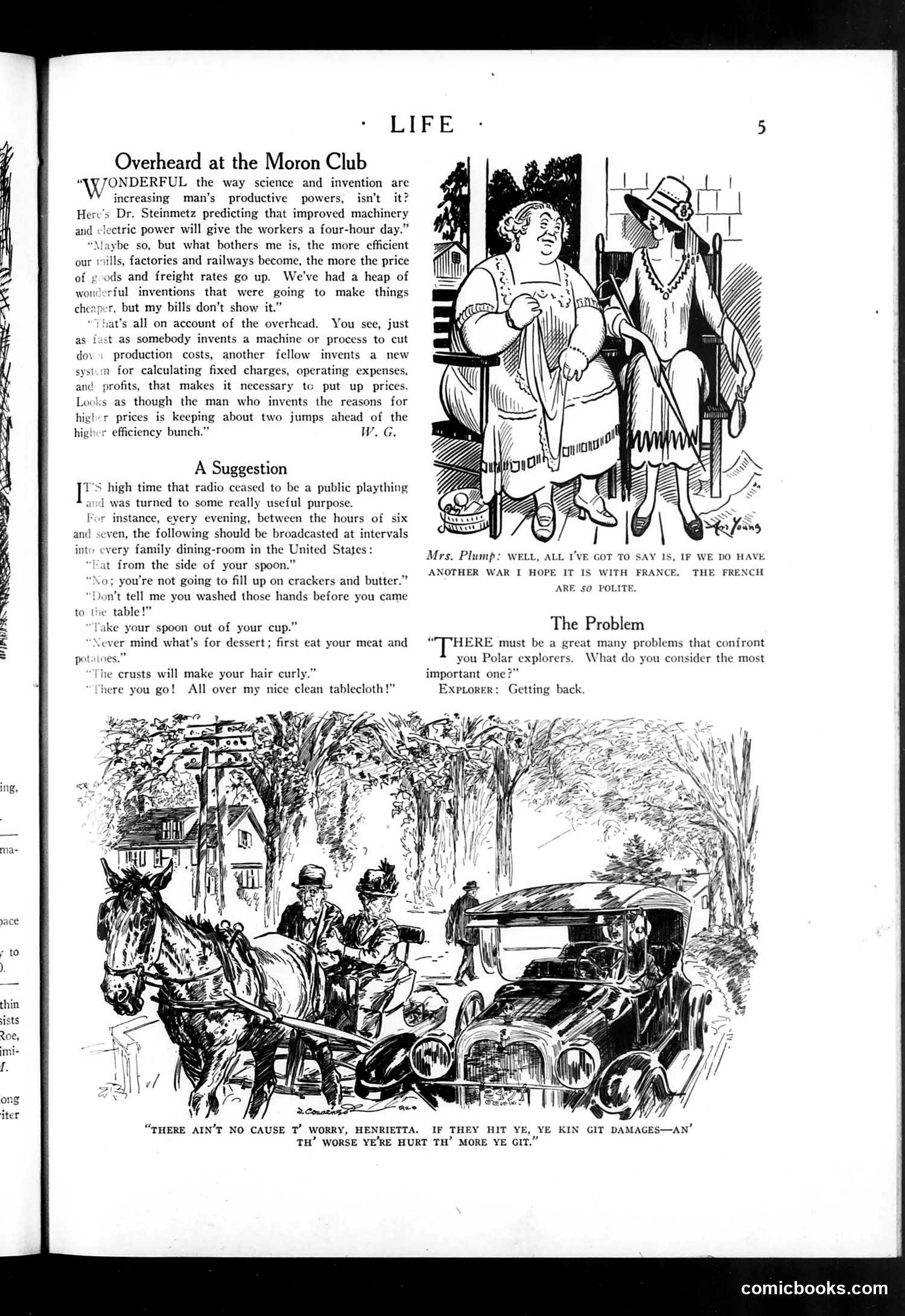
This page contains three distinct pieces of satirical commentary: 1. **"Overheard at the Moron Club"**: A dialogue mocking the disconnect between industrial efficiency gains and actual consumer prices. The speaker argues that while machinery improves productivity, bills don't reflect savings—suggesting manufacturers pocket profits rather than passing benefits to workers. 2. **"A Suggestion"**: Proposes using radio broadcasts for family dinner-hour public service announcements with mundane etiquette reminders ("don't fill up on crackers," "take your spoon out of your cup"). It's satire on radio's potential being wasted on trivial matters. 3. **The lower cartoon** depicts a horse-drawn vehicle meeting an automobile, with the caption joking about accident liability—suggesting anxieties about new automotive technology and property damage disputes during the automobile's early adoption period.
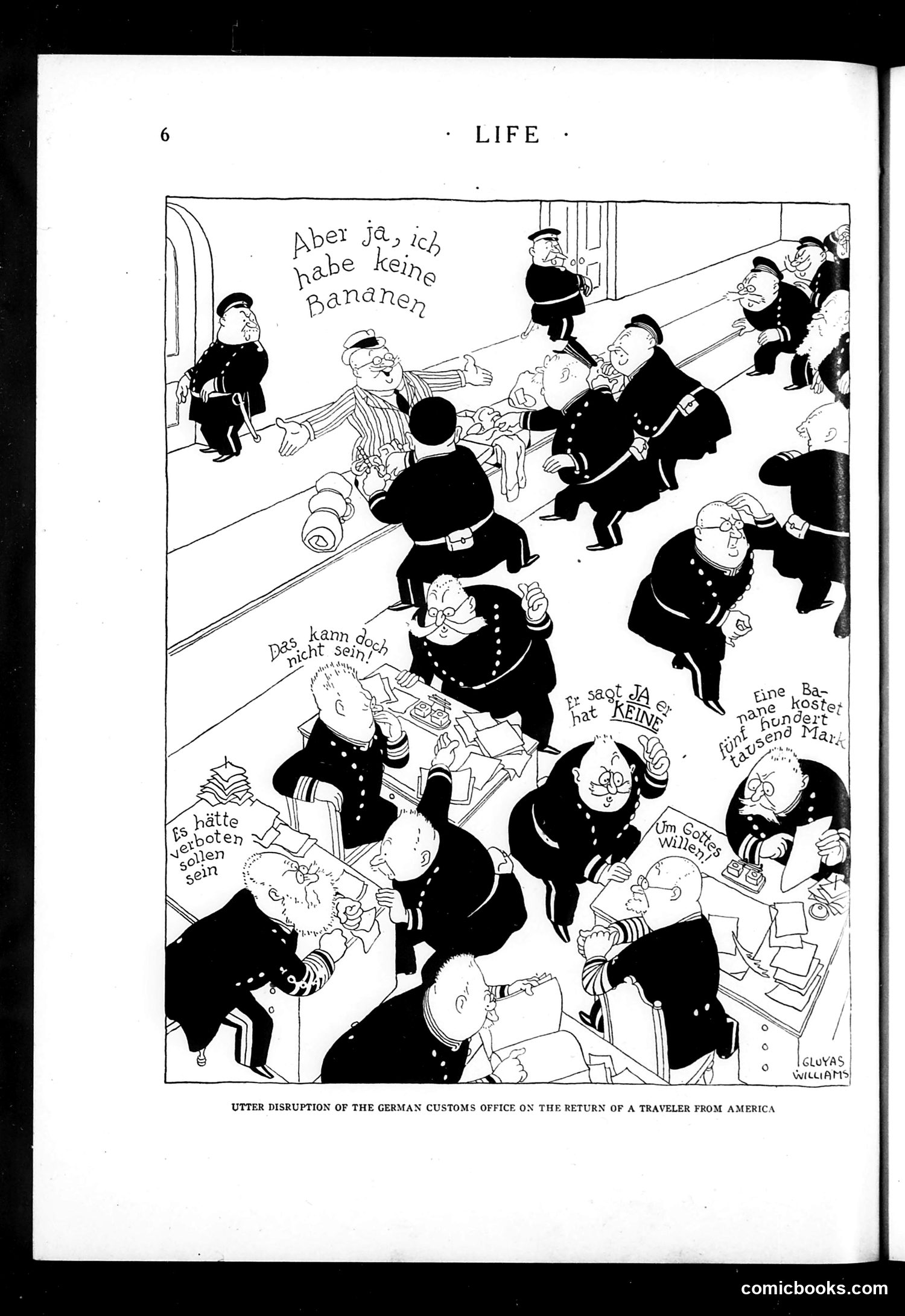
This satirical cartoon depicts German customs officials in chaos as they inspect baggage from an American traveler. The humor centers on the stereotype that American travelers returned home laden with exotic goods, particularly bananas—which were relatively rare and luxurious in early 20th-century Germany. The officials' dialogue (in German) expresses bewilderment and frustration: "But I have no bananas!" and similar complaints about missing or confiscated items. The cartoon satirizes both American excess/materialism and German bureaucratic rigidity. The signed artwork (by Gluyas Williams) mocks the potential culture clash and customs procedures of the era, suggesting that returning American travelers were expected to bring scandalously foreign goods that would perplex conservative German authorities.
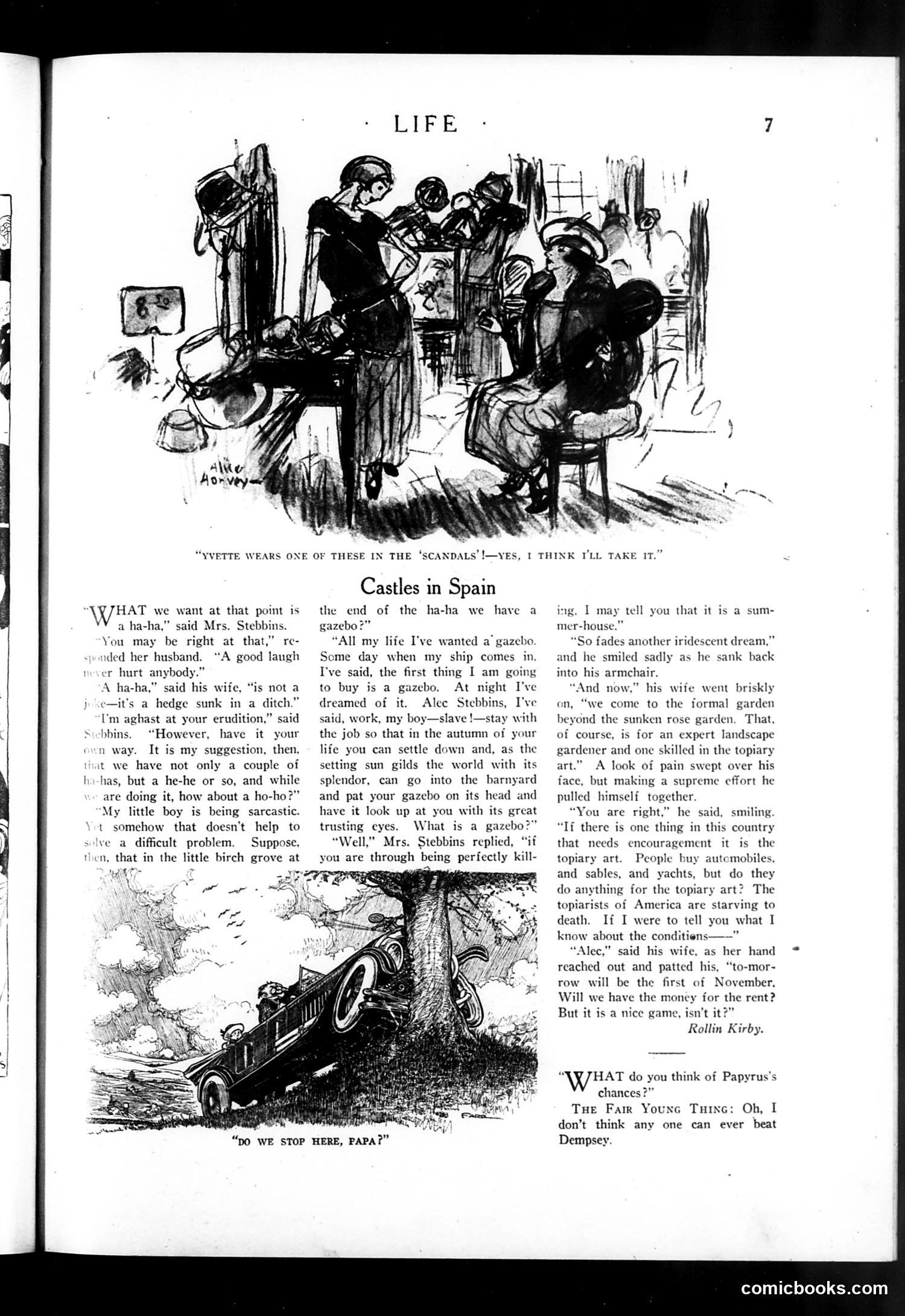
This page contains a short story by Rollin Kirby about a couple, Mr. and Mrs. Stebbins, discussing their dreams and finances. Mrs. Stebbins wants a gazebo for their property; her husband counters that they can barely afford basic necessities, describing their financial situation colorfully ("a hedge sunk in a ditch"). The top cartoon shows a domestic scene where a woman displays scandal-sheet clothing to others, with the caption "YVETTE WEARS ONE OF THESE IN THE 'SCANDALS'—YES, I THINK I'LL TAKE IT." The lower illustration depicts a car crash, captioned "DO WE STOP HERE, PAPA?" The page satirizes middle-class aspirations versus financial reality, and includes commentary on contemporary entertainment ("The Scandals"—likely the 1920s Broadway revue series).
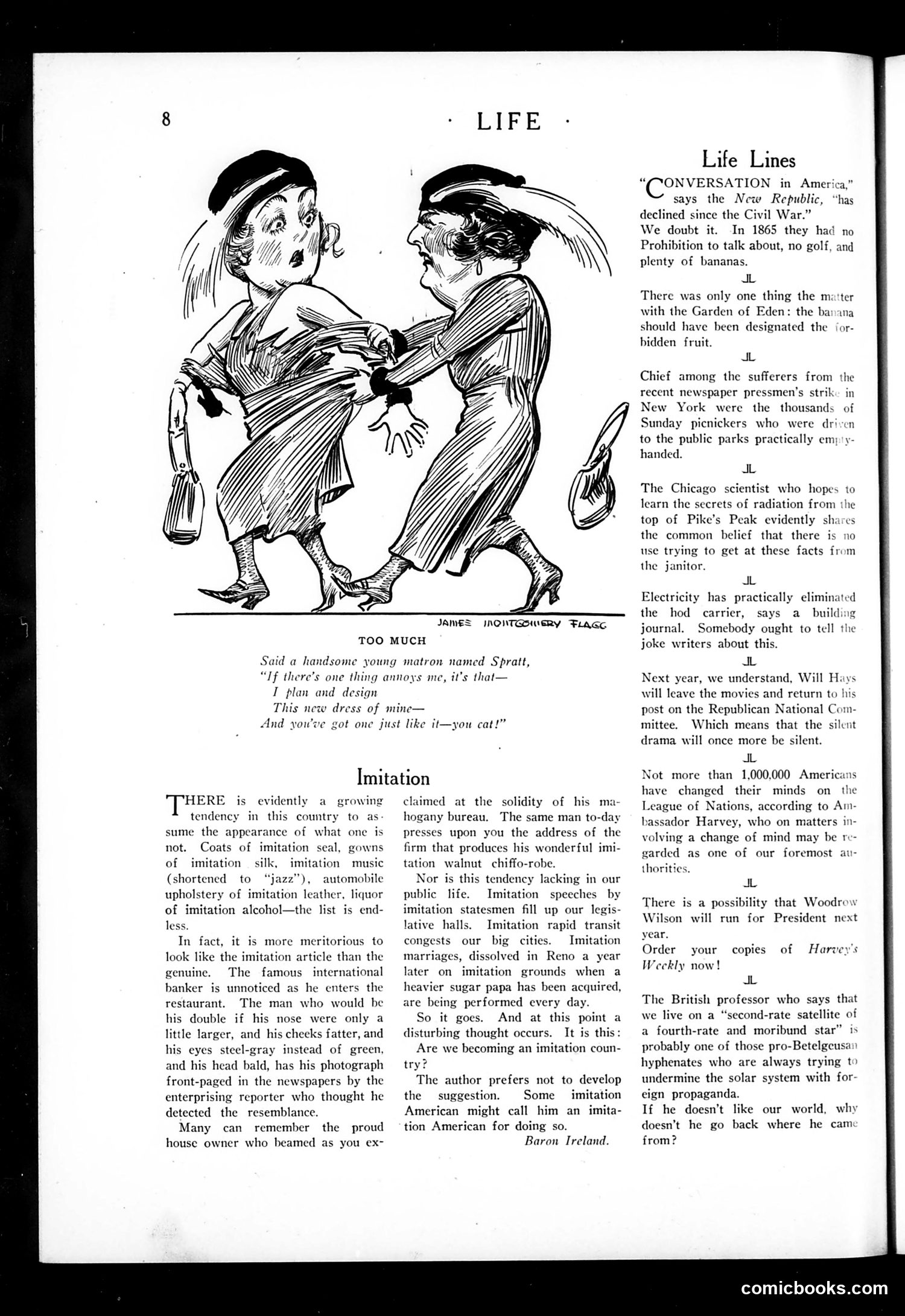
This cartoon by James Montgomery Flagg depicts two women in a physical altercation over fashion. The caption quotes a young woman named Spratt complaining that her rival has copied her new dress design. The satire targets the growing American tendency toward imitation—a theme developed in the accompanying article titled "Imitation." The piece critiques widespread copying in fashion, architecture, music, and public life, suggesting this represents a decline in American originality and authenticity since the Civil War era. The cartoon illustrates how this imitation culture creates social friction, particularly among women concerned with fashion distinction. The satire mocks both the petty nature of such disputes and the broader cultural anxiety about American society becoming increasingly derivative rather than innovative.
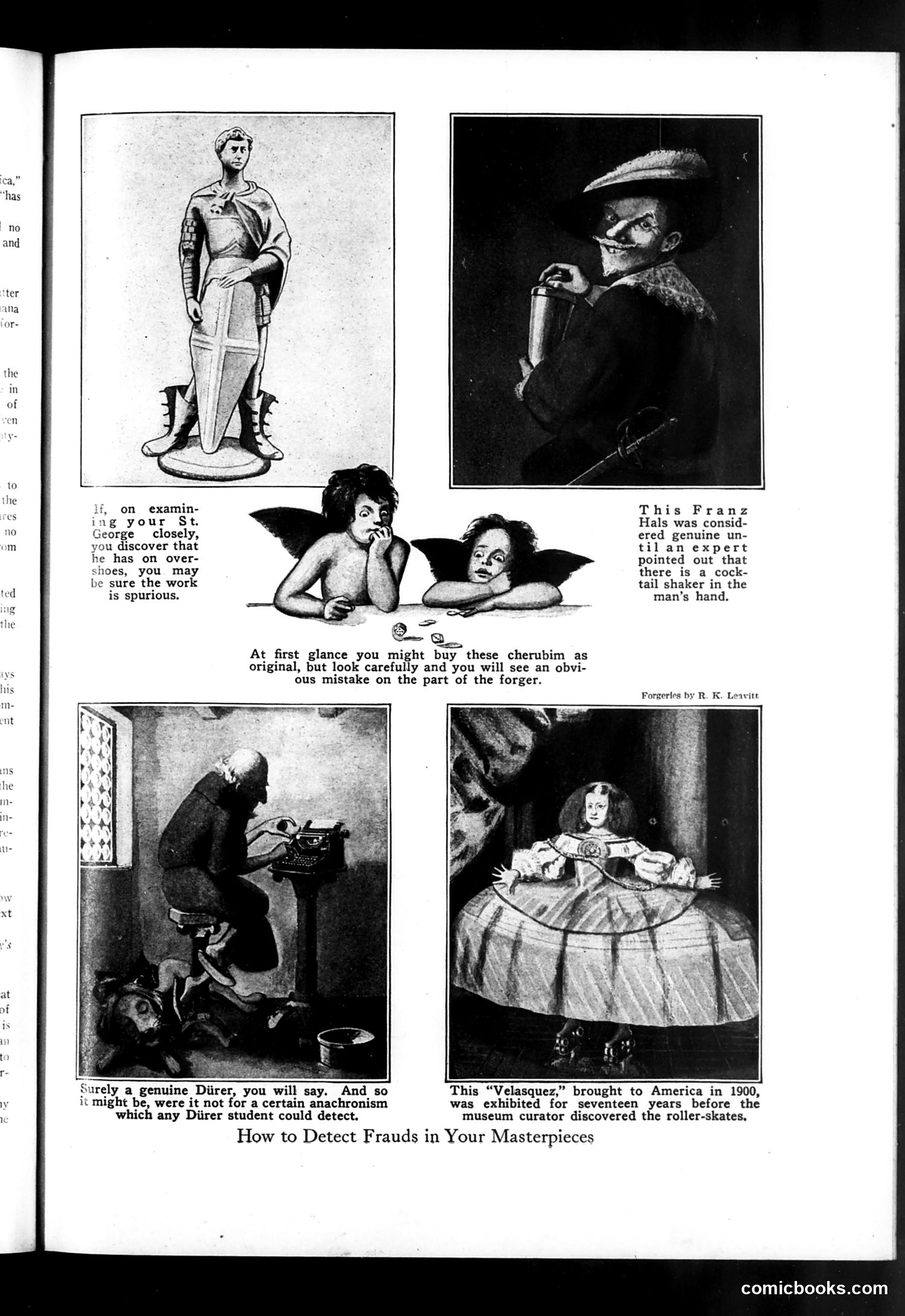
This page presents satirical illustrations about art forgery detection. The top image shows a classical statue of Saint George; the accompanying text advises examining such works closely, as counterfeit shoes might indicate forgery. The cherub illustration warns that forged Renaissance-style angels contain obvious mistakes visible to careful observers. A lower image depicts someone hunched over a typewriter (labeled as "Surely a Dürer, they will say"), satirizing how forgers might use anachronistic tools—a typewriter wouldn't exist in Dürer's era (15th-16th century)—yet might still deceive casual buyers. The "Velasquez" portrait shows a child with a doll, revealed as a 1900 American forgery after seventeen years of exhibition. The satire targets wealthy collectors' gullibility regarding artwork authenticity.
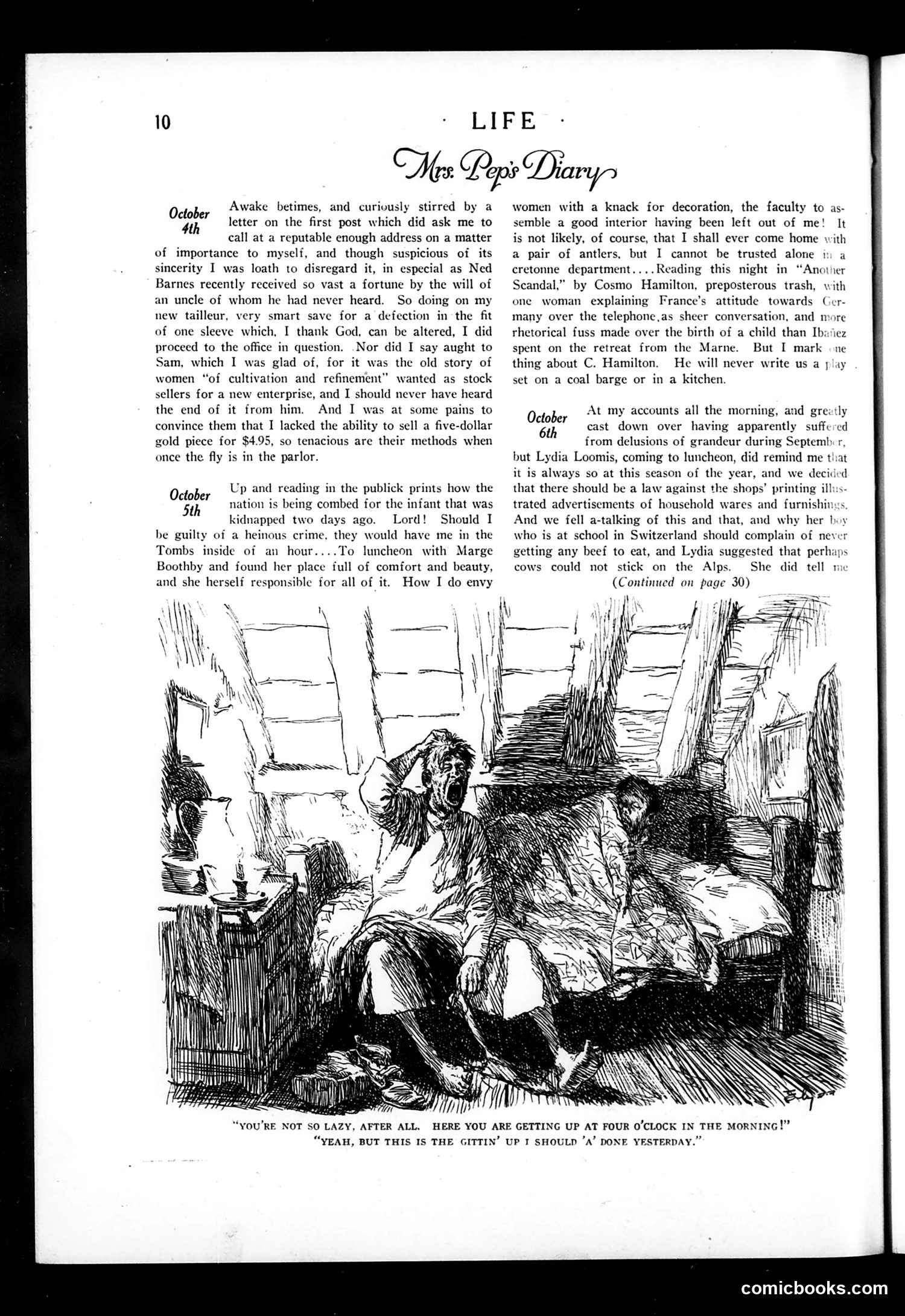
This page contains diary entries from "Mrs. Pepis Diary," a recurring satirical column. The entries (October 4th, 5th, and 6th) mock domestic life and social concerns of the period. The cartoon below depicts a woman in bed confronting what appears to be her husband about laziness—she sarcastically notes he's "getting up at four o'clock in the morning" when "this is the gettin' up I should a' done yesterday." The humor satirizes working-class domestic friction and marital dynamics. The diary entries themselves critique women's domestic authority and decision-making, society gossip, and absurd household product advertising. The overall tone mocks both female social pretension and the mundane concerns of middle-class domestic life during this period.
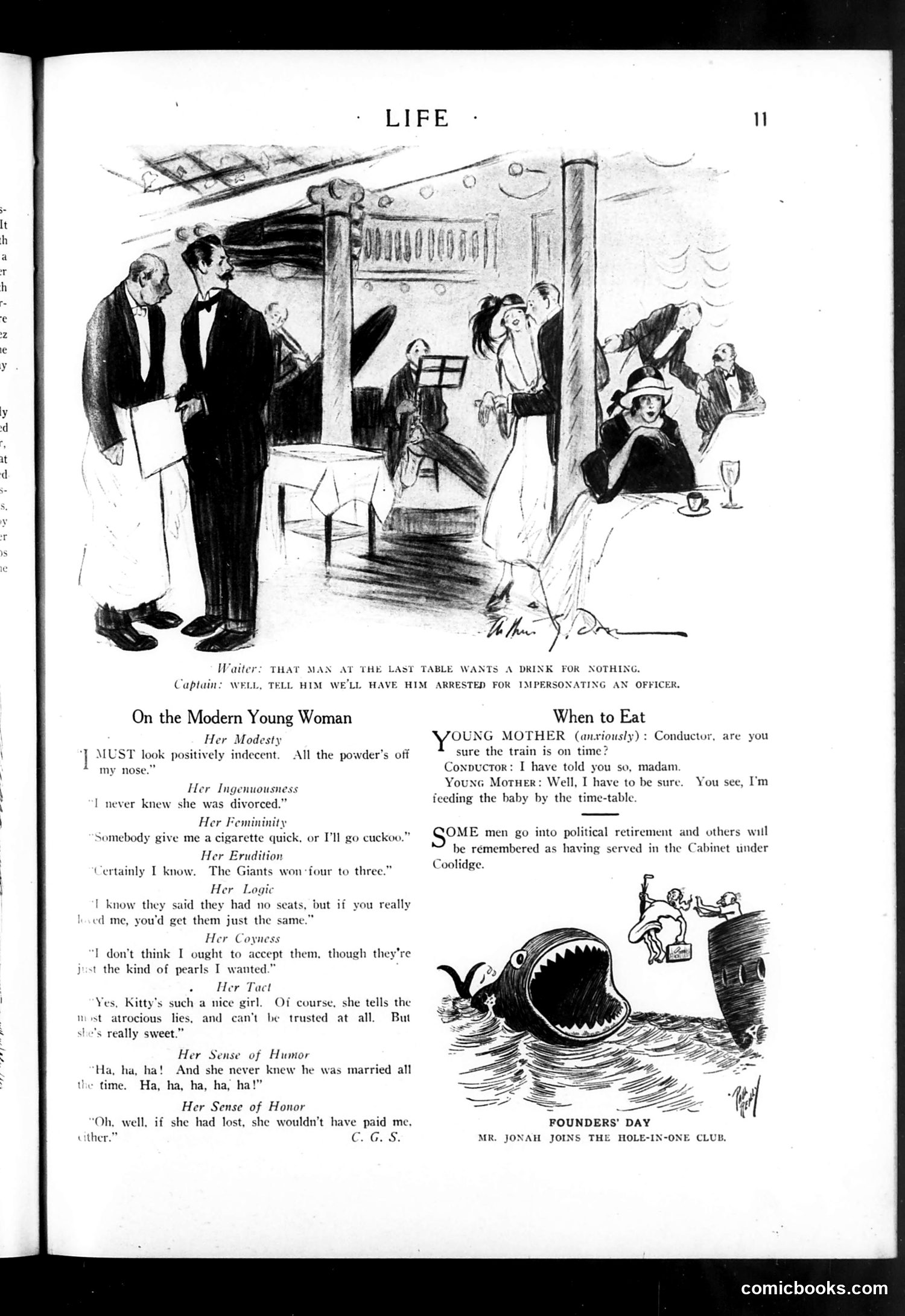
**Top Cartoon:** A waiter interrupts two diners at what appears to be a ship's dining room. The waiter reports that a man at the last table wants a drink "for nothing," and the captain threatens to arrest him for impersonating an officer. The joke satirizes pretentious dining establishments and false claims of status. **"On the Modern Young Woman":** A series of satirical character sketches mocking contemporary women's behavior—their affectations of modesty masking deception, their logic, their dishonesty ("tells the most atrocious lies"), and their humor. The section critiques evolving social attitudes and female independence. **"Founders' Day":** A cartoon shows Mr. Jonah joining "the hole-in-one club"—a golf joke about achieving an unlikely feat, likely satirizing club membership pretensions.
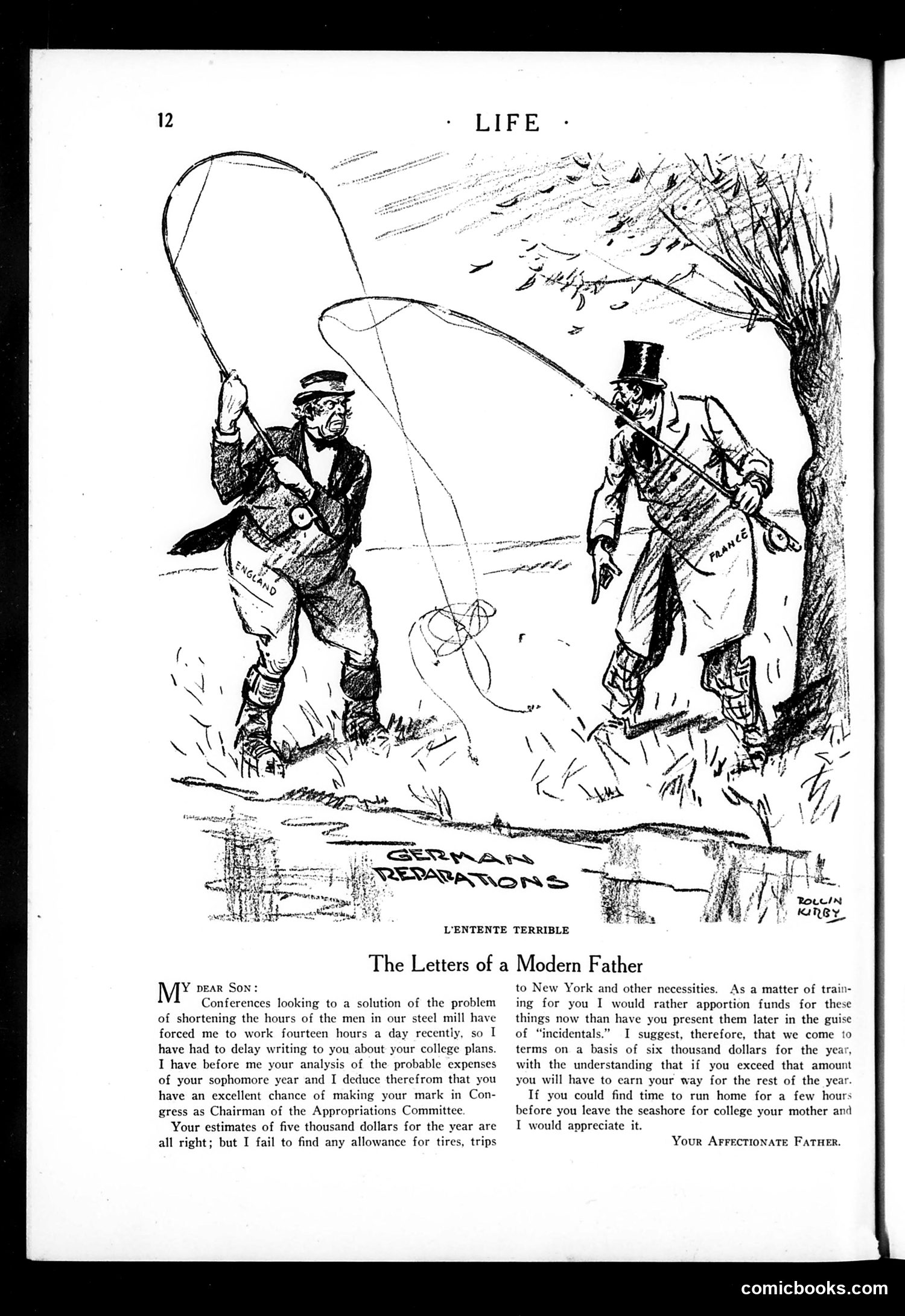
This satirical cartoon depicts two figures fishing together labeled "German Reparations," likely referencing post-WWI peace negotiations. The two anglers appear to represent Britain and France (suggested by their formal attire and top hats, typical caricature dress for European powers). They're fishing in troubled waters beneath a gnarled tree, with birds fleeing overhead—visual metaphors for instability and discord. The satire mocks the Allied powers' attempts to extract reparations from defeated Germany, suggesting their efforts are futile or self-destructive ("terrible entente"). The title plays on "Entente Cordiale" (the British-French alliance), implying the partnership itself becomes problematic through reparations disputes. The accompanying letter about a father's college finances may be intentionally juxtaposed to suggest national financial troubles parallel family budget crises.
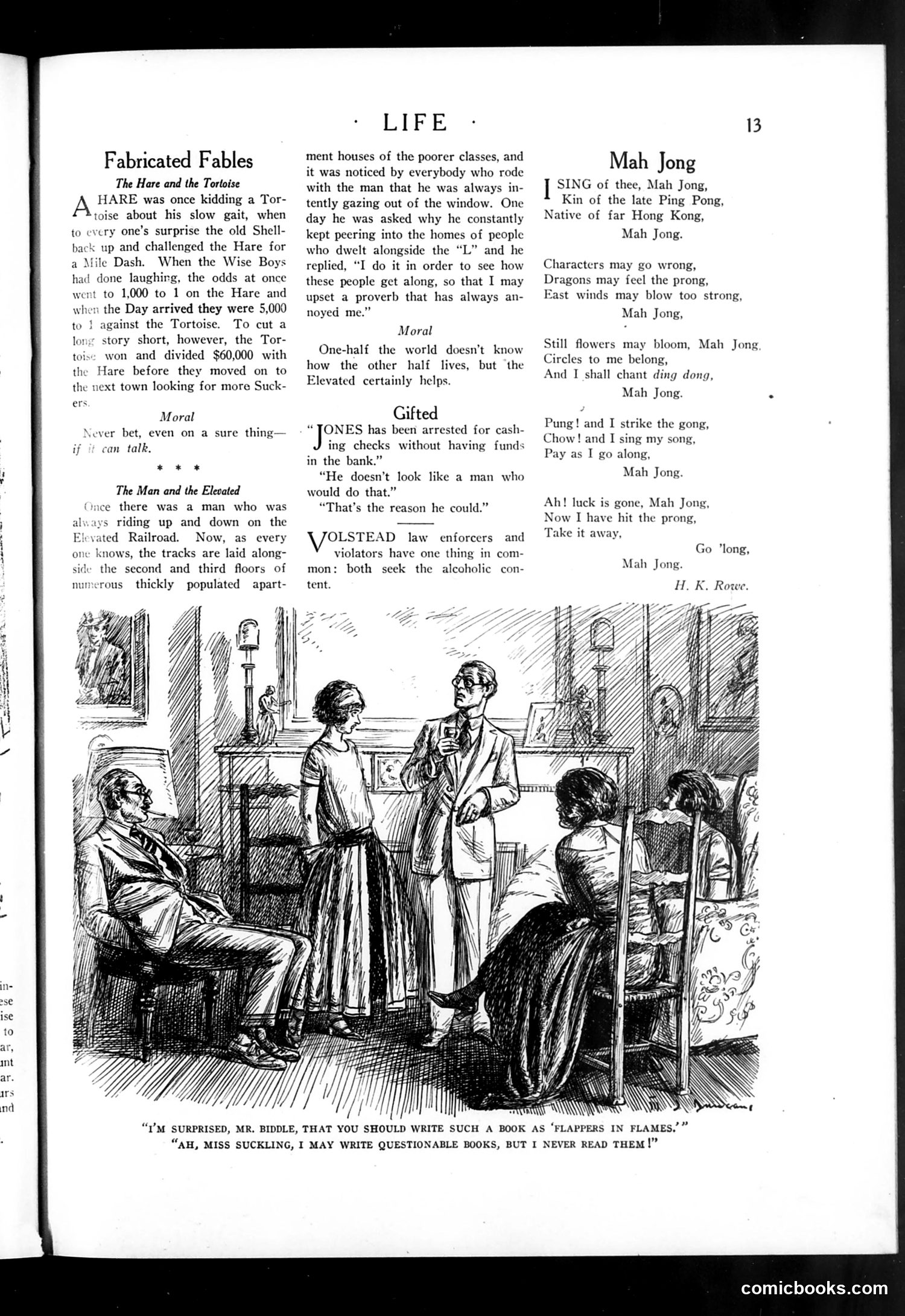
This page contains **fabricated fables** and a single cartoon illustration. The main visual satirizes literary pretension and censorship. The cartoon depicts a social scene where Mr. Biddle appears surprised that someone would write books like "Flappers in Flames," while Miss Suckling responds that she may write "questionable" books but never reads them—a jab at authors who produce sensational material without engaging seriously with literature. The fables above (including "The Hare and the Tortoise" and "The Man and the Elevated") offer moral lessons, while the "Mah Jong" poem section suggests the page mixed humor, satire, and light verse typical of Life's satirical content during the 1920s Jazz Age.
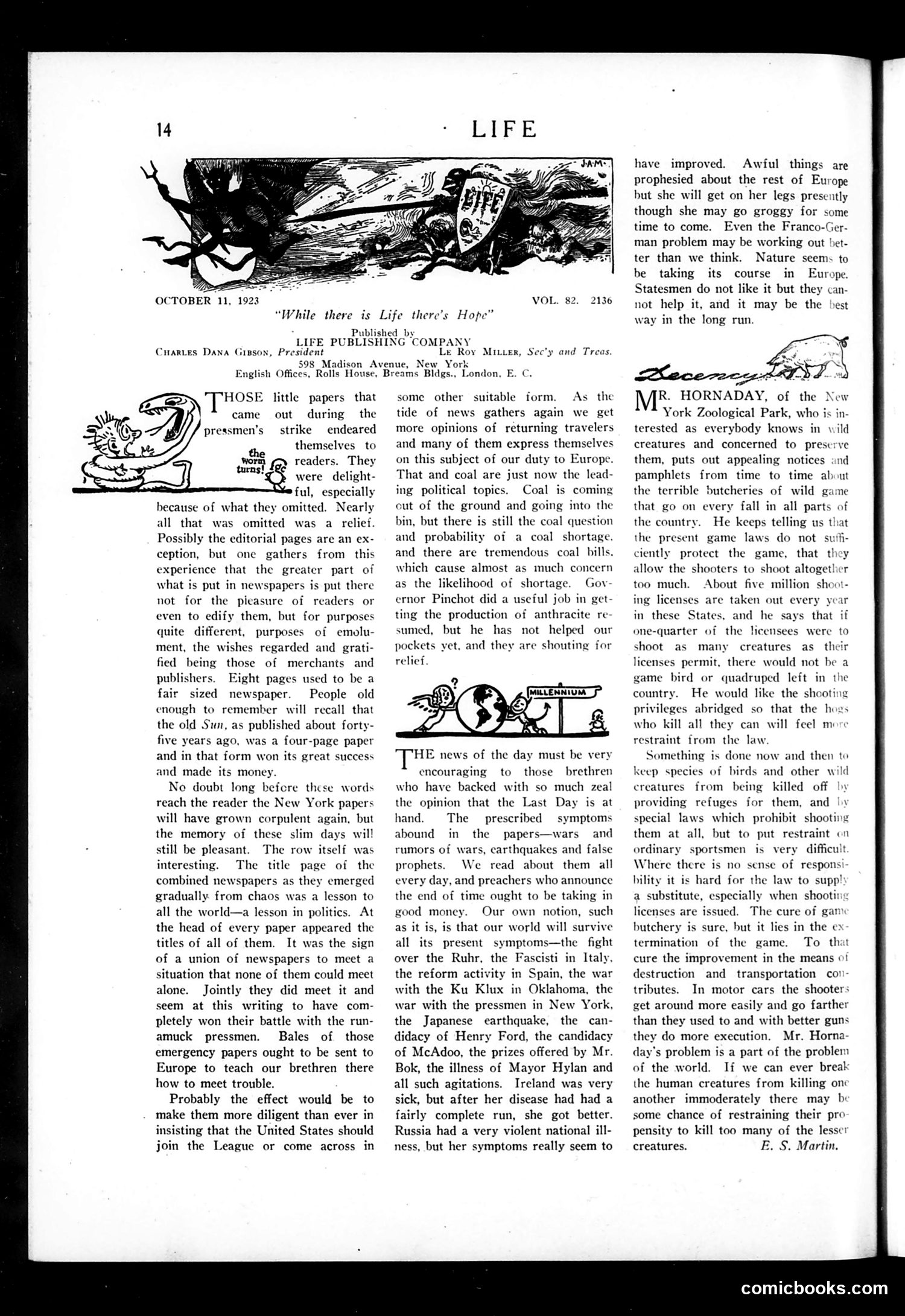
The main illustration shows a grotesque figure labeled "MILLENNIUM," appearing to represent an idealized but nightmarish future state. The cartoon satirizes contemporary optimism about progress and modernity. The accompanying editorial discusses European conditions—particularly economic troubles, coal shortages, and political instability affecting France, Germany, and Russia. It mentions specific contemporary crises: the Franco-German problem, Fascism in Italy, conflict in Spain, the Ku Klux Klan in Oklahoma, and Japanese earthquake aftermath. The satirical point: despite the era's technological advancement and hopeful rhetoric ("While there is Life there's Hope"), the world faces serious political and economic turmoil that makes utopian visions of a "millennium" darkly ironic. Progress and chaos coexist uncomfortably.
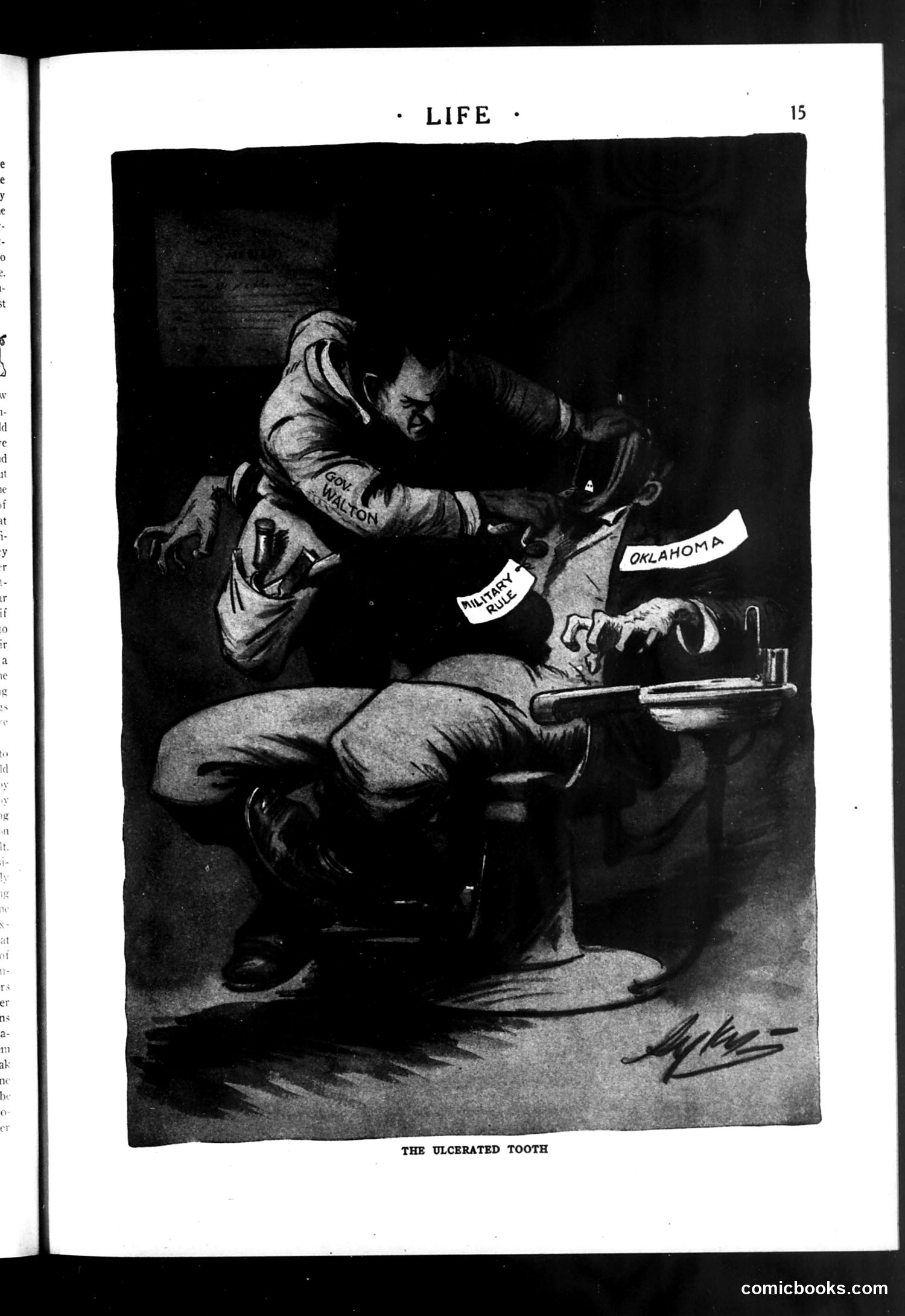
This political cartoon depicts a dentist extracting a problematic tooth labeled "RAILROAD RATE" while another tooth labeled "OKLAHOMA" waits in the background. The dentist wears a jacket marked "GOV. HACTION" (likely "Gov. HACTION" or similar), suggesting a government official or governor addressing railroad regulation issues. The satire appears to address early 20th-century railroad rate controversies and regulatory disputes. The "ulcerated tooth" metaphor suggests railroad rates were viewed as a painful, infected problem requiring extraction. Oklahoma's appearance likely references that state's specific railroad grievances or regulatory concerns. The cartoon advocates for government intervention to remove what reformers considered exploitative railroad practices—a common Progressive Era theme.
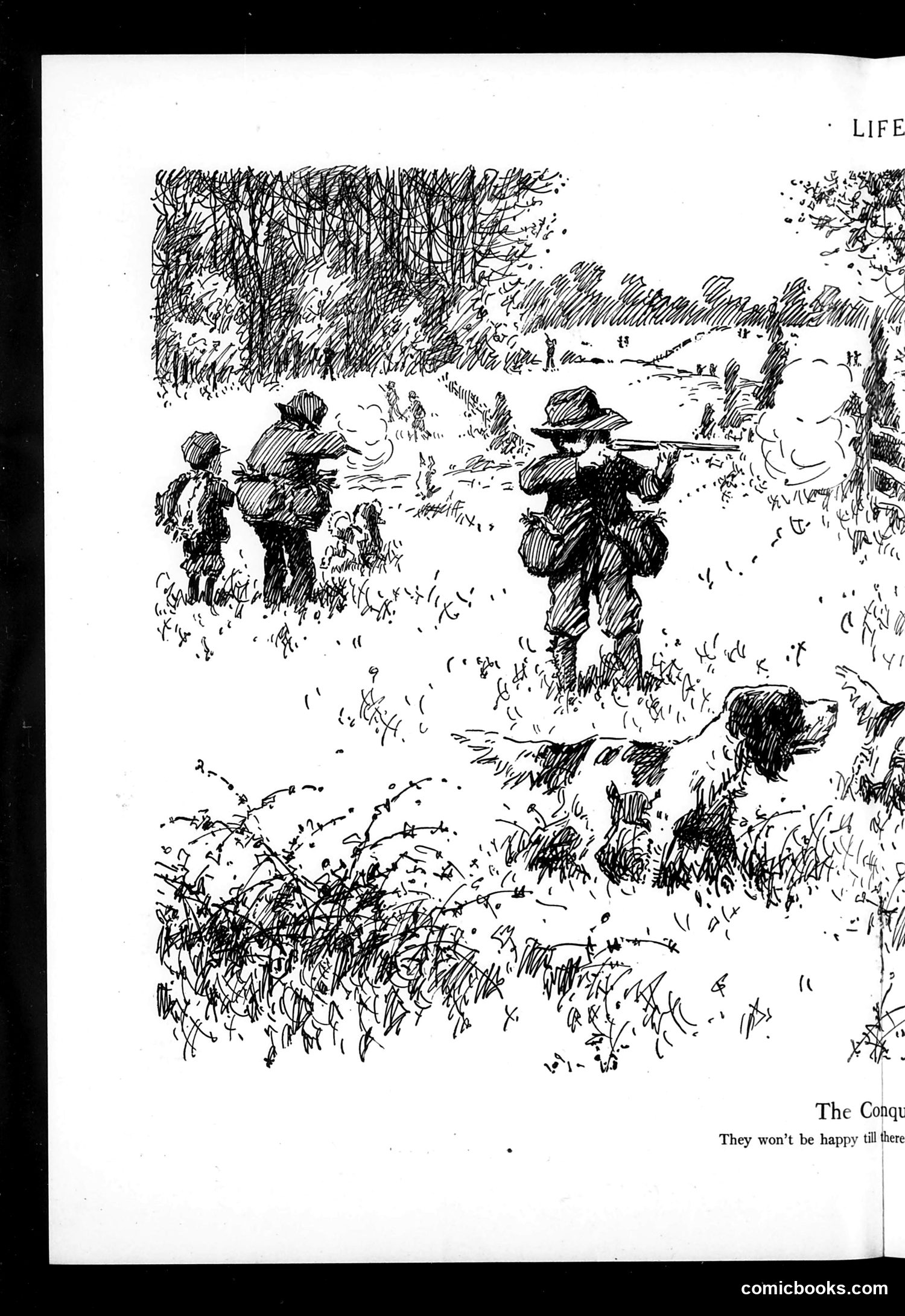
This is a pen-and-ink illustration showing what appears to be a rural or countryside scene. Several figures in period clothing (possibly late 19th or early 20th century based on their hats and dress) are scattered across a grassy field with trees and a fence visible. The caption reads "The Conqu[est]" with the partial text "They won't be happy till there" visible below—suggesting the caption is cut off. Without the complete caption or additional context, the specific satirical point is unclear. The illustration could reference territorial conquest, land acquisition, or some contemporary political conflict, but **I cannot definitively identify the historical or political reference intended** based solely on what's visible here. The fragmented text prevents full interpretation of the cartoon's meaning.
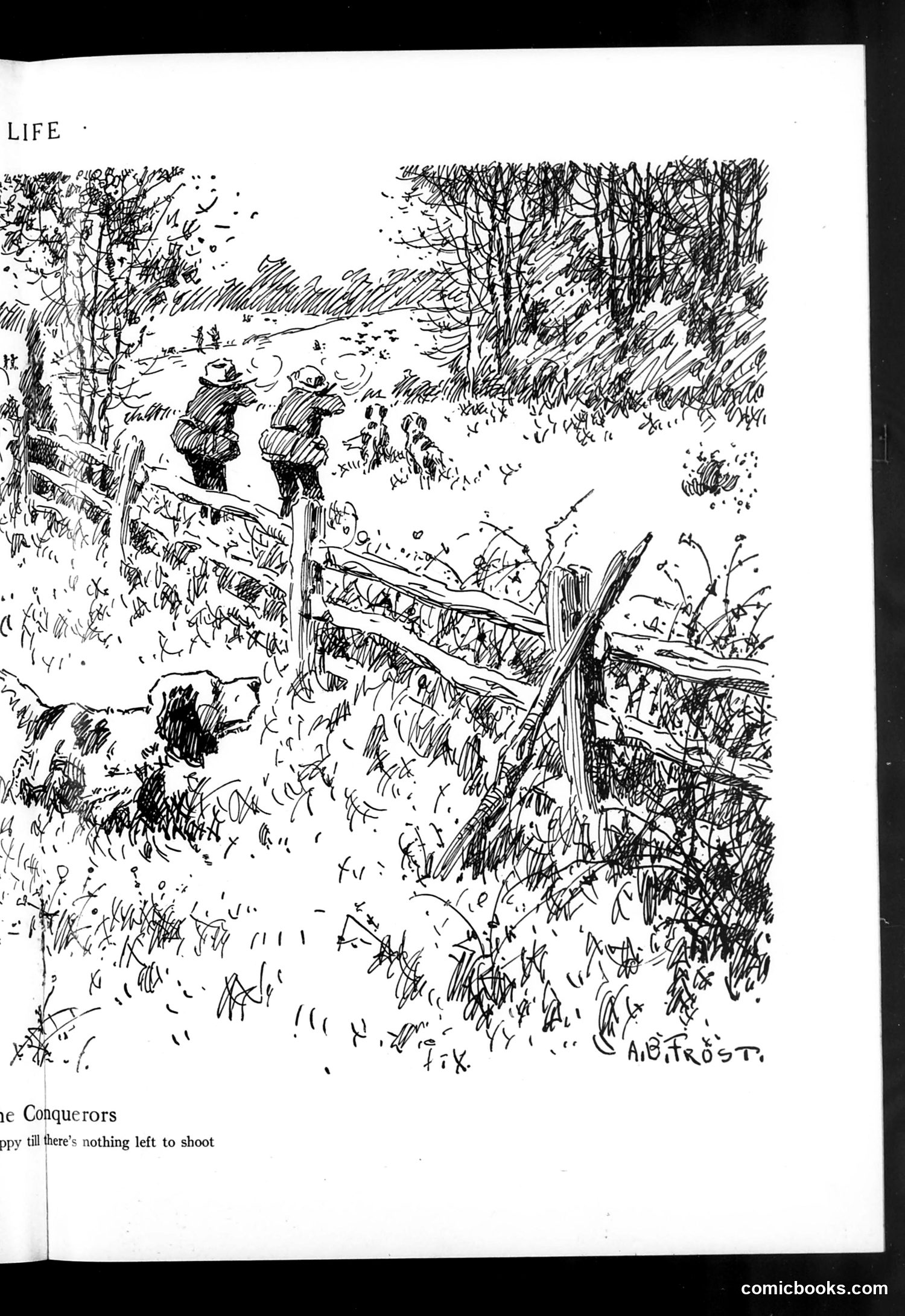
This cartoon satirizes hunting culture, likely from the early-to-mid 20th century. It depicts hunters in a field who have apparently shot all available game—the caption reads "happy till there's nothing left to shoot," suggesting they'll continue killing indiscriminately until wildlife is completely depleted. The sketch shows two well-dressed hunters standing amid an empty landscape with a fence, while small animals scatter in the distance. The satire critiques hunters' shortsighted destructiveness and lack of conservation ethics—they're portrayed as so consumed by the sport that they'll destroy their own resource through overhunting. The title "The Conquerors" uses irony: these figures aren't heroic but destructive, conquering nature to its extinction rather than preserving it for future generations. This reflects early conservation movement concerns about wildlife depletion in America.
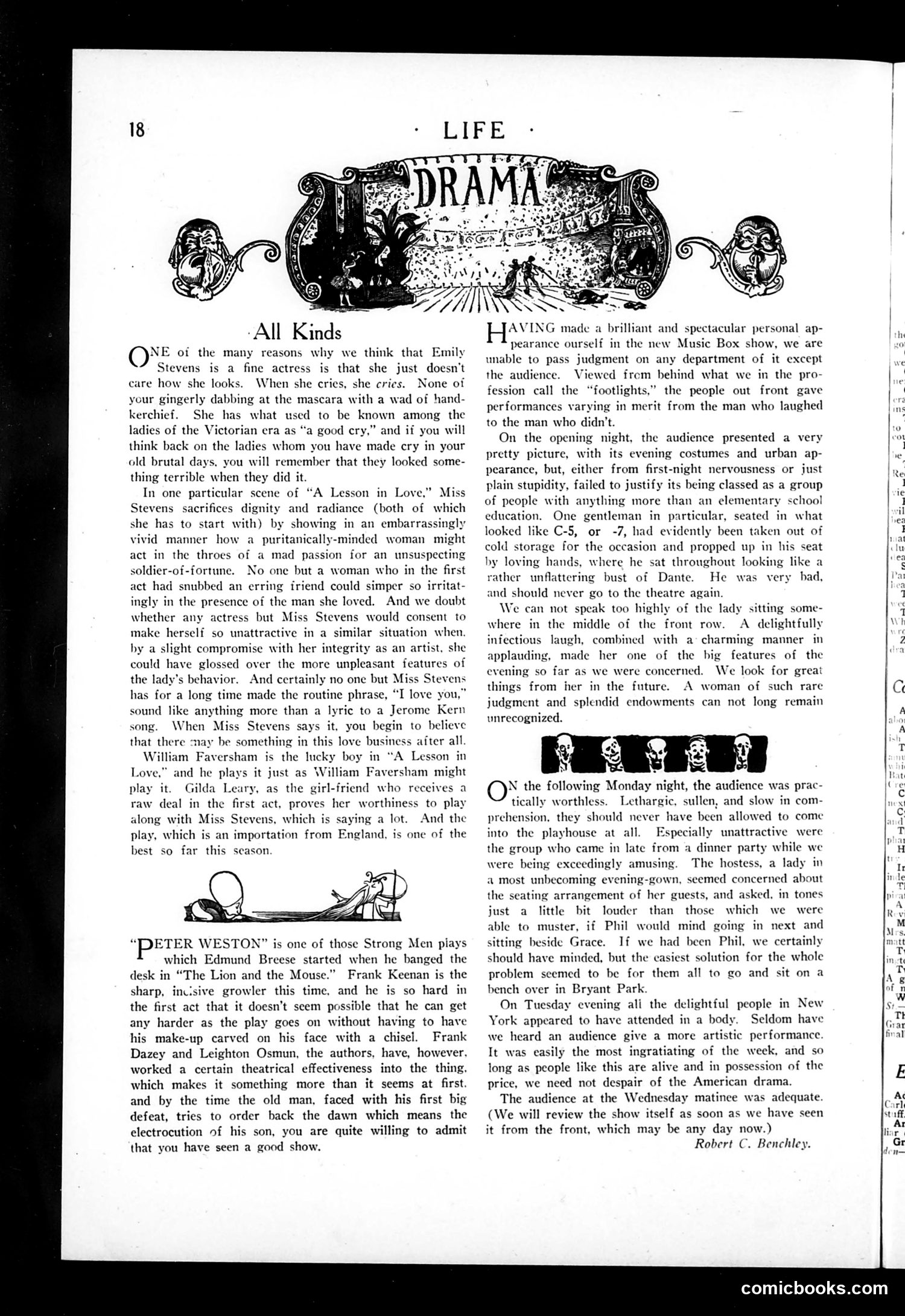
This page contains theater reviews rather than political cartoons. The critic praises actress Emily Stevens for her unsentimental acting style—specifically her willingness to appear unflattering while crying, contrasting her with Victorian-era actresses who maintained composure. The reviews also cover plays "A Lesson in Love" (with William Faversham) and "Peter Weston" (with Frank Keenan), both praised for their theatrical effectiveness. The decorative header and small skull illustrations are typical Life magazine ornaments. The reviewer's sarcastic closing section mocks an audience member at the Music Box show who sat motionless "like a rather unflattering bust of Dante," suggesting he was either extremely bored or literally removed from cold storage—a common Life magazine joke format of cruel but witty social observation targeting poor audience behavior and taste.
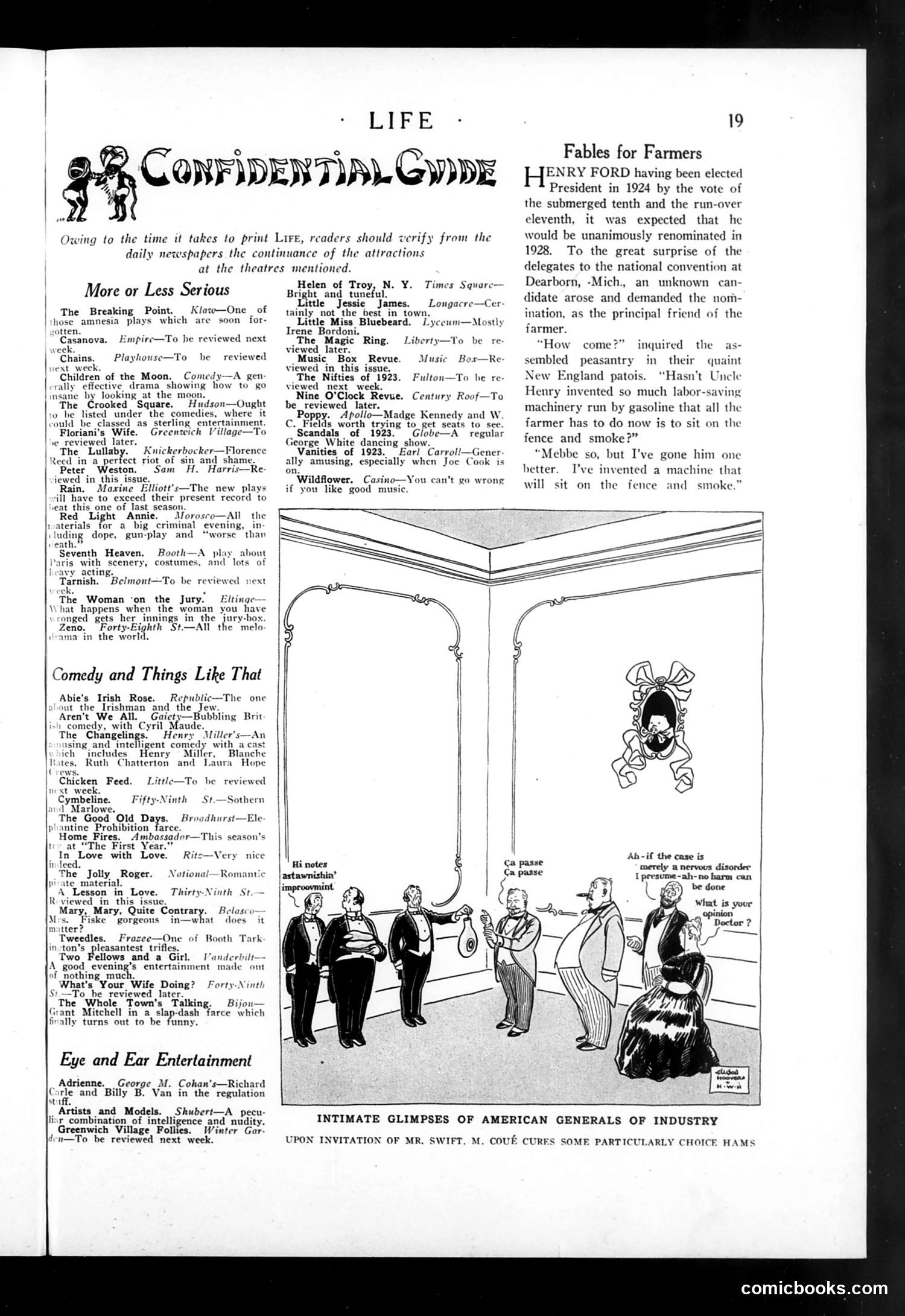
This page is primarily a **theatrical listings and reviews section** typical of Life magazine in the 1920s. However, the bottom contains a significant political satire cartoon titled **"Intimate Glimpses of American Generals of Industry."** ## The Cartoon The image depicts what appears to be **industrial magnates as "generals"** — a metaphor critiquing their power and influence. The caption references **Mr. Swift, M. Cove** and "particularly choice hams," suggesting these are caricatures of major industrialists (likely meatpacking magnates), presented in a formal, almost military setting with one figure suspended by noose-like ropes. ## The Political Context The opening article "Fables for Farmers" mentions Henry Ford's expected 1924 presidential nomination and references an "unknown candidate" from Dearborn, Michigan surprising convention delegates in 1928. This satirizes Ford's political ambitions and his appeal to rural/agricultural voters ("farmers"). **The satire's point**: Wealthy industrialists ("generals of industry") wielded enormous political power, positioning themselves as America's true leaders while claiming to represent common farmers' interests.
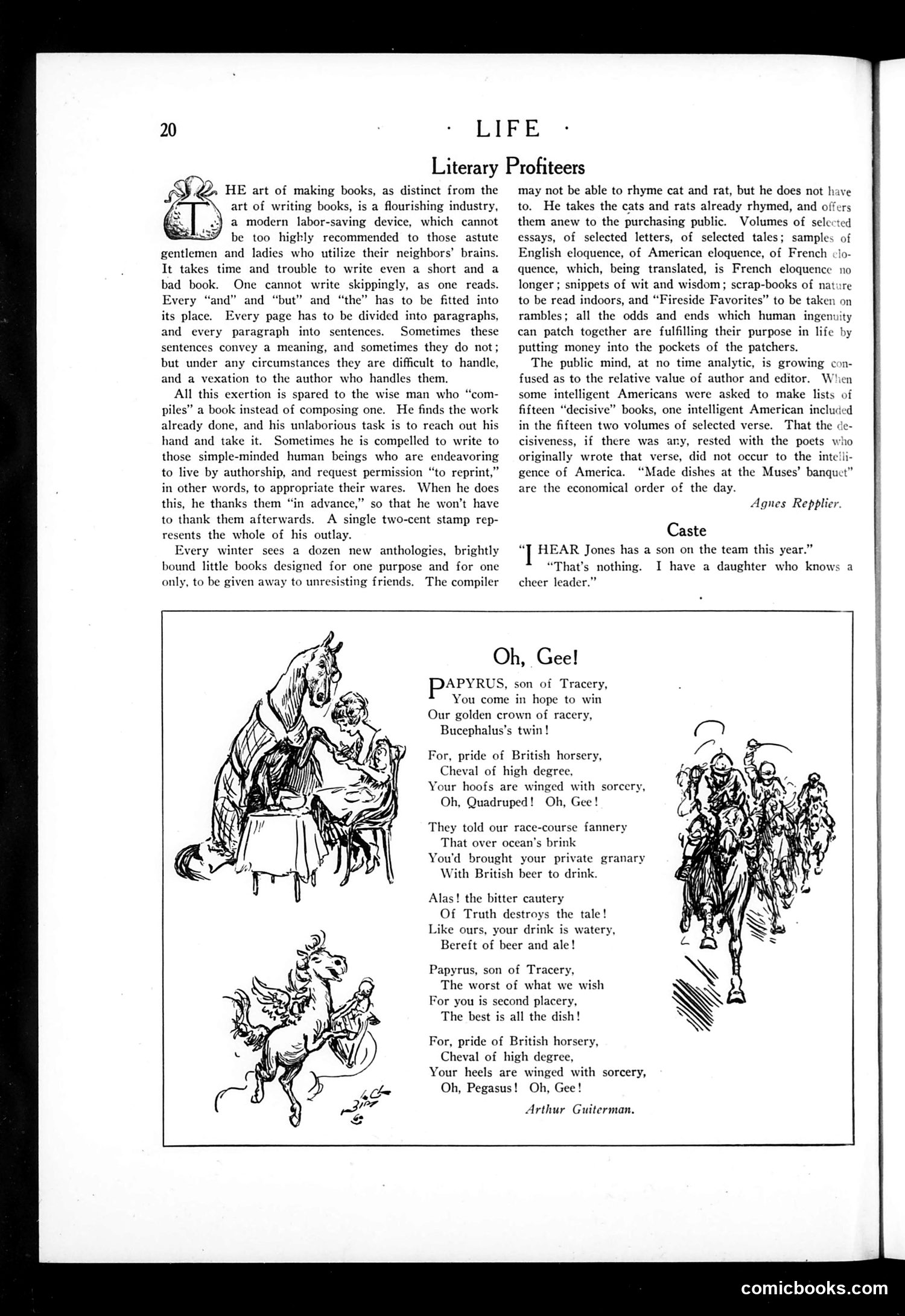
**Top Essay:** Agnes Repplier satirizes anthology editors who profit by reprinting others' work without original effort. She mocks "compilers" who assemble selected essays, letters, and verse—taking existing writing and repackaging it for gift-giving seasons. The joke: these editors claim credit while doing minimal work, paying authors pittance (a two-cent stamp), yet confusing the public about who deserves literary merit. "Made dishes at the Muses' banquet" means serving reheated scraps as fresh fare. **Bottom Poem:** Arthur Guiterman's comic verse mocks class pretension. "Papyrus" is a British racehorse entering American competition. The satire: wealthy British import fanfare claims the horse drinks imported British beer and represents superiority ("pride of British horsery"), but truth deflates this—the horse drinks plain water like common American horses. The repeated "Oh, Gee!" emphasizes deflated expectations. It's social commentary on imported British snobbery meeting American reality.
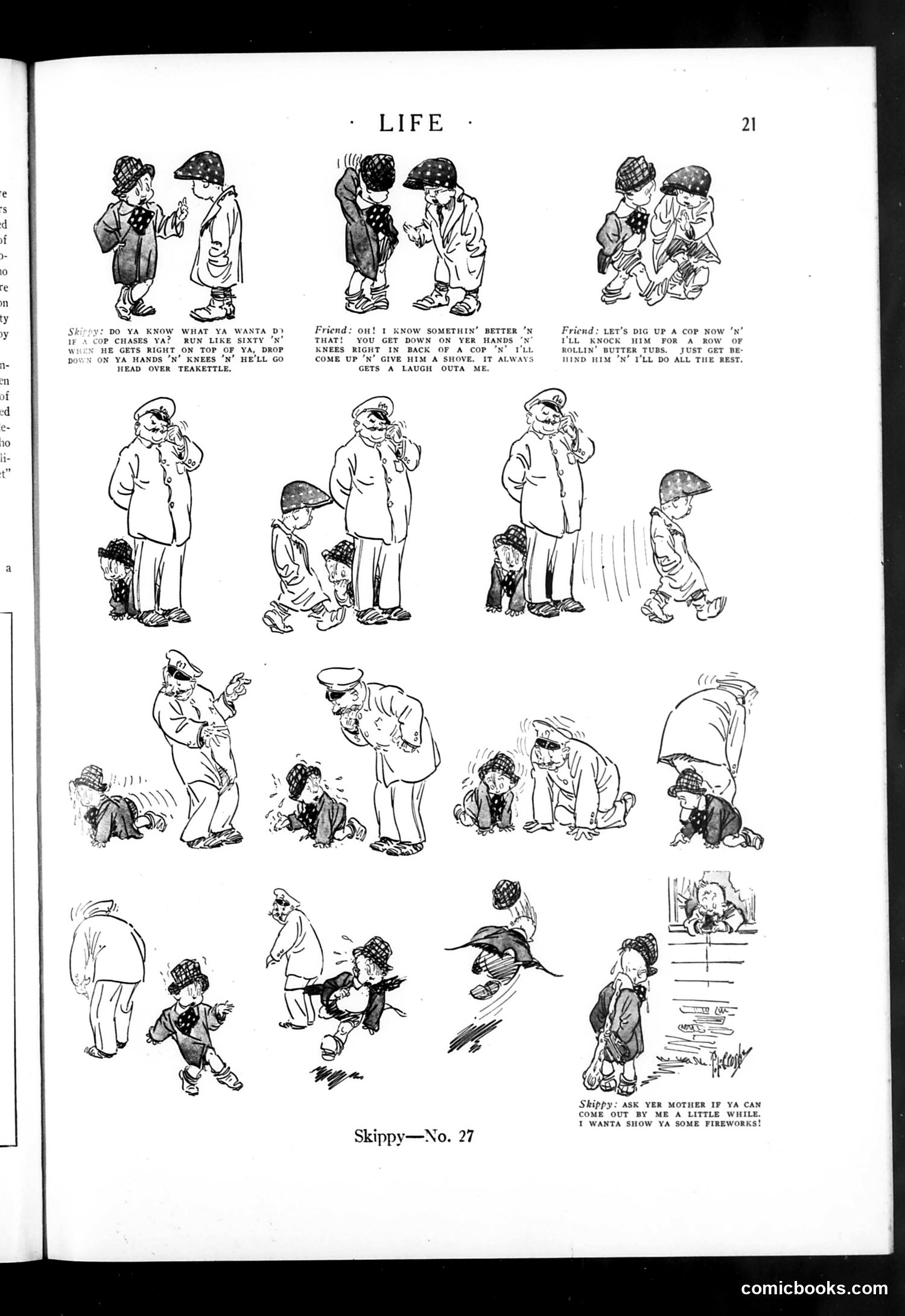
This is a comic strip titled "Skippy—No. 27" depicting street children sharing tricks for evading police. The humor relies on early 20th-century urban childhood mischief: kids boasting about techniques to escape cops chasing them—running, then deliberately tripping the pursuing officer by positioning themselves low so he tumbles over them ("head over teakettle"). The strip captures a specific social context: poor urban children routinely playing pranks on authority figures, with police pursuit being a common childhood "game." The final panel shows Skippy inviting a friend to watch "fireworks," likely meaning mischievous displays or street celebrations. The satire gently mocks both the children's casual attitude toward authority and the era's common sight of cops chasing street urchins through neighborhoods. It reflects a time when such interactions were normalized entertainment rather than serious criminality.
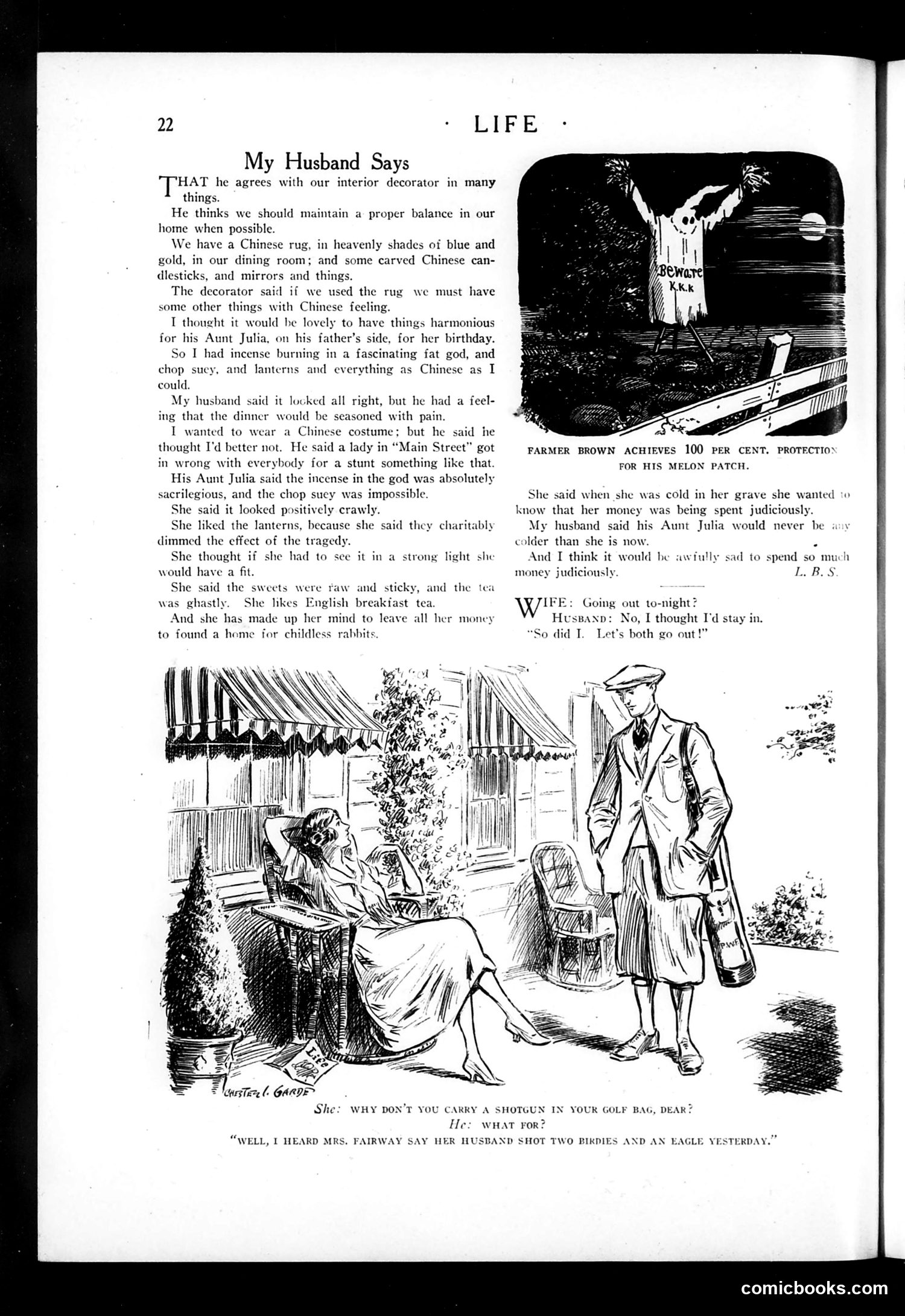
This page contains a humorous domestic column titled "My Husband Says" alongside two cartoons. The main text humorously recounts a wife's attempts to decorate their home with Chinese aesthetic elements to please relatives. The husband's practical objections—that a Chinese costume looks wrong on "Main Street," that raw sweets and tea are unpalatable—satirize overzealous adoption of foreign fashions and décor without practical consideration. The lower cartoon by **Cortlandt Garrde** depicts a golfing couple, with the wife suggesting her husband carry a shotgun to bag birds and eagles alongside his golf game. The husband's incredulous response ("What for?") mocks the absurdity of the suggestion, likely satirizing either excessive hunting enthusiasm or impractical spouse suggestions. Both pieces employ gentle domestic satire typical of early 20th-century Life magazine humor.
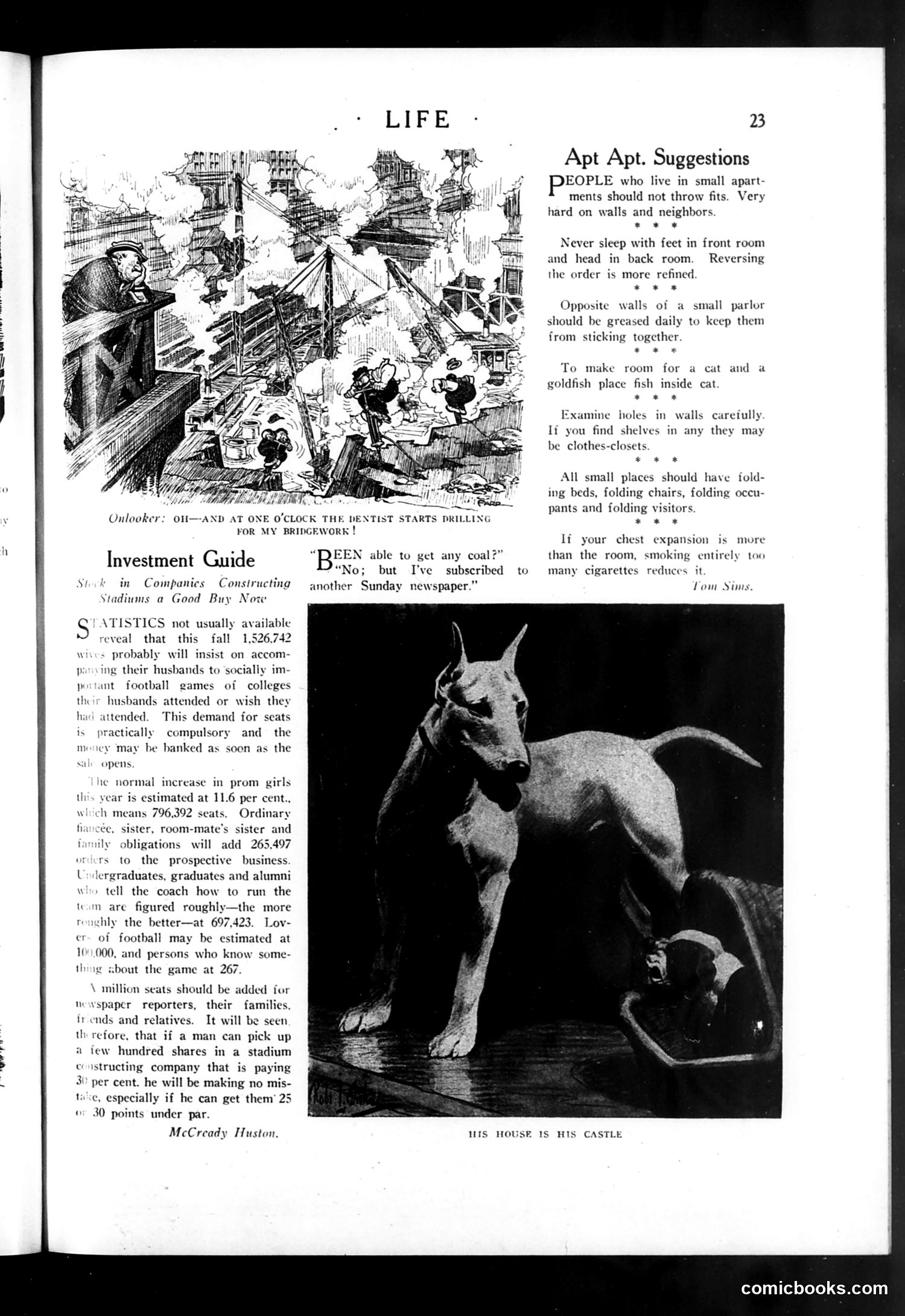
This page contains satirical content mocking early 1920s urban apartment living and financial speculation. **"Apt. Apt. Suggestions"** offers absurdist advice for cramped city apartments—greasing parlor walls to prevent them "sticking together," placing goldfish inside cats, and featuring folding furniture and "folding visitors." The cartoon at top shows a dentist operating amid chaotic apartment noise (drilling at 1 AM), satirizing how thin walls make privacy impossible. **"Investment Guide"** by McCready Huston mocks the stadium-construction stock boom. It calculates demand for football-game seating by tallying wives, prom girls, family members, and hangers-on attending college games—ultimately arguing investors can profit handsomely by buying stadium-company shares at discount. The satire targets both the absurd speculation mania and the era's obsession with college football as a commercial enterprise. The dog photo ("His House Is His Castle") ironically contrasts a pet's confident posture with the cramped apartment living described above.
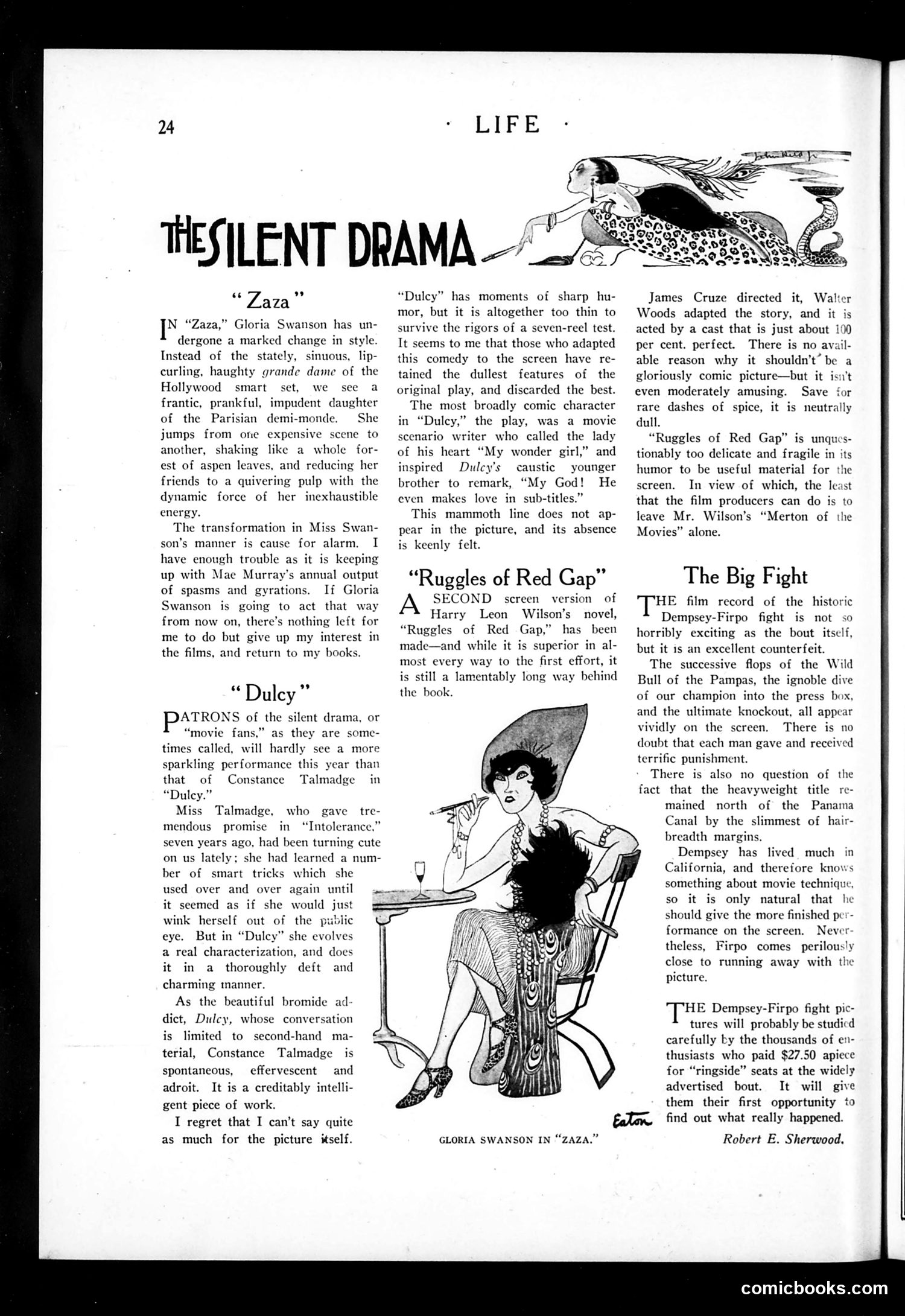
This page reviews four silent films. The critic praises **Gloria Swanson's performance in "Zaza,"** noting she's abandoned her typical "haughty grande dame" persona for a more energetic, frantic character—a change the reviewer finds exhausting and worrisome. **Constance Talmadge shines in "Dulcy,"** delivering excellent comedic acting, though the film adaptation itself disappoints by discarding the play's best jokes, including a witty meta-joke about a screenwriter declaring his love "in sub-titles." **"Ruggles of Red Gap"** (a second film version of a Harry Leon Wilson novel) suffers from being too delicate for cinema, despite competent direction and casting. Finally, the critic reviews the **Dempsey-Firpo boxing match film**—a record of the historic heavyweight championship fight. While not as thrilling as the actual bout, it effectively captures the action, including the famous moment when Dempsey was knocked into the press box, ultimately retaining his title by the narrowest margin.
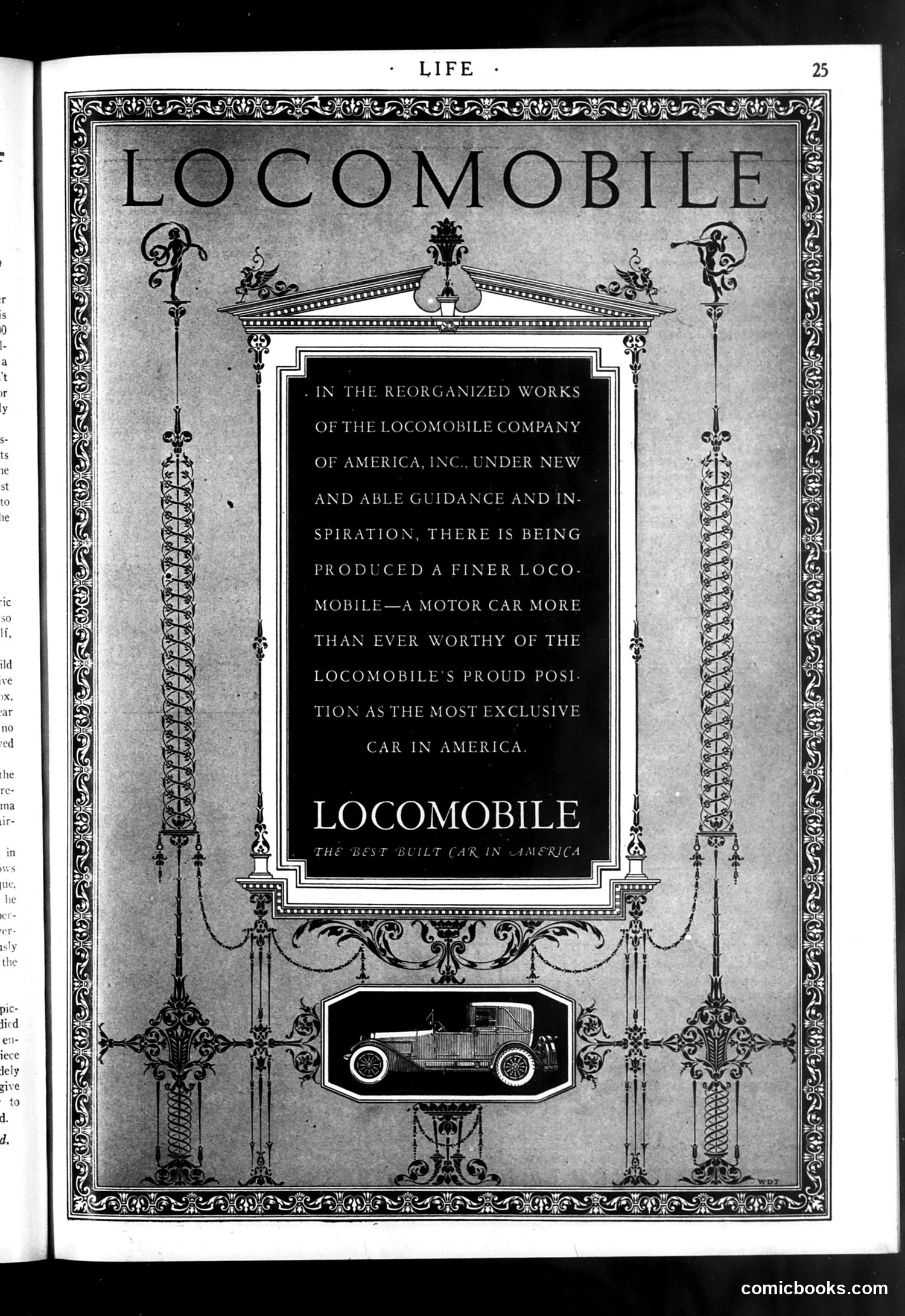
This is a **Locomobile automobile advertisement**, not a political cartoon. The ornate Art Deco design frames promotional text claiming the Locomobile is "the most exclusive car in America" and "the best built car in America," produced under new company leadership promising superior quality. The decorative border, classical architectural elements, and formal typography reflect early 20th-century luxury marketing aesthetic. A small illustration of the vehicle appears at bottom center. This is essentially a full-page advertisement disguised as editorial content—a common practice in early *Life* magazine, which blended satire, humor, and paid advertising. The page makes **no satirical point**; it's straightforward product promotion targeting wealthy readers.
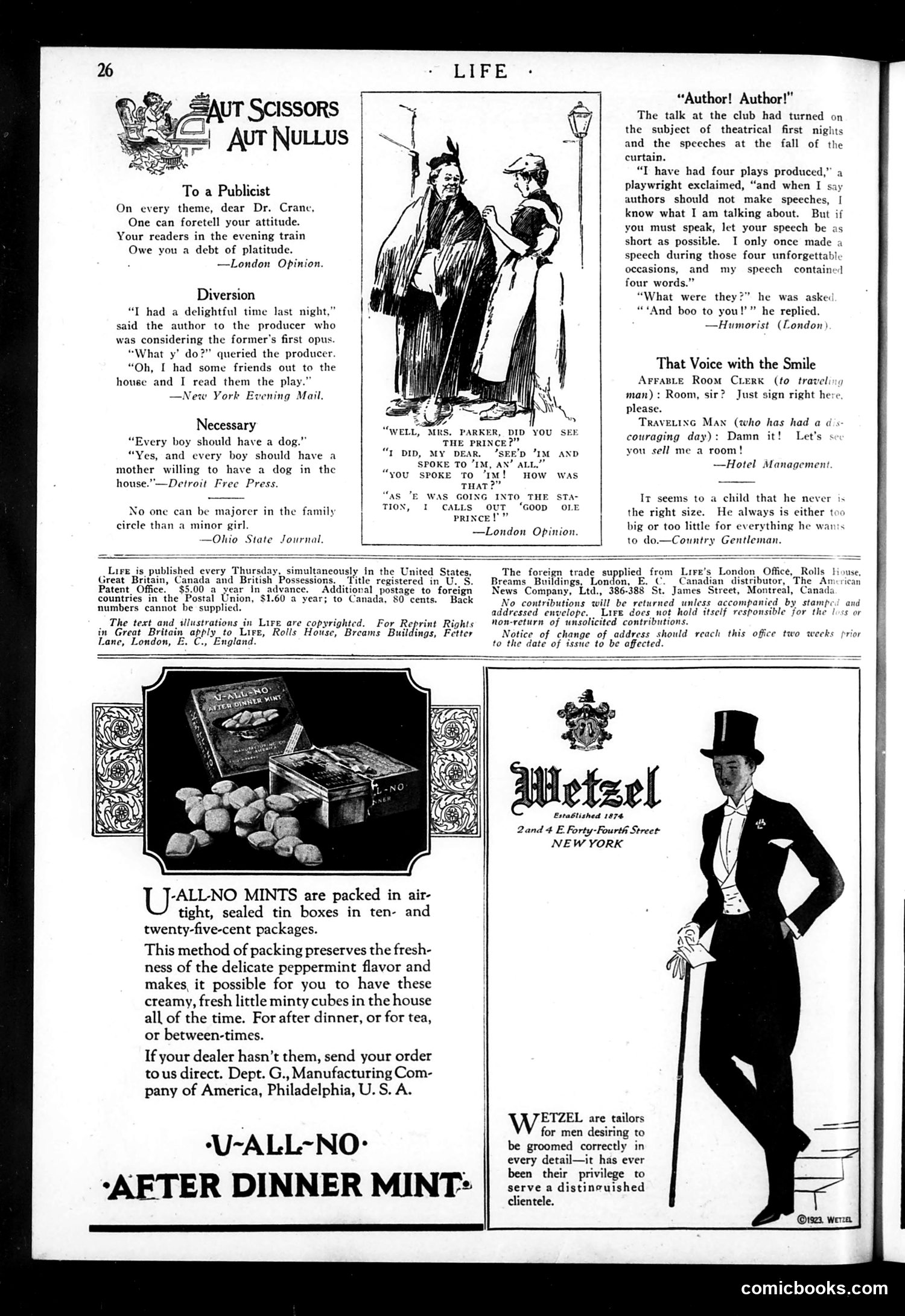
This page contains multiple short humorous anecdotes and advertisements typical of *Life* magazine's satirical format. **The main cartoon** depicts a theater scene where a man (likely a playwright or producer) discusses theatrical etiquette. The joke centers on author speeches at opening nights—a social convention of the era. The punchline involves an author who made only a four-word speech: "And boo to you!"—mocking the pretension of lengthy curtain speeches. **The surrounding text** offers brief satirical quips on various topics: a publicist's platitudes, a boy's need for a dog, and a child never being the "right size." These reflect *Life*'s role as a humor magazine commenting on middle-class social conventions and parenting advice. **The advertisements** (U-All-No Mints, Wetzel tailors) represent period products marketed to affluent readers. The page's humor relies on understanding early-20th-century theater culture and social etiquette—contexts largely unfamiliar to modern readers.
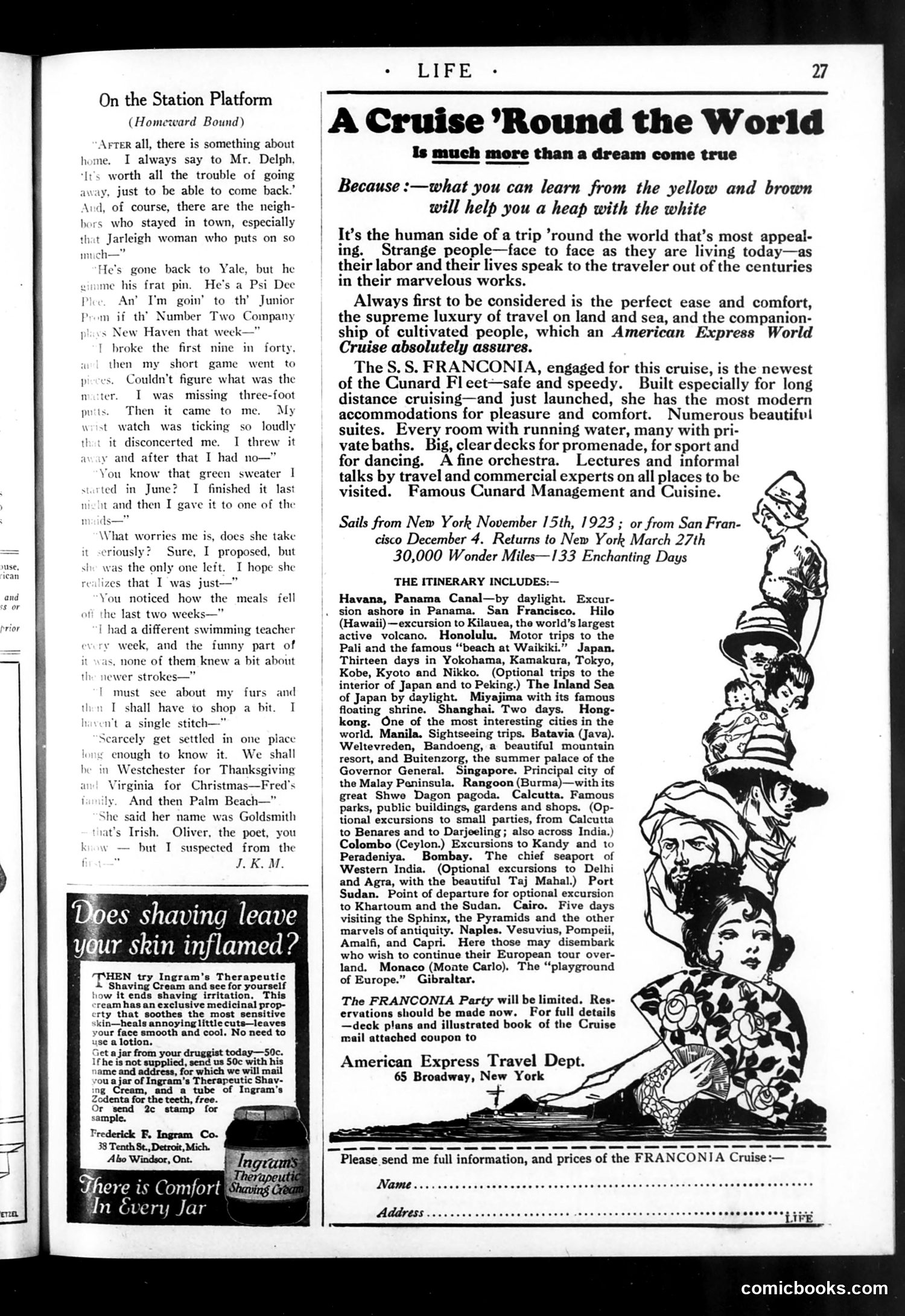
This page mixes social satire with travel advertising. The left column presents "On the Station Platform (Homeward Bound)," a humorous monologue capturing upper-class American speech patterns of the 1920s—vacuous, name-dropping chatter about returning from vacation, fretting over minor domestic concerns (a loud watch, unfinished knitting, swimming lessons), and planning the next season's travels (Westchester, Virginia, Palm Beach). The satire targets the self-absorbed leisure class: people oblivious to their own superficiality, constantly traveling yet learning nothing, endlessly gossiping. The monologue's fragmented, breathless delivery—jumping between unrelated anecdotes—mocks their scattered, vapid priorities. The right side features a Cunard cruise advertisement, which ironically reinforces the satirized mindset: wealthy Americans embarking on world travel promising "perfect ease and comfort" and encounters with "strange people"—exotic cultures reduced to tourist spectacle. The ad's colonial-era language ("yellow and brown will help you with the white") reflects casual racial hierarchies of the period. Together, they mock affluent American travelers as culturally superficial, more interested in luxury than genuine engagement.
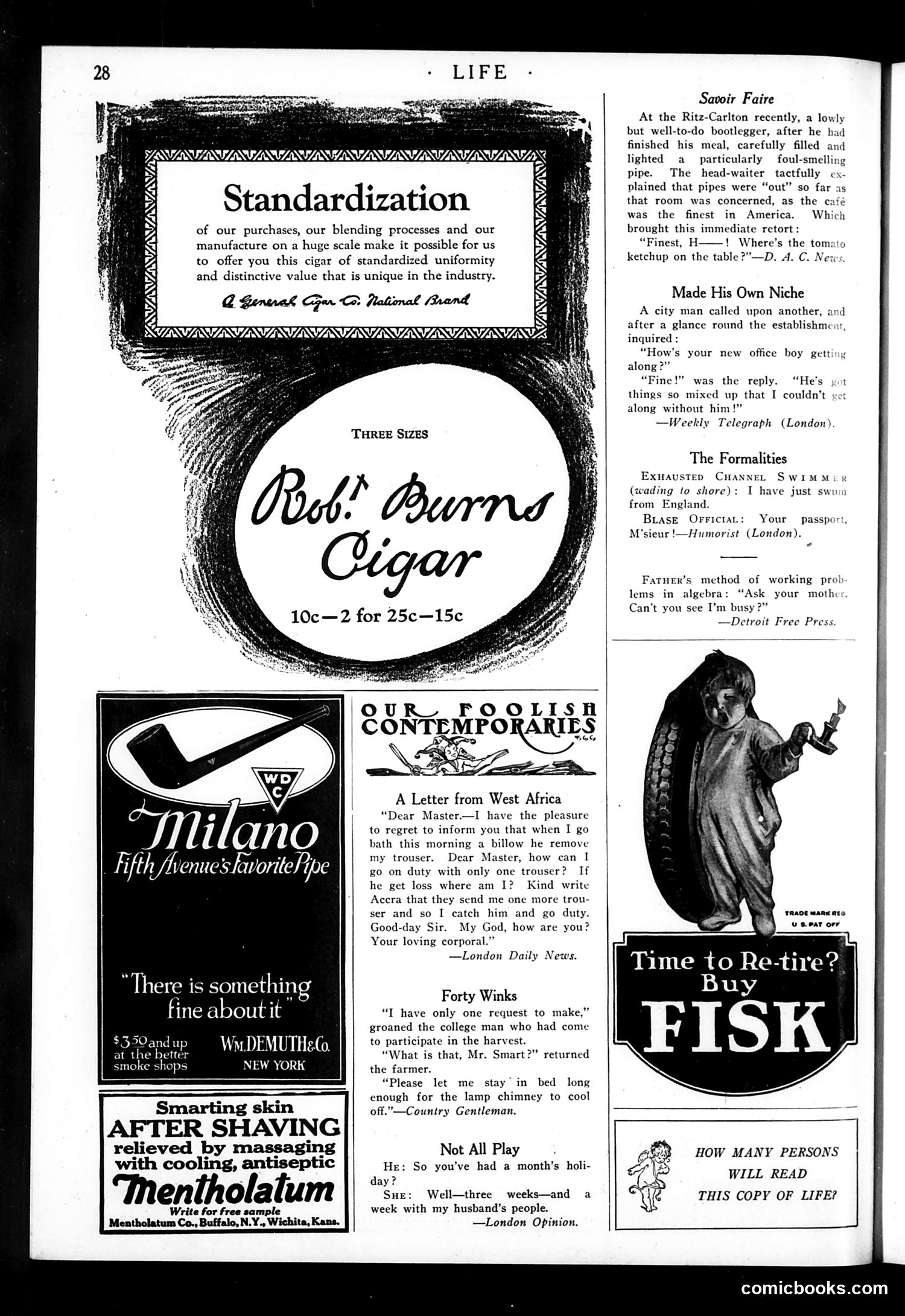
This page is primarily **advertisements and humor snippets** rather than political cartoons. The content reflects early 20th-century American commercial culture and social humor. **Key advertisements:** - **Bob Burns Cigars**: Emphasizes standardization and mass manufacturing as selling points—a distinctly modern industrial appeal - **Milano pipes**: Luxury tobacco product - **Mentholatum**: Post-shaving skin relief - **Fisk Tires**: The famous "Time to Re-tire?" slogan with a sleepy figure **Humor section ("Our Foolish Contemporaries"):** Contains short jokes satirizing everyday situations—a British officer's servant losing his trousers in West Africa, a college boy prioritizing sleep over farm work, and a woman's vague holiday accounting. These mock working-class mishaps and middle-class pretension through dialect and exaggeration. **"Savoir Faire" anecdote**: Mocks a wealthy bootlegger (Prohibition-era reference) who, despite his wealth, lacks refinement—demanding ketchup at an upscale restaurant. The overall tone reflects 1920s consumer culture and gentle social satire rather than pointed political commentary.
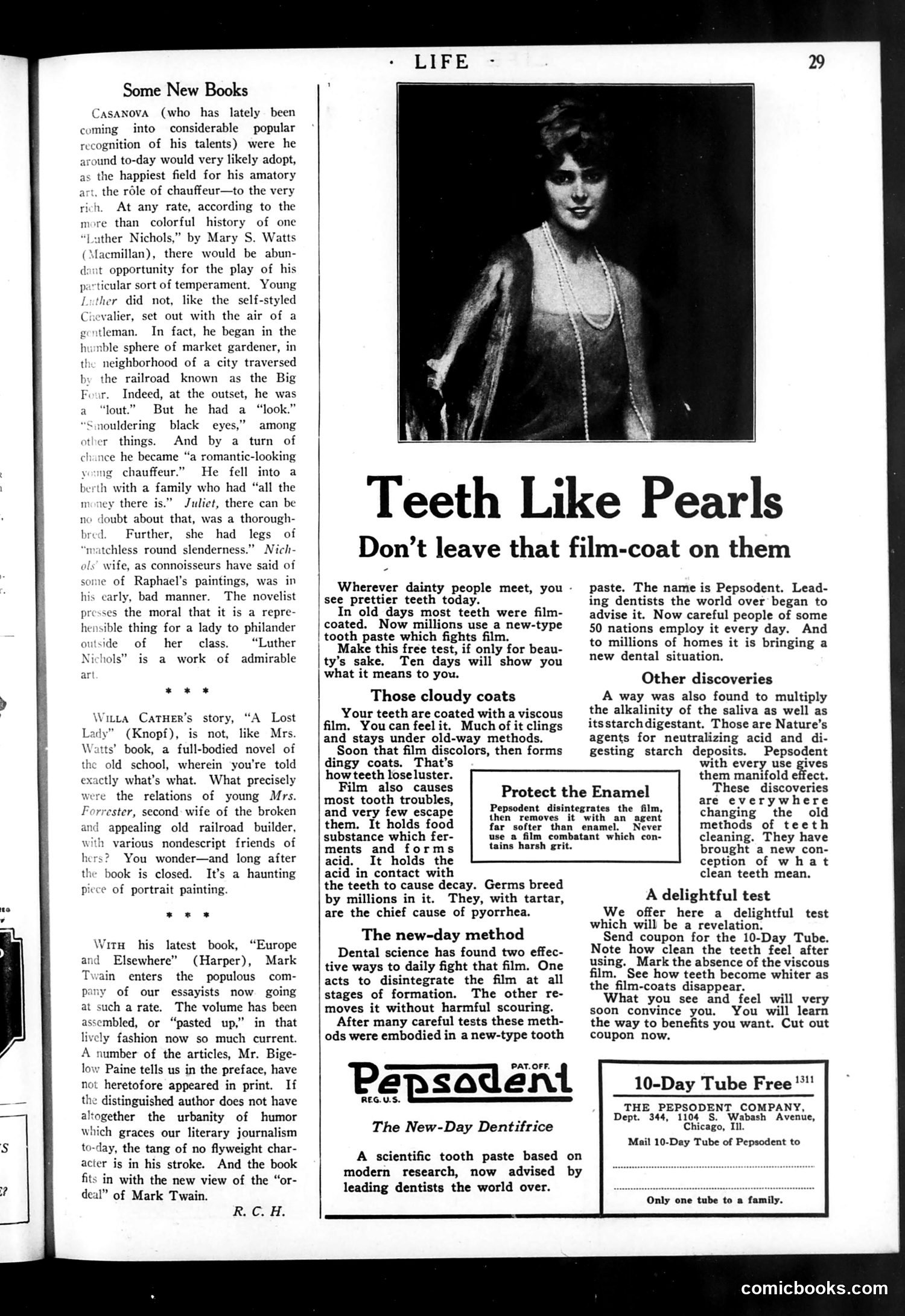
This page is primarily advertising rather than political satire. The dominant content is a Pepsodent toothpaste advertisement ("Teeth Like Pearls"), which occupies roughly half the page and uses pseudo-scientific marketing language typical of the 1920s—claiming the product fights "film" on teeth that causes discoloration and decay. The left column contains book reviews by R.C.H., discussing novels by Mary S. Watts, Willa Cather, and Mark Twain. These are straightforward literary criticism with no evident satirical intent, though the Watts novel review notes a moral lesson about class boundaries in romantic affairs. The advertisement represents the era's nascent consumer culture and early dental hygiene marketing, presenting toothpaste as scientifically advanced and socially necessary for "dainty people." There is no political cartoon or satire visible on this page.
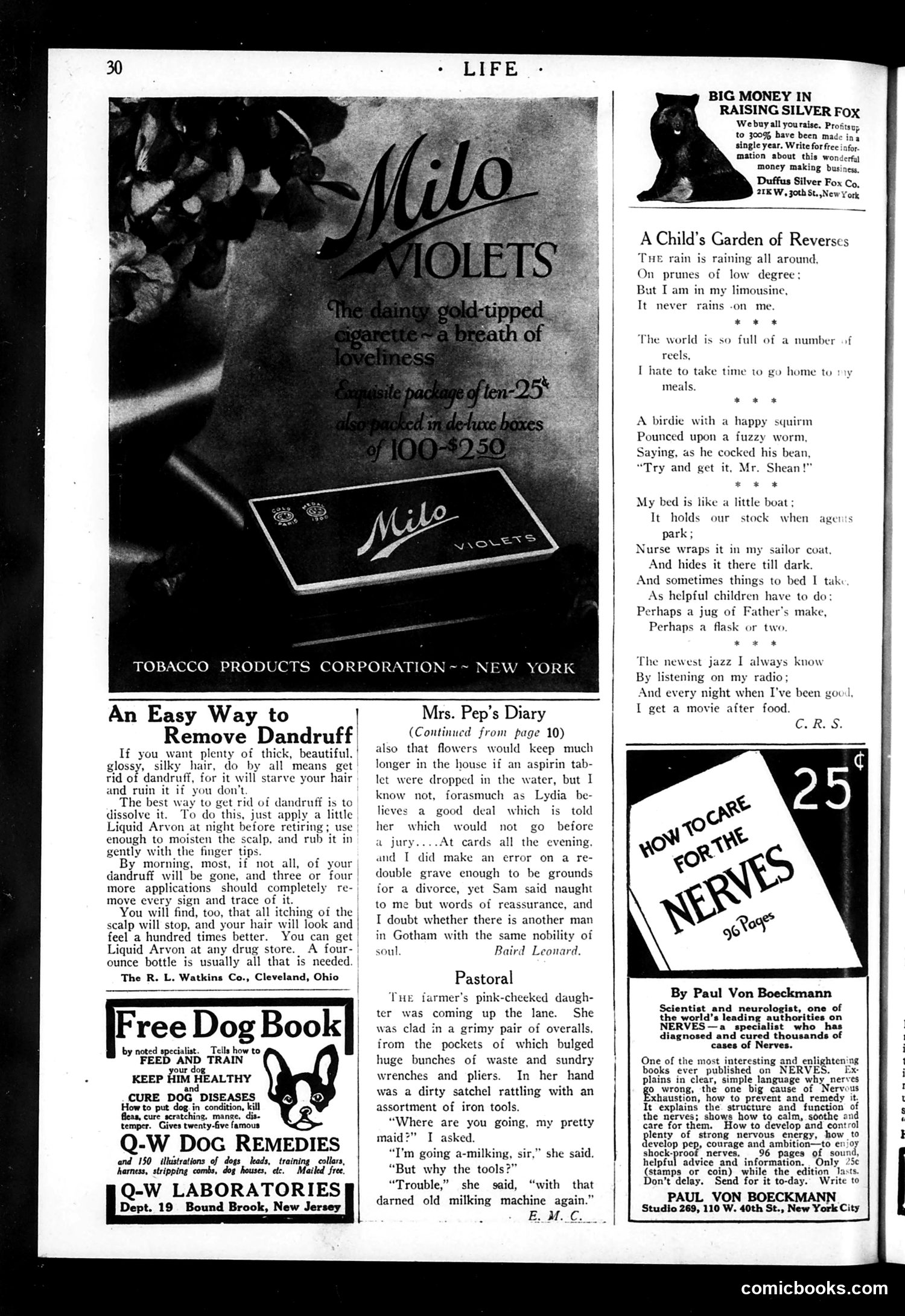
This page is primarily **advertisements and light satirical verse**, with no political cartoons. The main content includes: **Advertisements:** Milo Violets cigarettes (gold-tipped, 25¢), dandruff remedy, dog training book, silver fox raising scheme, and a book on treating nerves. **"A Child's Garden of Reverses"** — satirical poetry (credited C.R.S.) mocking wealth disparity. It inverts Robert Louis Stevenson's "A Child's Garden of Verses," replacing innocent childhood observations with cynical commentary: the speaker enjoys limousine rides while rain falls on "prunes of low degree," hides stock certificates in bed from creditors, and enjoys movies as reward for being "good." The satire targets class inequality and materialistic excess of the era. **"Mrs. Pep's Diary"** and **"Pastoral"** are light, humorous anecdotes about domestic life. The page reflects 1920s consumer culture and gentle social humor rather than pointed political satire.
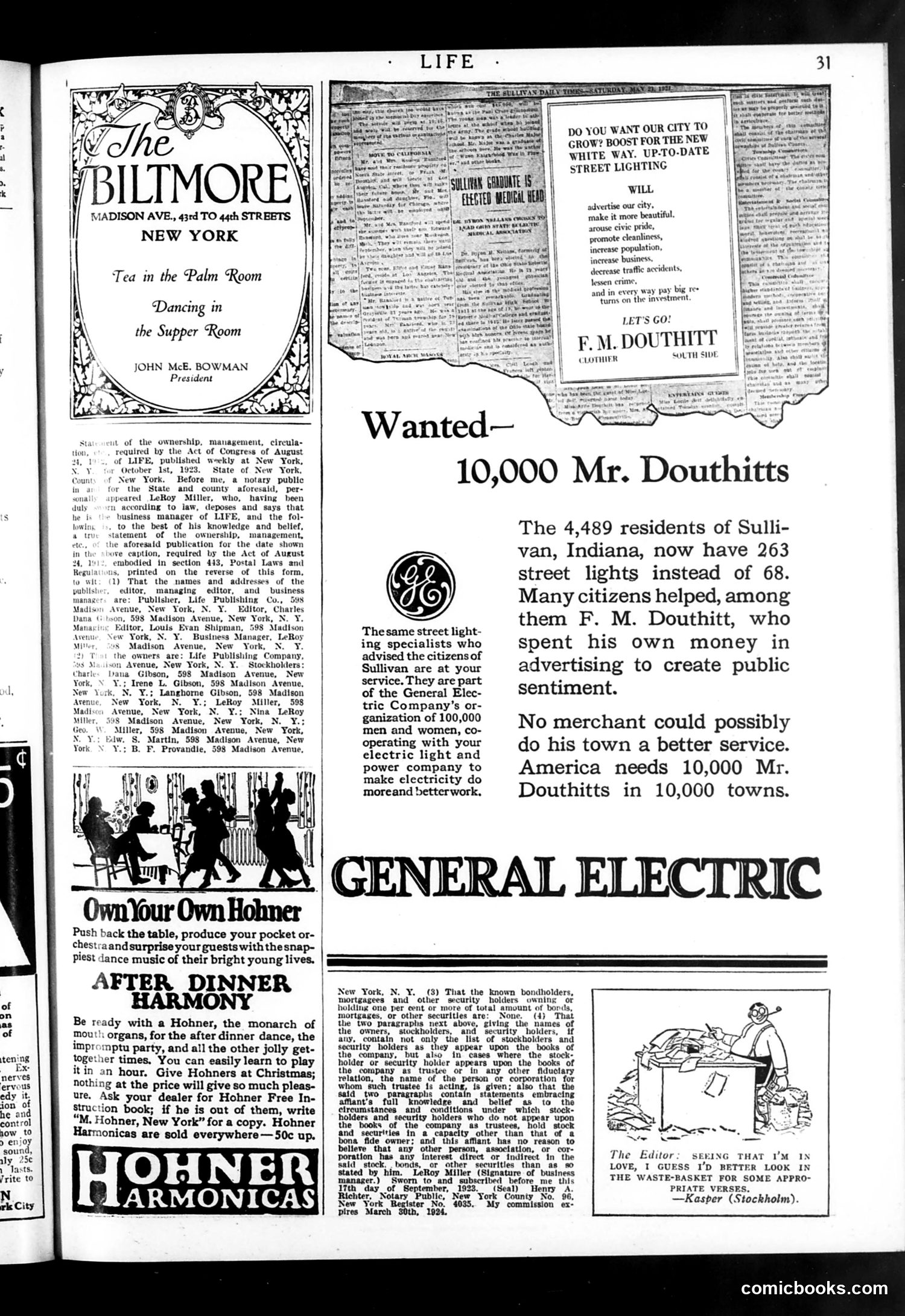
This page is primarily **advertisements and masthead information**, not editorial satire. The main content includes: **The Biltmore Hotel ad** (top left): A straightforward luxury hotel advertisement featuring dining and dancing venues. **General Electric's "Wanted—10,000 Mr. Douthitts" campaign** (center): This is corporate advocacy disguised as civic boosterism. It celebrates F. M. Douthitt, a clothier in Sullivan, Indiana, who personally funded street lighting improvements. GE uses his example to promote their electrical infrastructure business, arguing America needs 10,000 such civic-minded merchants. The implicit message: electrification benefits everyone and drives community progress. **Hohner Harmonicas ad** (bottom left): A consumer product advertisement. **The cartoon** (bottom right): Shows someone in a waste basket—appears to be a visual gag about miscommunication or literal interpretation of a phrase, unrelated to the page's other content. The page reflects 1920s corporate messaging emphasizing technological progress and civic virtue as interconnected ideals.
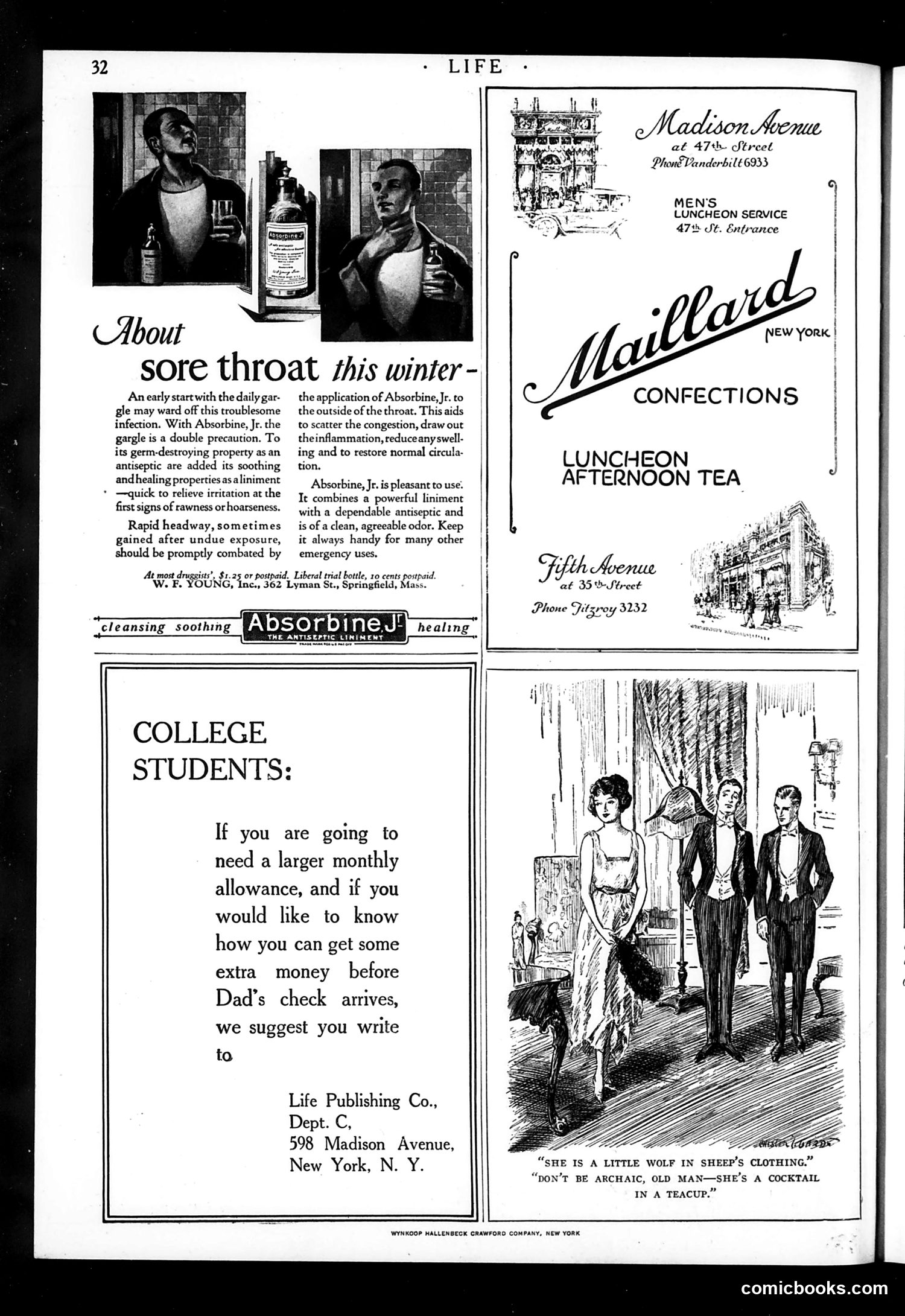
This page combines medical advertising with social satire typical of 1920s Life magazine. **Top section**: An Absorbine Jr. advertisement addresses winter sore throats, positioning the liniment as both antiseptic and pain reliever—standard product marketing of the era. **Bottom right cartoon**: The illustration depicts a young woman in fashionable 1920s dress entering what appears to be a formal social setting, with three men observing her. The dialogue reveals the satire: an older man calls her "a little wolf in sheep's clothing" (implying deception), but a younger man corrects him, calling her instead "a cocktail in a teacup"—meaning she appears demure or innocent on the surface but is actually modern, daring, and perhaps scandalous. This mocks generational attitudes toward "flapper" women of the Jazz Age: older Americans saw them as dangerous seductresses, while younger sophisticates viewed them as simply fashionable and liberated. **Left section**: A tongue-in-cheek appeal to college students, suggesting they contact Life Publishing for extra money—likely referring to paid contributions or competitions the magazine offered.
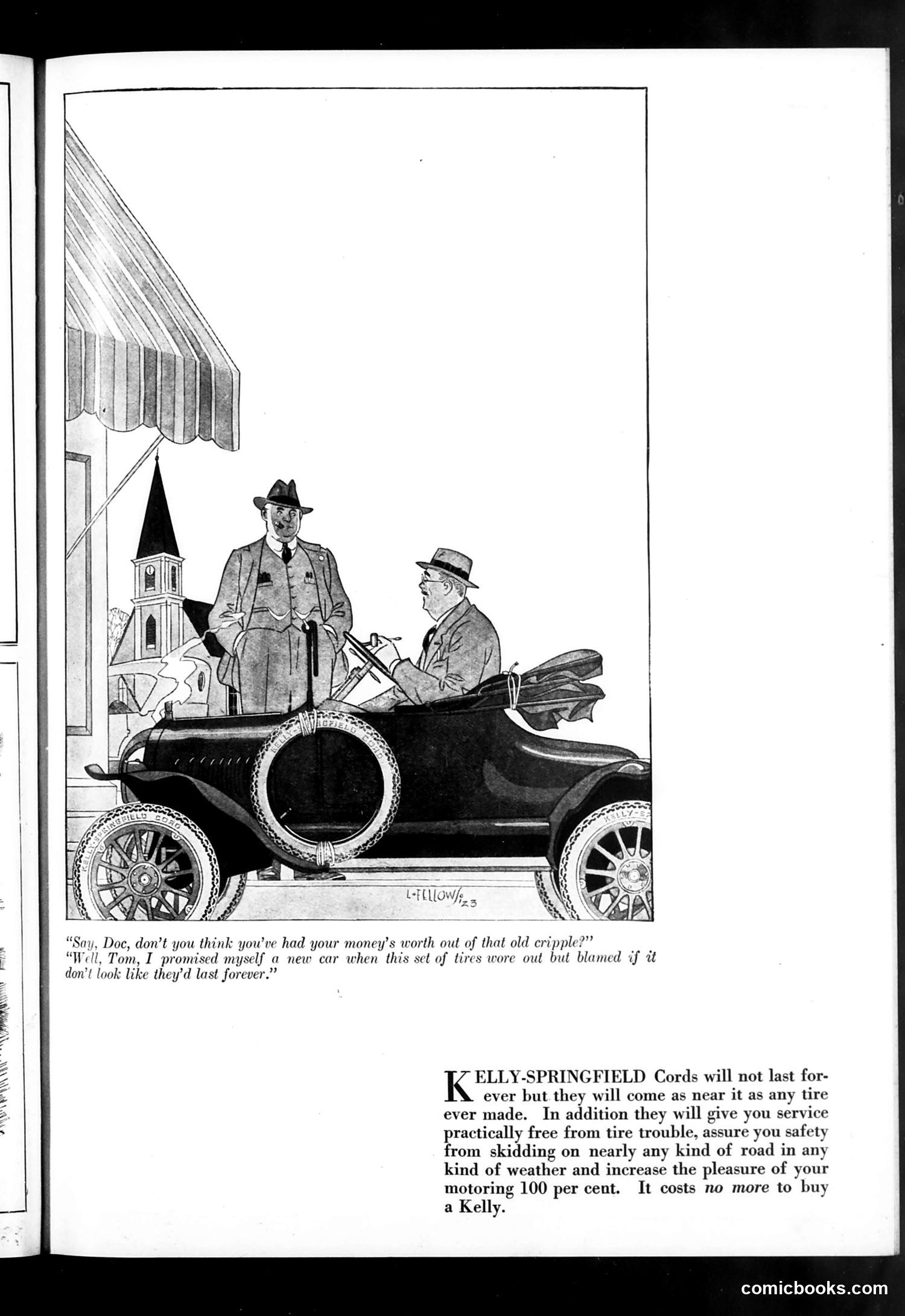
This is a **Kelly-Springfield tire advertisement** using humor rather than a political cartoon. The joke: Two men in a car discuss the car's worn tires. One ("Doc") calls the vehicle an "old cripple," while the other (Tom) notes the tires have lasted so long he can't justify buying the new car he promised himself once they wore out. The humor plays on consumer frustration—the tires are *too durable*, preventing him from upgrading. The advertisement then pivots: Kelly-Springfield tires, while not literally eternal, come closest to lasting forever. This salesmanship strategy acknowledges tire quality while suggesting buyers can trust the brand's durability. The cartoon reflects early 20th-century car culture, when tire replacement was a major maintenance expense and a sign of vehicle aging. The satire gently mocks both consumer desire for new purchases and the reliability problem the advertiser claims to solve.
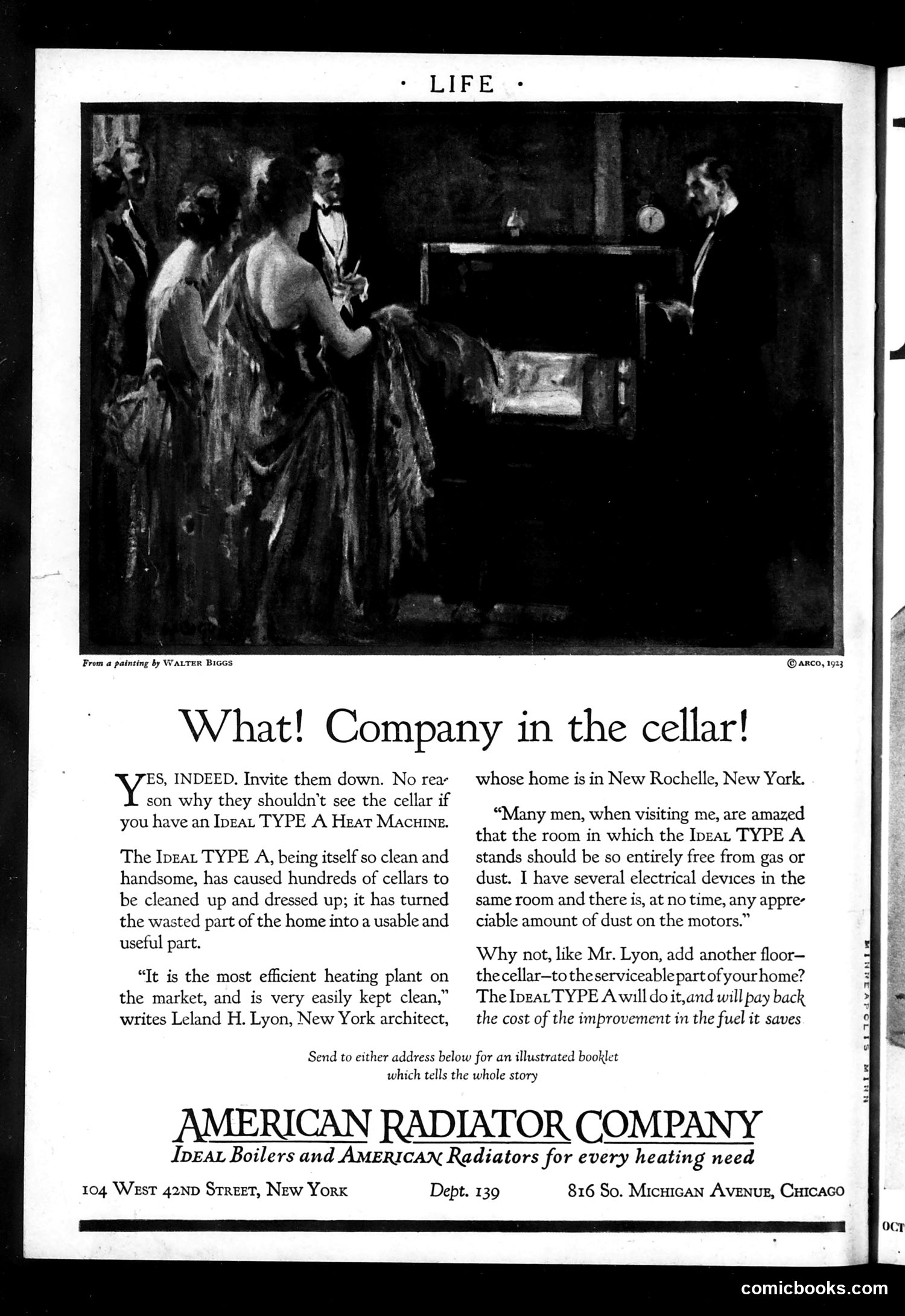
This is primarily **advertising, not satire**. The page features a Walter Biggs painting illustrating an advertisement for the American Radiator Company's "Ideal TYPE A" heating system. The ad uses a social comedy premise: a well-dressed couple entertaining guests in their cellar. The "joke" is that basements were traditionally dirty, unusable spaces—but with a clean, attractive heating unit installed, homeowners could invite company downstairs without embarrassment. The narrative quotes a New York architect praising how clean the device keeps the room, arguing that basement space becomes valuable real estate when heated properly. The ad's pitch: installing this furnace will "pay back" its cost through fuel savings while transforming wasted cellar space into usable living area. This reflects 1920s concerns about home modernization and efficient heating, positioning industrial equipment as aspirational home décor that enables social entertaining.