
Life, 1923-10-11 · page 20 of 36
Life — October 11, 1923 — page 20: what you’re looking at
What you’re looking at
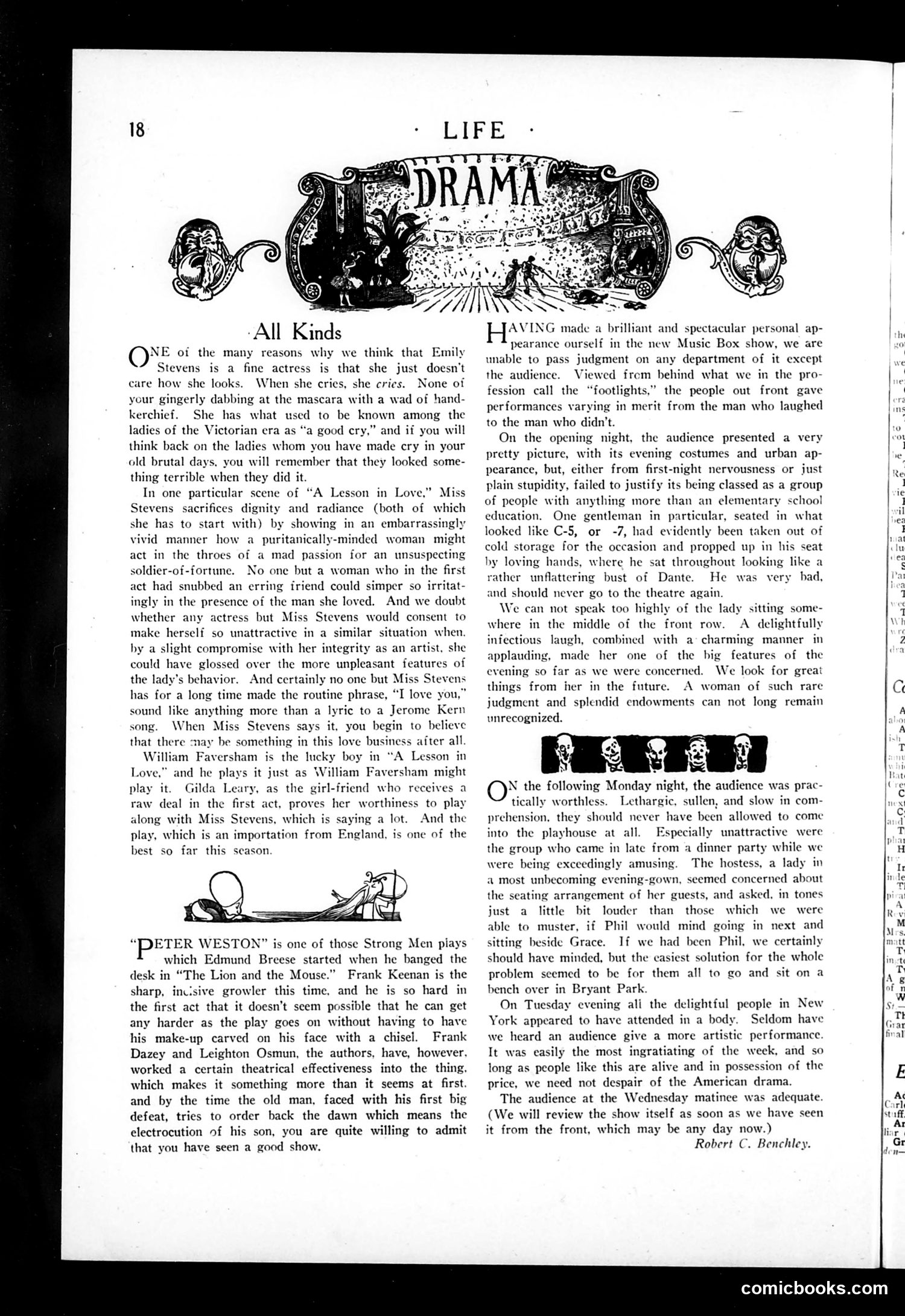
This page contains theater reviews rather than political cartoons. The critic praises actress Emily Stevens for her unsentimental acting style—specifically her willingness to appear unflattering while crying, contrasting her with Victorian-era actresses who maintained composure. The reviews also cover plays "A Lesson in Love" (with William Faversham) and "Peter Weston" (with Frank Keenan), both praised for their theatrical effectiveness. The decorative header and small skull illustrations are typical Life magazine ornaments. The reviewer's sarcastic closing section mocks an audience member at the Music Box show who sat motionless "like a rather unflattering bust of Dante," suggesting he was either extremely bored or literally removed from cold storage—a common Life magazine joke format of cruel but witty social observation targeting poor audience behavior and taste.
📄 Transcribed text from this page (OCR, searchable)
Machine-transcribed from the original scan — historical spelling and the odd misread are preserved.
-All Kinds NE of the many reasons why we think that Emi Stevens is a fine actress is that she just doesn’t care how she looks. When she cries, she cries. None of your gingerly dabbing at the mascara with a wad of hand- kerchief. She has what used to be known among the ladies of the Victorian era as “a good cry,” and if you will think back on the ladies whom you have made cry in your old brutal days. you will remember that they looked some- thing terrible when they did it. In one particular scene of “A Lesson in Love,” Miss Stevens sacrifices dignity and radiance (both of which she has to start with) by showing in an embarrassingly vivid manner how a puritanically-minded woman might act in the throes of a mad passion for an unsuspecting soldier-of-fortune. No one but a woman who in the first act had snubbed an erring iriend could simper so irritat- ingly in the presence of the man she loved. And we doubt whether any actress but Miss Stevens would consent to make herself so unattractive in a similar situation when by a slight compromise with her integrit: an artist, she could have glossed over the more unpleasant features of the lady's behavior. And certainly no one but Miss Stevens has for a long time made the routine phrase, “I love you,” sound like anything more than a lyric to a Jerome Kern song. When Miss Stevens says it, you begin to believe that there nay be something in this love business after all. William Faversham is the lucky boy in “A Lesson in Love,” and he plays it just as William Faversham might play it. Gilda Leary, as the girl-friend who receives a raw deal in the first act, proves her worthiness to play along with Miss Stevens, which is saying a lot. And the play, which is an importation from England, is one of the best so far this season. a “DETER WESTON” is one of those Strong Men piays which Edmund Breese started when he banged the desk in “The Lion and the Mouse.” Frank Keenan is the sharp, incisive growler this time, and he is so hard in the first act that it doesn’t seem possible that he can get any harder as the play goes on without having to have his make-up carved on his face with a chisel. Frank Dazey and Leighton Osmun, the authors, have, however, worked a certain theatrical effectiveness into the thing. which makes it something more than it seems at first. and by the time the old man, faced with his first big defeat, tries to order back the dawn which means the electrocution of his son, you are quite willing to admit that you have seen a good show. AVING made a brilliant and spectacular personal ap- pearance ourself in the new Music Box show, we are unable to pi judgment on any department of it except the audience. Viewed from behind what we in the pro- fession call the “footlights,” the people out front gave performances varying in merit from the man who laughed to the man who didn't. On the opening night, the audience presented a very pretty picture, with its evening costumes and urban ap- pearance, but, either from first-night nervousness or just plain stupidity, failed to justify its being classed as a group of people with anything more than an elementary school education. One gentleman in particular, seated in what looked like C-5, or -7, had evidently been taken out of cold storage for the occasion and propped up in his seat by loving hands, where he sat throughout looking like a rather unflattering bust of Dante. He was very bad, and should never go to the theatre again. We can not speak too highly of the lady sitting some- where in the middle of the front row. A delightfully infectious laugh, combined with a° charming manner in applauding, made her one of the big features of the evening so far as we were concerned. We look for great things from her in the future. A woman of such rare judgment and splendid endowments can not long remain unrecognized. \ the following Monday night, the audience was prac- ly worthless. Lethargic, sullen, and slow in com- prehension, they should never have been allowed to come into the playhouse at all. Especially unattractive were the group who came in late from a dinner party while we were being exceedingly amusing. The hostess, a lady in a most unbecoming evening-gown, seemed concerned about the seating arrangement of her guests, and asked, in tones just a little bit louder than those which we were able to muster, if Phil would mind going in next and sitting beside Grace. If we had been Phil, we certainly should have minded, but the easiest solution for the whole problem seemed to be for them all to go and sit on a bench over in Bryant Park. On Tuesday evening ali the delightful people in New York appeared to have attended in a body. Seldom have we heard an audience give a more artistic performance. It was easily the most ingratiating of the week, and so long as people like this are alive and in possession of the price, we need not despair of the American drama. The audience at the Wednesday matinee was adequate. (We will review the show itself as soon as we have seen it from the front, which may be any day now.) Robert C. Benchl. comicbooks.com