
Life, 1923-10-11 · page 26 of 36
Life — October 11, 1923 — page 26: what you’re looking at
What you’re looking at
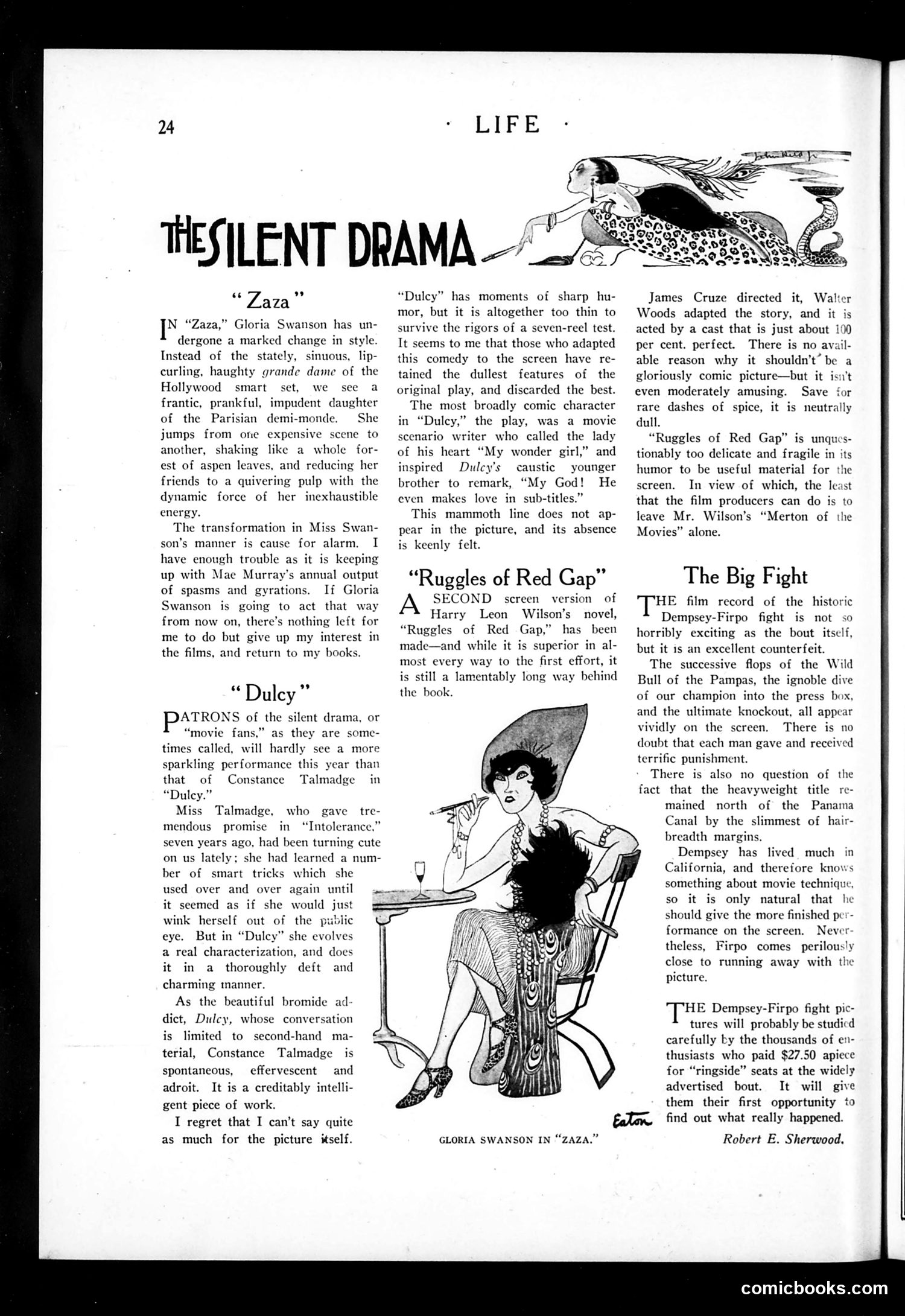
This page reviews four silent films. The critic praises **Gloria Swanson's performance in "Zaza,"** noting she's abandoned her typical "haughty grande dame" persona for a more energetic, frantic character—a change the reviewer finds exhausting and worrisome. **Constance Talmadge shines in "Dulcy,"** delivering excellent comedic acting, though the film adaptation itself disappoints by discarding the play's best jokes, including a witty meta-joke about a screenwriter declaring his love "in sub-titles." **"Ruggles of Red Gap"** (a second film version of a Harry Leon Wilson novel) suffers from being too delicate for cinema, despite competent direction and casting. Finally, the critic reviews the **Dempsey-Firpo boxing match film**—a record of the historic heavyweight championship fight. While not as thrilling as the actual bout, it effectively captures the action, including the famous moment when Dempsey was knocked into the press box, ultimately retaining his title by the narrowest margin.
📄 Transcribed text from this page (OCR, searchable)
Machine-transcribed from the original scan — historical spelling and the odd misread are preserved.
TESILENT DRAMA “Zaza” N “Zaza,” Gloria Swanson has un- dergone a marked change in style. Instead of the stately, sinuous, lip- curling, haughty grande dame of the Hollywood smart set, we see a frantic, prankful, impudent daughter of the Parisian She jumps from one expensive scene to another, shaking like a whole for- est of aspen leaves, and reducing her friends to a quivering pulp with the dynamic force of her inexhaustible energy. The transformation in Miss Swan- son’s manner is cause for alarm. I have enough trouble as it is keeping up with Mae Murray's annual output of spasms and gyrations. If Gloria Swanson is going to act that way from now on, there’s nothing left for me to do but give up my interest in the films, and return to my books. “Duley” ATRONS of the silent drama, or “movie fans,” as they are some- times called, will hardly see a more sparkling performance this year than that of Constance Talmadge in “Dulcy.” Miss Talmadge, who mendous promise in seven years ago, had been turning cute on us lately; she had learned a num- ber of smart used over and over again until it seemed as if she would just wink herself out of the public eye. But in “Dulcy’ a real characterization, and does it in a thoroughly deft and charming tanner. demi-monde. gave tre- “Intolerance.” tricks which she she evolves As the beautiful bromide ad dict, Dulcy, whose conversation is limited to terial, spontaneous, adroit. It is a creditably intelli- gent piece of work. I regret that I can’t say quite as much for the picture itself. second-hand ma- Constance Talmadge is effervescent and “Dulcy” has moments of sharp hu- mor, but it is altogether too thin to survive the rigors of a seven-reel test. It seems to me that those who adapted this comedy to the screen have re- tained the dullest features of the original play, and discarded the best. The most broadly comic character in “Dulcy,” the play, was a movie scenario writer who called the lady of his heart “My wonder girl,” and inspired Dulcy’s caustic younger brother to remark, “My God! He even makes love in sub-titles.” This mammoth line does not ap- pear in the picture, and its absence is keenly felt. ” “Ruggles of Red Gap SECOND screen version of Harry Leon Wilson’s novel, “Ruggles of Red Gap,” has been made—and while it is superior in al- most every way to the first effort, it is still a lamentably long way behind the book. James Cruze directed it, Walter Woods adapted the story, and it is acted by a cast that is just about 190 per cent. perfect. There is no avail- able reason why it shouldn’t’ be a gloriously comic picture—but it isn't even moderately amusing. Save for rare dashes of spice, it is neutrally dull. “Ruggles of Red Gap” is unques- tionably too delicate and fragile in its humor to be useful material for the screen. In view of which, the least that the film producers can do is to leave Mr. Wilson’s “Merton of the Movies” alone. The Big Fight HE film record of the historic Dempsey-Firpo fight is not so horribly exciting as the bout itself, but it is an excellent counterfeit. The successive flops of the Wild Bull of the Pampas, the ignoble dive of our champion into the press box, and the ultimate knockout, all appear vividly on the screen, There is no doubt that each man gave and received terrific punishment. There is also no question of the fact that the heavyweight title re- mained north of the Panama Canal by the slimmest of hair- breadth margins. Dempsey has lived much in California, and therefore knows something about movie technique, so it is only natural that he should give the more finished per- formance on the screen. Never- theless, Firpo comes perilously close to running away with the picture. ne Dempsey-Firpo fight pic- tures will probably be studied carefully by the thousands of en- thusiasts who paid $27.50 apiece for “ringside” seats at the widely advertised bout. It will give them their first opportunity to talon find out what really happened. GLORIA SWANSON IN “ZAZA,” Robert E. Sherwood. comicbooks.com