
Life, 1923-10-11 · page 22 of 36
Life — October 11, 1923 — page 22: what you’re looking at
What you’re looking at
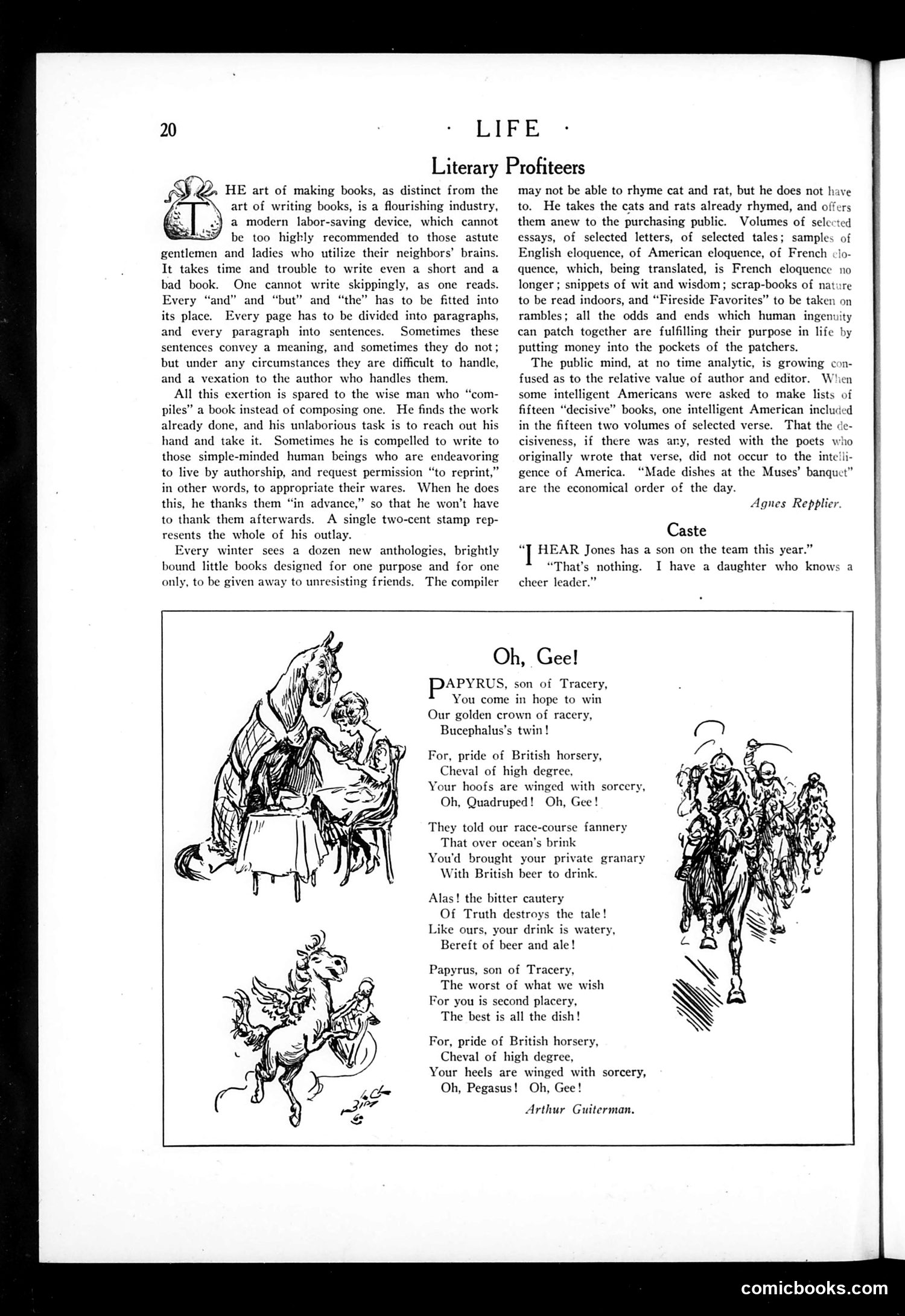
**Top Essay:** Agnes Repplier satirizes anthology editors who profit by reprinting others' work without original effort. She mocks "compilers" who assemble selected essays, letters, and verse—taking existing writing and repackaging it for gift-giving seasons. The joke: these editors claim credit while doing minimal work, paying authors pittance (a two-cent stamp), yet confusing the public about who deserves literary merit. "Made dishes at the Muses' banquet" means serving reheated scraps as fresh fare. **Bottom Poem:** Arthur Guiterman's comic verse mocks class pretension. "Papyrus" is a British racehorse entering American competition. The satire: wealthy British import fanfare claims the horse drinks imported British beer and represents superiority ("pride of British horsery"), but truth deflates this—the horse drinks plain water like common American horses. The repeated "Oh, Gee!" emphasizes deflated expectations. It's social commentary on imported British snobbery meeting American reality.
📄 Transcribed text from this page (OCR, searchable)
Machine-transcribed from the original scan — historical spelling and the odd misread are preserved.
LIFE Literary Profiteers HE art of making books, as distinct from the art of writing books, is a flourishing industry, a modern labor-saving device, which cannot be too higkly recommended to those astute gentlemen and ladies who utilize their neighbors’ brains. It takes time and trouble to write even a short and a bad book. One cannot write skippingly, as one reads. Every “and” and “but” and “the” has to be fitted into its place. Every page has to be divided into paragraphs, and every paragraph into sentences. Sometimes these sentences convey a meaning, and sometimes they do not; but under any circumstances they are difficult to handle, and a vexation to the author who handles them. All this exertion is spared to the wise man who “com- piles” a book instead of composing one. He finds the work already done, and his unlaborious task is to reach out his hand and take it. Sometimes he is compelled to write to those simple-minded human beings who are endeavoring to live by authorship, and request permission “to reprint,” in other words, to appropriate their wares. When he does this, he thanks them “in advance,” so that he won't have to thank them afterwards. A single two-cent stamp rep- resents the whole of his outlay. Every winter sees a dozen new anthologies, brightly bound little books designed for one purpose and for one only, to be given away to unresisting friends. The compiler may not be able to rhyme cat and rat, but he does not have to. He takes the cats and rats already rhymed, and offers them anew to the purchasing public. Volumes of selected essays, of selected letters, of selected tales; samples of English eloquence, of American eloquence, of French clo- quence, which, being translated, is French eloquence no longer ; snippets of wit and wisdom; scrap-books of nature to be read indoors, and “Fireside Favorites” to be taken on rambles; all the odds and ends which human ingen can patch together are fulfilling their purpose in life by putting money into the pockets of the patchers. The public mind, at no time analytic, is growing con- fused as to the relative value of author and editor. When some intelligent Americans were asked to make lists of fifteen “decisive” books, one intelligent American included in the fifteen two volumes of selected verse. That the de- cisiveness, if there was any, rested with the poets who originally wrote that verse, did not occur to the inte'li- gence of America. “Made dishes at the Muses’ banquet” are the economical order of the day. Agnes Repplier. Caste “TI HEAR Jones has a son on the team this year.” “That's nothing. cheer leader.” I have a daughter who knows a Oh, Gee! APYRUS, son of Tracery, You come in hope to win Our golden crown of racery, Bucephalus’s twin! For, pride of British horsery, Cheval of high degree, Your hoofs are winged with sorcery, Oh, Quadruped! They told our race-course fannery That over ocean's brink You'd brought your private granary With British beer to drink. Alas! the bitter cautery Of Truth destroys the tale! Like ours, your drink is watery, Bereft of beer and ale! Papyrus, son of Tracery, The worst of what we wish For you is second placery, The best is all the dish! For, pride of British horsery, Cheval of high degree, Your heels are winged with sorcery, Oh, Pegasus! Oh, Gee! Oh, Gee! Arthur Guiterman. comicbooks.com