
Life, 1923-10-11 · page 10 of 36
Life — October 11, 1923 — page 10: what you’re looking at
What you’re looking at
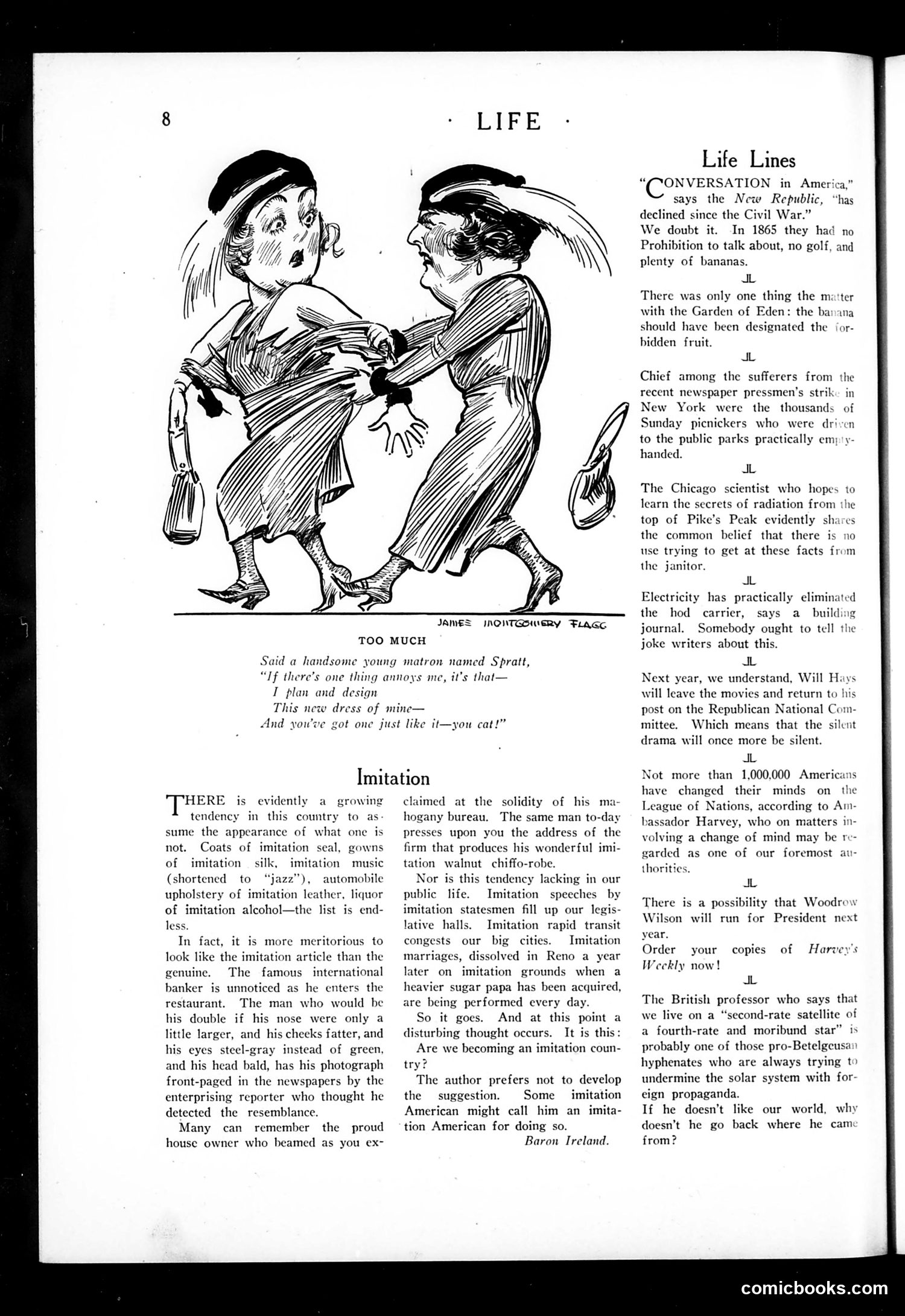
This cartoon by James Montgomery Flagg depicts two women in a physical altercation over fashion. The caption quotes a young woman named Spratt complaining that her rival has copied her new dress design. The satire targets the growing American tendency toward imitation—a theme developed in the accompanying article titled "Imitation." The piece critiques widespread copying in fashion, architecture, music, and public life, suggesting this represents a decline in American originality and authenticity since the Civil War era. The cartoon illustrates how this imitation culture creates social friction, particularly among women concerned with fashion distinction. The satire mocks both the petty nature of such disputes and the broader cultural anxiety about American society becoming increasingly derivative rather than innovative.
📄 Transcribed text from this page (OCR, searchable)
Machine-transcribed from the original scan — historical spelling and the odd misread are preserved.
JAMES INONTGOWERY FLAG TOO MUCH Said a handsome young matron named Spratt, “If there’s one thing annoys me, it’s that— T plan and design This new dress of mine— And youve got one just like it you cat!” Imitation HERE is growing tendency in this country to as sume the appearance of what one is not. Coats of imitation seal, gowns of imitation music (shortened to “jazz”), automobile upholstery of imitation leather, liquor of imitation alcohol—the list is end- less. evidently a silk, imitation In fact, it is more meritorious to look like the imitation article than the The international banker is unnoticed as he enters the restaurant. The man who would be his double if his nose were only a little larger, and his cheeks fatter, and his eyes steel-gray instead of green, and his head bald, has his photograph front-paged in the newspapers by the enterprising reporter who thought he detected the resemblance. Many can remember the proud house owner who beamed as you ex- genuine, famous claimed at the solidity of his ma- hogany bureau. The same man to-day presses upon you the address of the firm that produces his wonderful imi- tation walnut chiffo-robe. Nor is this tendency lacking in our public life. Imitation speeches by imitation statesmen fill up our legis- lative halls. Imitation rapid transit congests our big cities. Imitation marriages, dissolved in Reno a year later on imitation grounds when a heavier sugar papa has been acquired, are being performed every day. So it goes. And at this point a disturbing thought occurs. It is this: Are we becoming an imitation coun- try? The author prefers not to develop the suggestion. Some _ imitation American might call him an imita- tion American for doing so. Baron Ireland. Life Lines WE ONVERSATION in America,” says the New Republic, “has declined since the Civil War.” We doubt it. In 1865 they had no Prohibition to talk about, no golf, and plenty of bananas. aL There was only one thing the matter with the Garden of Eden: the banana should have been designated the {or- hidden fruit. dL Chief among the sufferers from the recent newspaper pressmen’s strik in New York were the thousands of Sunday picnickers who were driven to the public parks practically emp'y- handed. JL The Chicago scientist who hopes to learn the secrets of radiation from the top of Pike’s Peak evidently shares the common belief that there is no use trying to get at these facts from the janitor. JL Electricity has practically eliminated hod carrier, says a_ building journal. Somebody ought to tell the joke writers about this. aL Next year, we understand, Will Hays will leave the movies and return to his post on the Republican National Com- mittee. Which means that the silent drama will once more be silent. dL Not more than 1,000,000 Americans changed their minds on the League of Nations, according to Am- »assador Harvey, who on matters in- volving a change of mind may be re- garded as one of our foremost au- thorities. have JL There is a possibility that Woodrow Wilson will run for President next y . Order your copies of Harvey's Weekly now! dL The British professor who says that we live on a “second-rate satellite of a fourth-rate and moribund star” is probably one of those pro-Betelgeusa: hyphenates who are always trying to undermine the solar system with for- eign propaganda. If he doesn’t like our world, why doesn’t he go back where he came from? comicbooks.com