
Life, 1923-10-11 · page 16 of 36
Life — October 11, 1923 — page 16: what you’re looking at
What you’re looking at
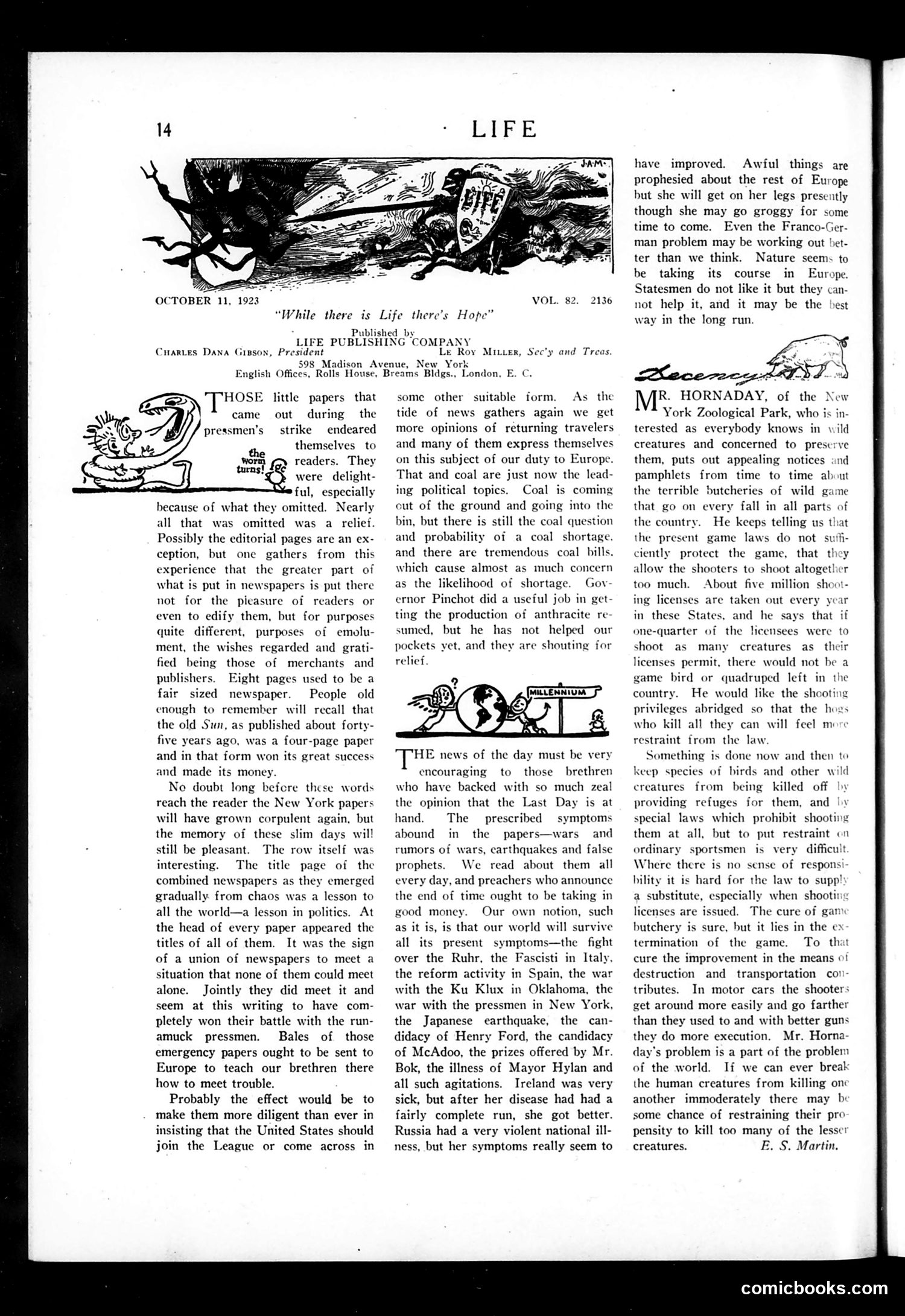
The main illustration shows a grotesque figure labeled "MILLENNIUM," appearing to represent an idealized but nightmarish future state. The cartoon satirizes contemporary optimism about progress and modernity. The accompanying editorial discusses European conditions—particularly economic troubles, coal shortages, and political instability affecting France, Germany, and Russia. It mentions specific contemporary crises: the Franco-German problem, Fascism in Italy, conflict in Spain, the Ku Klux Klan in Oklahoma, and Japanese earthquake aftermath. The satirical point: despite the era's technological advancement and hopeful rhetoric ("While there is Life there's Hope"), the world faces serious political and economic turmoil that makes utopian visions of a "millennium" darkly ironic. Progress and chaos coexist uncomfortably.
📄 Transcribed text from this page (OCR, searchable)
Machine-transcribed from the original scan — historical spelling and the odd misread are preserved.
82. 2136 “While there is Life there’s Hope” Published _by LIFE PUBLISHING C Crartes Dana Gipson, President 598 Madison Avenue, English Offices, Rolls House, little papers that out during the pressmen’s strike endeared themselves to the erm Let readers. They were delight- ful, especially because of what they omitted. Nearly all that was omitted was a_ relief. Possibly the editorial pages are an ex- ception, but one gathers from this experience that the greater part of what is put in newspapers is put there not for the pieasure of readers or even to edify them, but for purposes quite different, purposes of emolu- ment, the wishes regarded and grati- fied being those of merchants and publishers. Eight pages used to be a fair sized newspaper. People old enough to remember will recall that the old Sun, as published about forty- five years ago, was a four-page paper and in that form won its great success and made its money. No doubt long befcre these words reach the reader the New York papers will have grown corpulent again, but the memory of these slim days wil! still be pleasant. The row itself was interesting. The title page of the combined newspapers as they emerged gradually from chaos was a lesson to all the world—a lesson in politics. At the head of every paper appeared the titles of all of them. It was the sign of a union of newspapers to meet a situation that none of them could meet alone. Jointly they did meet it and seem at this writing to have com- pletely won their battle with the run- amuck pressmen. Bales of those emergency papers ought to be sent to Europe to teach our brethren there how to meet trouble. Probably the effect would be to make them more diligent than ever in insisting that the United States should join the League or come across in “Puose came OMPANY Le Roy New York Breams Bldgs., London, E Minter, Sec’y and Treas. some other suitable form. As_ the tide of news gathers again we get more opinions of returning travelers and many of them express themselves on this subject of our duty to Europe. That and coal are just now the lead- ing political topics. Coal is coming cut of the ground and going into the bin, but there is still the coal question and probability of a coal shortage. and there are tremendous coal bills. which cause almost as much concern as the likelihood of shortage. Goy- ernor Pinchot did a useful job in get- ting the production of anthracite re but he has not helped our pockets yet, and they are shouting for sumed, relief HE news of the day must be very encouraging to those brethren who have backed with so much zeal the opinion that the Last Day is at hand. The prescribed symptoms abound in the papers—wars and rumors of wars, earthquakes and false prophets. We read about them all every day, and preachers who announce the end of time ought to be taking in good money. as it is, is that our world will survive all its present symptoms—the fight over the Ruhr, the Fascisti in Italy, the reform activity in Spain, the war with the Ku Klux in Oklahoma, the war with the pressmen in New York, the Japanese earthquake, the can- didacy of Henry Ford, the candidacy of McAdoo, the prizes offered by Mr. Bok, the illness of Mayor Hylan and all such agitations. Ireland was very sick, but after her disease had had a fairly complete run, she got better. Russia had a very violent national ill- ness, but her symptoms really seem to Our own notion, such have improved. Awful things are prophesied about the rest of Europe but she will get on her legs presently though she may go groggy for some time to come. Even the Franco-Ger- man problem may be working out bet- ter than we think. Nature seems to be taking its course in Europe. Statesmen do not like it but they can- not help it, and it may be the best way in the long run. R. HORNADAY, of the New York Zoological Park, who is in- terested as everybody knows in wild creatures and concerned to preserve them, puts out appealing notices and pamphlets from time to time about the terrible butcheries of wild game that go on every fall in all parts of the country. He keeps telling us that the present game laws do not suffi- ciently protect the game, that they allow the shooters to shoot altogether too much. About five million shoot ing licenses are taken out every y¢ in these States, and he says that if one-quarter of the licensees were shoot as many creatures as tl licenses permit, there would not be game bird or quadruped left in 1 country. He would like the shooting privileges abridged so that the hog who kill all they can will feel m: restraint from the Something is done now and then to keep species of birds and other wild creatures from being killed off by providing refuges for them, and ly special laws which prohibit shooting them at all, but to put restraint on ‘y difficult Where there is no sense of respons’ bility it is hard for the law to supp! a substitute, especially when shooting licenses are issued. The cure of gan butchery is sure, but it lies in the ex termination of the game. To that cure the improvement in the means o! destruction and transportation con- tributes. In motor cars the shooters get around more easily and go farther than they used to and with better guns they do more execution. Mr. Horna- day's problem is a part of the problem of the world. If we can ever break the human creatures from killing onc another immoderately there may be some chance of restraining their pro pensity to kill too many of the lesser creatures. E. S. Martin. law. ordinary sportsmen is v comicbooks.com