
A complete issue · 42 pages · 1923
Life — July 26, 1923
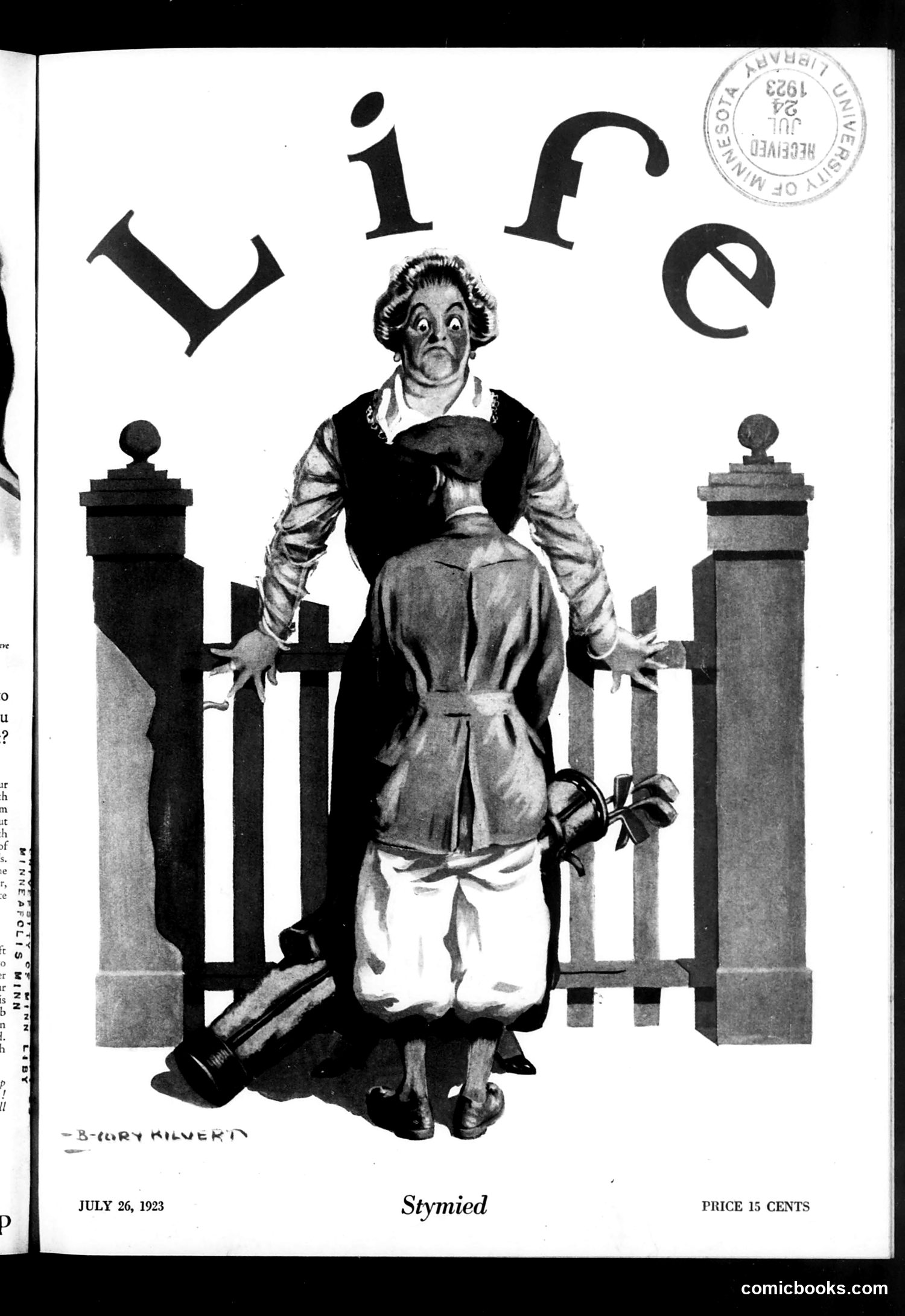
This cartoon depicts a woman at a gate, appearing frustrated or exasperated, with the word "LIFE" spelled above her in large letters. The gate pillars and her body language suggest she is blocked or trapped. The title "Stymied" (a golf term meaning obstructed) indicates the subject is being prevented from achieving something. Given the 1923 date and the prominent female figure, this likely relates to women's social or legal restrictions of that era—possibly reproductive rights, marriage laws, or other gender-based limitations. The gate represents an obstacle or barrier. The woman's expression conveys frustration at being unable to proceed with desired activities or choices. Without additional context, the specific issue remains unclear, but the cartoon critiques restrictions imposed on women's freedom or autonomy.
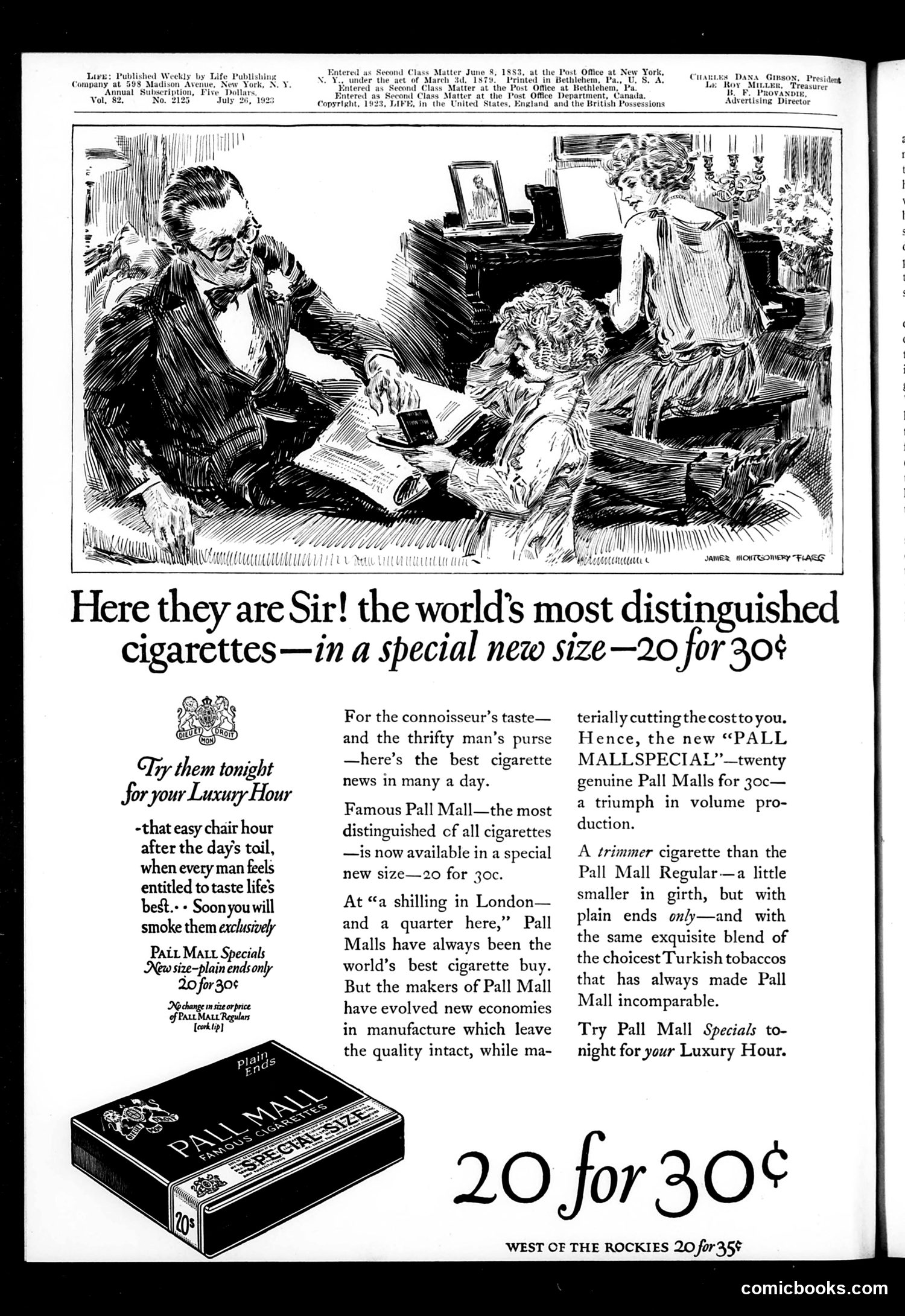
This is primarily a **cigarette advertisement** for Pall Mall Specials, not political satire. The illustrated scene shows a man and woman examining cigarettes in what appears to be a well-furnished home, with a piano visible in the background. The advertisement emphasizes luxury and affordability: Pall Mall cigarettes—described as "the world's most distinguished"—are now available in a smaller "Special" format at 20 cigarettes for 30 cents, undercutting the regular price. The copy targets both "the connoisseur's taste" and "the thrifty man's purse." The tagline "Try them tonight for your Luxury Hour" frames smoking as an aspirational leisure activity. This reflects 1920s advertising conventions normalizing cigarettes as sophisticated consumer goods for relaxation.
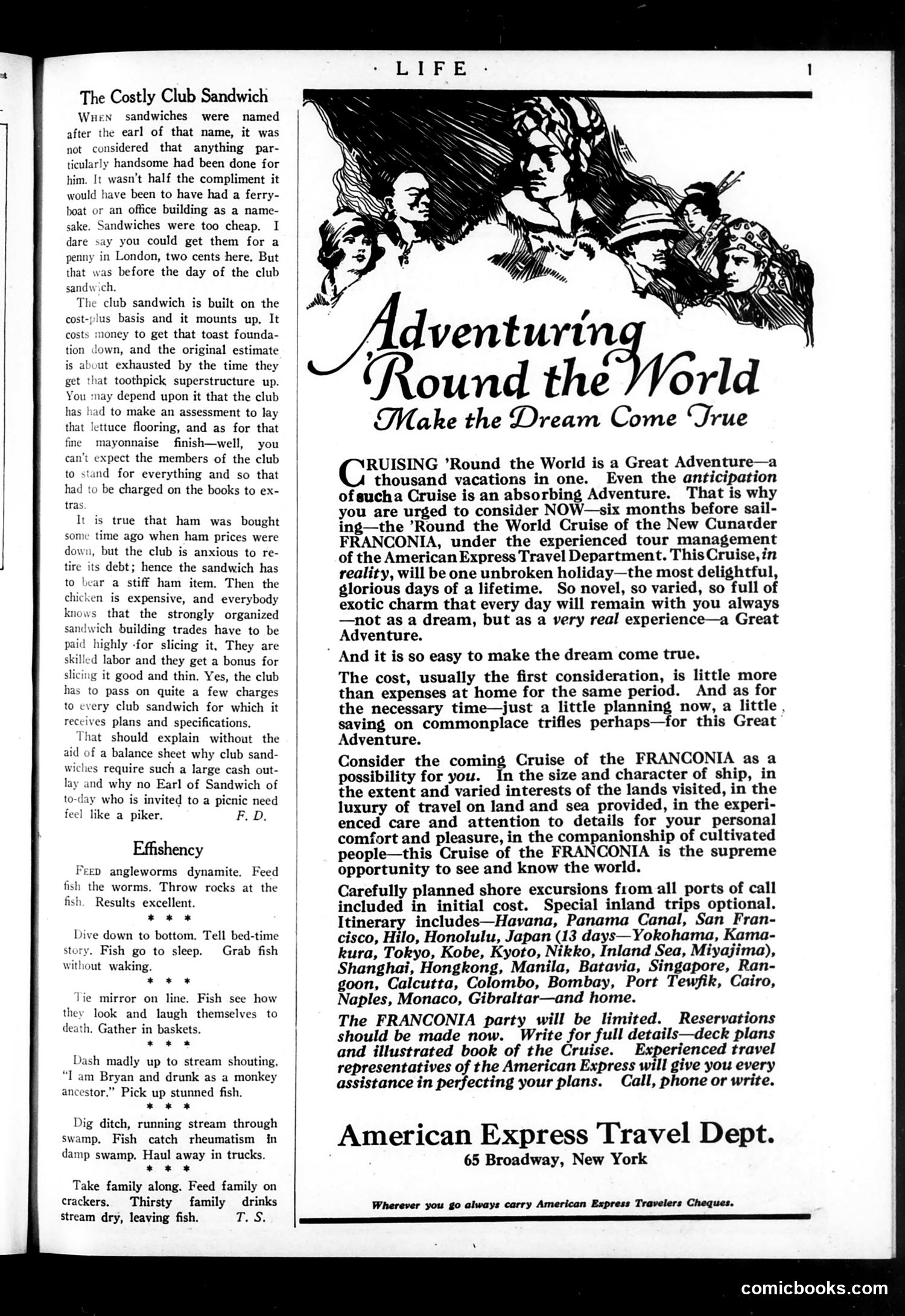
This page contains two distinct sections: **Left Column:** A satirical essay titled "The Costly Club Sandwich" critiques the economics of club sandwiches. The author notes that despite sandwiches' historical reputation as cheap food, exclusive clubs charge premium prices for them. The essay humorously argues this reflects the club's need to justify membership costs through expensive food—essentially claiming members overpay for mediocre sandwiches as part of club prestige. The tone is light social satire about conspicuous consumption. **Right Side:** A large advertisement for the Franconia cruise ship's around-the-world voyage, promoted by American Express Travel Department. This occupies most of the page and is not satirical—it's straightforward advertising promoting luxury travel. The "Effishency" section contains brief humorous fishing tips, unrelated to the main content.
This page is **not a cartoon or satirical content** — it's a straightforward **advertisement for Phoenix Hosiery** from Milwaukee. The decorative ornamental borders frame promotional text emphasizing that Phoenix hosiery is "hand-finished," which the ad claims gives it superior durability and beauty compared to mass-produced alternatives. The copy appeals to quality-conscious consumers by arguing that human craftsmanship — specifically hand-finishing — extends the product's lifespan and maintains its appearance through wear. The ad positions Phoenix as "the standard hosiery of the world" and the "best selling line" across retail markets for all demographics (men, women, children). There is no satire or political commentary present — this is commercial advertising typical of early 20th-century magazine content.
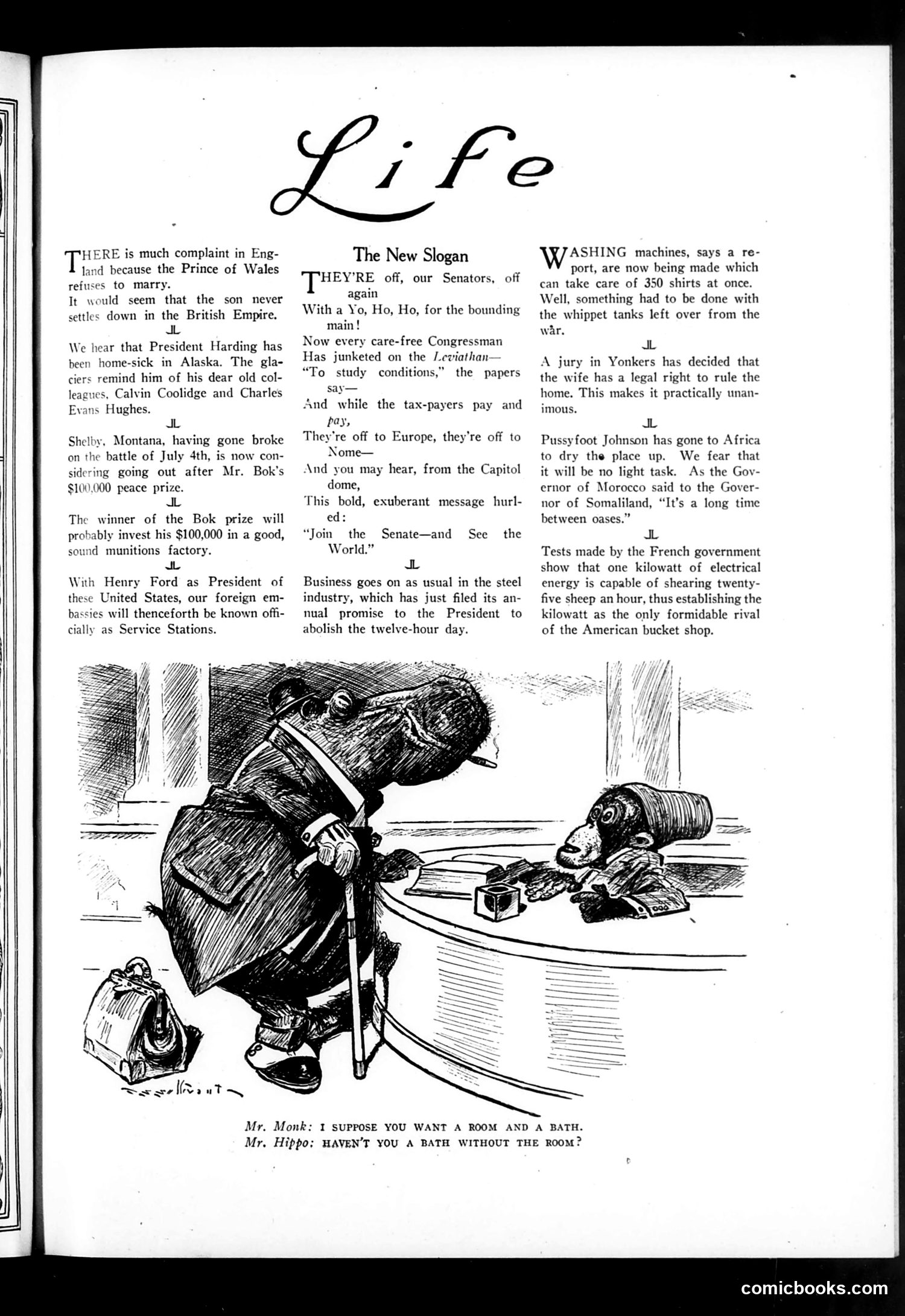
The main cartoon depicts two anthropomorphic animals (a monk and a hippo) discussing lodging accommodations. The monk states he wants "a room and a bath," to which the hippo replies "haven't you a bath without the room?" This appears to be satirizing post-WWI housing scarcity or luxury accommodations pricing—a common complaint during the 1920s when housing was expensive relative to wages. The surrounding text contains brief political commentary, including jabs at President Harding's homesickness in Alaska, Congressional trips to Europe, and the abolition of the twelve-hour workday in steel industries. These items reflect typical Life magazine satire of early 1920s American politics and business practices, critiquing government spending and labor disputes of the era.
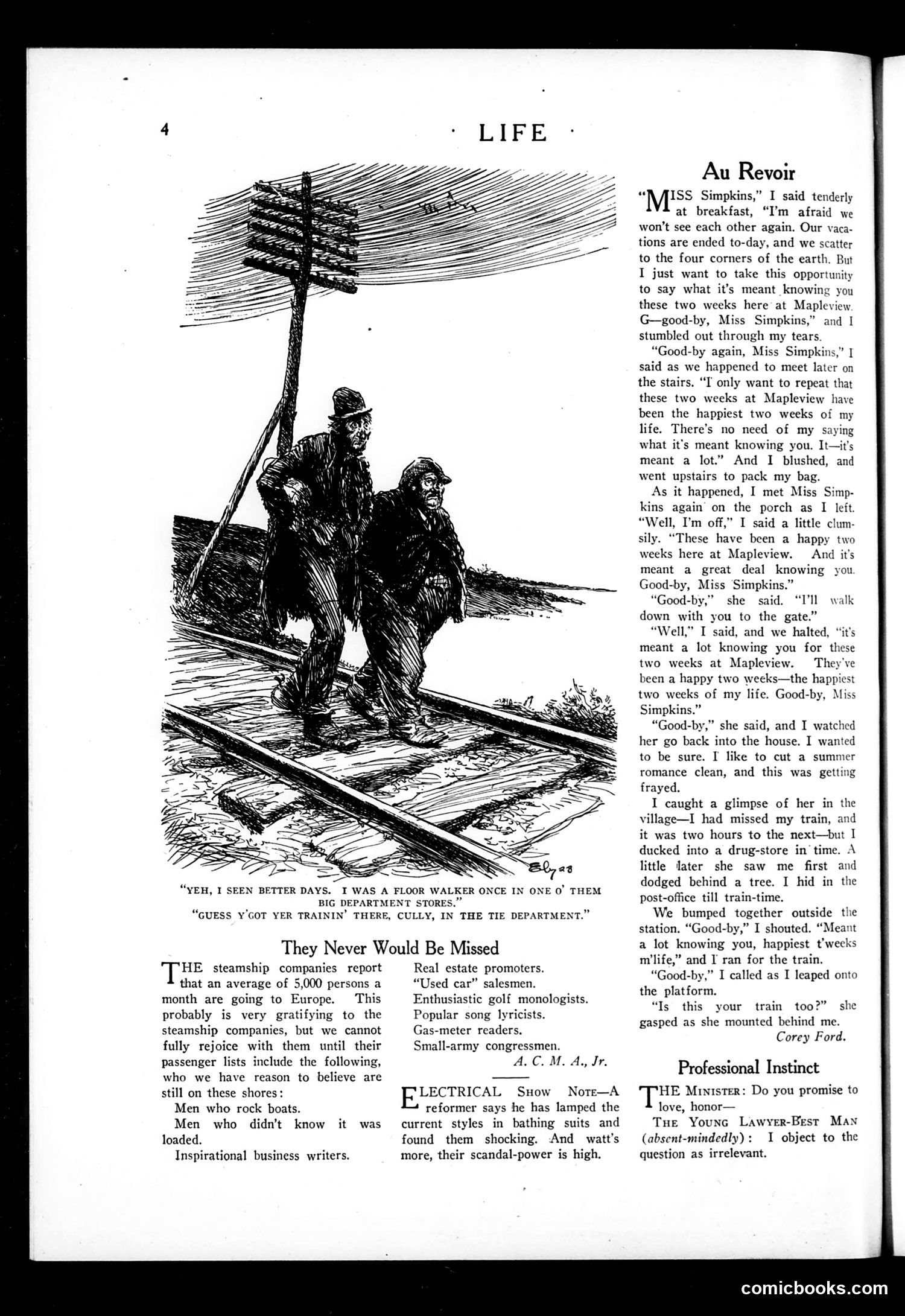
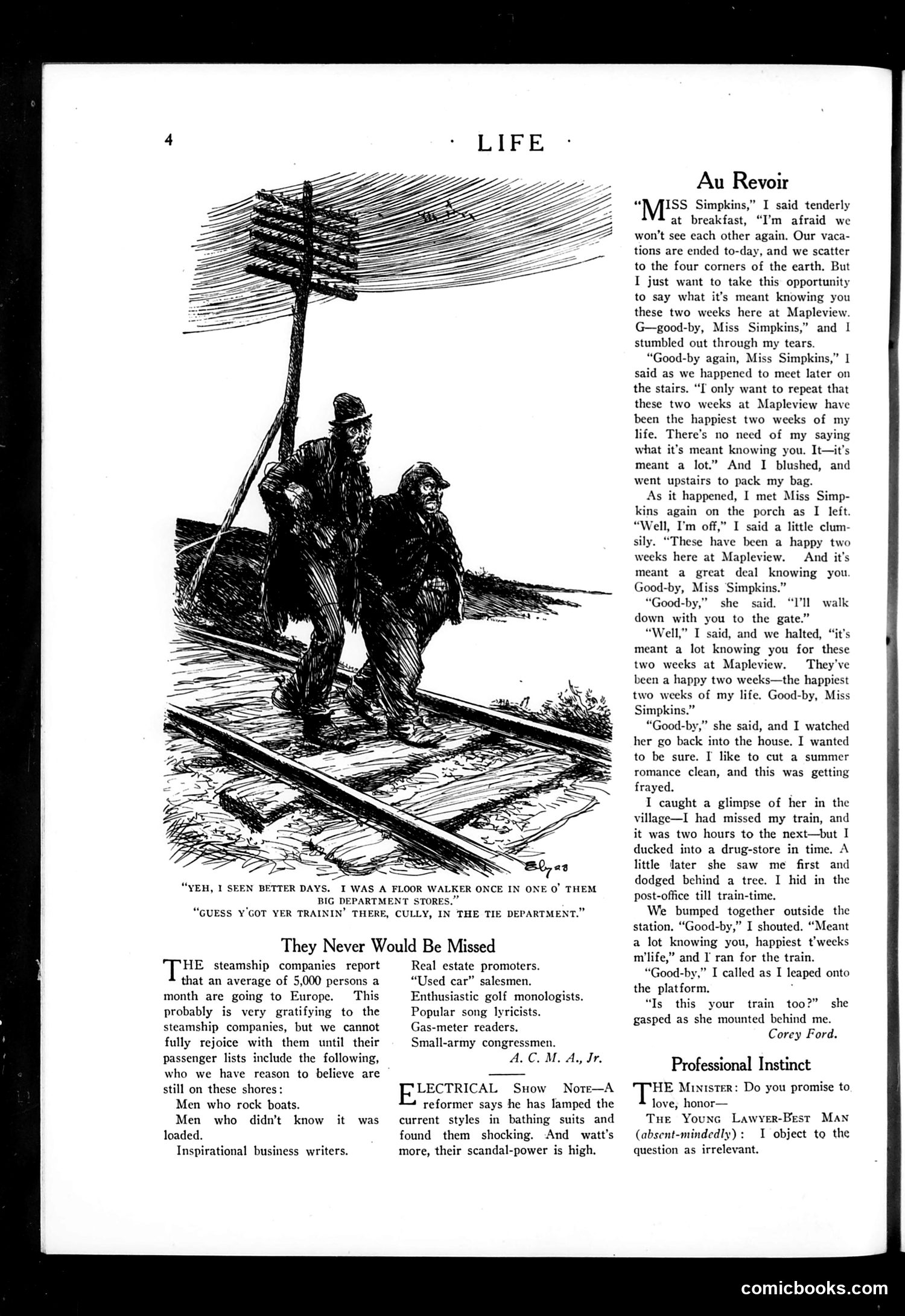
The main cartoon depicts two men in working-class attire standing beside railroad tracks, with one holding a pole or signal device. The caption reads: "YEH, I SEEN BETTER DAYS. I WAS A FLOOR WALKER ONCE IN ONE O' THEM BIG DEPARTMENT STORES" / "GUESS Y'GOT YER TRANSFER THERE, CURLY, IN THE TIE DEPARTMENT." This satirizes economic decline during what appears to be the Great Depression era. The joke portrays a former department store employee (a "floor walker"—a supervisory retail position) now reduced to railroad work. The "tie department" pun darkly suggests either railroad ties or suicide by hanging, mocking the desperation of unemployment and downward mobility that many Americans experienced during economic hardship.
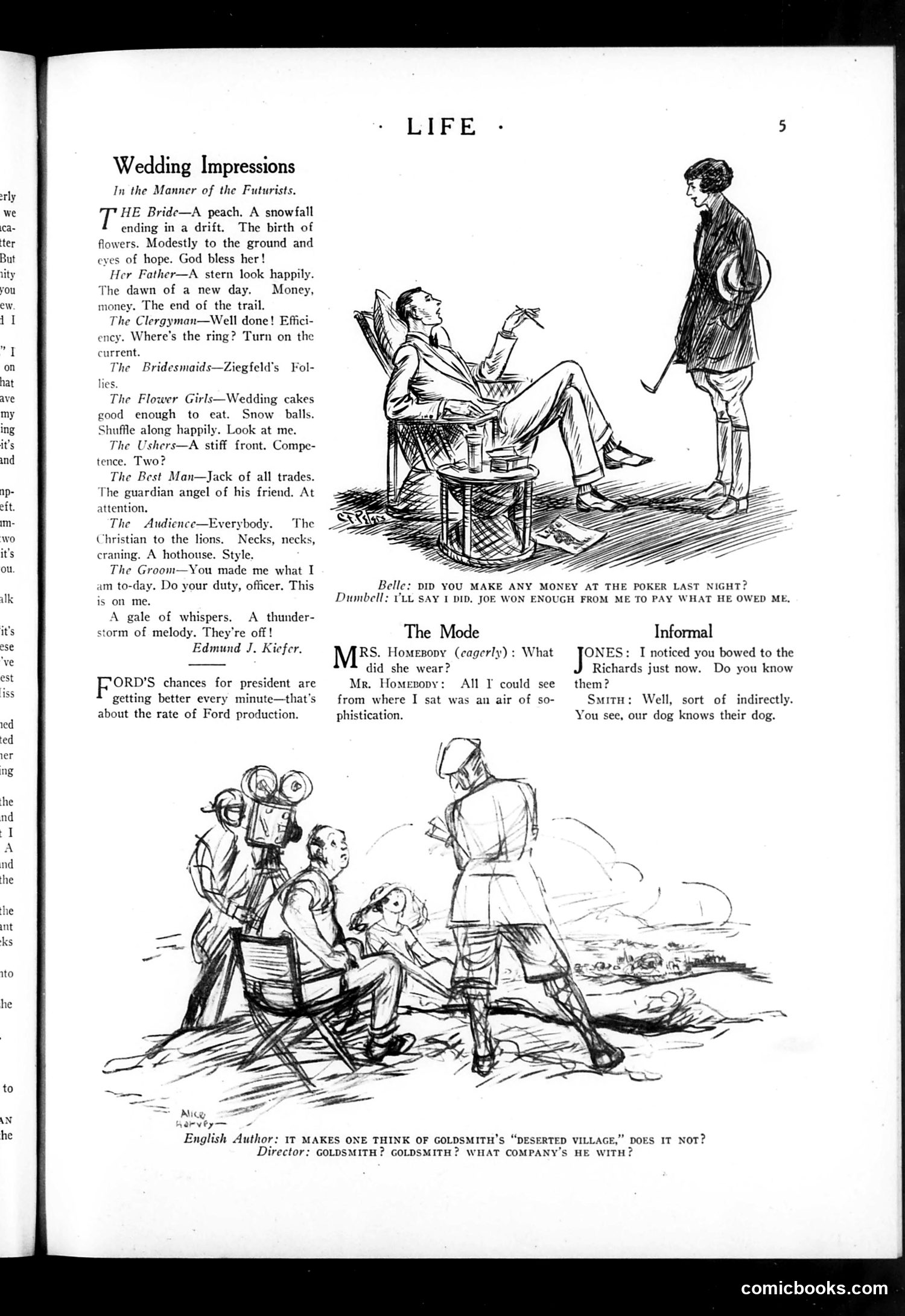
The top section satirizes wedding participants through exaggerated character sketches—the bride as fragile ("peach"), the father stern, the clergyman focused on efficiency, bridesmaids as decoration, and the best man as Jack-of-all-trades. The humor mocks social pretense and rigid wedding roles. The upper cartoon shows a man at leisure asking "Did you make any money at the poker last night?" with the response about winning enough to pay what he owed—satirizing men's gambling habits and financial irresponsibility. The lower cartoon depicts a film director (labeled "GOLDSMITH") shooting a scene with actors and children outdoors, likely mocking early cinema production practices or specific contemporary films. The dialogue jokes about the artificial nature of filmmaking.
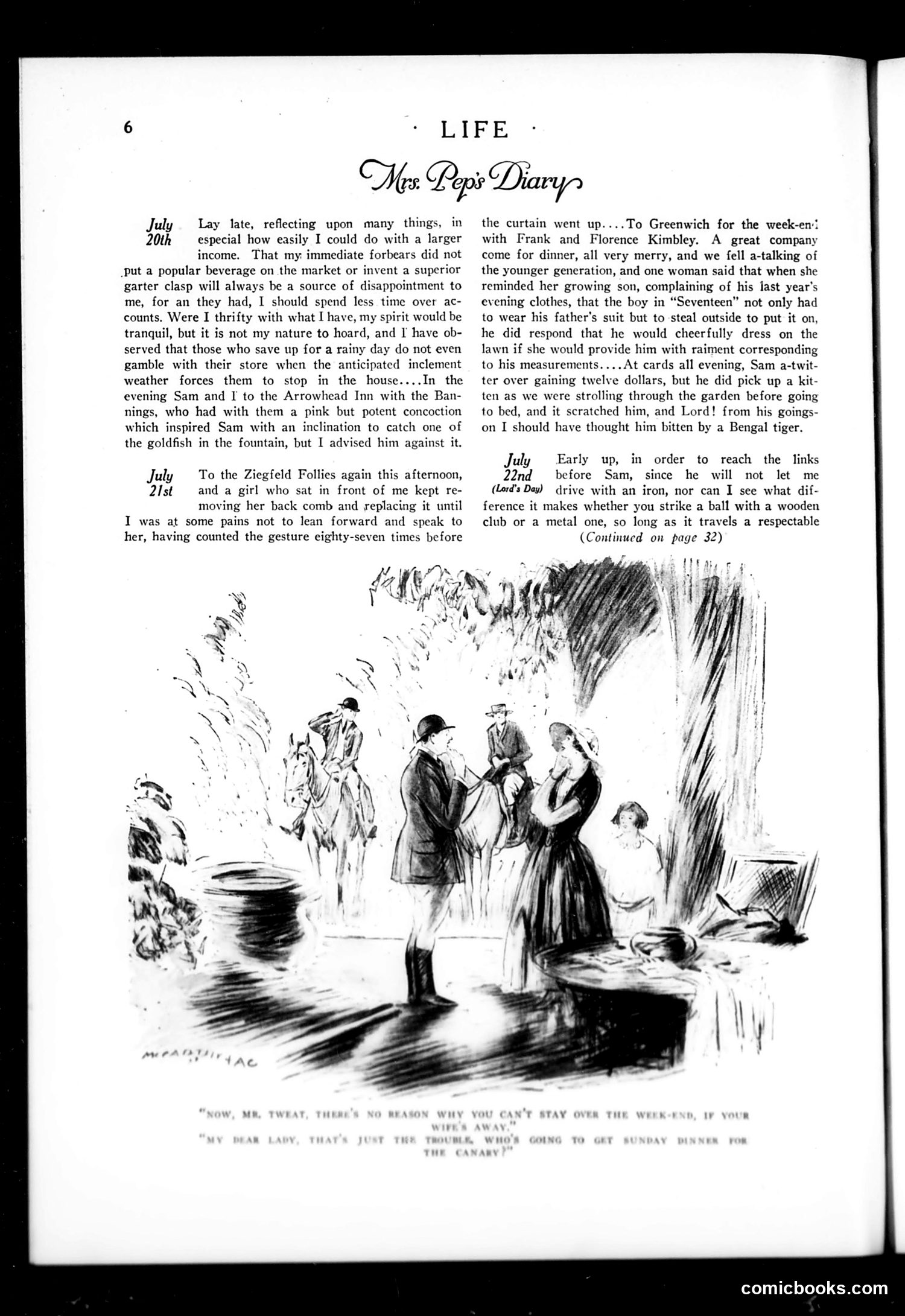
This page from *Life* magazine presents "Mrs. Peps Diary," a domestic humor column mocking upper-middle-class social anxieties. The diary entries describe trivial concerns: anxiety over modest income, complaints about household help and fashions, and petty social drama at the Ziegfeld Follies and golf outings. The accompanying cartoon satirizes marital dynamics. A husband tells his wife there's "no reason why you can't stay over the week-end, if your wife's away"—a sexually suggestive double entendre about infidelity. The wife responds tartly about getting "Sunday dinner for the canary," implying the husband's priorities are absurdly misplaced. The satire targets the self-absorbed concerns and marital tensions of affluent leisure-class couples.
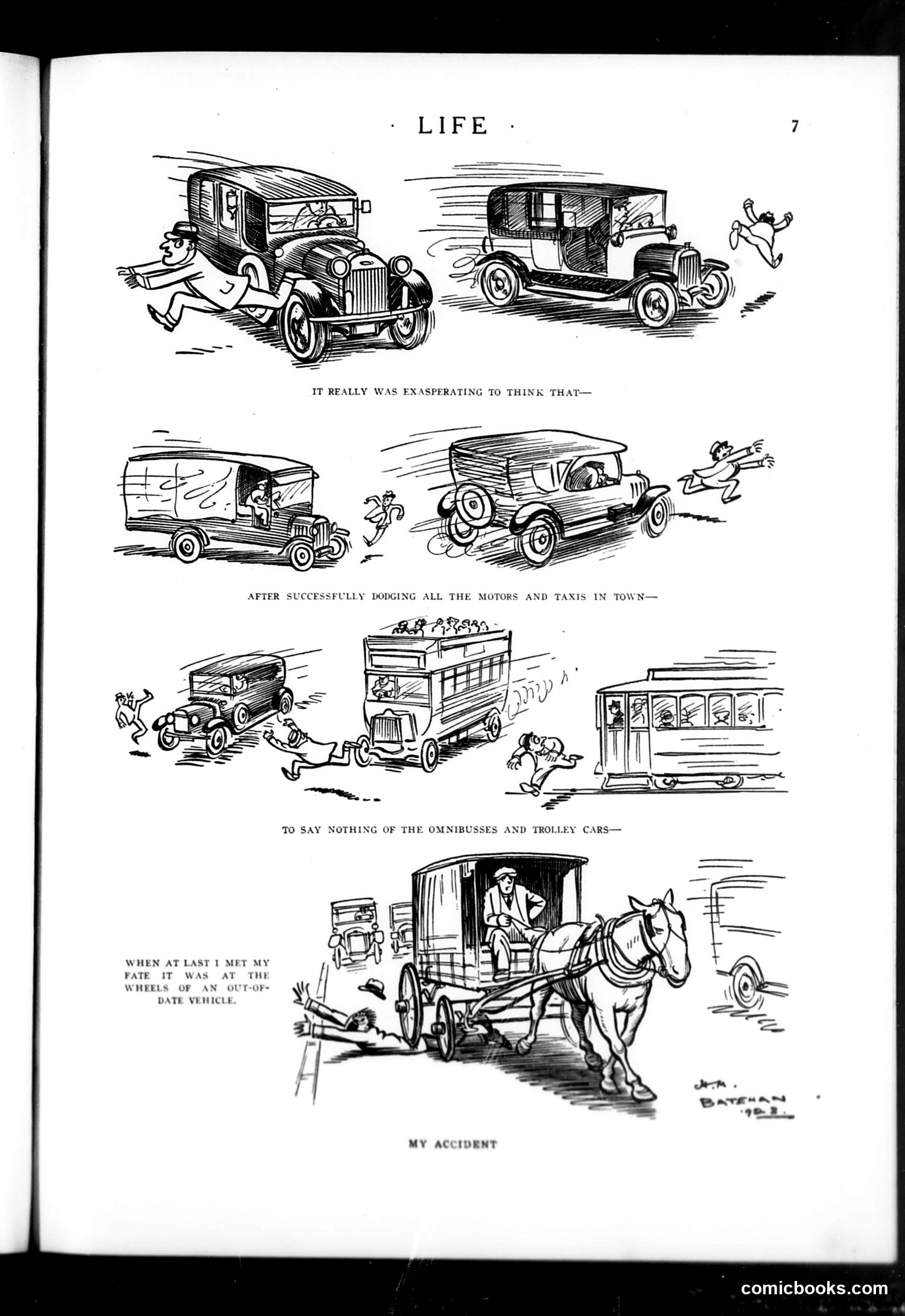
This is a humorous comic about urban traffic dangers in the early automobile era. The narrative progresses through six panels showing a pedestrian's increasingly frantic attempts to cross a busy city street while dodging various vehicles—motorcars, taxis, omnibuses, and trolley cars. The joke culminates with the narrator finally meeting his wife "at the wheels of an out-of-date vehicle": a horse-drawn cart. The satire mocks the chaotic, dangerous conditions of modern city traffic, where traditional horse transport has become the safest option by comparison. The cartoon reflects anxieties about rapid motorization and urban congestion in the 1920s-1930s period when automobiles were still relatively new. The ironic punchline suggests that old-fashioned horse transport is paradoxically safer than all the "modern" motorized alternatives crowding city streets.
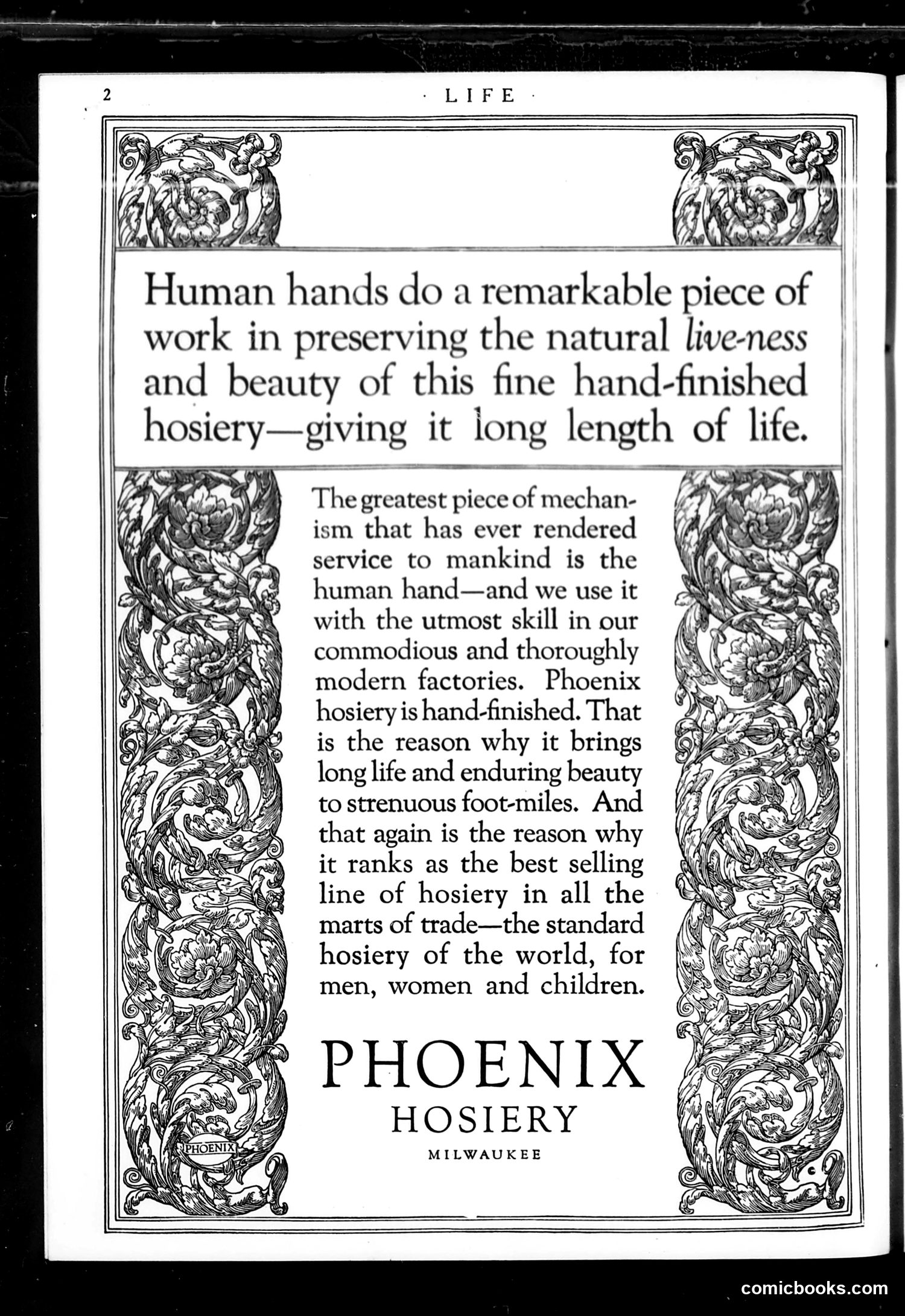
This is a **full-page advertisement** for Phoenix Hosiery (a Milwaukee company), not editorial satire or political cartoon content. The page uses ornate decorative borders typical of early 20th-century advertising design. The text promotes Phoenix hosiery as superior because it is "hand-finished" in modern factories, claiming this craftsmanship gives it durability and beauty. The ad emphasizes that human skill—"the greatest piece of mechanism that has ever rendered service to mankind"—combined with factory production creates the "standard hosiery of the world." There is **no political satire or cartoon here**. This appears to be a straightforward product advertisement leveraging contemporary values around craftsmanship, quality, and the modernization of manufacturing.
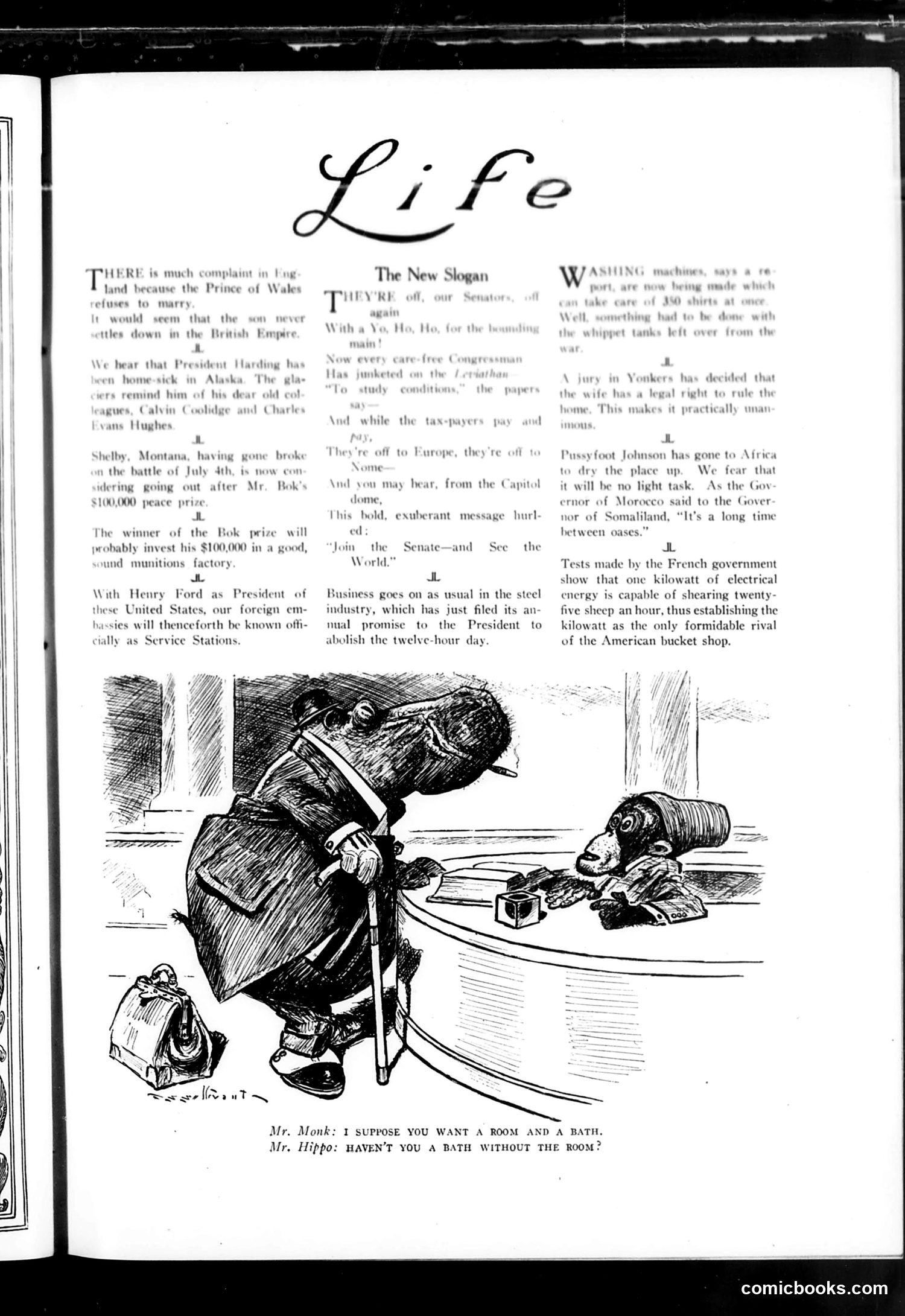
The cartoon depicts two figures in what appears to be a bathroom negotiation. The larger figure (labeled "Mr. Monk") proposes wanting "a room and a bath," while the smaller figure (labeled "Mr. Hippo") responds "Haven't you a bath without the room?" This is likely satirizing real estate or housing disputes of the era—possibly referencing disputes between landlords and tenants, or conflicts over bathroom access and apartment configurations. The caricatured animals (a monk and hippo) suggest the absurdity of the argument itself. Without more historical context about who "Monk" and "Hippo" specifically reference, the cartoon's full satirical target remains unclear, though it appears to mock housing negotiations and unreasonable demands from both parties involved.
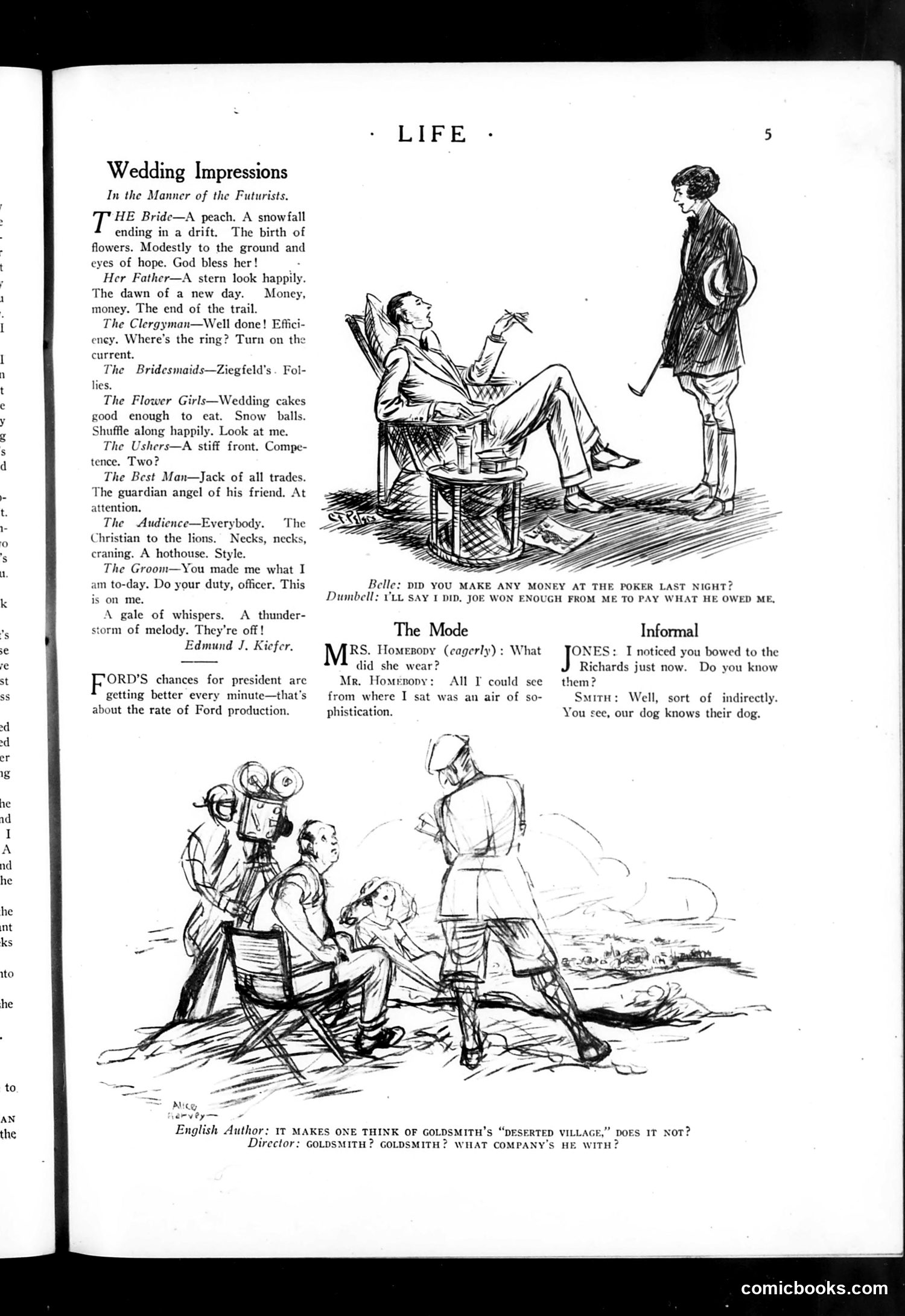
This page contains three satirical pieces from *Life* magazine: **"Wedding Impressions"** offers humorous character sketches of wedding attendees—the bride, father, clergyman, bridesmaids, etc.—each with cynical commentary. For example, the father has "a stern look happily. The dawn of a new day. Money. The end of the trail," satirizing paternal relief at marrying off a daughter. **"The Mode"** mocks fashion pretension through dialogue where Mrs. Homeboy describes her dress affectedly as having "an air of sophistication," though it's simply what she could afford. **The lower cartoon** depicts a film director shooting a movie scene outdoors, with text joking about Goldsmith's "Deserted Village"—suggesting the bustling film production ironically mimics abandonment. All pieces employ gentle social satire typical of early 20th-century *Life* magazine's humor targeting middle-class affectations and modern absurdities.
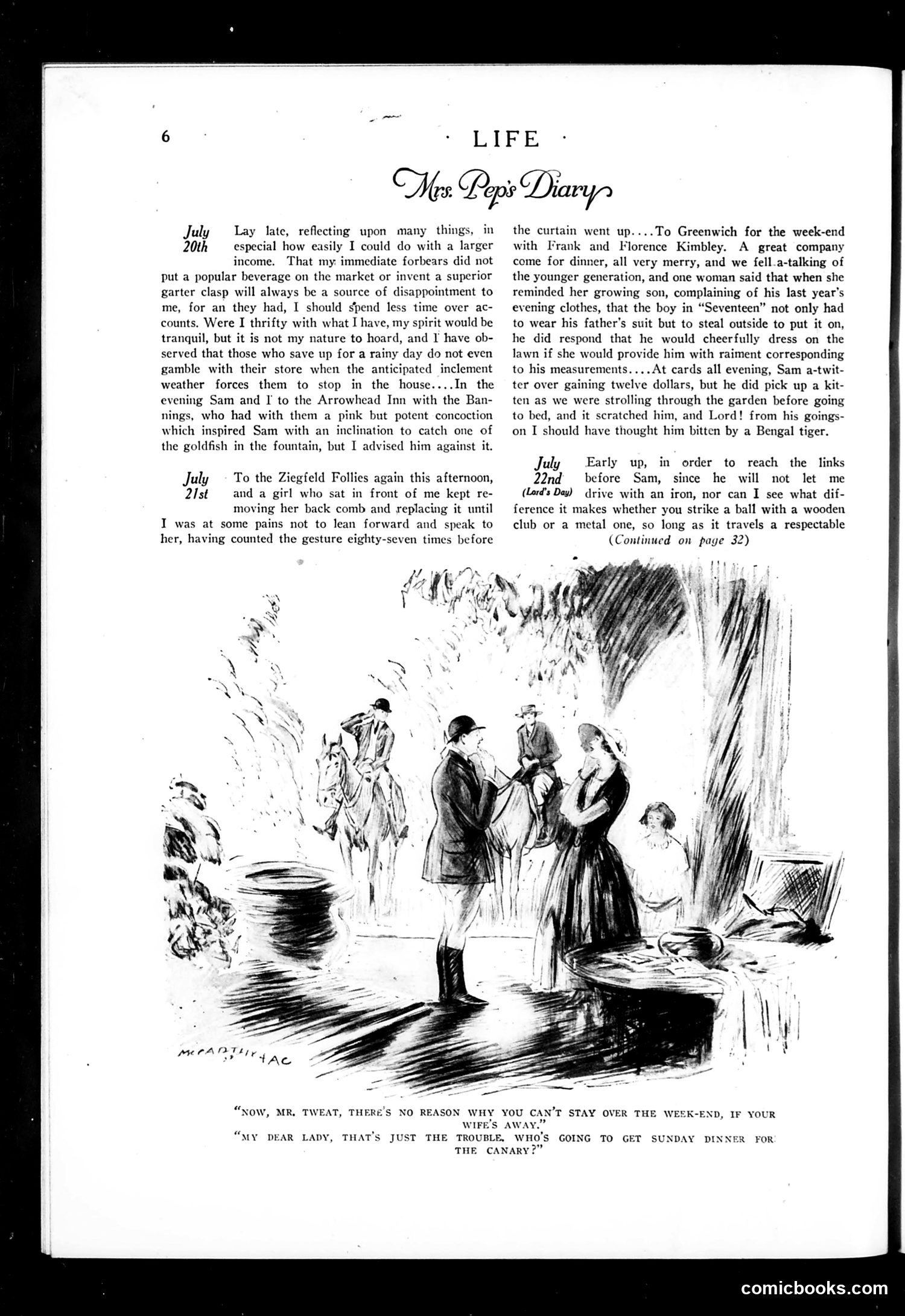
This page from Life magazine presents a humorous diary entry satirizing upper-middle-class social conventions and gender dynamics of the early 20th century. The cartoon illustrates a domestic dispute about weekend leisure. A man argues he should stay over the weekend, while a woman (his wife, presumably away) objects. The man counters that someone must stay home to prepare Sunday dinner—specifically for "the canary," humorously suggesting the wife's priorities are absurdly misplaced. The satire targets: wives' rigid domestic expectations, husbands' desire for recreational freedom (golf), and the petty household disputes that arise from these gendered roles. The canary reference mocks the woman's apparent concern with trivial domestic details over her husband's reasonable leisure time, reflecting contemporary anxieties about marriage and personal autonomy.
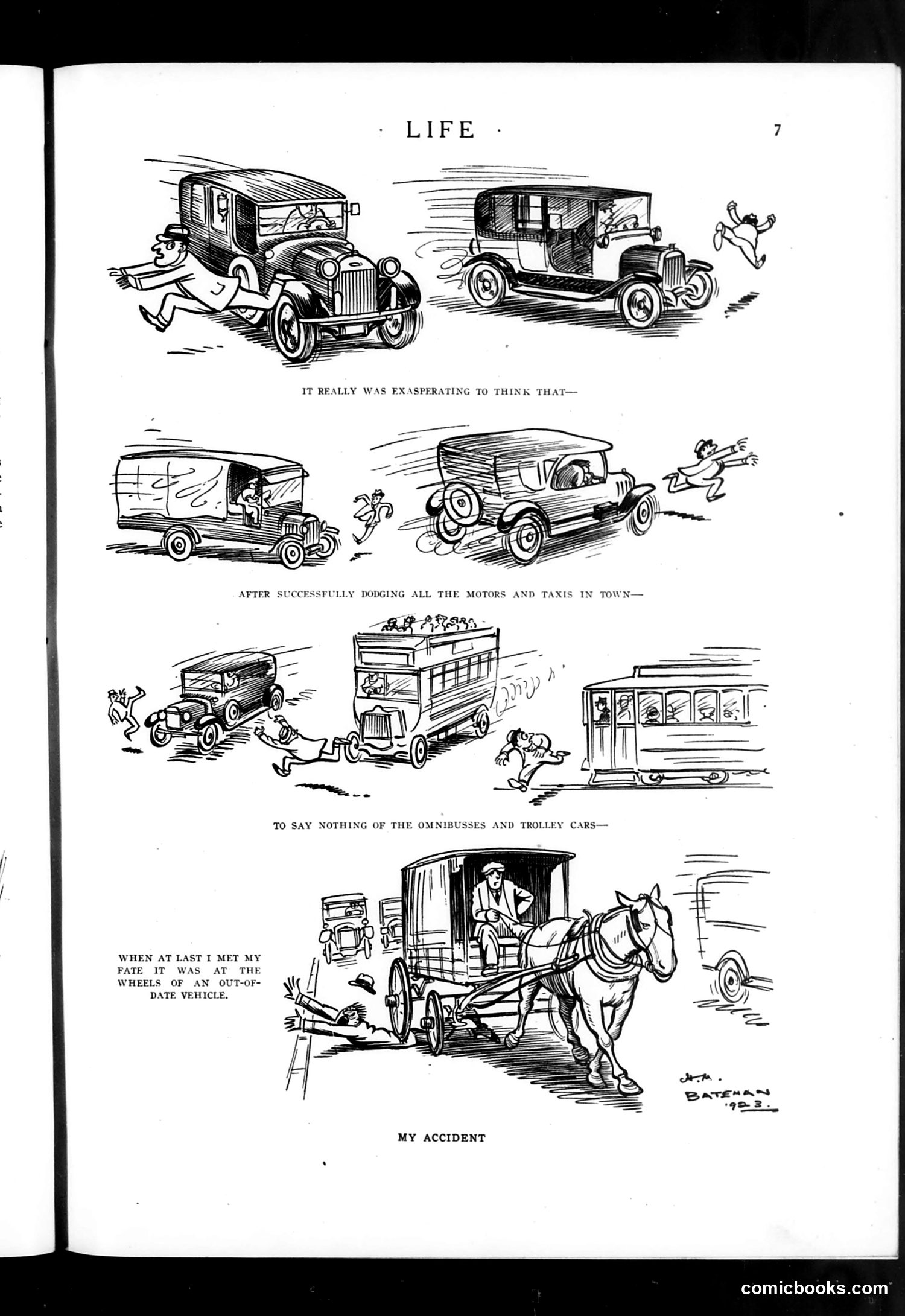
This is a humorous narrative cartoon satirizing traffic hazards in early 20th-century urban America. The comic depicts a pedestrian's increasingly frantic attempts to avoid various motorized vehicles—cars, taxis, buses, and trolleys—while navigating city streets. Each panel shows the narrator narrowly escaping collisions with different vehicle types, demonstrating the period's anxiety about rapid automobile proliferation and urban congestion. The punchline appears at bottom: having successfully dodged all modern motorized traffic, the narrator's "accident" finally occurs when hit by an old-fashioned horse-drawn carriage—the very vehicle becoming obsolete. This satirizes the irony of modern hazards making people forget traditional dangers, and likely mocks the rapid technological transition reshaping American cities during the automotive age.
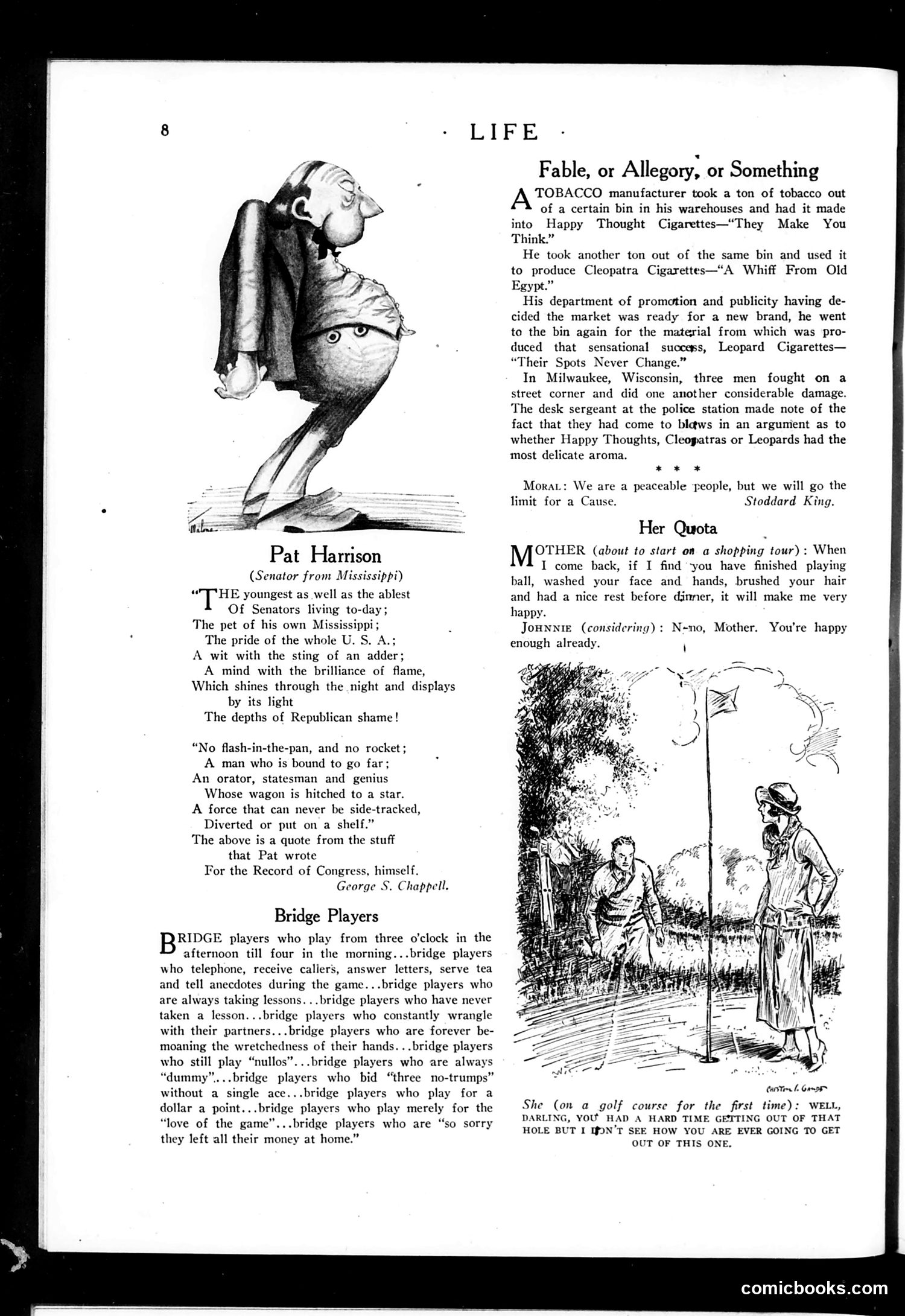
The main illustration shows **Pat Harrison**, identified as a Senator from Mississippi, depicted as a grotesque caricature in an exaggerated pose. The accompanying text praises him as "the youngest as well as ablest / Of Senators living to-day," calling him brilliant and witty. However, the cartoon's visual exaggeration—with distorted facial features and awkward posture—appears deliberately unflattering, suggesting **satirical mockery despite the praise**. This contradiction between the glowing written description and the unflattering image is the joke: the visual caricature undercuts the text's compliments, implying ironic criticism of Harrison's actual abilities or character. The satire works through this disconnect between words and image.
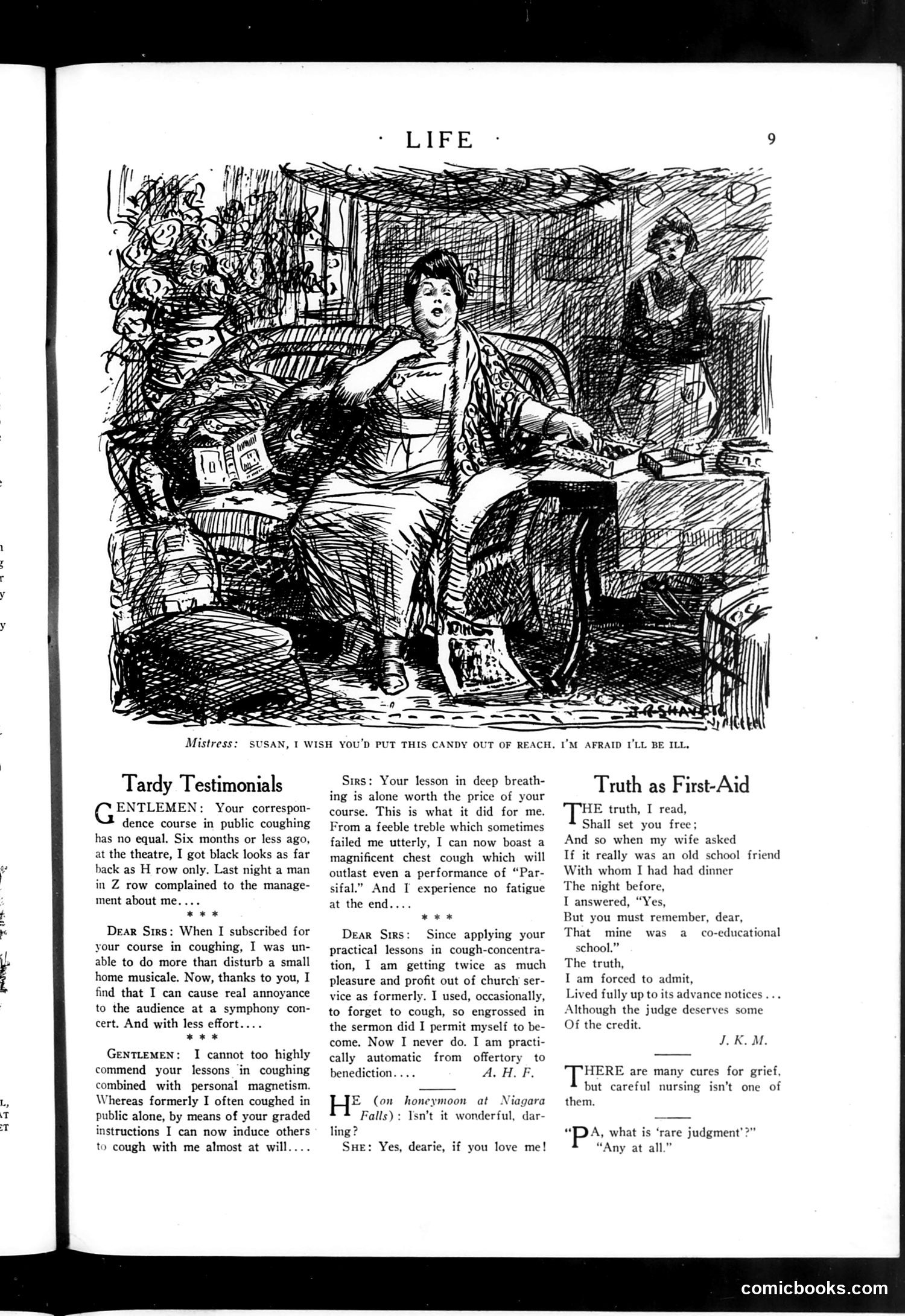
This page contains satirical humor pieces typical of early 20th-century Life magazine. **"Tardy Testimonials"** mocks a fake "correspondence course in public coughing." Testimonials praise increasingly disruptive coughing abilities—from disturbing distant theater rows to causing synchronized group coughing at symphonies and church services. The satire targets both theatrical etiquette violations (chronic audience coughing was apparently a real social problem) and the era's proliferation of dubious mail-order self-improvement courses. **The cartoon** depicts a woman on a couch complaining to her maid about candy, seemingly concerned about overeating. **"Truth as First-Aid"** presents a brief anecdote where a man admits his dinner companion was a "co-educational school friend"—a euphemistic confession implying infidelity. The joke mocks his attempt to use literal honesty as a shield while technically admitting wrongdoing. The final joke about "rare judgment" suggests such honesty is uncommon. The page satirizes social hypocrisy, consumer culture gullibility, and marital dishonesty through light humor.
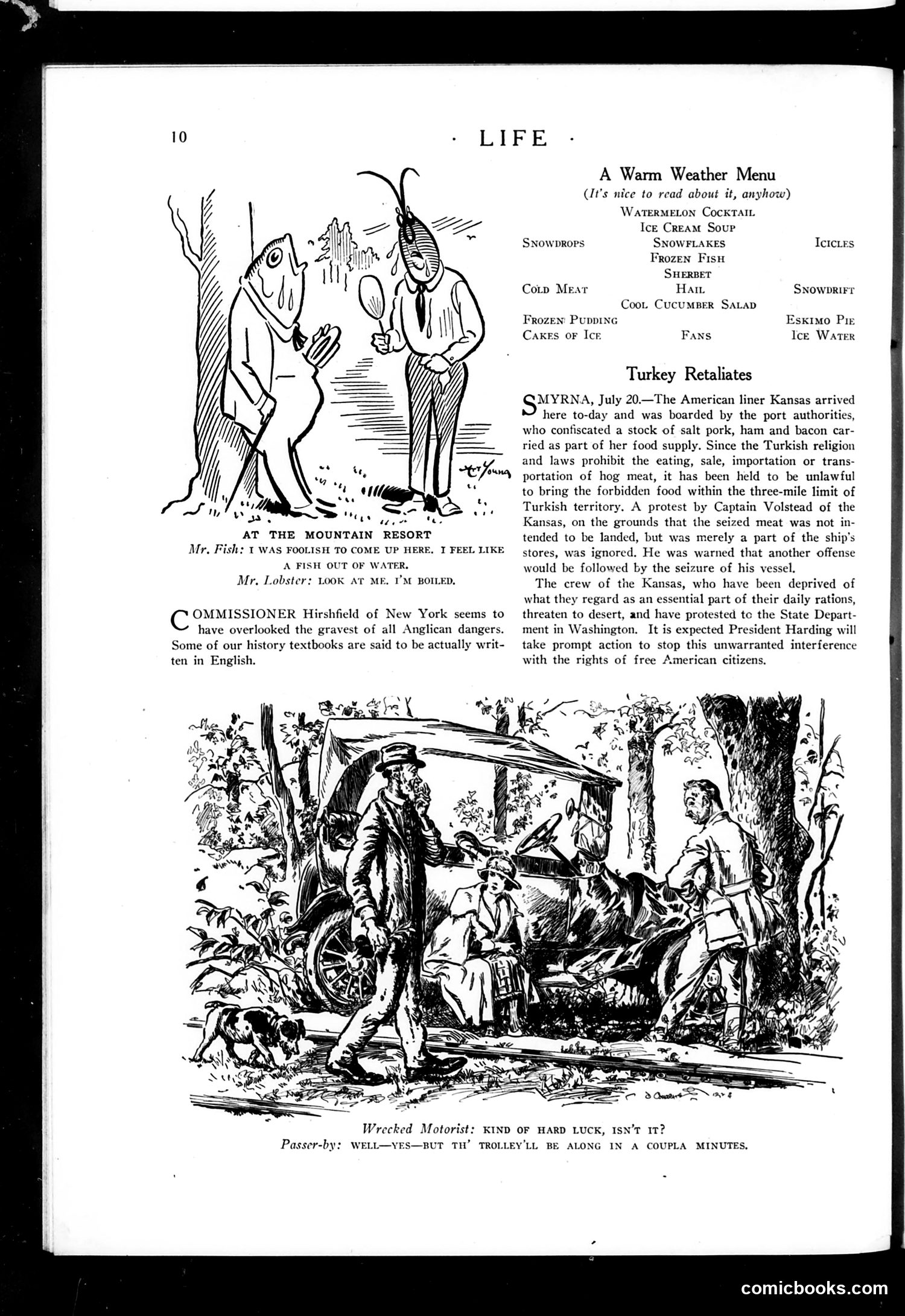
**Top Cartoon**: Two men at a mountain resort complain about discomfort—a fish feels out of water, a lobster jokes he's "boiled." This is simple wordplay humor with no political content. **Middle Section**: A brief jab at Commissioner Hirshfield of New York, sarcastically suggesting he overlooked a grave "Anglican danger"—that history textbooks are "actually written in English." This mocks either Hirshfield's oversight or uses absurdist humor to critique educational standards. **"Turkey Retaliates" Article**: Reports the U.S. liner *Kansas* had salt pork confiscated by Turkish authorities in port, as Islamic law prohibits pork. The piece presents this as an affront to American sailors and their "rights," with implicit expectation that President Harding will intervene. It satirizes American exceptionalism—the notion that U.S. citizens' dietary preferences supersede host nations' laws. **Bottom Cartoon**: A wrecked motorist asks a passerby about his bad luck; the passerby responds that a trolley will arrive soon—dark humor suggesting the motorist faces imminent death.
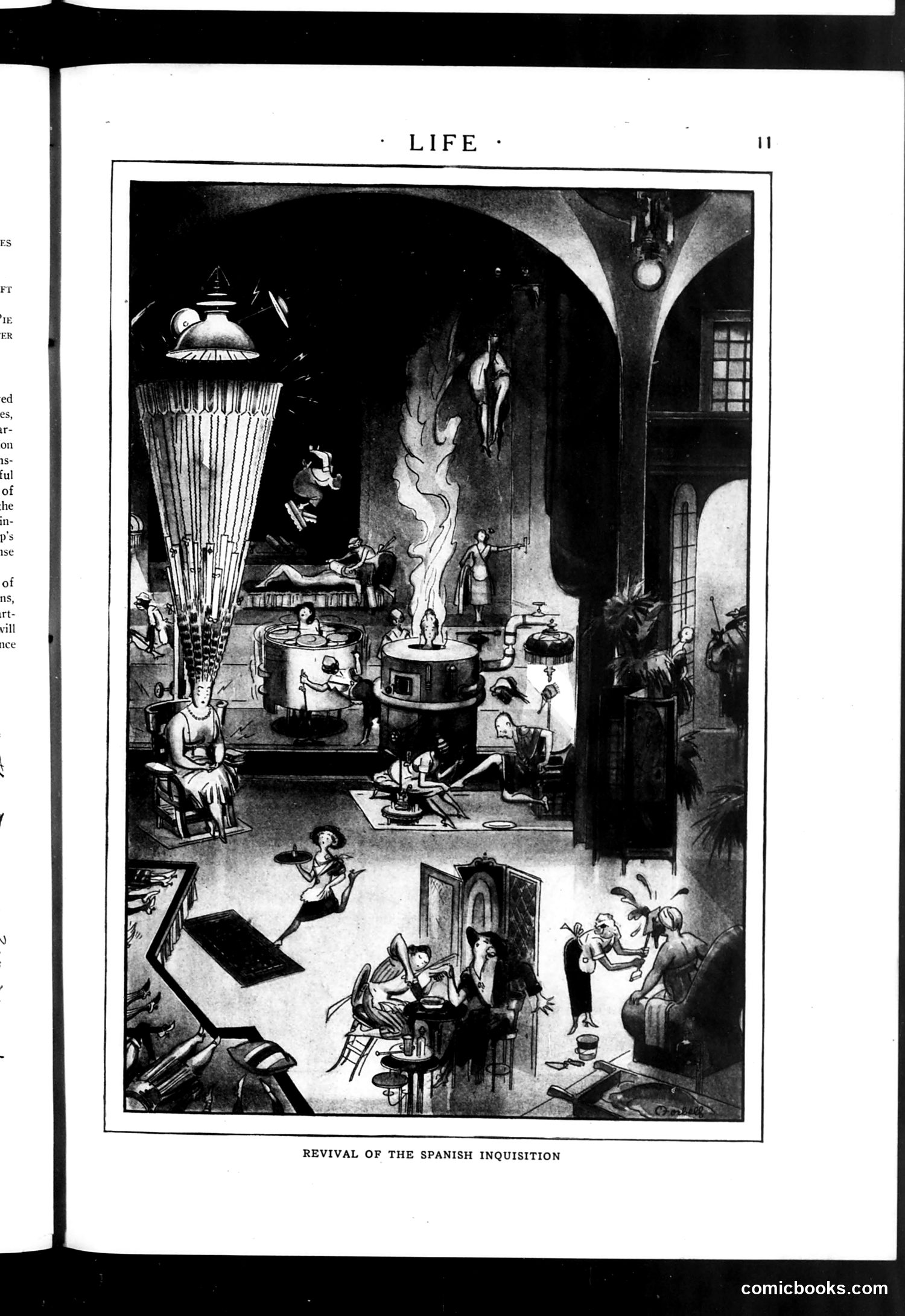
This satirical illustration depicts a dark, cavernous medieval chamber filled with torture implements and suffering figures. The caption "Revival of the Spanish Inquisition" suggests the cartoonist is using historical atrocities as metaphor for contemporary events. Without additional context or visible dates, the specific target remains unclear—it could reference fascist Spain under Franco, religious persecution, or authoritarian practices the magazine wished to condemn. The imagery of the Spanish Inquisition (15th-17th century religious persecution) was commonly invoked in American satire to critique oppression. The elaborate torture devices and writhing victims create visceral commentary on whatever modern practice the cartoonist equated with medieval cruelty. The work appears designed to shock readers into recognizing present injustice through historical parallel.
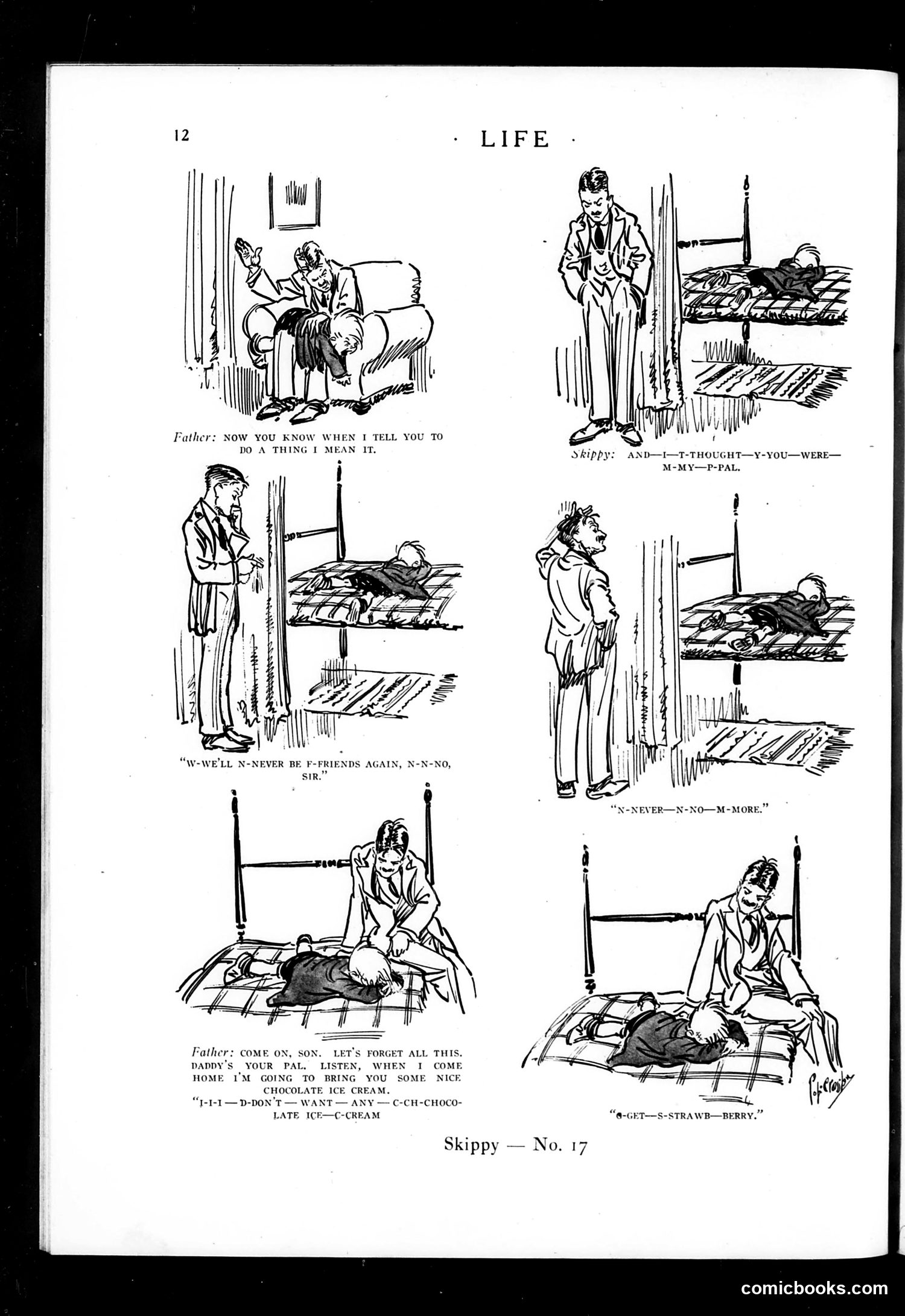
This is "Skippy," a popular children's comic strip from Life magazine. The strip depicts a father-son reconciliation sequence: A father disciplines his young son Skippy after misbehavior, warning him about obedience. Skippy responds tearfully that he thought they were pals. The father, moved by guilt, attempts reconciliation by offering treats (ice cream and strawberries) as peace offerings. The humor derives from the father's transparent emotional manipulation—he contradicts his stern disciplinary stance within moments, bribing the child with sweets rather than maintaining consistent authority. The exaggerated stammering and crying in the dialogue emphasizes the melodrama of the domestic conflict and quick reversal. This satirizes early 20th-century parenting: fathers' difficulty maintaining authority, their susceptibility to children's emotional appeals, and the era's casual use of food rewards for behavioral management. The strip gently mocks both rigid paternal discipline and its rapid abandonment.
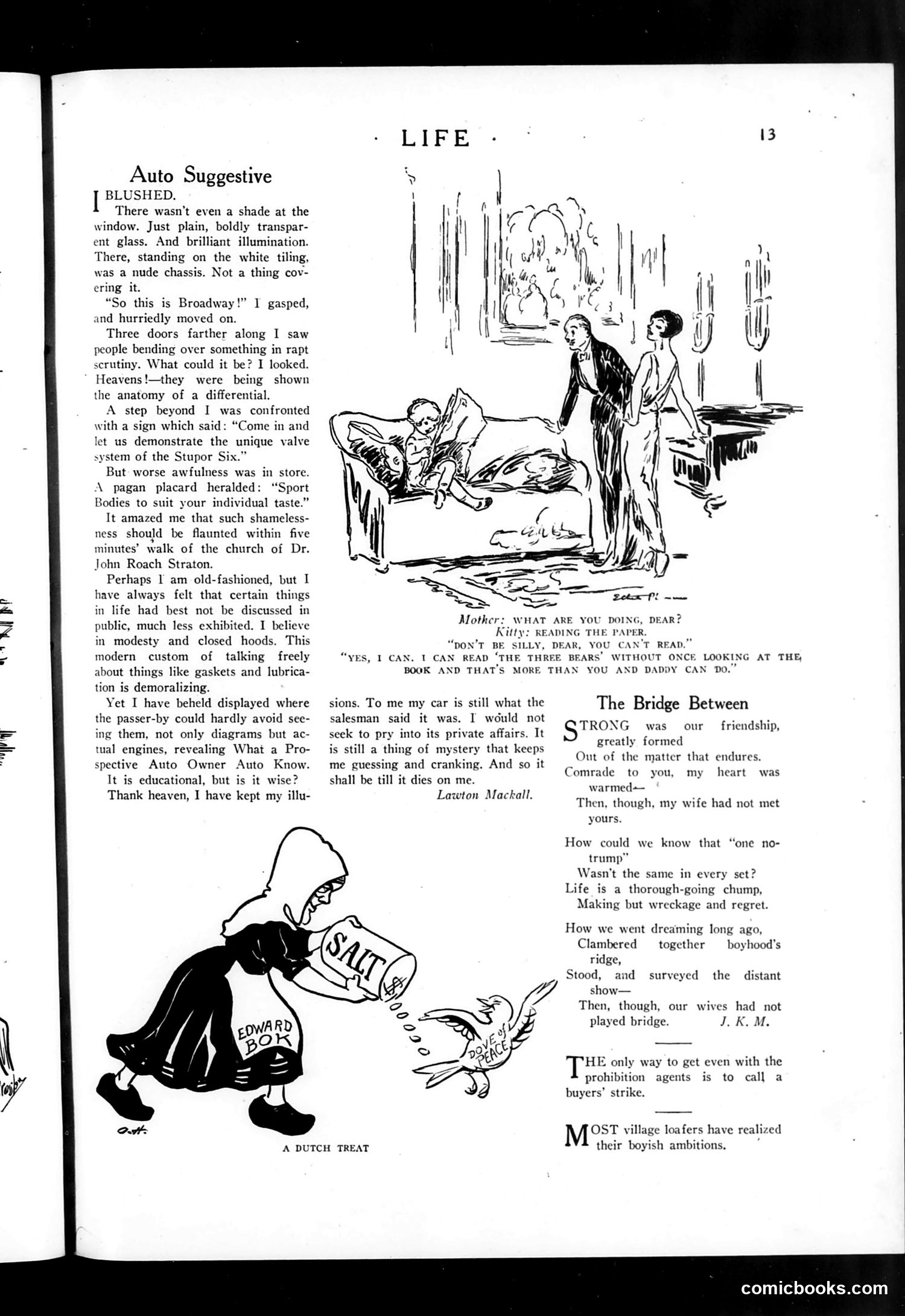
This page contains two distinct pieces satirizing early 20th-century American social attitudes. **"Auto Suggestive"** mocks puritanical prudishness about automobiles. The author feigns shock that car dealerships openly display mechanical parts—"nude chassis," differentials, valve systems—near churches (specifically referencing Dr. John Roach Straton, a real NYC fundamentalist minister). The satire targets those who believe technical automotive discussion is "demoralizing" and immodest. The joke is that these people treat car mechanics with the same scandal they'd reserve for actual impropriety. **"A Dutch Treat"** cartoon depicts someone (labeled "EDWARD BORK") salting a bird, satirizing Prohibition-era circumvention—likely referencing alcohol smuggling or black-market dealings hidden under innocent pretenses. **"The Bridge Between"** is a poem about friendship undermined when wives don't get along—specifically can't play bridge together, a popular social game. It's a gentle commentary on how marriages complicate male friendships. The page reflects 1920s anxieties: automotive modernity versus moral conservatism, Prohibition enforcement, and changing social dynamics.
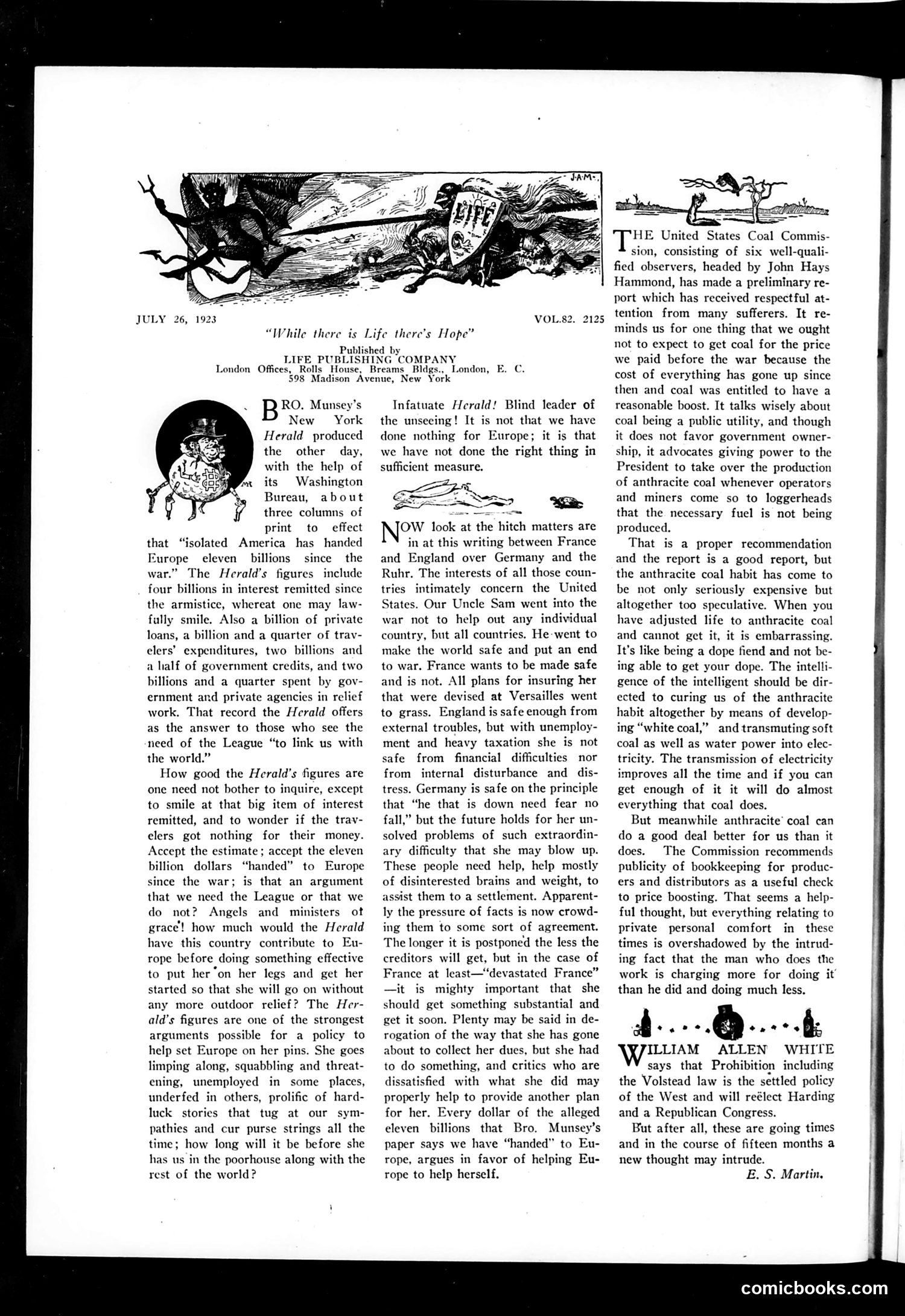
This page from *Life* magazine satirizes the *New York Herald*'s claim that America has "handed" Europe eleven billion dollars since World War I. The author argues the Herald uses this figure to question whether the U.S. needs the League of Nations—implying we've already done enough. The satire's point: the Herald misses the real issue. America's aid hasn't solved Europe's fundamental problems. France remains economically devastated, England faces unemployment and taxation crises, and Germany's instability threatens regional peace. The editorial argues that merely dispensing money without addressing these deeper structural issues is throwing good money after bad—eventually dragging America into "the poorhouse." The cartoon's opening image (left) appears to show Europe as a sinking, desperate figure, reinforcing this bleak assessment of the continent's post-war condition and America's ineffective charitable response.
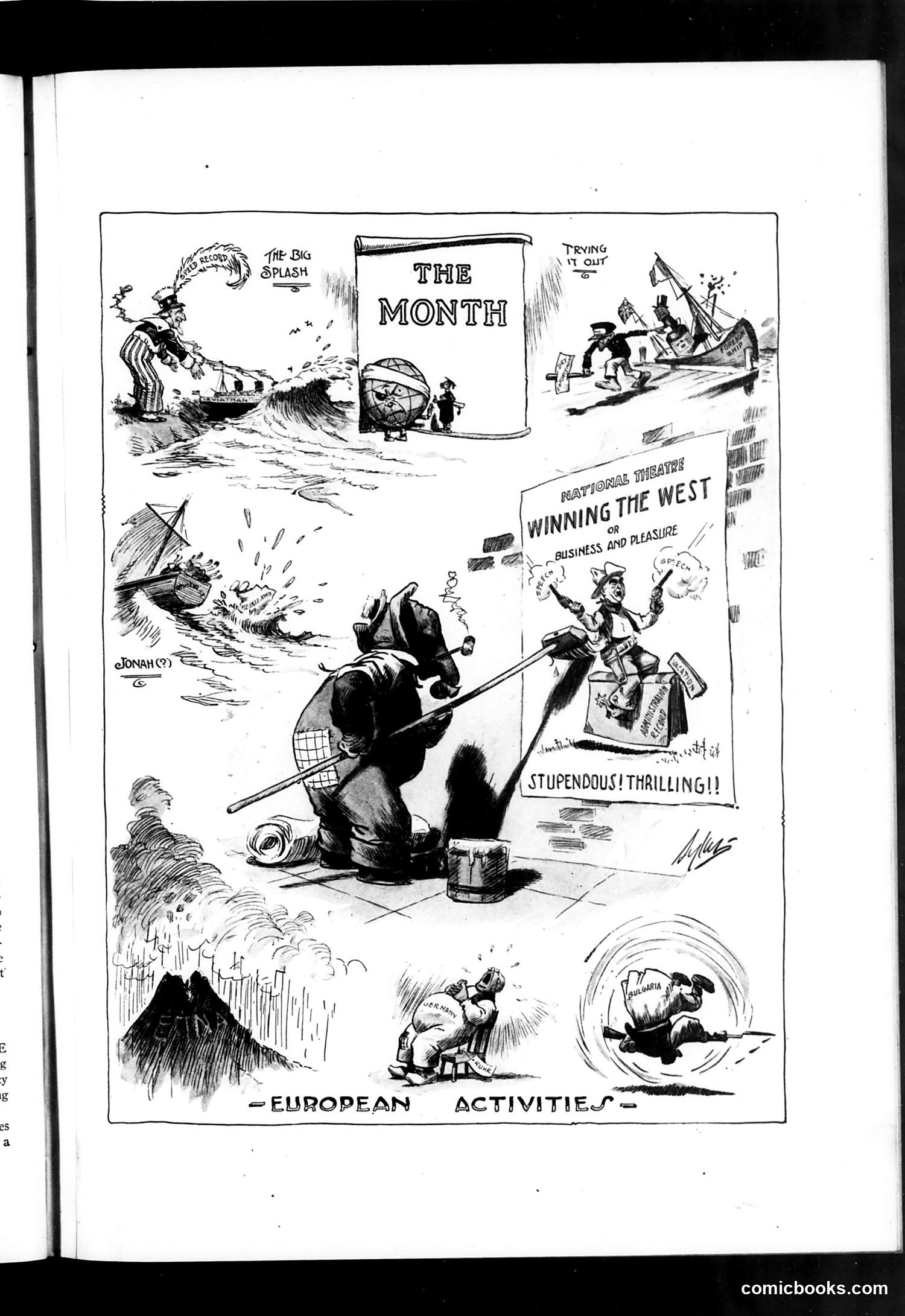
This is a satirical collage titled "The Month" contrasting American and European activities. The central figure appears to be Uncle Sam, depicted as a carnival barker promoting "Winning the West" as thrilling entertainment ("Business and Pleasure"). The surrounding vignettes labeled "European Activities" show various violent scenes: warfare, explosions, and conflict. The implicit satire contrasts American expansionism and commercial entertainment (the "winning" narrative) with contemporary European warfare and turmoil—likely referencing World War I. The cartoon suggests Americans are marketing westward expansion as spectacle while Europe engages in actual warfare. It critiques American industrial/commercial exploitation framed as adventure, juxtaposed against real European suffering.
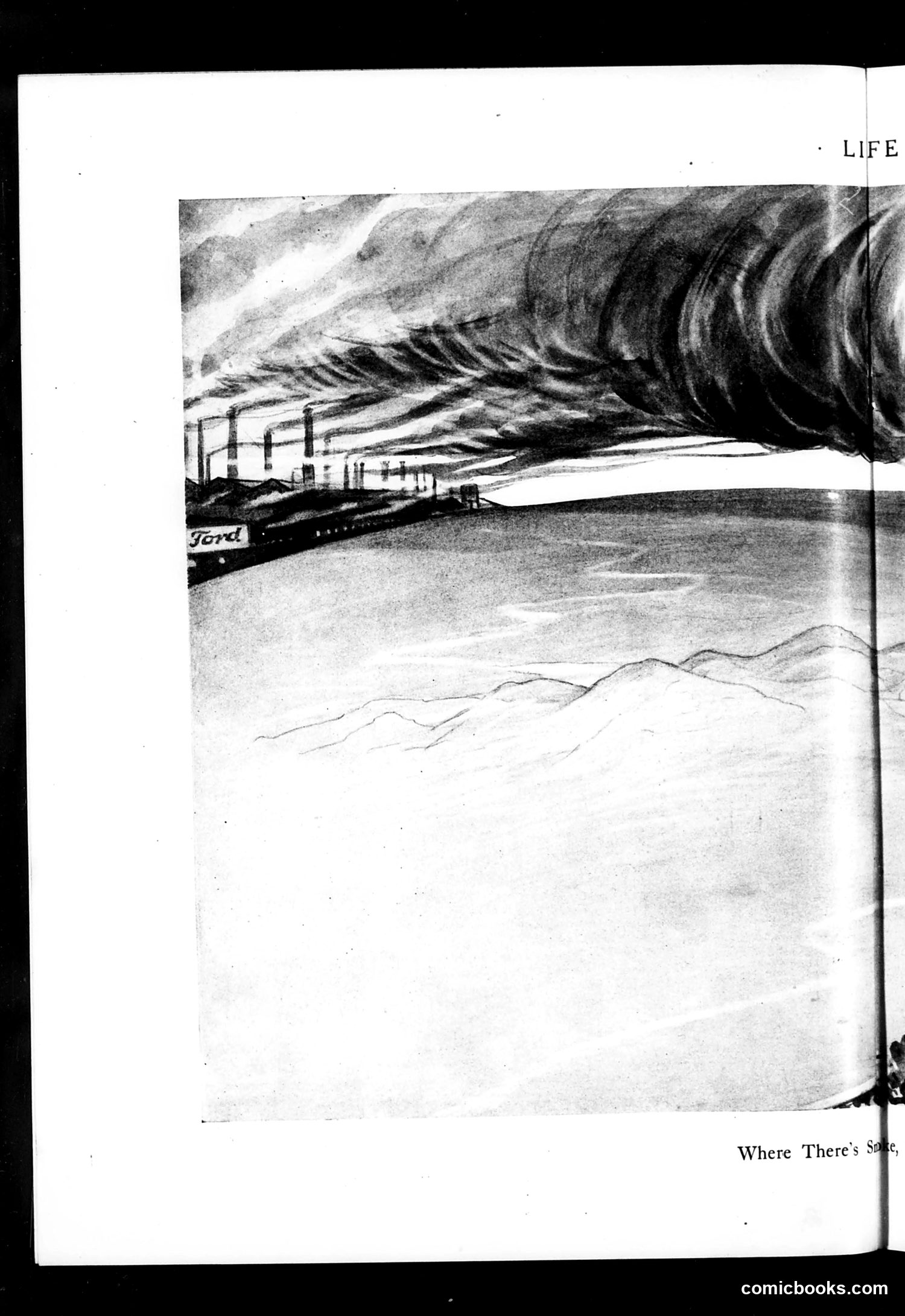
This page appears to be from a LIFE magazine advertisement or editorial illustration featuring an industrial or landscape scene. The image shows what seems to be an oil derrick or industrial structure dominating a mountainous landscape, with a Ford truck visible in the lower left. The dramatic sky and angular composition suggest this is commentary on industrial development or resource extraction. The partial text "Where There's S[moke]" (likely "Where There's Smoke") at the bottom suggests a play on the common phrase "where there's smoke, there's fire"—possibly satirizing industrial pollution, resource exploitation, or the relationship between commerce and environmental impact. However, without the complete caption and publication date, the specific satirical target remains unclear.
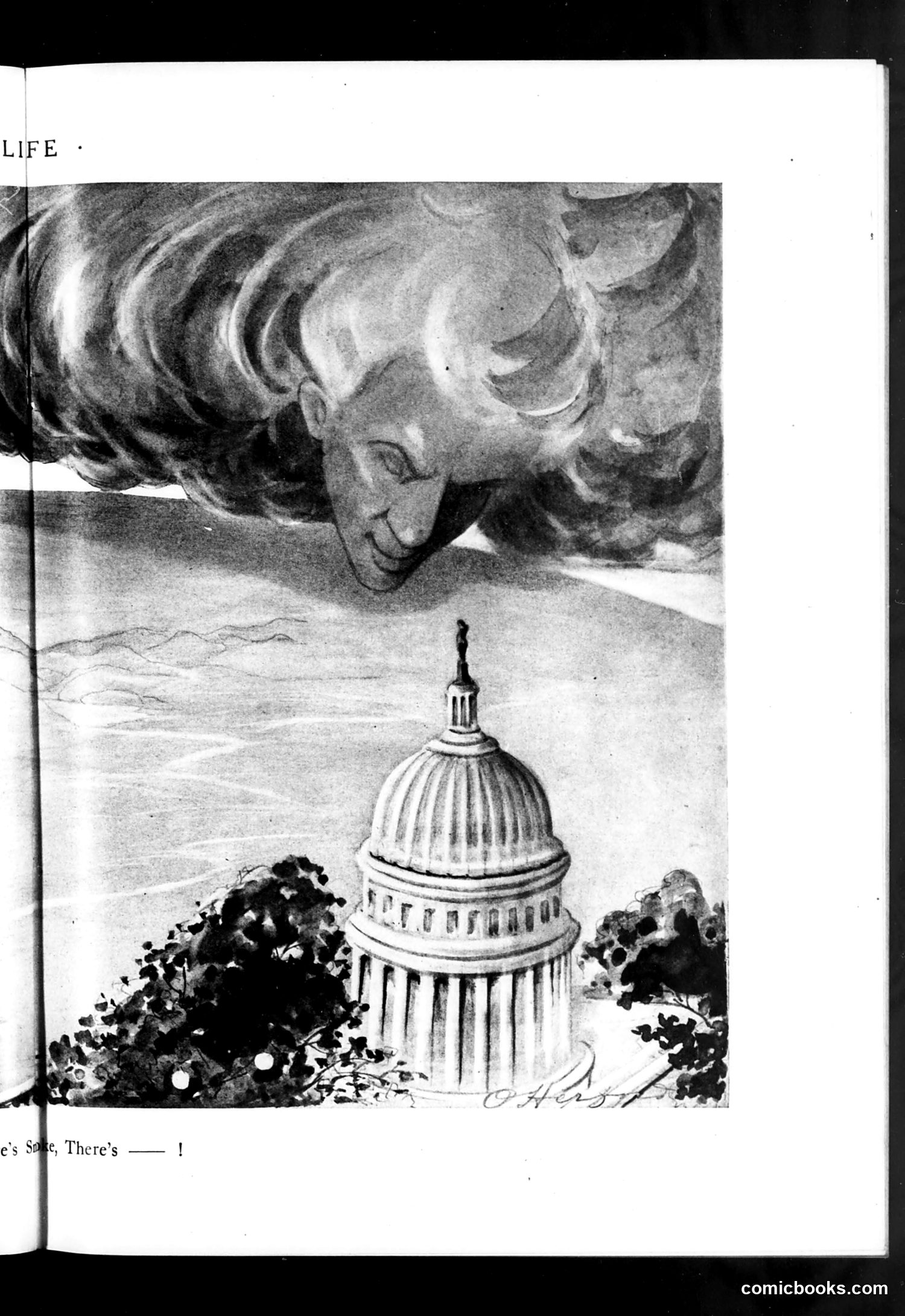
This page from *Life* magazine features a political cartoon showing a large face peering down at the U.S. Capitol building. The caption "e's Same, There's ——" (likely "He's Same, There's ——") appears incomplete, making the specific reference unclear. The cartoon likely satirizes a prominent political figure's influence over or interest in Capitol politics. The exaggerated scale—the face dominating over the building—suggests commentary on individual power or ego overshadowing institutional governance. Without the complete caption or visible date, I cannot definitively identify the figure or specific political event referenced. The style and subject matter suggest this targets early-to-mid 20th century American politics, but further context would be needed for accurate interpretation.
This is a theater review of the Ziegfeld Follies (the famous American musical revue), specifically critiquing Eddie Cantor's addition to the show. The author distinguishes between Cantor's two stage personas: his "blackface comedian" character (offensive by modern standards) versus his newer "Jewish boy" persona, preferring the latter for its humility and comedic timing. The review praises the popular novelty song "Yes, We Have No Bananas" as refreshingly absurd—a break from sentimental clichés that reveals Americans aren't "fools." However, it then contradicts itself by condemning Gallagher and Shean's equally absurd song about Paris and women's knees as proof of national decline caused by Prohibition, sarcastically threatening to leave the country. The satire's point: the author mocks inconsistent cultural criticism and arbitrary standards of taste—praising identical nonsense in one song while condemning it in another, exposing how subjective judgments of "good" entertainment actually are.
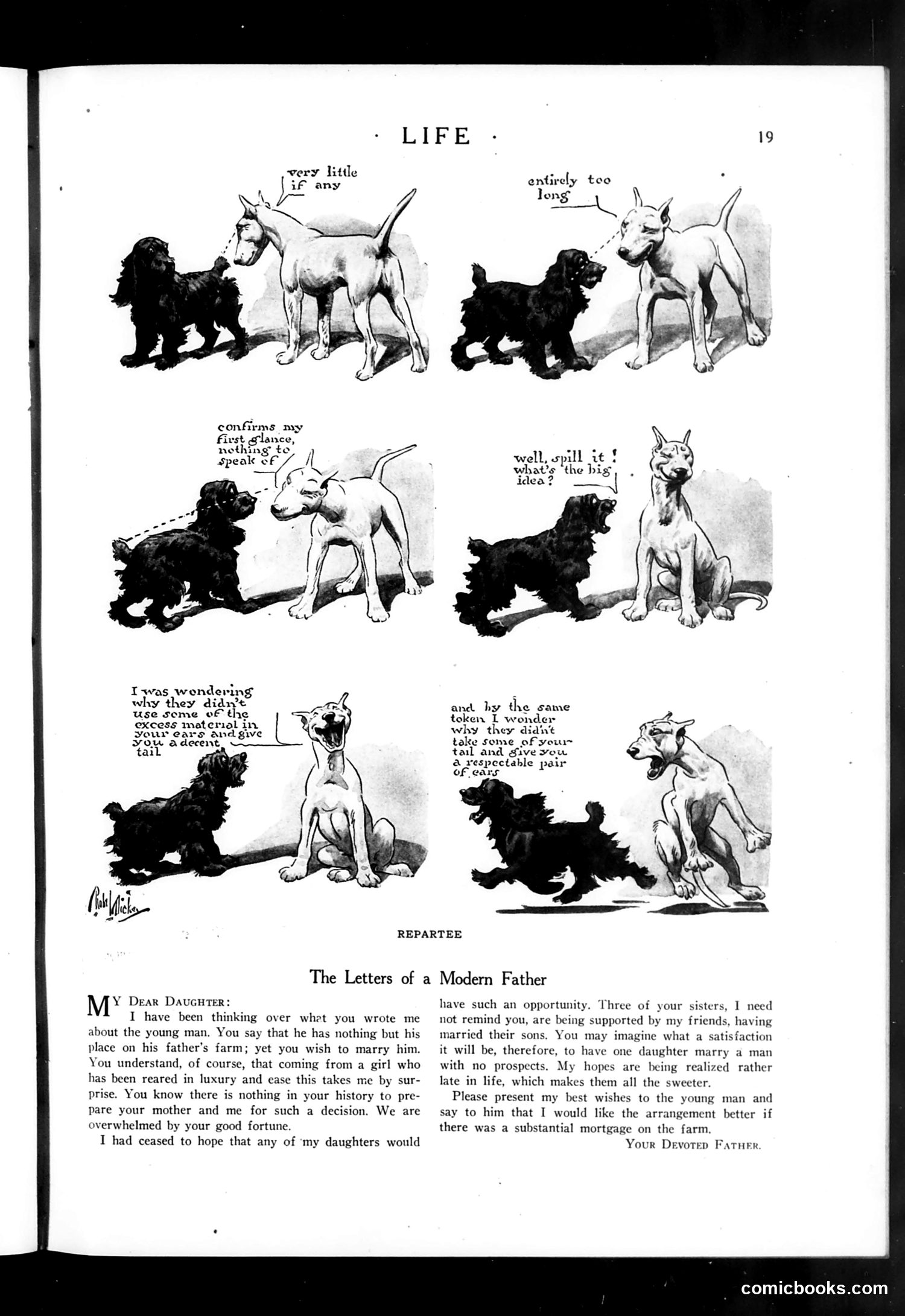
This page contains two satirical pieces from *Life* magazine: **Top: "Repartee" Comic Strip** A conversation between two dogs—one with floppy ears, one with pointed ears—debating ear and tail aesthetics. The black dog criticizes the other's long ears as "entirely too long" and suggests redistributing excess ear tissue to create a "respectable pair of ears," while offering to do the same with tails. This is gentle visual humor about breed differences and aesthetic preferences. **Bottom: "The Letters of a Modern Father"** A father sarcastically congratulates his daughter on marrying a poor farmer with no prospects. The satire targets wealthy upper-class attitudes: he's "overwhelmed by your good fortune" because her sisters married wealthy men, so he's relieved she's finally making a "good" match—even though it's financially disastrous. The punchline: he'd prefer the arrangement "better if there was a substantial mortgage on the farm" (making it worse). The piece mocks class consciousness and parental materialism in early 20th-century society.
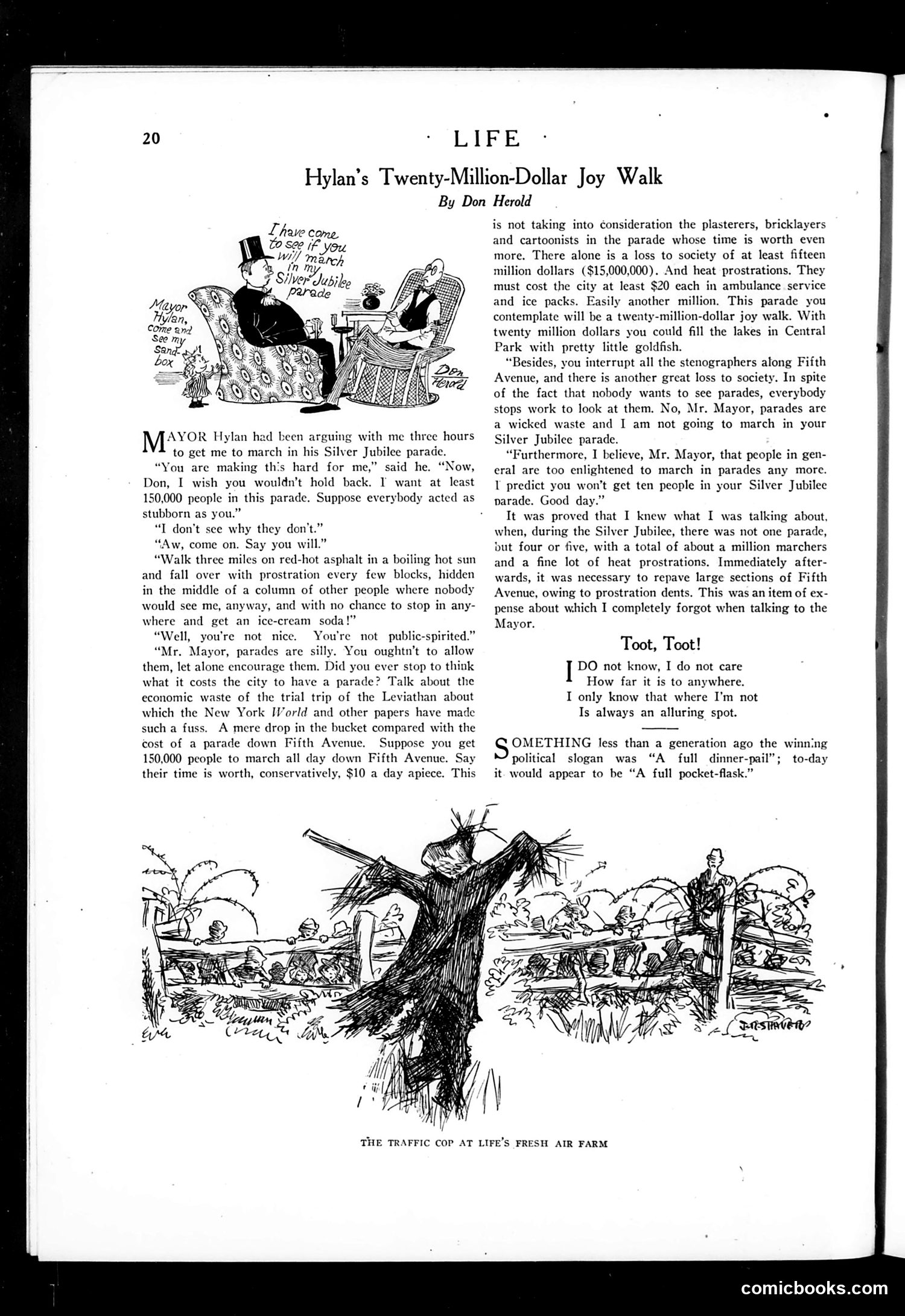
This satirical piece by Don Herold mocks Mayor Hylan's Silver Jubilee parade (likely celebrating his 25 years in office—Hylan was NYC mayor 1918-1925). The author argues parades are economically wasteful: 150,000 people at $10/day wages equals $1.5 million, plus heat prostration costs and Fifth Avenue damage totaling roughly $20 million—hence "joy walk." The joke: Herold predicts the parade will flop, but it actually happens with multiple parades and a million marchers, proving him wrong. The irony is that his economic critique, though logically sound, fails because people enjoy parades regardless of cost. The bottom cartoon references Prohibition-era "pocket-flask" drinking culture, contrasting it with the pre-WWI slogan "full dinner-pail" (worker prosperity). It satirizes how American values had shifted toward hidden vice during Prohibition.
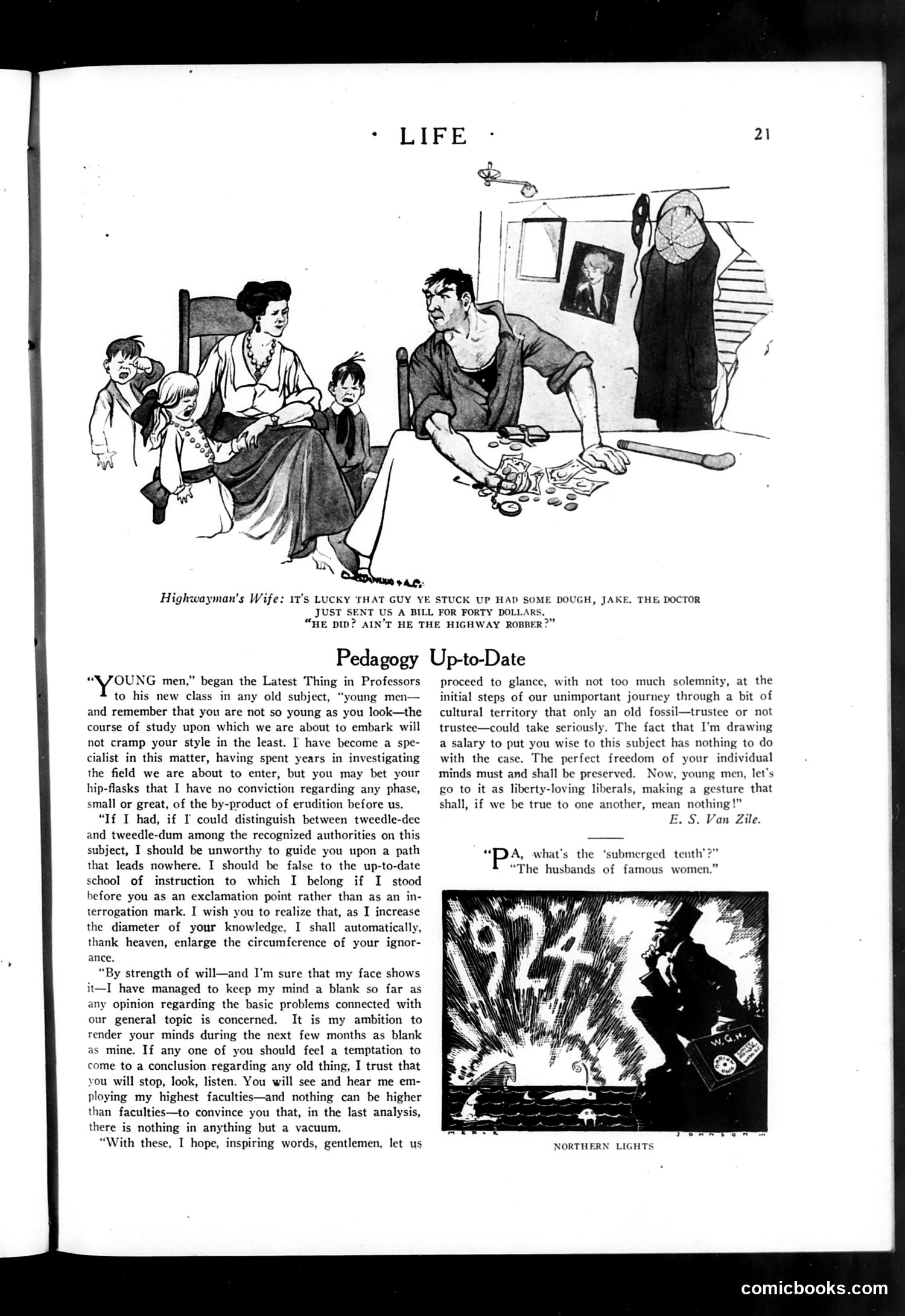
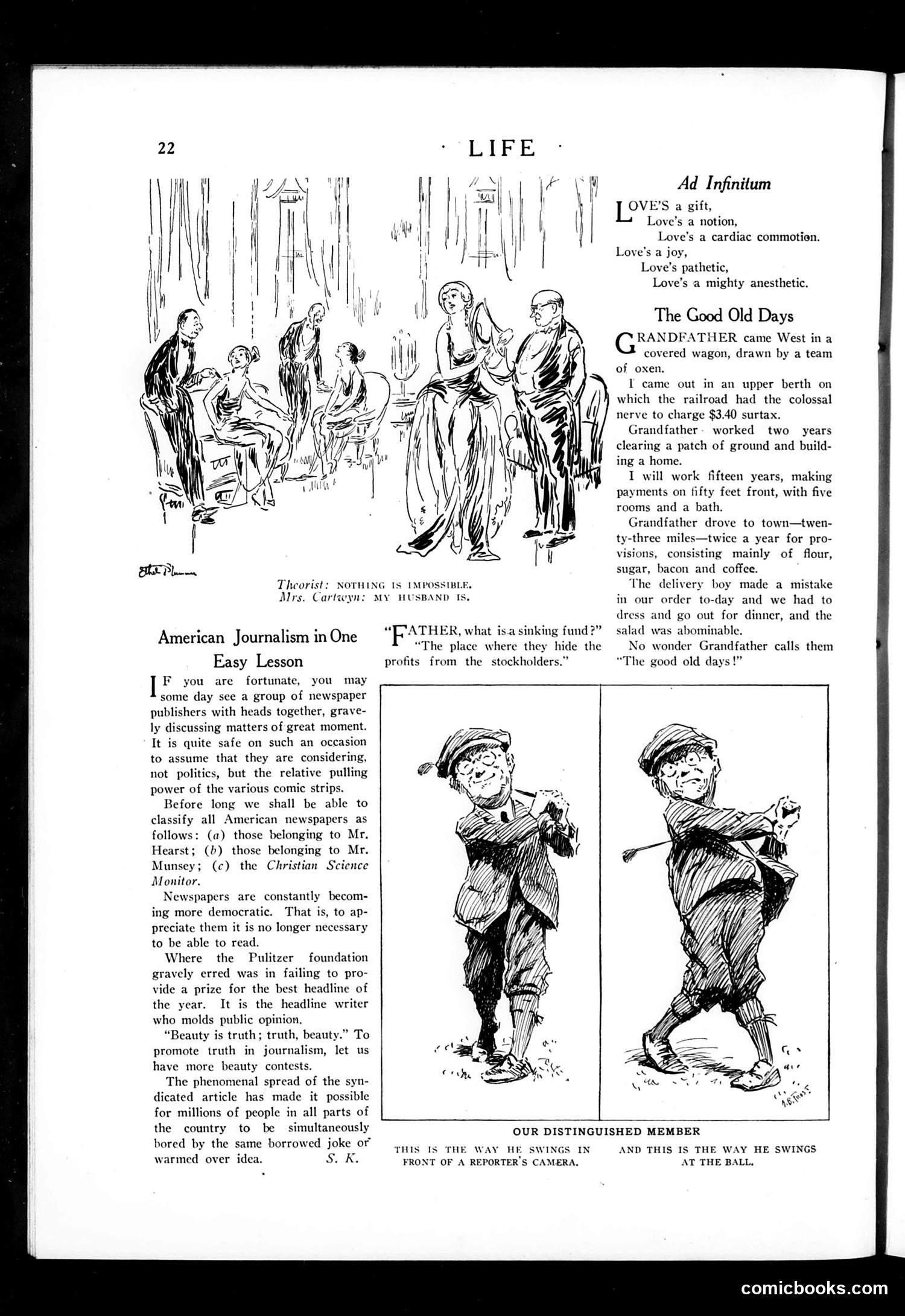
This page contains multiple satirical pieces mocking early 20th-century American society and journalism: **"American Journalism in One Easy Lesson"** critiques newspaper publishers' obsession with comic strips over serious content, suggesting newspapers are becoming less democratic and readable. It mocks the Pulitzer Prize for overlooking headline writers' influence on public opinion, and attacks syndicated articles for spreading boring content nationwide. **The "Sinking Fund" joke** is a father-son exchange: a child asks about financial terminology, and the father cynically defines it as where corporations hide profits from shareholders—reflecting skepticism about corporate transparency. **"The Good Old Days"** nostalgically contrasts grandfather's pioneer hardships (wagon travel, homesteading) with the narrator's modern "struggles" (mortgage payments, demanding delivery boys, poor salad)—satire on contemporary complaint and softness. **"Our Distinguished Member"** shows contrasting golf swings: one posed for cameras, one actual—mocking public figures' performance of competence versus reality. All pieces reflect characteristic Life magazine humor: irreverent, class-conscious, skeptical of institutions and modern affectations.
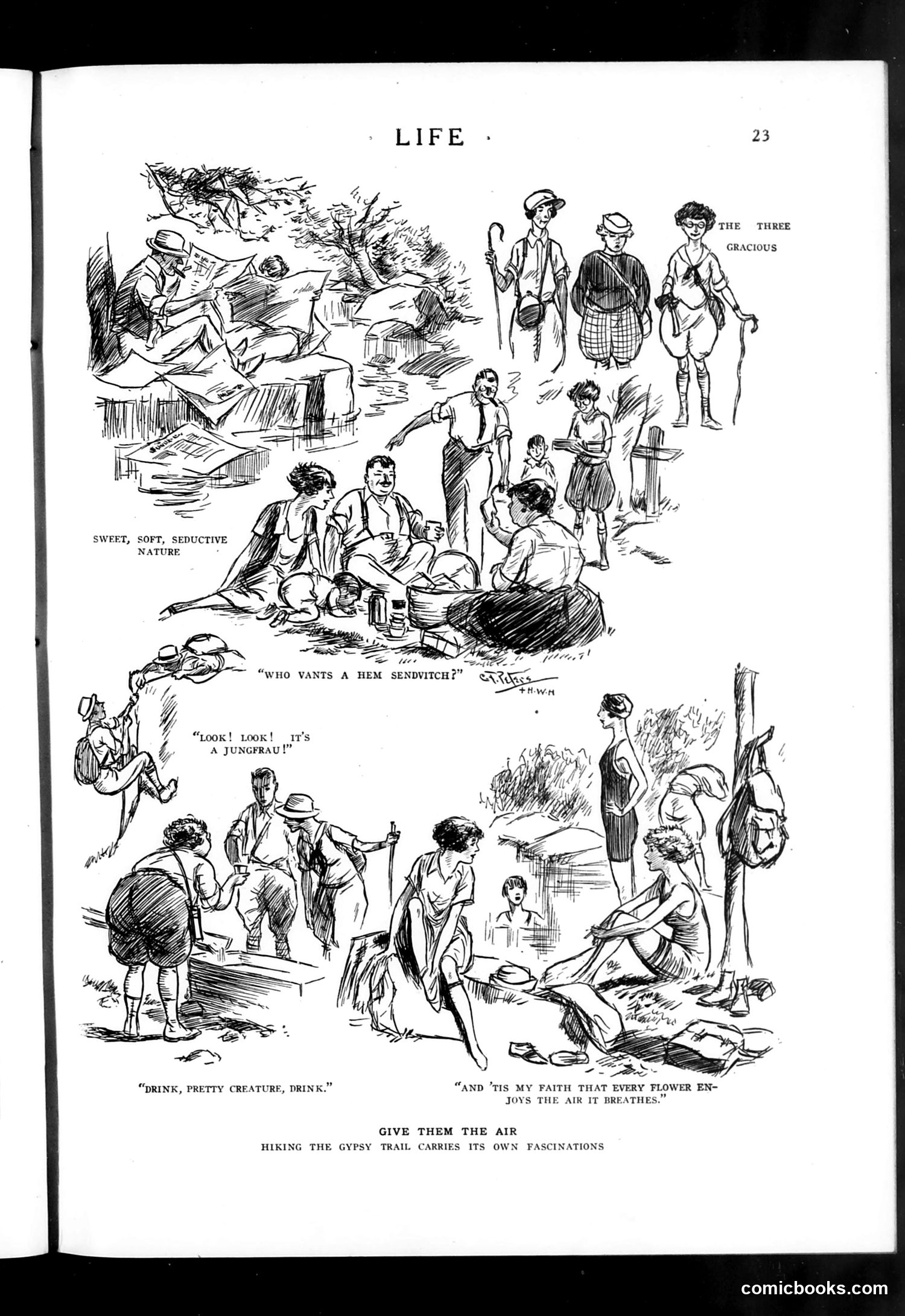
This satirical cartoon mocks romantic idealization of bohemian/gypsy lifestyles and nature-worship among the upper classes. The multiple scenes show men attempting to seduce women during outdoor hiking excursions by quoting flowery poetry and romantic rhetoric ("Drink, pretty creature, drink"; references to flowers enjoying air). The humor lies in the contrast between the men's pretentious, overwrought romantic language and the mundane reality depicted—the women appear unimpressed, and the "gypsy trail" lifestyle is portrayed as a thin cover for philandering. The phrase "give them the air" suggests dismissal or rejection—the joke being that these poeticizing men should be rejected despite (or because of) their affected romanticism. The cartoon critiques both the men's manipulation tactics and the broader cultural fetishization of "free spirits" and nature as backdrops for seduction.
This story satirizes the runaway commercial ambition and theatrical excess of the 1920s movie palace era. **The Setup:** Two Irish immigrants, Mike and Pat, represent the archetypal "self-made man" narrative. Mike's modest plan to buy a single movie theater spirals into an empire of ornately decorated palaces across the Midwest. **The Satire:** The humor lies in Mike's obsessive elaboration—marble, gilt, symphony orchestras, swimming pools, hand-painted murals of classical scenes—each detail more extravagant than necessary. The story mocks how entertainment venues had become monuments to excess rather than functional cinemas. The catalog of amenities ("program boys dressed like Rear-Admirals," opera productions weekly) exaggerates real architectural trends of the era's "movie palaces." **The Punchline:** Pat's final observation—that Mike never actually *bought the movie theater* because he was too busy decorating everything—critiques how capitalist ambition becomes self-defeating through endless embellishment, losing sight of the original, simple purpose. This gentle satire targets 1920s consumer culture and architectural grandiosity disguised as improvement.
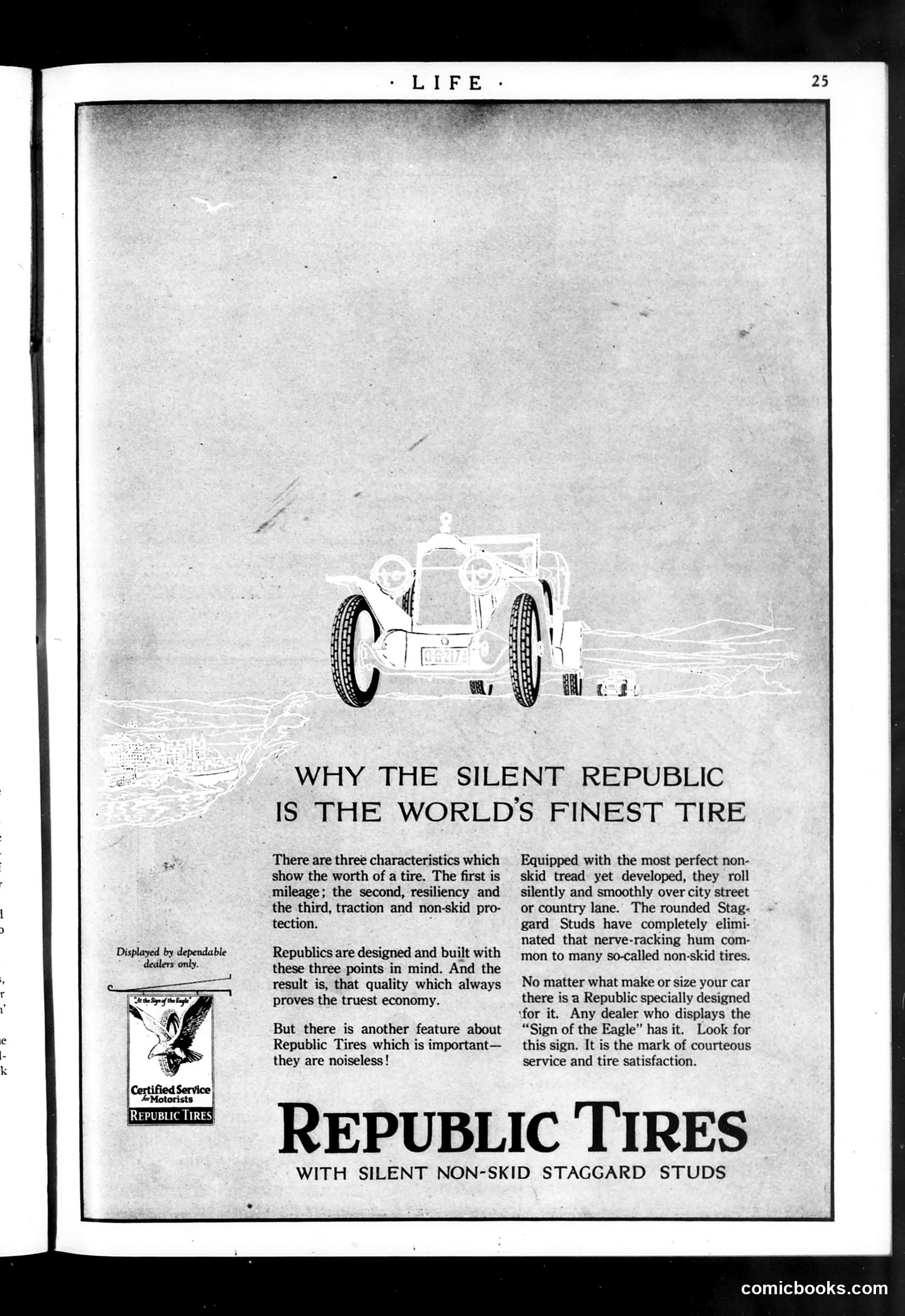
This is a **tire advertisement**, not political satire or a cartoon. It appeared in *Life* magazine (page 25) promoting Republic Tires. The page features an illustration of an early racing car speeding across desert landscape. The ad emphasizes three tire qualities: mileage, resiliency, and traction/non-skid protection. Its main selling point is that Republic Tires are "noiseless"—their rounded "Staggard Studs" eliminate the "nerve-racking hum" of competitor non-skid tires, positioning silent operation as a luxury feature. The "Sign of the Eagle" logo appears as the dealer identifier. This is straightforward product marketing aimed at automobile owners, highlighting performance and comfort benefits typical of early-20th-century tire advertising. There is no political commentary or satirical intent visible.
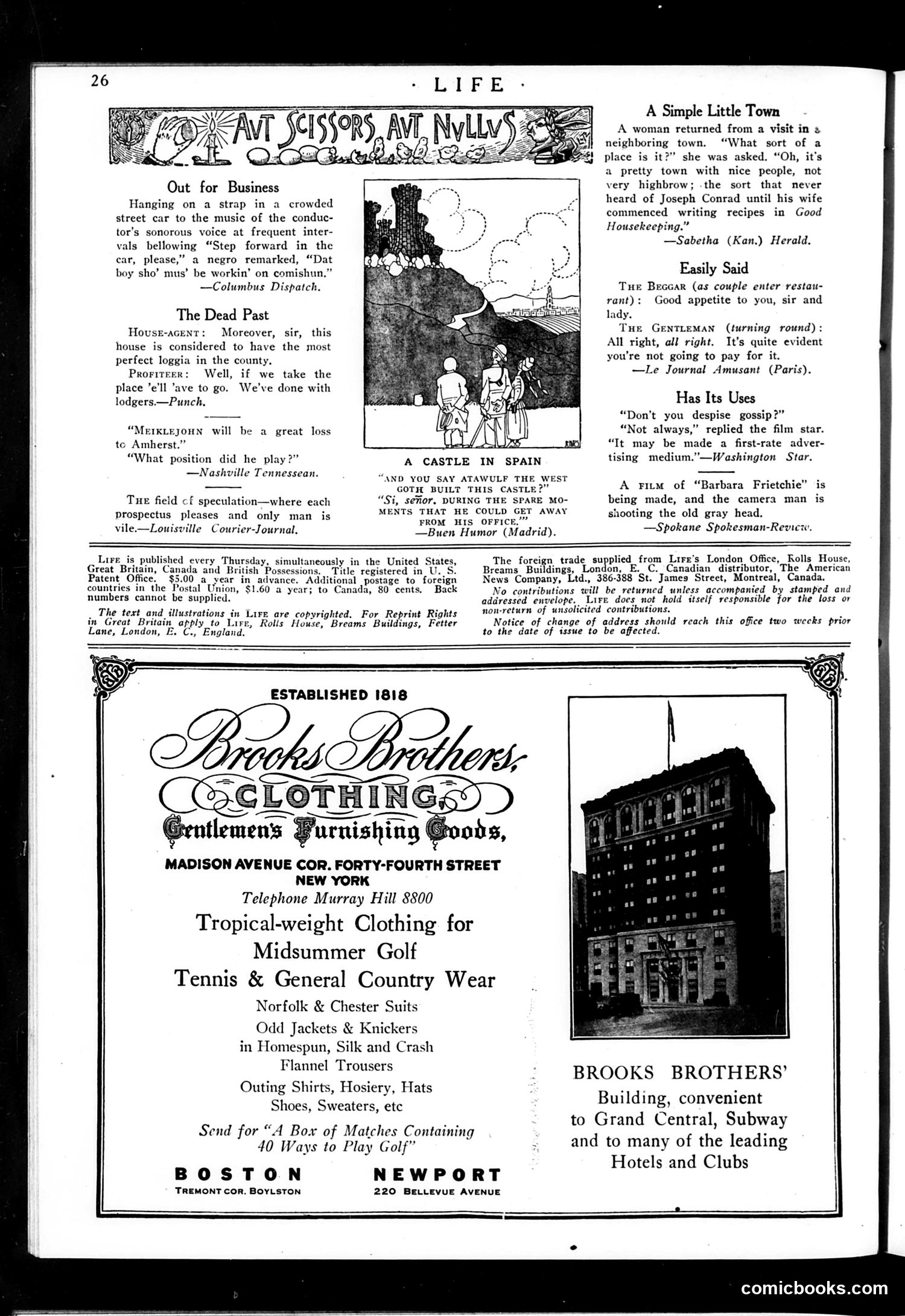
This page is primarily **advertising and reprinted humor**, not original political satire. The small humor items ("Out for Business," "The Dead Past," "Easily Said," "Has Its Uses") are brief jokes reprinted from various newspapers and foreign publications. These include: - A racial caricature joke about a Black streetcar passenger (Columbus Dispatch) - Workplace humor about a property owner evicting lodgers - A Spanish joke about a medieval official juggling castle-building with office duties - Mild satire on film stars and gossip columnists The illustration labeled "A Castle in Spain" depicts a castle on a hilltop with tourists, accompanying the Spanish joke about divided attention between official duties and personal projects—a play on the idiom "castles in Spain" (impractical dreams). The **bulk of the page is Brooks Brothers advertising**, featuring their building photograph and clothing offerings. Overall, this is a typical Life magazine page from the 1920s: light, internationally reprinted humor mixed with upscale advertising, rather than hard-hitting political cartooning. The content reflects period attitudes, including casual racial stereotyping common to the era.
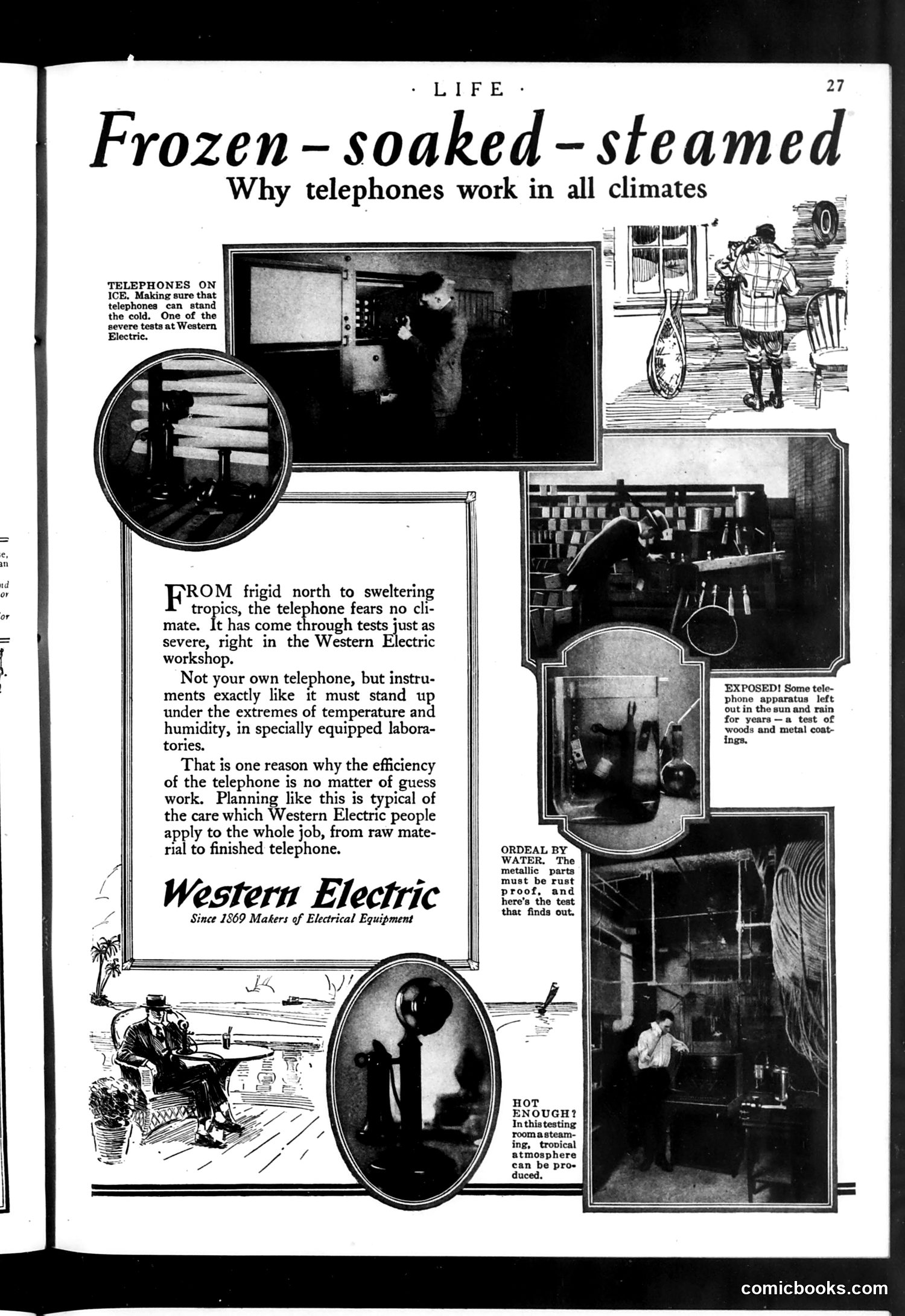
This is a **Western Electric advertising page**, not satire or political commentary. It promotes telephone reliability through industrial testing. The page shows **Western Electric's quality control procedures** for telephone equipment, demonstrating that phones function across extreme climates. The circular photographs document actual laboratory tests: frozen conditions (ice test), water exposure (submersion), salt/rust testing (coastal corrosion), and heat/humidity simulation (tropical conditions). The text emphasizes that rigorous, scientific testing—not guesswork—ensures telephone durability "from raw material to finished telephone." The illustrated vignettes (man in snow, woman with bicycle, child) suggest ordinary users in various climates who can rely on their phones. **For modern readers**: This reflects early-20th-century industrial confidence in **systematic engineering and quality assurance** as selling points. The ad positions Western Electric as scientifically rigorous, appealing to consumer trust in technological expertise—a common marketing approach during this era of industrial modernization.
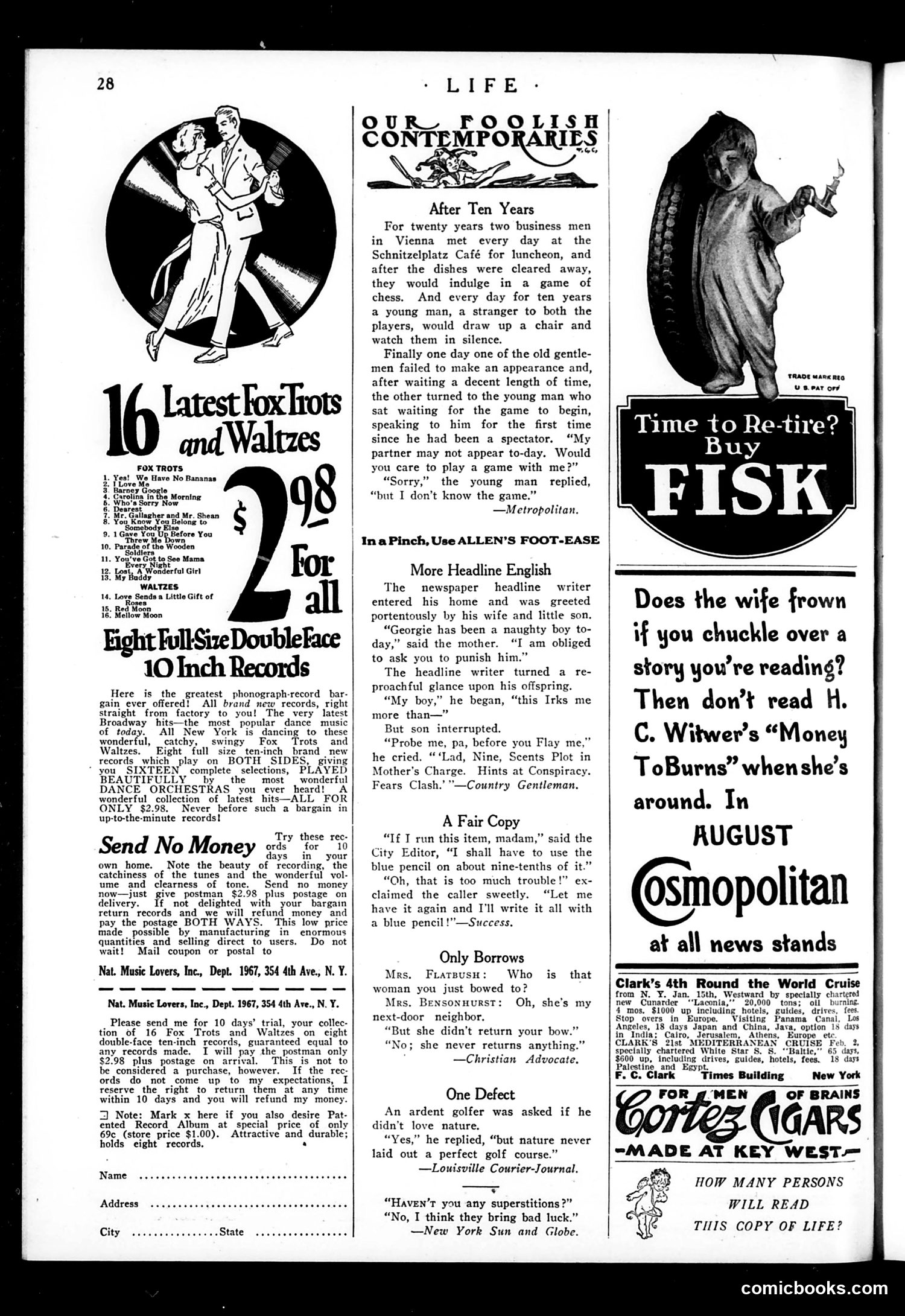
This page from Life magazine presents several unrelated humorous pieces typical of the publication's format. **"Our Foolish Contemporaries" section** contains brief anecdotes mocking human behavior: - "After Ten Years" satirizes obsessive routine and social awkwardness—a young man watches two men play chess daily for a decade without speaking, then admits he doesn't know the game. - "More Headline English" jokes about a newspaper headline writer's pretentious speech patterns irritating his own family. - Additional short humor pieces mock social conventions (wives' reactions to reading material, borrowing etiquette). **The left side features** advertisements for Fox Trot records and phonographs—typical commercial content mixed with editorial material. **Right-side advertising** includes Fisk tires, Cosmopolitan magazine, and Cornet cigars. The satire targets middle-class affectations, social ritual, and generational misunderstandings—common Life magazine themes. No specific political figures or dated references appear; instead, the humor emphasizes universal human foibles recognizable to modern readers.
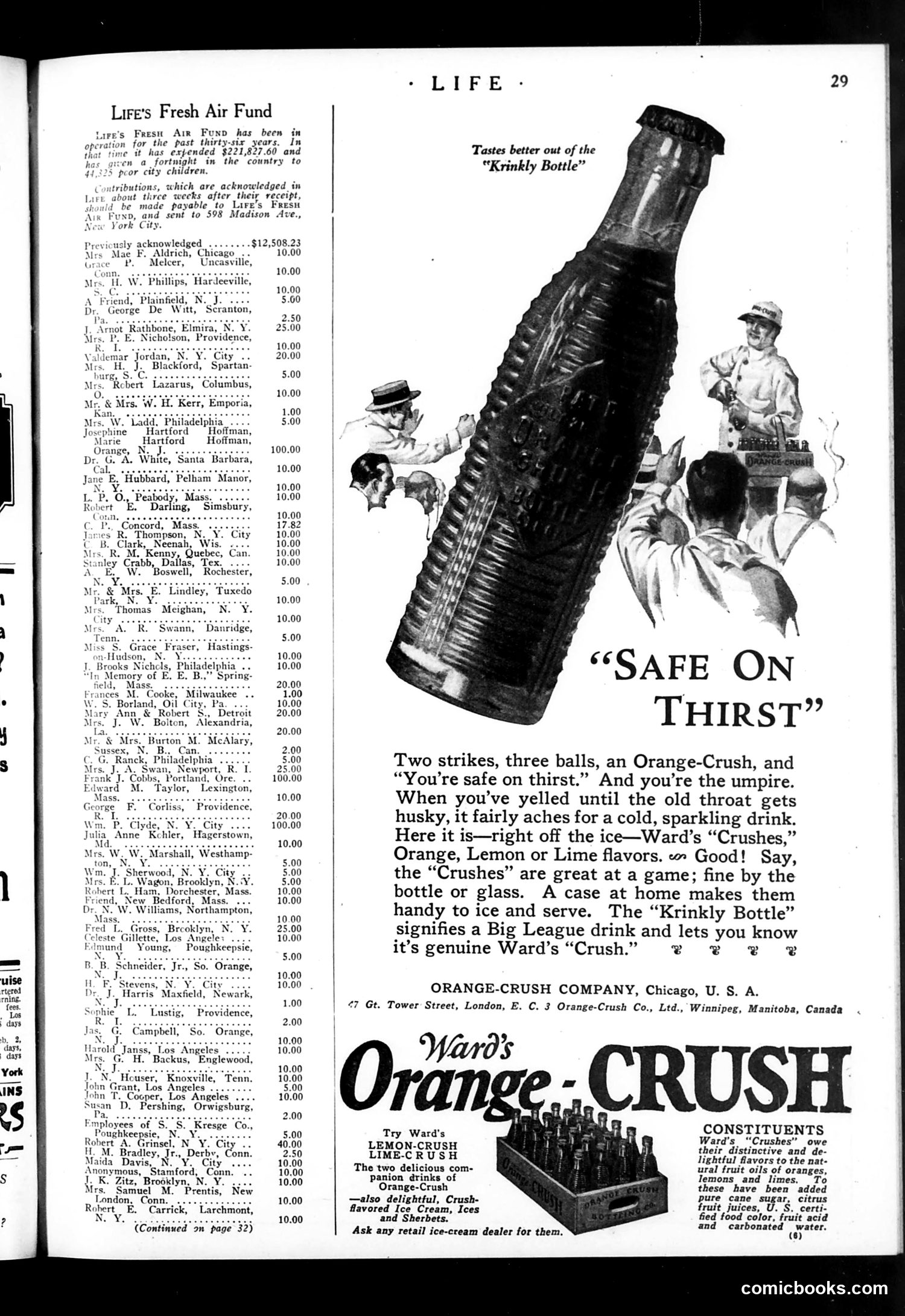
This page is primarily an **advertisement for Ward's Orange-Crush beverage**, not political satire. The left column lists contributors to Life's Fresh Air Fund, a charitable program that sent poor city children to the countryside (established 36 years prior, having spent over $221,000). The main illustration depicts a **baseball umpire** at a game, parched and exhausted from calling strikes and balls. The ad uses baseball vernacular—"safe on thirst"—to pitch Orange-Crush as refreshment for hot, sweaty situations. The illustration shows three figures around an oversized bottle, emphasizing the drink's appeal to spectators and players at outdoor sporting events. The ad positions Orange-Crush as a "Big League drink," marketed in a distinctive "Krinkly Bottle" for authenticity. Companion flavors (Lemon-Crush, Lime-Crush) and related products (ice cream, sherbets) are promoted. This represents early 20th-century advertising linking branded beverages to American leisure and sports culture.
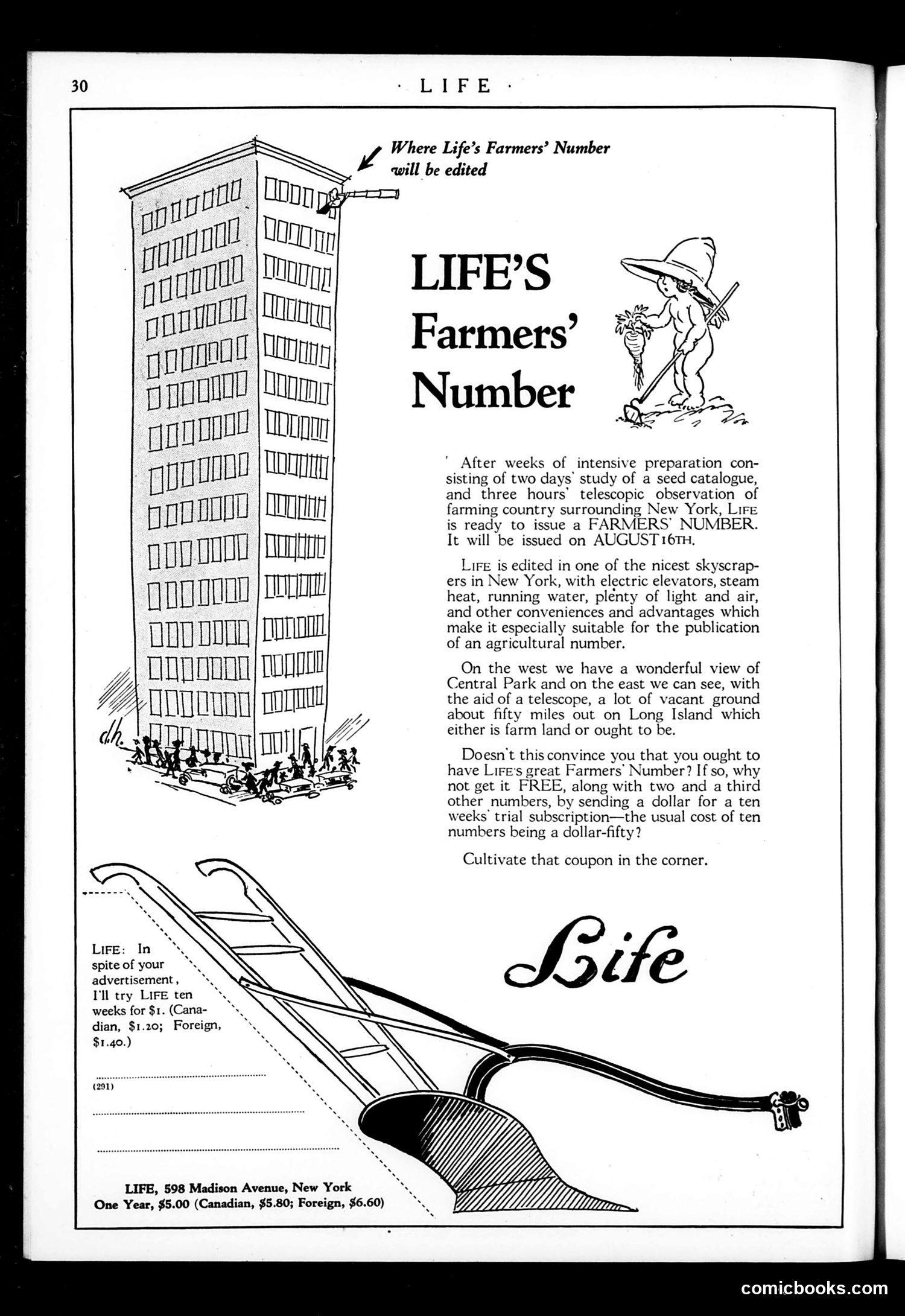
This is a self-promotional advertisement that mocks Life magazine's own credibility. The satire is directed at the magazine itself and urban sophistication generally. The joke: Life, edited in a Manhattan skyscraper with modern conveniences, claims to be publishing an authoritative "Farmers' Number" despite having done minimal actual agricultural research—just two days studying a seed catalog and three hours observing farmland through a telescope from Long Island. The absurdity is compounded by the suggestion that their office's view of Central Park and distant vacant land somehow qualifies them as farming experts. The cartoon satirizes the disconnect between urban, white-collar magazine culture and actual farming life. It's self-aware humor: Life is openly admitting its own detachment from rural America while still confidently producing content about it. This reflects early-20th-century tensions between urban and rural American perspectives, and the metropolitan magazine's somewhat patronizing relationship with agricultural readers. The ad promotes a ten-week trial subscription for one dollar.
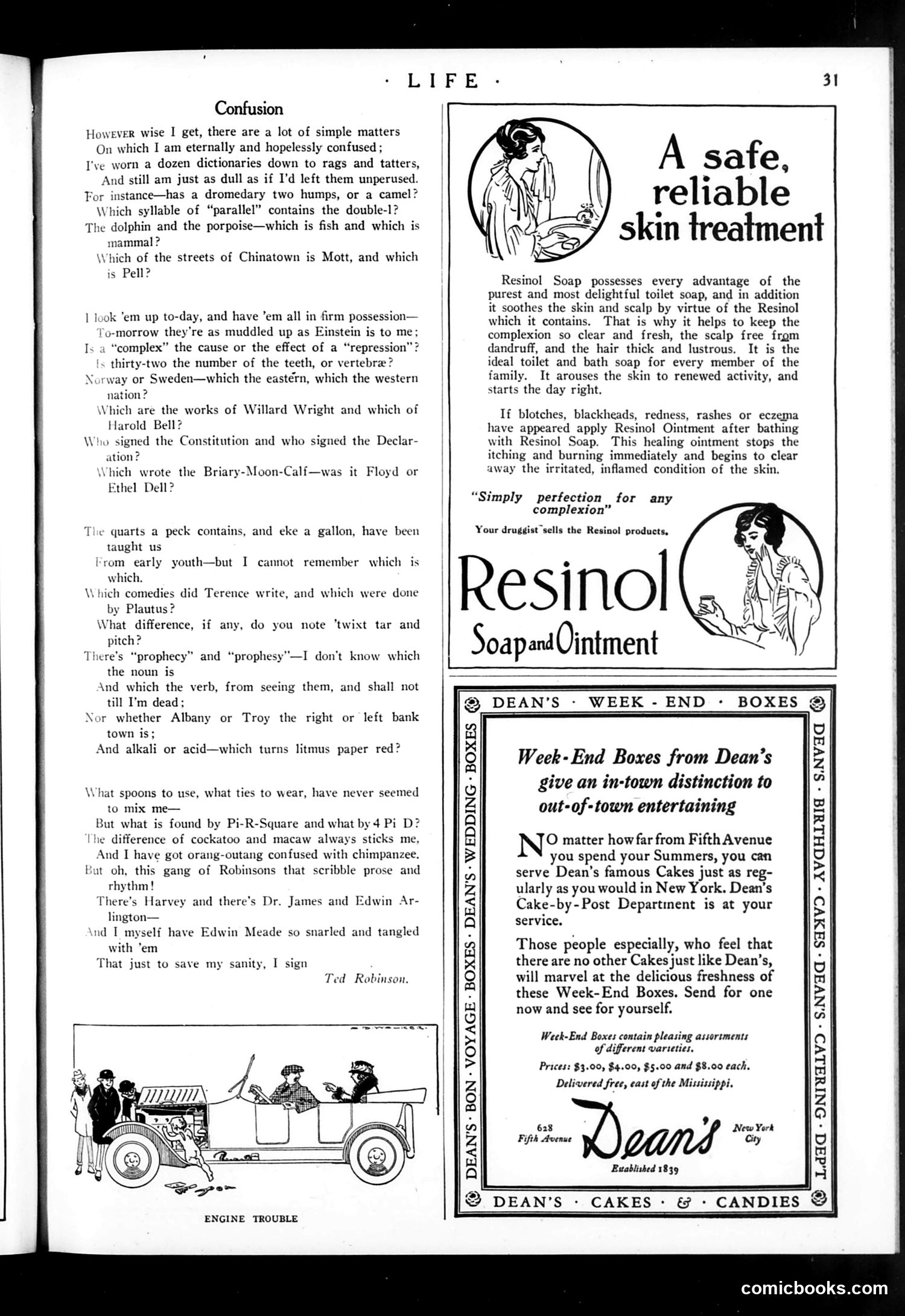
**Main Content: "Confusion" Poem** Ted Robinson's humorous poem lists everyday facts he perpetually forgets—distinguishing camels from dromedaries, dolphin from porpoise, Norwegian from Swedish geography. The joke satirizes intellectual pretension: despite looking things up repeatedly, he remains confused, comparing himself to Einstein struggling with complexity. The cartoon "Engine Trouble" (bottom) visualizes this mental breakdown—a car full of people in chaos, reinforcing the theme of cognitive disorder. **Social Context**: This reflects 1920s anxieties about information overload and the limits of education. Despite widespread literacy and reference materials, knowledge remained slippery and unreliable. **Advertisements**: The page also features Resinol Soap (skin treatment) and Dean's Cakes (mail-order luxury goods), typical of Life's commercial content targeting middle-class readers. The satire gently mocks educated people's persistent confusion despite modern conveniences.
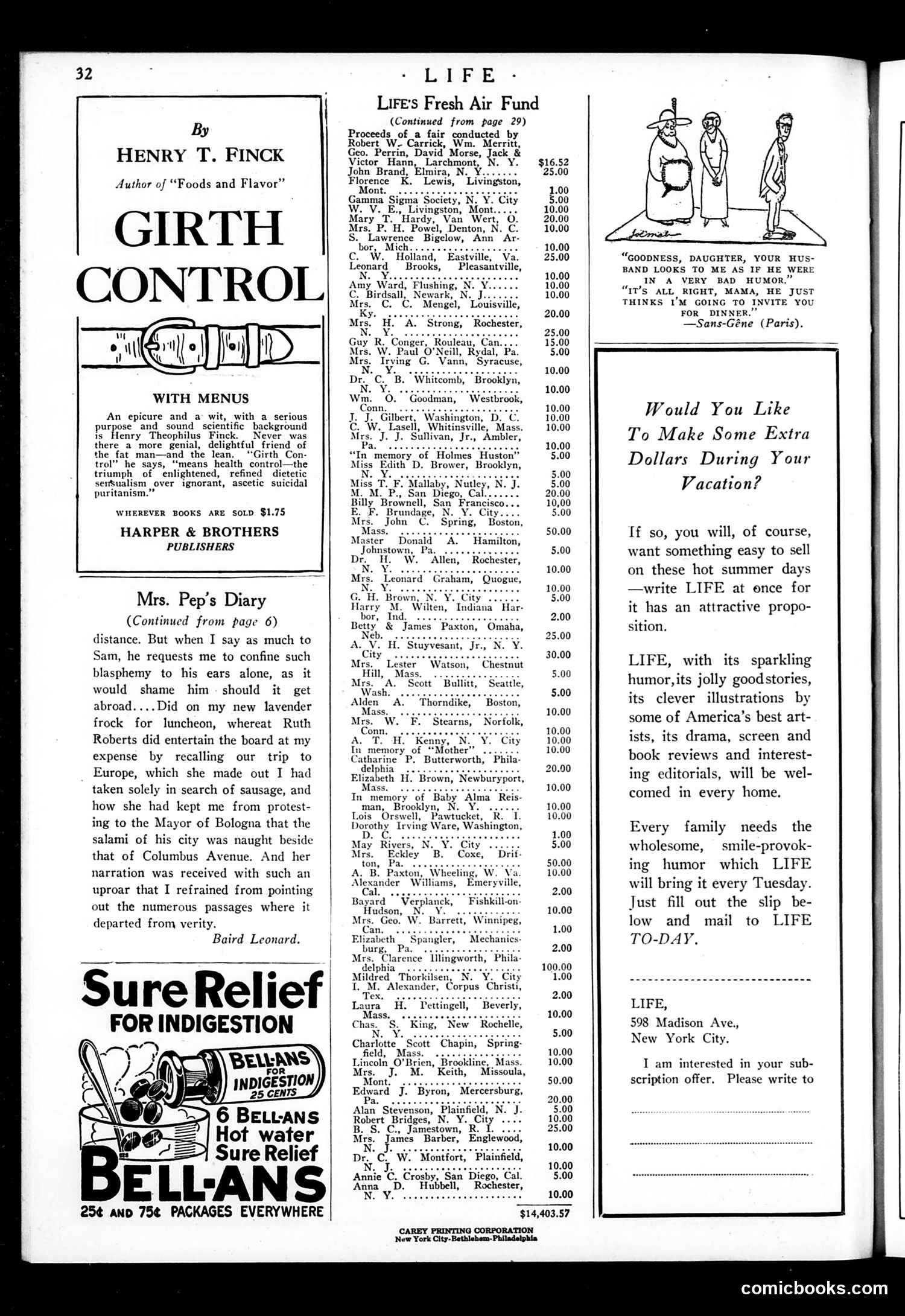
This page primarily contains **advertisements and subscription materials** rather than editorial content. Key elements: **Main Content:** - Book advertisement for Henry T. Finck's "Girth Control," a diet/health guide published by Harper & Brothers - "Mrs. Pep's Diary" (continued column) featuring light domestic humor about a woman's social embarrassments - A cartoon captioned with dialogue about a husband's bad mood, attributed to "Sans-Géne (Paris)"—the husband dreads his mother-in-law's dinner invitation **Advertisements:** - Bellans indigestion relief product (25¢ and 75¢) - Life magazine subscription pitch, targeting summer vacation sellers **Context:** The page reflects early 20th-century concerns: weight management ("girth control"), indigestion remedies, and domestic comedy centering on family relationships and social performance. The cartoon's mild marital tension represents typical genteel humor of the era. The "Fresh Air Fund" listing represents Life's charitable fundraising activities for children's welfare.
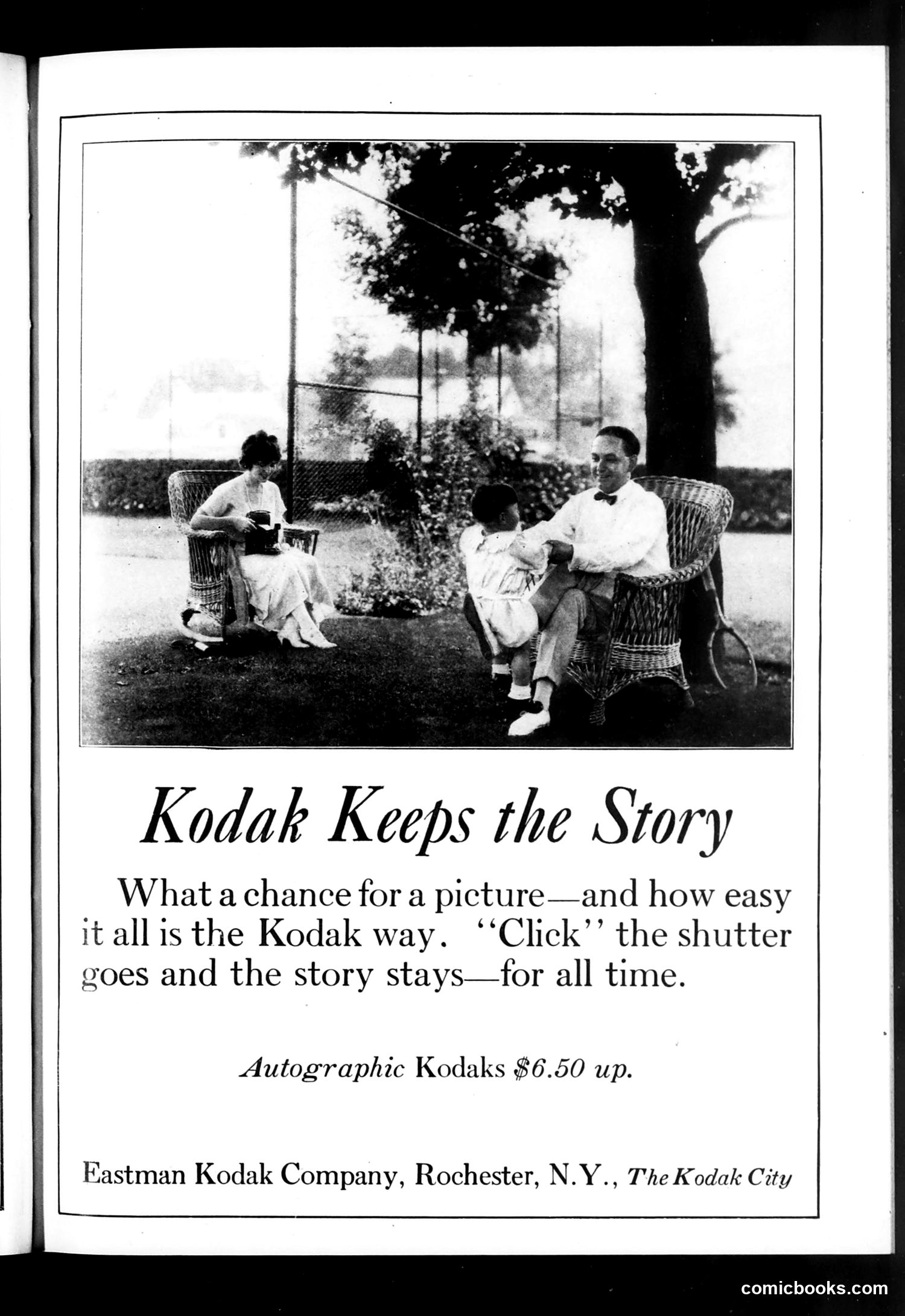
This is a **Kodak camera advertisement**, not political satire or a cartoon. The image shows a family scene—two adults and a child in wicker chairs outdoors beneath large trees—designed to appeal to consumers by depicting an idealized domestic moment. The advertisement's messaging emphasizes convenience: photography is now so simple that anyone can capture and preserve family memories with a "click." The phrase "Kodak Keeps the Story" suggests permanence and emotional value. The "Autographic" feature mentioned refers to Kodak's innovation allowing photographers to write notes directly on the film negative. The price point ($6.50 and up, circa 1910s-1920s based on styling) positioned these cameras as accessible to middle-class families. This represents early advertising strategy: associating a product with cherished memories and ease of use rather than technical specifications.
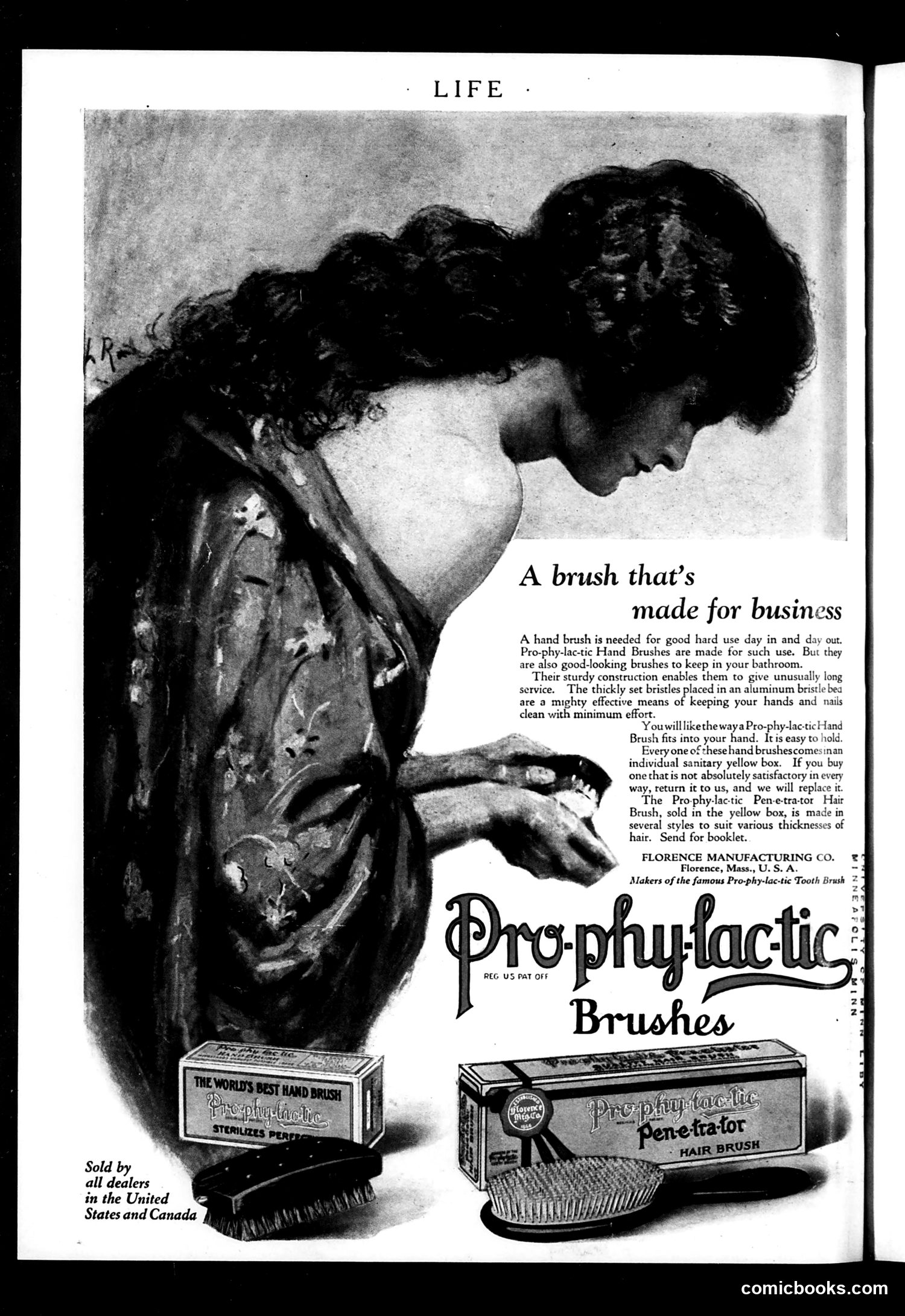
This is **not a political cartoon or satire**—it's a straightforward **advertisement** for Pro-phy-lac-tic brand brushes, made by Florence Manufacturing Company of Massachusetts. The page features a black-and-white photograph of a woman examining her hands/nails, presumably after using the advertised hand brush. The ad emphasizes the brush's practical durability ("good hard use day in and day out") and aesthetic appeal ("good-looking brushes to keep in your bathroom"). Key selling points include sturdy aluminum construction, thickly-set bristles for cleaning hands and nails "with minimum effort," and a satisfaction guarantee—if unsatisfied, customers could return it for replacement. The ad also promotes a companion product: the "Pen-e-tra-tor Hair Brush," available in various styles. Both products came in distinctive yellow boxes. This represents typical early 20th-century advertising strategy: combining practical product information with aspirational imagery of middle-class domesticity.