
Life, 1923-07-26 · page 22 of 42
Life — July 26, 1923 — page 22: what you’re looking at
What you’re looking at
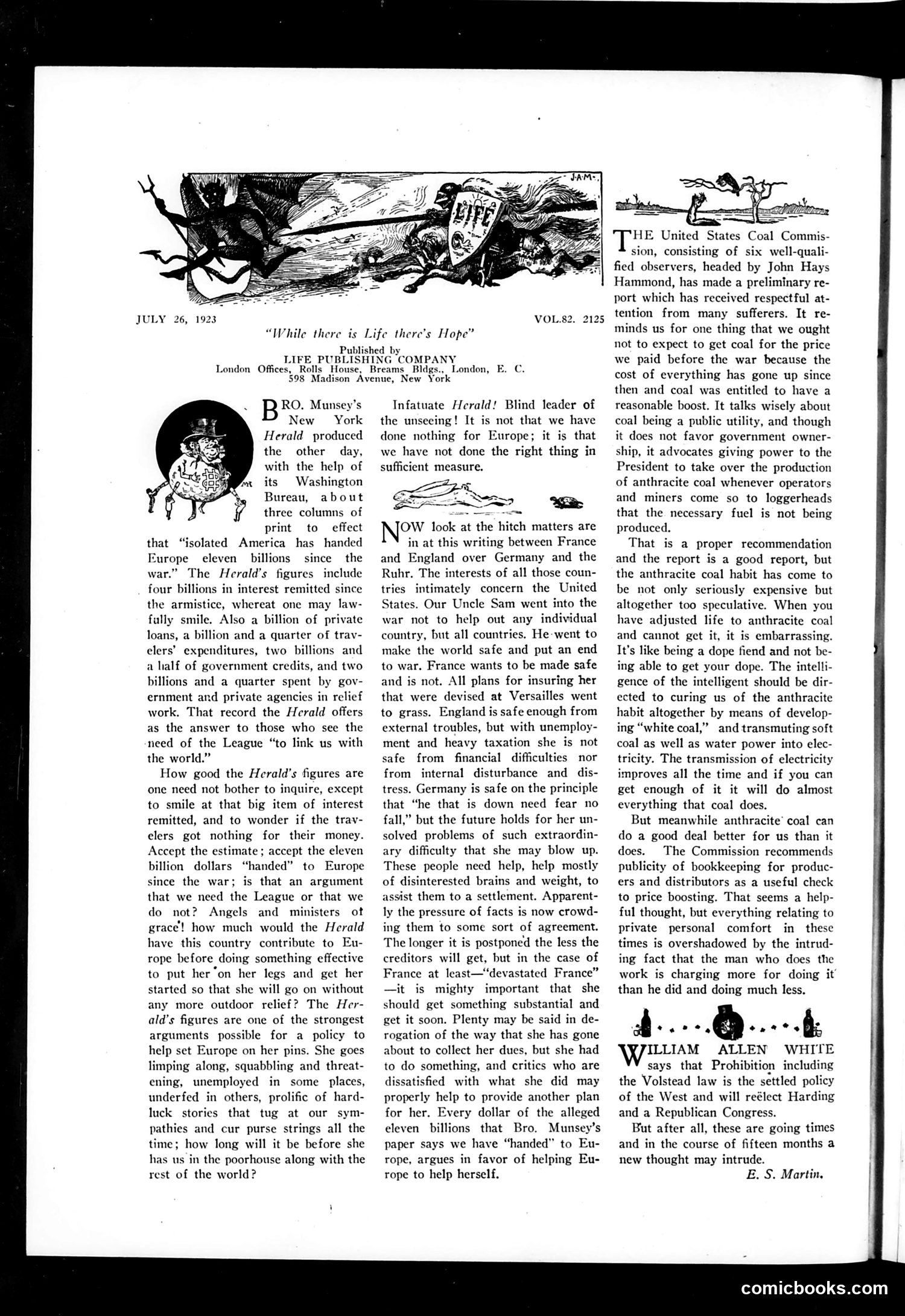
This page from *Life* magazine satirizes the *New York Herald*'s claim that America has "handed" Europe eleven billion dollars since World War I. The author argues the Herald uses this figure to question whether the U.S. needs the League of Nations—implying we've already done enough. The satire's point: the Herald misses the real issue. America's aid hasn't solved Europe's fundamental problems. France remains economically devastated, England faces unemployment and taxation crises, and Germany's instability threatens regional peace. The editorial argues that merely dispensing money without addressing these deeper structural issues is throwing good money after bad—eventually dragging America into "the poorhouse." The cartoon's opening image (left) appears to show Europe as a sinking, desperate figure, reinforcing this bleak assessment of the continent's post-war condition and America's ineffective charitable response.
📄 Transcribed text from this page (OCR, searchable)
Machine-transcribed from the original scan — historical spelling and the odd misread are preserved.
JULY 26, 1923 “While there is Life there's Hope” Published by LIFE PUBLISHING COMPANY London Offices, Rolls House, Breams_ Bld London, E. 598 Madison Avenue, New York RO. Munsey’s New York Herald produced the other day, with the help of its Washington Bureau, about three columns of print to effect that “isolated America has handed rope eleven billions since the war.” The Herald’s figures include four billions in interest remitted since the armistice, whereat one may law- fully smile. Also a billion of private loans, a billion and a quarter of trav- elers’ expenditures, two billions and a half of government credits, and two billions and a quarter spent by gov- ernment and private agencies in relief work. That record the Herald offers as the answer to those who see the need of the League “to link us with the world.” How good the Herald's figures are one need not bother to inquire, except to smile at that big item of interest remitted, and to wonder if the trav- elers got nothing for their money. Accept the estimate ; accept the eleven billion dollars “handed” to Europe since the war; is that an argument that we need the League or that we do not? Angels and ministers of grace! how much would the Herald have this country contribute to Eu- rope before doing something effective to put her‘on her legs and get her started so that she will go on without any more outdoor relief? The Her- ald’s figures are one of the strongest arguments possible for a policy to help set Europe on her pins. She goes limping along, squabbling and threat- ening, unemployed in some places, underfed in others, prolific of hard- luck stories that tug at our sym- pathies and cur purse strings all the time; how long will it be before she has us in the poorhouse along with the rest of the world? Infatuate Herald! Blind leader of the unseeing! It is not that we have done nothing for Europe; it is that we have not done the right thing in sufficient measure. gees ae Sa: ‘OW look at the hitch matters are in at this writing between France and England over Germany and the Ruhr. The interests of all those coun- tries intimately concern the United States. Our Uncle Sam went into the war not to help out any individual country, but all countries. He-went to make the world safe and put an end to war. France wants to be made safe and is not. All plans for insuring her that were devised at Versailles went to grass. England is safe enough from external troubles, but with unemploy- ment and heavy taxation she is not safe from financial difficulties nor from internal disturbance and dis- tress. Germany is safe on the principle that “he that is down need fear no fall,” but the future holds for her un- solved problems of such extraordin- ary difficulty that she may blow up. These people need help, help mostly of disinterested brains and weight, to assist them to a settlement. Apparent- ly the pressure of facts is now crowd- ing them to some sort of agreement. The longer it is postponed the less the creditors will get, but in the case of France at least—“devastated France” —it is mighty important that she should get something substantial and get it soon. Plenty may be said in de- rogation of the way that she has gone about to collect her dues, but she had to do something, and critics who are dissatisfied with what she did may properly help to provide another plan for her. Every dollar of the alleged eleven billions that Bro. Munsey’s paper says we have “handed” to Eu- rope, argues in favor of helping Eu- rope to help herself. HE United States Coal Commis- sion, consisting of six well-quali- fied observers, headed by John Hays Hammond, has made a preliminary re- port which has received respectful at- tention from many sufferers. It re- minds us for one thing that we ought not to expect to get coal for the price we paid before the war because the cost of everything has gone up since then and coal was entitled to have a reasonable boost. It talks wisely about coal being a public utility, and though it does not favor government owner- ship, it advocates giving power to the President to take over the production of anthracite coal whenever operators and miners come so to loggerheads that the necessary fuel is not being produced. That is a proper recommendation and the report is a good report, but the anthracite coal habit has come to be not only seriously expensive but altogether too speculative. When you have adjusted life to anthracite coal and cannot get it, it is embarrassing. It’s like being a dope fiend and not be- ing able to get your dope. The intelli- gence of the intelligent should be dir- ected to curing us of the anthracite habit altogether by means of develop- ing “white coal,” and transmuting soft coal as well as water power into elec- tricity. The transmission of electricity improves all the time and if you can get enough of it it will do almost everything that coal does. But meanwhile anthracite’ coal can do a good deal better for us than it does. The Commission recommends publicity of bookkeeping for produc- ers and distributors as a useful check to price boosting. That seems a help- ful thought, but everything relating to private personal comfort in these times is overshadowed by the intrud- ing fact that the man who does the work is charging more for doing it than he did and doing much less. hee Qe ILLIAM ALLEN WHITE says that Prohibition including the Volstead law is the settled policy of the West and will reélect Harding and a Republican Congress. But after all, these are going times and in the course of fifteen months a new thought may intrude. E, S. Martin, comicbooks.com