
Life, 1923-07-26 · page 32 of 42
Life — July 26, 1923 — page 32: what you’re looking at
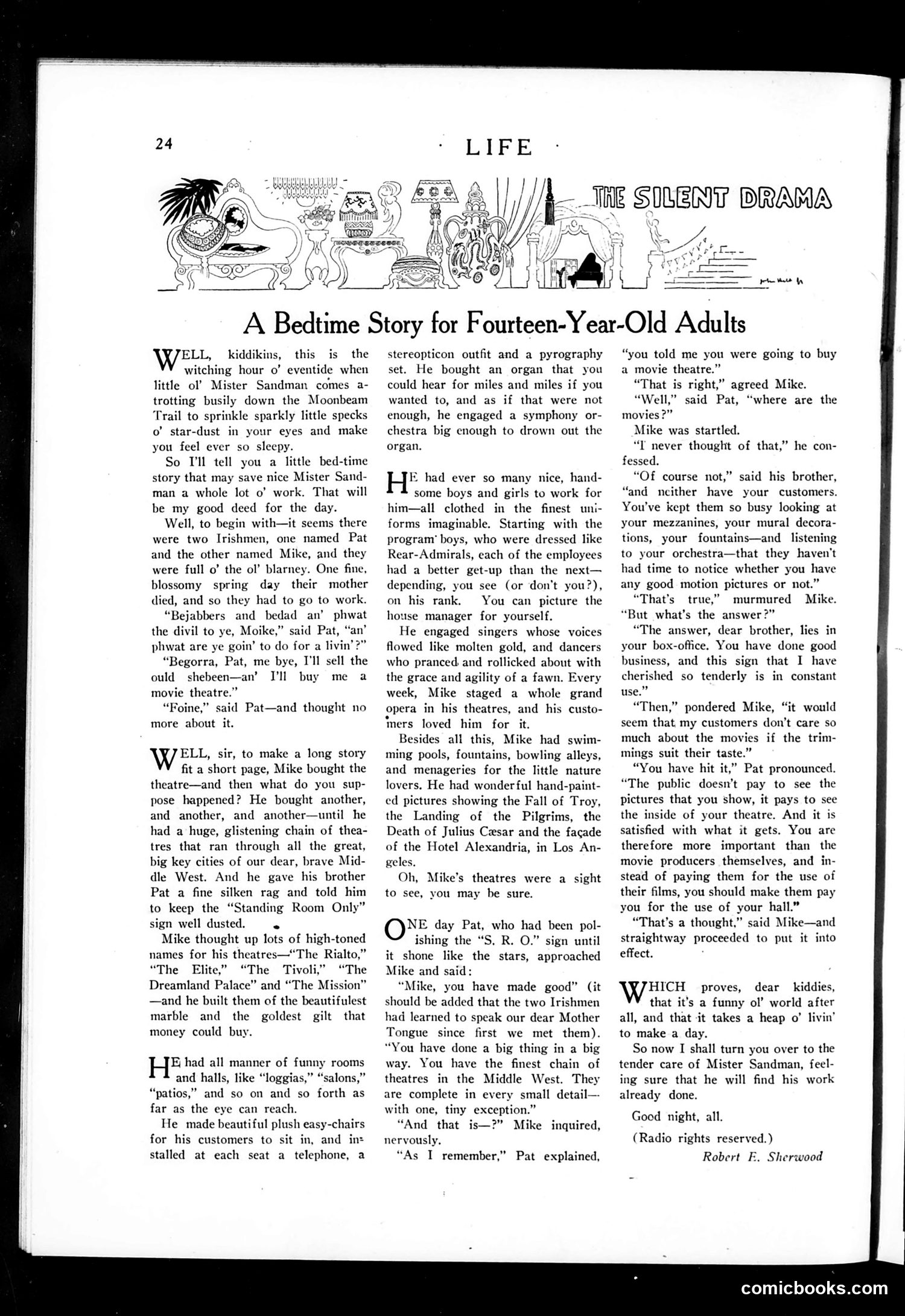
What you’re looking at
This story satirizes the runaway commercial ambition and theatrical excess of the 1920s movie palace era. **The Setup:** Two Irish immigrants, Mike and Pat, represent the archetypal "self-made man" narrative. Mike's modest plan to buy a single movie theater spirals into an empire of ornately decorated palaces across the Midwest. **The Satire:** The humor lies in Mike's obsessive elaboration—marble, gilt, symphony orchestras, swimming pools, hand-painted murals of classical scenes—each detail more extravagant than necessary. The story mocks how entertainment venues had become monuments to excess rather than functional cinemas. The catalog of amenities ("program boys dressed like Rear-Admirals," opera productions weekly) exaggerates real architectural trends of the era's "movie palaces." **The Punchline:** Pat's final observation—that Mike never actually *bought the movie theater* because he was too busy decorating everything—critiques how capitalist ambition becomes self-defeating through endless embellishment, losing sight of the original, simple purpose. This gentle satire targets 1920s consumer culture and architectural grandiosity disguised as improvement.
📄 Transcribed text from this page (OCR, searchable)
Machine-transcribed from the original scan — historical spelling and the odd misread are preserved.
A Bedtime Story for Fourteen-Y ear-Old Adults ELL, kiddikins, this is the witching hour o’ eventide when little ol’ Mister Sandman comes a- trotting busily down the Moonbeam Trail to sprinkle sparkly little specks o’ star-dust in your eyes and make you feel ever so sleepy. So I'll tell you a little bed-time story that may save nice Mister Sand- man a whole lot o’ work. That will be my good deed for the day. Well, to begin with—it seems there were two Irishmen, one named Pat and the other named Mike, and they were full o’ the ol’ blarney. One fine, blossomy spring day their mother died, and so they had to go to work. “Bejabbers and bedad an’ phwat the divil to ye, Moike,” said Pat, “a phwat are ye goin’ to do for a livin'?” “Begorra, Pat, me bye, I'll sell the ould shebeen—an’ I'll buy me a movie theatre.” “Foine,” said Pat—and thought no more about it. ELL, sir, to make a long story fit a short page, Mike bought the theatre—and then what do you sup- pose happened? He bought another, and another, and another—until he had a huge, glistening chain of thea- tres that ran through all the great, big key cities of our dear, brave Mid- dle West. And he gave his brother Pat a fine silken rag and told him to keep the “Standing Room Only” sign well dusted. ° Mike thought up lots of high-toned names for his theatres—“The Rialto,” “The Elite,” “The Tivoli,” “The Dreamland Palace” and “The Mission” —and he built them of the beautifulest marble and the goldest gilt that money could buy. & had all manner of funny rooms and halls, like “loggias,” “salons,” “patios,” and so on and so forth as far as the eye can reach. He made beautiful plush easy-chairs for his customers to sit in, and in= stalled at each seat a telephone, a stereopticon outfit and a pyrography set. He bought an organ that you could hear for miles and miles if you wanted to, and as if that were not enough, he engaged a symphony or- chestra big enough to drown out the organ. FE had ever so many nice, hand- some boys and girls to work for him—all clothed in the finest uni- forms imaginable. Starting with the program’ boys, who were dressed like Rear-Admirals, each of the employees had a better get-up than the next— depending, you see (or don’t you?), on his rank. You can picture the house manager for yourself. He engaged singers whose voices flowed like molten gold, and dancers who pranced. and rollicked about with the grace and agility of a fawn. Every week, Mike staged a whole grand opera in his theatres, and his custo- ‘mers loved him for it. Besides all this, Mike had swim- ming pools, fountains, bowling alleys, and menageries for the little nature lovers. He had wonderful hand-paint- ed pictures showing the Fall of Troy, the Landing of the Pilgrims, the Death of Julius Cesar and the facade of the Hotel Alexandria, in Los An- geles. Oh, Mike’s theatres were a sight to see, you may be sure. NE day Pat, who had been pol- ishing the “S, R. O.” sign until it shone like the stars, approached Mike and said: “Mike, you have made good” (it should be added that the two Irishmen had learned to speak our dear Mother Tongue since first we met them). “You have done a big thing in a big way. You have the finest chain of theatres in the Middle West. They are complete in every small detail— with one, tiny exception.” “And that is—?” Mike inquired, nervously, “As I remember,” Pat explained, “you told me you were going to buy a movie theatre.” “That is right,” agreed Mike. “Well,” said Pat, “where are the movies?” Mike was startled. “T never thought of that,” he con- fessed. “Of course not,” said his brother, “and neither have your customers. You've kept them so busy looking at your mezzanines, your mural decora- tions, your fountains—and listening to your orchestra—that they haven't had time to notice whether you have any good motion pictures or not.” “That's true,” murmured Mike. “But what's the answer?” “The answer, dear brother, lies in your box-office. You have done good business, and this sign that I have cherished so tenderly is in constant use.” “Then,” pondered Mike, “it would seem that my customers don’t care so much about the movies if the trim- mings suit their taste.” “You have hit it,” Pat pronounced. “The public doesn’t pay to see the pictures that you show, it pays to see the inside of your theatre. And it is satisfied with what it gets. You are therefore more important than the movie producers themselves, and in- stead of paying them for the use of their films, you should make them pay you for the use of your hall.” “That's a thought,” said Mike—and straightway proceeded to put it into effect. HICH proves, dear kiddies, that it’s a funny ol’ world after all, and that it takes a heap o’ livin’ to make a day. So now I shall turn you over to the tender care of Mister Sandman, feel- ing sure that he will find his work already done. Good night, all. (Radio rights reserved.) Robert FE. Sherwood comicbooks.com