
Life, 1923-07-26 · page 30 of 42
Life — July 26, 1923 — page 30: what you’re looking at
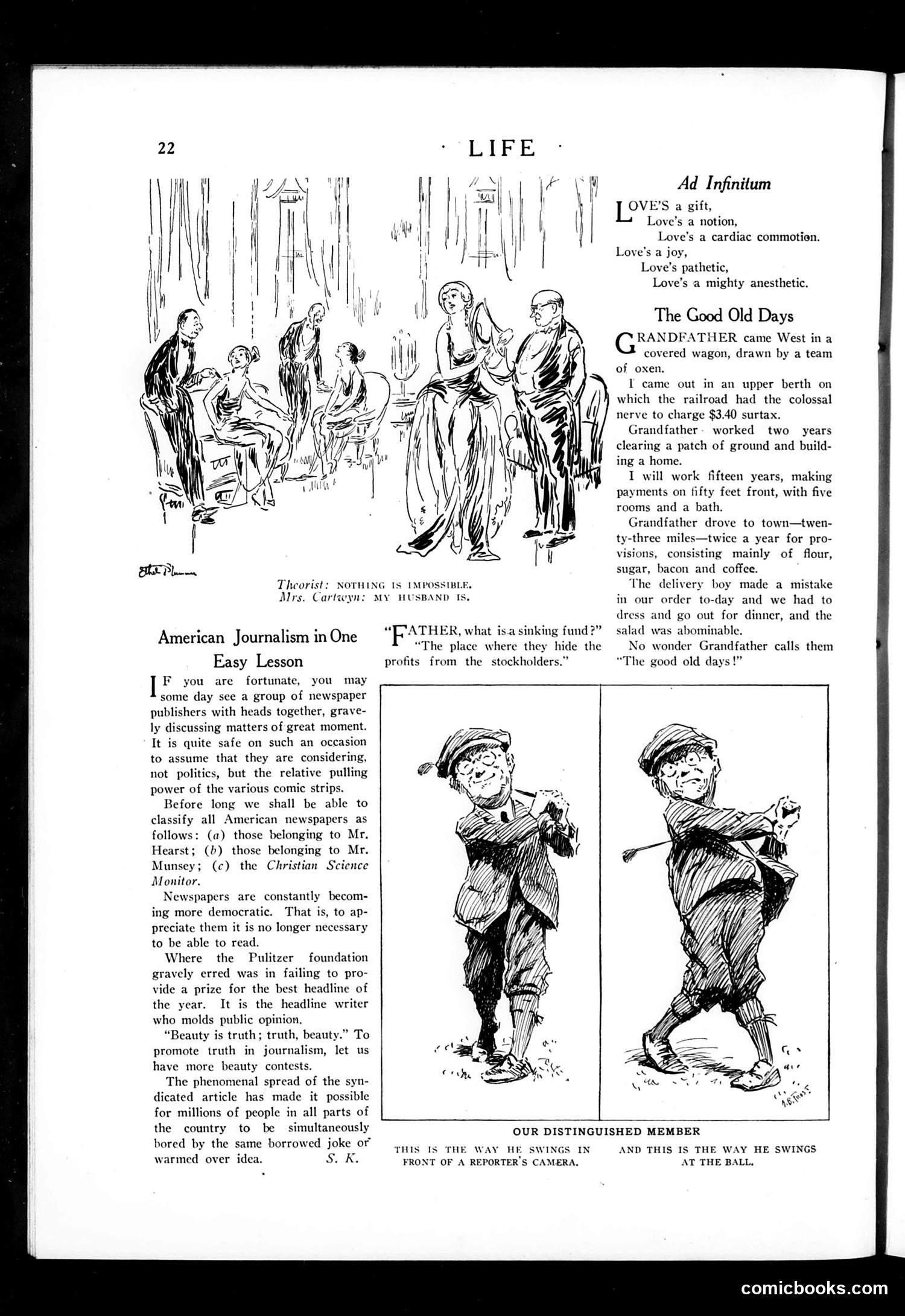
What you’re looking at
This page contains multiple satirical pieces mocking early 20th-century American society and journalism: **"American Journalism in One Easy Lesson"** critiques newspaper publishers' obsession with comic strips over serious content, suggesting newspapers are becoming less democratic and readable. It mocks the Pulitzer Prize for overlooking headline writers' influence on public opinion, and attacks syndicated articles for spreading boring content nationwide. **The "Sinking Fund" joke** is a father-son exchange: a child asks about financial terminology, and the father cynically defines it as where corporations hide profits from shareholders—reflecting skepticism about corporate transparency. **"The Good Old Days"** nostalgically contrasts grandfather's pioneer hardships (wagon travel, homesteading) with the narrator's modern "struggles" (mortgage payments, demanding delivery boys, poor salad)—satire on contemporary complaint and softness. **"Our Distinguished Member"** shows contrasting golf swings: one posed for cameras, one actual—mocking public figures' performance of competence versus reality. All pieces reflect characteristic Life magazine humor: irreverent, class-conscious, skeptical of institutions and modern affectations.
📄 Transcribed text from this page (OCR, searchable)
Machine-transcribed from the original scan — historical spelling and the odd misread are preserved.
Theorist: NOTHING IS IMPOSSIBLE, Mrs. Cartwyn: MY HUSBAND Is, American Journalism in One Easy Lesson F you are fortunate, may some day see a group of newspaper publishers with heads together, grave- ly discussing matters of great moment. It is quite safe on such an occasion to assume that they are considering, not politics, but the relative pulling power of the various comic strips. Before long we shall be able to classify all American newspapers as follows: (a) those belonging to Mr. Hearst; (b) those belonging to Mr. Munsey; (c) the Christian Science Monitor. Newspapers are constantly becom- ing more democratic. That is, to ap- preciate them it is no longer necessary to be able to read. Where the Pulitzer foundation gravely erred was in failing to pro- vide a prize for the best headline of the year. It is the headline writer who molds public opinion, “Beauty is truth; truth, beauty.” To promote truth in journalism, let us have more beauty contests. The phenomenal spread of the syn- dicated article has made it possible for millions of people in all parts of the country to be simultaneously bored by the same borrowed joke or warmed over idea. S. Ky you “TATHER, what is.a sinking fund?” “The place where they hide the profits from the stockholders.” Ad Infinitum [LOvES a gift, Love's a notion, Love's a cardiac commotion. Love's a joy, Love's pathetic, Love’s a mighty anesthetic. The Good Old Days RANDFATHER came West in a covered wagon, drawn by a team of oxen. 1 came out in an upper berth on which the railroad had the colossal nerve to charge $3.40 surtax. Grandfather. worked two years clearing a patch of ground and build- ing a home. I will work fifteen years, making payments on fifty feet front, with five rooms and a bath. Grandfather drove to town—twen- ty-three miles—twice a year for pro- visions, con ng mainly of flour, sugar, bacon and coffee. The delivery boy made a mistake in our order to-day and we had to dress and go out for dinner, and the salad was abominable. No wonder Grandfather calls them “The good old days!” OUR DISTINGUISHED MEMBER THIS IS THE WAY HE SWINGS IN FRONT OF A REPORTER'S CAMERA, AND THIS IS THE WAY HE SWINGS AT THE BALL, comicbooks.com