
Life, 1923-07-26 · page 26 of 42
Life — July 26, 1923 — page 26: what you’re looking at
What you’re looking at
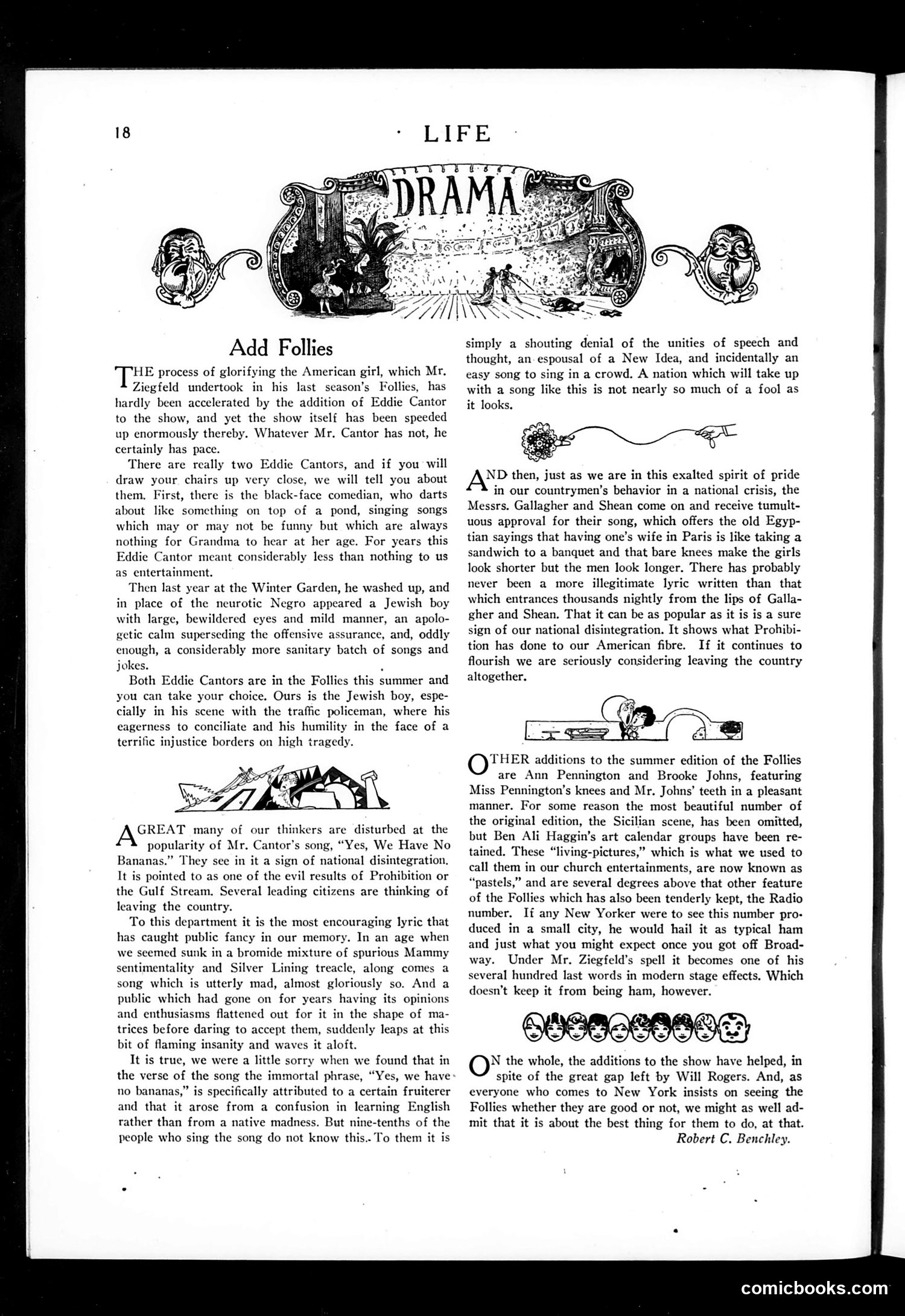
This is a theater review of the Ziegfeld Follies (the famous American musical revue), specifically critiquing Eddie Cantor's addition to the show. The author distinguishes between Cantor's two stage personas: his "blackface comedian" character (offensive by modern standards) versus his newer "Jewish boy" persona, preferring the latter for its humility and comedic timing. The review praises the popular novelty song "Yes, We Have No Bananas" as refreshingly absurd—a break from sentimental clichés that reveals Americans aren't "fools." However, it then contradicts itself by condemning Gallagher and Shean's equally absurd song about Paris and women's knees as proof of national decline caused by Prohibition, sarcastically threatening to leave the country. The satire's point: the author mocks inconsistent cultural criticism and arbitrary standards of taste—praising identical nonsense in one song while condemning it in another, exposing how subjective judgments of "good" entertainment actually are.
📄 Transcribed text from this page (OCR, searchable)
Machine-transcribed from the original scan — historical spelling and the odd misread are preserved.
Add Follies THE process of glorifying the American girl, which Mr. gfeld undertook in his last season’s Follies, has hardly been accelerated by the addition of Eddie Cantor to the show, and yet the show itself has been speeded up enormously thereby. Whatever Mr. Cantor has not, he certainly has pace. There are really two Eddie Cantors, and if you will draw your chairs up very close, we will tell you about them. First, there is the black-face comedian, who darts about like something on top of a pond, singing songs which may or may not be funny but which are always nothing for Grandma to hear at her age. For years this Eddie Cantor meant considerably less than nothing to us as entertainment. Then last year at the Winter Garden, he washed up, and in place of the neurotic Negro appeared a Jewish boy with large, bewildered eyes and mild manner, an apolo- getic calm superseding the offensive assurance, and, oddly enough, a considerably more sanitary batch of songs and jokes. . Both Eddie Cantors are in the Follies this summer and you can take your choice. Ours is the Jewish boy, espe- cially in his scene with the traffic policeman, where his eagerness to conciliate and his humility in the face of a terrific injustice borders on high tragedy. JXCREAT many of our thinkers are disturbed at the popularity of Mr. Cantor’s song, “Yes, We Have No Bananas.” They see in it a sign of national disintegration, It is pointed to as one of the evil results of Prohibition or the Gulf Stream, Several leading citizens are thinking of leaving the country. To this department it is the most encouraging lyric that has caught public fancy in our memory. In an age when we seemed sunk in a bromide mixture of spurious Mammy sentimentality and Silver Lining treacle, along comes a song which is utterly mad, almost gloriously so. And a public which had gone on for years having its opinions and enthusiasms flattened out for it in the shape of ma- trices before daring to accept them, suddenly leaps at this bit of flaming insanity and waves it aloft. It is true, we were a little sorry when we found that in the verse of the song the immortal phrase, “Yes, we have no bananas,” is specifically attributed to a certain fruiterer and that it arose from a confusion in learning English rather than from a native madness. But nine-tenths of the people who sing the song do not know this..To them it is simply a shouting denial of the unities of speech and thought, an-espousal of a New Idea, and incidentally an easy song to sing in a crowd. A nation which will take up with a song like this is not nearly so much of a fool as it looks, ND then, just as we are in this exalted spirit of pride in our countrymen’s behavior in a national crisis, the Messrs. Gallagher and Shean come on and receive tumult- uous approval for their song, which offers the old Egyp- tian sayings that having one’s wife in Paris is like taking a sandwich to a banquet and that bare knees make the girls look shorter but the men look longer. There has probably never been a more illegitimate lyric written than that which entrances thousands nightly from the lips of Galla- gher and Shean. That it can be as popular as it is is a sure sign of our national disintegration. It shows what Prohibi- tion has done to our American fibre. If it continues to flourish we are seriously considering leaving the country altogether. THER additions to the summer edition of the Follies are Ann Pennington and Brooke Johns, featuring Miss Pennington’s knees and Mr. Johns’ teeth in a pleasant manner. For some reason the most beautiful number of the original edition, the Sicilian scene, has been omitted, but Ben Ali Haggin’s art calendar groups have been re- tained. These “living-pictures,” which is what we used to call them in our church entertainments, are now known as “pastels,” and are several degrees above that other feature of the Follies which has also been tenderly kept, the Radio number. If any New Yorker were to see this number pro- duced in a small city, he would hail it as typical ham and just what you might expect once you got off Broad- way. Under Mr. Ziegfeld’s spell it becomes one of his several hundred last words in modern stage effects. Which doesn’t keep it from being ham, however. N the whole, the additions to the show have helped, in spite of the great gap left by Will Rogers. And, as everyone who comes to New York insists on seeing the Follies whether they are good or not, we might as well ad- mit that it is about the best thing for them to do, at that. Robert C. Benchley. comicbooks.com