
A complete issue · 36 pages · 1923
Life — January 11, 1923
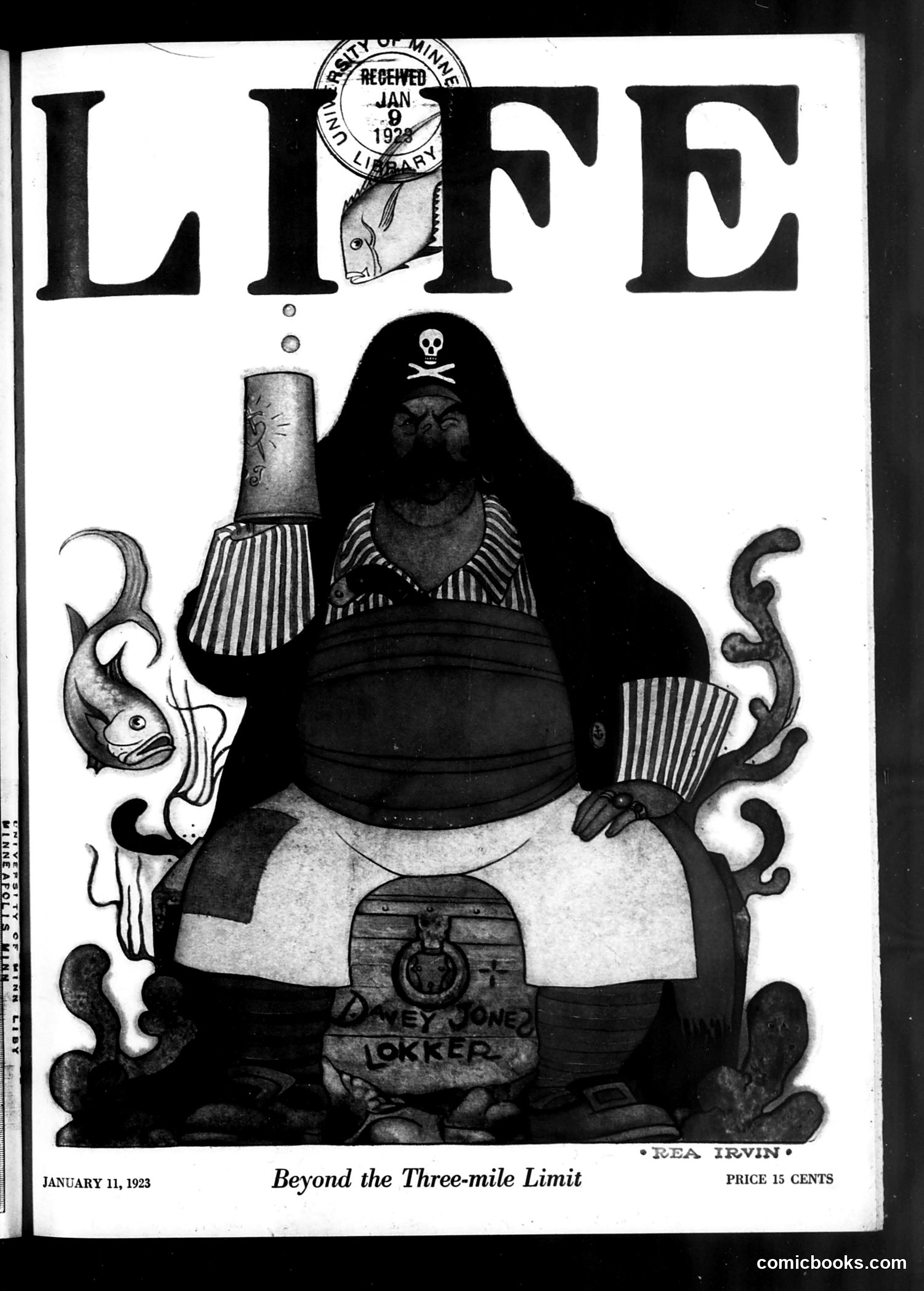
This Life magazine cover satirizes Prohibition-era smuggling. The grotesque pirate figure represents a bootlegger operating "beyond the three-mile limit"—the international waters boundary where U.S. law couldn't reach. Smugglers would anchor ships there to supply illegal alcohol to American consumers. The character wears skull-and-crossbones imagery, equating bootleggers with pirates. The barrel marked "HOOCH" and decorative fish suggest maritime smuggling operations. The satirical point: organized crime was thriving in the lawless zone created by Prohibition (1920-1933), turning ordinary bootleggers into criminals as dangerous as historical pirates. The artwork is credited to Rea Irwin.
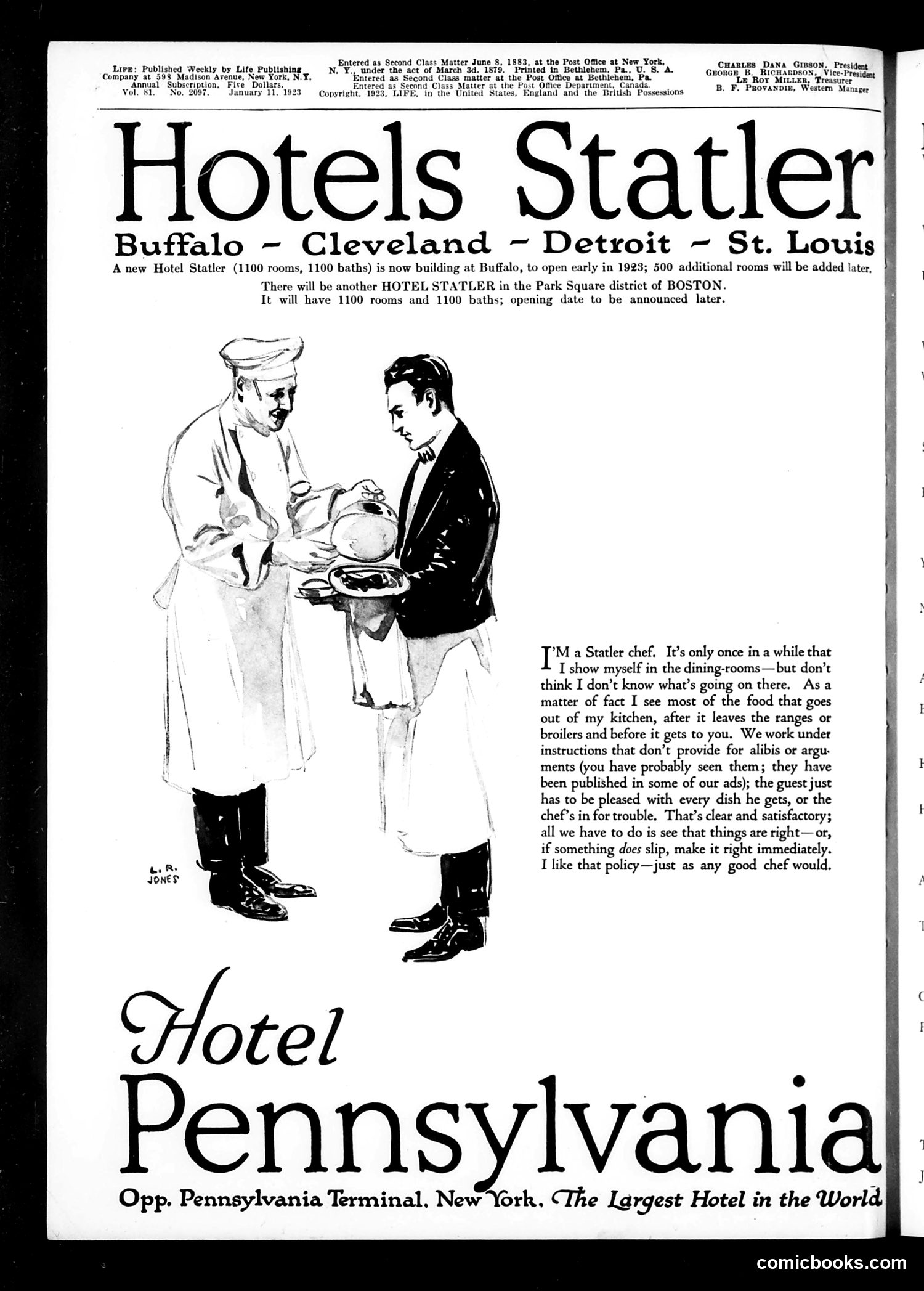
This page is primarily **advertising**, not satire or political commentary. The top half advertises **Hotels Statler**, a hotel chain operating in Buffalo, Cleveland, Detroit, and St. Louis, with new locations opening in Buffalo (1923) and Boston. The illustration shows a chef presenting a dish to a well-dressed man, with the chef's accompanying text emphasizing quality control—guests are satisfied or the chef takes responsibility. The bottom half advertises the **Hotel Pennsylvania** in New York, claiming to be "The Largest Hotel in the World" and located opposite Pennsylvania Terminal. Both ads use professional illustrations to convey luxury and reliability, reflecting 1920s hospitality marketing. There is no political satire or social commentary present—this is straightforward commercial promotion.
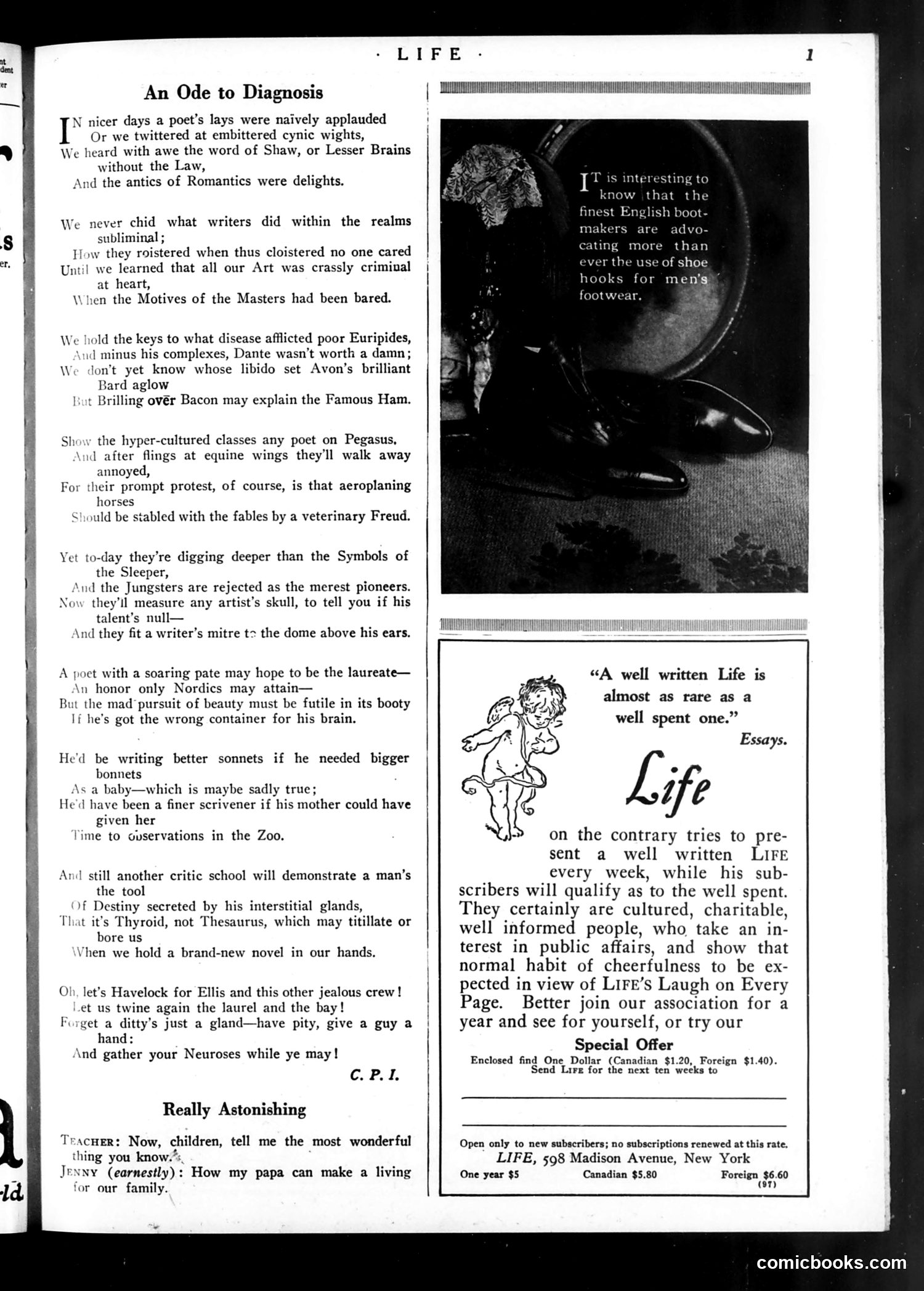
The left page contains "An Ode to Diagnosis," a satirical poem by C.P.I. mocking literary criticism of the era. It critiques intellectuals who diagnose writers' psychological flaws—attributing their work to Freudian complexes, thyroid conditions, or other pseudo-scientific explanations rather than evaluating the writing itself. References to "Euripides," "Bacon," and "Pegasus" invoke classical literature, while mentions of "Symbols of the Sleeper" and "Jungsters" likely reference Freudian and Jungian psychology trends popular in the 1920s. The satire suggests critics obsess over authors' mental states rather than artistic merit. The right page shows a shoe photograph and contains an advertisement for Life magazine's subscription service, featuring a cherub illustration and promoting their "Laugh on Every Page."
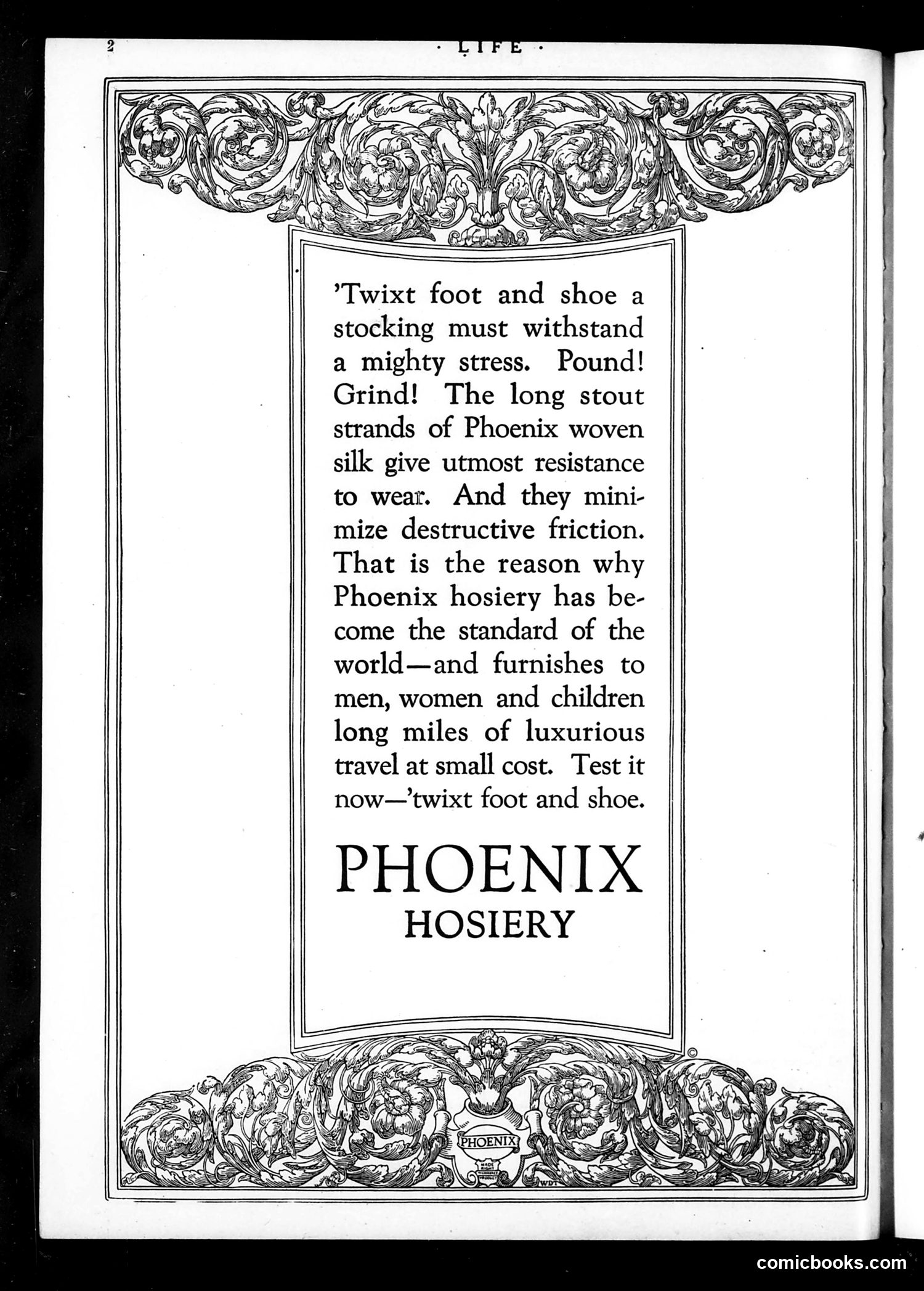
This page is **not a cartoon or satire** — it's a straightforward **advertisement** for Phoenix Hosiery, likely from the early 20th century. The ad uses vivid language to market stockings as durable and comfortable. The phrase "'Twixt foot and shoe" emphasizes the product's position against the body. Key selling points include: - Durability ("withstand a mighty stress") - Quality materials ("Phoenix woven silk") - Resistance to wear and friction - Affordability ("small cost") - Universal appeal ("men, women and children") The ornate decorative border is typical of period advertising design. There's no political satire here — just vintage marketing that emphasizes product reliability as its main virtue to consumers.
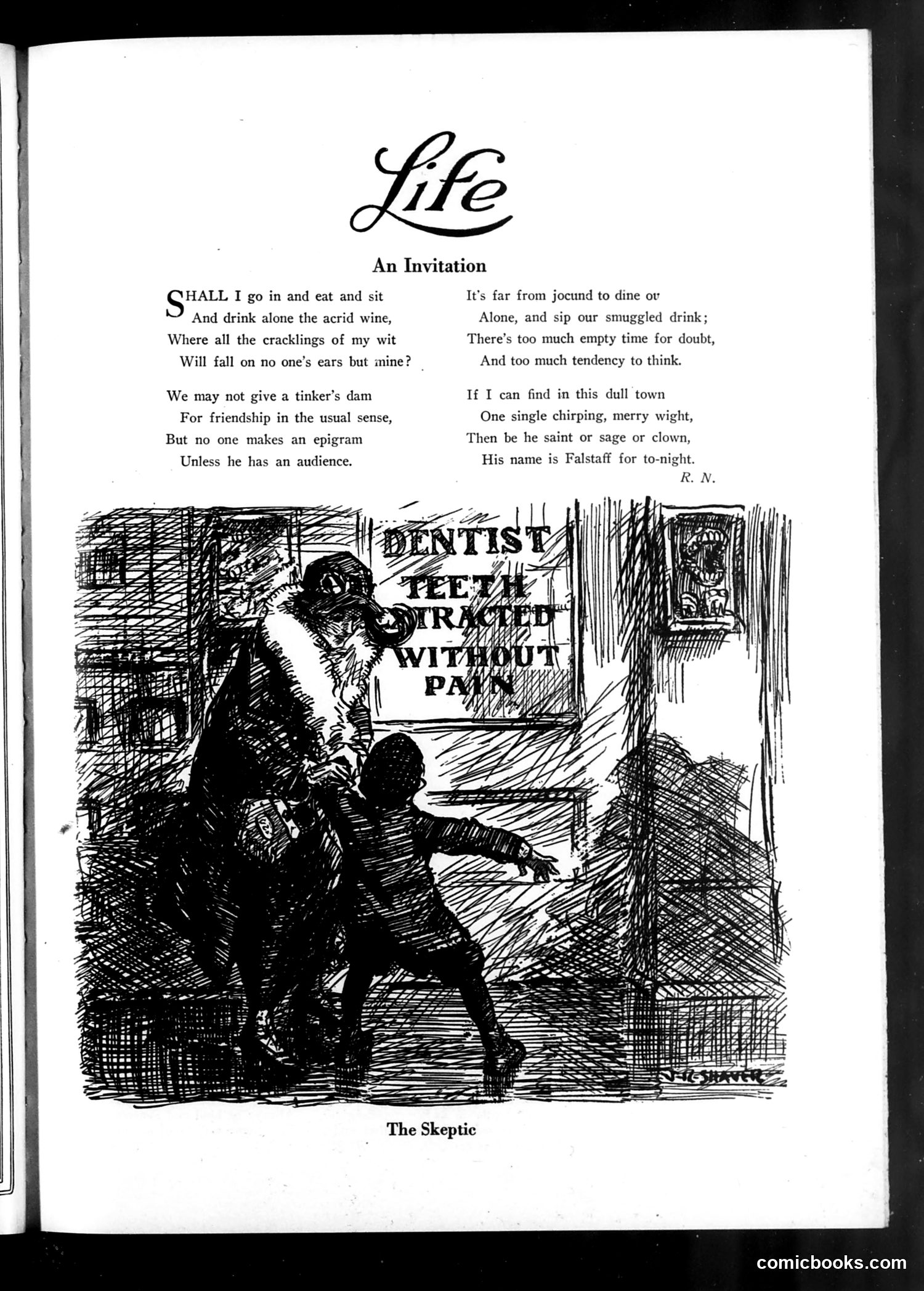
**Content:** A poem titled "An Invitation" (credited to R.N.) and an illustration labeled "The Skeptic." **The Poem:** Debates whether to dine alone or seek company. It questions whether wit or conversation matters without an audience, ultimately inviting someone named "Falstaff" for the evening—a literary reference to Shakespeare's jovial character. **The Illustration:** Shows two figures looking at a dentist's sign advertising "TEETH EXTRACTED WITHOUT PAIN." One figure appears skeptical or uncertain, which explains the cartoon's title. **The Satire:** The cartoon mocks the common advertising claim that dental extraction could be painless—treating this dubious promise with gentle humor. The skeptical expression of the onlooker represents the reader's own reasonable doubt about such exaggerated medical marketing claims.
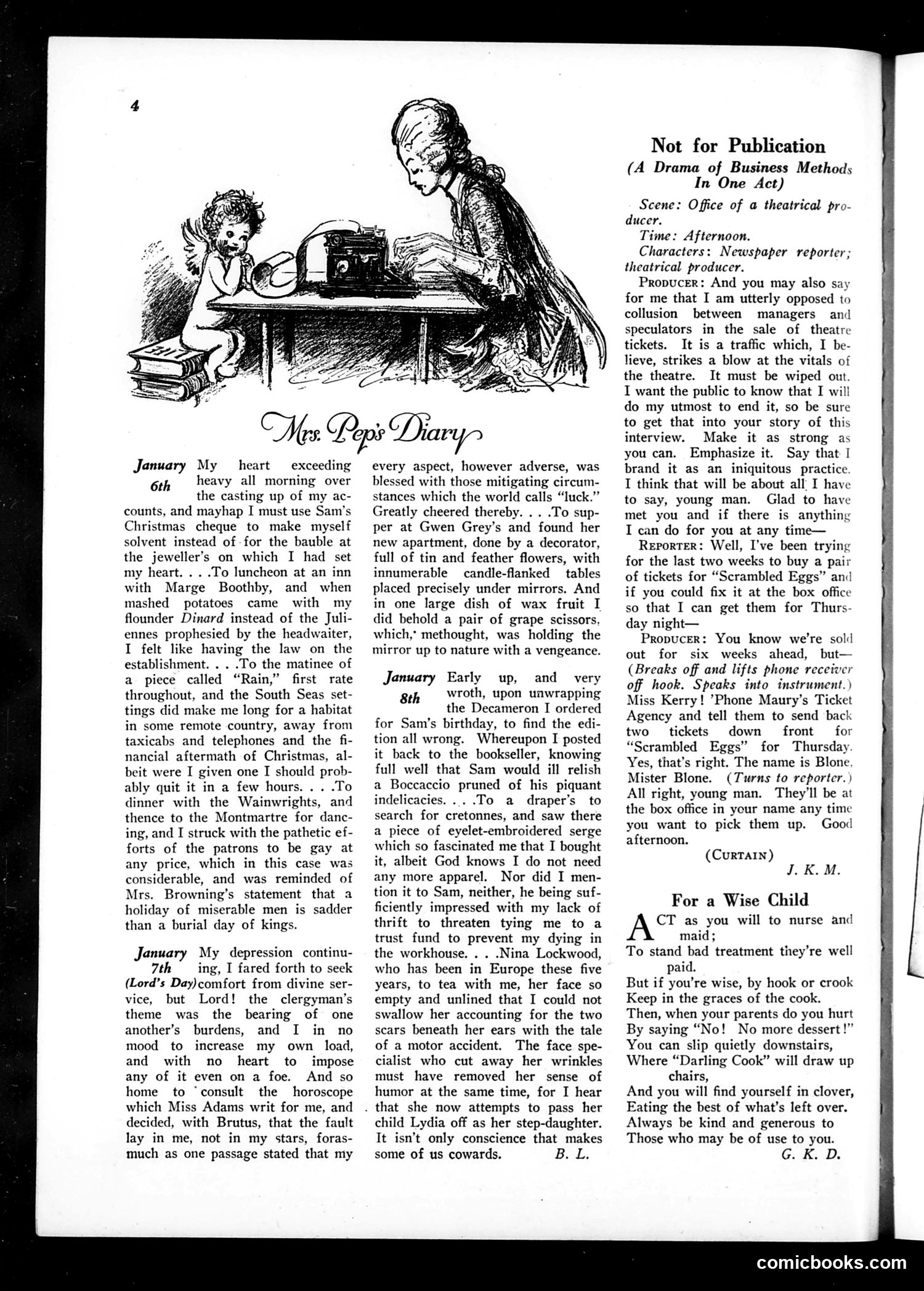
The page contains three distinct pieces of satirical content: **"Mrs. Pepys Diary"** (left): A mock diary entry in the style of Samuel Pepys, satirizing theatrical business practices. The diarist complains about collusion between theater managers and ticket speculators—a contemporary scandal. The satire mocks both the affected literary style and the corrupt ticket-scalping industry. **"Not for Publication"** (top right): A one-act satirical drama depicting a confrontation between a newspaper reporter and theatrical producer. The producer attempts to manipulate the reporter's story, offering bribes and making threats to suppress unfavorable coverage. This satirizes press corruption and entertainment industry control of media narratives. **"For a Wise Child"** (bottom): A brief poem about parenting advice. The content collectively critiques theatrical industry dishonesty and media manipulation—issues apparently prominent in the period this *Life* magazine was published.
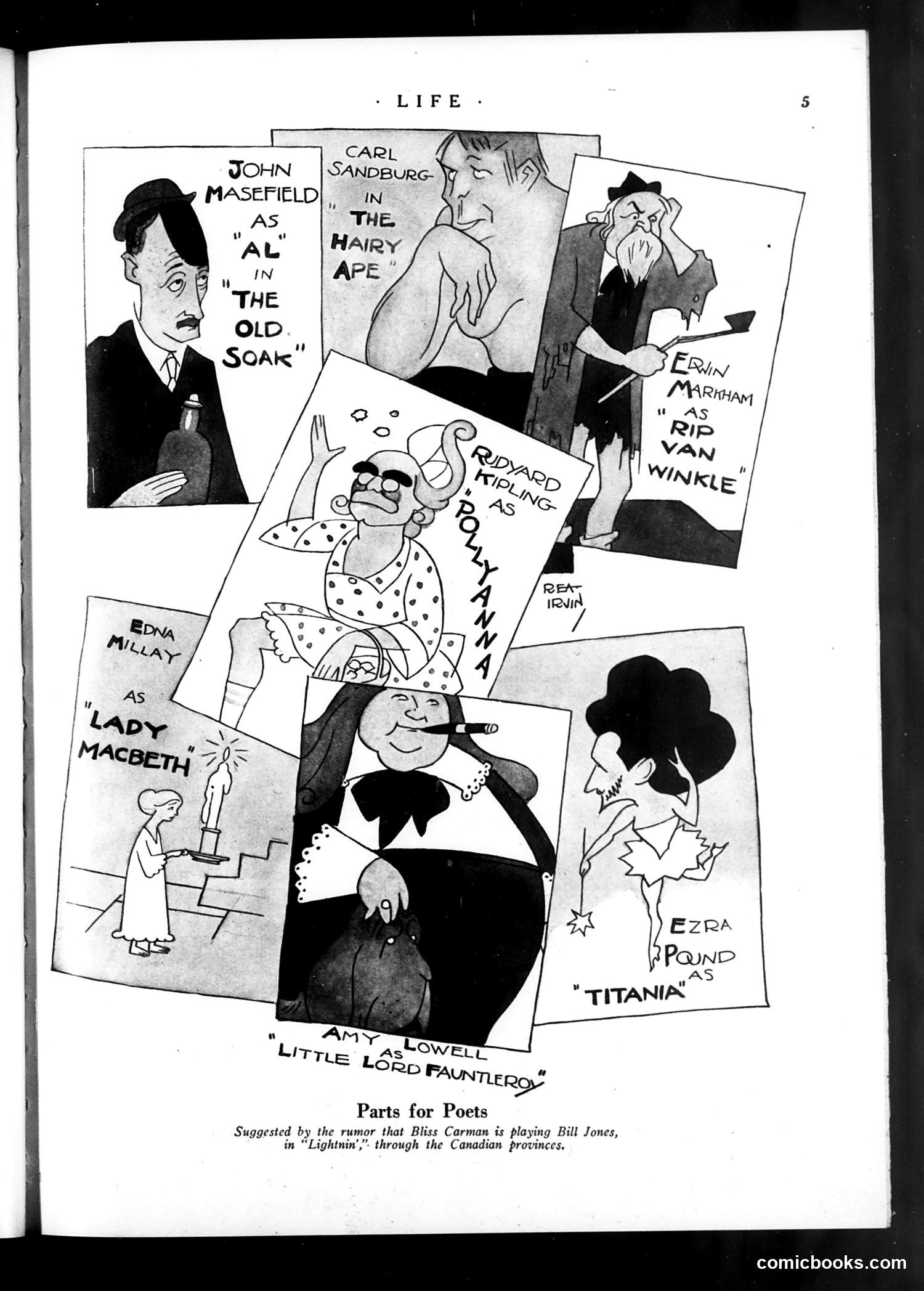
This satirical page proposes casting famous poets in theatrical roles, lampooning both the poets and contemporary plays/literature. The caricatures pair literary figures with character names: - **John Masefield** as "Al" in "The Old Soak" (a popular period play about an alcoholic) - **Carl Sandburg** as "The Hairy Ape" - **Rudyard Kipling** as "Pollyanna" - **Erwin Markham** as "Rip Van Winkle" - **Edna Millay** as "Lady Macbeth" - **Amy Lowell** as "Little Lord Fauntleroy" - **Ezra Pound** as "Titania" (from *A Midsummer Night's Dream*) The humor derives from absurd mismatches between each poet's public image/work and their assigned role—suggesting these serious literary figures would be ridiculously miscast. The caption notes this is "suggested by the rumor that Bliss Carman is playing Bill Jones" in a theatrical production touring Canadian provinces.
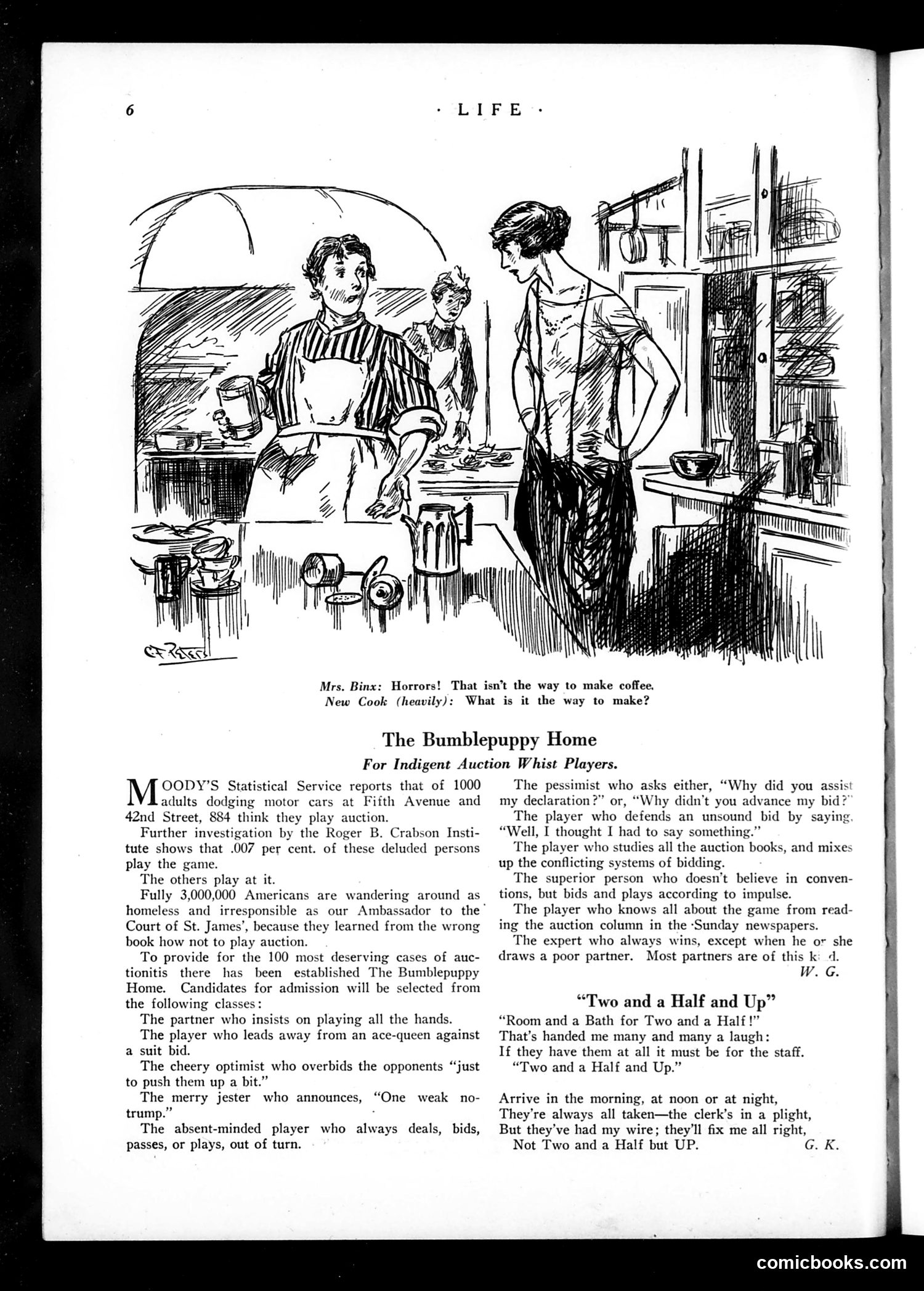
This satirical piece mocks auction bridge (a card game popular in the early 20th century). The cartoon shows a kitchen scene where "Mrs. Binx" corrects a "New Cook" about coffee-making—a humorous opening to an article targeting incompetent bridge players. The text identifies various problematic player types: those insisting on playing every hand, poor leaders, overconfident optimists, pessimists, and absent-minded players. The "Bumblepuppy Home" is a fictional refuge proposed for these 3 million "homeless" Americans who play bridge incorrectly. The satire ridicules both bridge obsession (Moody's reports Americans lodge at "Fifth Avenue and 42nd Street" playing) and the players' absurd incompetence. The second poem humorously describes accommodations ("Two and a Half and Up") for these undesirable cardplayers.
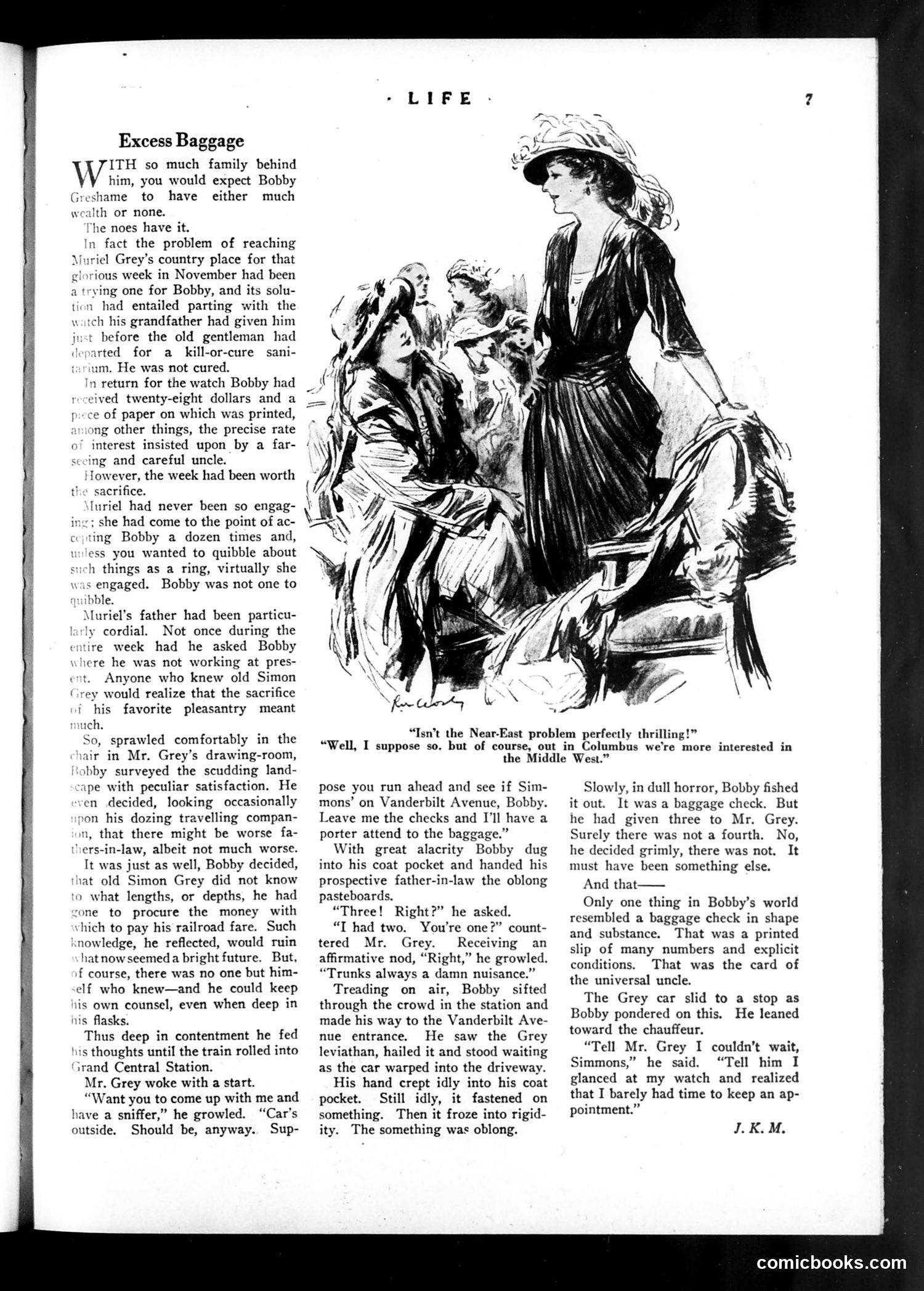
This story-illustration depicts a social comedy about Bobby Gresham, a young man from a wealthy family. The narrative concerns Bobby's attempt to retrieve a valuable watch his grandfather gave him, which requires a trip to the family's country estate. The illustration shows well-dressed figures in period clothing (appears early 20th century). The satire targets the complications of upper-class life—specifically how family obligations, travel logistics, and financial entanglements create absurd burdens. The "excess baggage" metaphor refers metaphorically to the social and familial complications Bobby carries. The story emphasizes themes of inheritance, responsibility, and the sometimes-ridiculous constraints of maintaining wealthy family status and propriety.
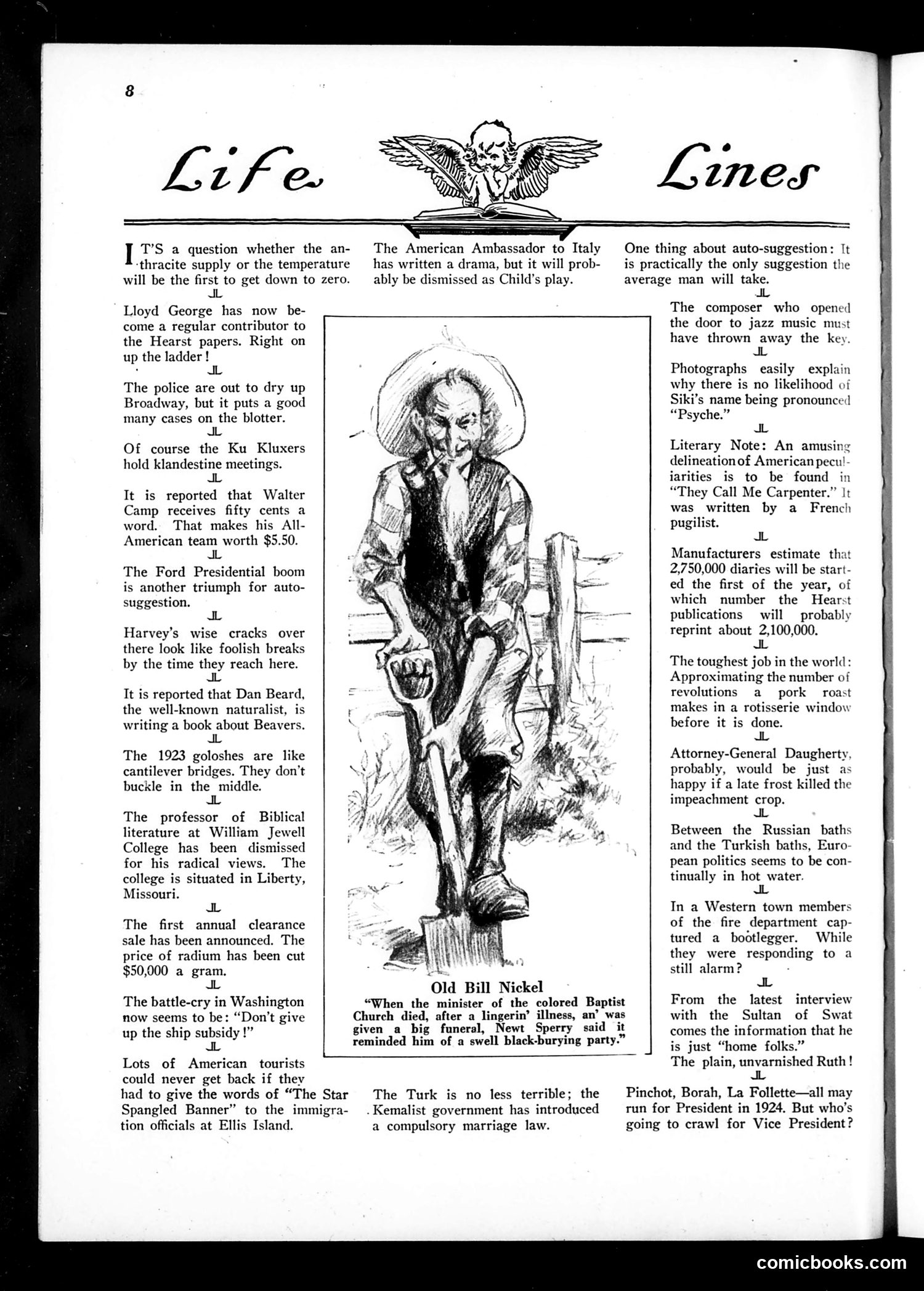
The central illustration depicts a ragged, elderly man labeled "Old Bill Nickel." The caption explains he was a colored Baptist Church minister who died after a "lingerin' illness," and his funeral included notable attendees: Newt Sperry and others who "reminded him of a swell black-burying party." This appears to be a satirical piece on African American funeral customs and social life, using dialect humor typical of 1920s-era publications. The character type—poor, elderly Black minister—was a common subject of period satire, though the specific historical figure "Old Bill Nickel" is unclear. The humor relies on period stereotypes about funeral culture and vernacular speech patterns.
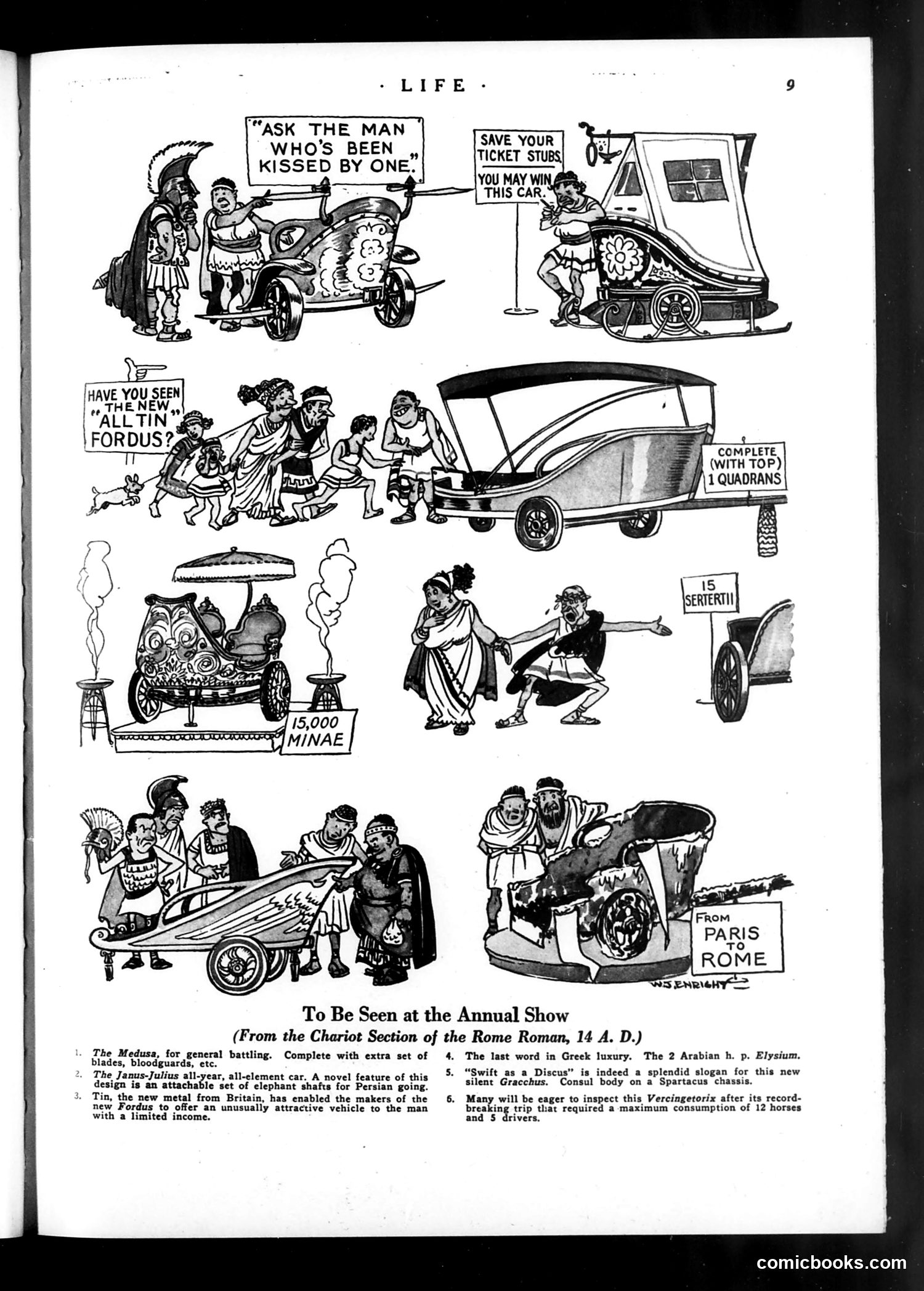
This page satirizes Roman chariot and vehicle innovations, presented as if advertising a contemporary auto show. The cartoons humorously reimagine ancient Roman transportation using modern car-show language and promotions. The sketches reference specific Roman vehicles: "The Medusa" (ornate chariot), "The Janus-Julius" (all-weather car), and "Tin, the new metal from Britain" (featuring elephant shafts—a Persian innovation). Other panels show elaborate parade chariots and luxury vehicles with comedic price tags ("15,000 MINAE") and promotional slogans ("Swift as a Discus," "Save your ticket stubs"). The satire compares ancient Roman engineering ambitions to modern automobile marketing hype, suggesting that vanity-driven vehicle design is timeless. The pseudo-historical setting allows social commentary on contemporary car culture through ancient Rome's lens.
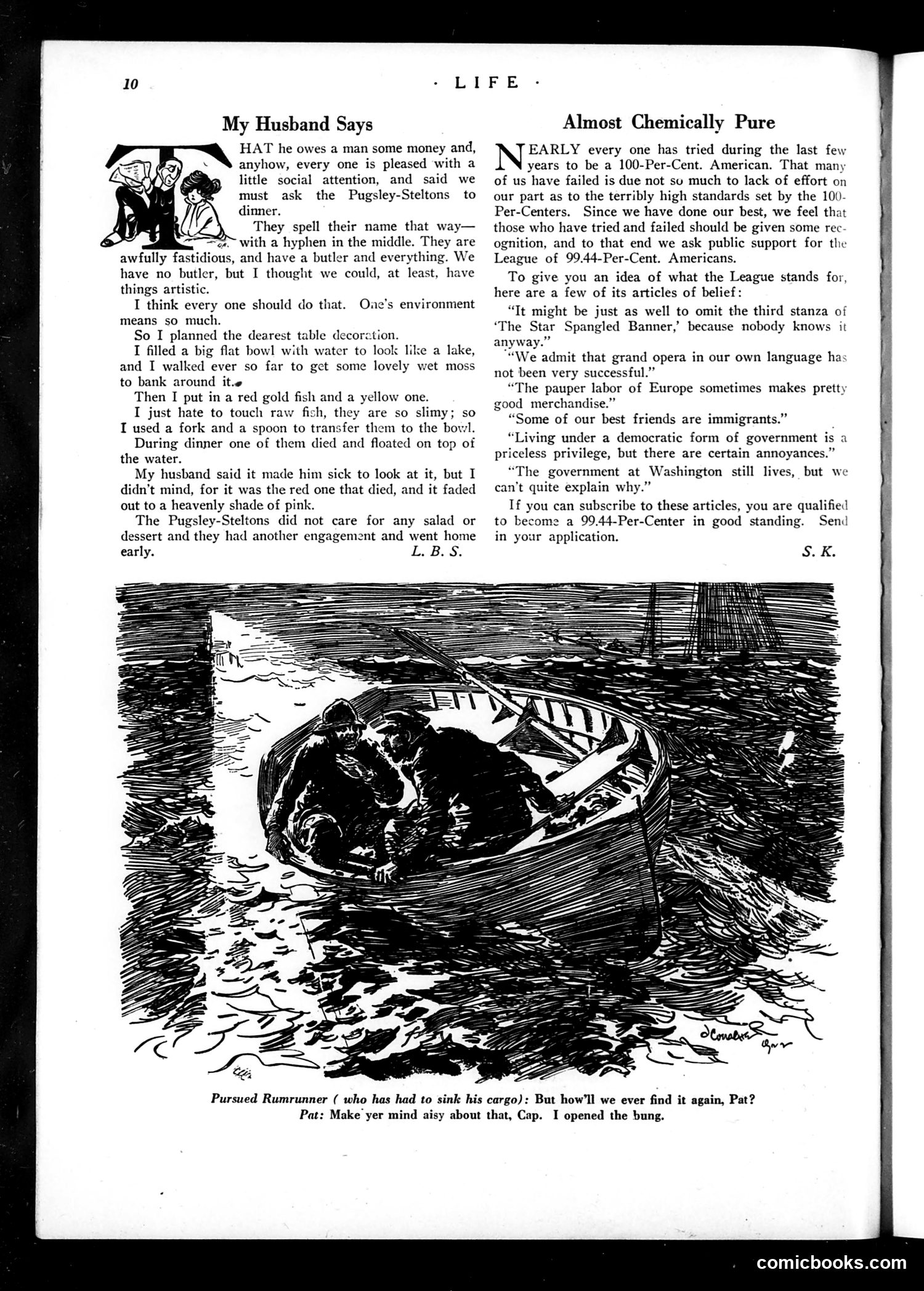
This page contains two distinct pieces: **Left Column - "My Husband Says":** A humorous domestic anecdote (signed L.B.S.) about a wife's failed dinner party. She attempted to impress guests (the Pugsley-Steltons) with artistic table decoration using a fish bowl and goldfish, but the experiment backfired when a fish died during dinner, creating an awkward moment. **Right Column - "Almost Chemically Pure":** An article about the "99.44-Per-Cent American" movement, discussing efforts to be authentically American. It quotes various perspectives on American identity, immigration, and government, with some gentle satire about nationalist standards and the difficulty of achieving complete "purity." **Bottom Illustration:** A cartoon showing two men in a rowboat, one asking how they'll retrieve their sunken cargo. The caption references a "Pursued Rumrunner," indicating Prohibition-era bootlegging humor—the boat had to dump illegal alcohol ("cargo") to avoid capture.
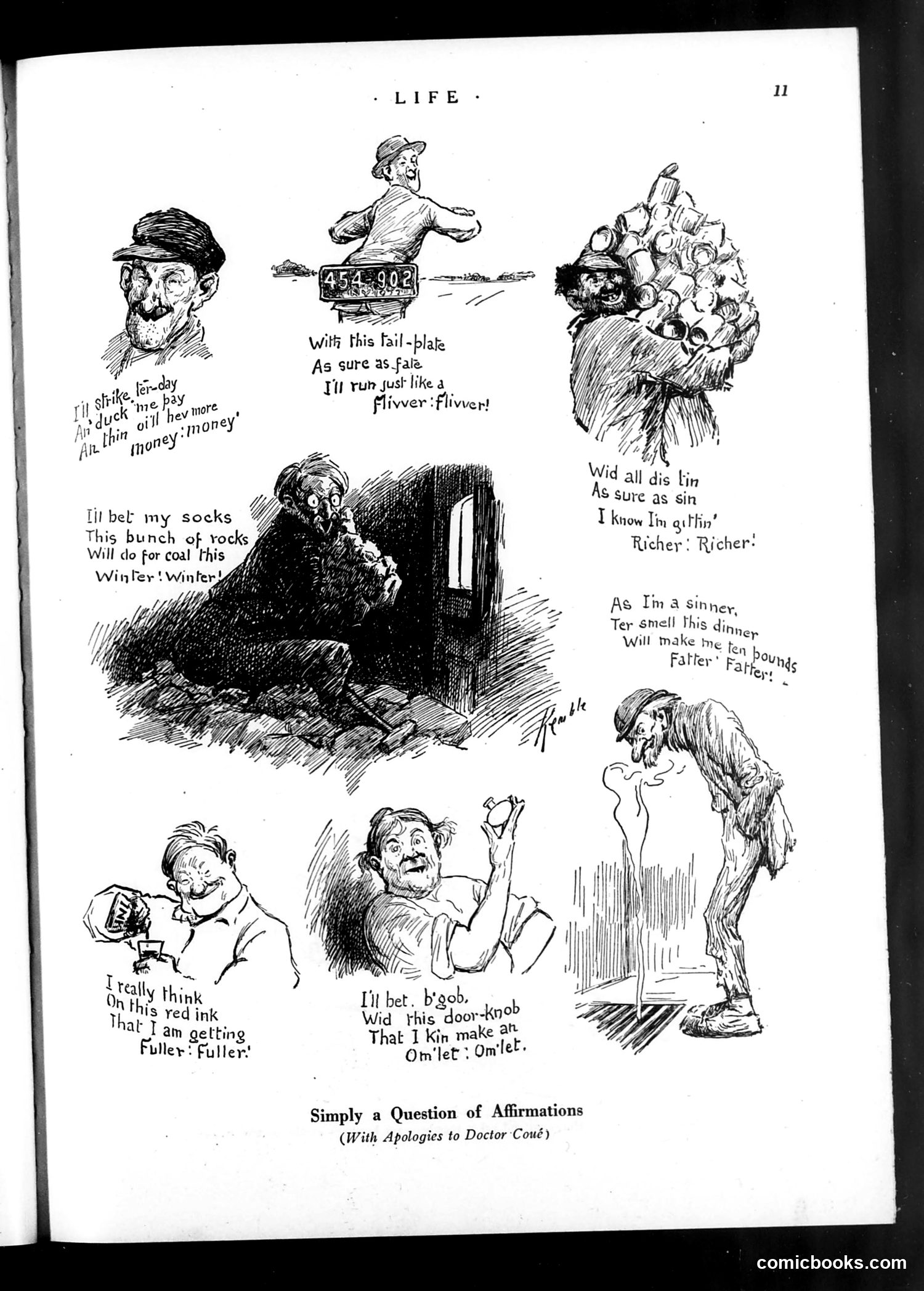
This satirical page from *Life* magazine depicts various working-class and poor men making optimistic affirmations about their dire circumstances—what appears to be a commentary on the psychological coping mechanisms of the economically disadvantaged. Each figure makes a hopeful statement despite obvious hardship: a man betting his socks will sustain him through winter, another claiming a tail-plate will make him rich, someone asserting a doorknob will become an omelet. The subtitle references "Doctor Coué," likely alluding to Émile Coué's early-20th-century "autosuggestion" self-help movement, which promoted positive affirmations as cure-alls. The satire suggests that mere wishful thinking cannot overcome genuine poverty—that affirmations alone cannot transform material deprivation into prosperity.
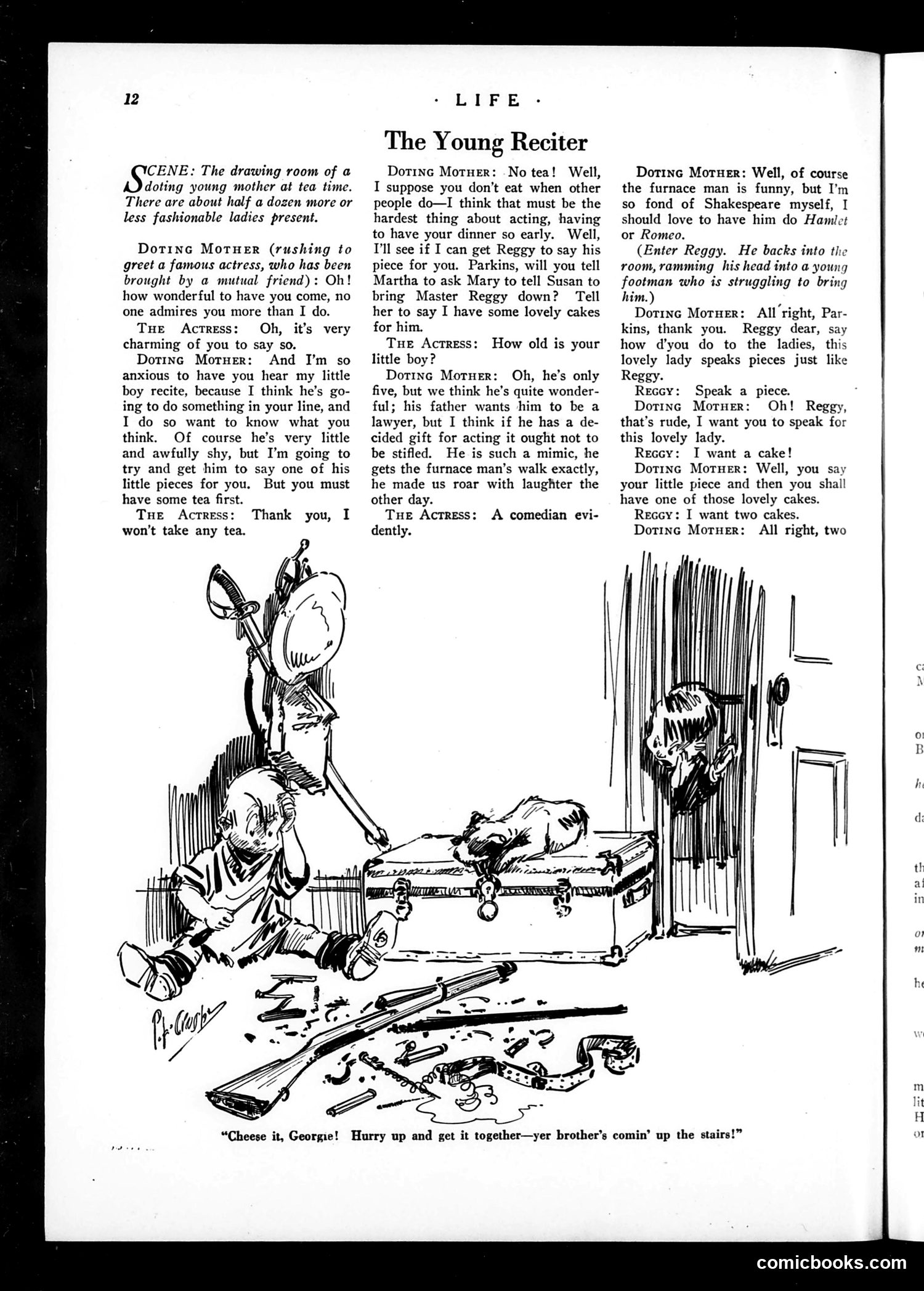
This is a comedic sketch about a stage mother pushing her young son into theatrical performance. The "Doting Mother" pressures her reluctant five-year-old to recite dramatic monologues—mentioning *Hamlet* and *Romeo*—before fashionable society ladies at a drawing room gathering. The humor centers on the child's honest priorities: he wants cake, not Shakespeare. The illustration shows the boy surrounded by theatrical chaos and scattered props, captured mid-mischief while his mother coaches him relentlessly. The satire targets the Victorian-era practice of ambitious parents exploiting talented children for social prestige. The boy's practical resistance to his mother's theatrical ambitions—demanding cakes instead—represents common-sense childhood rebelling against pretentious adult expectations. It's gentle mockery of pushy stage parents and their young performers.
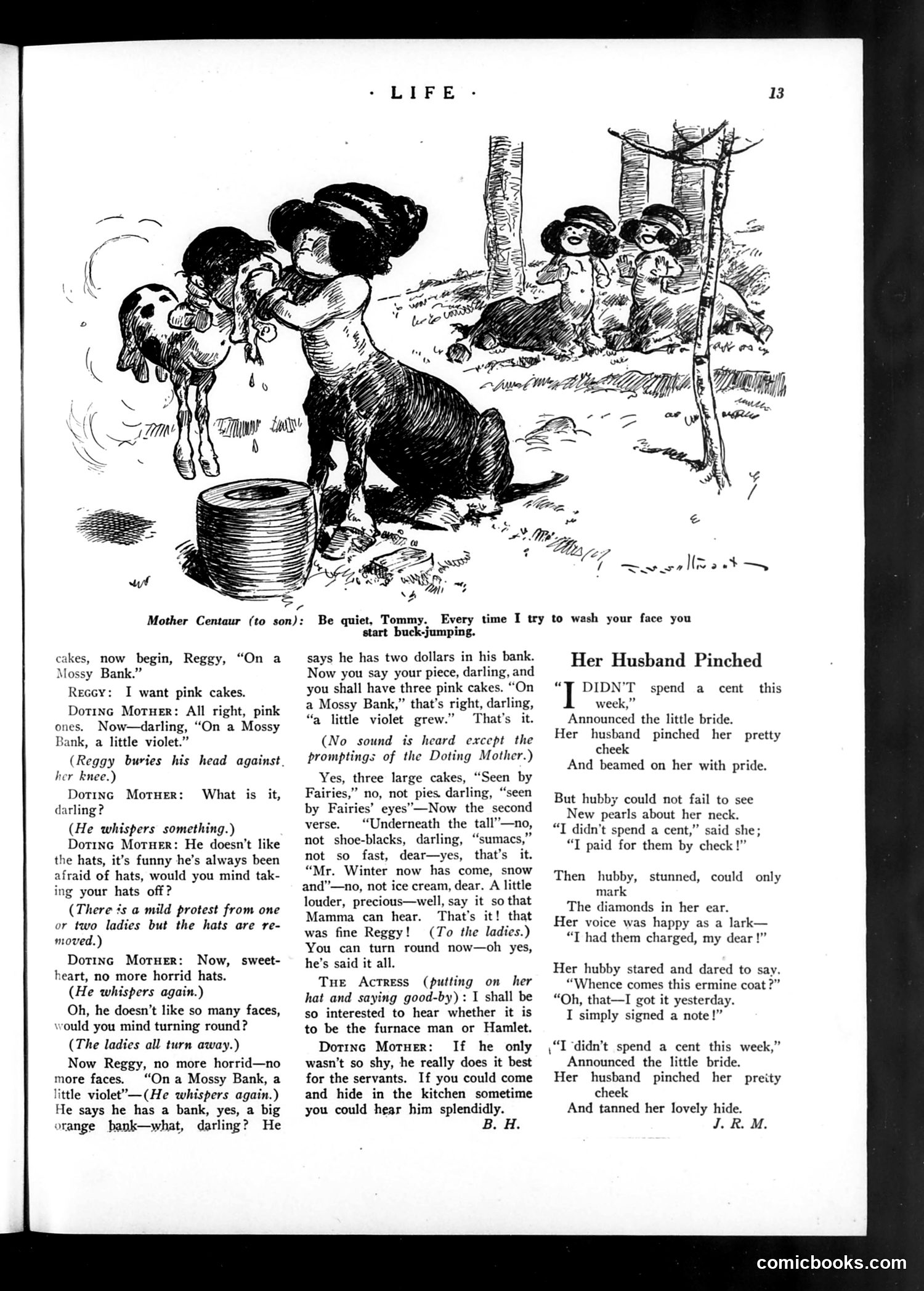
This page contains two separate pieces: **Top illustration:** A sketch showing a mother (labeled "Mother Centaur") attempting to wash a young centaur's face while other centaurs watch. The dialogue reveals the joke: the mother struggles because "every time I try to wash your face you start buck-jumping" — a pun on centaurs' horse nature combined with children's resistance to bathing. This is absurdist humor playing on the mythological creature's dual nature. **Bottom section:** A poem titled "Her Husband Pinched" about newlyweds. The husband boasts he "didn't spend a cent this week" while his wife displays new jewelry and a fur coat. She reveals she paid for everything "by check," implying she's spending his money anyway. The satire targets early 20th-century marital dynamics and the illusion of financial control in marriages. Both pieces use gentle, domestic humor typical of *Life*'s style.
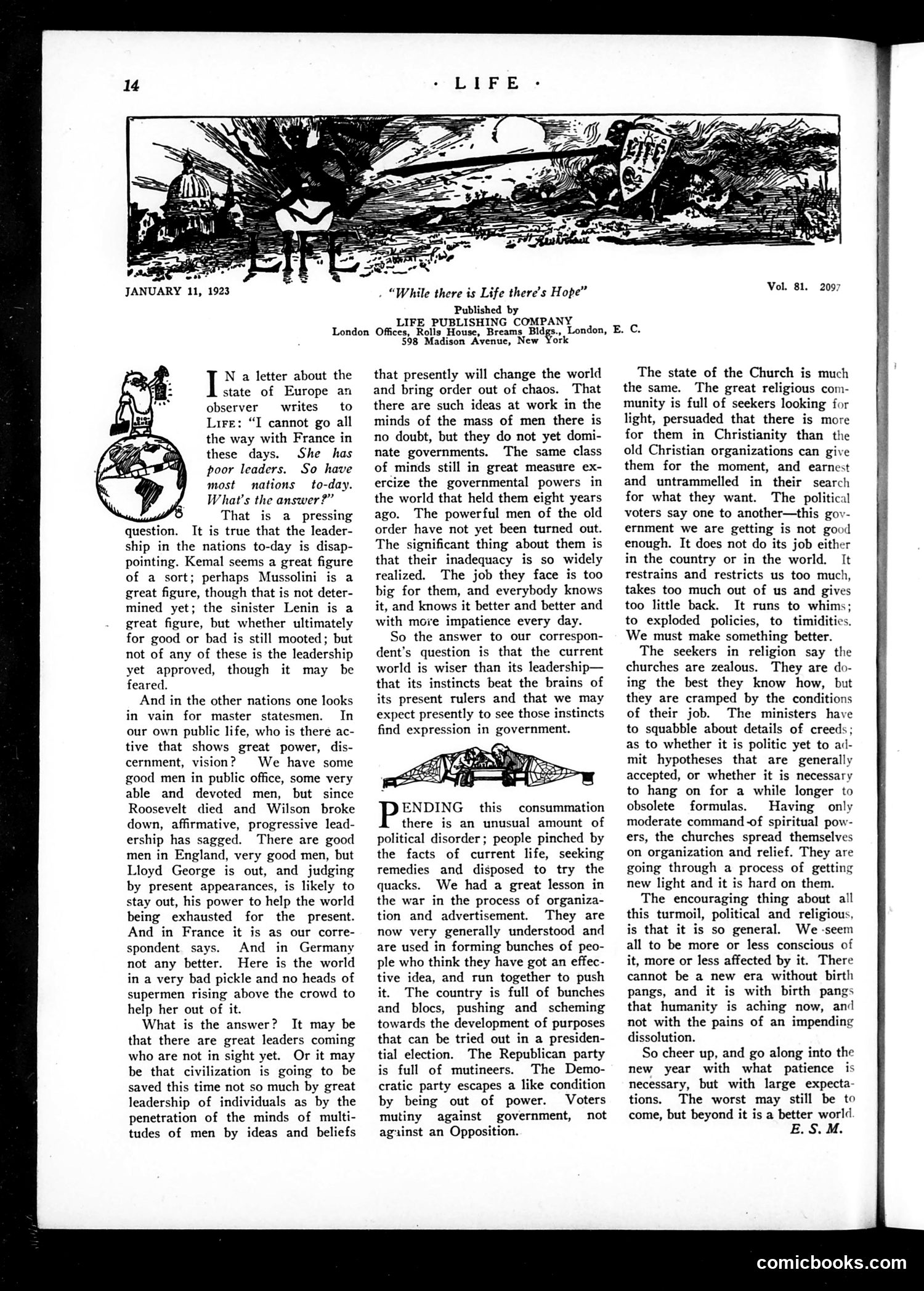
This editorial page features a header illustration depicting a chaotic global scene with destruction and hope imagery, captioned "While there is Life there's Hope." The main article discusses European political instability and leadership crises. It references **Kemal** (likely Mustafa Kemal Atatürk) as a significant emerging figure, while critiquing current world leaders' inadequacy in addressing post-World War I chaos. The piece argues that real change requires ideological penetration of mass consciousness rather than great-man leadership alone. It addresses political disorder across multiple nations—mentioning France, England, and the Republican and Democratic parties in America—suggesting widespread governmental failure. The author advocates for hope and patience regarding spiritual and religious renewal as solutions to civilization's problems.
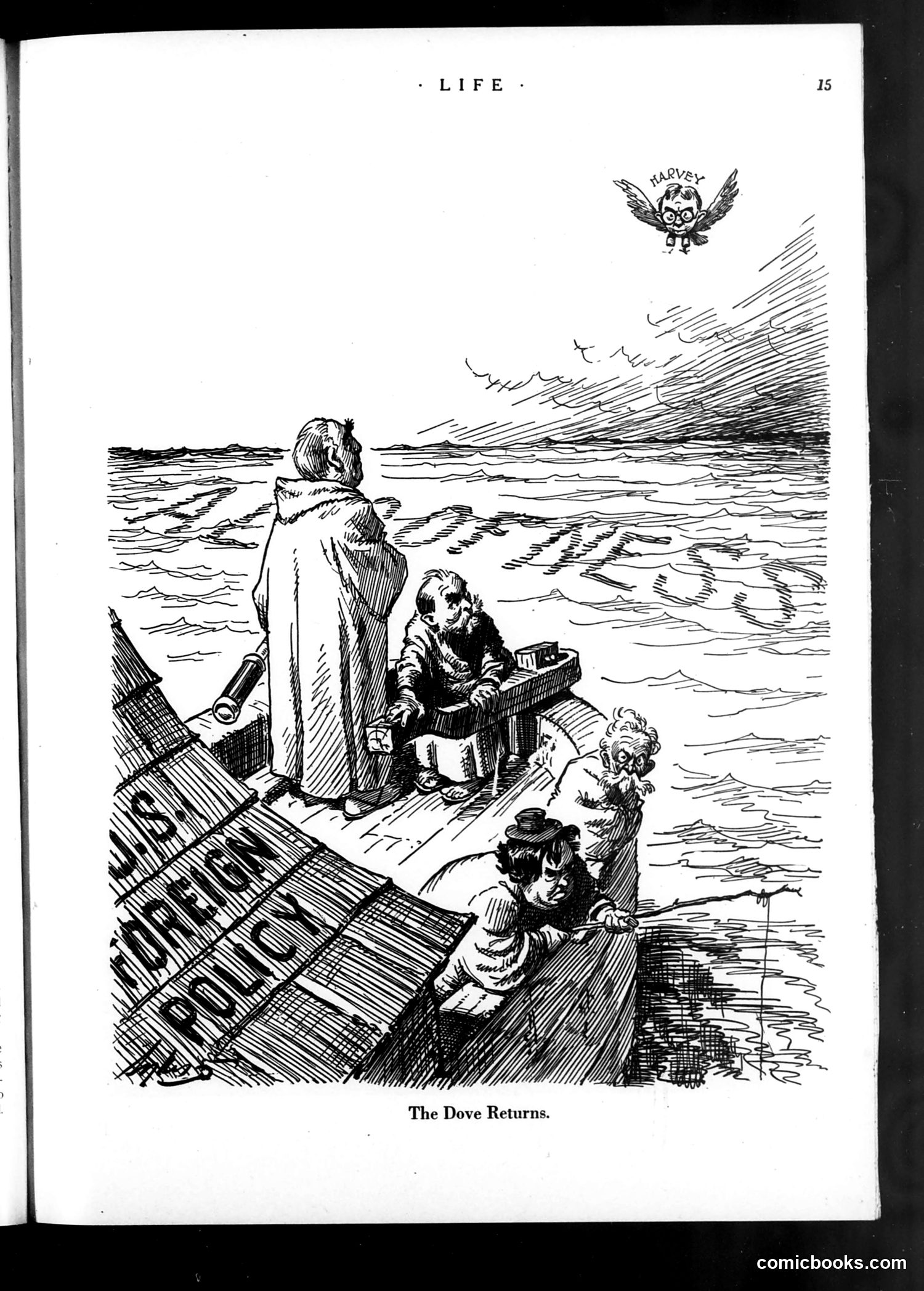
This illustration depicts a biblical scene from Noah's Ark—specifically the moment when the dove returns after being sent to scout for dry land following the flood. The figures shown are Noah (the bearded man standing) and his family aboard the ark, gazing upward as the dove (visible at top with the Harvey signature/logo) approaches. The satire likely references peace negotiations or a diplomatic breakthrough of the era, using the dove as a traditional symbol of peace. The "return" of the dove suggests successful resolution of conflict, making this a commentary on contemporary political events. Without the publication date visible, the specific historical context—which war or dispute is referenced—remains unclear, though the reference to Noah's deliverance implies themes of salvation or safe harbor from turmoil.
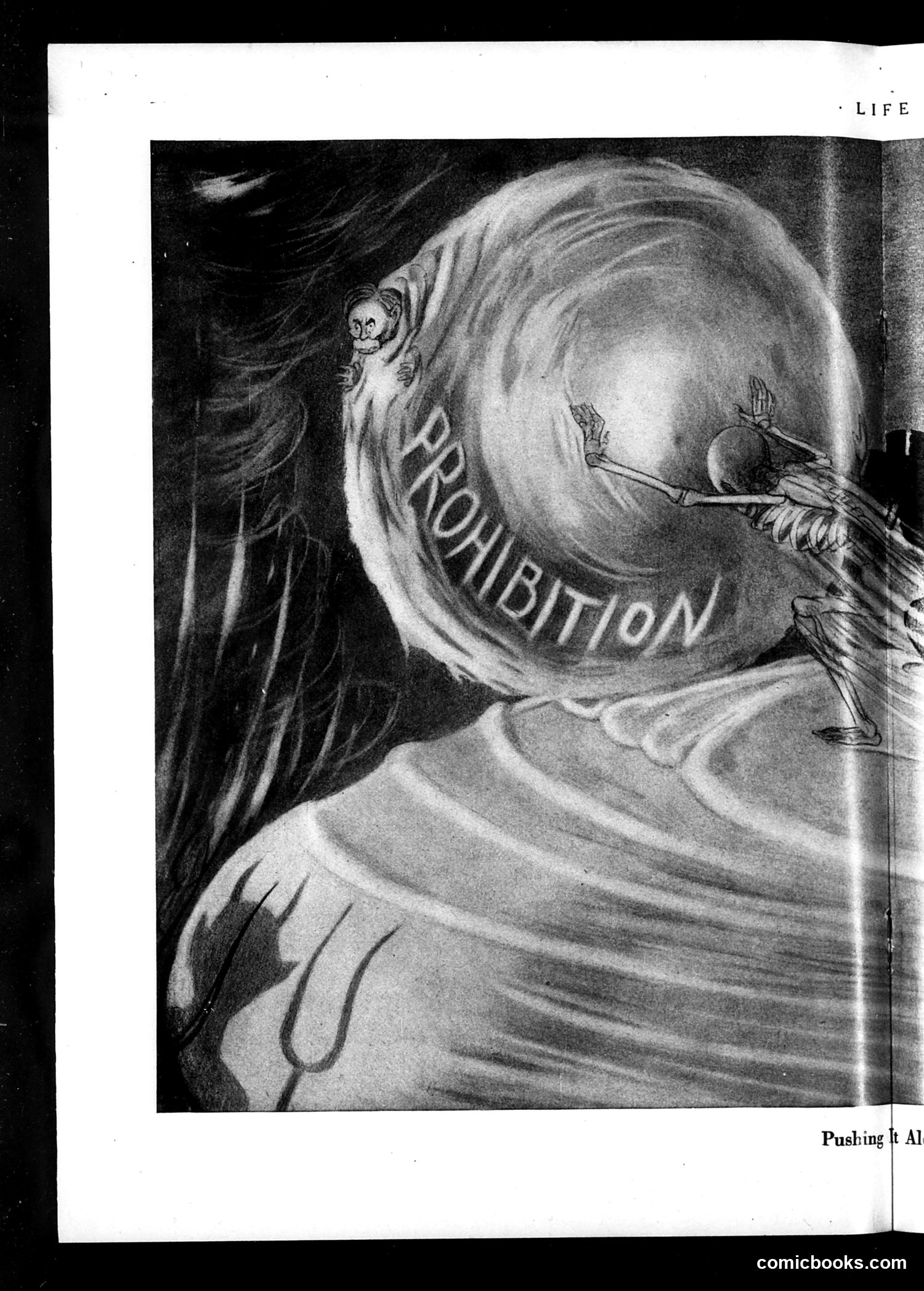
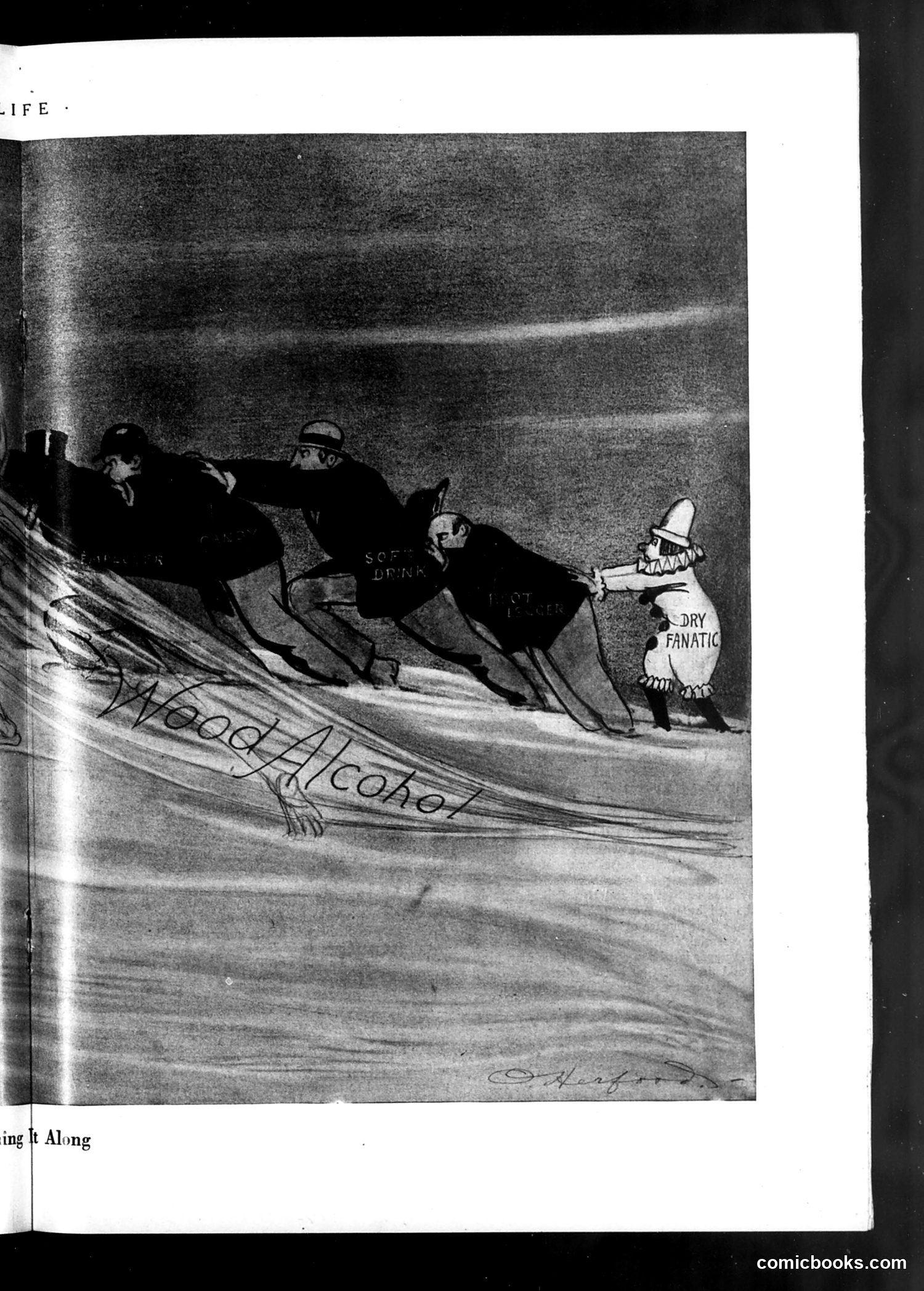
This appears to be a satirical cartoon about Prohibition enforcement. The image shows figures labeled "Dry Fanatic" pulling or dragging what appears to be a boat or vessel labeled "Prohibition" through rough waters. The text visible includes "Bootlegger" and references to Prohibition enforcement. The cartoon likely critiques overzealous Prohibition advocates ("dry fanatics") attempting to maintain alcohol bans despite widespread resistance and illegal smuggling ("bootlegging"). The rough waters suggest the difficulty and turbulence of enforcing such unpopular legislation. This reflects early-to-mid 20th-century American debates over Prohibition's effectiveness and the conflict between temperance crusaders and those opposing alcohol restrictions—a contentious political issue of that era.
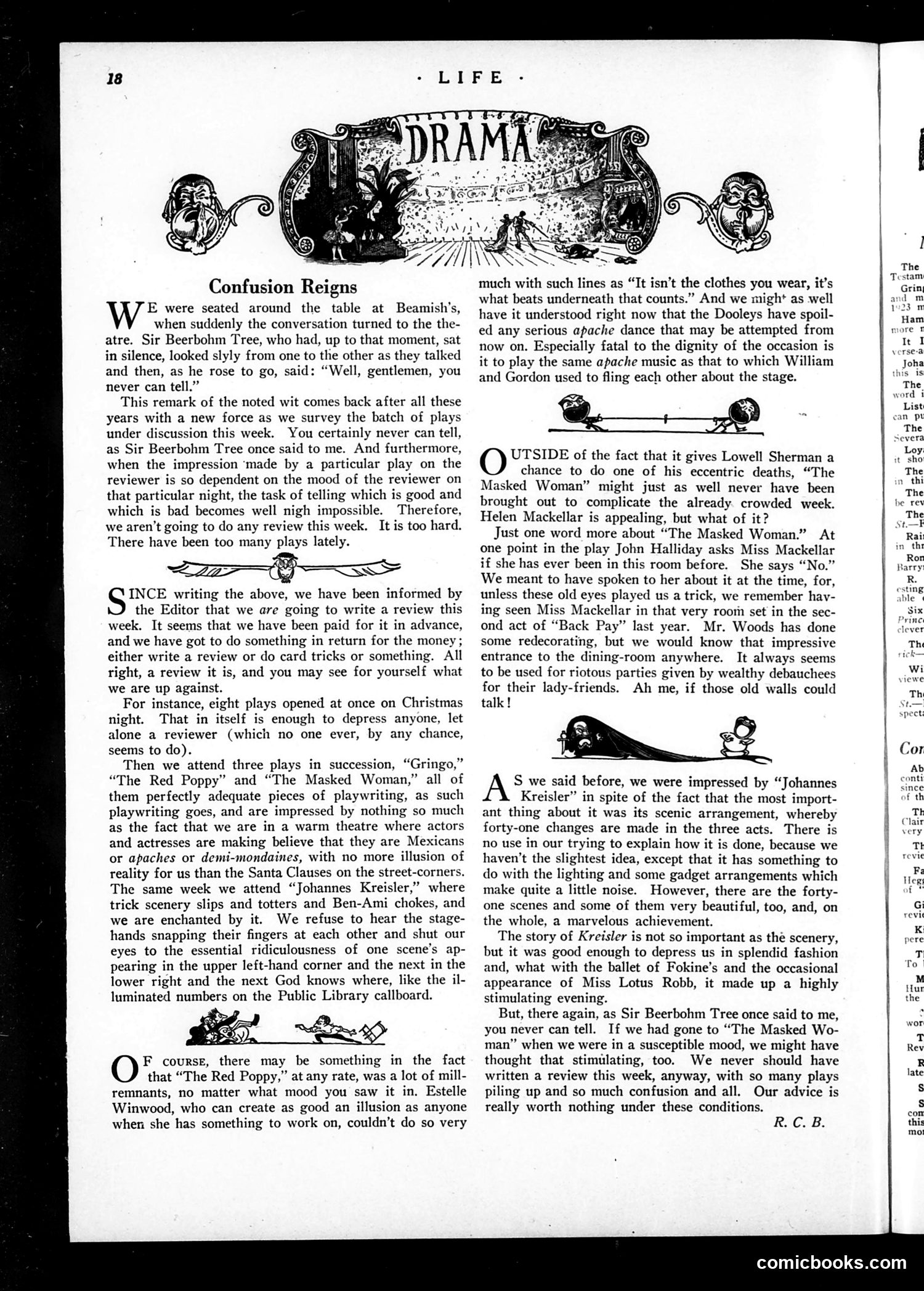
This is a drama review column from *Life* magazine's "Drama" section. The author humorously discusses the impossibility of reviewing theater fairly, given eight plays opened simultaneously at Christmas and reviewer mood drastically affects judgment. The piece references specific 1920s Broadway productions: "Gringo," "The Red Poppy," "The Masked Woman," and "Johannes Kreisler" (featuring actor Jacob Ben-Ami). Sir Beerbohm Tree, the famous British actor-manager quoted at opening, appears to lend authority to the critic's complaint. The satire targets: (1) theater's artificial illusions—actors pretending to be Mexicans while audiences see "Santa Clauses on street-corners"; (2) inconsistent scenic design that defies logic; (3) bad dialogue undermining serious dramatic intention; (4) the Dooleys (likely a famous vaudeville act) having made apache dances ridiculous. The column's core joke: critics are unreliable judges because emotional state matters more than objective quality. The author admits being "enchanted" by elaborate scenery while dismissing decent plays as mediocre—revealing theater criticism as arbitrary.
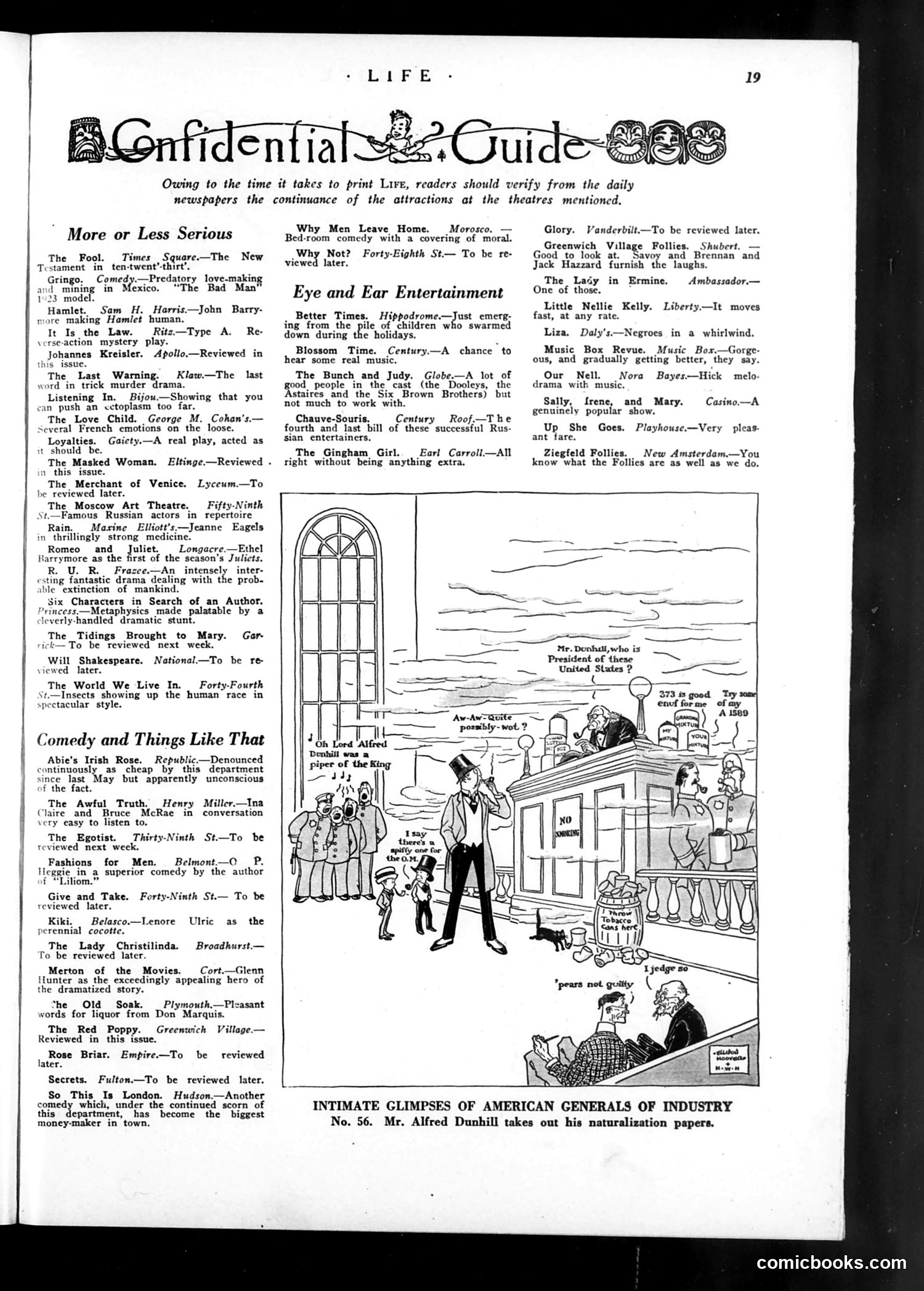
This is a theatre listings and reviews page from Life magazine, circa early 1920s. The main content consists of two sections: brief critical reviews of Broadway theatrical productions, divided into "More or Less Serious" dramas and "Comedy and Things Like That," plus an "Eye and Ear Entertainment" section covering musicals and revues. The cartoon at bottom, captioned "Intimate Glimpses of American Generals of Industry, No. 56: Mr. Alfred Dunhill takes out his naturalization papers," depicts a man in formal dress at what appears to be an immigration office, surrounded by officials and onlookers. The humor targets wealthy industrialists undergoing citizenship procedures—suggesting satire about newly wealthy businessmen gaining formal American status. The cartoon's tone implies gentle mockery of the formality and bureaucratic process such prominent figures must endure, equating business success with a kind of "arrival" in America.
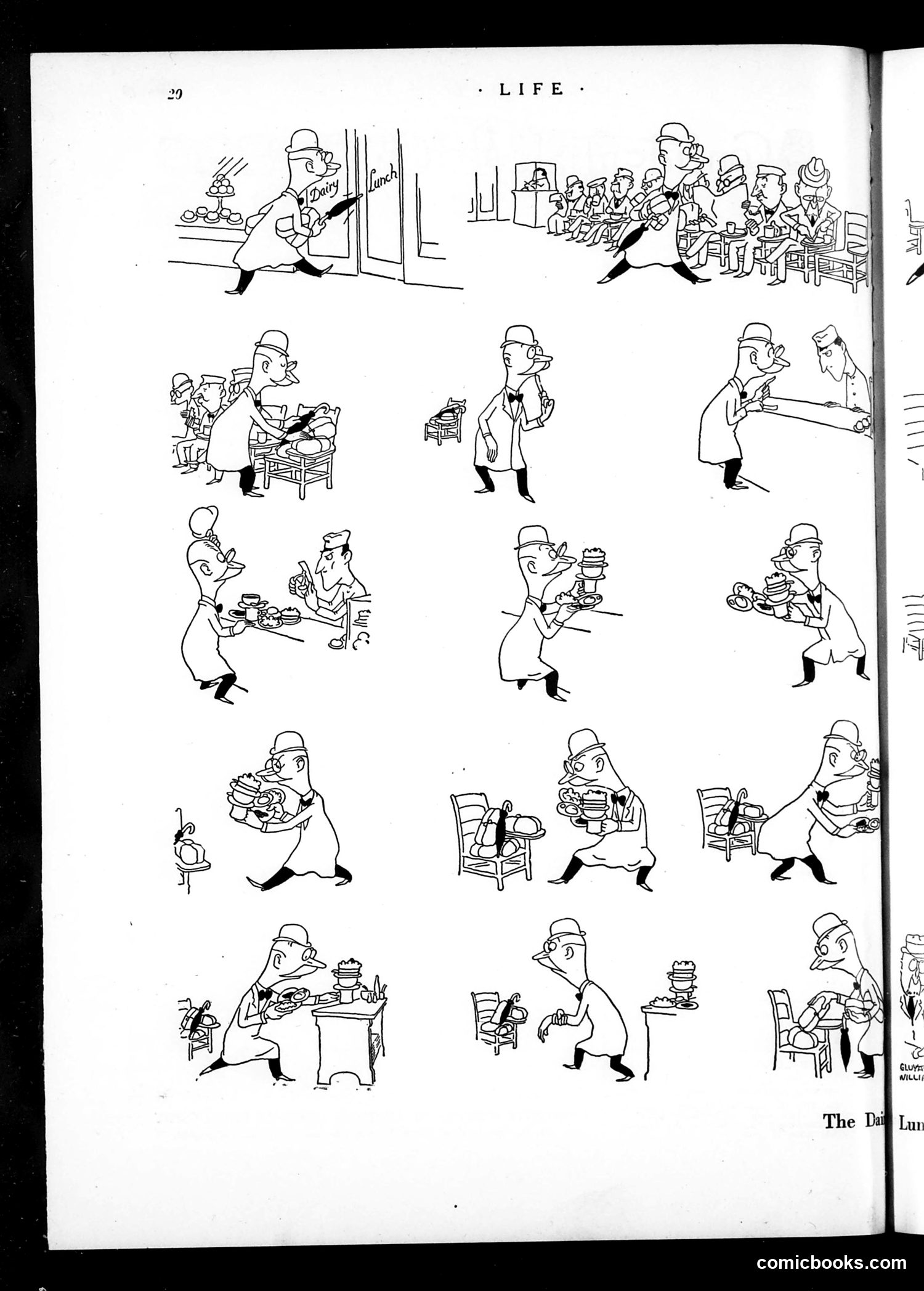
This appears to be a humorous sequential comic strip showing a man in a bowler hat attempting to enjoy lunch at a diner. The narrative arc depicts his escalating frustration: he enters confidently, orders, then gradually becomes overwhelmed by interruptions from waiters, other patrons, or service mishaps. The repeated panels show him in various states of exasperation while juggling plates, dealing with crowded seating conditions, and attempting to maintain composure while eating. The satire targets the chaos and indignity of budget dining establishments—a relatable experience for working-class readers of Life magazine. The character's formal attire (bowler hat, suit) contrasts comically with the undignified situations he endures, suggesting that even respectable people cannot escape the disorder of cheap restaurant culture. The joke centers on the gap between expectation and reality in urban dining.
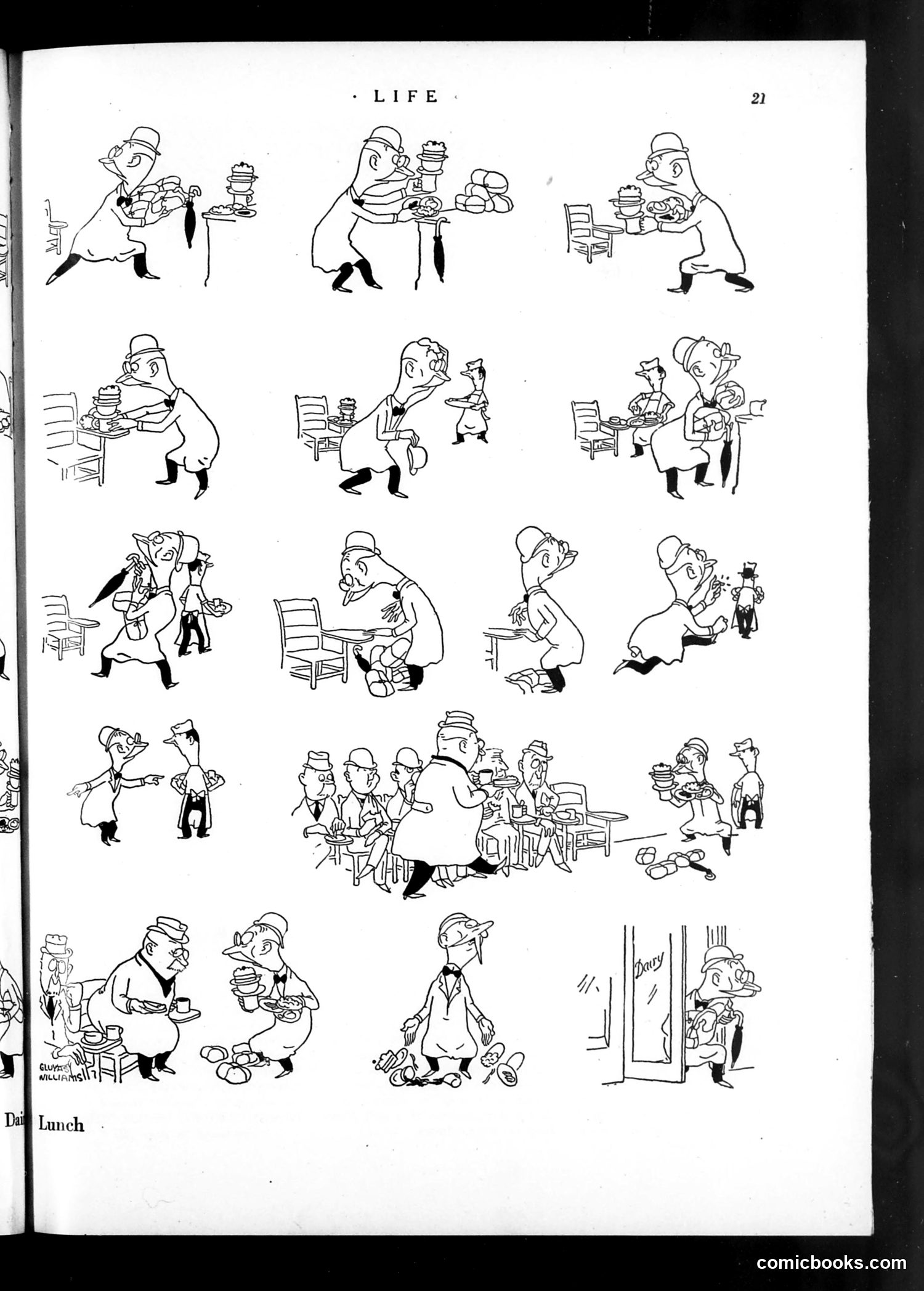
This page presents a visual narrative about lunch through multiple cartoon vignettes. The repeated character—a rotund man in a bowler hat—is shown in various lunch scenarios: juggling food, eating at tables, entertaining companions, and socializing during meals. The satire appears to target **excessive eating and gluttony**, particularly among well-dressed, wealthy-appearing gentlemen of the era. The progression suggests how lunch transforms from a simple meal into an elaborate social performance—the man entertains others, makes dramatic gestures with his food, and generally makes spectacle of himself. The humor lies in the contrast between genteel dining etiquette and this character's unrestrained, theatrical approach to eating. The repetition emphasizes obsessive food-focus as a character flaw or social commentary on consumption habits of the leisured class.
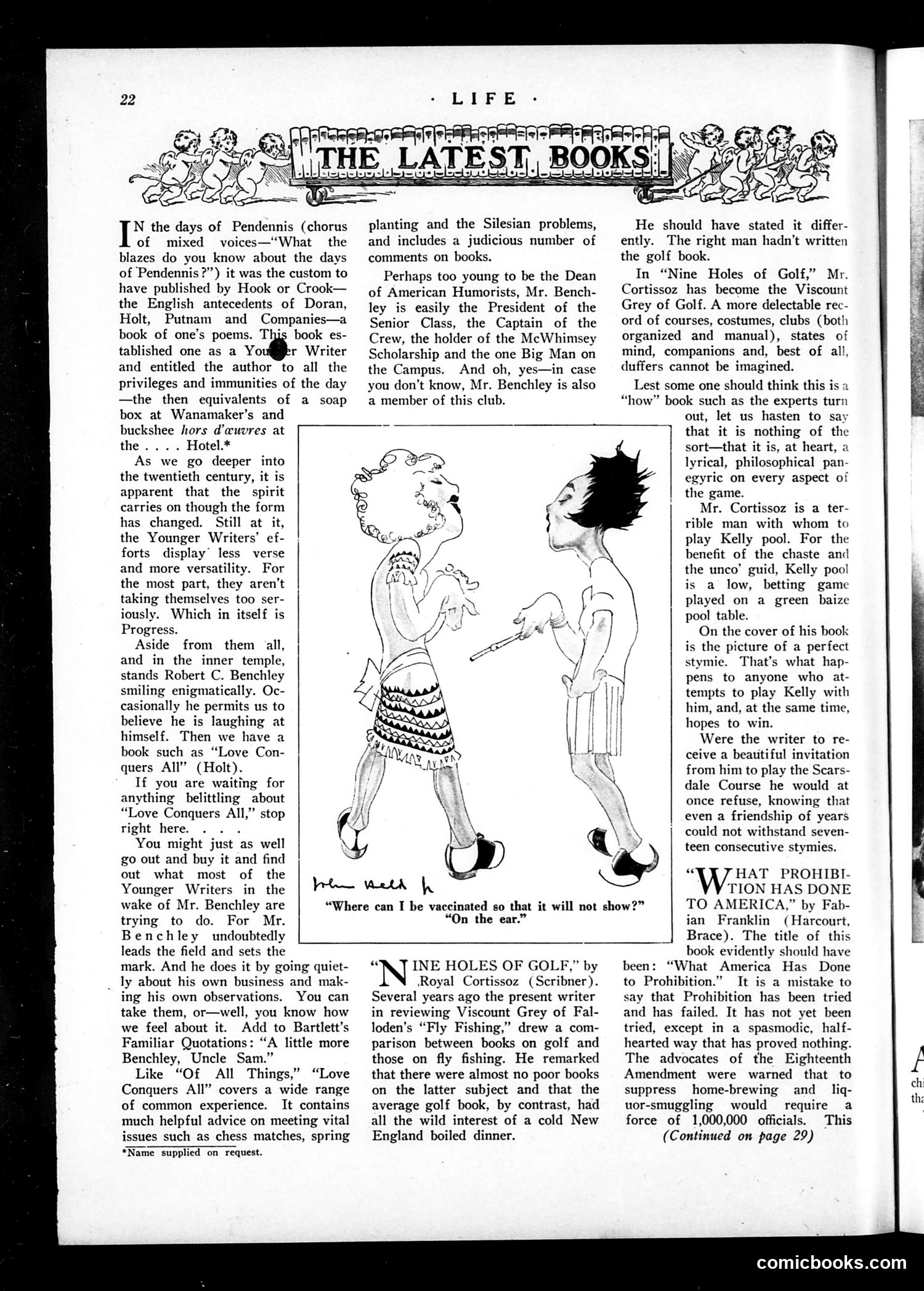
This is a book review section from Life magazine featuring literary commentary on recent publications. The main cartoon depicts a woman asking "Where can I be vaccinated so that it will not show?" with the reply "On the ear"—a topical joke about vaccination, likely referencing the 1920s anti-vaccination concerns or public health campaigns. The text reviews Robert C. Benchley's essay collections "Love Conquers All" and praises his wit and enigmatic humor. It also reviews Royal Cortissoz's "Nine Holes of Golf," a golf book that avoids being a technical "how-to" guide, instead offering lyrical observations about the sport. The page concludes mentioning Fabian Franklin's "What Prohibition Has Done to America," clearly referencing the Prohibition era (1920-1933). The overall tone celebrates younger American writers' less pretentious, more versatile approach to literature compared to earlier traditions.
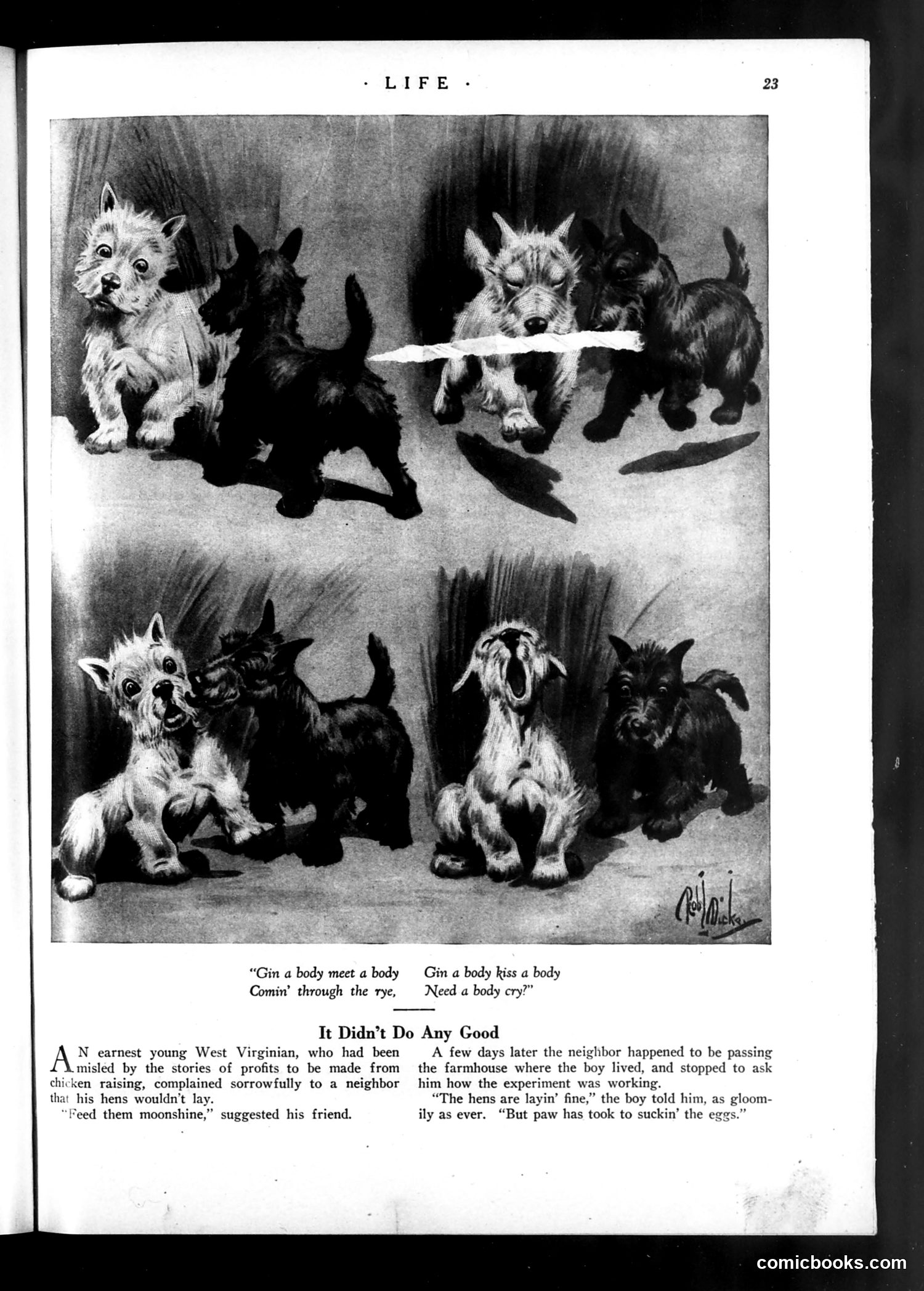
This humorous story mocks Prohibition-era rural life. A young West Virginian, seeking chicken-farming profits, complains to a neighbor that his hens won't lay eggs. The neighbor suggests feeding them "moonshine" (illegally distilled whiskey)—a joke implying bootleg alcohol was more readily available than proper chicken feed in rural areas during Prohibition. The punchline reveals the scheme backfired: the hens do lay fine, but the boy's father has become addicted to drinking the eggs, presumably because they absorbed the moonshine. The four illustrated dog pairs at top appear unrelated—a standard decorative element quoting Robert Burns' poem "Comin' Through the Rye." The satire targets rural Prohibition realities: illegal liquor's ubiquity and the social damage it caused.
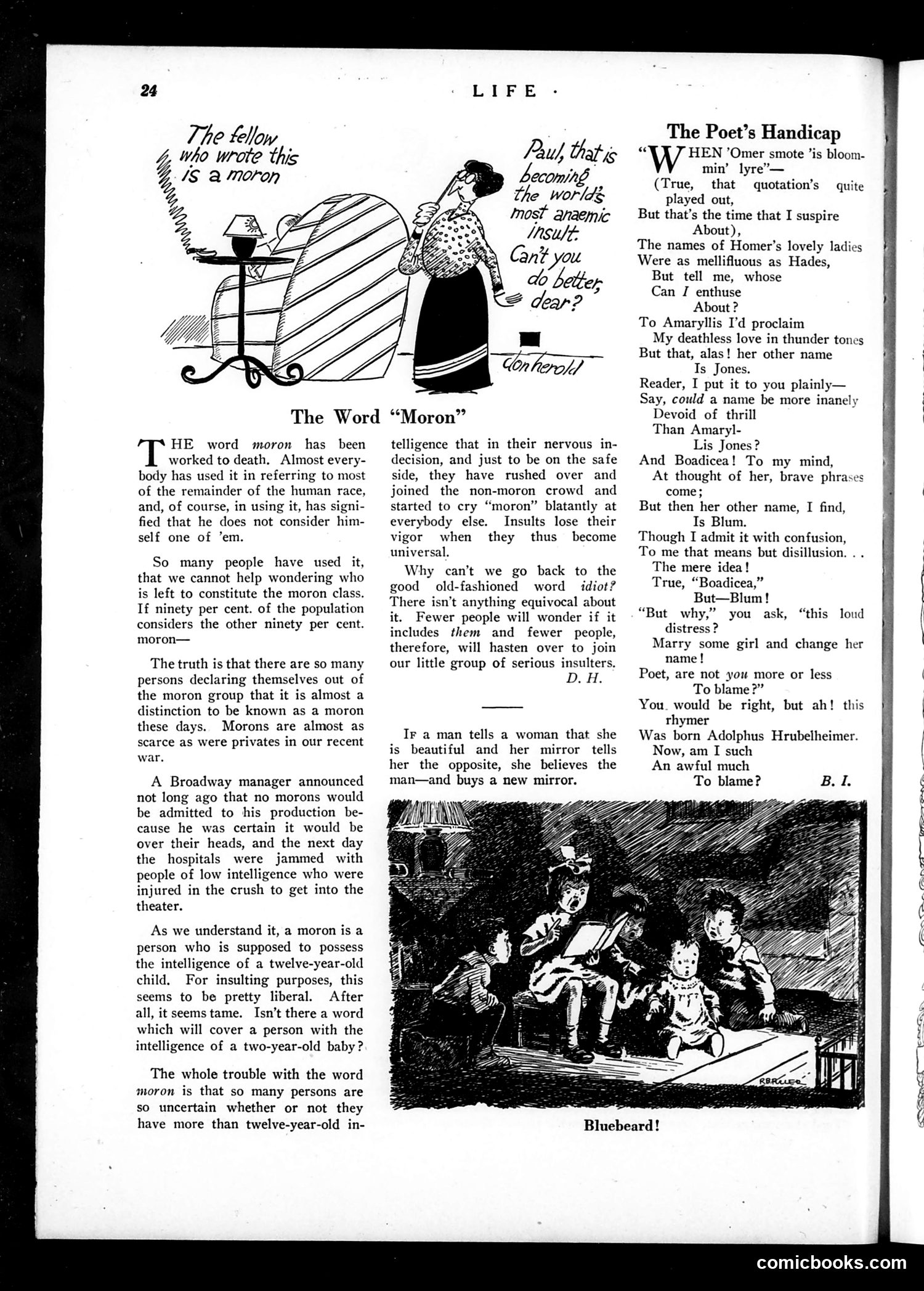
This page satirizes the overuse of the insult "moron" in 1920s American discourse. The main article argues that "moron"—originally a clinical term for someone with a twelve-year-old's intelligence—has been so universally applied that nearly everyone claims to be *not* a moron while calling others one. The satire suggests this makes the insult meaningless and proposes reverting to the less ambiguous term "idiot." The top cartoon illustrates this: a man accuses someone of being a moron for writing something, while he himself appears foolish—embodying the article's point about universal mutual accusation. Below are lighter pieces: "The Poet's Handicap" jokes that poets struggle to compose romantic verses about women with ugly surnames (Jones, Blum), and a final quip about mirror psychology in relationships. The "Bluebeard!" illustration appears unrelated to the visible text.
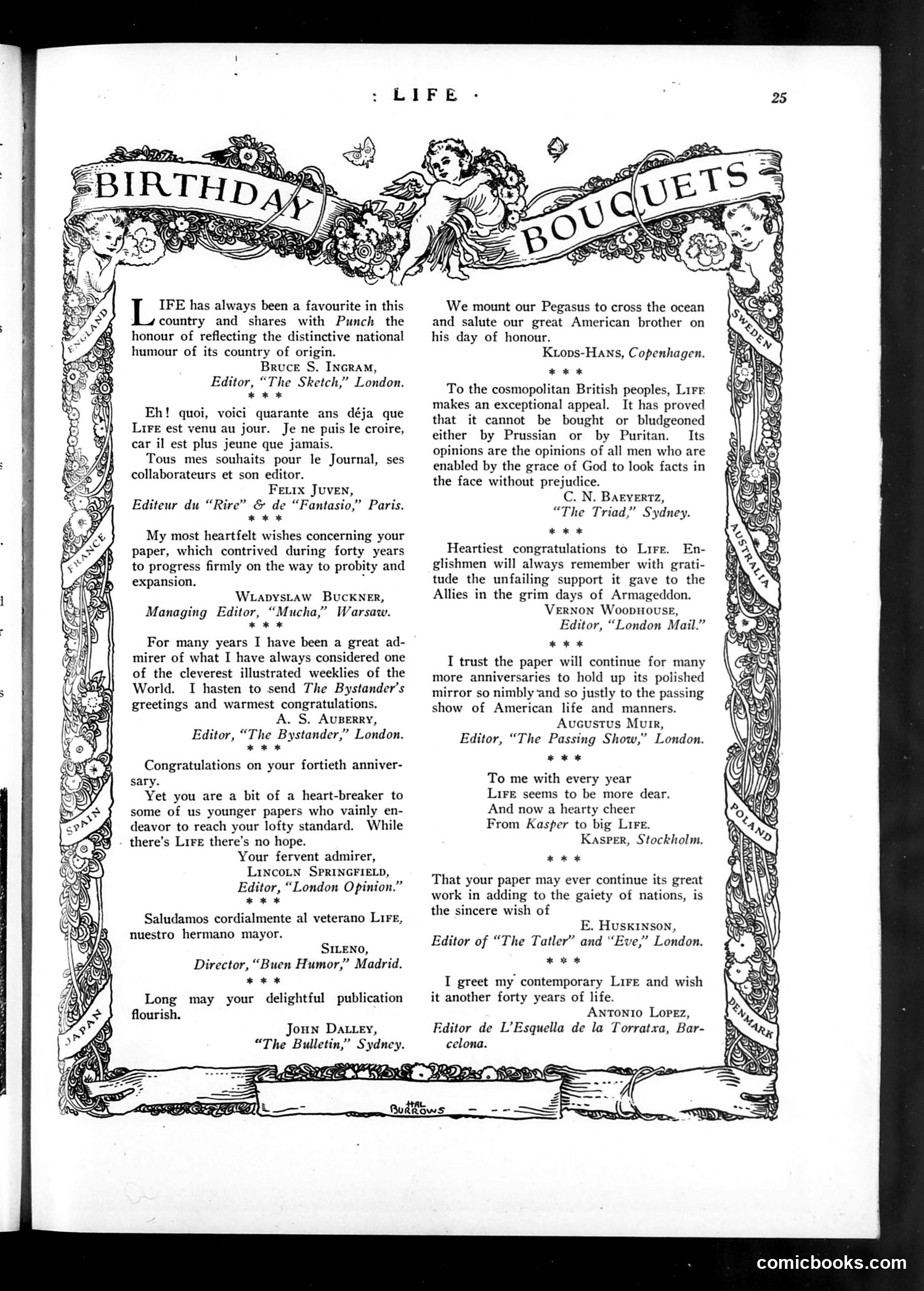
This is a **birthday greeting page**, not a political cartoon. It celebrates *Life* magazine's 40th anniversary with congratulatory messages from editors of international satirical and humor publications—including *Punch* (London), *The Bystander*, *Rire* (Paris), *Buen Humor* (Madrid), and others. The messages praise *Life* for maintaining editorial independence and satirical integrity. One notably references *Life's* support for "the Allies in the grim days of Armageddon"—indicating this page dates to the post-WWI era. The congratulations emphasize that *Life* couldn't be "bought or bludgeoned" by Prussian or Puritan pressures, suggesting its wartime editorial stance was valued by fellow publications. The ornate decorative border with cherubs and flowers is typical *Life* design. This is primarily a **celebratory document** rather than satirical commentary.
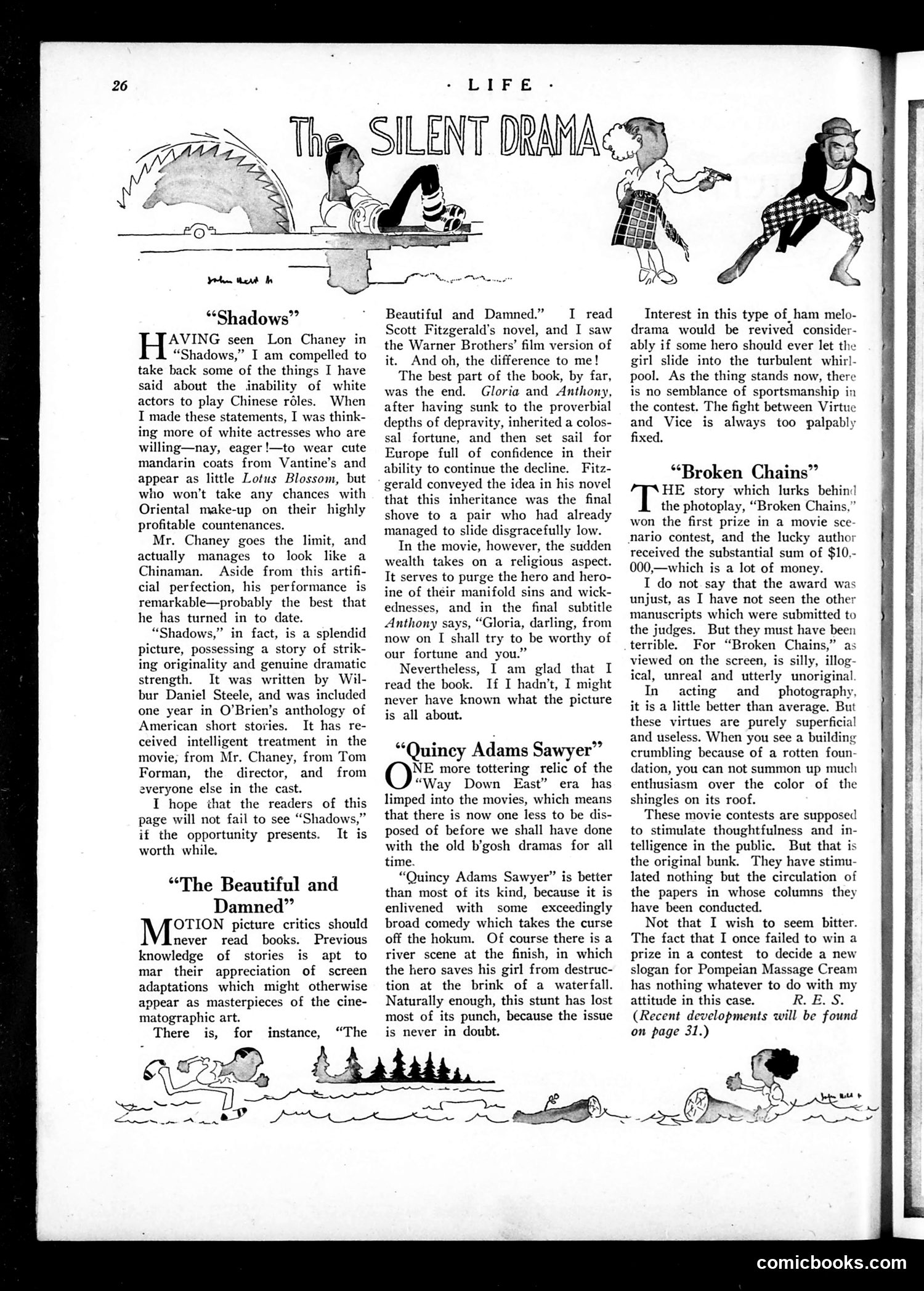
This page contains film criticism from Life magazine's "The Silent Drama" column. The reviewer discusses four movies: **"Shadows"**: Praises actor Lon Chaney's convincing portrayal of a Chinese character, noting white actors typically avoid authentic Oriental makeup. The film itself receives high marks for originality and dramatic strength. **"The Beautiful and Damned"**: Critiques the Warner Brothers adaptation of F. Scott Fitzgerald's novel, complaining the film sentimentalizes the ending. In the book, the protagonists' inheritance enables continued moral decline; in the movie, sudden wealth reforms them spiritually—a fundamental betrayal of Fitzgerald's darker vision. **"Quincy Adams Sawyer"**: Dismisses this "Way Down East" melodrama as dated hokum, though acknowledging its broad comedy. The reviewer satirizes the predictable rescue scene, sardonically suggesting the genre would gain interest if heroes occasionally *failed* to save heroines. **"Broken Chains"**: Briefly notes this scenario won a $10,000 contest prize. The tone is witty, sophisticated satire of silent film conventions and audience expectations.
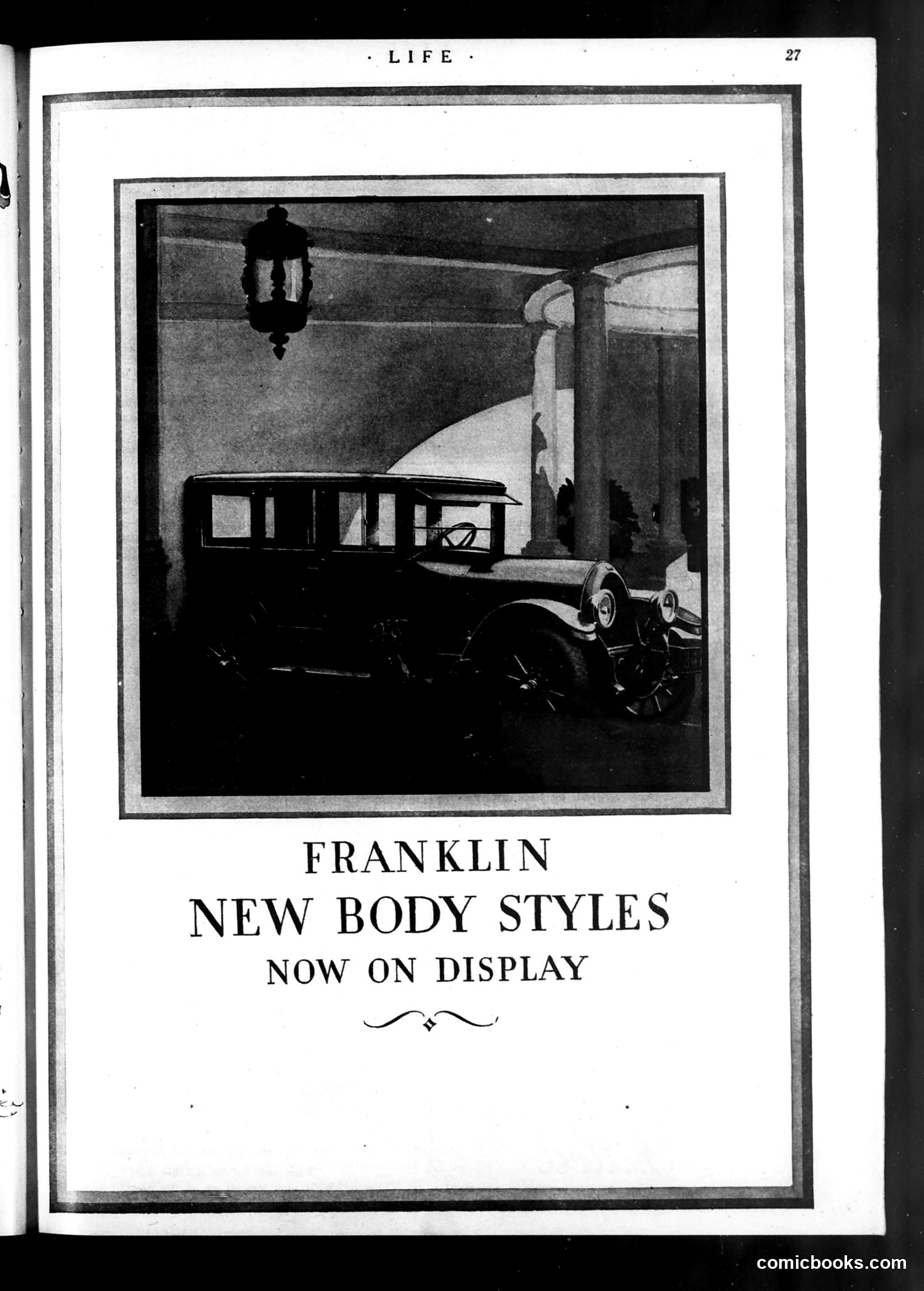
This page is a **product advertisement**, not political satire. It advertises the Franklin automobile's "new body styles" now available for viewing. The image shows a stylized garage or showroom scene with early 1920s-era automobiles displayed under dramatic lighting. The artistic rendering emphasizes the vehicles' modern design and elegant proportions. Franklin was a real American luxury car manufacturer known for air-cooled engines. This ad appears designed to attract affluent buyers by presenting their updated models as contemporary and desirable. The dramatic lighting and composition suggest sophistication and technical advancement—marketing appeals common to automobile advertising of this era. No political commentary or satirical content is present; this is straightforward commercial promotion.
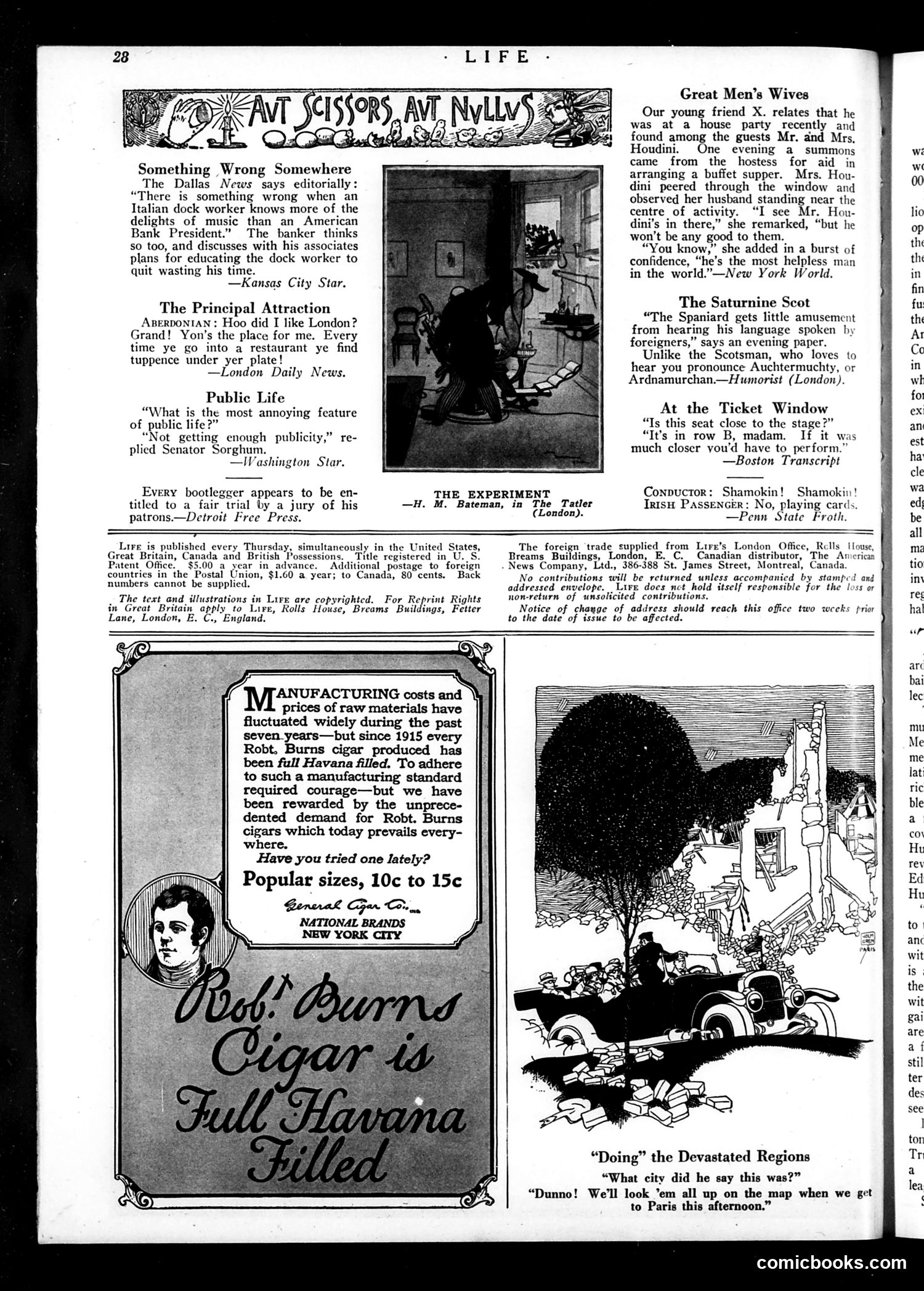
This page contains several short satirical pieces and advertisements typical of Life magazine's humor format: **Key Content:** The humor pieces mock American institutions and social pretenses. "Something Wrong Somewhere" satirizes a banker's condescension toward an Italian dock worker's musical knowledge. "Senator Sorghum" jokes that politicians' primary concern is gaining publicity rather than substantive work. **Notable items:** - "Great Men's Wives" references magician Houdini, humorously noting his wife considers him helpless despite his fame - "At the Ticket Window" contains a pun about theater seating - An Irish passenger mishears "Shamokin" (Pennsylvania town) as card-playing, playing on ethnic accent humor - The final cartoon "Doing the Devastated Regions" references WWI's European destruction, with tourists planning to identify damaged cities later **Advertisement:** Robt. Burns cigars dominates the left side, emphasizing "Full Havana Filled" quality despite post-war material cost fluctuations. The page reflects early 20th-century American attitudes: class condescension, ethnic stereotyping, and casual references to ongoing war devastation.
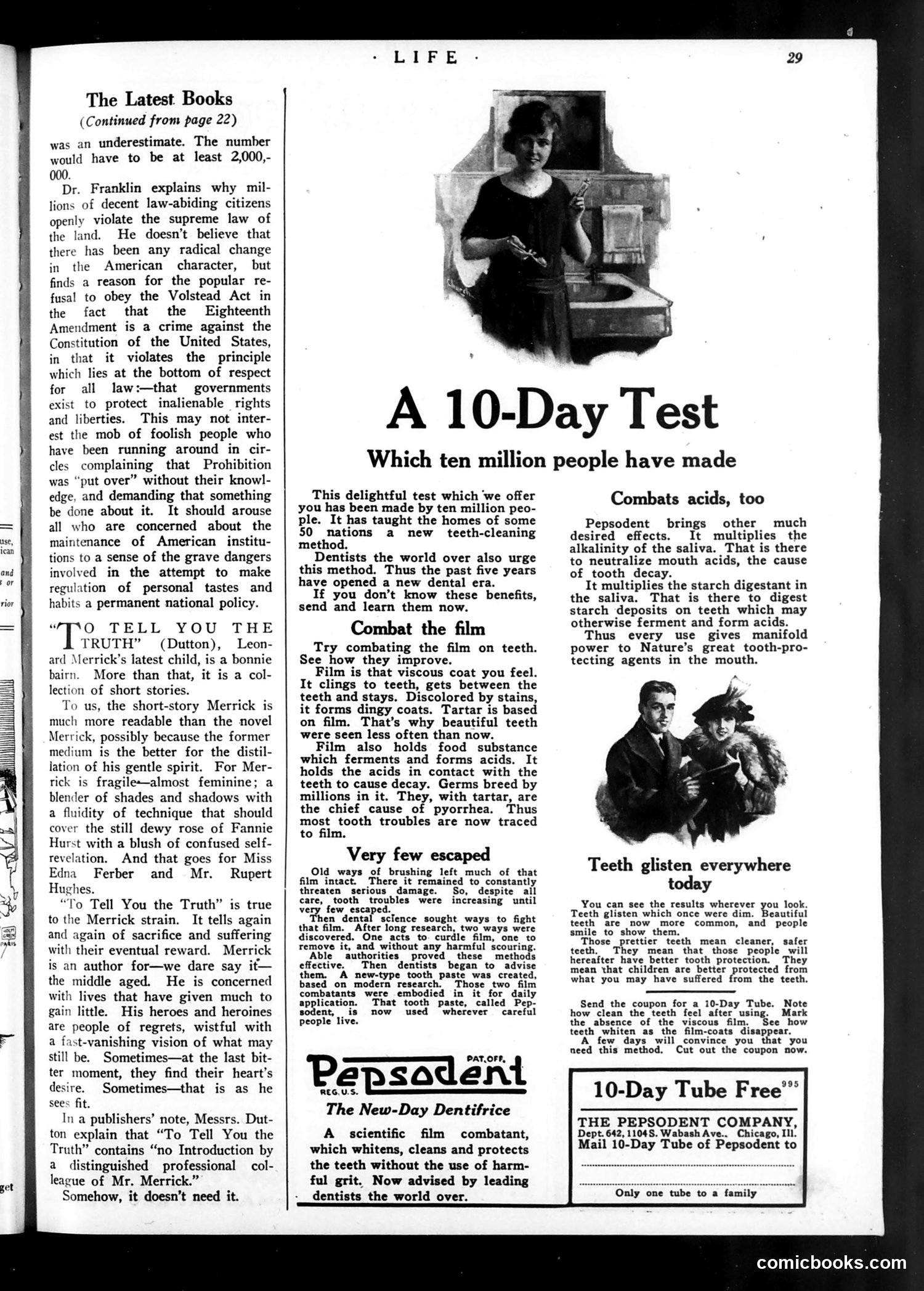
This page mixes book reviews with a Pepsodent toothpaste advertisement disguised as editorial content. **The Book Reviews** discuss Leonard Merrick's short-story collection "To Tell You the Truth" and reference Prohibition enforcement (the Volstead Act). The text criticizes citizens violating Prohibition laws, arguing the Eighteenth Amendment itself violates constitutional principles protecting personal liberty. **The Advertisement** presents Pepsodent's "10-Day Test" as a scientific discovery endorsed by dentists. It claims ten million people have adopted this "new" teeth-cleaning method, emphasizing film removal rather than traditional brushing. The ad uses pseudo-scientific language about "film," acids, and germs to position Pepsodent as modern dental science. **For modern readers:** This represents early 20th-century advertising that blurs editorial and promotional content—a practice now considered deceptive. The Prohibition reference reflects the unpopular alcohol ban (1920-1933) that many Americans openly defied.
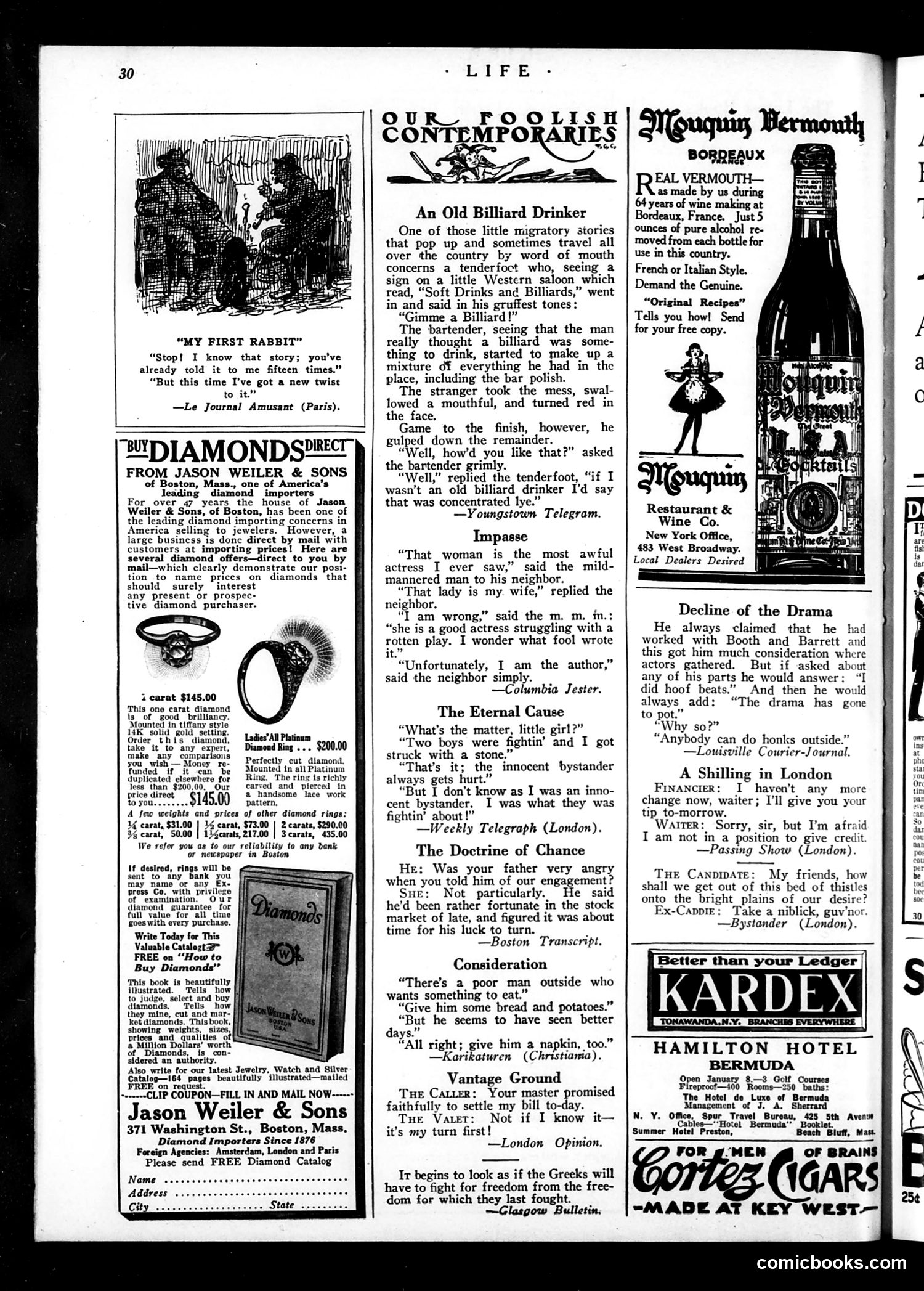
This page is primarily **advertising with humor columns**, not political satire. The cartoon "My First Rabbit" shows a listener shutting down a repetitive storyteller—a relatable domestic joke about tedious anecdotes. Below it are diamond advertisements from a Boston importer. The humor pieces are gentle satirical *anecdotes* about mishaps and irony: - **"An Old Billiard Drinker"**: A tenderfoot mistakes "billiards" (the game) for a drink at a Western saloon, accidentally consumes a toxic mixture, but claims experience to save face—mocking both naive urbanites and frontier swagger. - **"Impasse"**: A man insults a woman's acting, only to learn she's his neighbor's wife; worse, her neighbor wrote the play. Social embarrassment through cascading revelations. - **"The Eternal Cause"**: A girl beaten by fighting boys claims she was the *cause* of their fight—dark humor about bystander casualties and childhood conflict. These are **conversational jokes** typical of early-20th-century light magazines, emphasizing wordplay and social awkwardness rather than political commentary. The page targets general amusement over readers with specific topical knowledge.
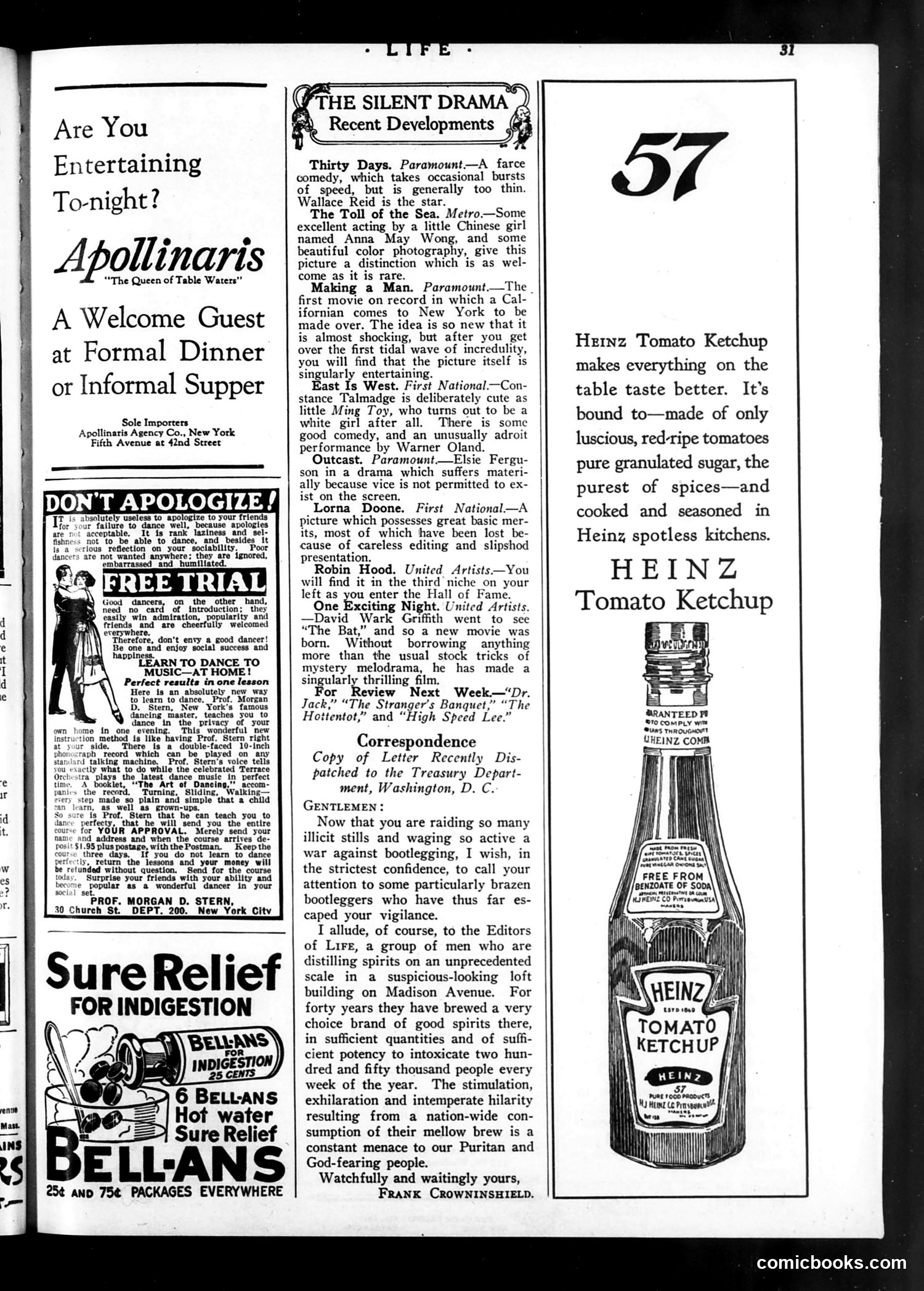
This page is primarily **advertising**, but the "DON'T APOLOGIZE!!" advertisement uses satire to mock social anxieties of the 1920s. The pitch mocks uptight etiquette culture: it tells readers not to apologize for poor dancing, because bad dancers are "embarrassed and humiliated" everywhere, while good dancers enjoy "social success and popularity." The heavy-handed messaging—treating dancing ability as a marker of social worth—satirizes the era's obsession with self-improvement and fitting into rigid social hierarchies. Prof. Morgan D. Stern's mail-order dance course is the actual product being sold. The satire works by exaggerating how much social status hinges on mastering one skill. The page also includes **film reviews** and typical period advertising (Apollinaris water, Heinz ketchup, indigestion relief). The correspondence section references Prohibition-era bootlegging raids, referencing contemporary alcohol smuggling.
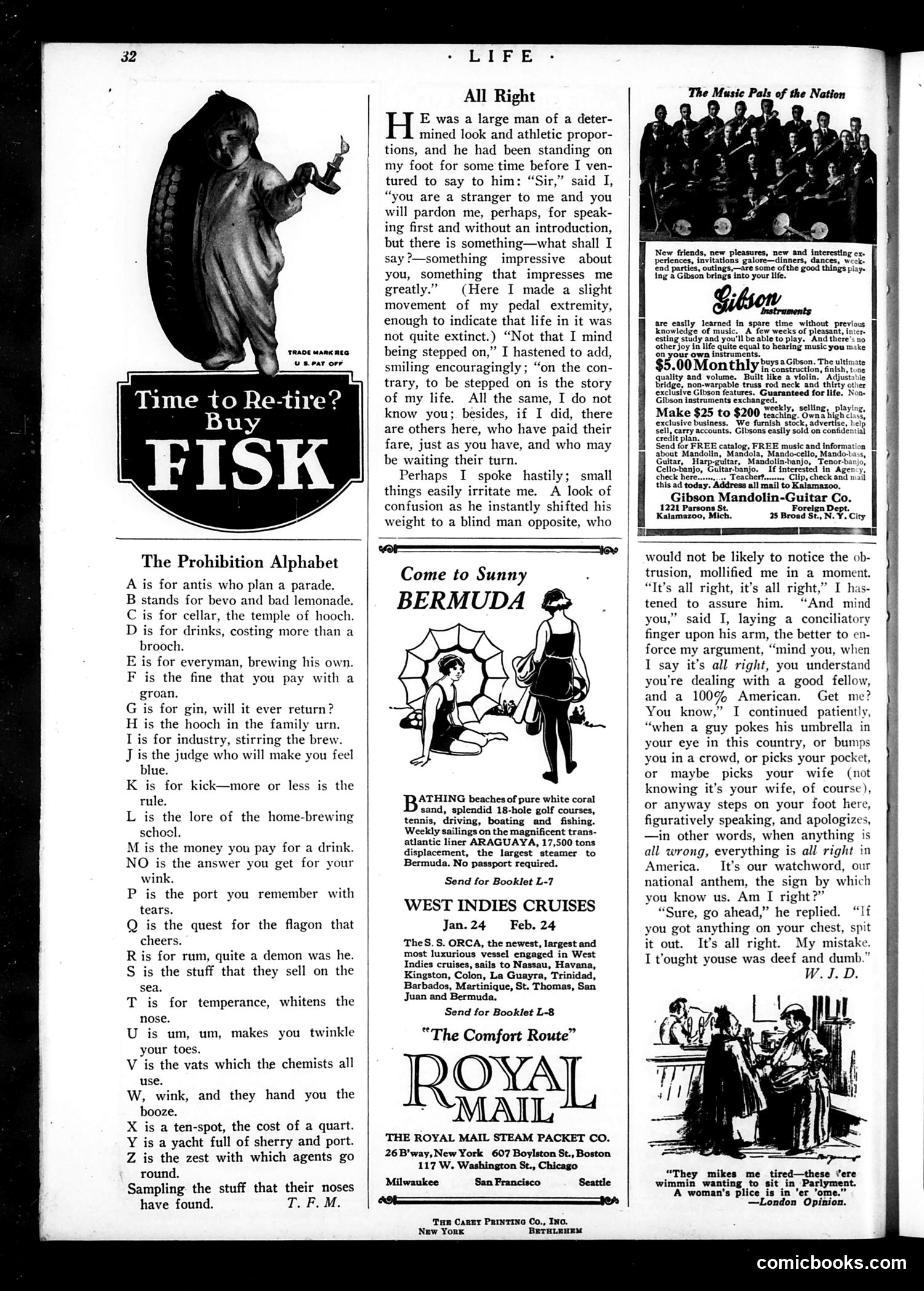
**Left side:** "Time to Re-tire? Buy FISK" is an advertisement for Fisk tires, using visual pun—the tire is anthropomorphized, appearing exhausted or worn out, suggesting it's time for replacement. **Center:** "The Prohibition Alphabet" is satirical verse mocking Prohibition (the 1920s alcohol ban). It humorously catalogs prohibition-related activities and consequences: home-brewing ("E is for everyman, brewing his own"), illegal spirits ("G is for gin, will it ever return?"), underground production ("C is for cellar, the temple of hooch"), and enforcement penalties. The tone is cynical about widespread law-breaking and the futility of the ban. **"All Right" story excerpt:** A humorous anecdote about someone standing on the narrator's foot—the punchline involves the stranger shifting weight to "a blind man opposite," implying deliberate rudeness or comedy of social awkwardness. **Right side:** Cruise ship and musical instrument advertisements—standard commercial content of the era.
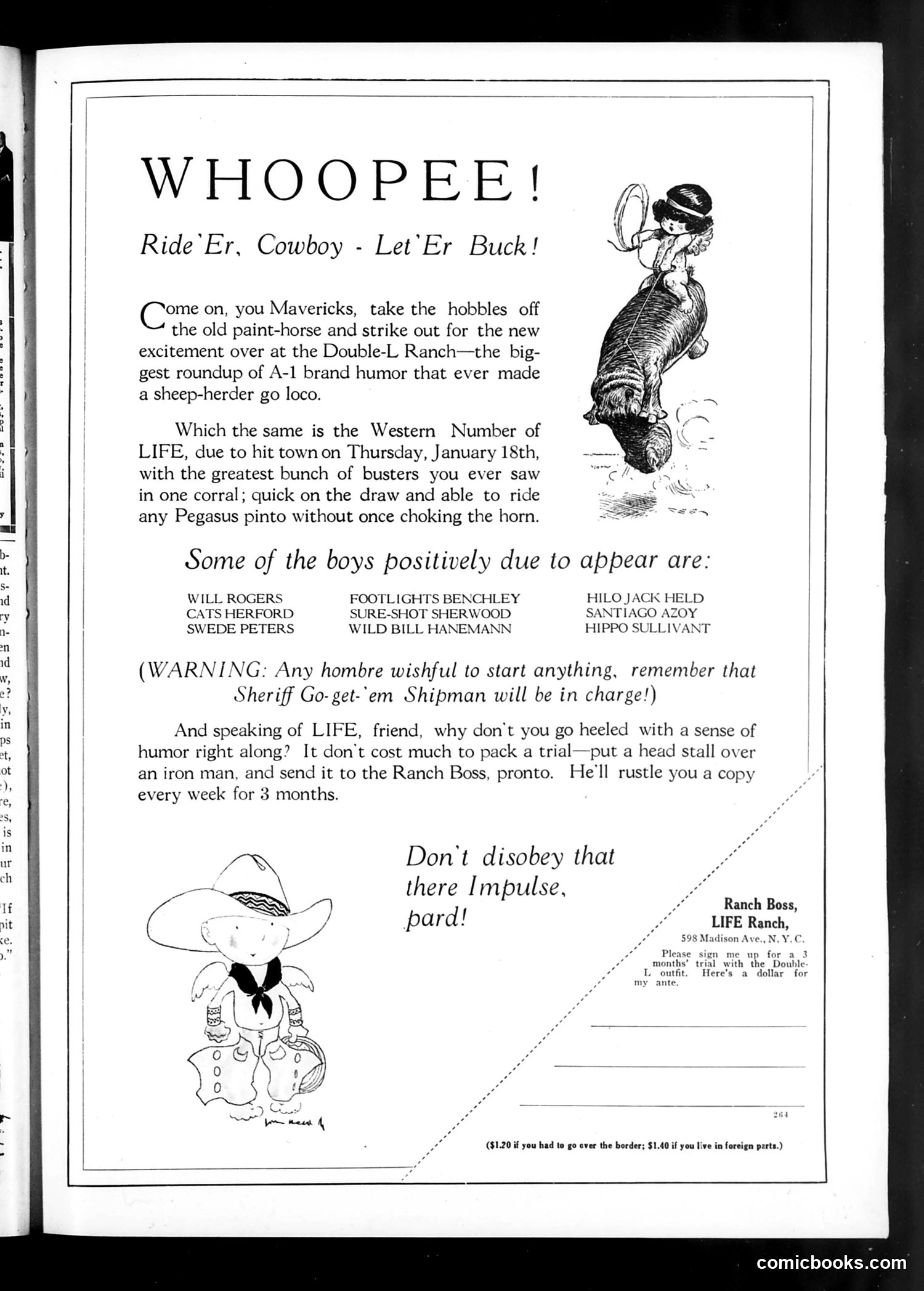
This is a promotional page for *Life* magazine's "Western Number" issue (January 18th). Using Wild West cowboy imagery and slang, it advertises the upcoming issue and invites subscriptions. The page lists famous contributors—Will Rogers (humorist), Benchley (likely Robert Benchley, humorist), and cartoonists Held and Sullivant—presented as cowboy characters with Western nicknames ("Sure-Shot Sherwood," "Wild Bill Hanemann"). The satire plays on the contrast between *Life's* sophisticated urban readership and crude Western stereotypes. The "Ranch Boss" character (the magazine's editor) extends a folksy invitation to subscribe for three months. The illustrations—a bucking bronco and a cartoonish cowboy—reinforce the tongue-in-cheek "roughneck humor" theme. This reflects the 1920s trend of using Western imagery to market entertainment and convey masculine, adventurous appeal to city dwellers.
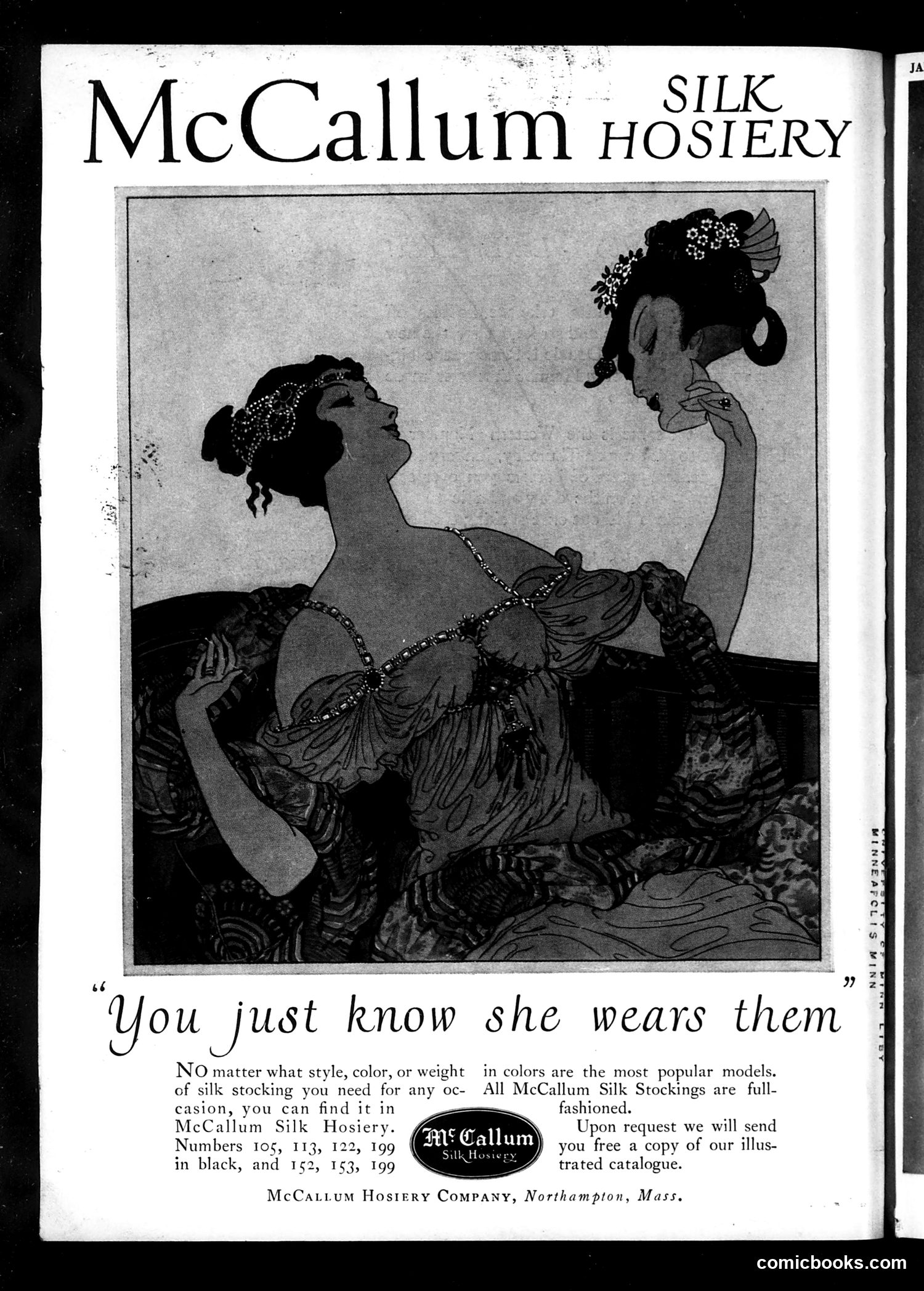
This is a **silk hosiery advertisement**, not a political cartoon. The page features an illustration of two fashionable women in elegant, draped clothing with decorative headpieces, examining silk stockings. The ad's tagline—"You just know she wears them"—plays on the idea that quality silk stockings were a status symbol indicating sophistication and elegance. The image suggests that well-dressed women of refinement would naturally wear McCallum brand stockings. The advertisement emphasizes variety (multiple styles, colors, weights) and quality construction ("full-fashioned"), listing specific product numbers. It concludes with a standard offer of a free illustrated catalogue. This represents early-to-mid 20th-century luxury goods marketing, appealing to aspirational middle and upper-class women through imagery of glamour and social status.