
Life, 1923-01-11 · page 20 of 36
Life — January 11, 1923 — page 20: what you’re looking at
What you’re looking at
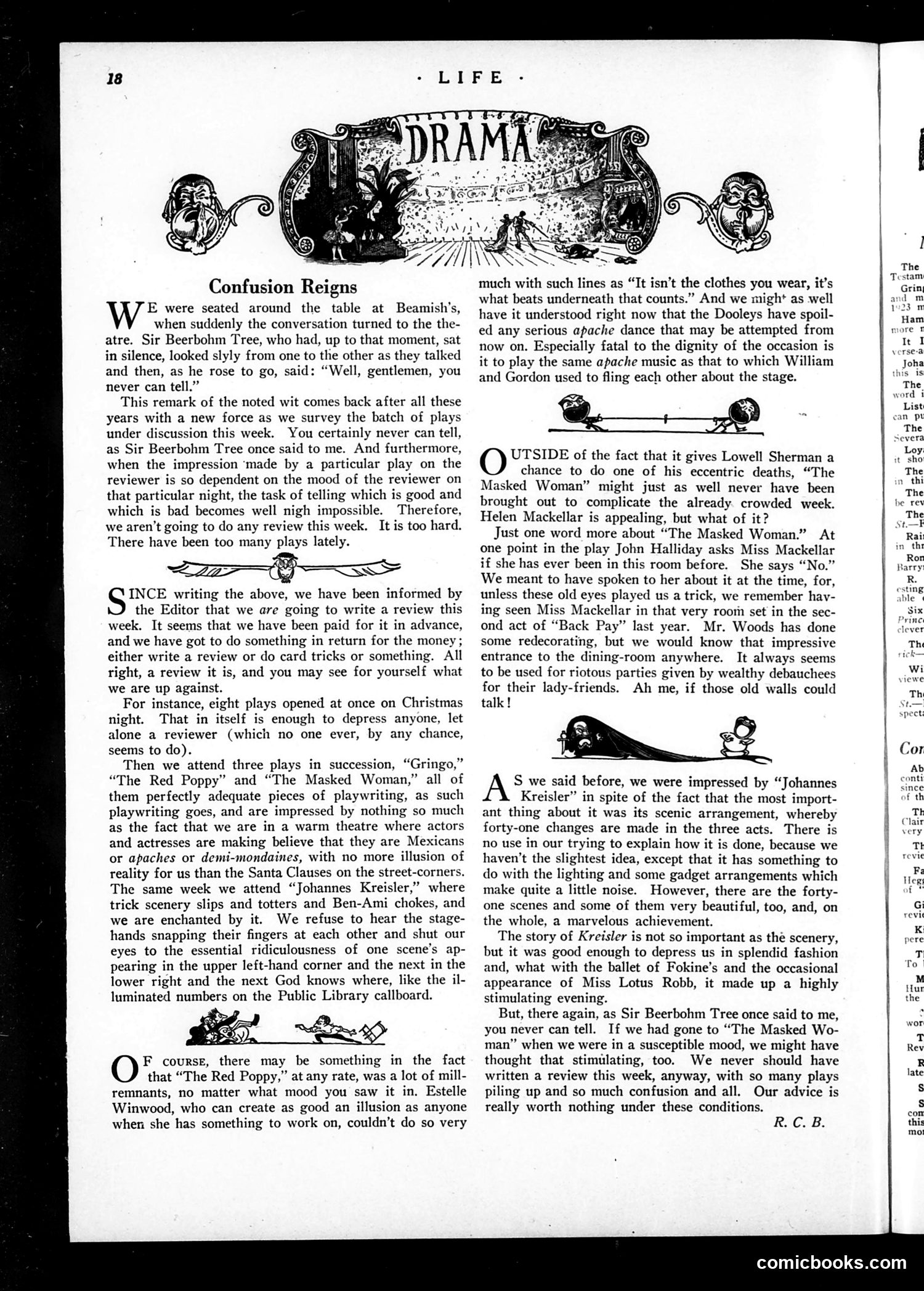
This is a drama review column from *Life* magazine's "Drama" section. The author humorously discusses the impossibility of reviewing theater fairly, given eight plays opened simultaneously at Christmas and reviewer mood drastically affects judgment. The piece references specific 1920s Broadway productions: "Gringo," "The Red Poppy," "The Masked Woman," and "Johannes Kreisler" (featuring actor Jacob Ben-Ami). Sir Beerbohm Tree, the famous British actor-manager quoted at opening, appears to lend authority to the critic's complaint. The satire targets: (1) theater's artificial illusions—actors pretending to be Mexicans while audiences see "Santa Clauses on street-corners"; (2) inconsistent scenic design that defies logic; (3) bad dialogue undermining serious dramatic intention; (4) the Dooleys (likely a famous vaudeville act) having made apache dances ridiculous. The column's core joke: critics are unreliable judges because emotional state matters more than objective quality. The author admits being "enchanted" by elaborate scenery while dismissing decent plays as mediocre—revealing theater criticism as arbitrary.
📄 Transcribed text from this page (OCR, searchable)
Machine-transcribed from the original scan — historical spelling and the odd misread are preserved.
Confusion Reigns E were seated around the table at Beamish’s, when suddenly the conversation turned to the the- atre. Sir Beerbohm Tree, who had, up to that moment, sat in silence, looked slyly from one to the other as they talked and then, as he rose to go, said: “Well, gentlemen, you never can tell.” This remark of the noted wit comes back after all these years with a new force as we survey the batch of plays under discussion this week. You certainly never can tell, as Sir Beerbohm Tree once said to me. And furthermore, when the impression ‘made by a particular play on the reviewer is so dependent on the mood of the reviewer on that particular night, the task of telling which is good and which is bad becomes well nigh impossible. Therefore, we aren’t going to do any review this week. It is too hard. There have been too many plays lately. ee INCE writing the above, we have been informed by the Editor that we are going to write a review this week. It seems that we have been paid for it in advance, and we have got to do something in return for the money ; either write a review or do card tricks or something. All right, a review it is, and you may see for yourself what we are up against. For instance, eight plays opened at once on Christmas night. That in itself is enough to depress anyone, let alone a reviewer (which no one ever, by any chance, seems to do). Then we attend three plays in succession, “Gringo,” “The Red Poppy” and “The Masked Woman,” all of them perfectly adequate pieces of playwriting, as such playwriting goes, and are impressed by nothing so much as the fact that we are in a warm theatre where actors and actresses are making believe that they are Mexicans or apaches or demi-mondaines, with no more illusion of reality for us than the Santa Clauses on the street-corners. The same week we attend “Johannes Kreisler,” where trick scenery slips and totters and Ben-Ami chokes, and we are enchanted by it. We refuse to hear the stage- hands snapping their fingers at each other and shut our eyes to the essential ridiculousness of one scene’s ap- pearing in the upper left-hand corner and the next in the lower right and the next God knows where, like the il- luminated numbers on the Public Library callboard. F course, there may be something in the fact that “The Red Poppy,” at any rate, was a lot of mill- remnants, no matter what mood you saw it in. Estelle Winwood, who can create as good an illusion as anyone when she has something to work on, couldn’t do so very much with such lines as “It isn’t the clothes you wear, it’s what beats underneath that counts.” And we might as well have it understood right now that the Dooleys have spoil- ed any serious apache dance that may be attempted from now on. Especially fatal to the dignity of the occasion is it to play the same apache music as that to which William and Gordon used to fling each other about the stage. ay O UTSIDE of the fact that it gives Lowell Sherman a chance to do one of his eccentric deaths, “The Masked Woman” might just as well never have been brought out to complicate the already crowded week. Helen Mackellar is appealing, but what of it? Just one word more about “The Masked Woman.” At one point in the play John Halliday asks Miss Mackellar if she has ever been in this room before. She says “No.” We meant to have spoken to her about it at the time, for, unless these old eyes played us a trick, we remember hav- ing seen Miss Mackellar in that very room set in the sec- ond act of “Back Pay” last year. Mr. Woods has done some redecorating, but we would know that impressive entrance to the dining-room anywhere. It always seems to be used for riotous parties given by wealthy debauchees for their lady-friends. Ah me, if those old walls could talk! S we said before, we were impressed by “Johannes Kreisler” in spite of the fact that the most import- ant thing about it was its scenic arrangement, whereby forty-one changes are made in the three acts. There is no use in our trying to explain how it is done, because we haven't the slightest idea, except that it has something to do with the lighting and some gadget arrangements which make quite a little noise. However, there are the forty- one scenes and some of them very beautiful, too, and, on the whole, a marvelous achievement. The story of Kreisler is not so important as the scenery, but it was good enough to depress us in splendid fashion and, what with the ballet of Fokine’s and the occasional appearance of Miss Lotus Robb, it made up a highly stimulating evening. But, there again, as Sir Beerbohm Tree once said to me, you never can tell. If we had gone to “The Masked Wo- man” when we were in a susceptible mood, we might have thought that stimulating, too. We never should have written a review this week, anyway, with so many plays piling up and so much confusion and all. Our advice is really worth nothing under these conditions. R.C. B. Ron Rarry The Testam Grin, and om 23m Ham P more f It 1 verse-a Joha The. word i List Rai in thr | ] j J Ab comicbooks.com