
Life, 1923-01-11 · page 26 of 36
Life — January 11, 1923 — page 26: what you’re looking at
What you’re looking at
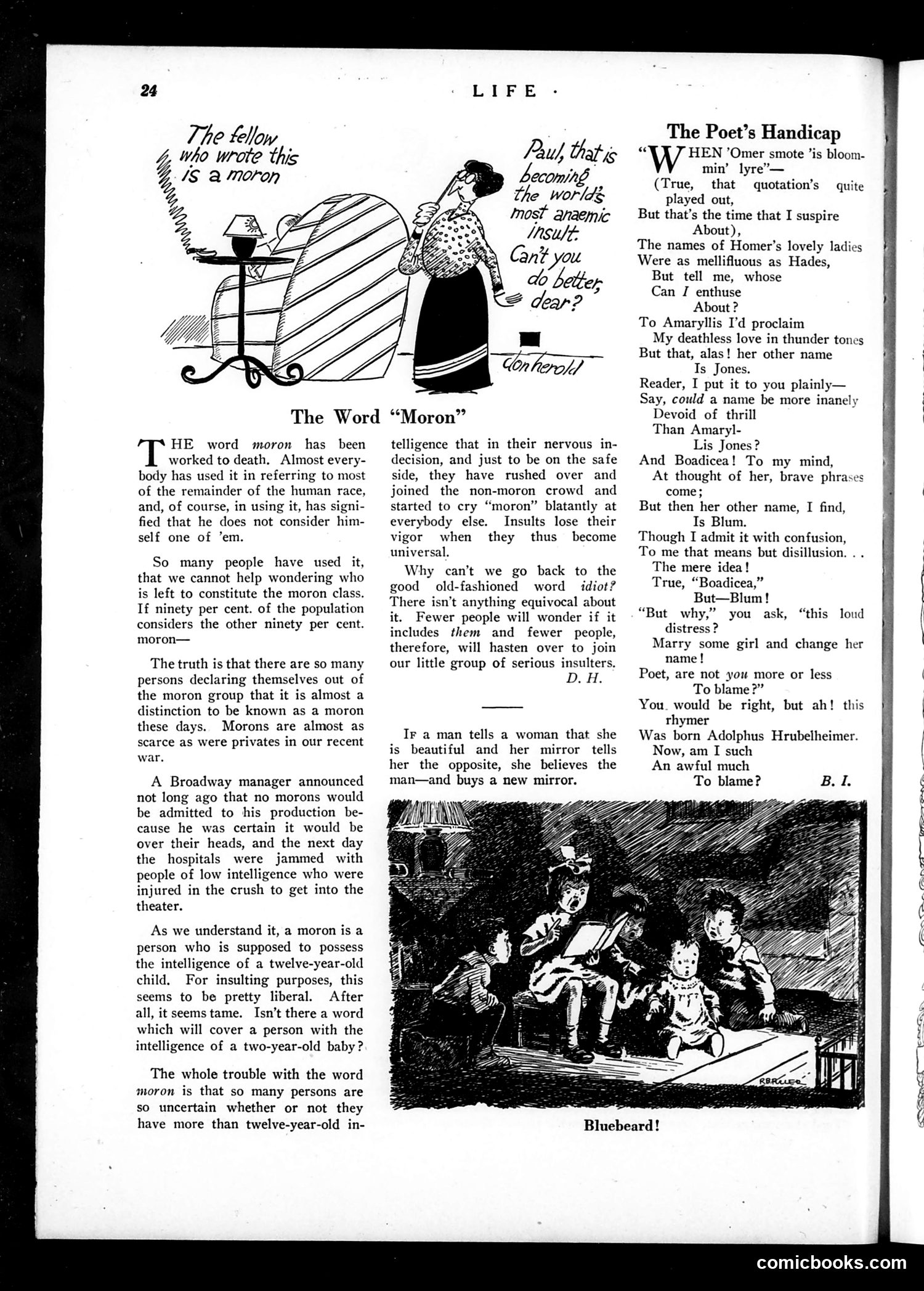
This page satirizes the overuse of the insult "moron" in 1920s American discourse. The main article argues that "moron"—originally a clinical term for someone with a twelve-year-old's intelligence—has been so universally applied that nearly everyone claims to be *not* a moron while calling others one. The satire suggests this makes the insult meaningless and proposes reverting to the less ambiguous term "idiot." The top cartoon illustrates this: a man accuses someone of being a moron for writing something, while he himself appears foolish—embodying the article's point about universal mutual accusation. Below are lighter pieces: "The Poet's Handicap" jokes that poets struggle to compose romantic verses about women with ugly surnames (Jones, Blum), and a final quip about mirror psychology in relationships. The "Bluebeard!" illustration appears unrelated to the visible text.
📄 Transcribed text from this page (OCR, searchable)
Machine-transcribed from the original scan — historical spelling and the odd misread are preserved.
The telloy who wrote this /§ a Moron LIFE .- Paul thats Becoming the worlds Most anaemic Misuft: The Word “Moron” HE word moron has been worked to death. Almost every- body has used it in referring to most of the remainder of the human race, and, of course, in using it, has signi- fied that he does not consider him- self one of ’em. So many people have used it, that we cannot help wondering who is left to constitute the moron class. If ninety per cent. of the population considers the other ninety per cent. moron— The truth is that there are so many persons declaring themselves out of the moron group that it is almost a distinction to be known as a moron these days. Morons are almost as scarce as were privates in our recent war. A Broadway manager announced not long ago that no morons would be admitted to his production be- cause he was certain it would be over their heads, and the next day the hospitals were jammed with people of low intelligence who were injured in the crush to get into the theater. As we understand it, a moron is a person who is supposed to possess the intelligence of a twelve-year-old child. For insulting purposes, this seems to be pretty liberal. After all, it seems tame. Isn’t there a word which will cover a person with the intelligence of a two-year-old baby? The whole trouble with the word moron is that so many persons are so uncertain whether or not they have more than twelve-year-old in- telligence that in their nervous in- decision, and just to be on the safe side, they have rushed over and joined the non-moron crowd and started to cry “moron” blatantly at everybody else. Insults lose their vigor when they thus become universal. Why can’t we go back to the good old-fashioned word idiot? There isn’t anything equivocal about it. Fewer people will wonder if it includes them and fewer people, therefore, will hasten over to join our little group of serious insulters. D. H. Ir a man tells a woman that she is beautiful and her mirror tells her the opposite, she believes the man—and buys a new mirror. The Poet’s Handicap “\ X 7 HEN ’Omer smote ’is bloom- min’ lyre”’— (True, that played out, But that’s the time that I suspire About), The names of Homer’s lovely ladies Were as mellifluous as Hades, But tell me, whose Can I enthuse About ? To Amaryllis I’d proclaim My deathless love in thunder tones But that, alas! her other name Is Jones. Reader, I put it to you plainly— Say, could a name be more inanely Devoid of thrill Than Amaryl- Lis Jones? And Boadicea! To my mind, At thought of her, brave phrases come; But then her other name, I find, Is Blum. Though I admit it with confusion, To me that means but disillusion. . . The mere idea! True, “Boadicea,” But—Blum! “But why,” you ask, “this loud distress ? Marry some girl and change her name! Poet, are not you more or less To blame?” You. would be right, but ah! this rhymer Was born Adolphus Hrubelheimer. Now, am I such An awful much To blame? quotation’s quite Bluebeard! comicbooks.com ONLINE fo