
Life, 1923-01-11 · page 8 of 36
Life — January 11, 1923 — page 8: what you’re looking at
What you’re looking at
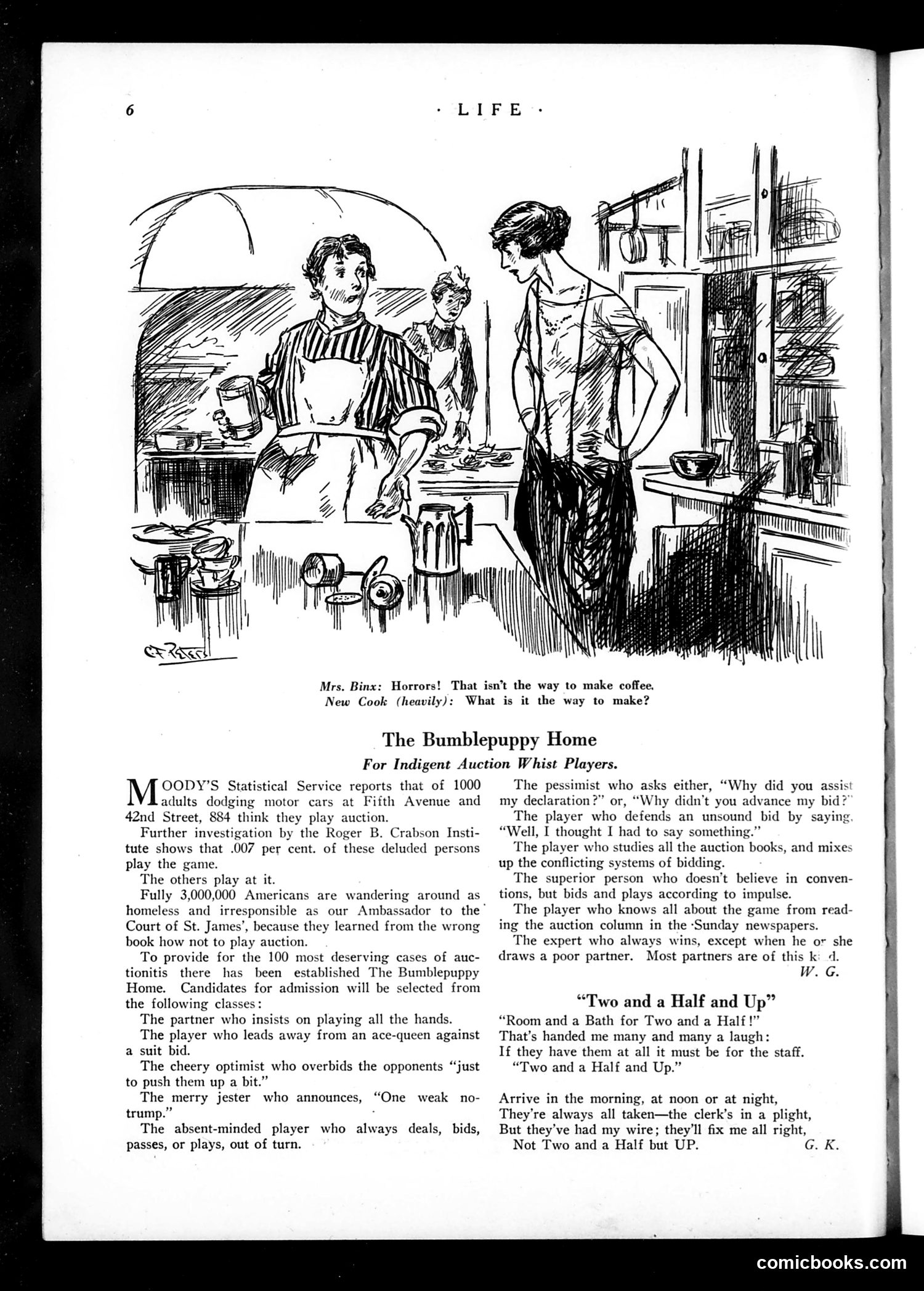
This satirical piece mocks auction bridge (a card game popular in the early 20th century). The cartoon shows a kitchen scene where "Mrs. Binx" corrects a "New Cook" about coffee-making—a humorous opening to an article targeting incompetent bridge players. The text identifies various problematic player types: those insisting on playing every hand, poor leaders, overconfident optimists, pessimists, and absent-minded players. The "Bumblepuppy Home" is a fictional refuge proposed for these 3 million "homeless" Americans who play bridge incorrectly. The satire ridicules both bridge obsession (Moody's reports Americans lodge at "Fifth Avenue and 42nd Street" playing) and the players' absurd incompetence. The second poem humorously describes accommodations ("Two and a Half and Up") for these undesirable cardplayers.
📄 Transcribed text from this page (OCR, searchable)
Machine-transcribed from the original scan — historical spelling and the odd misread are preserved.
Mrs. Binx: Horrors! That isn’t the way to make coffee. What is it the way to make? New Cook (heavily): The Bumblepuppy Home For Indigent Auction Whist Players. OODY’S Statistical Service reports that of 1000 adults dodging motor cars at Fifth Avenue and 42nd Street, 884 think they play auction. Further investigation by the Roger B. Crabson Insti- tute shows that .007 per cent. of these deluded persons play the game. The others play at it. Fully 3,000,000 Americans are wandering around as homeless and irresponsible as our Ambas Court of St. James’, because they learned from the wrong book how not to play auction. To provide for the 100 most deserving cases of auc- tionitis there has been established The Bumblepuppy Home. Candidates for admission will be selected from the following classes: The partner who insists on playing all the hands. The player who leads away from an ace-queen against a suit bid. The cheery optimist who overbids the opponents “just to push them up a bit.” The merry jester who announces, “One weak no- trump.” The absent-minded player who always deals, bids, passes, or plays, out of turn. ador to the’ The pessimist who asks either, “Why did you assist my declaration?” or, “Why didn’t you advance my bid? The player who defends an unsound bid by saying “Well, I thought I had to say something.” The player who studies all the auction books, and mixes up the conflicting systems of bidding. The superior person who doesn’t believe in conven- tions, but bids and plays according to impulse. The player who knows all about the game from read- ing the auction column in the “Sunday newspapers. The expert who always wins, except when he or she draws a poor partner. Most partners are of this ki 4. W. G. “Two and a Half and Up” “Room and a Bath for Two and a Half!” That’s handed me many and many a laugh: If they have them at all it must be for the staff. “Two and a Half and Up.” Arrive in the morning, at noon or at night, They're always all taken—the clerk’s in a plight, But they’ve had my wire; they'll fix me all right, G. K. Not Two and a Half but UP. comicbooks.com