
Life, 1923-01-11 · page 28 of 36
Life — January 11, 1923 — page 28: what you’re looking at
What you’re looking at
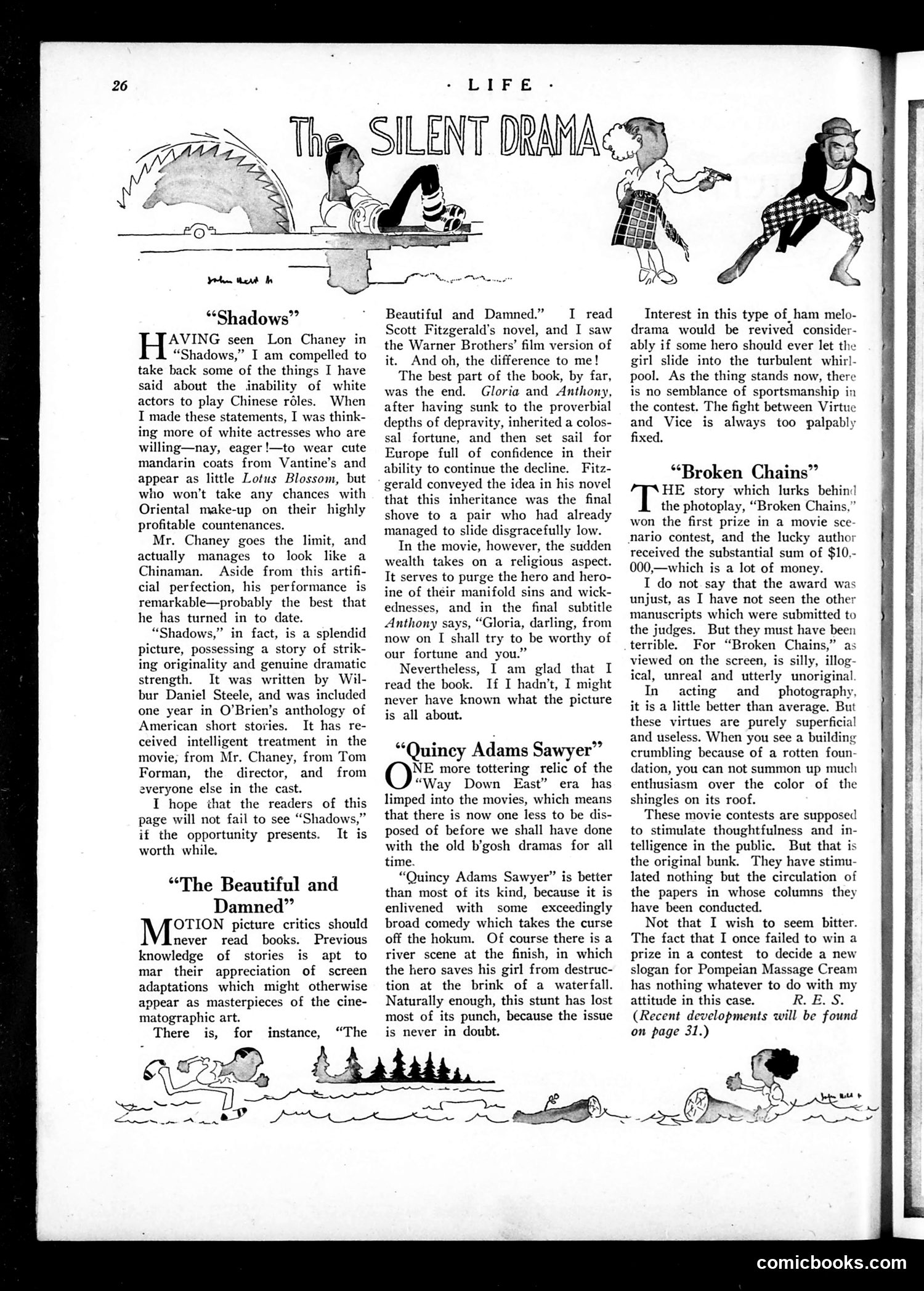
This page contains film criticism from Life magazine's "The Silent Drama" column. The reviewer discusses four movies: **"Shadows"**: Praises actor Lon Chaney's convincing portrayal of a Chinese character, noting white actors typically avoid authentic Oriental makeup. The film itself receives high marks for originality and dramatic strength. **"The Beautiful and Damned"**: Critiques the Warner Brothers adaptation of F. Scott Fitzgerald's novel, complaining the film sentimentalizes the ending. In the book, the protagonists' inheritance enables continued moral decline; in the movie, sudden wealth reforms them spiritually—a fundamental betrayal of Fitzgerald's darker vision. **"Quincy Adams Sawyer"**: Dismisses this "Way Down East" melodrama as dated hokum, though acknowledging its broad comedy. The reviewer satirizes the predictable rescue scene, sardonically suggesting the genre would gain interest if heroes occasionally *failed* to save heroines. **"Broken Chains"**: Briefly notes this scenario won a $10,000 contest prize. The tone is witty, sophisticated satire of silent film conventions and audience expectations.
📄 Transcribed text from this page (OCR, searchable)
Machine-transcribed from the original scan — historical spelling and the odd misread are preserved.
“Shadows” AVING seen Lon Chaney in “Shadows,” I am compelled to take back some of the things I have said about the inability of white actors to play Chinese réles. When I made these statements, I was think- ing more of white actresses who are willing—nay, eager!—to wear cute mandarin coats from Vantine’s and appear as little Lotus Blossom, but who won't take any chances with Oriental make-up on their highly profitable countenances. Mr. Chaney goes the limit, and actually manages to look like a Chinaman. Aside from this artifi- cial perfection, his performance is remarkable—probably the best that he has turned in to date. “Shadows,” in fact, is a splendid picture, possessing a story of strik- ing originality and genuine dramatic strength. It was written by Wil- bur Daniel Steele, and was included one year in O’Brien’s anthology of American short stories. It has re- ceived intelligent treatment in the movie, from Mr. Chaney, from Tom Forman, the director, and from everyone else in the cast. I hope that the readers of this page will not fail to see “Shadows,” if the opportunity presents. It is worth while. “The Beautiful and Damned” OTION picture critics should never read books. Previous knowledge of stories is apt to mar their appreciation of screen adaptations which might otherwise appear as masterpieces of the cine- matographic art. There is, for sacl instance, “The Beautiful and Damned.” I read Scott Fitzgerald's novel, and I saw the Warner Brothers’ film version of it. And oh, the difference to me! The best part of the book, by far, was the end. Gloria and Anthony, after having sunk to the proverbial depths of depravity, inherited a colos- sal fortune, and then set sail for Europe full of confidence in their ability to continue the decline. Fitz- gerald conveyed the idea in his novel that this inheritance was the final shove to a pair who had already managed to slide disgracefully low. In the movie, however, the sudden wealth takes on a religious aspect. It serves to purge the hero and hero- ine of their manifold sins and wick- ednesses, and in the final subtitle Anthony says, “Gloria, darling, from now on I shall try to be worthy of our fortune and you.” Nevertheless, I am glad that I read the book. If I hadn't, I might never have known what the picture is all about. “Quincy Adams Sawyer” NE more tottering relic of the “Way Down East” era has limped into the movies, which means that there is now one less to be dis- posed of before we shall have done with the old b’gosh dramas for all time. “Quincy Adams Sawyer” is better than most of its kind, because it is enlivened with some exceedingly broad comedy which takes the curse off the hokum. Of course there is a river scene at the finish, in which the hero saves his girl from destruc- tion at the brink of a waterfall. Naturally enough, this stunt has lost most of its punch, because the issue is never in doubt. Interest in this type of, ham melo- drama would be revived consider- ably if some hero should ever let the girl slide into the turbulent whirl- pool. As the thing stands now, there is no semblance of sportsmanship in the contest. The fight between Virtue and Vice is always too palpably fixed. “Broken Chains” HE story which lurks behind the photoplay, “Broken Chains,” won the first prize in a movie sce- nario contest, and the lucky author received the substantial sum of $10,- 000,—which is a lot of money. I do not say that the award was unjust, as I have not seen the other manuscripts which were submitted to the judges. But they must have been terrible. For “Broken Chains,” as viewed on the screen, is silly, illog- ical, unreal and utterly unoriginal In acting and _ photography, it is a little better than average. But these virtues are purely superficial and useless. When you see a building crumbling because of a rotten foun- dation, you can not summon up much enthusiasm over the color of the shingles on its roof. These movie contests are supposed to stimulate thoughtfulness and in- telligence in the public. But that is the original bunk. They have stimu- lated nothing but the circulation of the papers in whose columns they have been conducted. Not that I wish to seem bitter. The fact that I once failed to win a prize in a contest to decide a new slogan for Pompeian Massage Cream has nothing whatever to do with my attitude in this case. R-EWS, (Recent developments will be found on page 31.) ao a+ ae comicbooks.com