
Life, 1923-01-11 · page 24 of 36
Life — January 11, 1923 — page 24: what you’re looking at
What you’re looking at
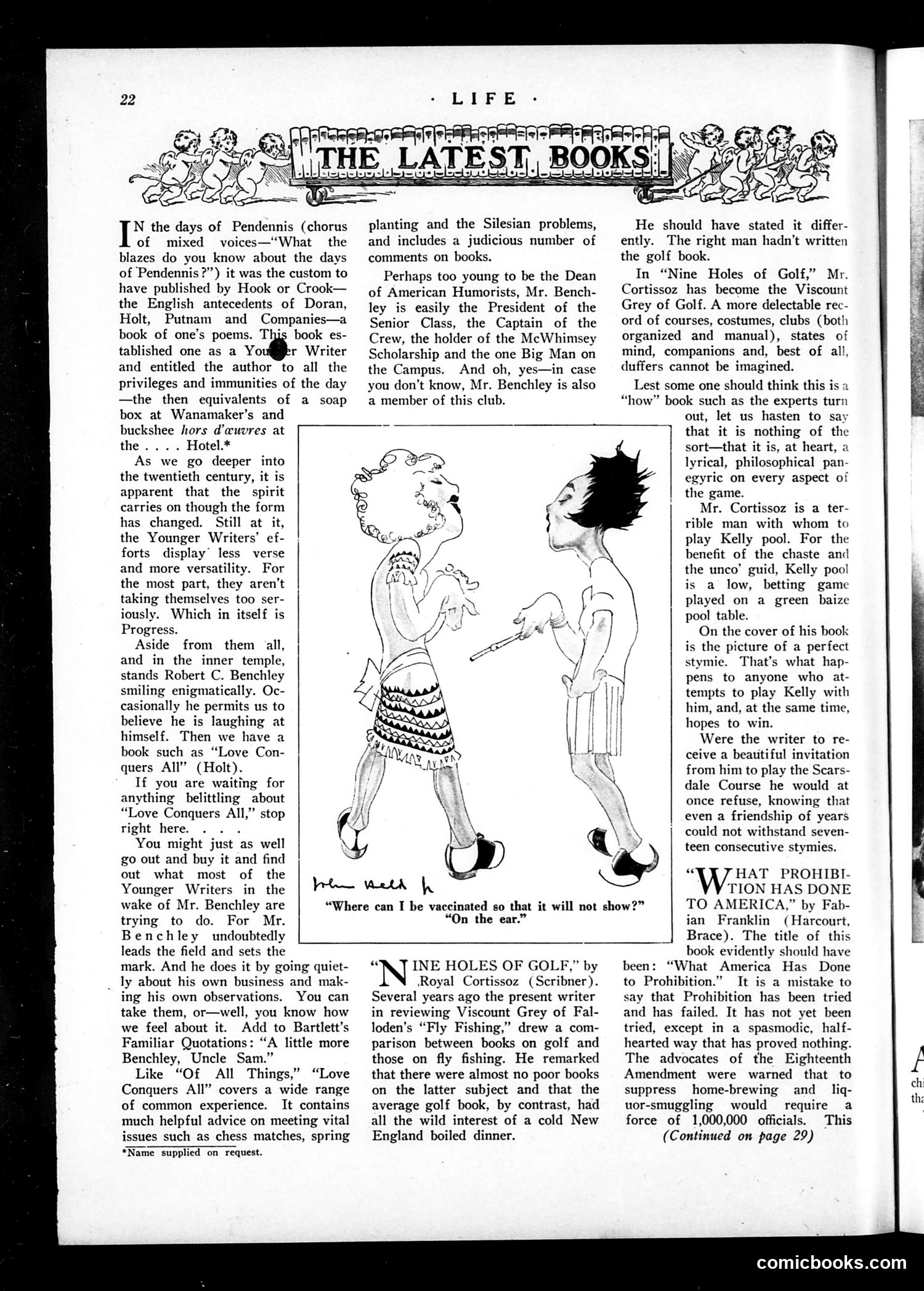
This is a book review section from Life magazine featuring literary commentary on recent publications. The main cartoon depicts a woman asking "Where can I be vaccinated so that it will not show?" with the reply "On the ear"—a topical joke about vaccination, likely referencing the 1920s anti-vaccination concerns or public health campaigns. The text reviews Robert C. Benchley's essay collections "Love Conquers All" and praises his wit and enigmatic humor. It also reviews Royal Cortissoz's "Nine Holes of Golf," a golf book that avoids being a technical "how-to" guide, instead offering lyrical observations about the sport. The page concludes mentioning Fabian Franklin's "What Prohibition Has Done to America," clearly referencing the Prohibition era (1920-1933). The overall tone celebrates younger American writers' less pretentious, more versatile approach to literature compared to earlier traditions.
📄 Transcribed text from this page (OCR, searchable)
Machine-transcribed from the original scan — historical spelling and the odd misread are preserved.
oe ae eecee = ‘H —— N the days of Pendennis (chorus of mixed voices—‘‘What the blazes do you know about the days of Pendennis ?”) it was the custom to have published by Hook or Crook— the English antecedents of Doran, Holt, Putnam and Companies—a book of one’s poems. Thjs book es- tablished one as a Yo r Writer and entitled the author to all the privileges and immunities of the day —the then equivalents of a soap box at Wanamaker’s and 7 Sisy ot: TES planting and the Silesian problems, and includes a judicious number of comments on books. Perhaps too young to be the Dean of American Humorists, Mr. Bench- ley is easily the President of the Senior Class, the Captain of the Crew, the holder of the McWhimsey Scholarship and the one Big Man on the Campus. And oh, yes—in case you don’t know, Mr. Benchley is also a member of this club. He should have stated it differ- ently. The right man hadn’t written the golf book. In “Nine Holes of Golf,” Mr. Cortissoz has become the Viscount Grey of Golf. A more delectable rec- ord of courses, costumes, clubs (both organized and manual), states of mind, companions and, best of all, duffers cannot be imagined. Lest some one should think this is a “how” book such as the experts turn out, let us hasten to say buckshee hors d’auvres at [— the... . Hotel.* As we go deeper into the twentieth century, it is apparent that the spirit carries on though the form has changed. Still at it, the Younger Writers’ ef- forts display’ less verse and more versatility. For the most part, they aren’t taking themselves too ser- iously. Which in itself is Progress. Aside from them all, and in the inner temple, stands Robert C. Benchley smiling enigmatically. Oc- casionally he permits us to believe he is laughing at himself. Then we have a book such as “Love Con- quers All” (Holt). If you are waiting for anything belittling about “Love Conquers All,” stop right here. You might just as well go out and buy it and find out what most of the Younger Writers in the wake of Mr. Benchley are trying to do. For Mr. Benchley undoubtedly “Where can I be vaccinated so that it will not show?” “On the ear.” that it is nothing of the sort—that it is, at heart, a lyrical, philosophical pan- egyric on every aspect of the game. Mr. Cortissoz is a ter- rible man with whom to play Kelly pool. For the benefit of the chaste and the unco’ guid, Kelly pool is a low, betting game played on a green baize pool table. On the cover of his book is the picture of a perfect stymie. That's what hap- pens to anyone who at- tempts to play Kelly with him, and, at the same time, hopes to win. Were the writer to re- ceive a beautiful invitation from him to play the Scars- dale Course he would at once refuse, knowing that even a friendship of years could not withstand seven- teen consecutive stymies. s HAT PROHIBI- TION HAS DONE TO AMERICA,” by Fab- ian Franklin (Harcourt, Brace). The title of this leads the field and sets the mark. And he does it by going quiet- . ly about his own business and mak- ing his own observations. You can take them, or—well, you know how we feel about it. Add to Bartlett’s Familiar Quotations: “A little more Benchley, Uncle Sam.” Like “Of All Things,” “Love Conquers All” covers a wide range of common experience. It contains much helpful advice on meeting vital issues such as chess matches, spring “Name supplied on request. ff INE HOLES OF GOLF,” by ‘Royal Cortissoz (Scribner). Several years ago the present writer in reviewing Viscount Grey of Fal- loden’s “Fly Fishing,” drew a com- parison between books on golf and those on fly fishing. He remarked that there were almost no poor books on the latter subject and that the average golf book, by contrast, had all the wild interest of a cold New England boiled dinner. book evidently should have been: “What America Has Done to Prohibition.” It is a mistake to say that Prohibition has been tried and has failed. It has not yet been tried, except in a spasmodic, half- hearted way that has proved nothing. The advocates of the Eighteenth Amendment were warned that to suppress home-brewing and_liq- uor-smuggling would require a force of 1,000,000 officials. This (Continued on page 29) comicbooks.com