
A complete issue · 44 pages · 1923
Life — January 4, 1923
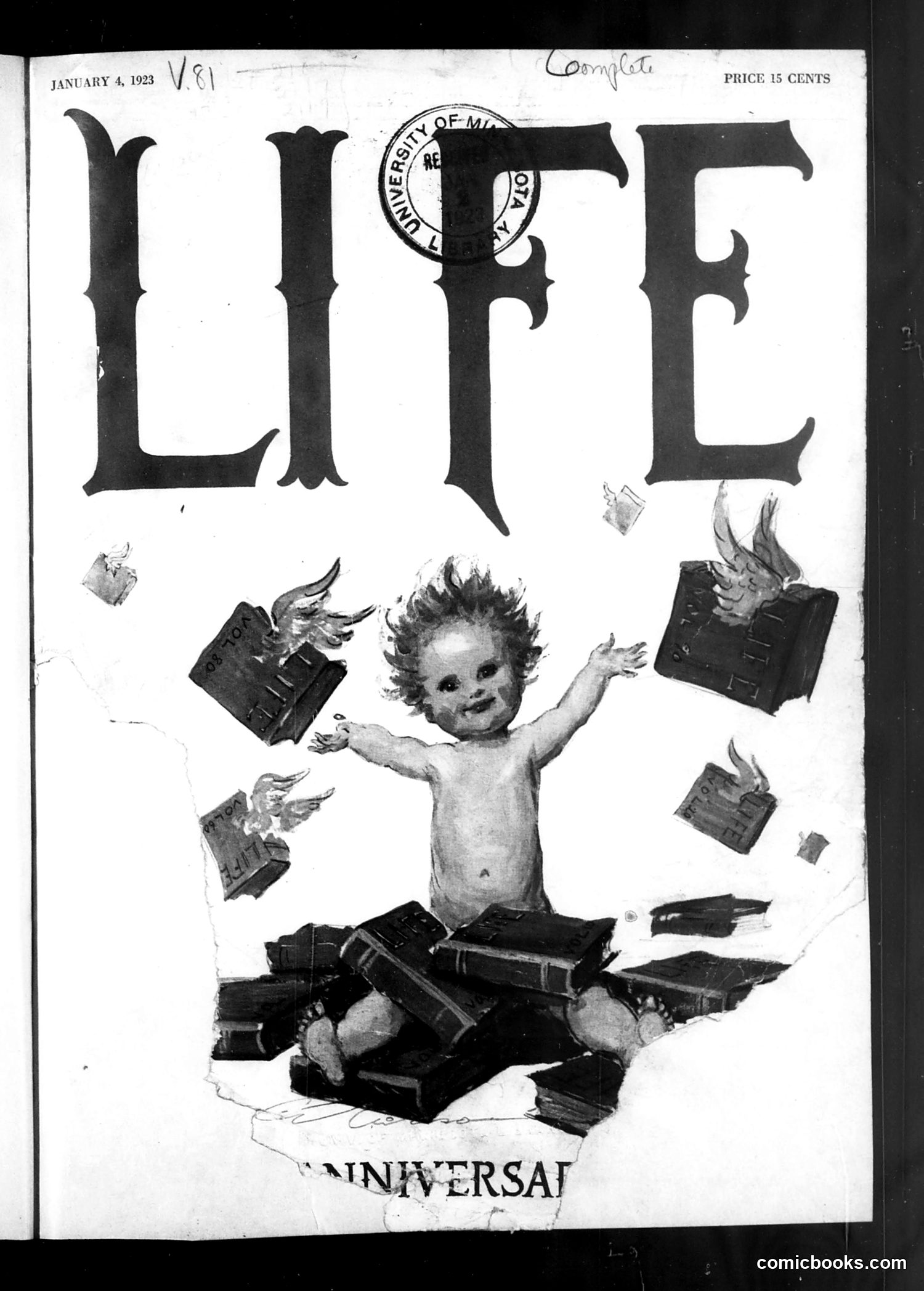
**January 4, 1923** This is a Life magazine cover featuring a cherubic baby surrounded by burning books and suitcases with wings. The imagery satirizes the post-WWI cultural upheaval and social anxieties of the 1920s. The burning books likely reference concerns about radical ideas, censorship debates, or the perceived "burning" of traditional values during this period of rapid social change. The winged luggage suggests transience and displacement—possibly referencing immigration, refugee movements, or the unsettled nature of post-war society. The joyful baby amid chaos creates dark humor, contrasting innocence with surrounding destruction. The "Universal" text (likely referencing Universal Film Company) suggests this may also comment on the film industry's cultural influence during the Jazz Age.
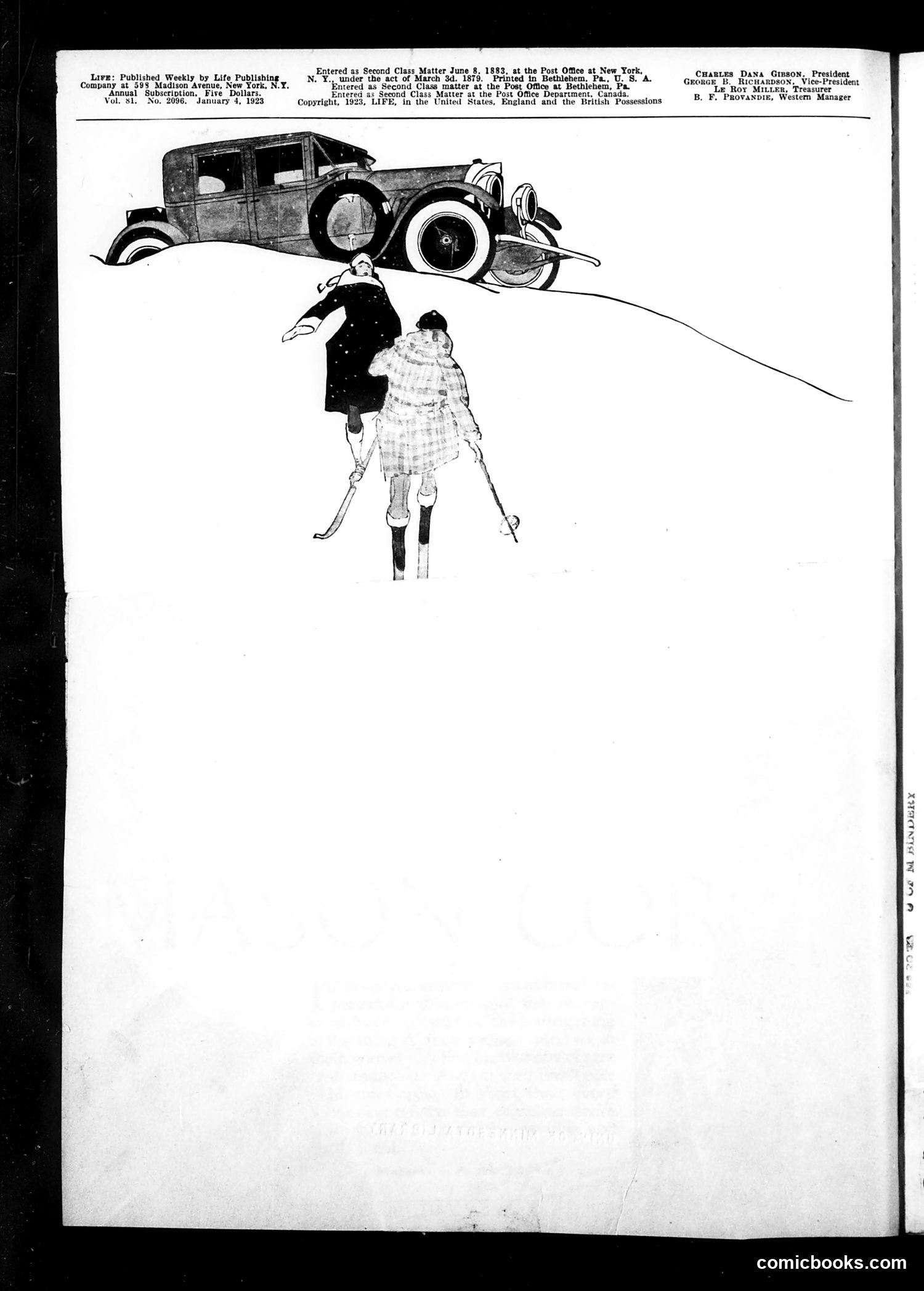
This is a page from *Life* magazine (January 4, 1923), containing an illustration showing two skiers descending a snowy slope toward an automobile parked above. The cartoon appears to be a winter sports satire, likely commenting on the novelty and danger of combining skiing—then an emerging recreational activity in America—with automobile culture. The composition suggests the skiers are racing downhill directly toward the car, implying either reckless behavior or a humorous collision scenario. Without additional context or captions visible in the image, the specific satirical target remains unclear. It may critique wealthy leisure activities, dangerous driving habits, or the collision of traditional winter sports with modern motorized transportation. The 1920s setting suggests commentary on the era's rapid technological and social changes.
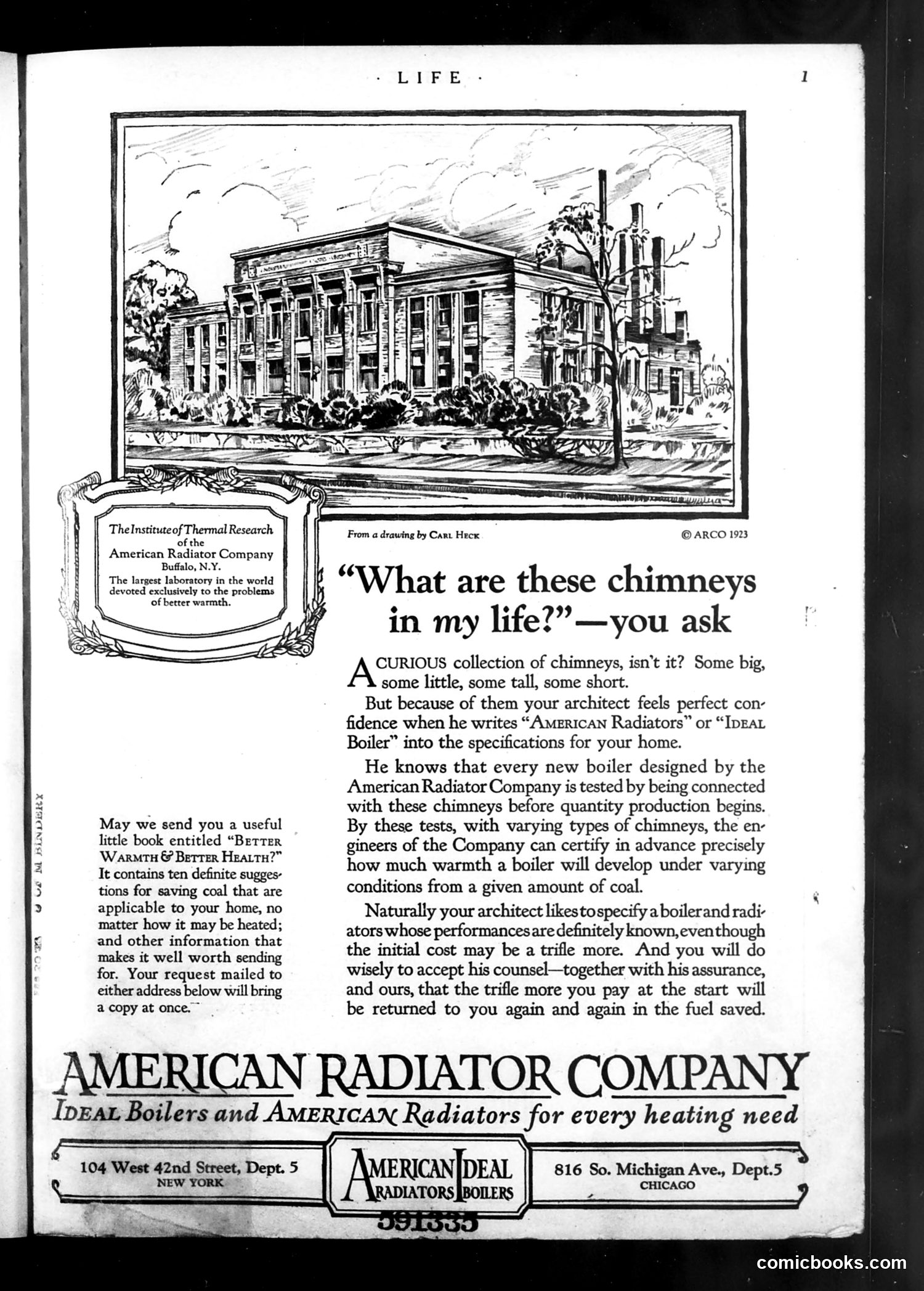
This is **primarily a 1923 advertisement**, not political satire. The page features an architectural drawing of an industrial building (the Institute of Thermal Research for American Radiator Company in Buffalo, NY) by artist Carl Heck. The "cartoon" element is minimal—just the rhetorical question "What are these chimneys in my life?" This is a copywriting device, not satire. The ad explains that architects specify American Radiator boilers confidently because the company tests them using various chimney configurations, ensuring predictable performance. The pitch emphasizes that higher upfront costs pay dividends through fuel savings. There's no political commentary or social satire here—it's straightforward industrial marketing aimed at architects and homeowners in the heating era.
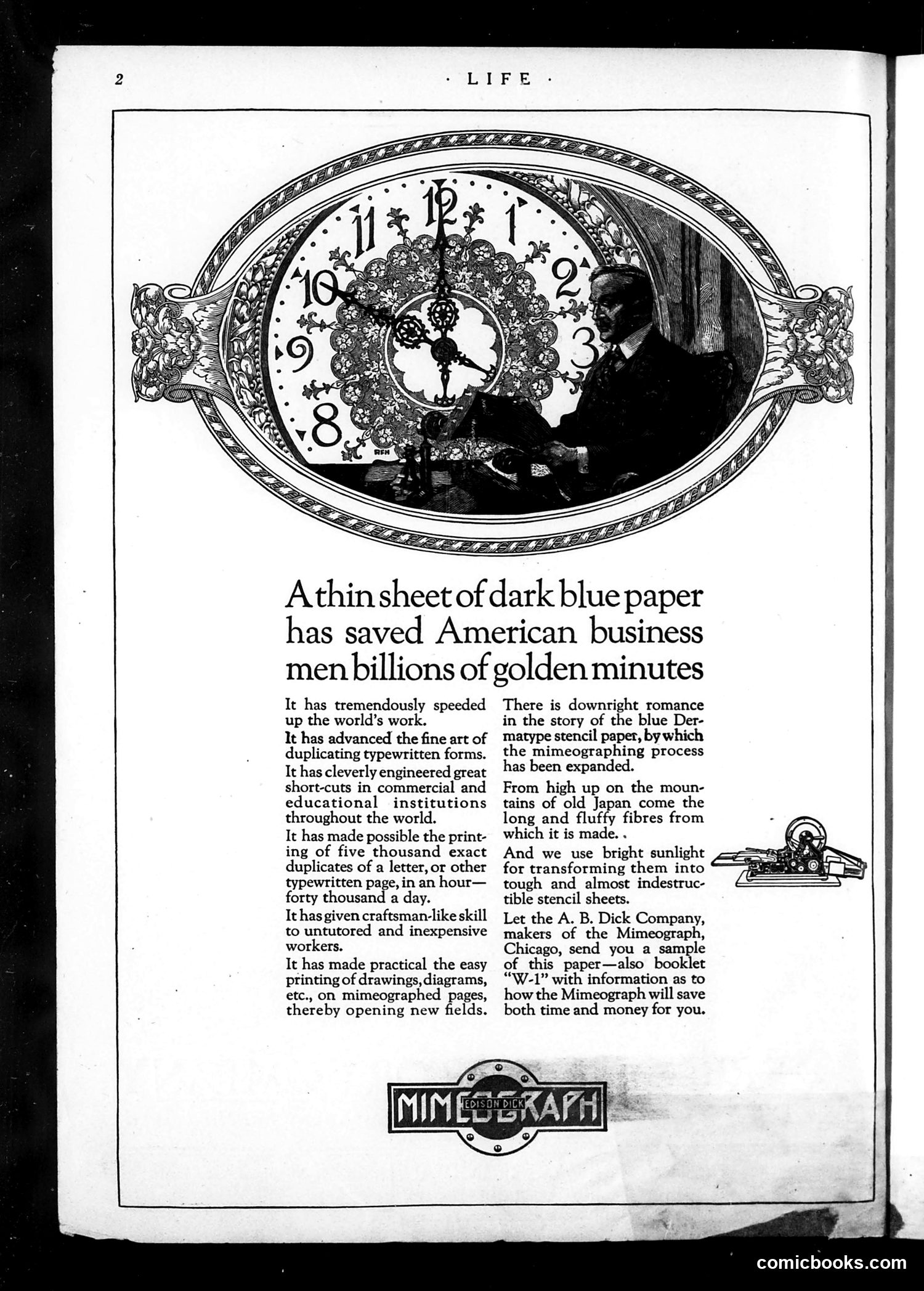
This page is primarily **advertising**, not satire or political commentary. It promotes the Mimeograph, a duplicating machine made by the A.B. Dick Company of Chicago. The advertisement uses a decorative ornamental clock face as its central image, with a silhouetted businessman seated beside it. The visual metaphor emphasizes time-saving: the headline claims blue carbon paper has saved American business "billions of golden minutes." The ad highlights practical applications—duplicating typewritten forms, printing drawings and diagrams—and appeals to cost-conscious businesses by emphasizing efficiency and affordability. The detailed text about Japanese paper sources adds credibility to the product's quality. This represents early 20th-century business automation marketing, targeting commercial enterprises and educational institutions seeking to modernize their operations.
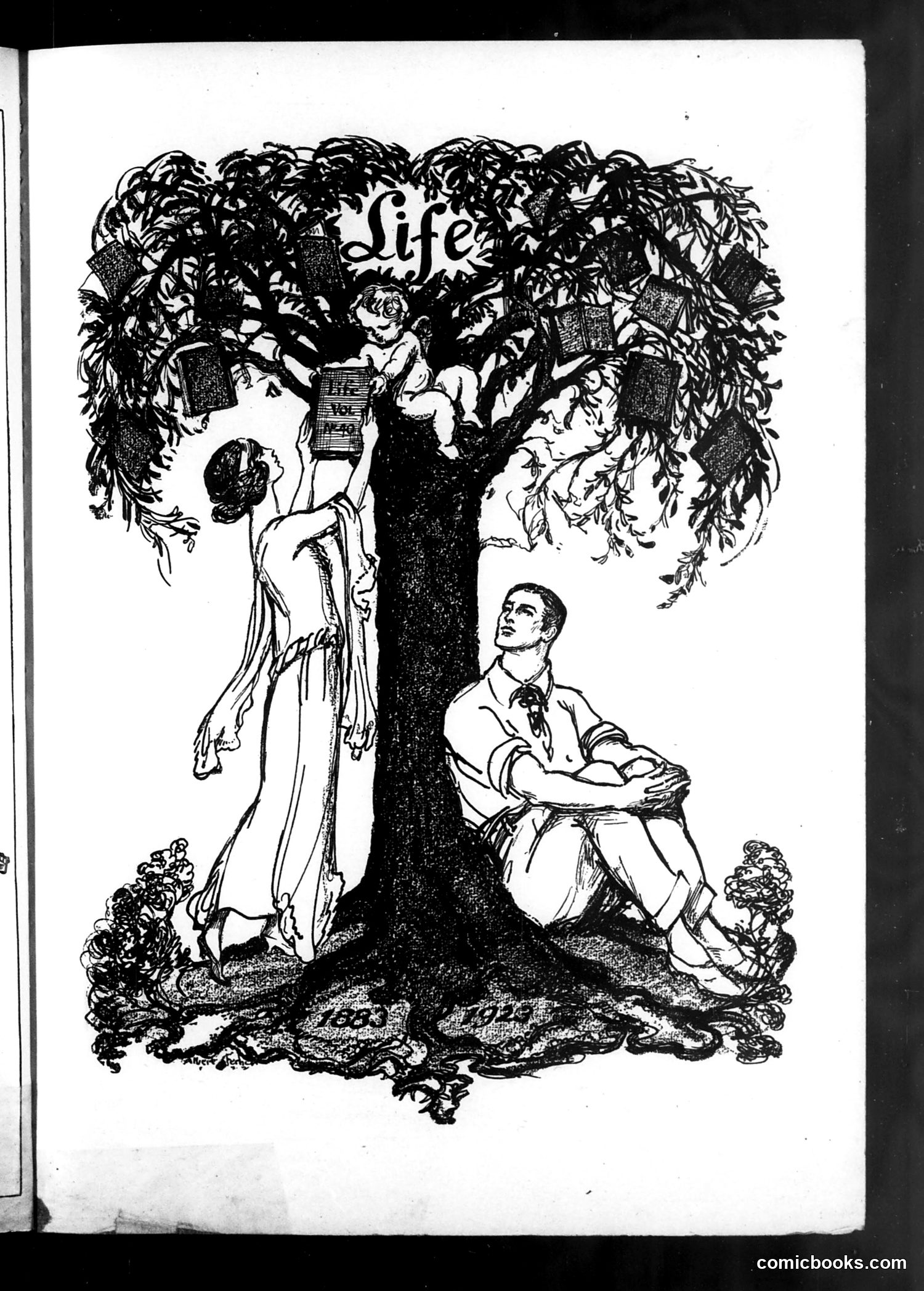
This is an allegorical illustration from *Life* magazine featuring a large tree labeled "Life" at its center. A woman in flowing robes reaches upward to pick fruit from the abundant branches, while a man sits contentedly below, holding a basket. Cherubs play in the foliage above. The image appears to be the magazine's masthead or title page rather than political satire. It presents an idealized vision of life's bounty and contentment—the woman actively pursuing life's rewards while the man enjoys its fruits. The cherubs and classical allegorical style suggest themes of innocence, prosperity, and human fulfillment. Without additional OCR text or context, the specific satirical point remains unclear, though the abundance imagery likely reflects early 20th-century American optimism.
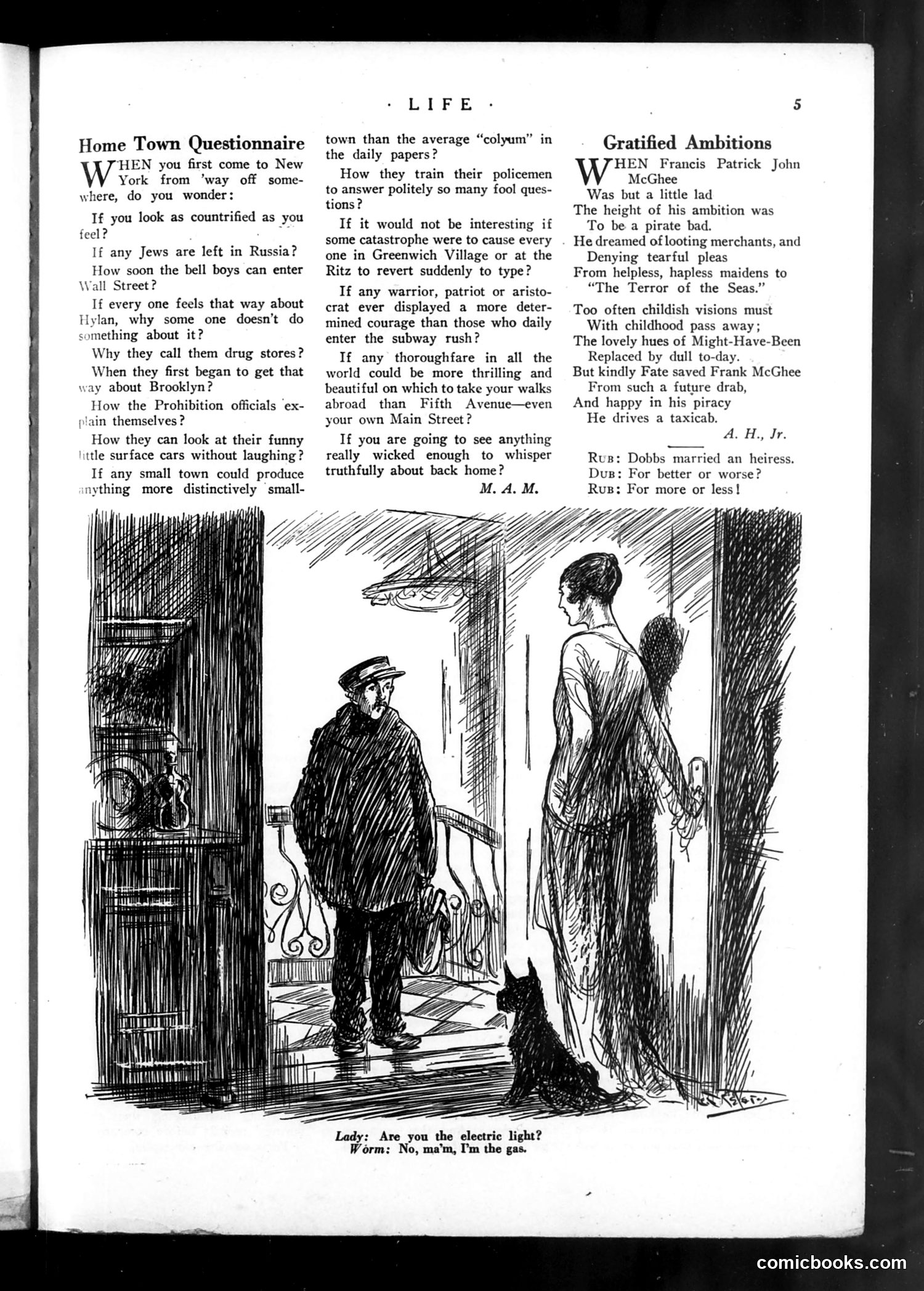
This page contains two unrelated pieces of early 20th-century American satire: **"Home Town Questionnaire"** (left column) poses ironic questions about small-town life—asking why citizens tolerate various local inconveniences and hypocrisies (drug stores, prohibition enforcement, surface cars). The humor targets provincial American towns' resistance to progress and self-awareness. **"Gratified Ambitions"** (right column) is a poem about Frank McGhee, a boy whose modest dream was simply to become a taxicab driver—presented as touchingly humble compared to grander childhood aspirations. **The cartoon below** shows a humorous misunderstanding: a woman asks a poorly-dressed man "Are you the electric light?" He replies "No, ma'm, I'm the gas"—a pun on "gas" as both fuel and derogatory slang for an unpleasant person.
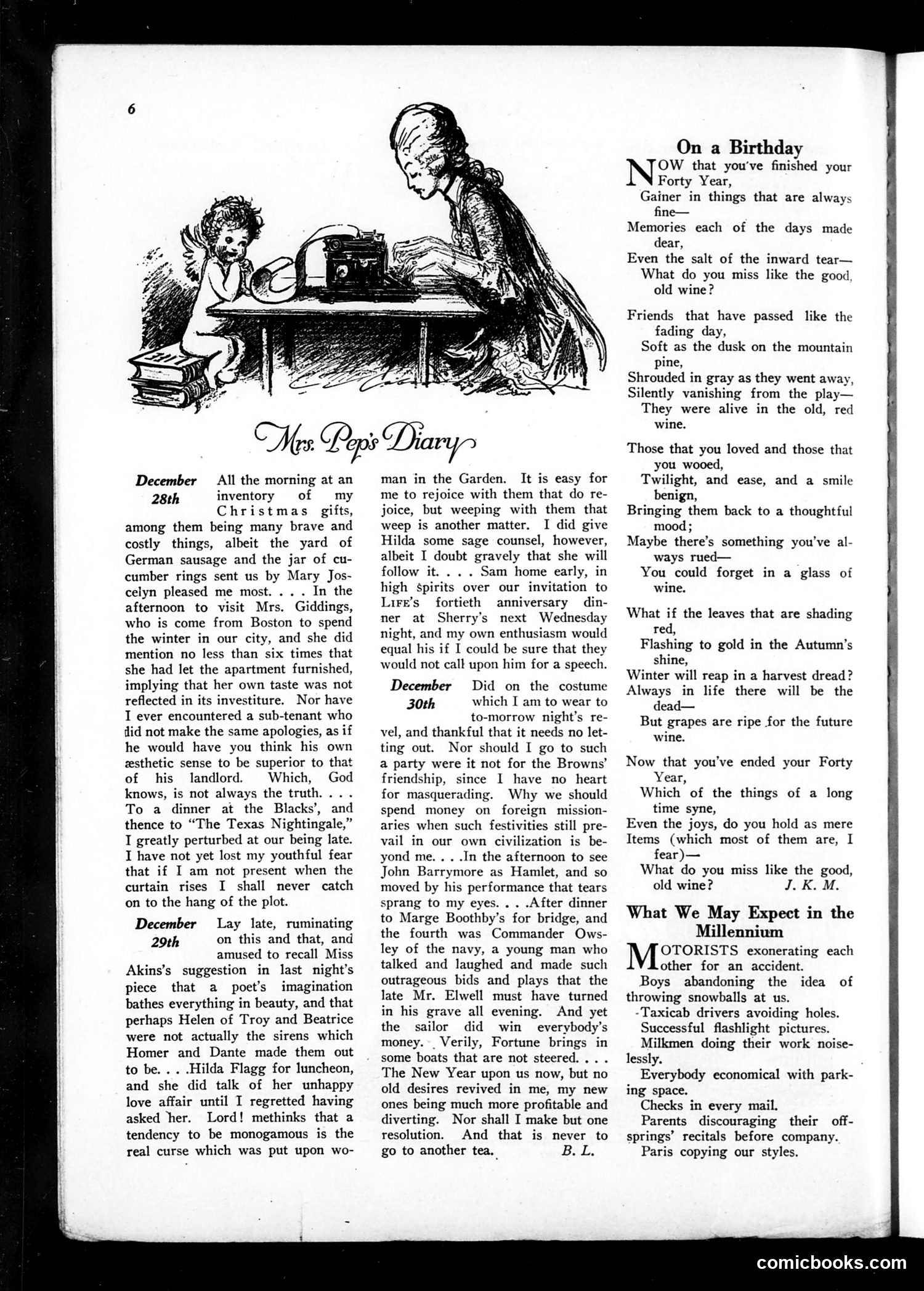
This page contains **Mrs. Pep's Diary**, a serialized personal narrative column appearing in *Life* magazine. The accompanying illustration shows a woman at a typewriter with a cherub-like figure, depicting the diary writer at work. The diary entries (December 24th and 30th) recount mundane upper-middle-class life: Christmas gifts, social dinners, theater attendance, and costume party preparations. The writer mentions specific acquaintances and social events with gentle criticism—noting a landlord's aesthetic sense, complaining about gift-giving expectations, and commenting on theatrical performances. Below the diary, "What We May Expect in the Millennium" offers satirical predictions about modern life improvements (motorists avoiding holes, taxicabs avoiding accidents, economical parking). This appears to be **genteel domestic satire** targeting educated, affluent readers through relatable social observation rather than political commentary.
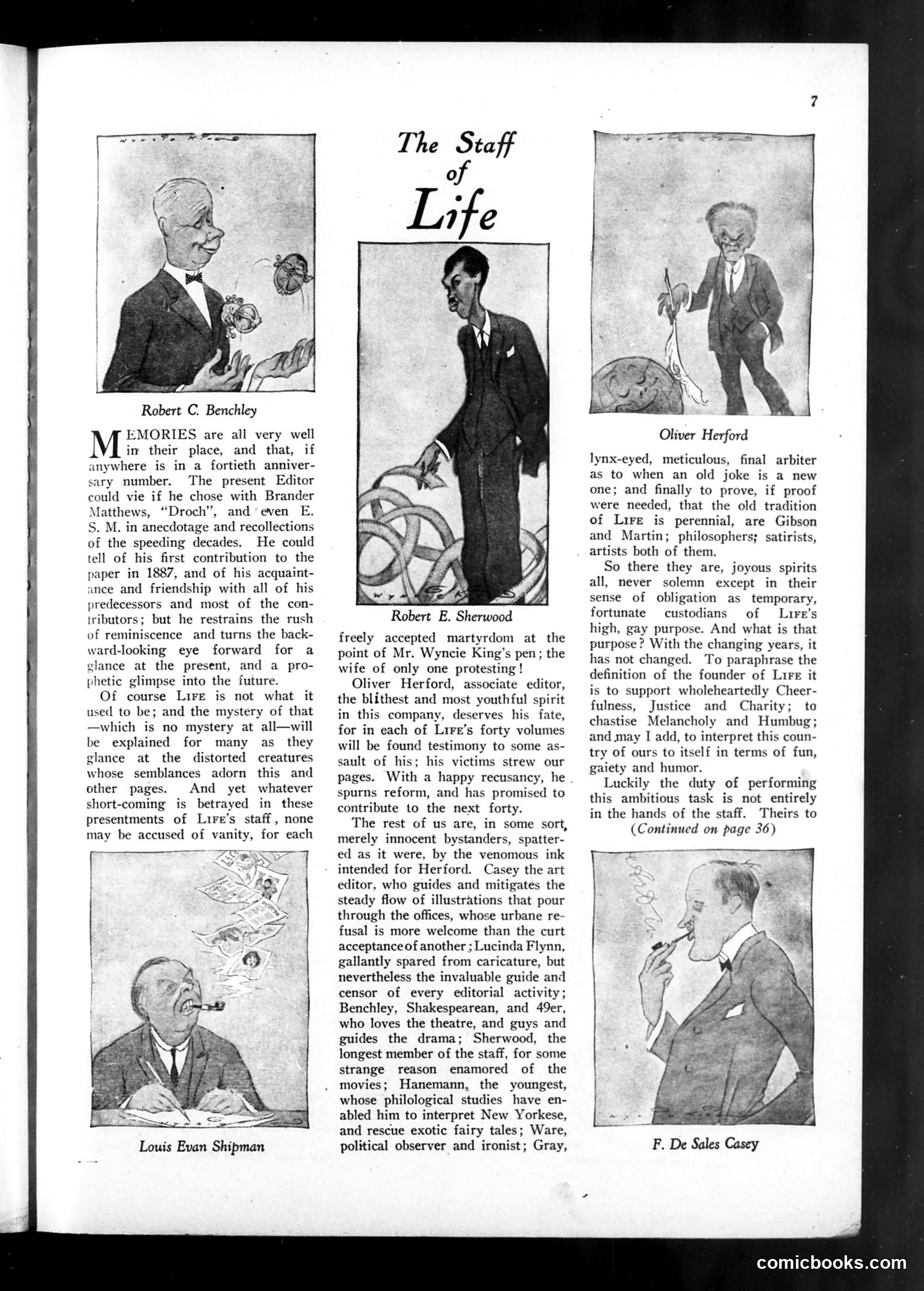
This page introduces Life magazine's editorial staff through portraits and biographical sketches. The title "The Staff of Life" is a pun—both referring to bread as sustenance and to the people who sustain the publication. The sketches describe various editors and contributors: Robert C. Benchley (humorist), Robert E. Sherwood, Oliver Herford (described as a final arbiter of jokes), Louis Ewan Shipman, F. De Sales Casey, and others. The text emphasizes their collective mission: maintaining Life's "fun, gaiety and humor" while upholding "Justice and Charity" and challenging pretension. This is essentially a self-promotional piece celebrating the magazine's creative team and their editorial philosophy during the early 20th century.
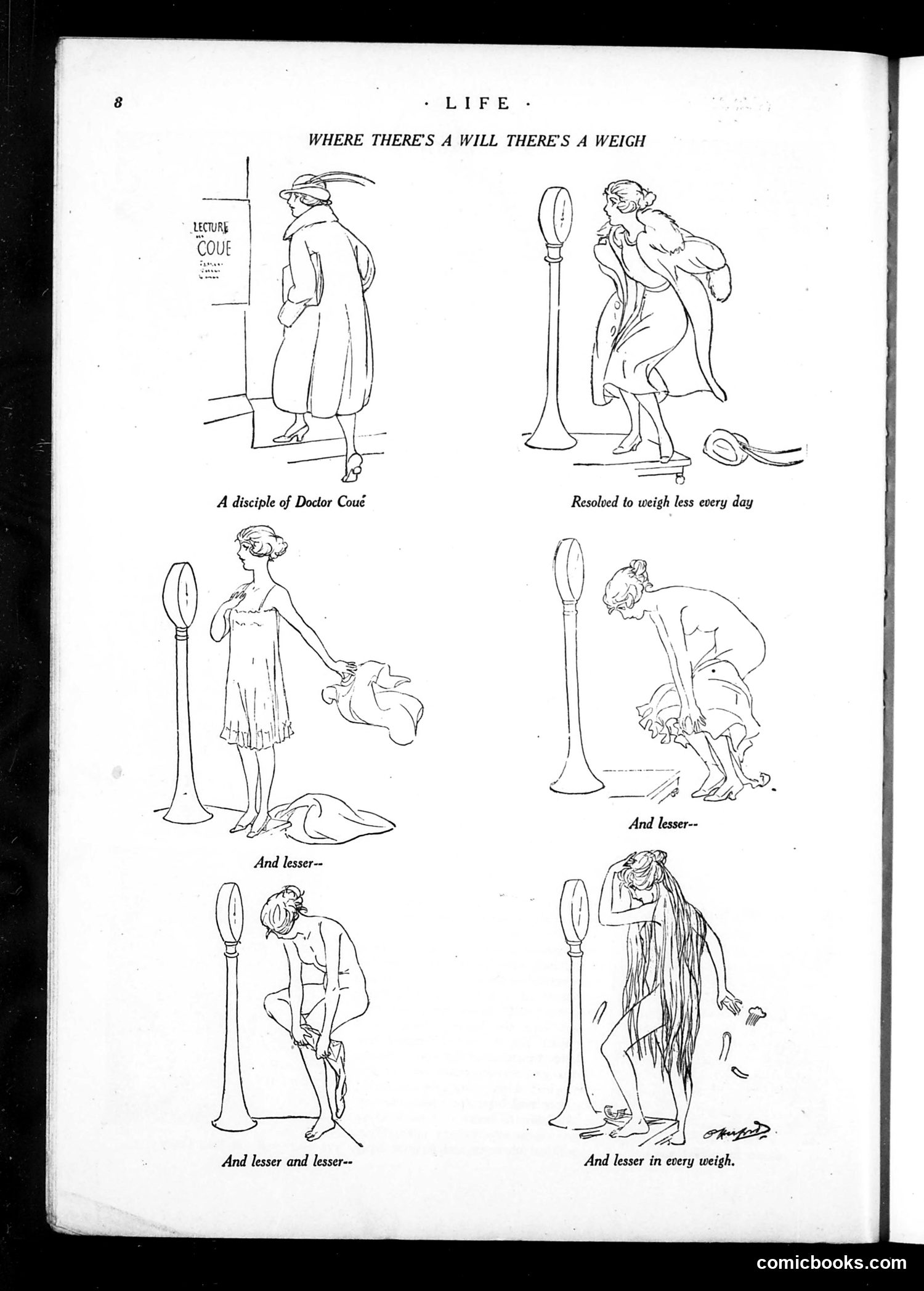
This is a humorous comic strip about weight loss and scales. The narrative follows a woman who resolves to weigh herself less frequently as a weight management strategy. The top panel references "Doctor Coué" and his disciple, likely alluding to Émile Coué, a popular early 20th-century French psychologist known for "autosuggestion" and positive thinking methods. The joke progresses through six panels showing the woman repeatedly using a scale while claiming to weigh less often, eventually abandoning the scale entirely while gaining weight. The punchline—"And lesser in every weigh"—is a pun on "weigh" versus "way," mocking the ineffectiveness of avoidance as a weight-loss strategy. The satire critiques both fad dieting and self-deceptive wellness trends of the era.
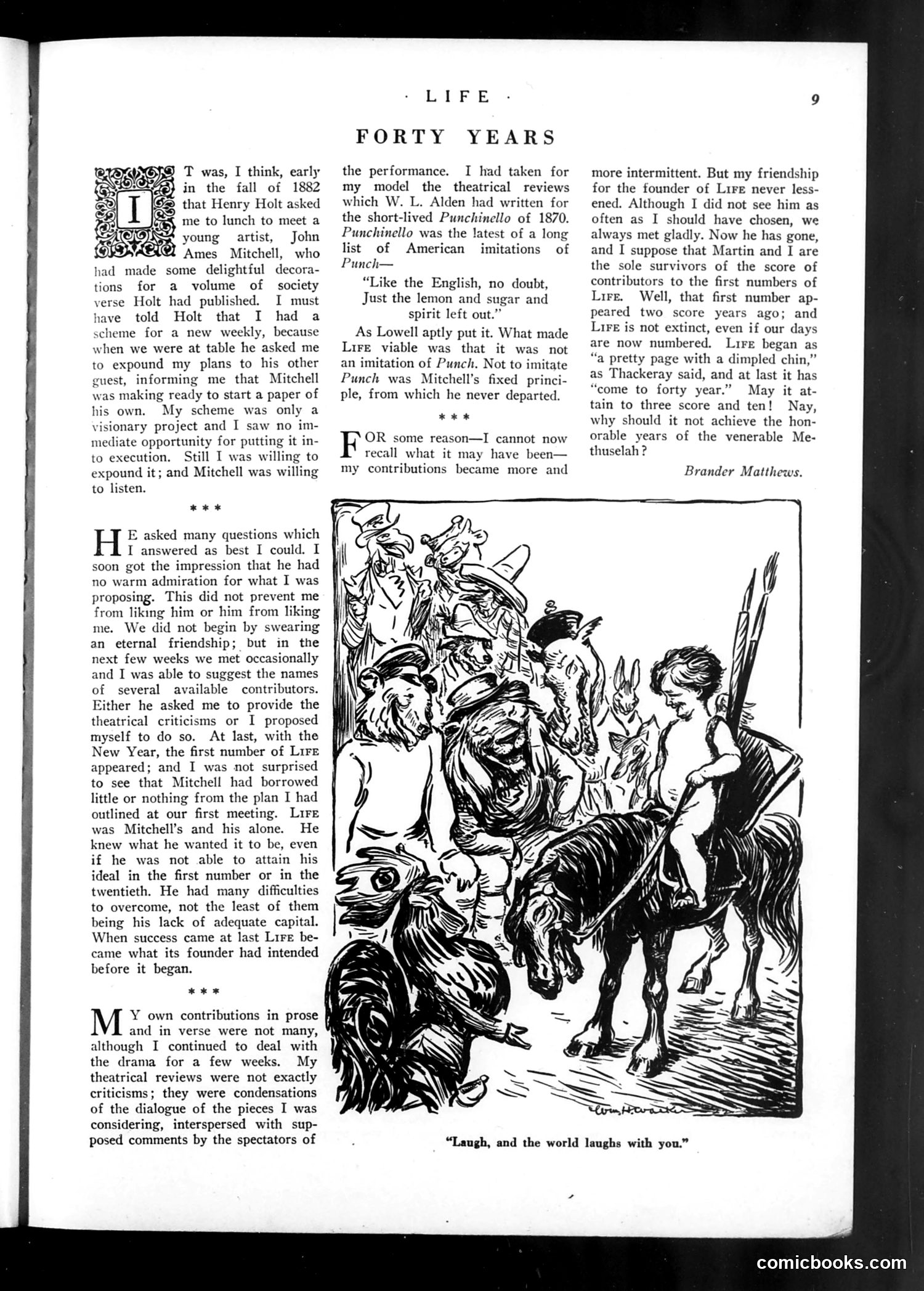
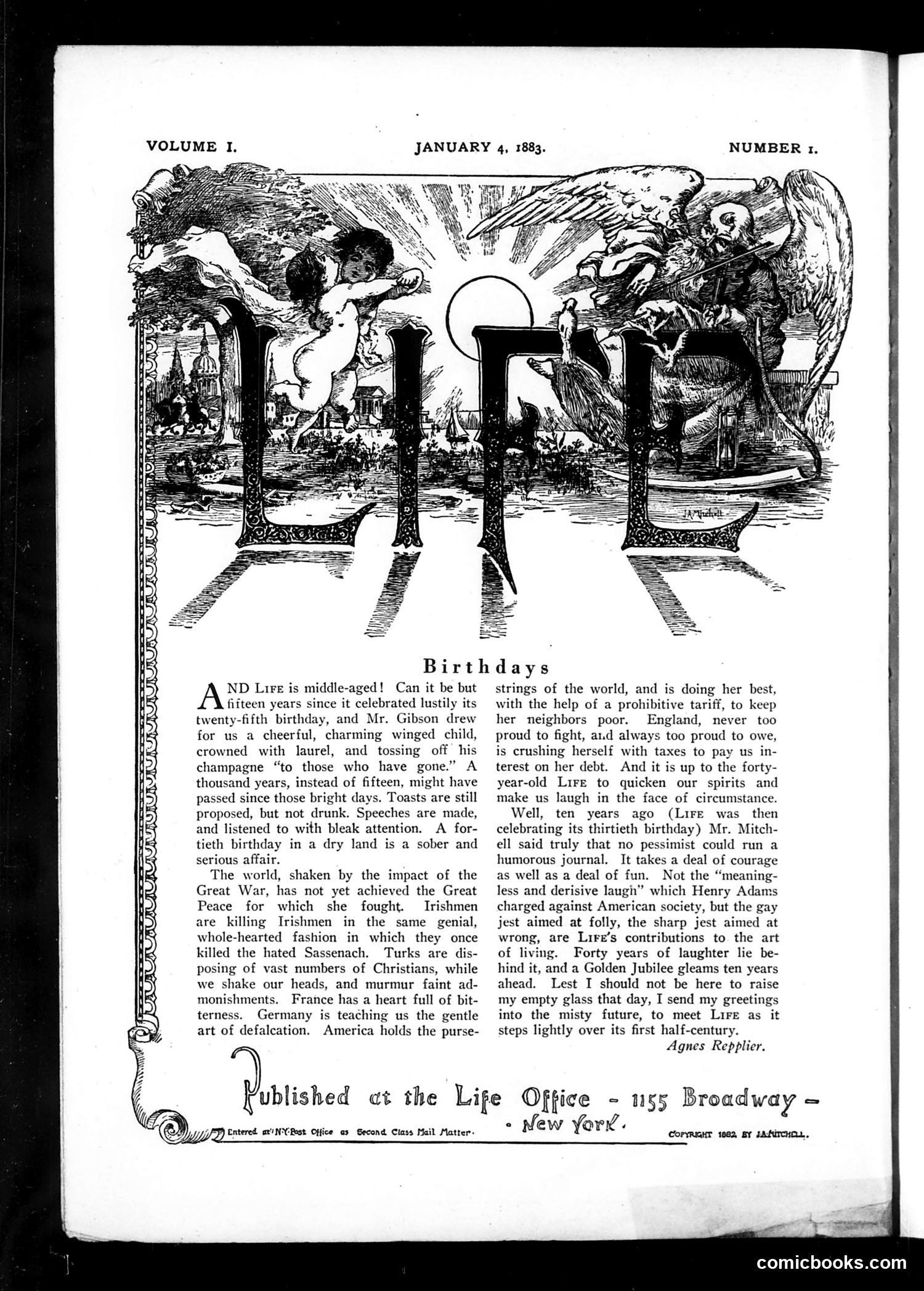
This page commemorates Life magazine's 40th anniversary. The author (identified as Brander Matthews) recounts how Henry Holt asked him to help launch a publication by young artist James Mitchell. The text describes Life as imitating the English *Punch* magazine—a satirical publication featuring witty social commentary. The accompanying illustration shows anthropomorphized animals (appearing to be goats or similar creatures) in a chaotic, comedic scene with the caption "Laugh, and the world laughs with you." This visual humor exemplifies Life's satirical approach to social observation. The narrative emphasizes Life's early struggles and Mitchell's vision, suggesting the magazine succeeded despite initial skepticism and limited capital—a testament to its founders' determination and the publication's appeal to audiences seeking intelligent comedy and social satire.
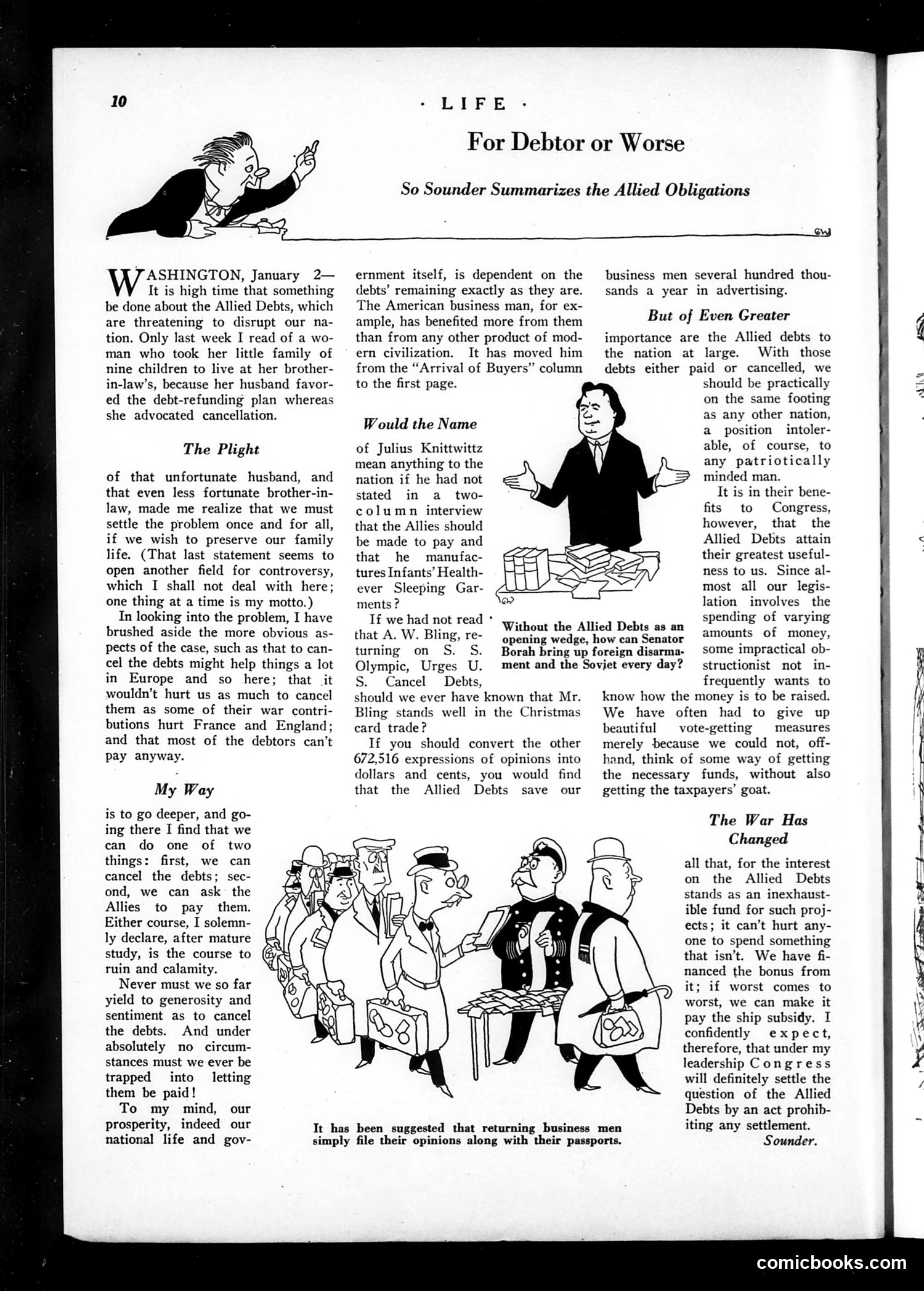
This 1920s Life magazine article satirizes debates over Allied war debts—money loaned to Britain, France, and other WWI allies that they hadn't repaid. The cartoons mock three groups: a struggling debtor family (representing the dilemma), American businessmen filing opinions about debt policy, and foreign delegations seeking favorable terms. The central figure appears to be "Sounder," Life's persona for summarizing complex issues. The satire's point: canceling Allied debts would hurt American finances, yet demanding repayment strains relationships with war allies. The author (likely mocking Congress) argues neither full cancellation nor indefinite lending serves national interests—a lose-lose situation requiring difficult political compromise. The cartoons exaggerate the complexity and frustration surrounding post-war financial negotiations that divided American policymakers.
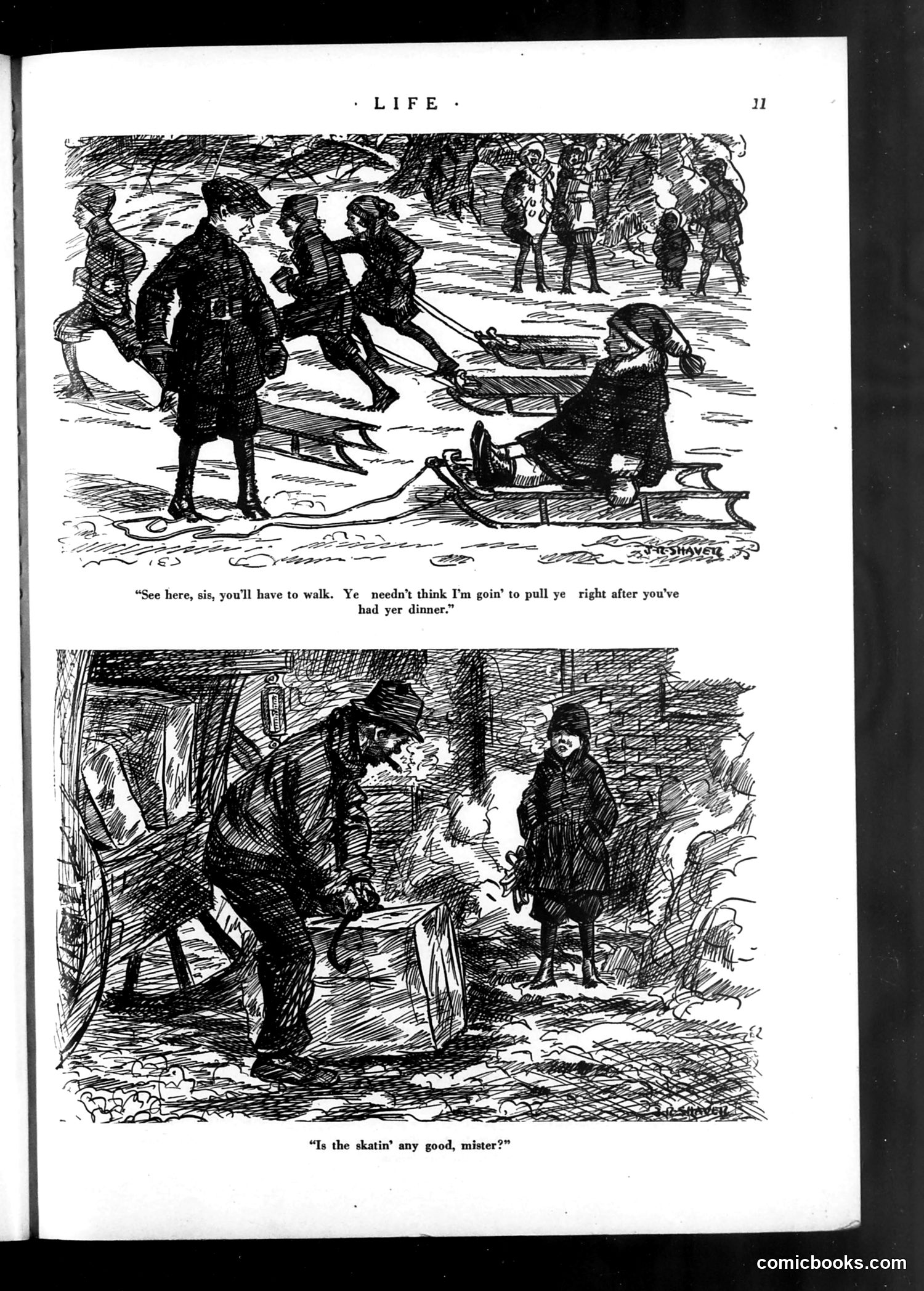
This page contains two winter-themed cartoons satirizing social class and gender roles. **Top cartoon:** A child refuses to walk after dinner, insisting an adult pull her on a sled instead. The satire targets parental indulgence and children's entitlement—the joke being that the child exploits digestive concerns as an excuse for continued leisure. **Bottom cartoon:** In what appears to be a poorer setting, a man asks if skating equipment is "any good," likely shopping secondhand or in a humble market. This contrasts sharply with the upper-class child above, satirizing economic disparity and how different social classes access the same winter activities. Together, these cartoons mock both wealthy parental over-accommodation and the resourcefulness required of working-class families.
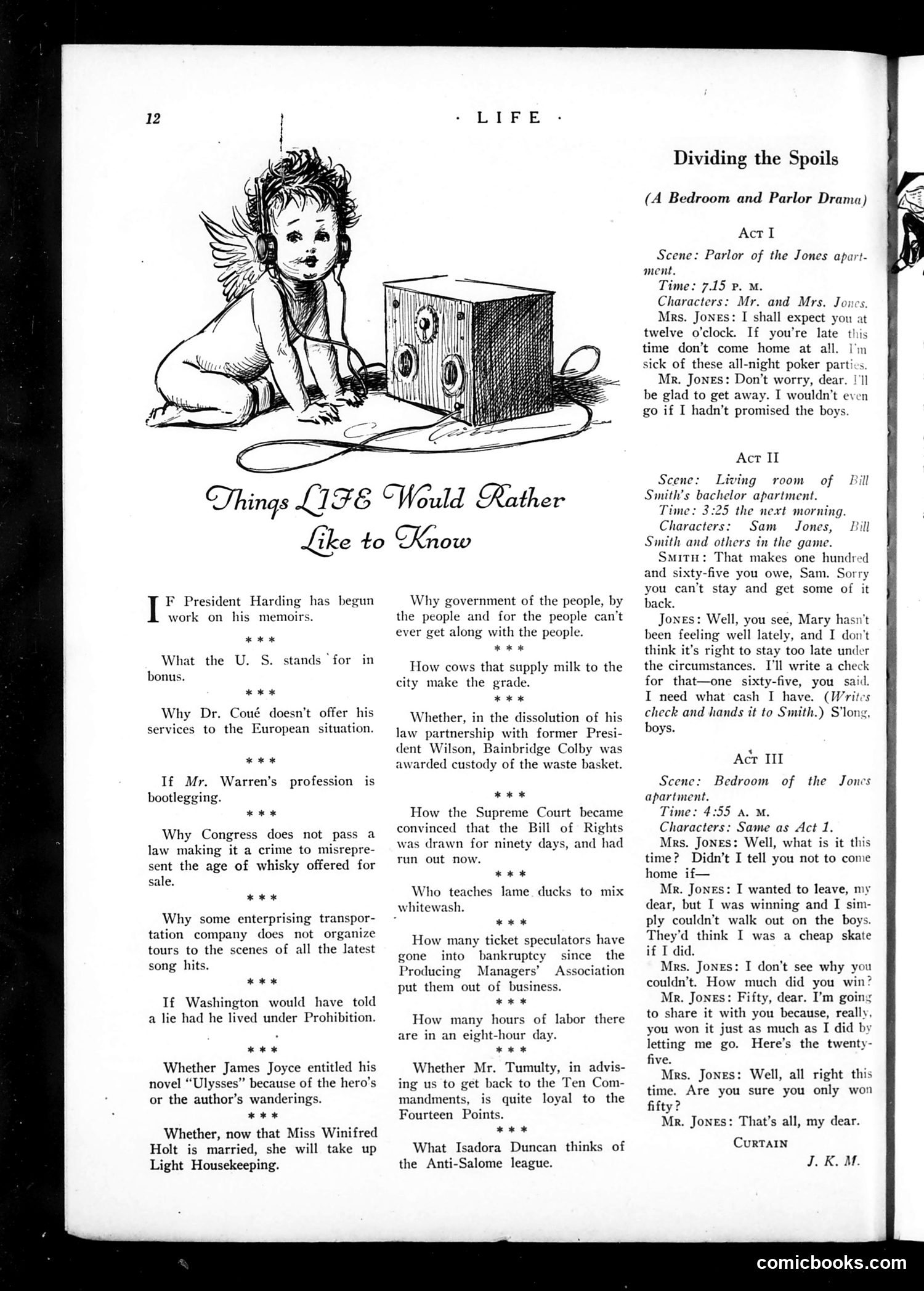
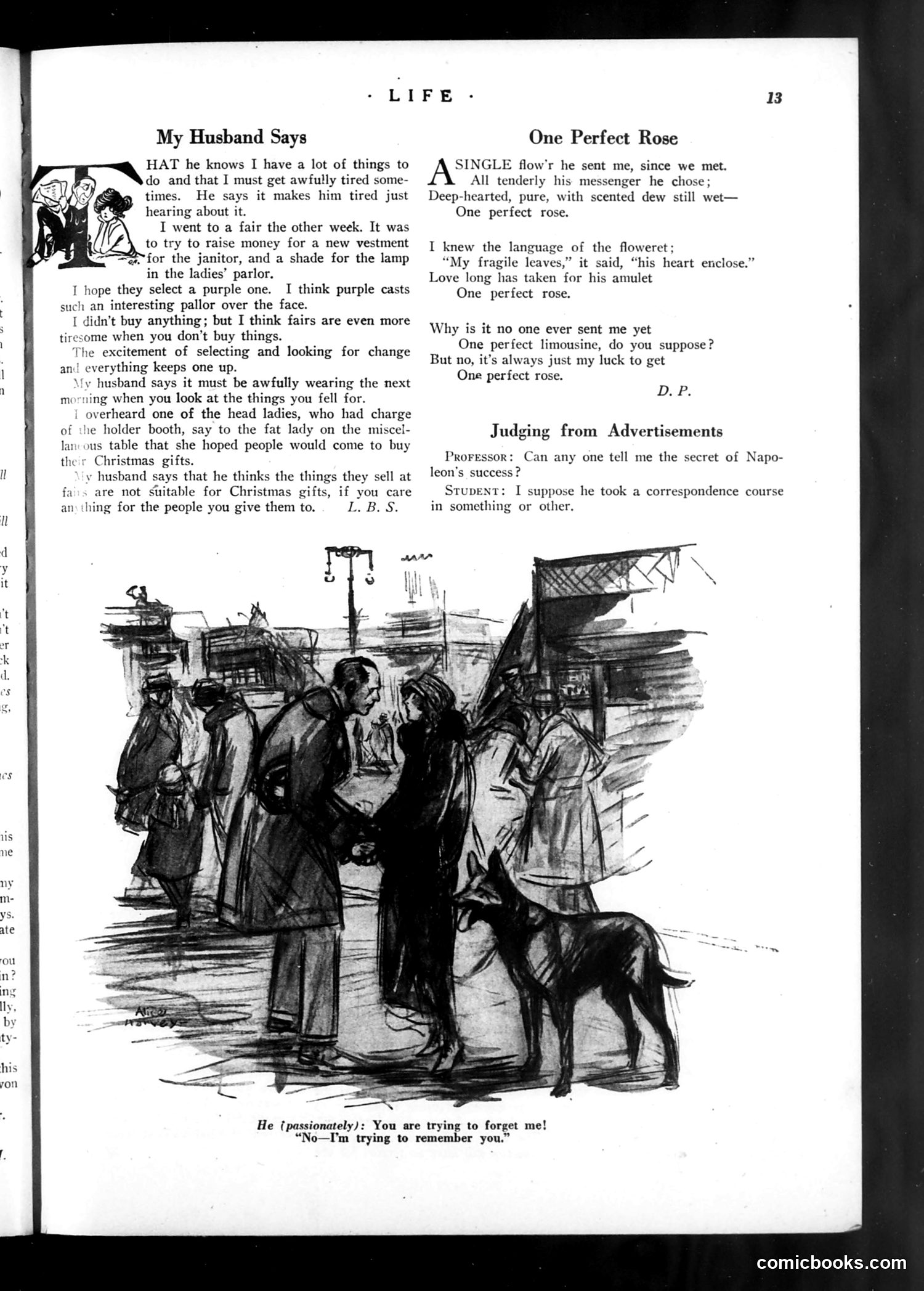
This page contains three separate pieces of social humor: 1. **"My Husband Says"** (left column): A domestic humor piece where a wife complains that her husband claims to be "awfully tired sometimes" despite knowing she has plenty of household tasks. She recounts shopping for fair items and her husband's observations about women's purchasing habits and gift-giving. 2. **"One Perfect Rose"** (top right): A romantic poem about receiving a single rose from an admirer, written by someone with initials "D.P." It plays on courtship conventions and the language of flowers. 3. **"Judging from Advertisements"** (middle right): A brief comedic exchange between a professor and student about Napoleon's success, joking that he likely took a correspondence course. The large illustration below depicts a street scene with well-dressed people and a dog, captioned with dialogue about forgetting versus remembering someone—likely romantic in nature.
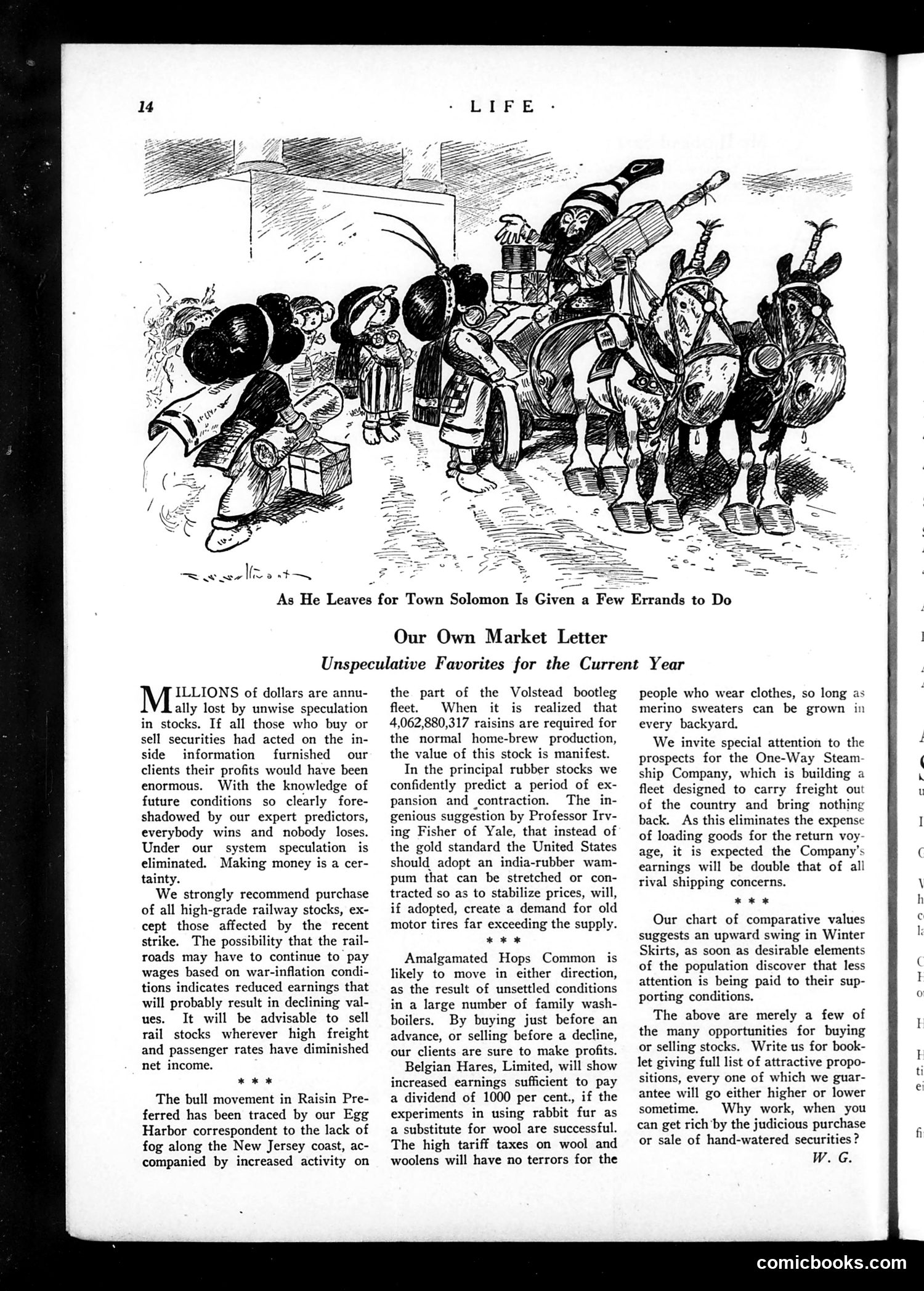
This cartoon satirizes **Solomon**, depicted as a bumbling figure departing on horseback while receiving instructions from smaller figures around him. The exaggerated, cartoonish style suggests mockery of someone's incompetence or confusion. The accompanying article, "Our Own Market Letter," discusses stock speculation and financial advice, touching on railroad stocks, rubber companies, and wool tariffs. The cartoon likely caricatures a financial figure or politician of the era—possibly someone involved in these industries—as foolish or unreliable, unable to handle even simple tasks ("errands") before leaving. The humor works through visual contrast: the elaborate, comical send-off for someone apparently unfit for responsibility.
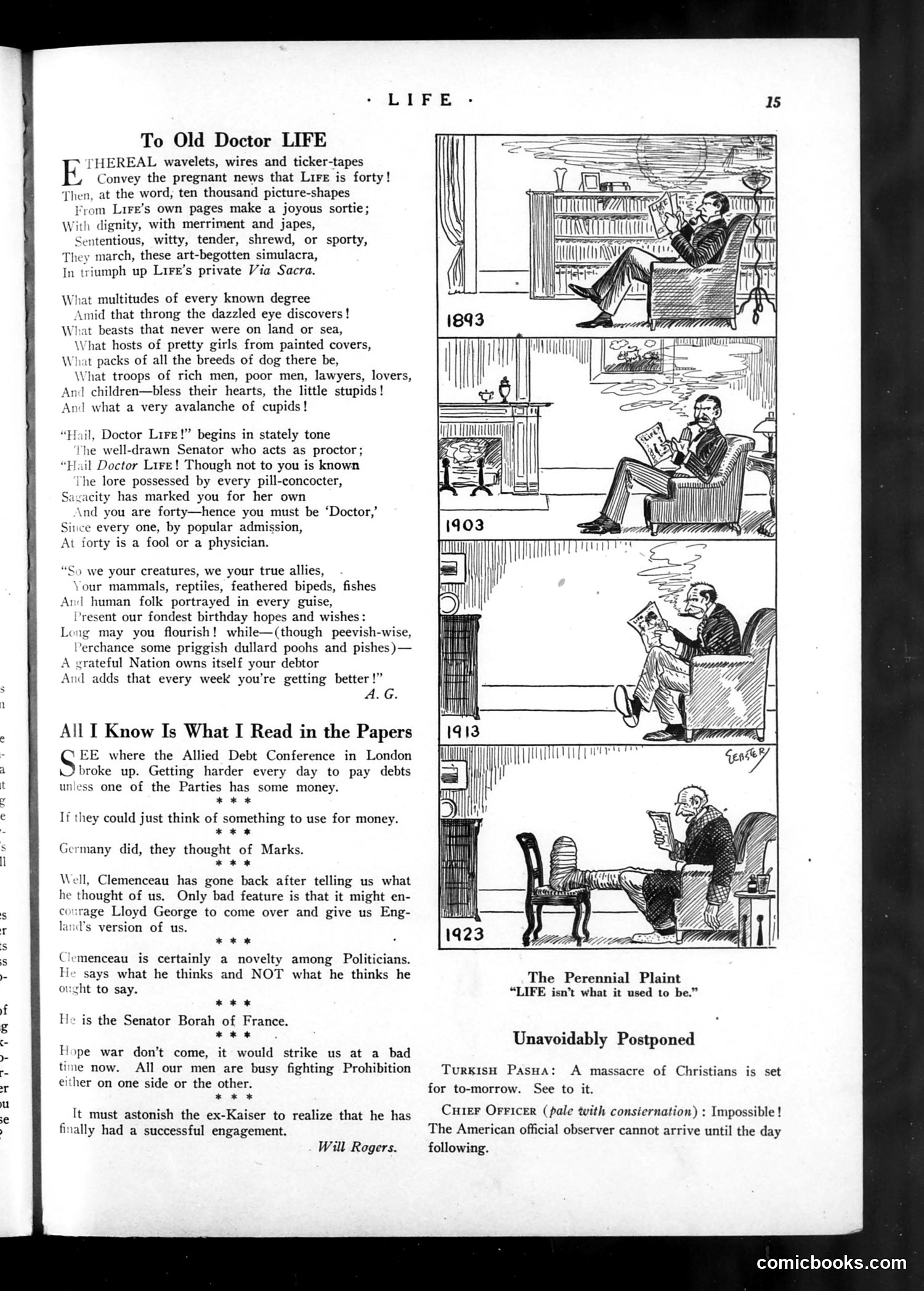
**The Main Content:** This page celebrates Life magazine's 40th anniversary with a poem praising the publication's cultural impact—its diverse cast of characters, from society figures to animals to common people. **The Political Commentary (Will Rogers column):** Rogers satirizes post-WWI economic chaos: the Allied Debt Conference's failure, Germany's hyperinflation (the "Marks" joke), and French politician Clemenceau's blunt honesty. He compares Clemenceau to Senator Borah, apparently meaning both are unusual for actually saying what they think. Rogers also quips about American Prohibition enforcement consuming national energy, and mocks the ex-Kaiser for finally achieving "a successful engagement" (likely referencing his marriage). **The Bottom Cartoon:** A darkly cynical joke: a Turkish Pasha orders a massacre of Christians tomorrow, but a Chief Officer postpones it because "the American official observer cannot arrive until the day following"—satirizing how American observation might legitimize or delay atrocities, and bureaucratic absurdity generally. The overall tone is sophisticated political humor typical of 1920s Life magazine.
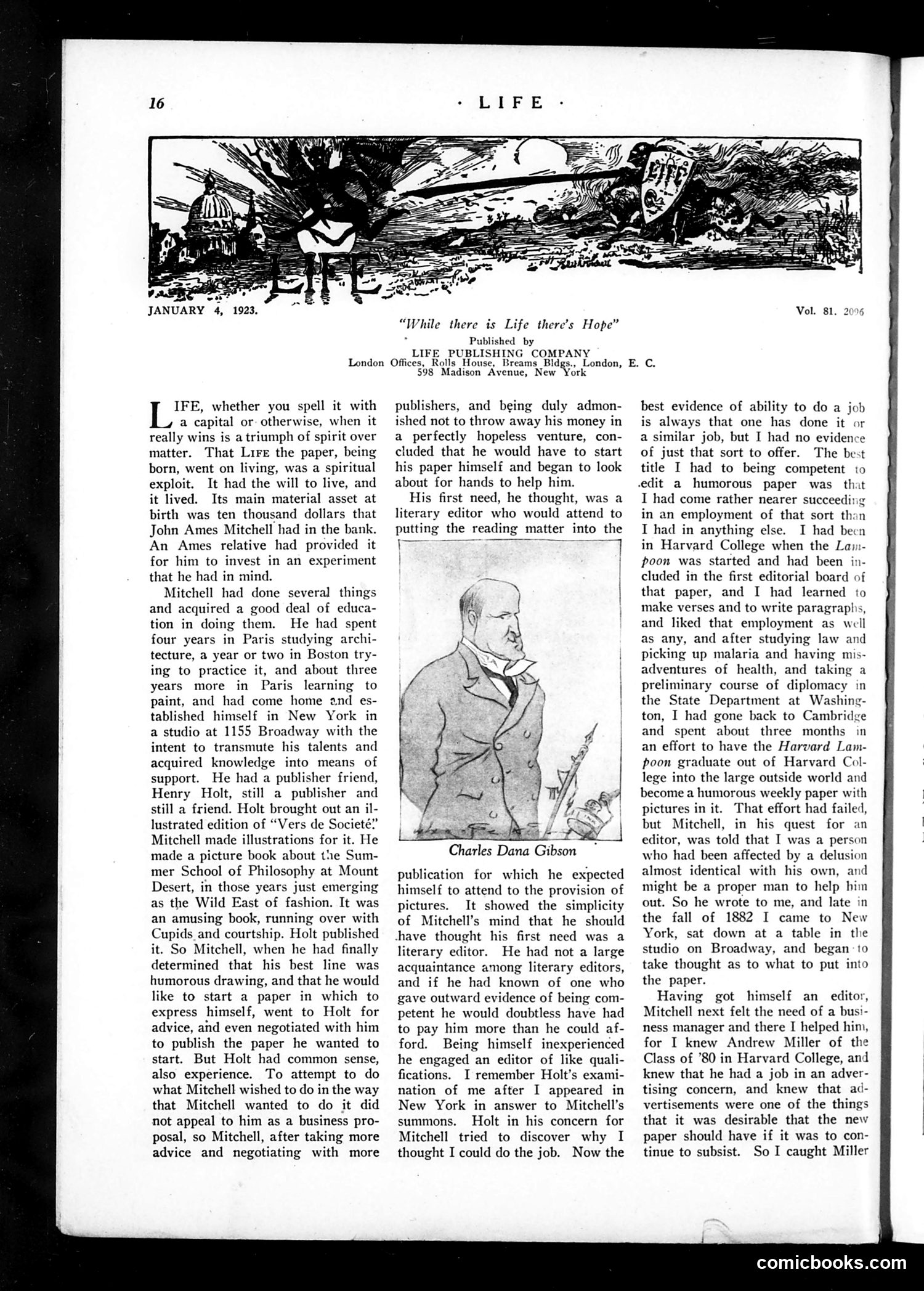
This page is not primarily a political cartoon but rather the opening of a longer article about the founding of *Life* magazine itself. The illustration shows **Charles Dana Gibson**, the famous illustrator and co-founder of *Life*. The text recounts how founder **John Ames Mitchell** started the satirical magazine with $10,000 in capital. Mitchell, trained in architecture and painting in Paris, decided to launch a humorous publication. Unable to secure publisher Henry Holt's backing (Holt deemed it too risky), Mitchell proceeded independently and needed a literary editor. The author—apparently the editor being discussed—explains that his only qualification was having worked on Harvard's *Lampoon* humor magazine, lacking direct professional editorial experience. The piece emphasizes *Life*'s origins as a bootstrapped venture relying on spirit rather than resources, celebrating its survival as proof of merit. This is essentially institutional history, not satire.
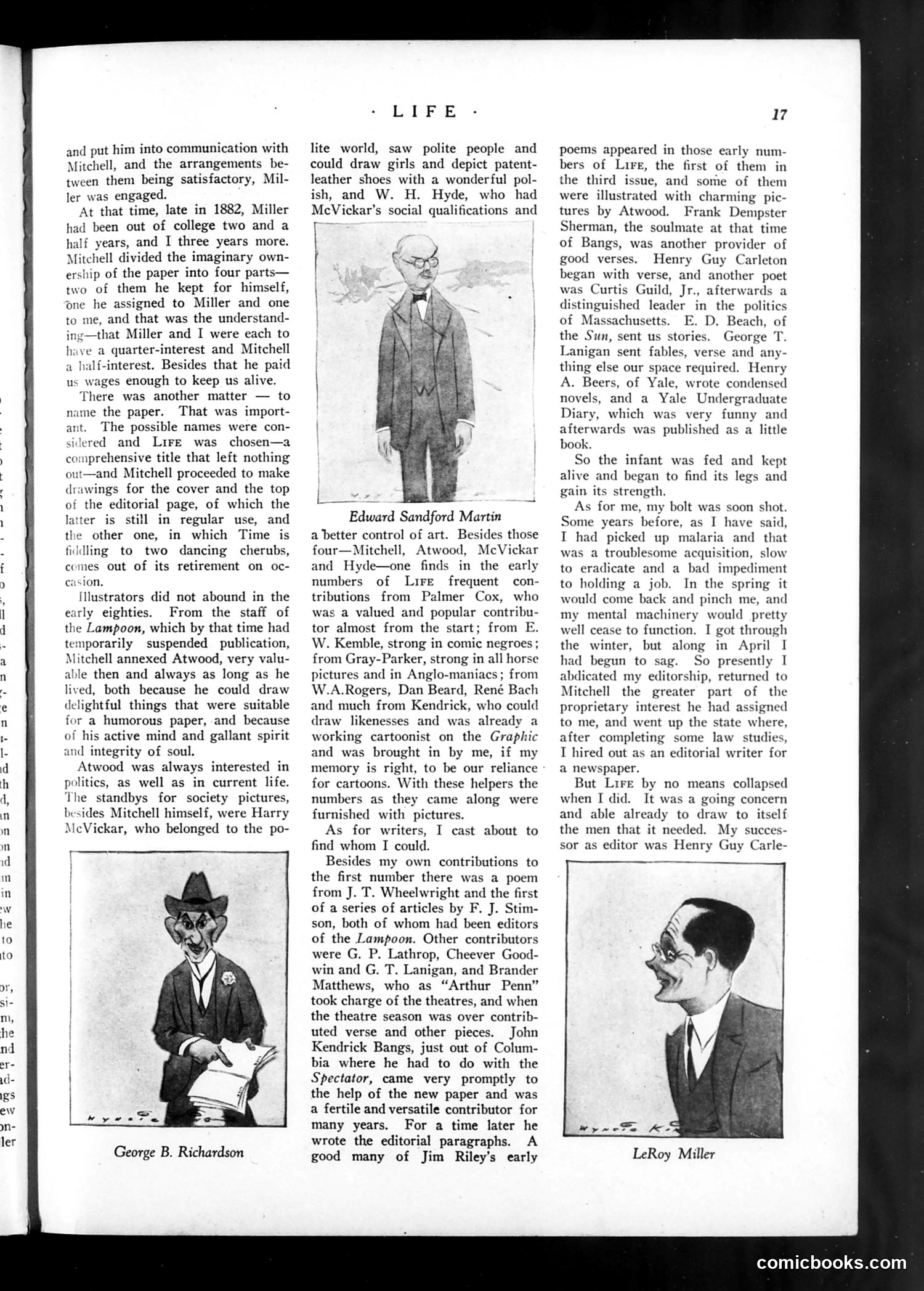
This page documents the early founding of **Life magazine** (circa 1882), not the modern publication. The text describes how editor John Ames Mitchell assembled the magazine's creative team. The two portrait sketches show **Edward Sandford Martin** and **George B. Richardson** (and partially **LeRoy Miller**), early contributors. The text explains their roles: Martin handled editorial control and illustration; Richardson and others provided society drawings and cartoons. Key context: This was a *satirical humor magazine* relying on talented illustrators like Palmer Cox and cartoonist Kendrick because photographic reproduction wasn't yet feasible. Contributors like John Kendrick Bangs (a famous humorist) and James Whitcomb Riley provided comedic verse. The "negroes" reference reflects the racist language of the 1880s-90s era when comic depictions of Black people were standard in publications. This is essentially institutional history—celebrating Life's founding team rather than satirizing current events.
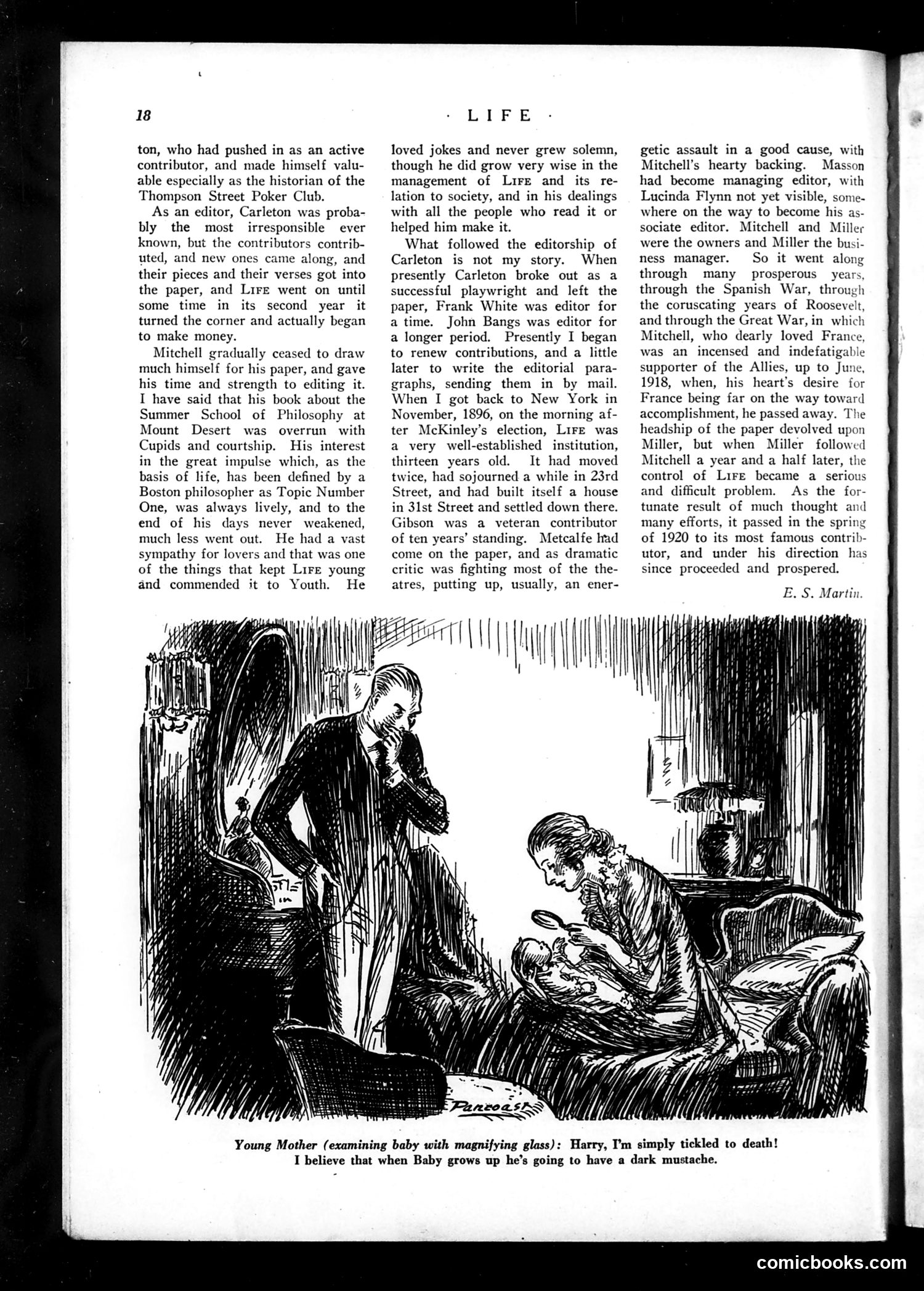
This page contains a humorous domestic cartoon captioned below the illustration. A young mother examines her infant through a magnifying glass while speaking to her husband (Harry), expressing delight that the baby will grow up to have a dark mustache. The joke relies on early 20th-century social attitudes: dark mustaches were considered a sign of masculine distinction and virility in this era. The satire targets the mother's premature obsession with her baby's future appearance and masculine traits, extrapolating adult characteristics from an infant's features. It gently mocks parental vanity and the tendency to project hopes onto newborns—here, the mother's eagerness to identify signs of her son's future handsomeness reflects period anxieties about social status and masculine presentation. The cartoon's humor depends on the absurdity of using a magnifying glass to predict facial hair growth, exposing the ridiculousness of such parental speculation.
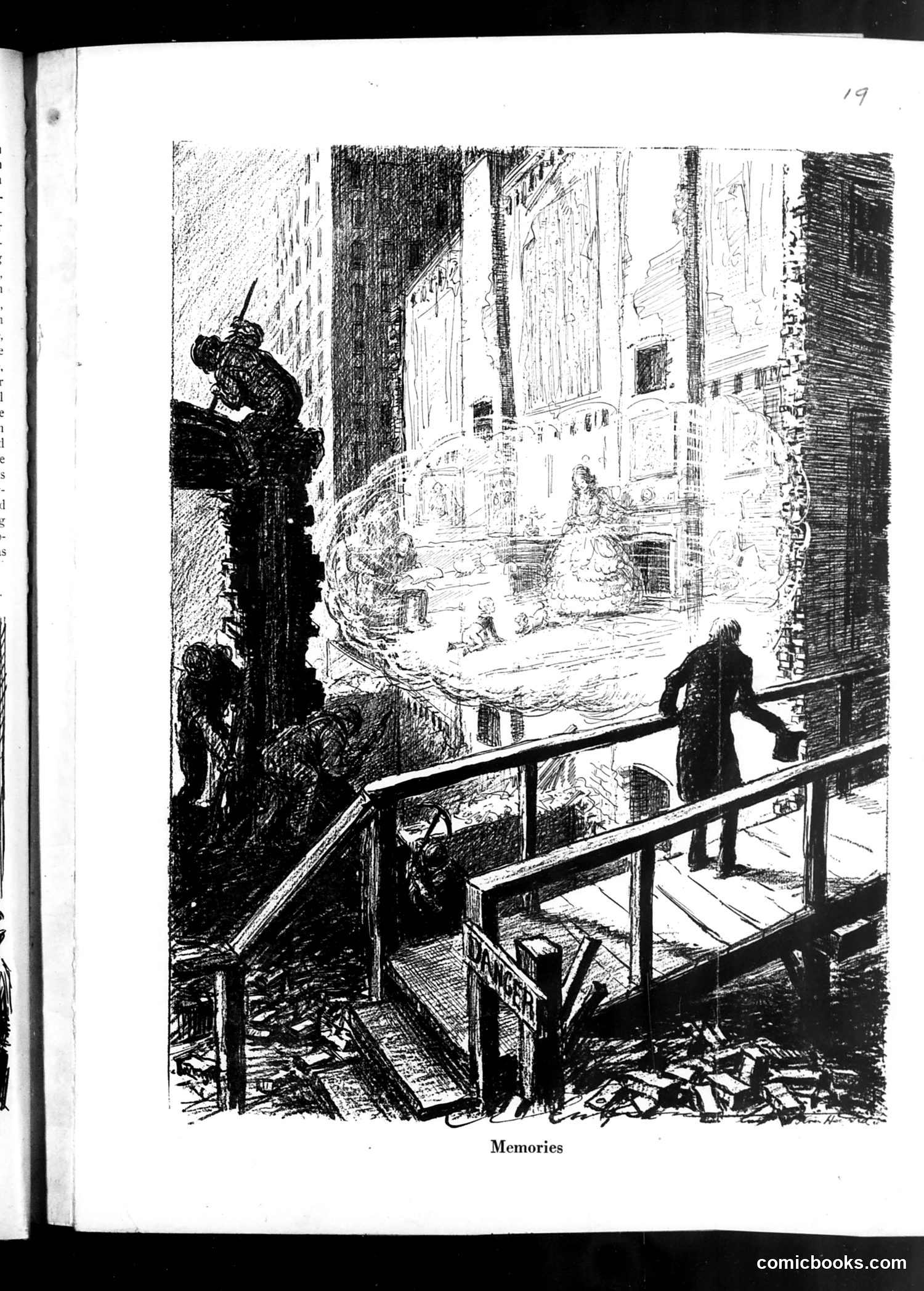
This ink sketch depicts an urban courtyard or alley viewed from an elevated perspective. A man in dark clothing stands on a railing or balcony overlooking the scene below. The composition emphasizes the stark contrast between foreground (where the figure stands) and the distant courtyard filled with numerous small figures and architectural detail. The title "Memories" suggests nostalgia or reflection. Without additional context from the original publication date or accompanying text, the specific satirical target remains unclear. The elevated viewpoint and solitary figure gazing downward could imply reflection on urban life, social separation, or observation of human activity—common themes in early 20th-century satirical illustration. The detailed cross-hatching technique was typical of Life magazine's artistic approach during this period.
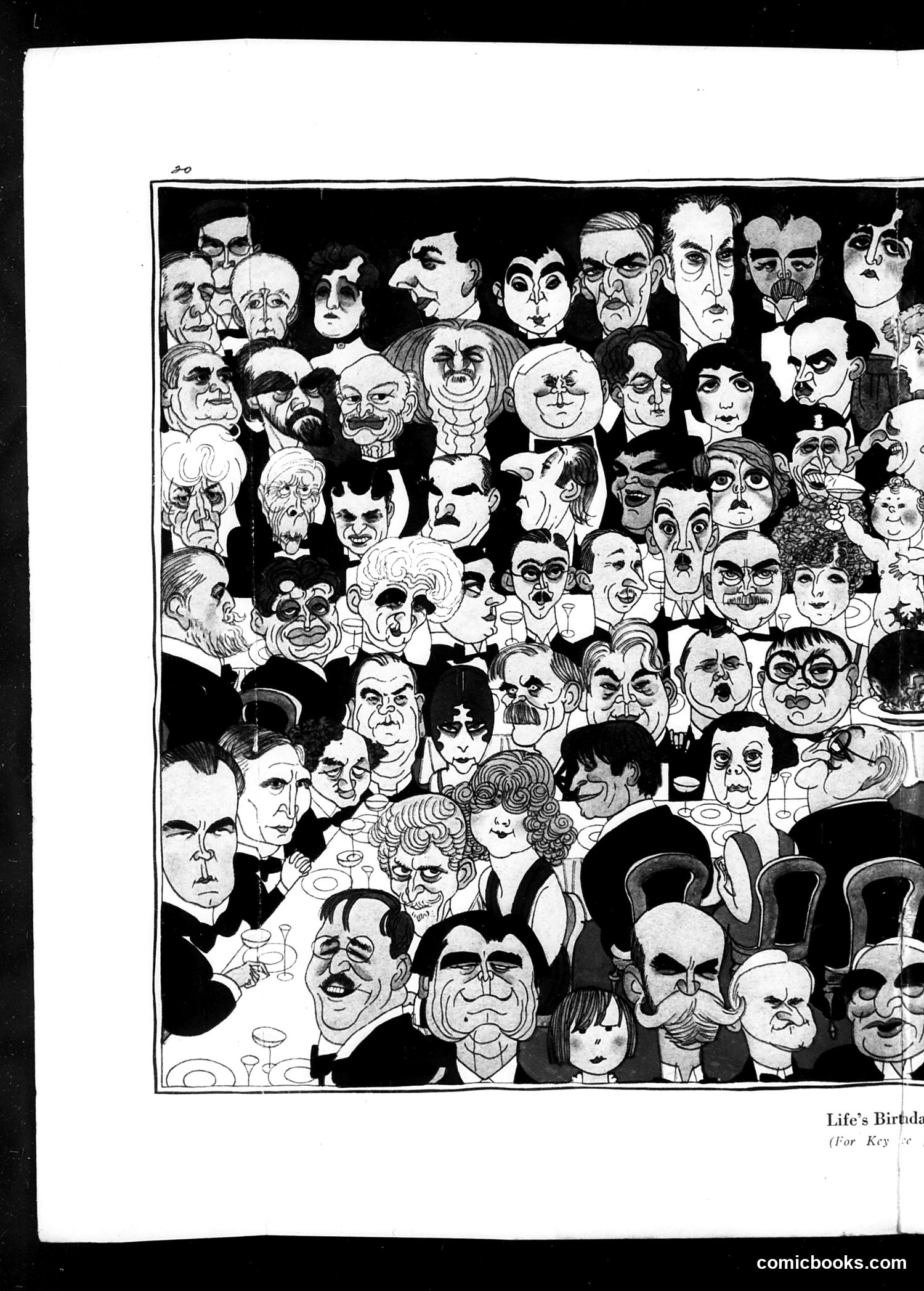
This is a densely packed satirical cartoon depicting a crowded social gathering or party. The exaggerated caricatures suggest prominent public figures of the era, though specific identities aren't clearly labeled in the visible text. The title "Life's Birthday" indicates this celebrates the magazine itself. The cartoon uses grotesque facial features—distorted noses, mouths, and expressions—a common satirical technique to mock politicians, celebrities, or social figures of the period. The crowded composition and varied character types suggest commentary on American society or politics, likely poking fun at different social classes or types mingling together. Without clearer labels or date information visible, the specific targets remain uncertain, but the style is consistent with early-to-mid 20th century American political satire.
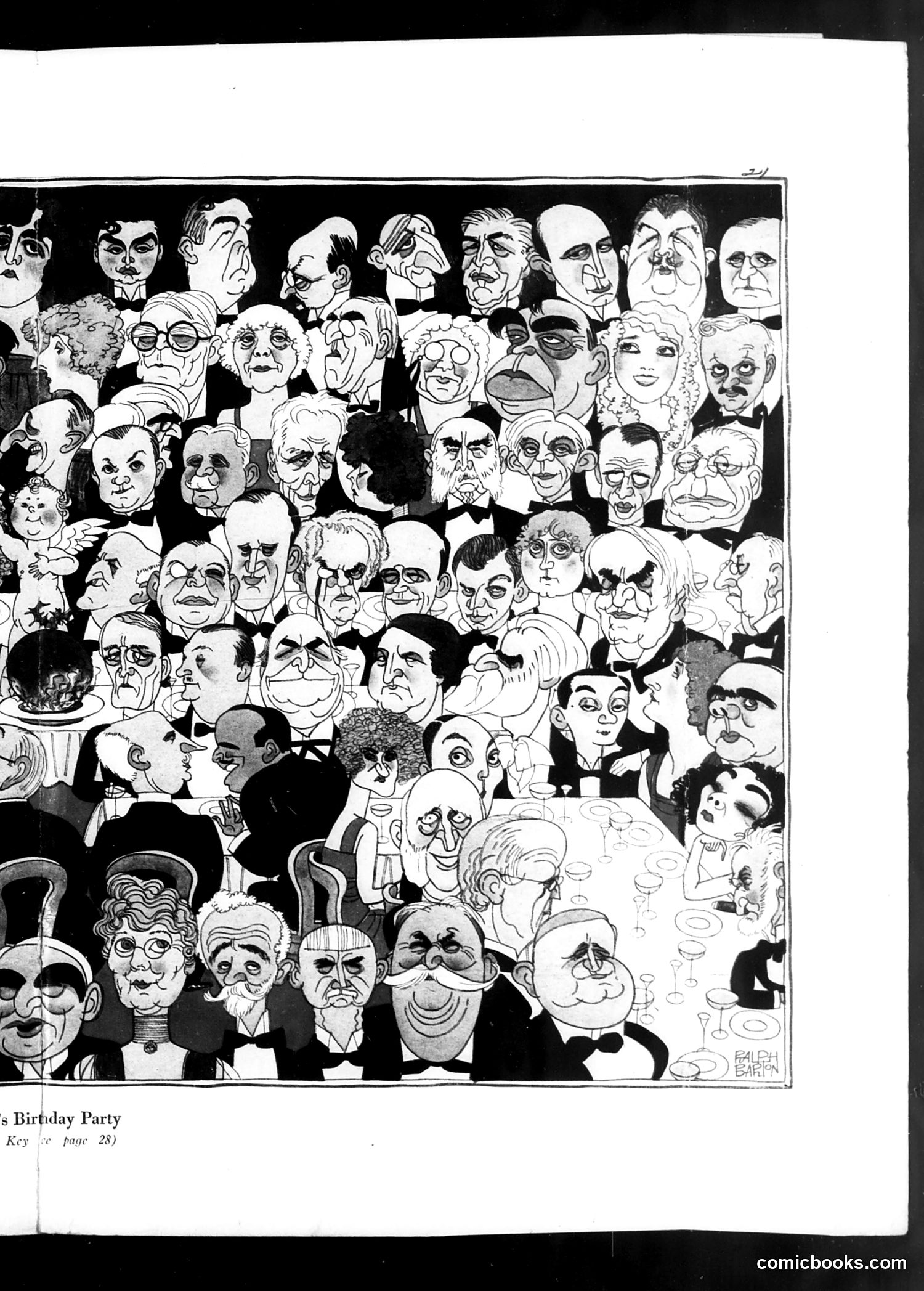
This is a densely-packed caricature cartoon by Ralph Barton (signed lower right) depicting what appears to be a formal social gathering or party populated entirely by exaggerated character portraits. The OCR text indicates this relates to a "Birthday Party" with a reference to "page 28" and a "Key." Without access to that key page, the specific identities of most figures remain unclear. However, the style suggests these are recognizable public figures, celebrities, or prominent personalities of the era when this *Life* magazine issue was published—likely politicians, entertainers, or society figures meant to be identified by readers familiar with contemporary gossip or news. The satire likely mocks the attendees collectively or their social pretensions, though the exact target cannot be determined from this image alone.
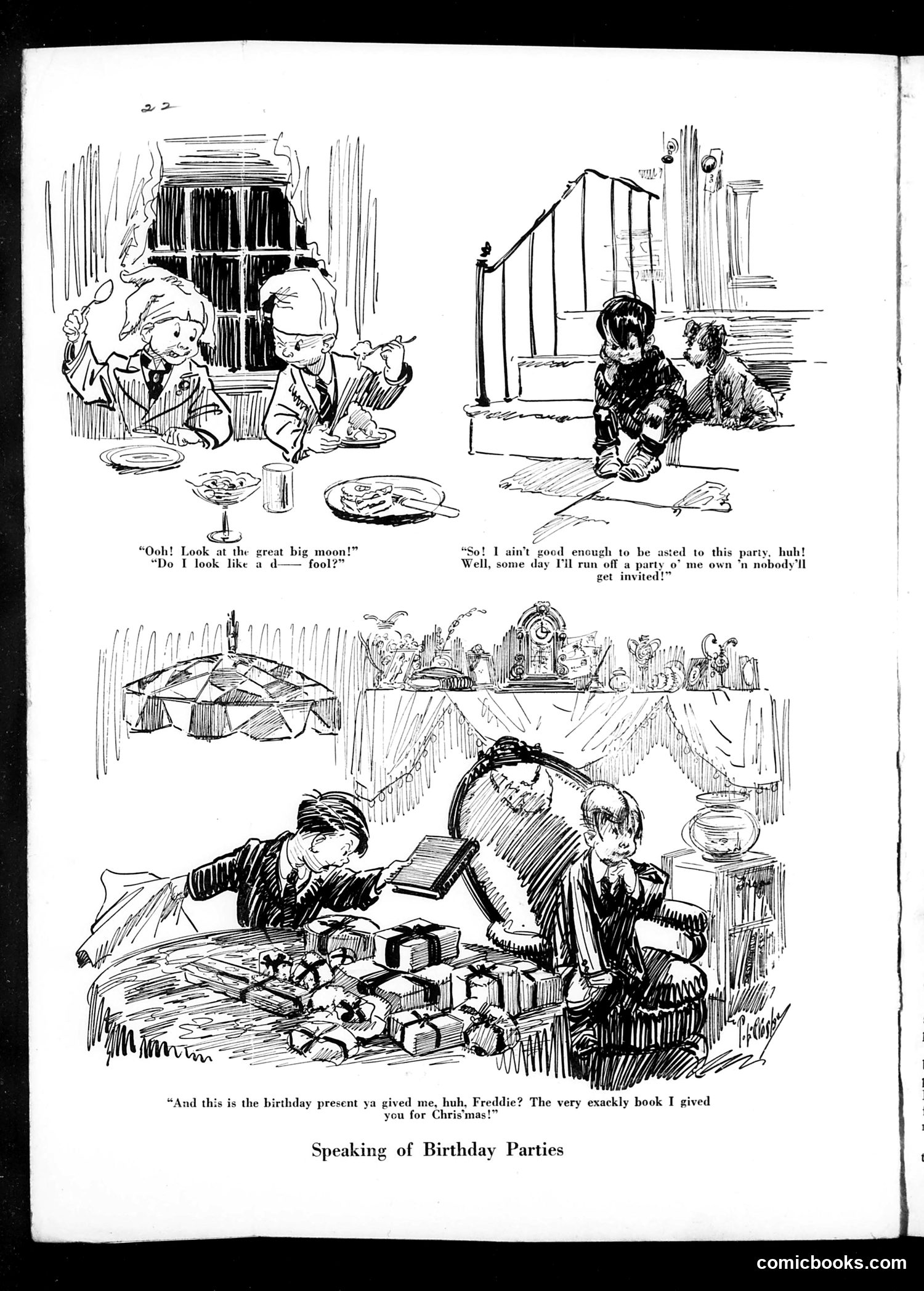
This page contains three cartoon vignettes about children's birthday parties, satirizing common social anxieties and behaviors among young people. The top panels show: children at a fancy dinner party, with one child worried about appearing foolish; an excluded child sitting outside on steps, resentfully declaring they'll throw their own party someday where nobody gets invited. The bottom panel depicts two children examining birthday gifts—specifically, they've apparently exchanged the exact same book: one gave it as a Christmas present, received it back as a birthday gift. The joke mocks the awkwardness of regifting and the social embarrassment of duplicate gifts. The satire targets both children's vanity and the often-uncomfortable social dynamics of gift-giving, presenting birthday parties as venues for social one-upmanship and minor humiliations rather than genuine celebration.
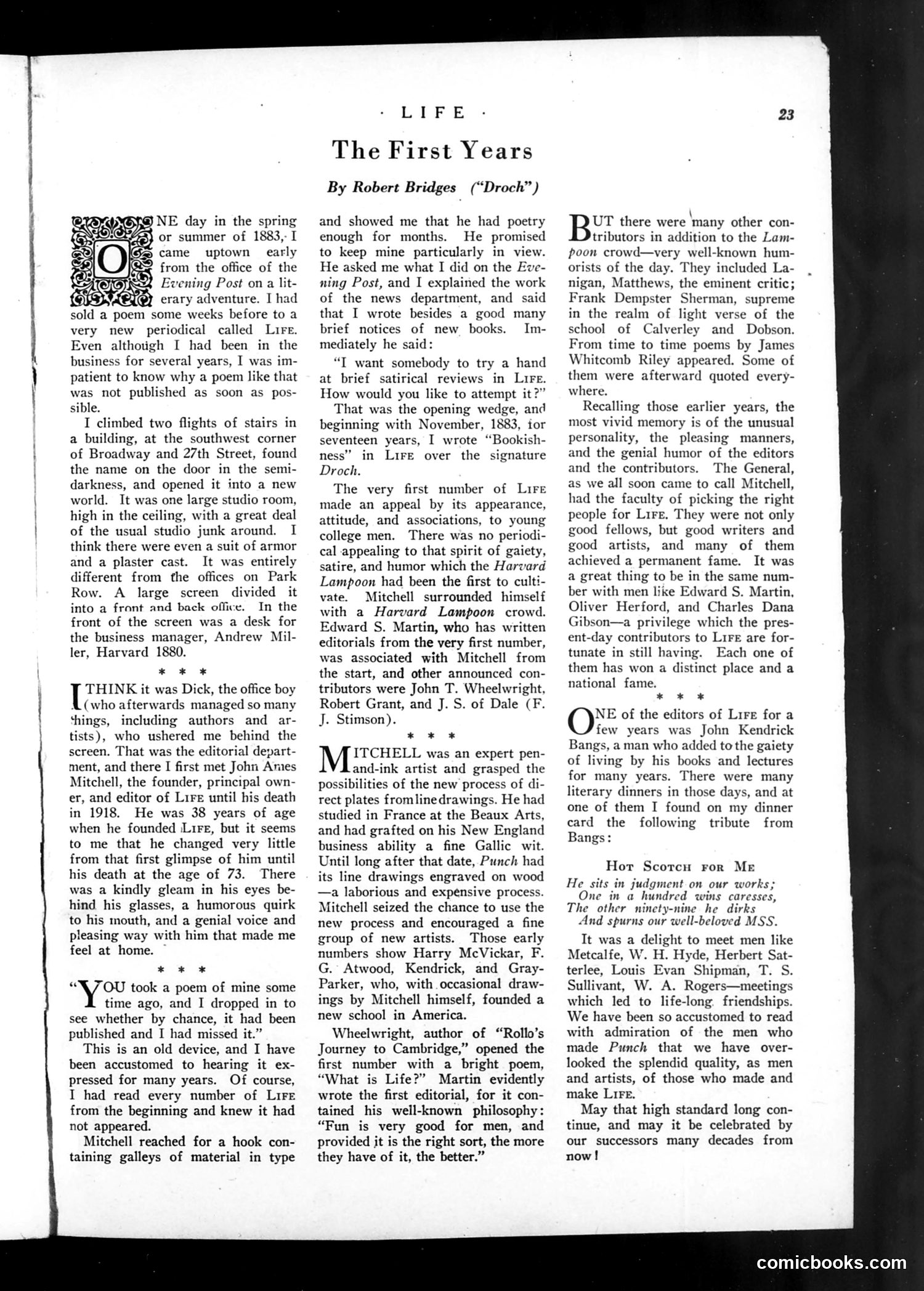
This is Robert Bridges's memoir about founding **Life magazine in 1883**—a satirical weekly for educated young men, modeled on *Harvard Lampoon*'s spirit of "gaiety, satire, and humor." The article profiles **John Ames Mitchell**, Life's founder and editor (1883-1918), describing him as a skilled pen-and-ink artist who exploited new printing technology to feature line drawings more efficiently than *Punch* magazine could with wood engravings. Key contributors mentioned include **Edward S. Martin** (editorials) and writers like **John T. Wheelwright** and **Robert Grant**—all Harvard-connected figures. Bridges himself contributed literary satire under the pseudonym "Droch" starting November 1883. The piece emphasizes Life's youth appeal and artistic innovation rather than specific political satire, functioning as institutional history rather than commentary on current events.
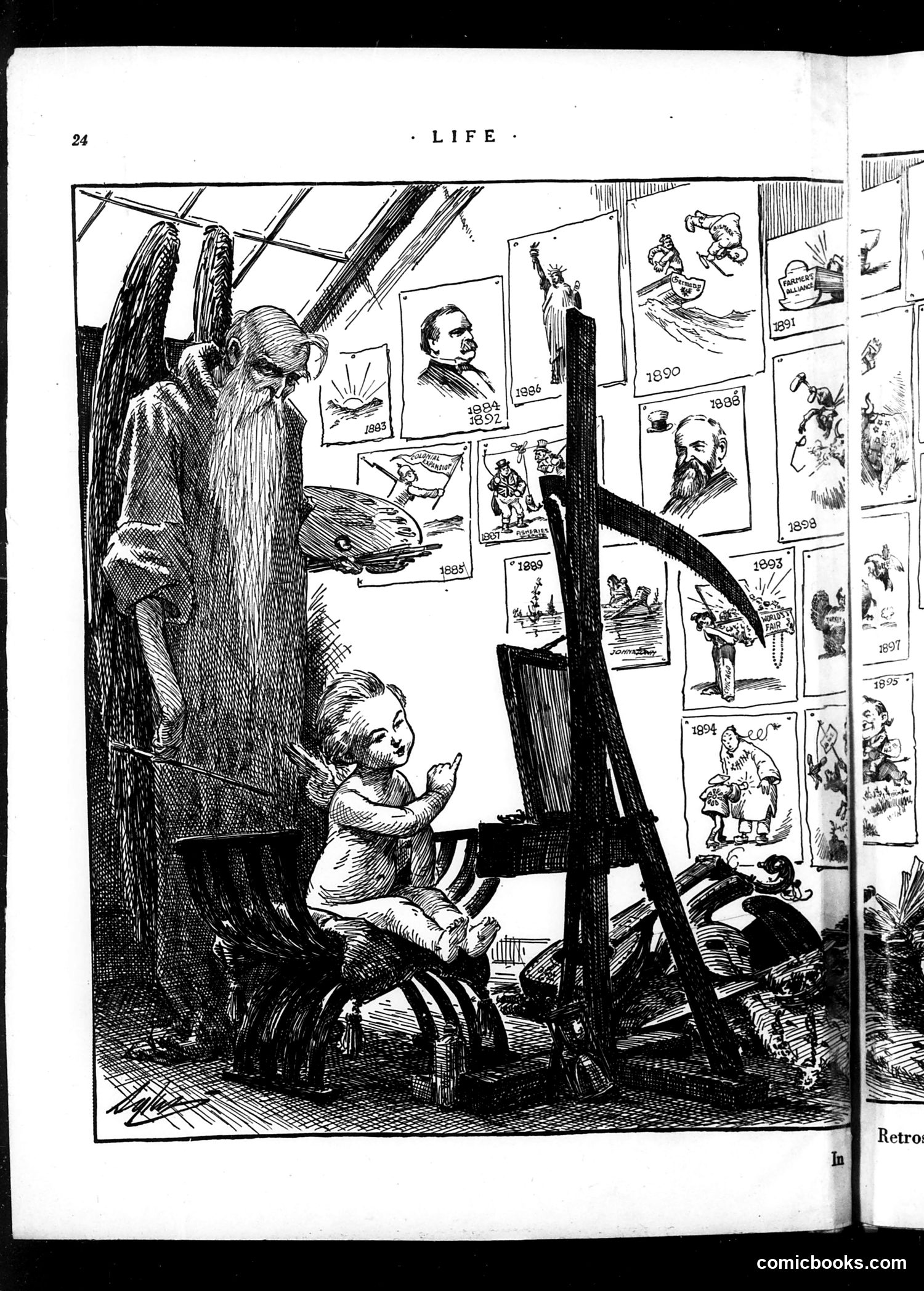
This is a satirical illustration showing an elderly, bearded man (appearing to be an artist or illustrator) with wings, observing a young child drawing at an easel. The wall behind them displays numerous sketches and drawings dated from 1883-1897, suggesting a chronological record of artistic work. The satire appears to comment on artistic legacy and generational artistic influence—the winged elder figure (possibly representing a muse or the spirit of art itself) watches as a child continues the tradition of drawing and creation. The dated sketches form a visual timeline of artistic development. Without clearer text identifying the specific figures, the exact political or social commentary remains unclear, though it likely addresses themes of artistic inheritance, education, or the passing down of creative traditions in late-19th-century America.
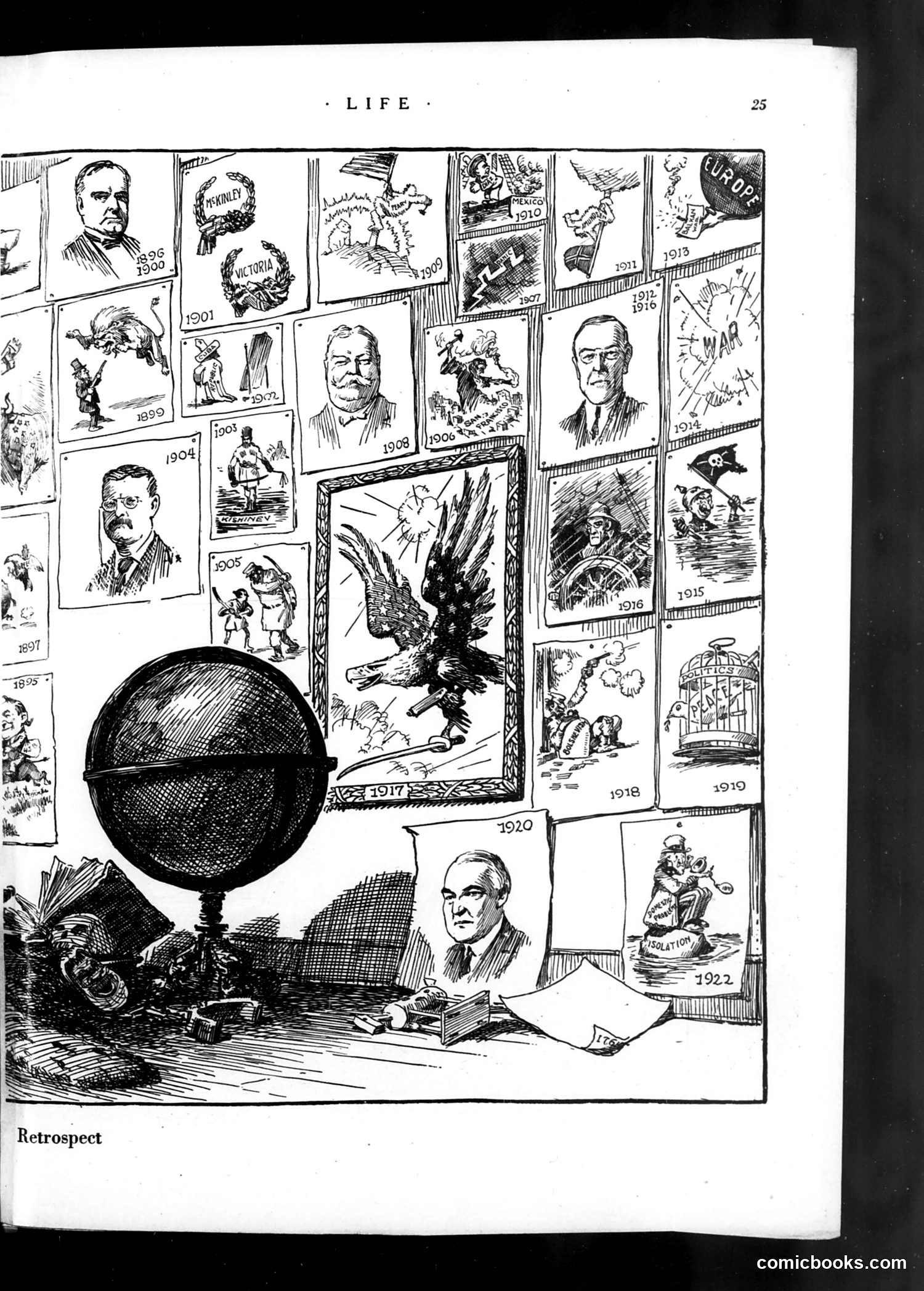
This political cartoon presents a chronological wall of portraits and sketches spanning roughly 1896-1922, arranged like newspaper clippings or magazine covers. A globe and books sit in the foreground, suggesting historical documentation. The layout traces major political figures and events across America's early 20th century—appearing to include U.S. presidents and significant moments (the eagle prominent in 1917 likely references American entry into World War I). Each year's small illustrations capture key political developments of that period. The title "Retrospect" indicates this is a reflective commentary on how these years unfolded historically. The accumulated images create a visual timeline, inviting readers to contemplate how events and leadership shaped the nation during a transformative era spanning the Spanish-American War through the post-WWI period.
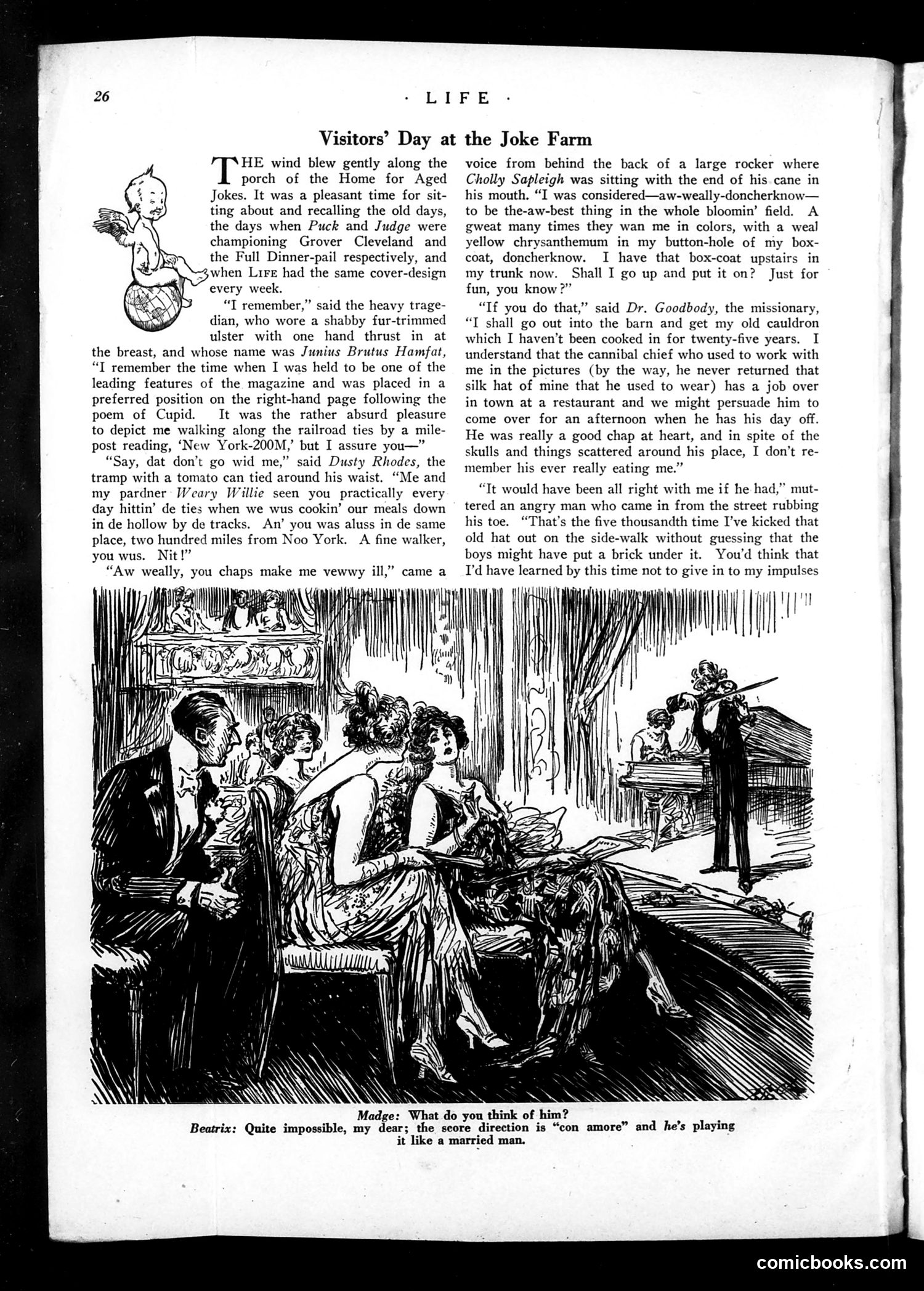
This satirical piece mocks outdated magazine humor by personifying old comic stereotypes as residents of a "Home for Aged Jokes." Characters include Junius Brutus Hamfat (a melodramatic tramp), Dusty Rhodes and Weary Willie (hobo characters), Cholly Sapleigh (an affected dandy), and Dr. Goodbody (a missionary caricature). The humor lies in these stock characters lamenting their lost prominence in *Life* magazine and competitor publications (*Puck*, *Judge*). They boast of past glory while exhibiting their tired, repetitive nature—illustrating how these comedy tropes had become stale and predictable. The bottom cartoon adds meta-commentary: a woman criticizes a musician for playing with marital detachment rather than passionate intent ("con amore"), suggesting performers have lost genuine feeling. The satire targets both aging comic conventions and the magazines' declining originality.
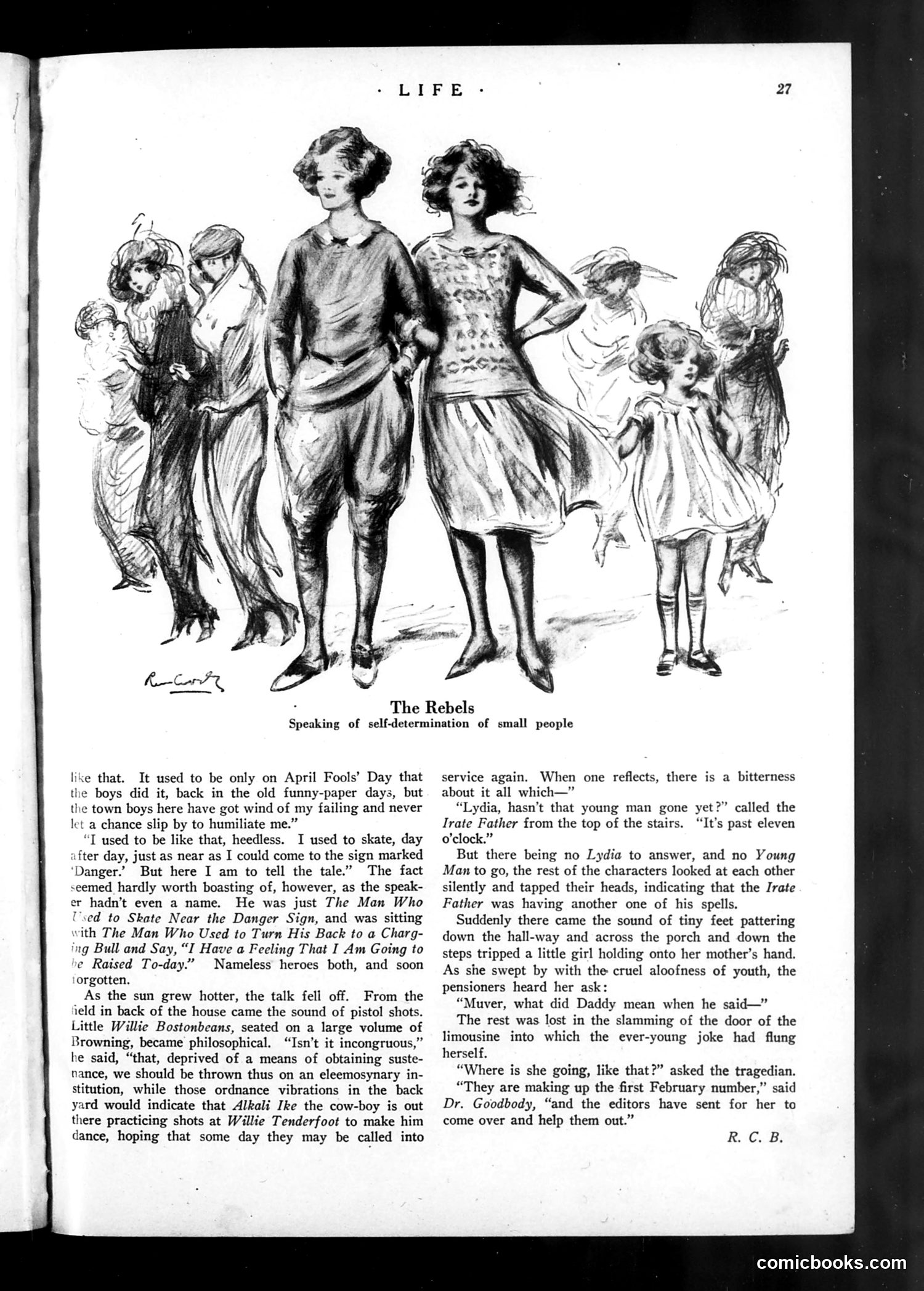
This appears to be a humorous short story with illustration rather than a political cartoon. The subtitle "Speaking of self-determination of small people" is ironic—the "small people" are recurring comic-strip characters (Willie Bostonbeans, Alkali Ike, Willie Tenderfoot, the Irate Father, and Little Lydia) who inhabit Life magazine's regular features. The joke satirizes how these stock characters have become unemployed or purposeless—reduced to sitting idle during what appears to be wartime (references to "service again" and pistol practice suggest WWI era). The story mocks their overwrought dialogue and melodramatic personas, with one character delivering absurdly pompous philosophizing about their predicament. The punchline: even these fictional "rebels" are so disposable that a little girl character is summoned away to help the magazine's February issue—suggesting these characters' only value is as filler content. It's satirizing both the cyclical nature of magazine humor and the shallow purpose of recurring comic characters.
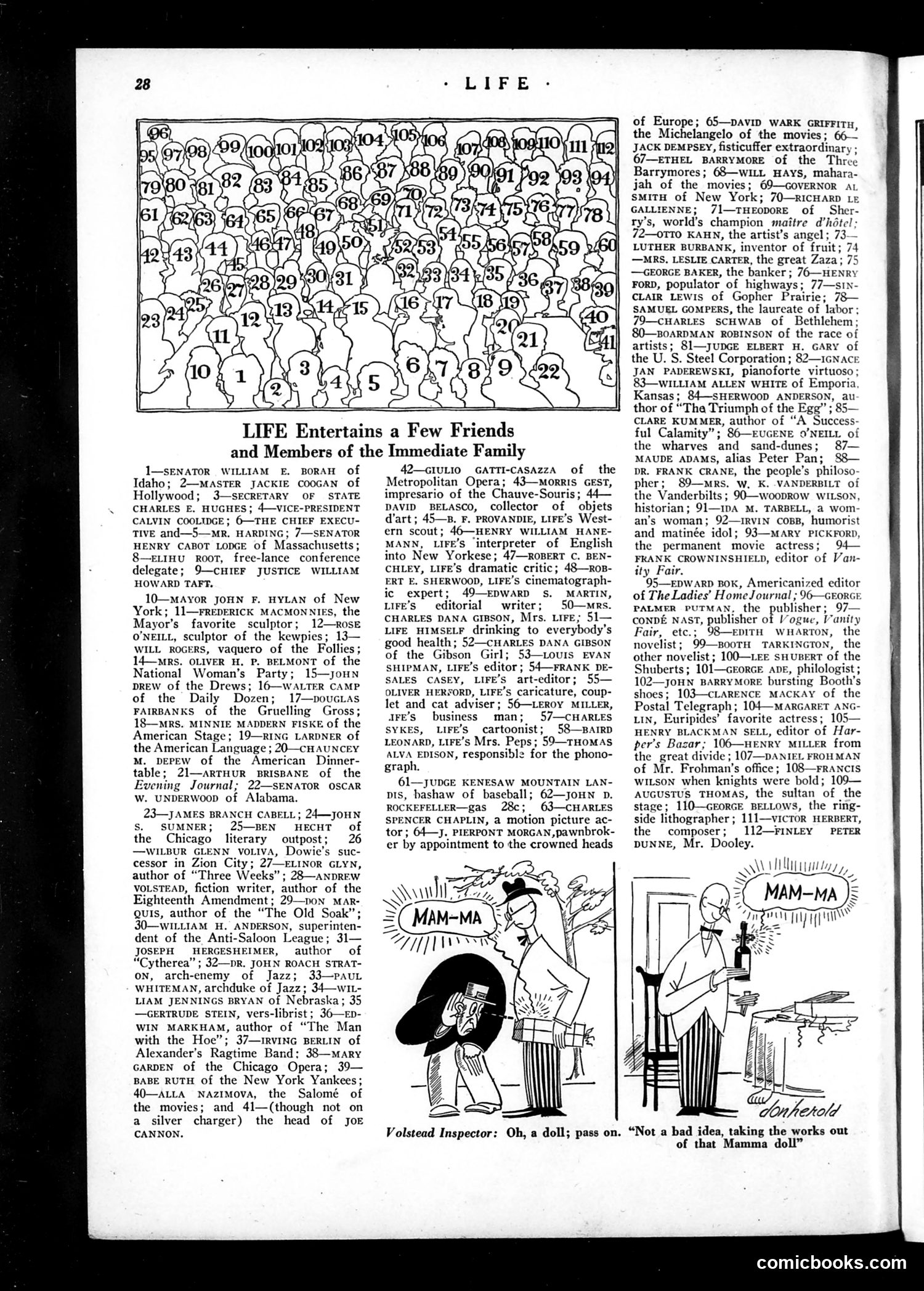
This page from Life magazine presents a crowded numbered cartoon map identifying 78 prominent American figures from the early 1920s at what the text calls "LIFE Entertains a Few Friends and Members of the Immediate Family." The cartoon satirizes the magazine's access to and relationship with America's cultural, political, and entertainment elite. The numbered bubbles contain caricatures of everyone from President Harding and Vice President Coolidge to Babe Ruth, Charlie Chaplin, and Elinor Glyn. The satire works on multiple levels: Life presents itself as intimate with the powerful, while the sheer quantity of names (78!) and the jumbled composition suggest both the magazine's broad reach and gentle mockery of celebrity culture itself. The bottom cartoon depicts a "Volstead Inspector" approving removal of a "Mamma doll"—likely referencing Prohibition enforcement and jazz-age irreverence. The page essentially serves as Life's visual boast of its cultural influence and access during the Roaring Twenties.
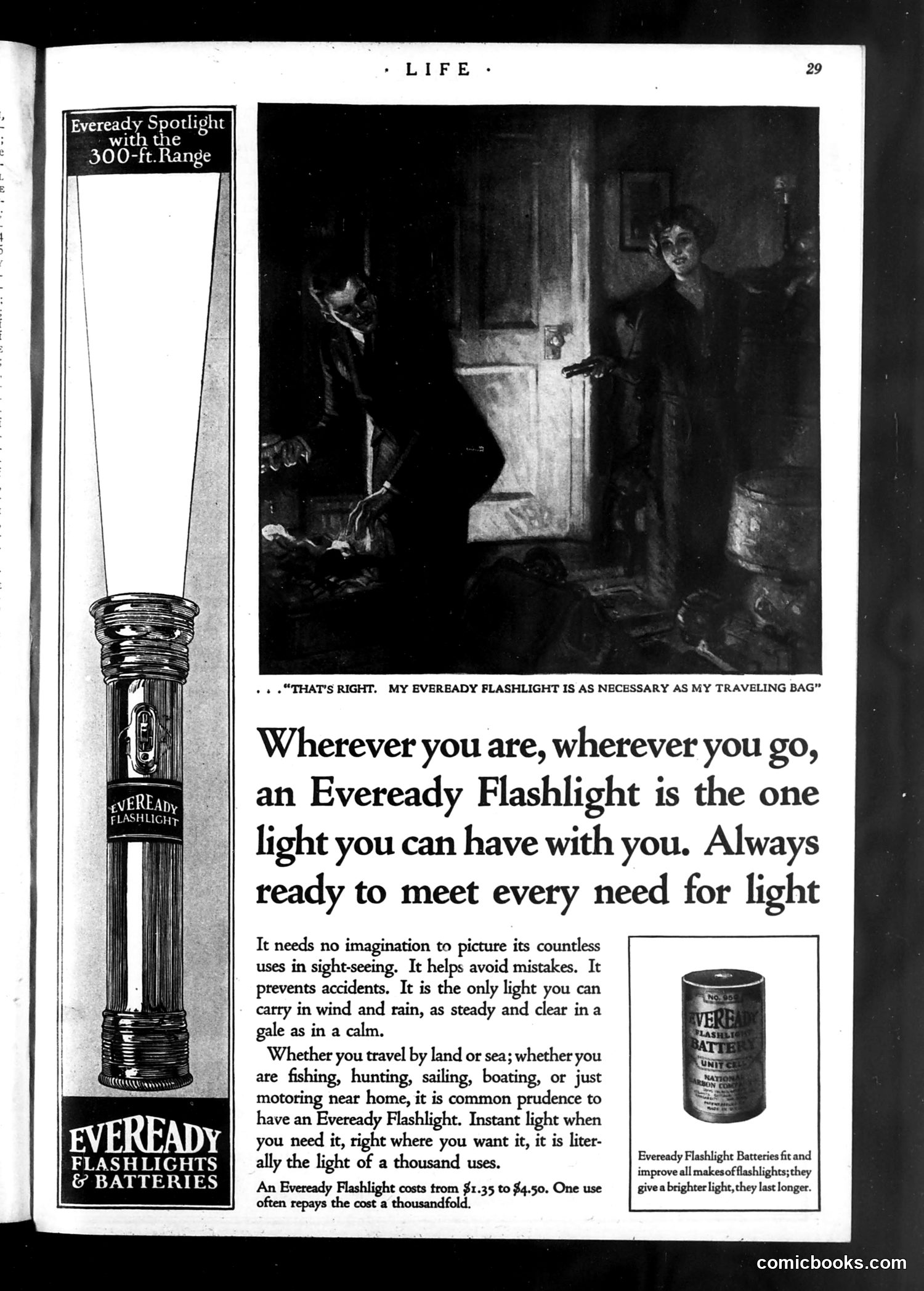
This is a **product advertisement**, not political satire. The page promotes Eveready brand flashlights and batteries to early 20th-century readers. The dramatic photograph shows a man using a flashlight to navigate a dark interior space—likely meant to illustrate the product's practical utility. The accompanying text emphasizes reliability for travelers, outdoor enthusiasts, and everyday users. The tagline quotes someone claiming their flashlight is "as necessary as my traveling bag," positioning it as an essential travel companion. The advertisement stresses durability in weather, portability, and versatility across activities (fishing, hunting, boating, motoring). Pricing ($1.35 to $4.50) and cost-benefit arguments ("one use often repays the cost a thousandfold") were typical sales tactics of the era. The separate battery product shown demonstrates the company's integrated business model. This represents mainstream magazine advertising from an era when electric flashlights were still relatively novel consumer products.
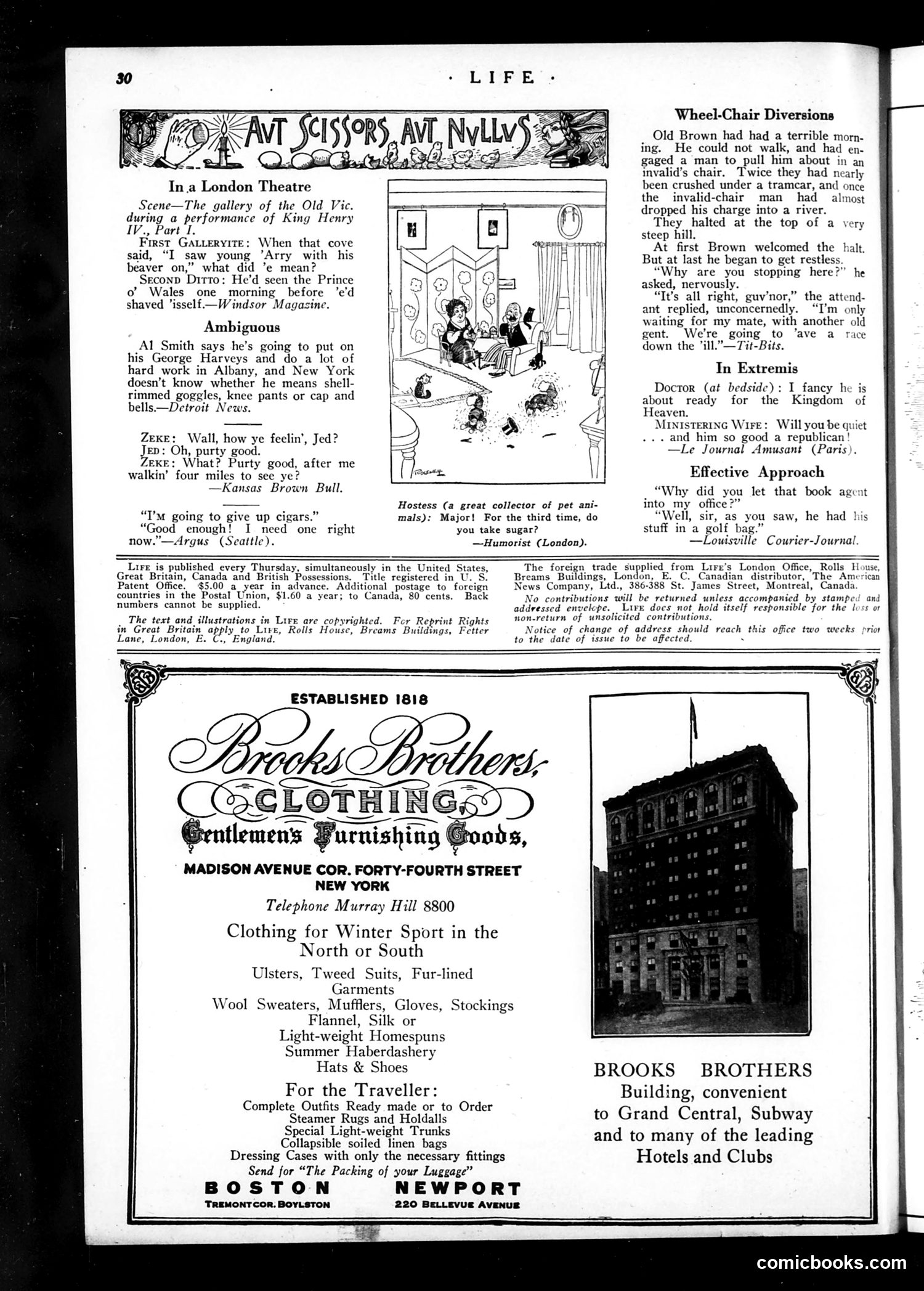
This page contains multiple brief humorous anecdotes rather than a single political cartoon. The jokes target everyday situations and British dialect humor typical of early 20th-century Life magazine: **"Wheel-Chair Diversions"** describes an invalid-chair attendant casually mentioning he plans to race downhill with another wheelchair operator—the dark humor lies in the casual endangerment of disabled passengers. **"In a London Theatre"** plays on Cockney working-class misunderstanding of theatrical language, where "beaver" (slang for a man's face) is mistaken for literal beaver fur on the Prince of Wales. **Other brief jokes** mock Al Smith's vague campaign promises, a book salesman's deceptive sales tactics (hiding in a golf bag), and a doctor's political indiscretion around a republican patient. The page is otherwise dominated by Brooks Brothers advertising. The humor relies on dialect comedy, class-based misunderstandings, and casual cruelty—all common to period publications but reflecting attitudes modern readers would find dated or offensive.
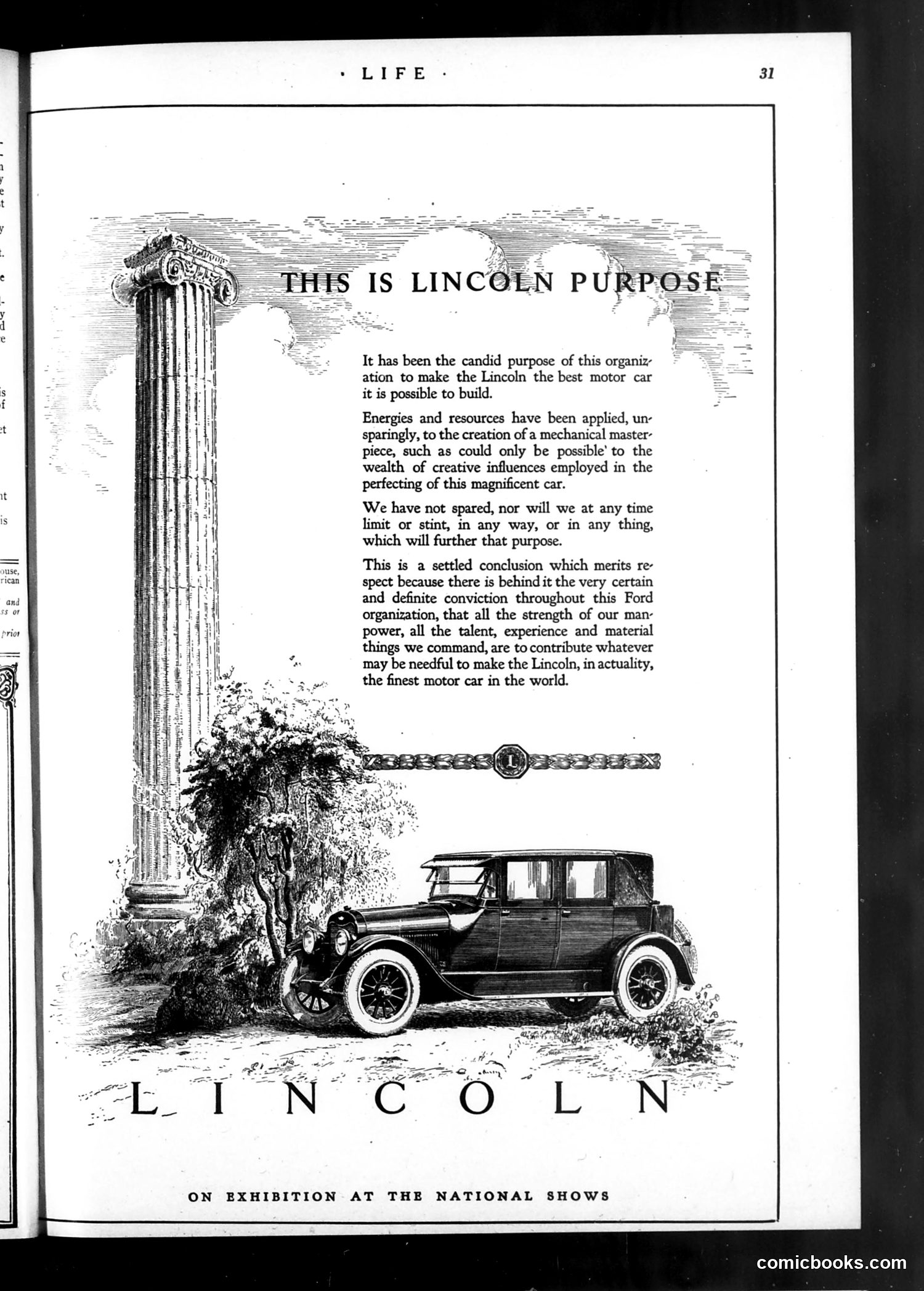
This is a **Ford Motor Company advertisement**, not satire. The page promotes the Lincoln automobile through a classical aesthetic: a grand Corinthian column suggests timeless elegance and permanence, while the car itself is depicted as a refined achievement worthy of architectural grandeur. The text presents Lincoln as Ford's premium vehicle—"the finest motor car in the world"—emphasizing unlimited resources and commitment to quality. The juxtaposition of neoclassical architecture with modern automotive technology suggests Lincoln occupies a prestigious position in American manufacturing. This appears from the **Life magazine era** when automobile advertising used highbrow imagery to appeal to wealthy consumers. The "Lincoln Purpose" framing positions the car as a serious industrial accomplishment, not merely transportation. The "National Shows" reference indicates exhibition venues for elite consumers. No satire is evident—this is corporate marketing dressed in aspirational cultural language.
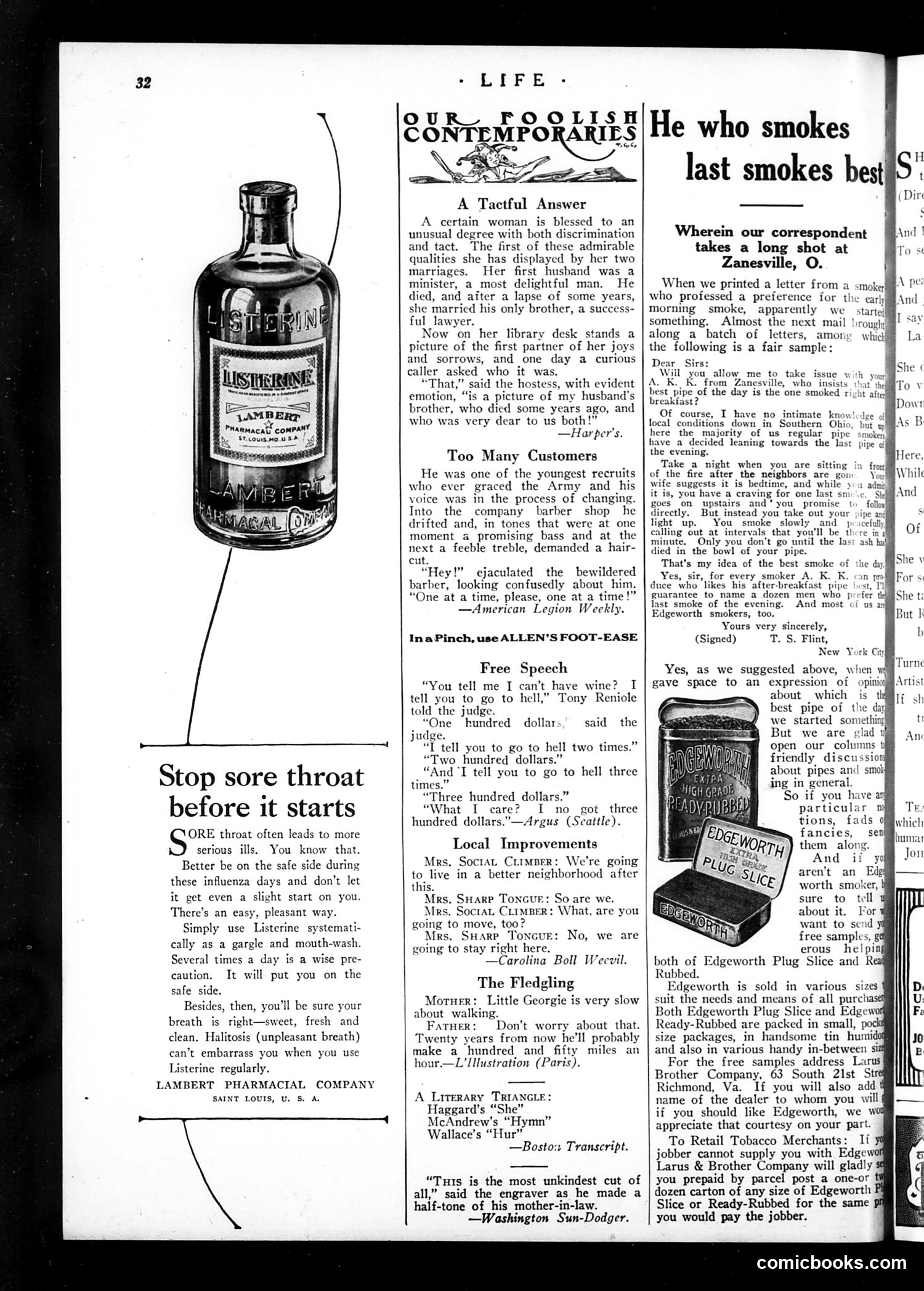
This page mixes advertising with humor columns typical of *Life* magazine's satirical format. The **main content** consists of brief comedic anecdotes: "A Tactful Answer" jokes about a widow who tactfully describes her first husband as her second husband's brother; "Too Many Customers" depicts a young soldier with a voice-changing problem confusing a barber; "Free Speech" shows a man negotiating fines by repeatedly insulting a judge. The **advertisements** (Listerine, Allen's Foot-Ease, Edgeworth tobacco) are period-typical. The **long letter** at right defends evening pipe-smoking against a reader who preferred morning smoking—a lighthearted debate about tobacco consumption habits. The **Listerine ad** references influenza fears (likely post-WWI era), promoting gargling as preventative medicine—reflecting early-20th-century health anxieties. Overall, this is a humor magazine blending entertainment, consumer advertising, and reader correspondence—no major political satire visible here.
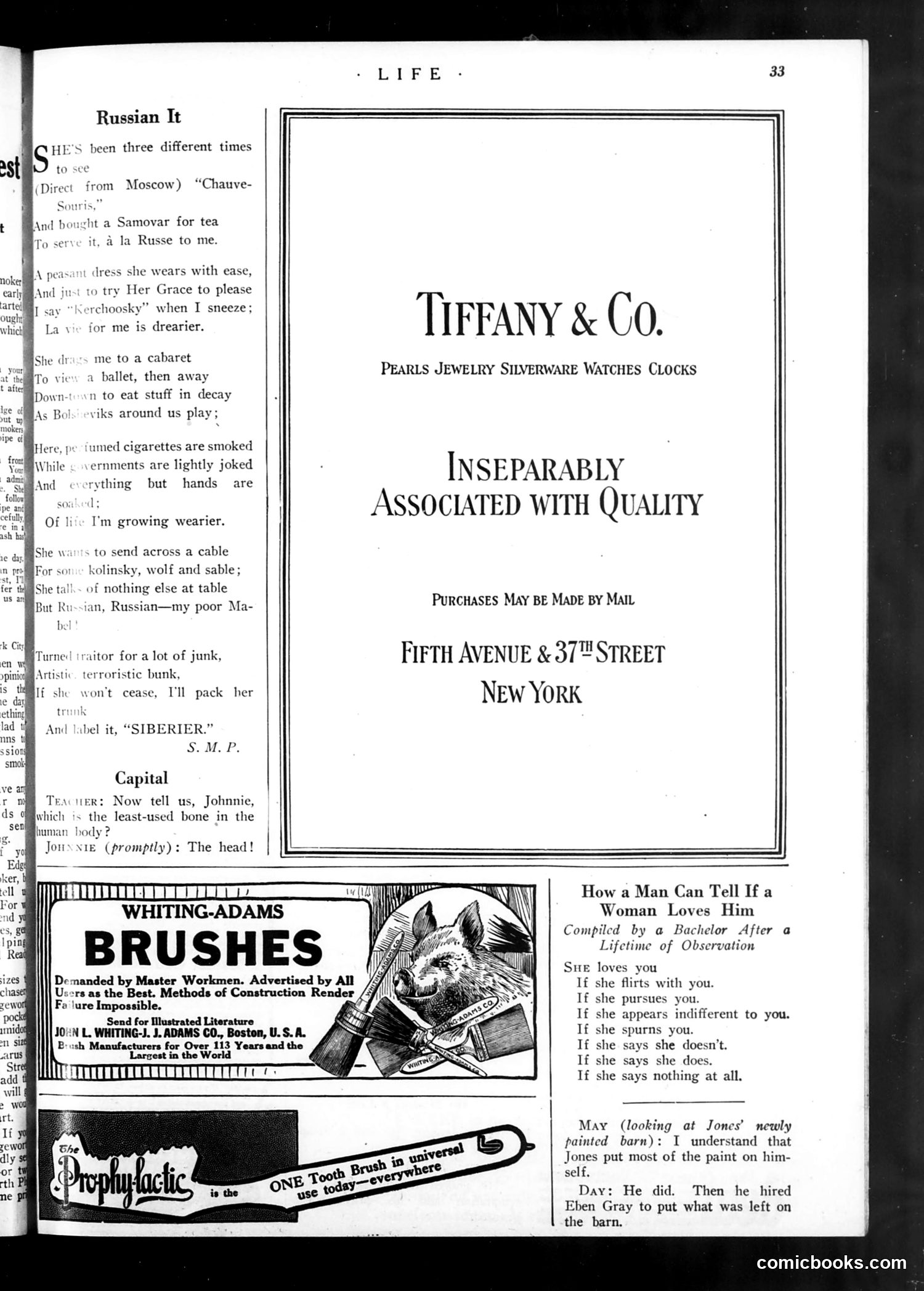
This page contains a poem titled "Russian It" satirizing American fascination with Russian culture during the early 20th century. The speaker describes a woman who constantly references Moscow, serves tea Russian-style, adopts Russian mannerisms (saying "Kerchoosky" when sneezing), and wears Russian furs. The satire mocks Americans' superficial adoption of Russian aesthetics and habits as fashionable affectation—she's performatively "Russian" to the point of absurdity, and the speaker finds it exhausting. The page also features commercial advertisements (Tiffany & Co., Whiting-Adams brushes) and humor snippets about how to tell if a woman loves you. The "Russian It" poem reflects broader early-1900s American culture where Russian imports, fashion, and style signaled cosmopolitan sophistication among the wealthy.
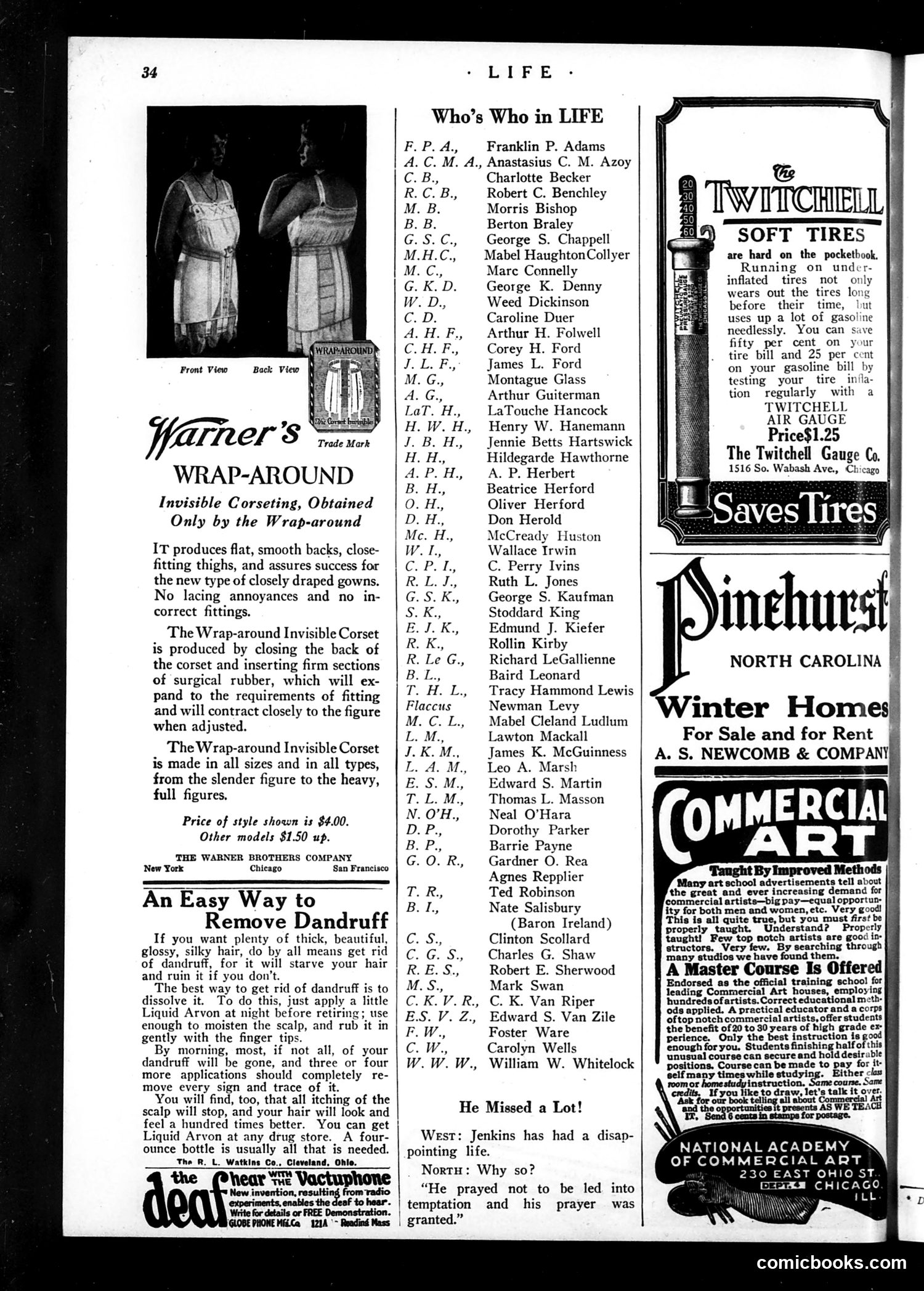
This is a **Life magazine page** from the 1920s, primarily featuring advertisements and a "Who's Who in LIFE" directory—a list of the magazine's regular contributors (cartoonists, humorists, writers like Robert Benchley, Dorothy Parker, and Robert Sherwood). The content is **mostly commercial**: Warner's corsets ("produces flat, smooth backs"), Liquid Arvon dandruff treatment, Twitchell tire gauges, and real estate/art school ads. These reflect period concerns—women's shapewear fashion, hair care standards, and automobile maintenance. **No political satire or caricature appears on this page.** It's essentially an early 20th-century house organ page: contributor credits mixed with paying advertisements. The "Who's Who" list suggests Life was a prestigious outlet for American humorists and writers of that era, combining literary content with consumer goods marketing.
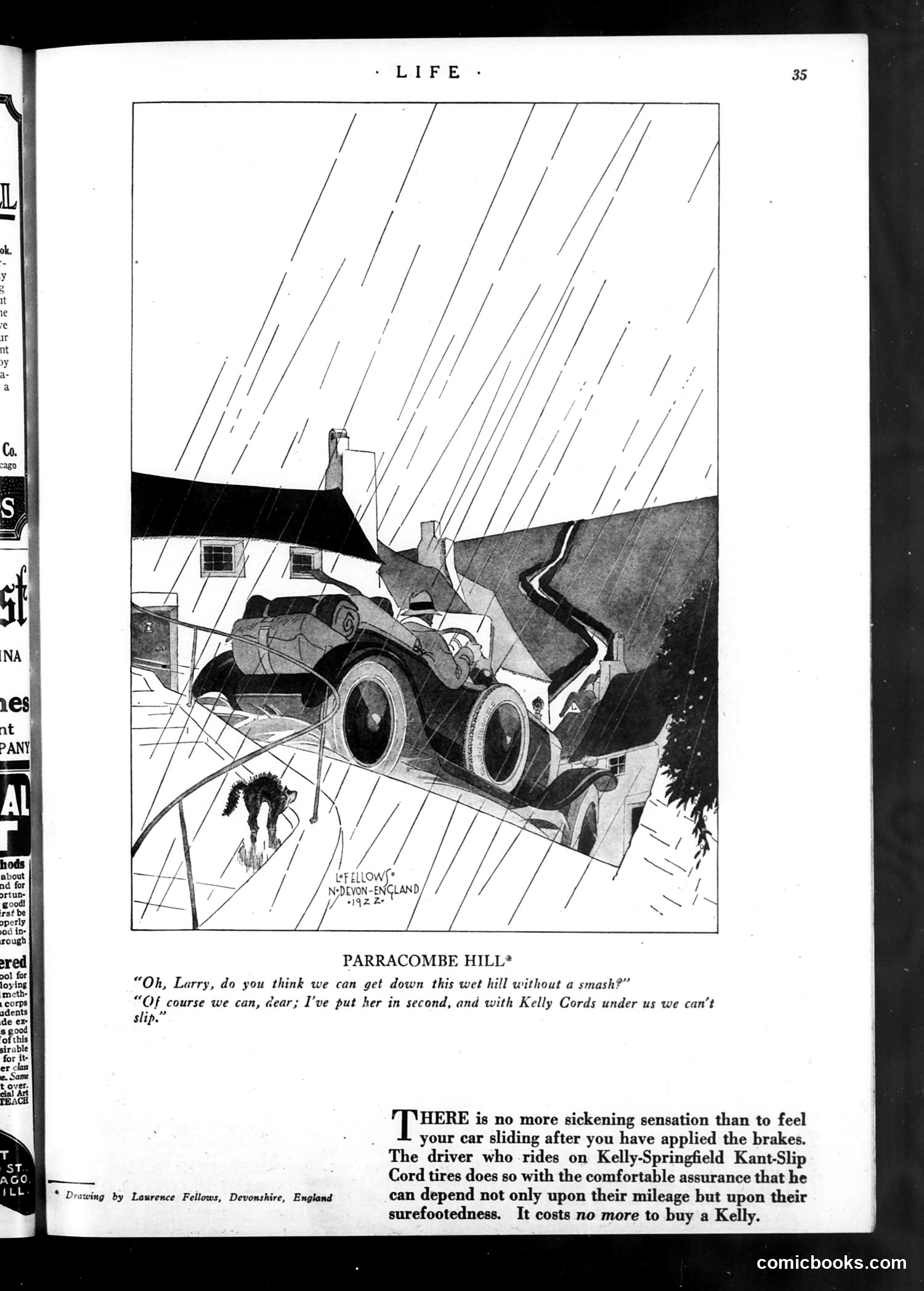
This is primarily a **tire advertisement** for Kelly-Springfield Kant-Slip Cord tires, illustrated as a humorous scene rather than straightforward ad copy. The cartoon depicts a couple in a car descending a steep, rainy English hill (Parracombe Hill, Devon). The wife expresses worry about losing traction; the husband confidently assures her the car won't slip because he's using Kelly brand tires. The "joke" is the setup-and-payoff structure: anxiety about sliding brakes is immediately relieved by mentioning the product. The satirical element is subtle—it's gently mocking car-safety advertising conventions while selling tire reliability. The drawing's signature places it as artwork by Laurence Fellows, an English illustrator. The advertisement's claim—"It costs no more to buy a Kelly"—emphasizes the product's competitive pricing and practical value proposition to worried motorists of the era.
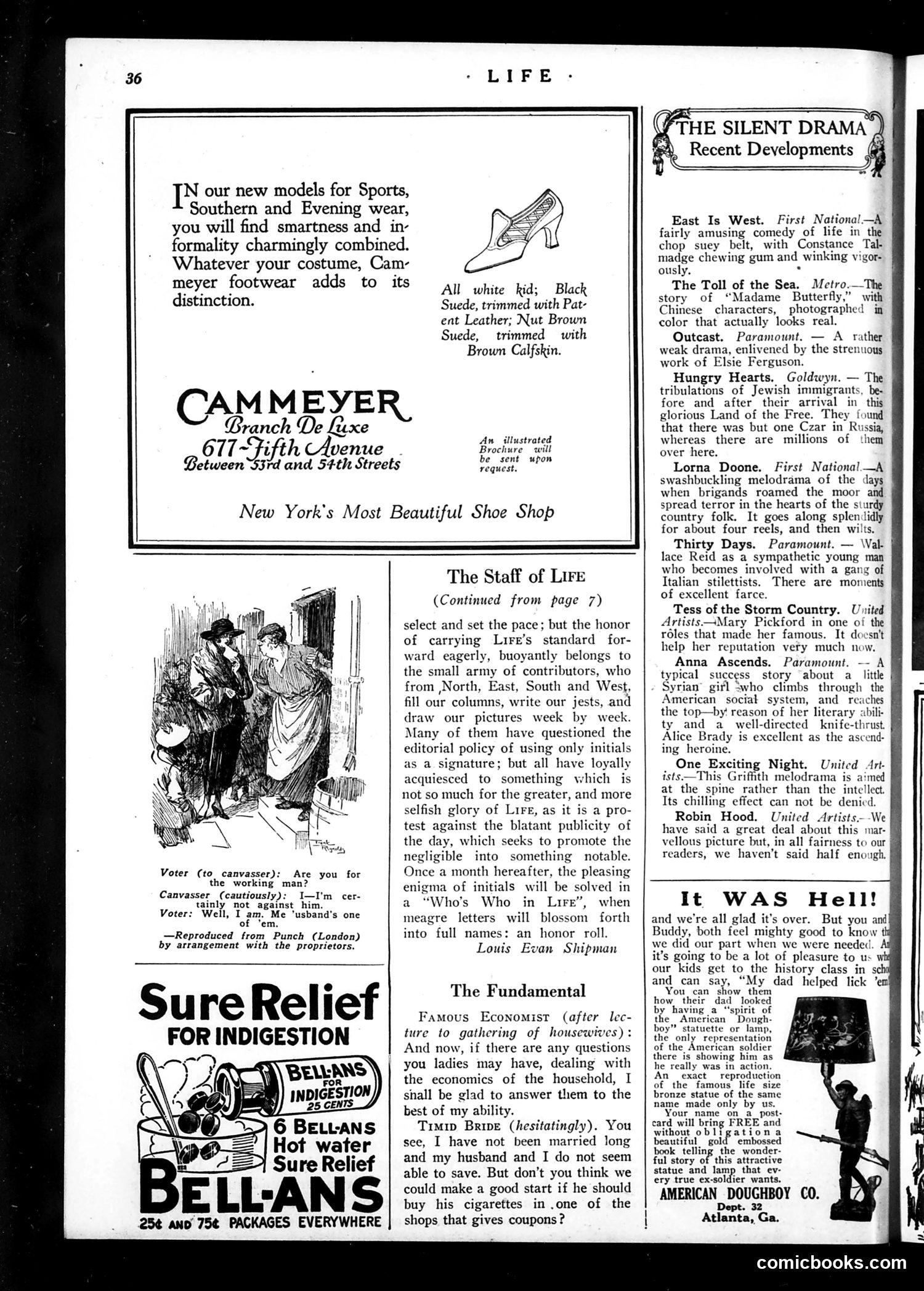
This page combines advertisements, a reprinted British political cartoon, and film reviews. **The Main Cartoon** (credited to *Punch* London): A voter questions a political canvasser about supporting "the working man." The canvasser evasively refuses to commit. The voter's punchline—"Well, I am. Me 'usband's one of 'em"—satirizes working-class wives' resentment toward their husbands' labor activism or unreliability. The humor relies on class stereotypes: the suggestion that a working man is economically burdensome to his wife. **Context**: This reflects post-WWI anxiety about labor movements and economic instability. The cartoon's reprinting from British *Punch* in an American magazine suggests shared Anglo-American concerns about worker organizing. **Surrounding Content**: The page also features shoe advertisements (Cammeyer), an indigestion remedy ad (Bellans), film reviews, and an editorial note about *Life*'s anonymous contributor policy. The reviews discuss contemporary films with immigrant and working-class themes (*Hungry Hearts*, *Anna Ascends*), indicating the era's interest in "outsider" narratives.
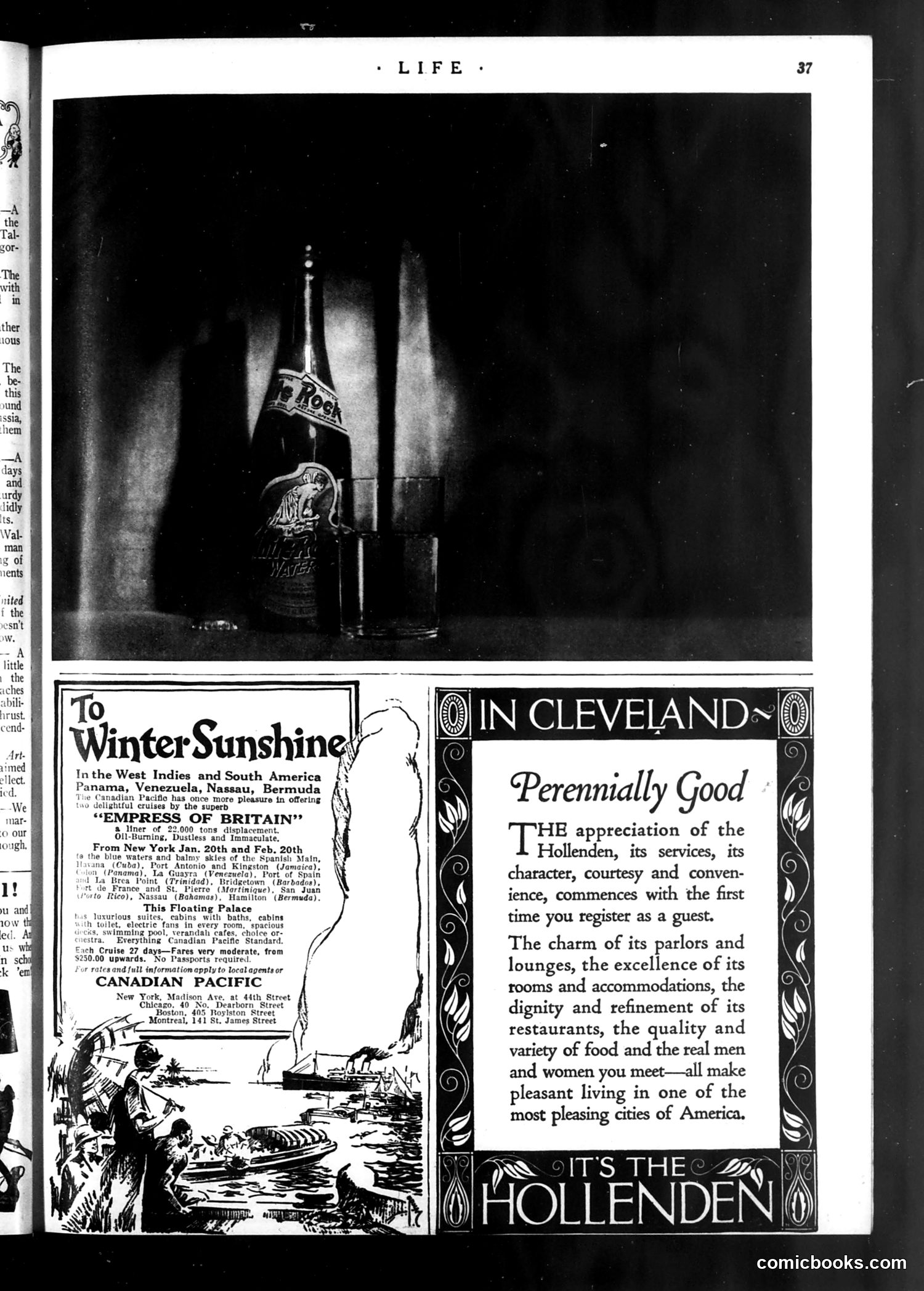
This page is primarily **advertising**, not political satire or commentary. It contains three distinct ads: 1. **Top image**: A atmospheric photograph of what appears to be a bottle (likely alcohol, given the "Water" label visible), suggesting prohibition-era commentary about hidden drinking. 2. **Lower left**: A Canadian Pacific cruise advertisement for the "Empress of Britain," promoting winter Caribbean voyages to Panama, Venezuela, and Bermuda—a luxury travel pitch for wealthy Americans seeking warm-weather escapes. 3. **Right side**: A hotel advertisement for the Hollenden in Cleveland, emphasizing its quality accommodations, restaurants, and refined atmosphere as an attraction to the city. The page reflects early 20th-century American consumer culture and leisure marketing. The apparent alcohol imagery in the top photo is notable given this was likely published during or shortly after Prohibition (1920-1933), when such references carried particular cultural weight.
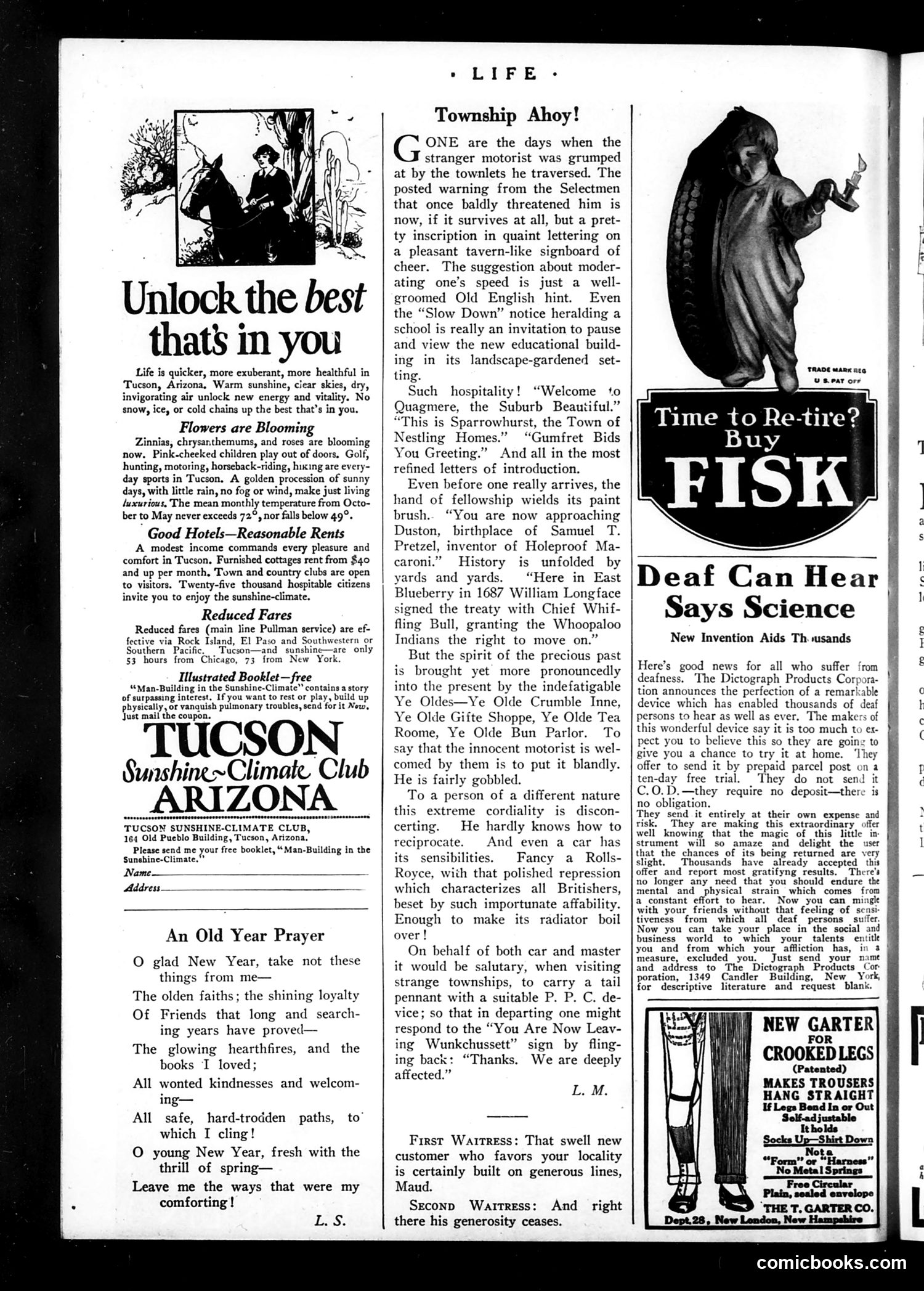
This satirical piece mocks the emerging trend of small American towns aggressively marketing themselves to automobile tourists in the early 20th century. The article describes towns replacing old "keep out" warnings with elaborate, saccharine welcomes—quaint signboards, historical plaques about invented local figures ("Samuel T. Pretzel, inventor of Holeproof Macaroni"), and contrived "Ye Olde" establishments designed to charm motorists into stopping and spending money. The satire targets both the towns' transparent commercialism and their cloying, inauthentic nostalgia. Phrases like "fairly gobbled" suggest the motorist is being consumed by relentless hospitality. The article implies this calculated friendliness is actually exhausting and off-putting to travelers—even "a Rolls-Royce, with that polished repression which characterizes all Britishers," has its limits. The humor lies in exposing the performative nature of rural tourism marketing.
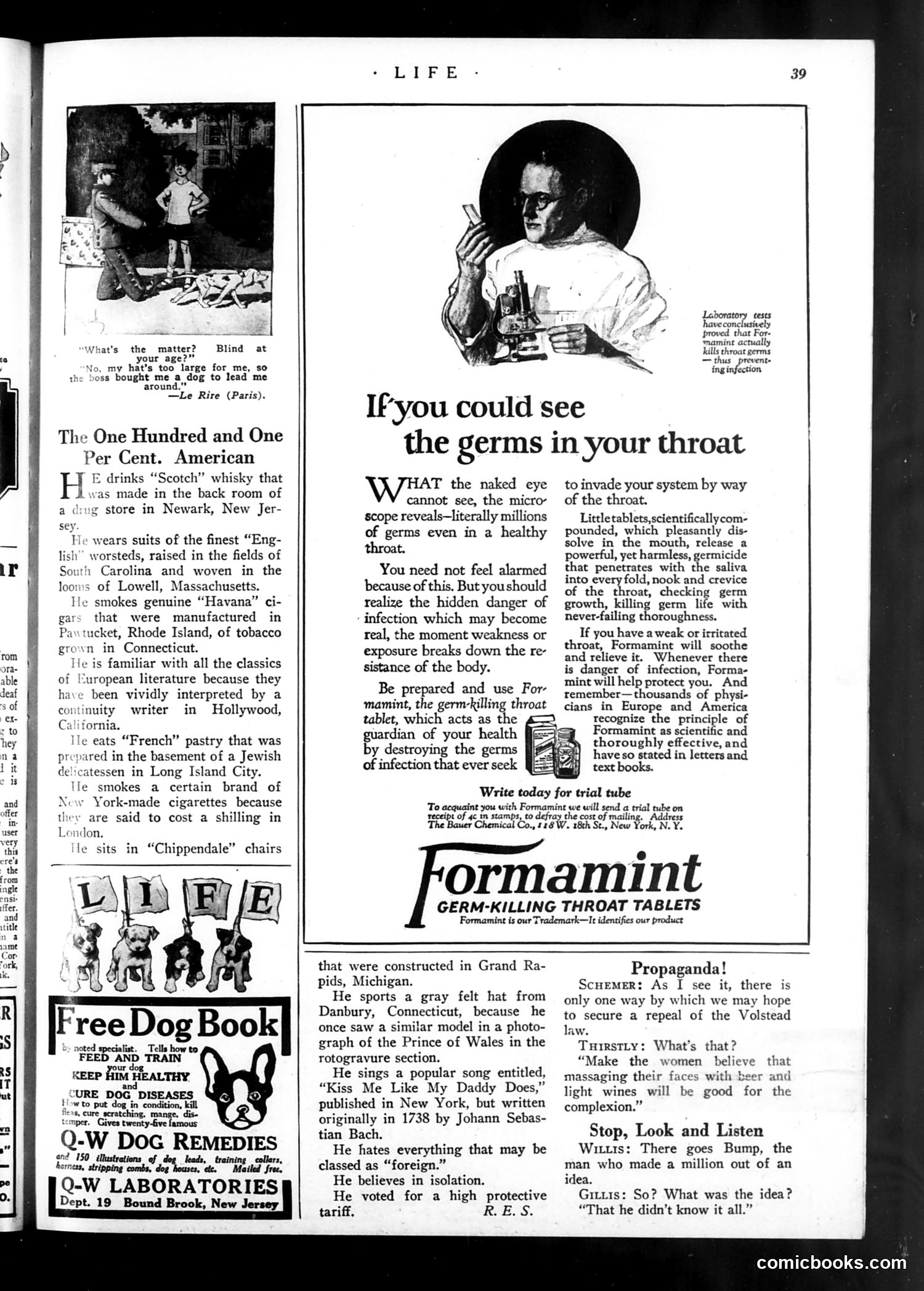
This satirical piece ridicules the hypocritical patriotism of American isolationists and protectionists. The subject claims to be fiercely "American" and opposes "foreign" goods, yet every aspect of his life—whisky from a Newark drugstore (bootleg, during Prohibition), English woolens from New England mills, "Havana" cigars made in Rhode Island, "French" pastry from Long Island—consists of either domestic knock-offs or foreign products domestically produced or relabeled. The joke exposes the absurdity of nationalist rhetoric: he votes for protective tariffs while unknowingly consuming foreign culture (Bach misattributed as contemporary), hates "foreign" anything, yet depends entirely on fake or rebranded imports. The satirist mocks those who champion isolationism and tariffs while their actual consumption patterns contradict their stated beliefs—a common target of 1920s-30s American satire.
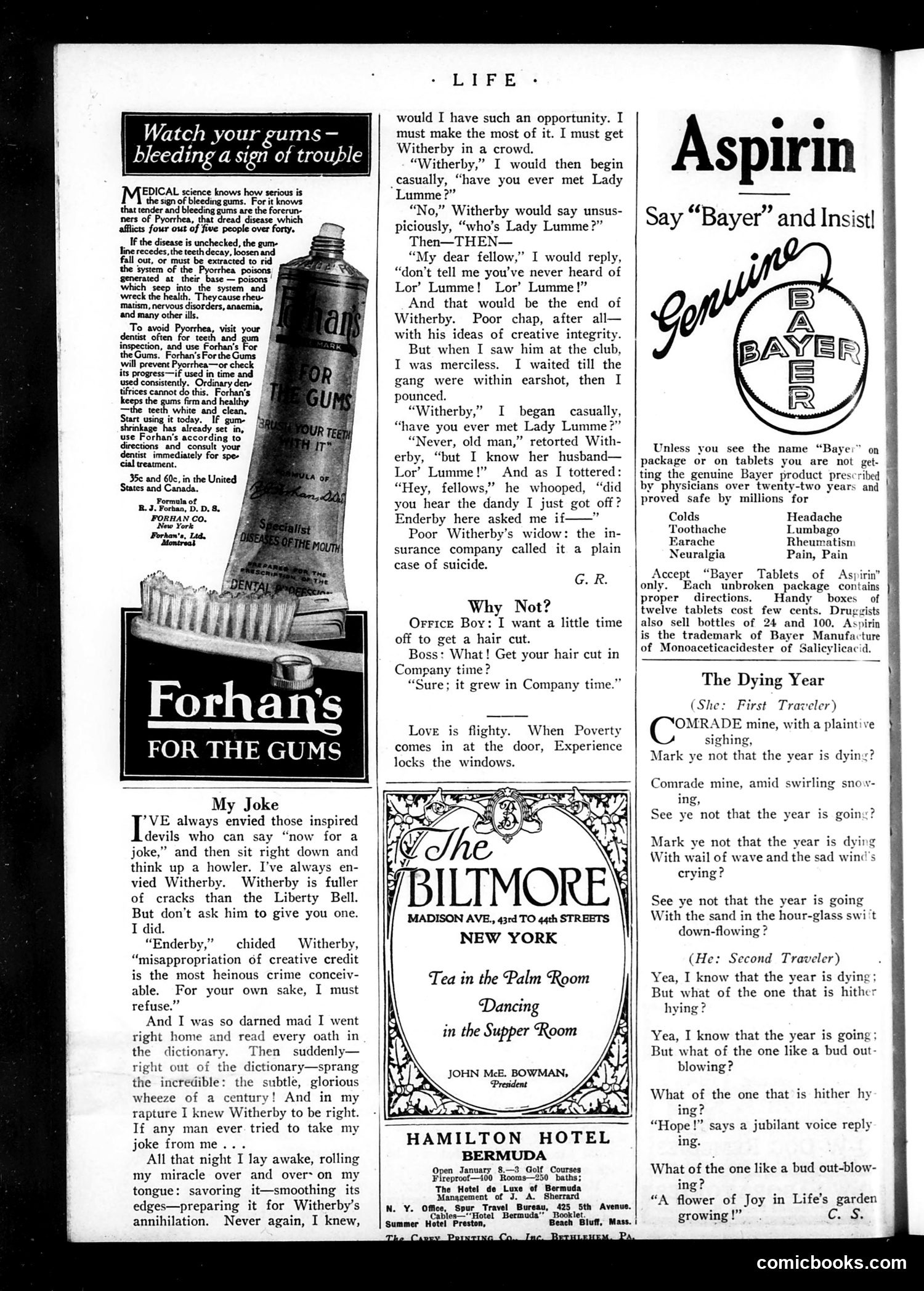
This page contains **humorous fiction and advertisements** rather than political cartoons. **"My Joke"** is a satirical short story about a man's obsession with stealing credit for a joke from his witty friend Witherby. The narrator plans an elaborate prank to humiliate Witherby by pretending ignorance of "Lady Lumme" (a nonsense name meant to embarrass). However, Witherby turns the tables, using the narrator's own setup against him—asking about "Lor' Lumme" (rhyming slang) instead. The punchline is darkly comedic: the narrator's humiliation drives Witherby to suicide. The satire targets vanity, the obsession with clever wit as social currency, and the petty cruelty of upper-class British society. **"Why Not?"** is a brief joke about workers performing personal tasks during company time—suggesting employees view their own time investment as justifying personal use of work hours. The page also features period advertisements for **Forhan's toothpaste** (addressing gum disease), **Aspirin**, and resort hotels.
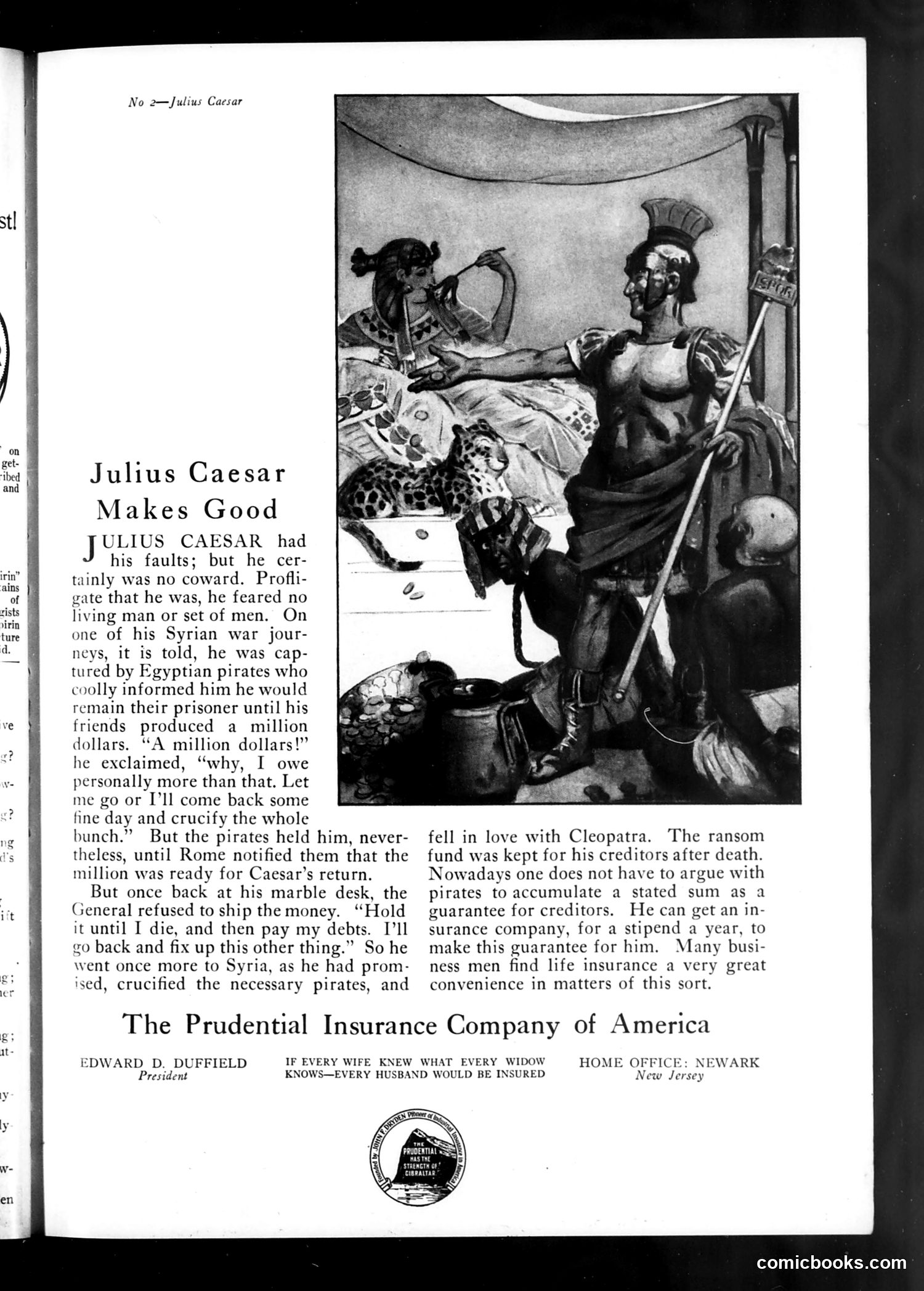
This is an advertisement for Prudential Insurance disguised as historical satire. The piece recounts how Julius Caesar, captured by pirates demanding ransom, refused to pay debts and instead promised to return and crucify them—which he did. He then diverted the ransom fund to his creditors posthumously. The satire's point: Caesar's ad-hoc approach to financial obligation was reckless. Modern businessmen, the text argues, should use life insurance instead—a "convenience" that guarantees creditors payment upon death without the messiness of broken promises or delayed settlements. The accompanying illustration shows Caesar in his tent with Cleopatra, emphasizing his priorities (romance and conquest) over financial responsibility. The advertisement's tagline—"If every wife knew what every widow knows—every husband would be insured"—implies widows understand insurance's necessity; husbands should too. It's a clever marketing pitch that uses historical anecdote to normalize life insurance as prudent financial management.
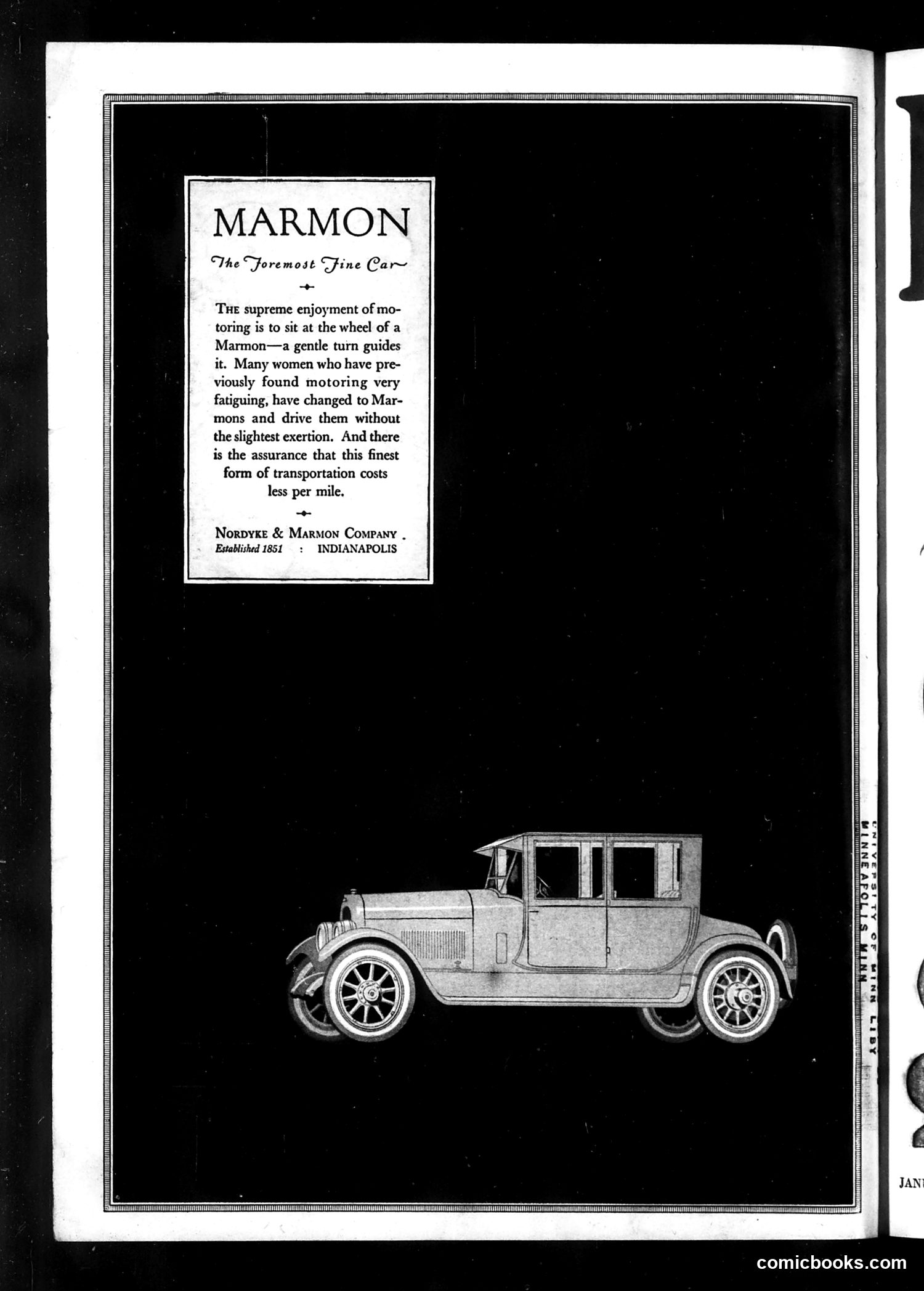
This is a **Marmon automobile advertisement**, not a cartoon or satire. The page features the luxury car brand's marketing pitch targeting female drivers specifically. The ad claims the Marmon requires minimal effort to operate—"a gentle turn guides it"—and emphasizes that women who found other cars "fatiguing" have switched to Marmons and "drive them without the slightest exertion." This reflects early 20th-century assumptions that women were physically delicate and needed specially designed vehicles. The ad also highlights cost-efficiency ("less per mile"), positioning the Marmon as both luxurious and practical. The illustration shows a sedan-style touring car typical of the era. The Nordyke & Marmon Company was indeed established in Indianapolis in 1851, as stated. This appears to be straightforward product advertising rather than satirical content.