
Life, 1923-01-04 · page 19 of 44
Life — January 4, 1923 — page 19: what you’re looking at
What you’re looking at
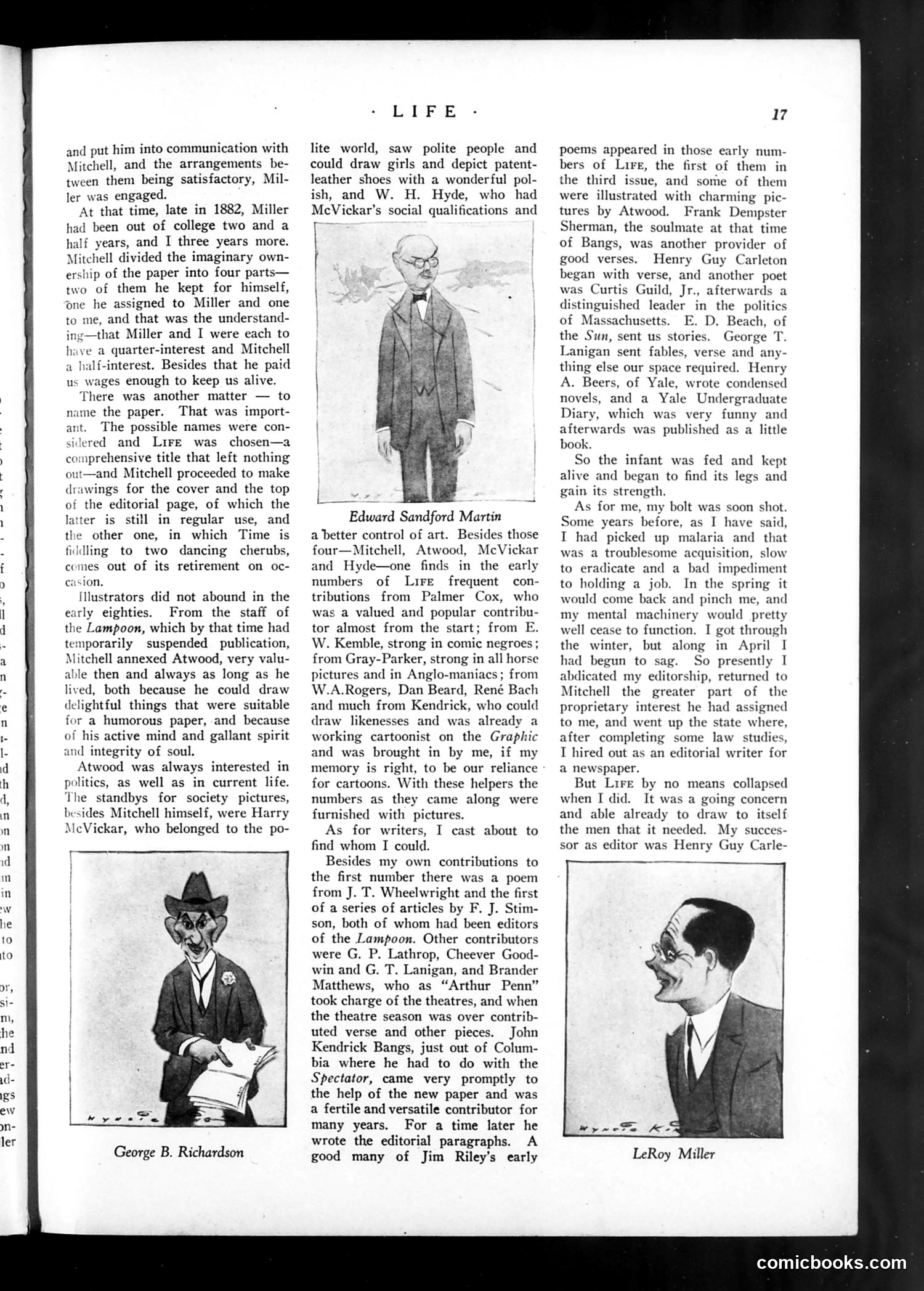
This page documents the early founding of **Life magazine** (circa 1882), not the modern publication. The text describes how editor John Ames Mitchell assembled the magazine's creative team. The two portrait sketches show **Edward Sandford Martin** and **George B. Richardson** (and partially **LeRoy Miller**), early contributors. The text explains their roles: Martin handled editorial control and illustration; Richardson and others provided society drawings and cartoons. Key context: This was a *satirical humor magazine* relying on talented illustrators like Palmer Cox and cartoonist Kendrick because photographic reproduction wasn't yet feasible. Contributors like John Kendrick Bangs (a famous humorist) and James Whitcomb Riley provided comedic verse. The "negroes" reference reflects the racist language of the 1880s-90s era when comic depictions of Black people were standard in publications. This is essentially institutional history—celebrating Life's founding team rather than satirizing current events.
📄 Transcribed text from this page (OCR, searchable)
Machine-transcribed from the original scan — historical spelling and the odd misread are preserved.
and put him into communication with Mitchell, and the arrangements be- tween them being satisfactory, Mil- ler was engaged. At that time, late in 1882, Miller had been out of college two and a half years, and I three years more. Mitchell divided the imaginary own- ership of the paper into four parts— two of them he kept for himself, one he assigned to Miller and one to me, and that was the understand- ing—that Miller and I were each to have a quarter-interest and Mitchell a half-interest. Besides that he paid us wages enough to keep us alive. There was another matter — to name the paper. That was import- ant. The possible names were con- sidered and Lire was chosen—a comprehensive title that left nothing out—and Mitchell proceeded to make drawings for the cover and the top of the editorial page, of which the latter is still in regular use, and the other one, in which Time is fiddling to two dancing cherubs, comes out of its retirement on oc- casion. [llustrators did not abound in the early eighties. From the staff of the Lampoon, which by that time had temporarily suspended publication, Mitchell annexed Atwood, very valu- able then and always as long as he lived, both because he could draw delightful things that were suitable for a humorous paper, and because of his active mind and gallant spirit and integrity of soul. Atwood was always interested in politics, as well as in current life. The standbys for society pictures, besides Mitchell himself, were Harry McVickar, who belonged to the po- George B. Richardson «“ LIFE : lite world, saw polite people and could draw girls and depict patent- leather shoes with a wonderful pol- ish, and W. H. Hyde, who had McVickar’s social qualifications and nae | Ex Edward Sandford Martin a better control of art. Besides those four—Mitchell, Atwood, McVickar and Hyde—one finds in the early numbers of Lire frequent con- tributions from Palmer Cox, who was a valued and popular contribu- tor almost from the start; from E. W. Kemble, strong in comic negroes ; from Gray-Parker, strong in all horse pictures and in Anglo-maniacs ; from W.A.Rogers, Dan Beard, René Bach and much from Kendrick, who could draw likenesses and was already a working cartoonist on the Graphic and was brought in by me, if my memory is right, to be our reliance for cartoons. With these helpers the numbers as they came along were furnished with pictures. As for writers, I cast about to find whom I could. Besides my own contributions to the first number there was a poem from J. T. Wheelwright and the first of a series of articles by F. J. Stim- son, both of whom had been editors of the Lampoon. Other contributors were G. P. Lathrop, Cheever Good- win and G, T. Lanigan, and Brander Matthews, who as “Arthur Penn” took charge of the theatres, and when the theatre season was over contrib- uted verse and other pieces. John Kendrick Bangs, just out of Colum- bia where he had to do with the Spectator, came very promptly to the help of the new paper and was a fertile and versatile contributor for many years. For a time later he wrote the editorial paragraphs. A good many of Jim Riley’s early 17 poems appeared in those early num- bers of Lire, the first of them in the third issue, and some of them were illustrated with charming pic- tures by Atwood. Frank Dempster Sherman, the soulmate at that time of Bangs, was another provider of good verses. Henry Guy Carleton began with verse, and another poet was Curtis Guild, Jr., afterwards a distinguished leader in the politics of Massachusetts. E. D. Beach, of the Sun, sent us stories. George T. Lanigan sent fables, verse and any- thing else our space required. Henry A. Beers, of Yale, wrote condensed novels, and a Yale Undergraduate Diary, which was very funny and afterwards was published as a little book. So the infant was fed and kept alive and began to find its legs and gain its strength. As for me, my bolt was soon shot. Some years before, as I have said, I had picked up malaria and that was a troublesome acquisition, slow to eradicate and a bad impediment to holding a job. In the spring it would come back and pinch me, and my mental machinery would pretty well cease to function. I got through the winter, but along in April I had begun to sag. So presently I abdicated my editorship, returned to Mitchell the greater part of the proprietary interest he had assigned to me, and went up the state where, after completing some law studies, I hired out as an editorial writer for a newspaper. But Lire by no means collapsed when I did. It was a going concern and able already to draw to itself the men that it needed. My succe sor as editor was Henry Guy Carle- LeRoy Miller comicbooks.com