
Life, 1923-01-04 · page 12 of 44
Life — January 4, 1923 — page 12: what you’re looking at
What you’re looking at
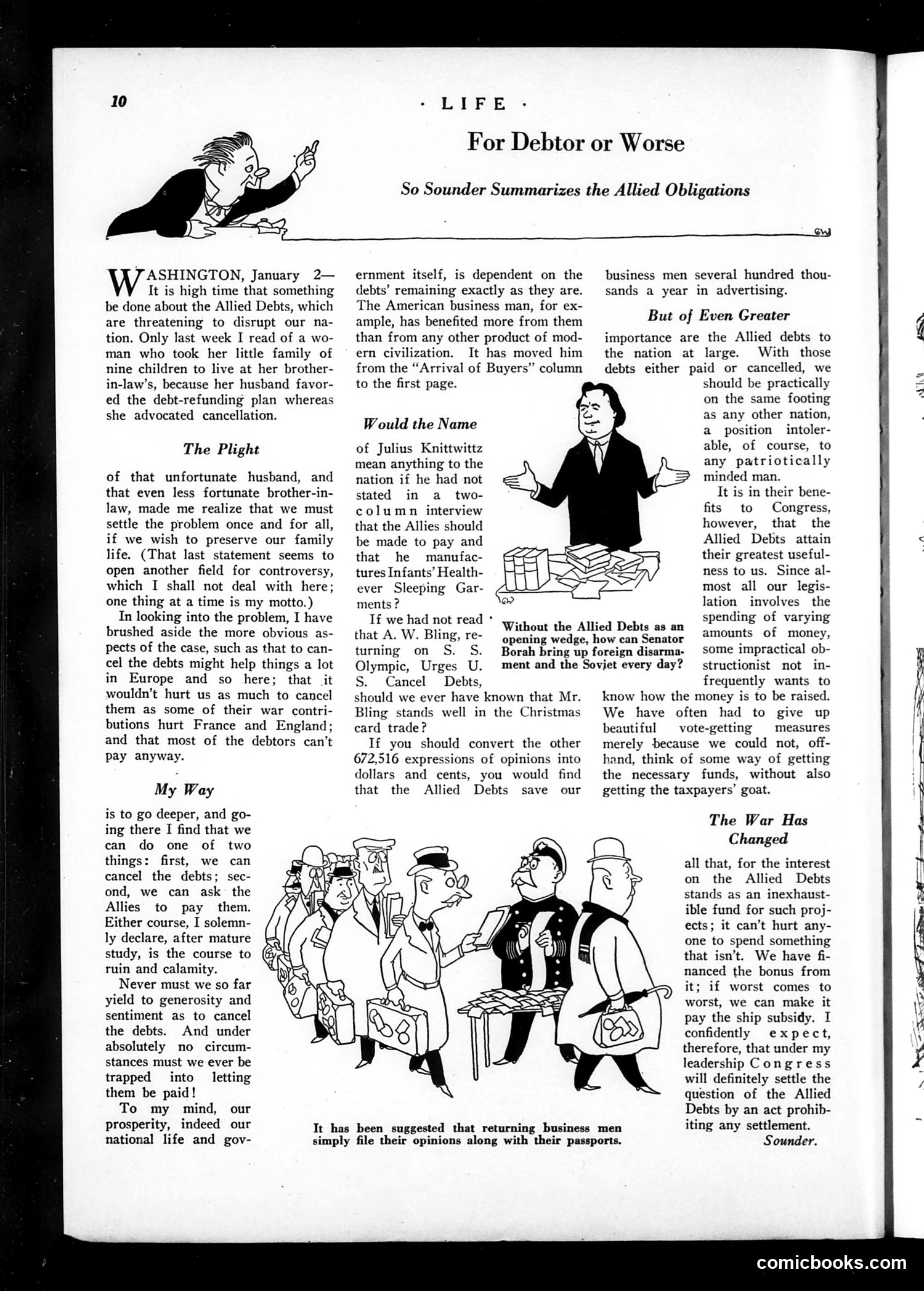
This 1920s Life magazine article satirizes debates over Allied war debts—money loaned to Britain, France, and other WWI allies that they hadn't repaid. The cartoons mock three groups: a struggling debtor family (representing the dilemma), American businessmen filing opinions about debt policy, and foreign delegations seeking favorable terms. The central figure appears to be "Sounder," Life's persona for summarizing complex issues. The satire's point: canceling Allied debts would hurt American finances, yet demanding repayment strains relationships with war allies. The author (likely mocking Congress) argues neither full cancellation nor indefinite lending serves national interests—a lose-lose situation requiring difficult political compromise. The cartoons exaggerate the complexity and frustration surrounding post-war financial negotiations that divided American policymakers.
📄 Transcribed text from this page (OCR, searchable)
Machine-transcribed from the original scan — historical spelling and the odd misread are preserved.
LL TERE * For Debtor or Worse So Sounder Summarizes the Allied Obligations sw ASHINGTON, January 2— It is high time that something be done about the Allied Debts, which are threatening to disrupt our na- tion. Only last week I read of a wo- man who took her little family of nine children to live at her brother- in-law’s, because her husband favor- ed the debt-refunding plan whereas she advocated cancellation. The Plight of that unfortunate husband, and that even less fortunate brother-in- law, made me realize that we must settle the problem once and for all, if we wish to preserve our family life. (That last statement seems to open another field for controversy, which I shall not deal with here; one thing at a time is my motto.) In looking into the problem, I have brushed aside the more obvious as- pects of the case, such as that to can- cel the debts might help things a lot in Europe and so here; that it wouldn’t hurt us as much to cancel them as some of their war contri- butions hurt France and England; and that most of the debtors can’t pay anyway. My Way is to go deeper, and go- ing there I find that we can do one of two things: first, we can cancel the debts; sec- ond, we can ask the Allies to pay them. Either course, I solemn- ly declare, after mature study, is the course to ruin and calamity. Never must we so far yield to generosity and sentiment as to cancel the debts. And under absolutely no circum- stances must we ever be trapped into letting them be paid! To my mind, our prosperity, indeed our national life and gov- ernment itself, is dependent on the debts’ remaining exactly as they are. The American business man, for ex- ample, has benefited more from them than from any other product of mod- ern civilization. It has moved him from the “Arrival of Buyers” column to the first page. Would the Name of Julius Knittwittz mean anything to the nation if he had not stated in a two- column interview that the Allies should be made to pay and that he manufac- tures Infants’ Health- business men several hundred thou- sands a year in advertising. But of Even Greater importance are the Allied debts to the nation at large. With those debts either paid or cancelled, we should be practically on the same footing as any other nation, a position intoler- able, of course, to any patriotically minded man. It is in their bene- fits to Congress, however, that the Allied Debts attain their greatest useful- ness to us. Since al- ever Sleeping Gar- ments ? Tf we had not read * without the Allied Debts as an opening wedge, how can Senator i Borah bring up foreign disarma- Some impractical ob- Olympic, Urges U. ment and the Soviet every day? that A. W. Bling, re- turning on S. S. S. Cancel Debts, should we ever have known that Mr. Bling stands well in the Christmas card trade? If you should convert the other 672,516 expressions of opinions into dollars and cents, you would find that the Allied Debts save our It has been suggested that returning business men simply file their opinions along with their passports. most all our legis- lation involves the spending of varying amounts of money, structionist not in- frequently wants to know how the money is to be raised. We have often had to give up beautiful vote-getting = measures merely because we could not, off- hand, think of some way of getting the necessary funds, without also getting the taxpayers’ goat. The War Has Changed all that, for the interest on the Allied Debts stands as an inexhaust- ible fund for such proj- ects; it can’t hurt any- one to spend something that isn’t. We have fi- nanced the bonus from it; if worst comes to worst, we can make it pay the ship subsidy. I confidently expect, therefore, that under my leadership Congress will definitely settle the question of the Allied Debts by an act prohib- iting any settlement. Sounder. comicbooks.com oo