
Life, 1923-01-04 · page 20 of 44
Life — January 4, 1923 — page 20: what you’re looking at
What you’re looking at
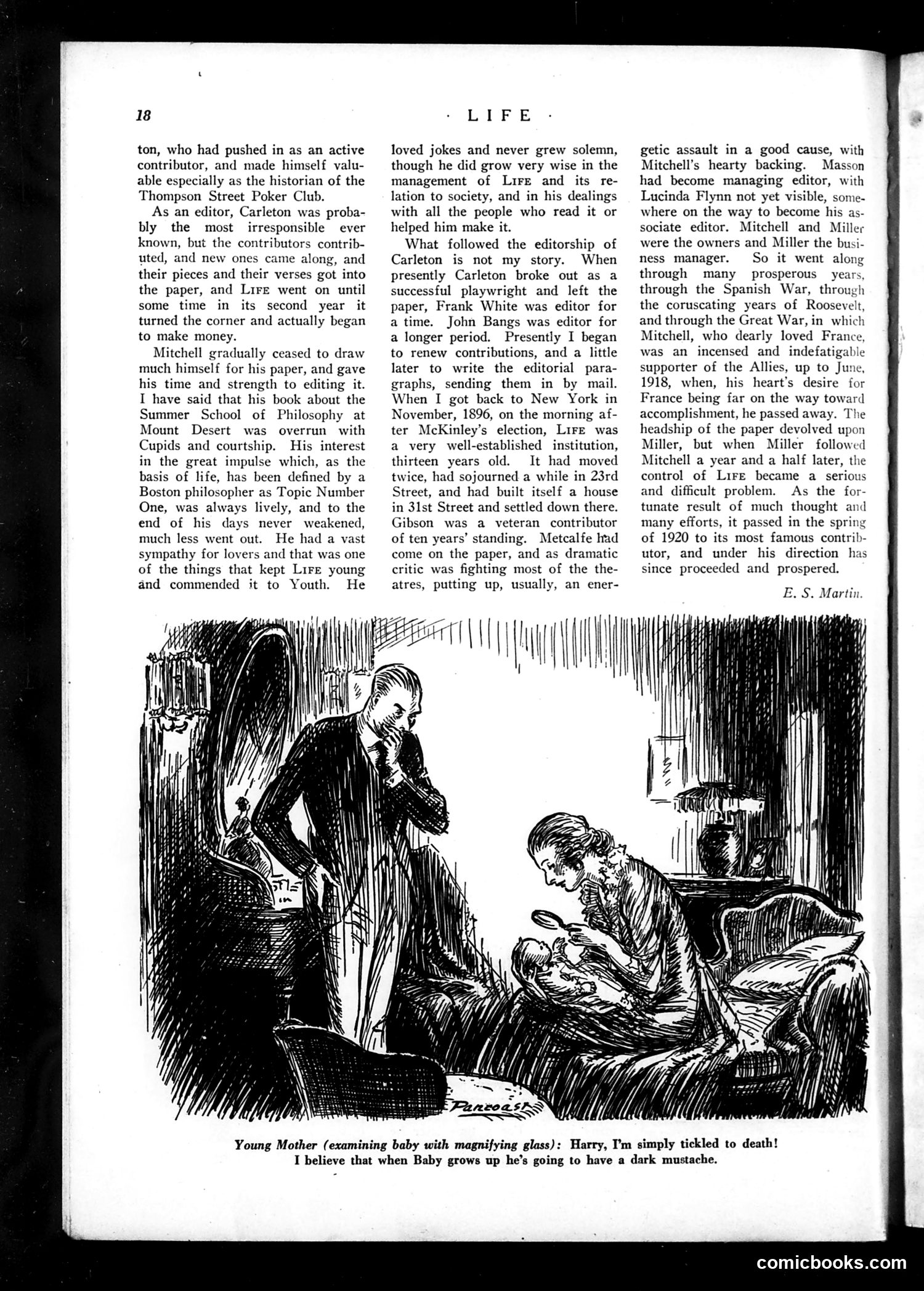
This page contains a humorous domestic cartoon captioned below the illustration. A young mother examines her infant through a magnifying glass while speaking to her husband (Harry), expressing delight that the baby will grow up to have a dark mustache. The joke relies on early 20th-century social attitudes: dark mustaches were considered a sign of masculine distinction and virility in this era. The satire targets the mother's premature obsession with her baby's future appearance and masculine traits, extrapolating adult characteristics from an infant's features. It gently mocks parental vanity and the tendency to project hopes onto newborns—here, the mother's eagerness to identify signs of her son's future handsomeness reflects period anxieties about social status and masculine presentation. The cartoon's humor depends on the absurdity of using a magnifying glass to predict facial hair growth, exposing the ridiculousness of such parental speculation.
📄 Transcribed text from this page (OCR, searchable)
Machine-transcribed from the original scan — historical spelling and the odd misread are preserved.
18 ton, who had pushed in as an active contributor, and made himself valu- able especially as the historian of the Thompson Street Poker Club. As an editor, Carleton was proba- bly the most irresponsible ever known, but the contributors contrib- uted, and new ones came along, and their pieces and their verses got into the paper, and Lire went on until some time in its second year it turned the corner and actually began to make money. Mitchell gradually ceased to draw much himself for his paper, and gave his time and strength to editing it. I have said that his book about the Summer School of Philosophy at Mount Desert was overrun with Cupids and courtship. His interest in the great impulse which, as the basis of life, has been defined by a Boston philosopher as Topic Number One, was always lively, and to the end of his days never weakened, much less went out. He had a vast sympathy for lovers and that was one of the things that kept Lire young and commended it to Youth. He LIFE loved jokes and never grew solemn, though he did grow very wise in the management of Lire and its re- lation to society, and in his dealings with all the people who read it or helped him make it. What followed the editorship of Carleton is not my story. When presently Carleton broke out as a successful playwright and left the paper, Frank White was editor for a time. John Bangs was editor for a longer period. Presently I began to renew contributions, and a little later to write the editorial para- graphs, sending them in by mail. When I got back to New York in November, 1896, on the morning af- ter McKinley’s election, Lire was a very well-established institution, thirteen years old. It had moved twice, had sojourned a while in 23rd Street, and had built itself a house in 31st Street and settled down there. Gibson was a veteran contributor of ten years’ standing. Metcalfe had come on the paper, and as dramatic critic was fighting most of the the- atres, putting up, usually, an ener- <a ee 74 getic assault in a good cause, with Mitchell’s hearty backing. Masson had become managing editor, with Lucinda Flynn not yet visible, some- where on the way to become his as- sociate editor. Mitchell and Miller were the owners and Miller the busi- ness manager. So it went along through many prosperous years, through the Spanish War, through the coruscating years of Roosevelt, and through the Great War, in which Mitchell, who dearly loved France, was an incensed and indefatigable supporter of the Allies, up to June, 1918, when, his heart’s desire for France being far on the way toward accomplishment, he passed away. The headship of the paper devolved upon Miller, but when Miller followed Mitchell a year and a half later, the control of Lire became a serious and difficult problem. As the for- tunate result of much thought and many efforts, it passed in the spring of 1920 to its most famous contrib- utor, and under his direction has since proceeded and prospered. E, S. Martin. Young Mother (examining baby with magnifying glass): Harry, I'm simply tickled to death! I believe that when Baby grows up he’s going to have a dark mustache. comicbooks.com