
Life, 1923-01-04 · page 11 of 44
Life — January 4, 1923 — page 11: what you’re looking at
What you’re looking at
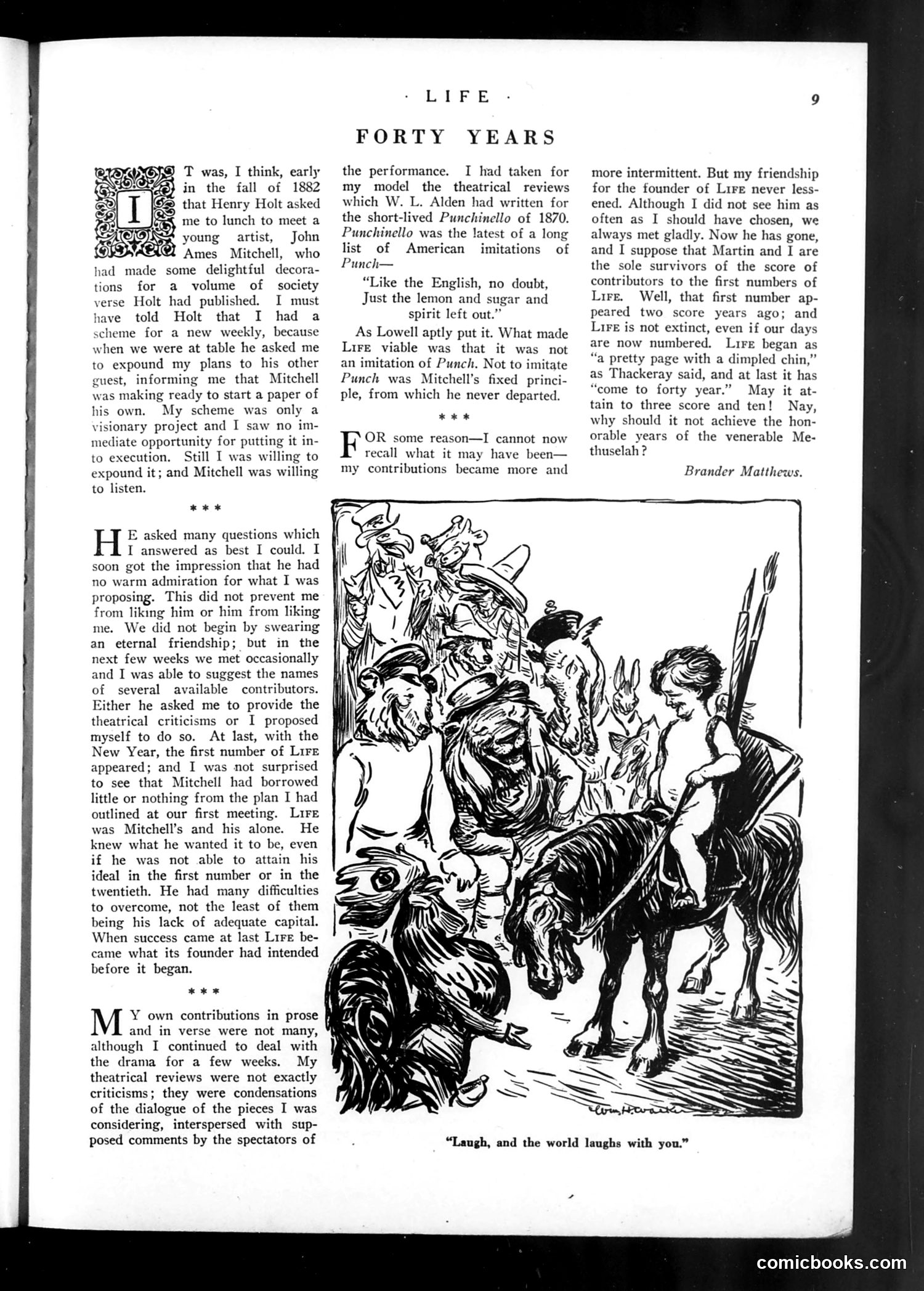
This page commemorates Life magazine's 40th anniversary. The author (identified as Brander Matthews) recounts how Henry Holt asked him to help launch a publication by young artist James Mitchell. The text describes Life as imitating the English *Punch* magazine—a satirical publication featuring witty social commentary. The accompanying illustration shows anthropomorphized animals (appearing to be goats or similar creatures) in a chaotic, comedic scene with the caption "Laugh, and the world laughs with you." This visual humor exemplifies Life's satirical approach to social observation. The narrative emphasizes Life's early struggles and Mitchell's vision, suggesting the magazine succeeded despite initial skepticism and limited capital—a testament to its founders' determination and the publication's appeal to audiences seeking intelligent comedy and social satire.
📄 Transcribed text from this page (OCR, searchable)
Machine-transcribed from the original scan — historical spelling and the odd misread are preserved.
COLO T was, I think, early ce) in the fall of 1882 ® that Henry Holt asked i me to lunch to meet a SZ young artist, John (CX@2 ‘Ames Mitchell, who had made some delightful decora- tions for a volume of society verse Holt had published. I must have told Holt that I had a scheme for a new weekly, because when we were at table he asked me to expound my plans to his other guest, informing me that Mitchell was making ready to start a paper of his own. My scheme was only a visionary project and I saw no im- mediate opportunity for putting it in- to execution. Still I was willing to expound it; and Mitchell was willing to listen. eee E asked many questions which I answered as best I could. I soon got the impression that he had no warm admiration for what I was proposing. This did not prevent me from liking him or him from liking me. We did not begin by swearing an eternal friendship; but in the next few weeks we met occasionally and I was able to suggest the names of several available contributors. Either he asked me to provide the theatrical criticisms or I proposed myself to do so. At last, with the New Year, the first number of Lire appeared; and I was not surprised to see that Mitchell had borrowed little or nothing from the plan I had outlined at our first meeting. LiFe was Mitchell’s and his alone. He knew what he wanted it to be, even if he was not able to attain his ideal in the first number or in the twentieth. He had many difficulties to overcome, not the least of them being his lack of adequate capital. When success came at last Lire be- came what its founder had intended before it began. xe OK Y own contributions in prose and in verse were not many, although I continued to deal with the drama for a few weeks. My theatrical reviews were not exactly criticisms; they were condensations of the dialogue of the pieces I was considering, interspersed with sup- posed comments by the spectators of LIFE FORTY YEARS the performance. I had taken for my model the theatrical reviews which W. L. Alden had written for the short-lived Punchinello of 1870. Punchinello was the latest of a long list of American imitations of Punch— “Like the English, no doubt, Just the lemon and sugar and spirit left out.” As Lowell aptly put it. What made Lire viable was that it was not an imitation of Punch. Not to imitate Punch was Mitchell’s fixed princi- ple, from which he never departed. eK OR some reason—I cannot now recall what it may have been— my contributions became more and more intermittent. But my friendship for the founder of Lire never less- ened. Although I did not see him as often as I should have chosen, we always met gladly. Now he has gone, and I suppose that Martin and I are the sole survivors of the score of contributors to the first numbers of Lire. Well, that first number ap- peared two score years ago; and Lire is not extinct, even if our days are now numbered. Lire began “a pretty page with a dimpled chin,” as Thackeray said, and at last it has “come to forty year.” May it at- tain to three score and ten! Nay, why should it not achieve the hon- orable years of the venerable Me- thuselah ? Brander Matthews. “Laugh, and the world laughs with you.” comicbooks.com