
Life, 1923-01-04 · page 29 of 44
Life — January 4, 1923 — page 29: what you’re looking at
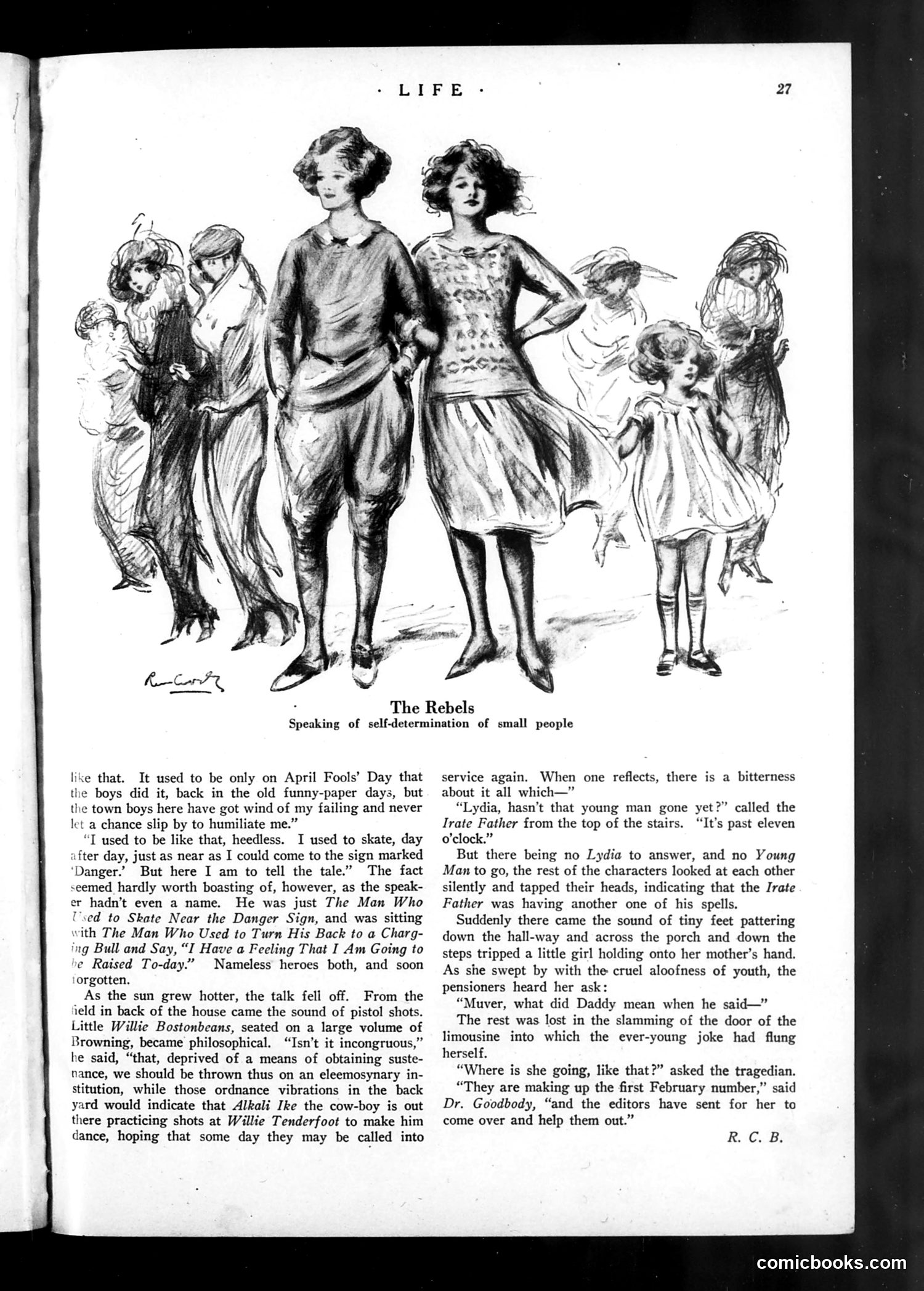
What you’re looking at
This appears to be a humorous short story with illustration rather than a political cartoon. The subtitle "Speaking of self-determination of small people" is ironic—the "small people" are recurring comic-strip characters (Willie Bostonbeans, Alkali Ike, Willie Tenderfoot, the Irate Father, and Little Lydia) who inhabit Life magazine's regular features. The joke satirizes how these stock characters have become unemployed or purposeless—reduced to sitting idle during what appears to be wartime (references to "service again" and pistol practice suggest WWI era). The story mocks their overwrought dialogue and melodramatic personas, with one character delivering absurdly pompous philosophizing about their predicament. The punchline: even these fictional "rebels" are so disposable that a little girl character is summoned away to help the magazine's February issue—suggesting these characters' only value is as filler content. It's satirizing both the cyclical nature of magazine humor and the shallow purpose of recurring comic characters.
📄 Transcribed text from this page (OCR, searchable)
Machine-transcribed from the original scan — historical spelling and the odd misread are preserved.
The Rebels Speaking of self-determination of small people like that. It used to be only on April Fools’ Day that the boys did it, back in the old funny-paper days, but the town boys here have got wind of my failing and never let a chance slip by to humiliate me.” “T used to be like that, heedless. after day, just as near as I could come to the sign marked I used to skate, day ‘Danger.’ But here I am to tell the tale.” The fact seemed hardly worth boasting of, however, as the speak- er hadn’t even a name. He was just The Man Who Used to Skate Near the Danger Sign, and was sitting vith The Man Who Used to Turn His Back to a Charg- ng Bull and Say, “I Have a Feeling That I Am Going to e Raised To-day.” Nameless heroes both, and soon orgotten. As the sun grew hotter, the talk feli off. From the ield in back of the house came the sound of pistol shots. Little Willie Bostonbeans, seated on a large volume of Browning, became philosophical. “Isn’t it incongruous,” he said, “that, deprived of a means of obtaining suste- nance, we should be thrown thus on an eleemosynary in- stitution, while those ordnance vibrations in the back yard would indicate that Alkali Ike the cow-boy is out there practicing shots at Willie Tenderfoot to make him dance, hoping that some day they may be called into service again. When one reflects, there is a bitterness about it all which—” “Lydia, hasn’t that young man gone yet?” called the Irate Father from the top of the stairs. “It’s past eleven o'clock.” But there being no Lydia to answer, and no Young Man to go, the rest of the characters looked at each other silently and tapped their heads, indicating that the Irate Father was having another one of his spells. Suddenly there came the sound of tiny feet pattering down the hall-way and across the porch and down the steps tripped a little girl holding onto her mother’s hand. As she swept by with the cruel aloofness of youth, the pensioners heard her ask: “Muver, what did Daddy mean when he said—” The rest was lost in the slamming of the door of the limousine into which the ever-young joke had flung herself. “Where is she going, like that?” asked the tragedian. “They are making up the first February number,” said Dr. Goodbody, “and the editors have sent for her to come over and help them out.” R. C. B. comicbooks.com