
Life, 1923-01-04 · page 18 of 44
Life — January 4, 1923 — page 18: what you’re looking at
What you’re looking at
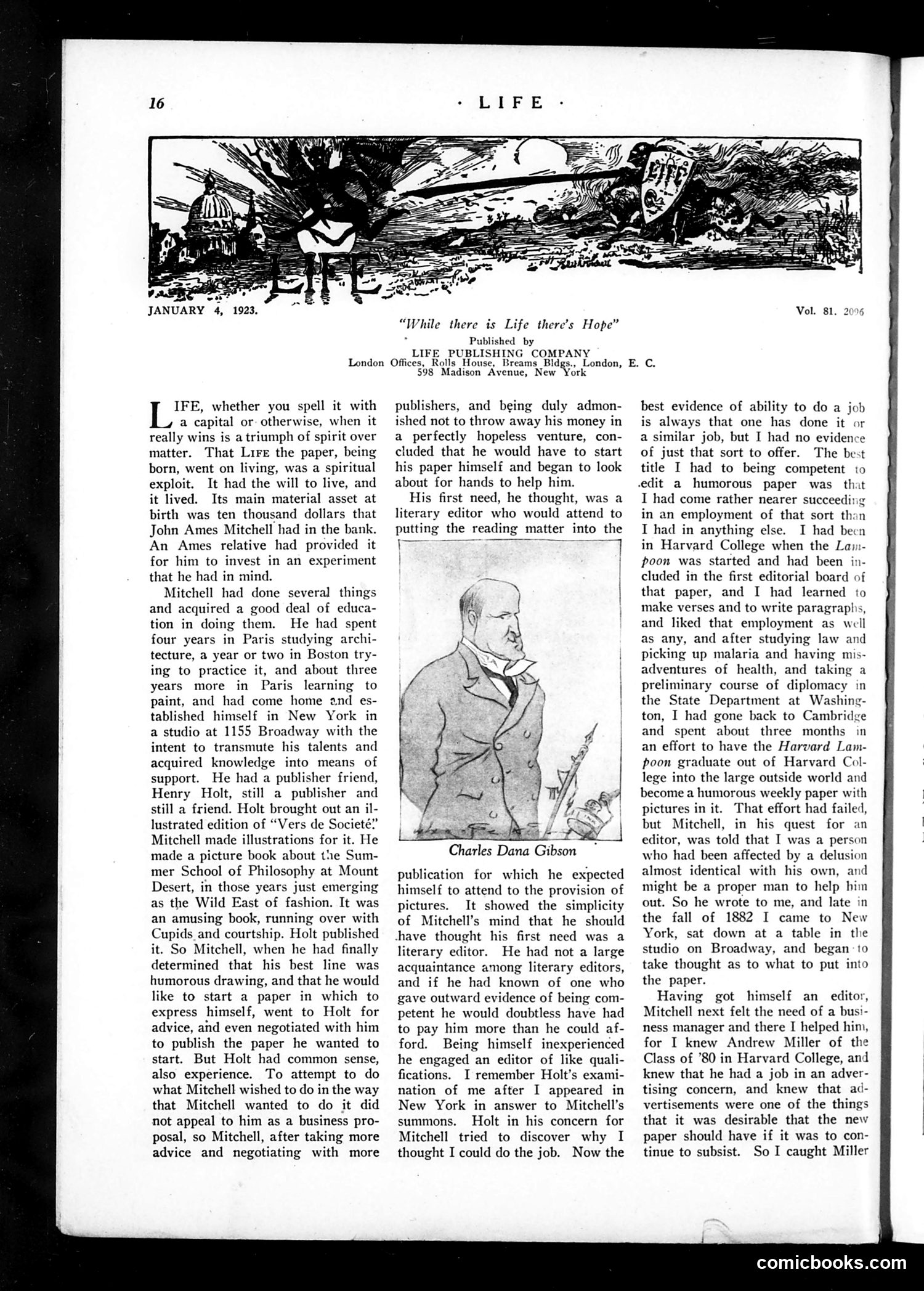
This page is not primarily a political cartoon but rather the opening of a longer article about the founding of *Life* magazine itself. The illustration shows **Charles Dana Gibson**, the famous illustrator and co-founder of *Life*. The text recounts how founder **John Ames Mitchell** started the satirical magazine with $10,000 in capital. Mitchell, trained in architecture and painting in Paris, decided to launch a humorous publication. Unable to secure publisher Henry Holt's backing (Holt deemed it too risky), Mitchell proceeded independently and needed a literary editor. The author—apparently the editor being discussed—explains that his only qualification was having worked on Harvard's *Lampoon* humor magazine, lacking direct professional editorial experience. The piece emphasizes *Life*'s origins as a bootstrapped venture relying on spirit rather than resources, celebrating its survival as proof of merit. This is essentially institutional history, not satire.
📄 Transcribed text from this page (OCR, searchable)
Machine-transcribed from the original scan — historical spelling and the odd misread are preserved.
JANUARY 4, 1923. “While there is Life there’s Hope” . Published by LIFE PUBLISHING COMPANY London Ofiees, Rolls House, Breams Bldgs., London, York IFE, whether you spell it with a capital or otherwise, when it really wins is a triumph of spirit over matter. That Lire the paper, being born, went on living, was a spiritual exploit. It had the will to live, and it lived. Its main material asset at birth was ten thousand dollars that John Ames Mitchell had in the bank. An Ames relative had provided it for him to invest in an experiment that he had in mind. Mitchell had done several things and acquired a good deal of educa- tion in doing them. He had spent four years in Paris studying archi- tecture, a year or two in Boston try- ing to practice it, and about three years more in Paris learning to paint, and had come home and es- tablished himself in New York in a studio at 1155 Broadway with the intent to transmute his talents and acquired knowledge into means of support. He had a publisher friend, Henry Holt, still a publisher and still a friend. Holt brought out an lustrated edition of “Vers de Societ Mitchell made illustrations for it. He made a picture book about the Sum- mer School of Philosophy at Mount Desert, in those years just emerging as the Wild East of fashion. It was an amusing book, running over with Cupids and courtship. Holt published it. So Mitchell, when he had finally determined that his best line was humorous drawing, and that he would like to start a paper in which to express himself, went to Holt for advice, and even negotiated with him to publish the paper he wanted to start. But Holt had common sense, also experience. To attempt to do what Mitchell wished to do in the way that Mitchell wanted to do it did not appeal to him as a business pro- posal, so Mitchell, after taking more advice and negotiating with more 98 Madison Avenue, New publishers, and being duly admon- ished not to throw away his money in a perfectly hopeless venture, con- cluded that he would have to start his paper himself and began to look about for hands to help him. His first need, he thought, was a literary editor who would attend to putting the reading matter into the | | publication for which he expected himself to attend to the provision of pictures. It showed the simplicity of Mitchell’s mind that he should -have thought his first need was a literary editor. He had not a large acquaintance among literary editors, and if he had known of one who gave outward evidence of being com- petent he would doubtless have had to pay him more than he could af- ford. Being himself inexperienced he engaged an editor of like quali- fications. I remember Holt’s exami- nation of me after I appeared in New York in answer to Mitchell's summons. Holt in his concern for Mitchell tried to discover why I thought I could do the job. Now the Cc best evidence of ability to do a job is always that one has done it or a similar job, but I had no evidence of just that sort to offer. The best title I had to being competent to -edit a humorous paper was that I had come rather nearer succeeding in an employment of that sort than I had in anything else. I had been in Harvard College when the Lam- poon was started and had been in- cluded in the first editorial board of that paper, and I had learned to make verses and to write paragraphs, and liked that employment as well as any, and after studying law and picking up malaria and having mis- adventures of health, and taking a preliminary course of diplomacy in the State Department at Washing- ton, I had gone back to Cambridge and spent about three months in an effort to have the Harvard Lam- poon graduate out of Harvard Col- lege into the large outside world and become a humorous weekly paper with pictures in it. That effort had failed, but Mitchell, in his quest for an editor, was told that I was a person who had been affected by a delusion almost identical with his own, and might be a proper man to help him out. So he wrote to me, and late in the fall of 1882 I came to New York, sat down at a table in the studio on Broadway, and began: to take thought as to what to put into the paper. Having got himself an editor, Mitchell next felt the need of a busi- ness manager and there I helped him, for I knew Andrew Miller of the Class of ’80 in Harvard College, and knew that he had a job in an adver- tising concern, and knew that ad- vertisements were one of the things that it was desirable that the new paper should have if it was to con- tinue to subsist. So I caught Miller comicbooks.com