
Life, 1923-01-04 · page 25 of 44
Life — January 4, 1923 — page 25: what you’re looking at
What you’re looking at
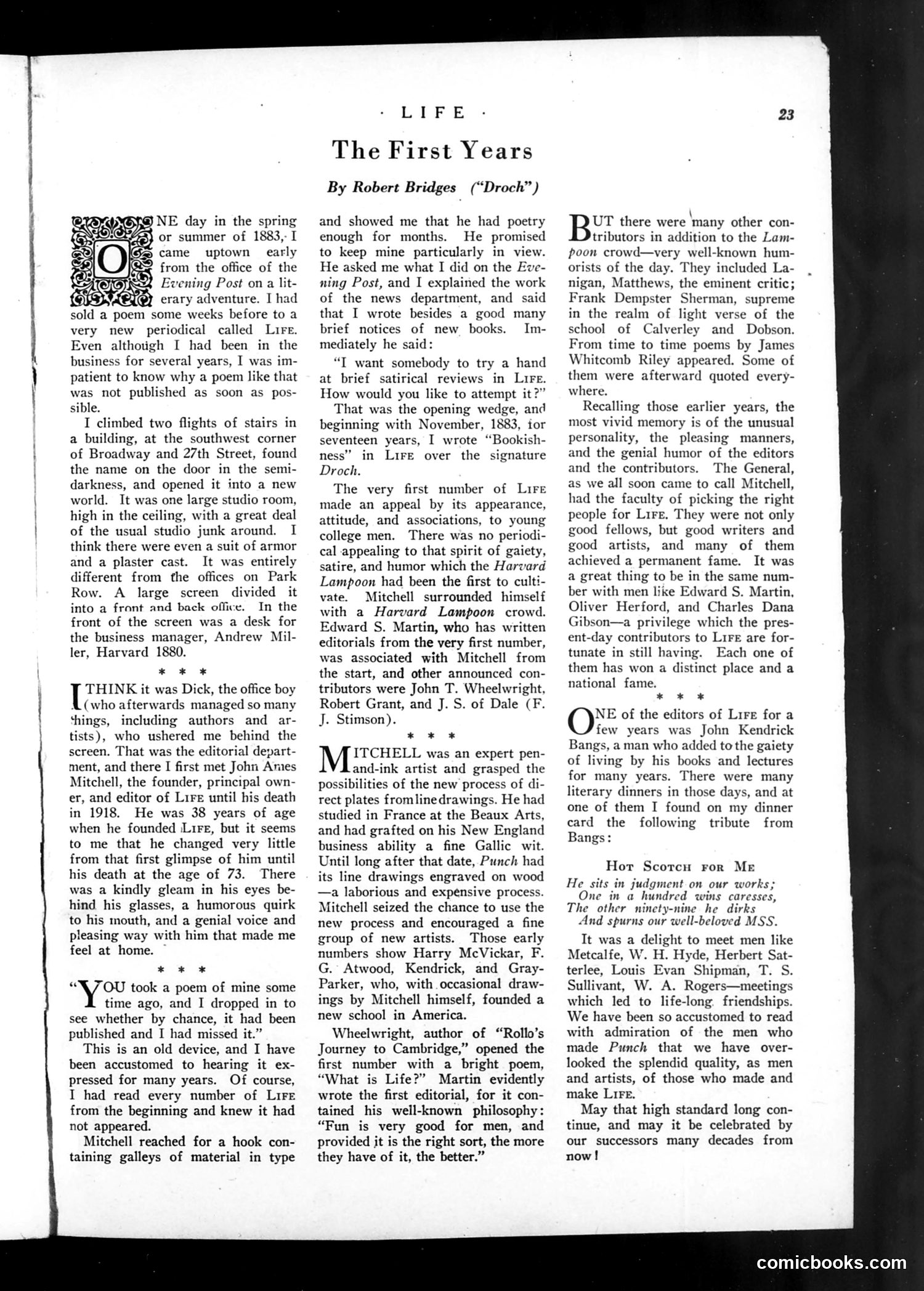
This is Robert Bridges's memoir about founding **Life magazine in 1883**—a satirical weekly for educated young men, modeled on *Harvard Lampoon*'s spirit of "gaiety, satire, and humor." The article profiles **John Ames Mitchell**, Life's founder and editor (1883-1918), describing him as a skilled pen-and-ink artist who exploited new printing technology to feature line drawings more efficiently than *Punch* magazine could with wood engravings. Key contributors mentioned include **Edward S. Martin** (editorials) and writers like **John T. Wheelwright** and **Robert Grant**—all Harvard-connected figures. Bridges himself contributed literary satire under the pseudonym "Droch" starting November 1883. The piece emphasizes Life's youth appeal and artistic innovation rather than specific political satire, functioning as institutional history rather than commentary on current events.
📄 Transcribed text from this page (OCR, searchable)
Machine-transcribed from the original scan — historical spelling and the odd misread are preserved.
ann Oj) NE day in the spring OCLs or summer of 1883,- I lS came uptown early from the office of the Evening Post ona lit- erary adventure. I had sold a poem some weeks before to a very new periodical called Lire. Even althoigh I had been in the business for several years, I was im- patient to know why a poem like that was not published as soon as pos- sible. I climbed two flights of stairs in a building, at the southwest corner of Broadway and 27th Street, found the name on the door in the semi- darkness, and opened it into a new world. It was one large studio room, high in the ceiling, with a great deal of the usual studio junk around. I think there were even a suit of armor and a plaster cast. It was entirely different from the offices on Park Row. A large screen divided it into a front and back office. In the front of the screen was a desk for the business manager, Andrew Mil- ler, Harvard 1880. * ok * THINK it was Dick, the office boy A(who afterwards managed so many things, including authors and ar- tists), who ushered me behind the screen. That was the editorial depart- ment, and there I first met John Ames Mitchell, the founder, principal own- er, and editor of Lire until his death in 1918. He was 38 years of age when he founded Lire, but it seems to me that he changed very little from that first glimpse of him until his death at the age of 73. There was a kindly gleam in his eyes be- hind his glasses, a humorous quirk to his mouth, and a genial voice and pleasing way with him that made me feel at home. * * * s OU took a poem of mine some time ago, and I dropped in to see whether by chance, it had been published and I had missed it.” This is an old device, and I have been accustomed to hearing it ex- pressed for many years. Of course, I had read every number of LiFe from the beginning and knew it had not appeared. Mitchell reached for a hook con- taining galleys of material in type LIFE The First Years By Robert Bridges (‘“Droch”) and showed me that he had poetry enough for months. He promised to keep mine particularly in view. He asked me what I did on the Eve- ning Post, and I explained the work of the news department, and said that I wrote besides a good many brief notices of new books. Im- mediately he said: “I want somebody to try a hand at brief satirical reviews in Lire. How would you like to attempt it?” That was the opening wedge, and beginning with November, 1883, ior seventeen years, I wrote “Bookish- ness” in Lire over the signature Droch. The very first number of Lire made an appeal by its appearance, attitude, and associations, to young college men. There was no periodi- cal appealing to that spirit of gaiety, satire, and humor which the Harvard Lampoon had been the first to culti- vate. Mitchell surrounded himself with a Harvard Lampoon crowd. Edward S. Martin, who has written editorials from the very first number, was associated with Mitchell from the start, and other announced con- tributors were John T. Wheelwright, Robert Grant, and J. S. of Dale (F. J. Stimson). * * * ITCHELL was an expert pen- and-ink artist and grasped the possibilities of the new process of di- rect plates fromlinedrawings. He had studied in France at the Beaux Arts, and had grafted on his New England business ability a fine Gallic wit. Until long after that date, Punch had its line drawings engraved on wood —a laborious and expensive process. Mitchell seized the chance to use the new process and encouraged a fine group of new artists. Those early numbers show Harry McVickar, F. G. Atwood, Kendrick, and Gray- Parker, who, with occasional draw- ings by Mitchell himself, founded a new school in America. Wheelwright, author of “Rollo’s Journey to Cambridge,” opened the first number with a bright poem, “What is Life?” Martin evidently wrote the first editorial, for it con- tained his well-known philosophy: “Fun is very good for men, and provided it is the right sort, the more they have of it, the better.” UT there were ‘many other con- tributors in addition to the Lam- poon crowd—very well-known hum- orists of the day. They included La- nigan, Matthews, the eminent critic; Frank Dempster Sherman, supreme in the realm of light verse of the school of Calverley and Dobson. From time to time poems by James Whitcomb Riley appeared. Some of them were afterward quoted every- where. Recalling those earlier years, the most vivid memory is of the unusual personality, the pleasing manners, and the genial humor of the editors and the contributors. The General, as we all soon came to call Mitchell, had the faculty of picking the right people for Lire. They were not only good fellows, but good writers and good artists, and many of them achieved a permanent fame. It was a great thing to be in the same num- ber with men like Edward S. Martin, Oliver Herford, and Charles Dana Gibson—a privilege which the pres- ent-day contributors to Lire are for- tunate in still having. Each one of them has won a distinct place and a national fame. * * * NE of the editors of Lire for a few years was John Kendrick Bangs, a man who added to the gaiety of living by his books and lectures for many years. There were many literary dinners in those days, and at one of them I found on my dinner card the following tribute from Bangs: Hor Scorcn ror Me He sits in judgment on our works; One in a hundred wins caresses, The other ninety-nine he dirks And spurns our well-beloved MSS. It was a delight to meet men like Metcalfe, W. H. Hyde, Herbert Sat- terlee, Louis Evan Shipman, T. S. Sullivant, W. A. Rogers—meetings which led to life-long. friendships. We have been so accustomed to read with admiration of the men who made Punch that we have over- looked the splendid quality, as men and artists, of those who made and make Lire. May that high standard long con- tinue, and may it be celebrated by our successors many decades from now! comicbooks.com