
Life, 1923-01-04 · page 28 of 44
Life — January 4, 1923 — page 28: what you’re looking at
What you’re looking at
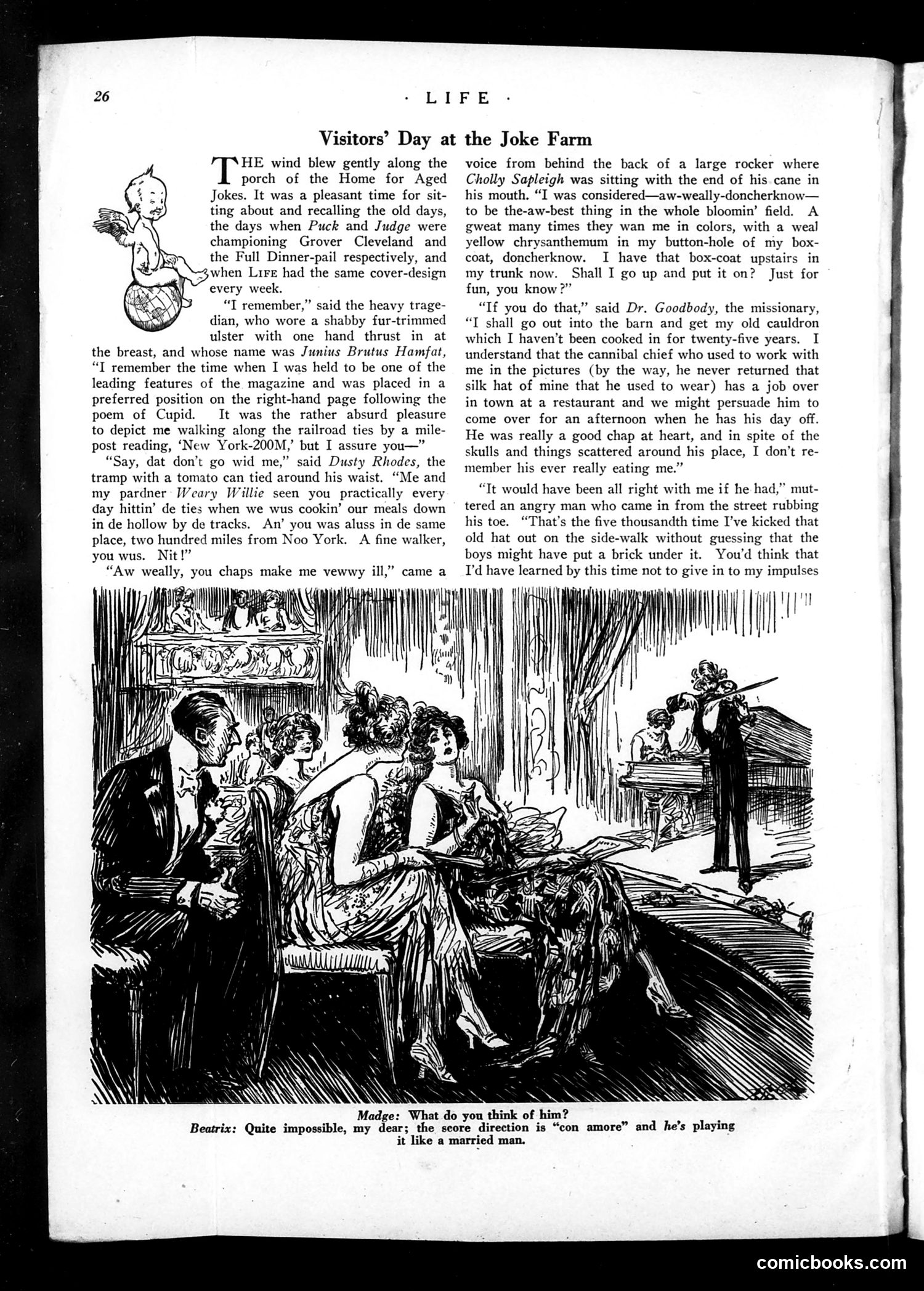
This satirical piece mocks outdated magazine humor by personifying old comic stereotypes as residents of a "Home for Aged Jokes." Characters include Junius Brutus Hamfat (a melodramatic tramp), Dusty Rhodes and Weary Willie (hobo characters), Cholly Sapleigh (an affected dandy), and Dr. Goodbody (a missionary caricature). The humor lies in these stock characters lamenting their lost prominence in *Life* magazine and competitor publications (*Puck*, *Judge*). They boast of past glory while exhibiting their tired, repetitive nature—illustrating how these comedy tropes had become stale and predictable. The bottom cartoon adds meta-commentary: a woman criticizes a musician for playing with marital detachment rather than passionate intent ("con amore"), suggesting performers have lost genuine feeling. The satire targets both aging comic conventions and the magazines' declining originality.
📄 Transcribed text from this page (OCR, searchable)
Machine-transcribed from the original scan — historical spelling and the odd misread are preserved.
LIFE Visitors’ Day at the Joke Farm HE wind blew gently along the porch of the Home for Aged Jokes. It was a pleasant time for sit- ting about and recalling the old days, the days when Puck and Judge were championing Grover Cleveland and the Full Dinner-pail respectively, and when Lire had the same cover-design every week. “T remember,” said the heavy trage- dian, who wore a shabby fur-trimmed ulster with one hand thrust in at the breast, and whose name was Junius Brutus Hamfat, “I remember the time when I was held to be one of the leading features of the magazine and was placed in a preferred position on the right-hand page following the poem of Cupid. It was the rather absurd pleasure to depict me walking along the railroad ties by a mile- post reading, ‘New York-200M,’ but I assure you—” “Say, dat don’t go wid me,” said Dusty Rhodes, the tramp with a tomato can tied around his waist. “Me and my pardner Weary Willie seen you practically every day hittin’ de ties when we wus cookin’ our meals down in de hollow by de tracks. An’ you was aluss in de same place, two hundred miles from Noo York. A fine walker, you wus. Nit!” “Aw weally, you chaps make me vewwy ill,” came a \ Vivid \ f} AAA | ea i I Ae ! | iy i \ \) y Soy i voice from behind the back of a large rocker where Cholly Sapleigh was sitting with the end of his cane in his mouth. “I was considered—aw-weally-doncherknow— to be the-aw-best thing in the whole bloomin’ field. A gweat many times they wan me in colors, with a weal yellow chrysanthemum in my button-hole of my box- coat, doncherknow. I have that box-coat upstairs in my trunk now. Shall I go up and put it on? Just for fun, you know?” “Tf you do that,” said Dr. Goodbody, the missionary, “T shall go out into the barn and get my old cauldron which I haven’t been cooked in for twenty-five years. I understand that the cannibal chief who used to work with me in the pictures (by the way, he never returned that silk hat of mine that he used to wear) has a job over in town at a restaurant and we might persuade him to come over for an afternoon when he has his day off. He was really a good chap at heart, and in spite of the skulls and things scattered around his place, I don’t re- member his ever really eating me.” “Tt would have been all right with me if he had,” mut- tered an angry man who came in from the street rubbing his toe. “That's the five thousandth time I’ve kicked that old hat out on the side-walk without guessing that the boys might have put a brick under it. You'd think that I'd have learned by this time not to give in to my impulses i" | | | | \) ii Madge: What do you think of him? 9 ; Beatrix: Quite impossible, my dear; the score direction is “con amore” and he’s playing it like a married man. comicbooks.com