
A complete issue · 36 pages · 1922
Life — September 28, 1922
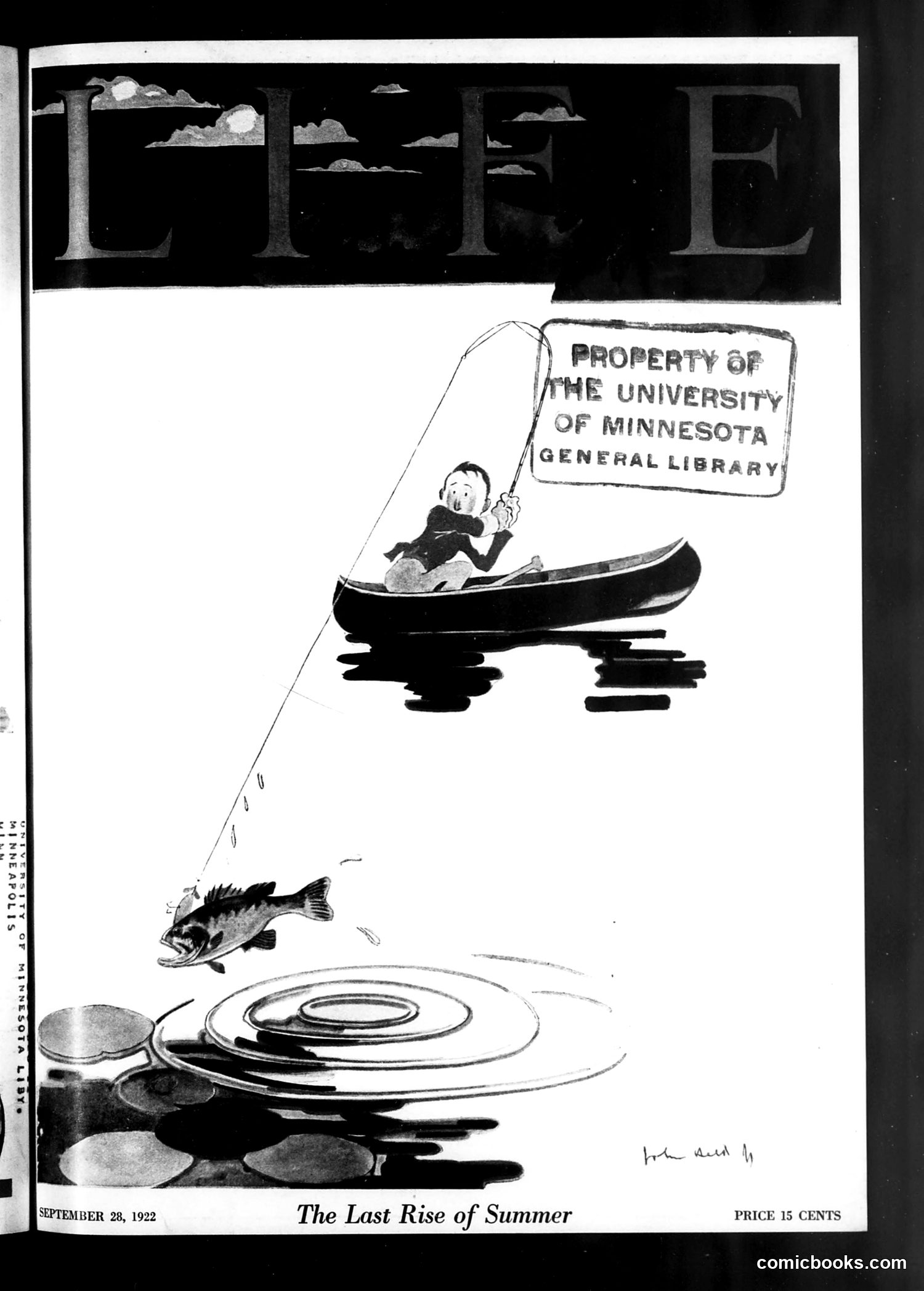
This cover illustration depicts a fishing scene with satirical intent. A figure in a small boat holds a fishing rod with a catch on the line, while plates and dishware are scattered below in the water—suggesting summer is being "caught" or ending. The title "The Last Rise of Summer" plays on fishing terminology ("rise" refers to fish surfacing). The artwork satirizes the end of the summer season as September approaches, using the metaphor of a successful catch to represent summer's departure. The cover likely reflects Americans' nostalgia for leisure and outdoor recreation—popular summer activities like fishing—as the season wanes. The price of 15 cents indicates this is from the post-WWI era when Life was primarily a humor and satire magazine.
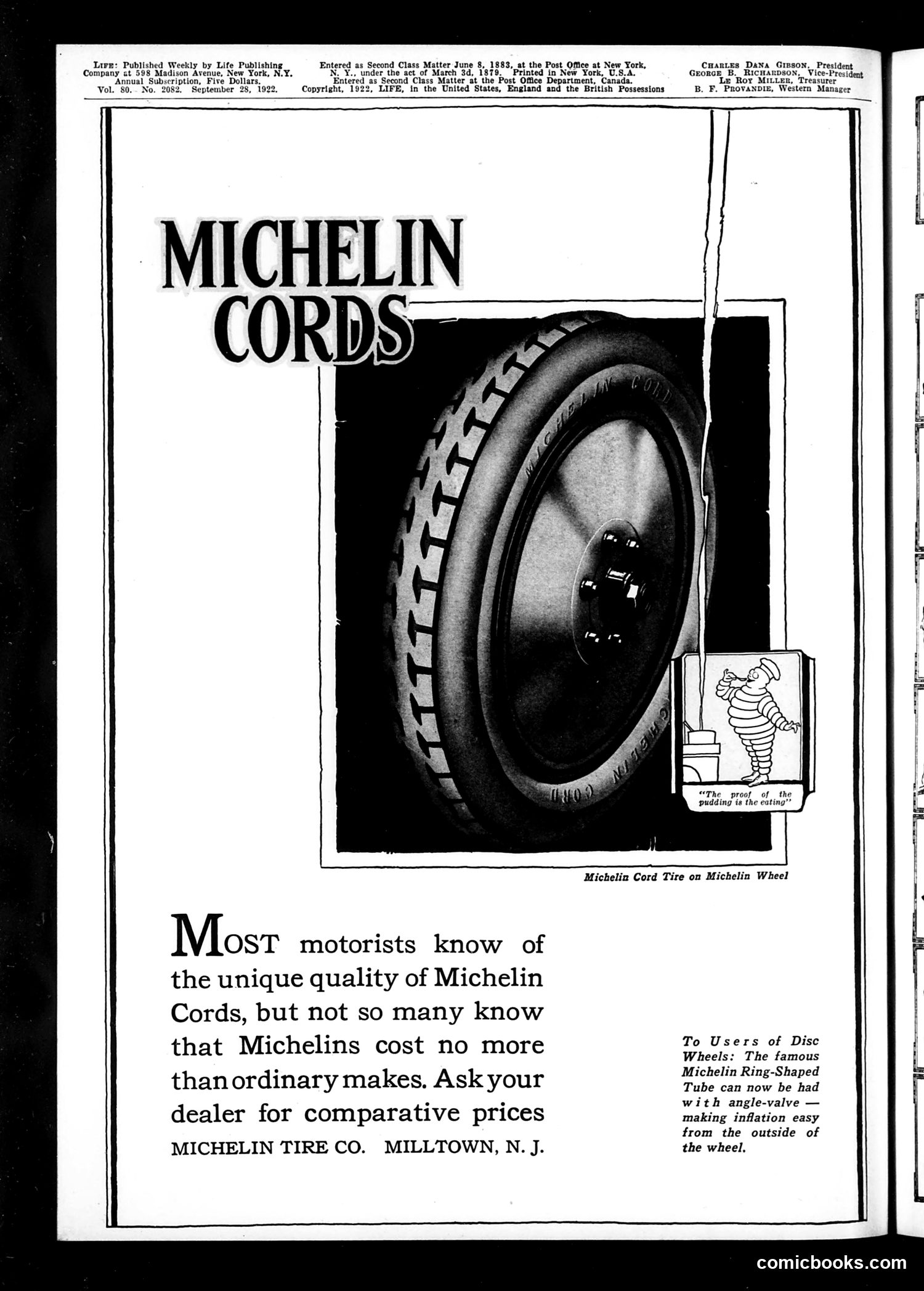
This page is **primarily a commercial advertisement**, not satirical content. It promotes Michelin Cord tires, published in Life magazine's September 28, 1922 issue. The ad features a large photograph of a Michelin tire on a wheel, with the Michelin mascot (Bibendum, the "Michelin Man") shown in a small inset cartoon labeled "The proof of the pudding is the eating." The text's main sales pitch is that **Michelin Cords cost the same as ordinary tire brands** despite their superior quality—a direct appeal to price-conscious motorists. A sidebar note mentions the new "Ring-Shaped Tube" with angle-valve for easier inflation. The manufacturer's location (Milltown, N.J.) and the call to "ask your dealer for comparative prices" emphasize affordability as the competitive advantage.
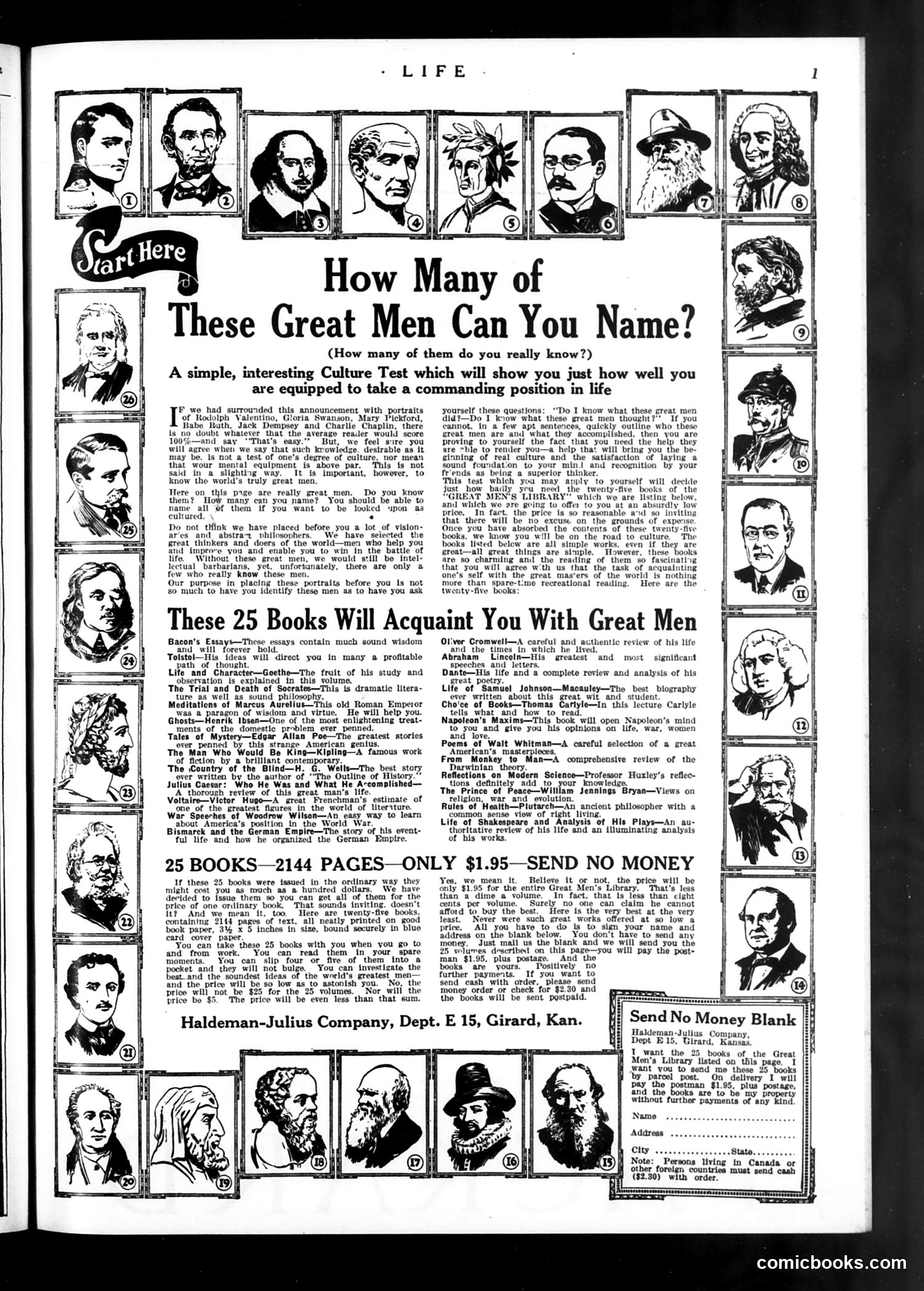
This page is primarily a **mail-order book advertisement**, not satire. It's disguised as a "culture test" challenging readers to identify 25 portraits of "great men"—a marketing gimmick to sell a 25-book collection about famous historical figures. The portraits appear to include philosophers, authors, scientists, and military leaders, though specific identities are difficult to confirm from the image alone. The advertisement emphasizes that owning these books will demonstrate cultural sophistication and prepare readers for "commanding positions in life." This reflects early 20th-century attitudes linking intellectual consumption to social status. The "test" format is manipulative—it shames readers into purchasing to prove their knowledge. The price ($1.95 for all 25 books) suggests this targeted middle-class aspirants seeking self-improvement through reading.
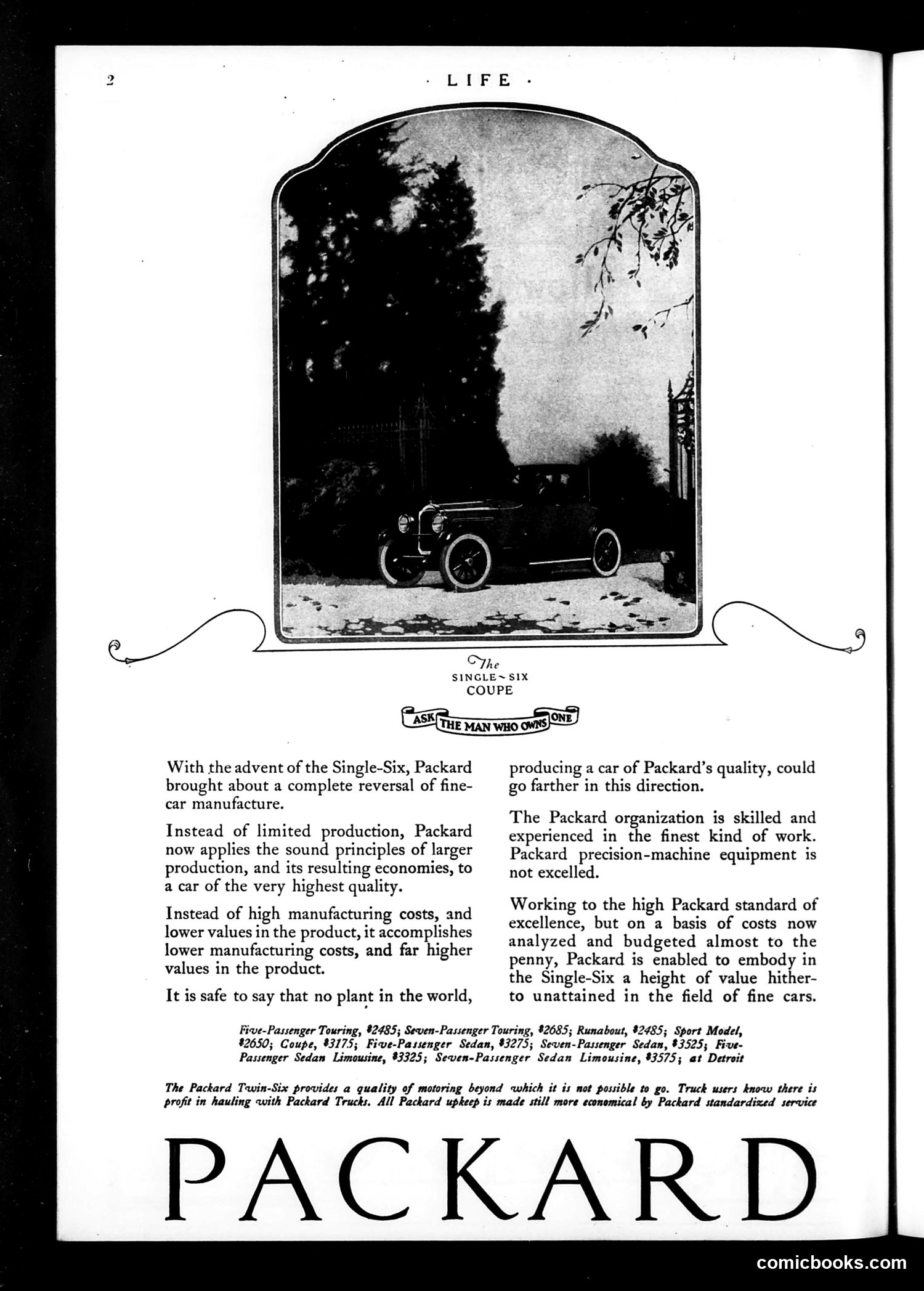
This page is primarily **advertising, not satire or political commentary**. It promotes Packard's new Single-Six Coupe automobile. The large image shows an elegant car parked on a tree-lined road at dusk or dawn, establishing an aspirational, romantic mood. The text emphasizes Packard's manufacturing innovation: they've applied mass-production economies (previously associated with lower-quality cars) to maintain Packard's reputation for excellence while reducing costs. The marketing claim is that no other manufacturer can combine high quality with competitive pricing. The tagline "The Man Who Owns One" reinforces the luxury brand positioning—ownership signifies taste and success. This reflects 1920s automotive advertising strategy: presenting cars as lifestyle symbols while highlighting technological and economic superiority.
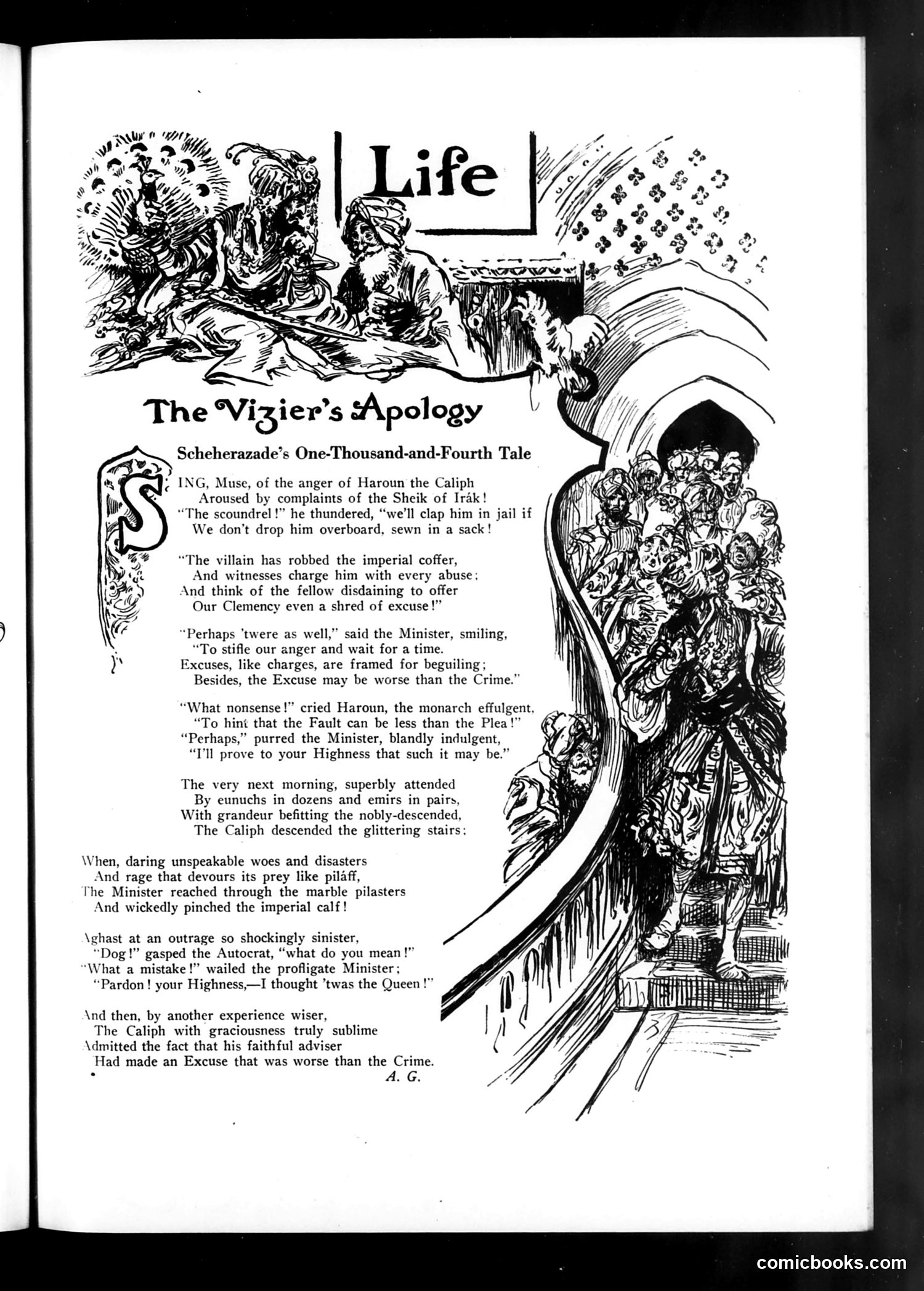
This satirical piece adapts a tale from *Scheherazade's One Thousand and One Nights* to critique Middle Eastern governance—specifically, it appears to reference the Sheik of Irak (Iraq) and Haroun the Caliph. The narrative mocks a corrupt vizier (minister) who has robbed the imperial treasury and abused his position. Rather than face justice, the vizier offers excuses to appease the angry ruler. The satirical point: the minister's excuse proves "worse than the crime" itself—a commentary on how officials deflect accountability through elaborate justification rather than accepting responsibility. The illustrations depict courtly figures in period dress, emphasizing the orientalist framing common to early 20th-century American satire about non-Western governance and corruption.
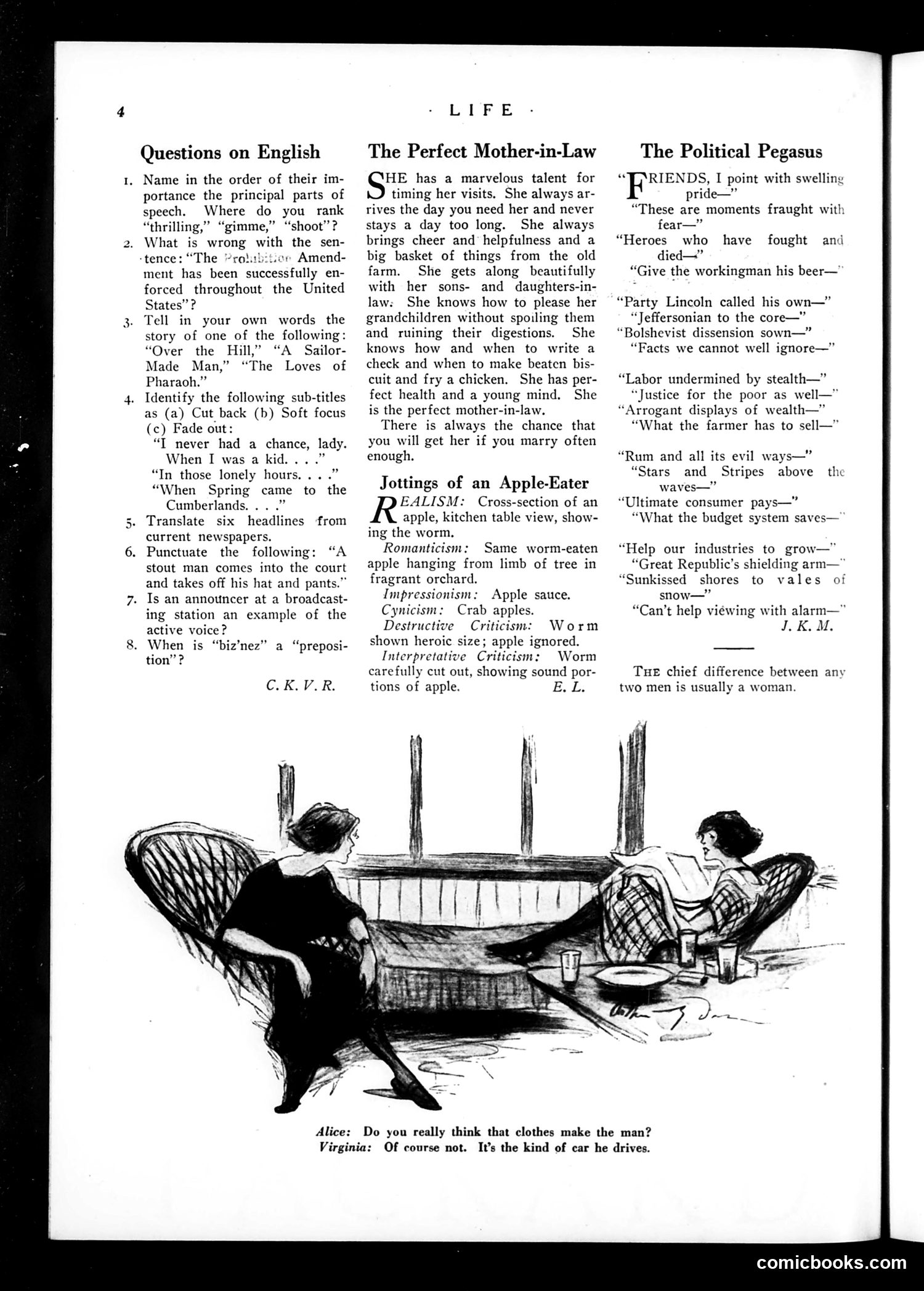
This page contains three distinct sections: English grammar questions, a piece titled "The Perfect Mother-in-Law" describing an idealized female relative, and "The Political Pegasus" featuring patriotic poetry excerpts. The main cartoon depicts two women in conversation. Alice asks Virginia, "Do you really think that clothes make the man?" Virginia replies, "Of course not. It's the kind of car he drives." **The satire targets:** Early 20th-century materialism and the emerging consumer culture, specifically how automobiles had become status symbols. The joke satirizes women's supposed superficiality—the cartoon suggests Virginia judges men not by character but by their vehicle, reflecting contemporary anxieties about wealth, modernization, and gender roles during the automobile boom era.
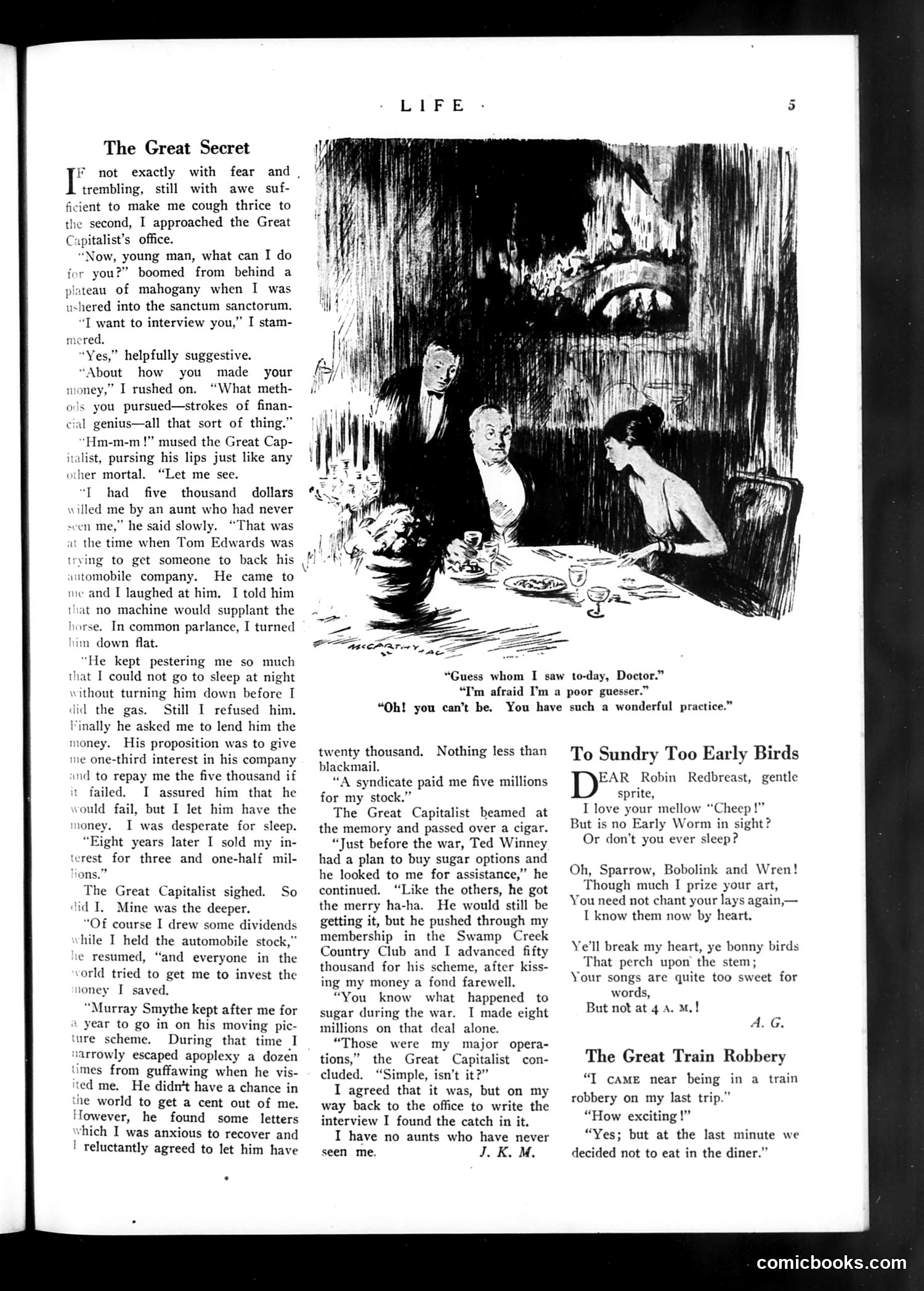
This Life magazine page contains three separate humorous pieces, including one cartoon illustration showing three men in formal dress at a dining table with a woman. The main illustrated story, "The Great Secret," satirizes wealthy businessmen's financial schemes. The narrator describes how a capitalist approached him seeking investment advice, mentioning "five thousand dollars" and later "five millions" for various ventures—including sugar options speculation during wartime and membership in exclusive country clubs. The humor lies in exposing how the wealthy used personal connections and insider knowledge to multiply fortunes while presenting themselves as self-made financial geniuses. The cartoon caption plays on this theme: a doctor is complimented on his "wonderful practice," though he's actually obtained wealth through other means. The page also includes two brief poems unrelated to the cartoon.
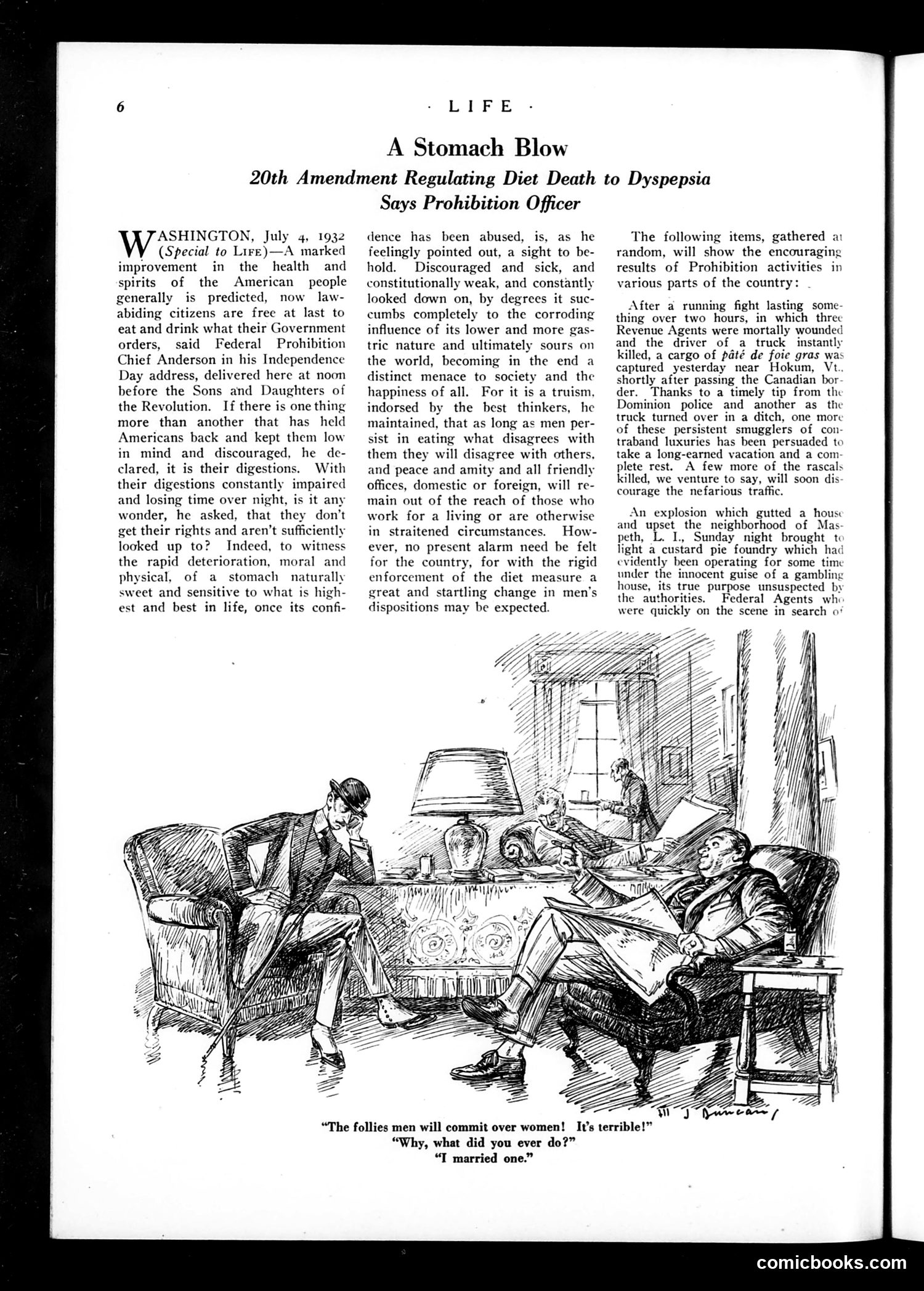
This 1932 *Life* magazine page satirizes Prohibition's effects on American health and morality. The headline mocks a Federal Prohibition Officer's claim that diet regulation could cure dyspepsia (indigestion). The cartoon depicts a man complaining to his doctor about marital troubles, saying "The follies men will commit over women! It's terrible!" The doctor's response—"Why, what did you ever do?" "I married one"—is a misogynistic joke typical of the era. The satire's broader point appears to be that Prohibition hasn't improved American life as promised. Instead of addressing real social problems (like failed marriages), officials blame dietary issues. The cartoon suggests Prohibition has created worse problems than it solved, leaving citizens physically and morally compromised rather than improved.
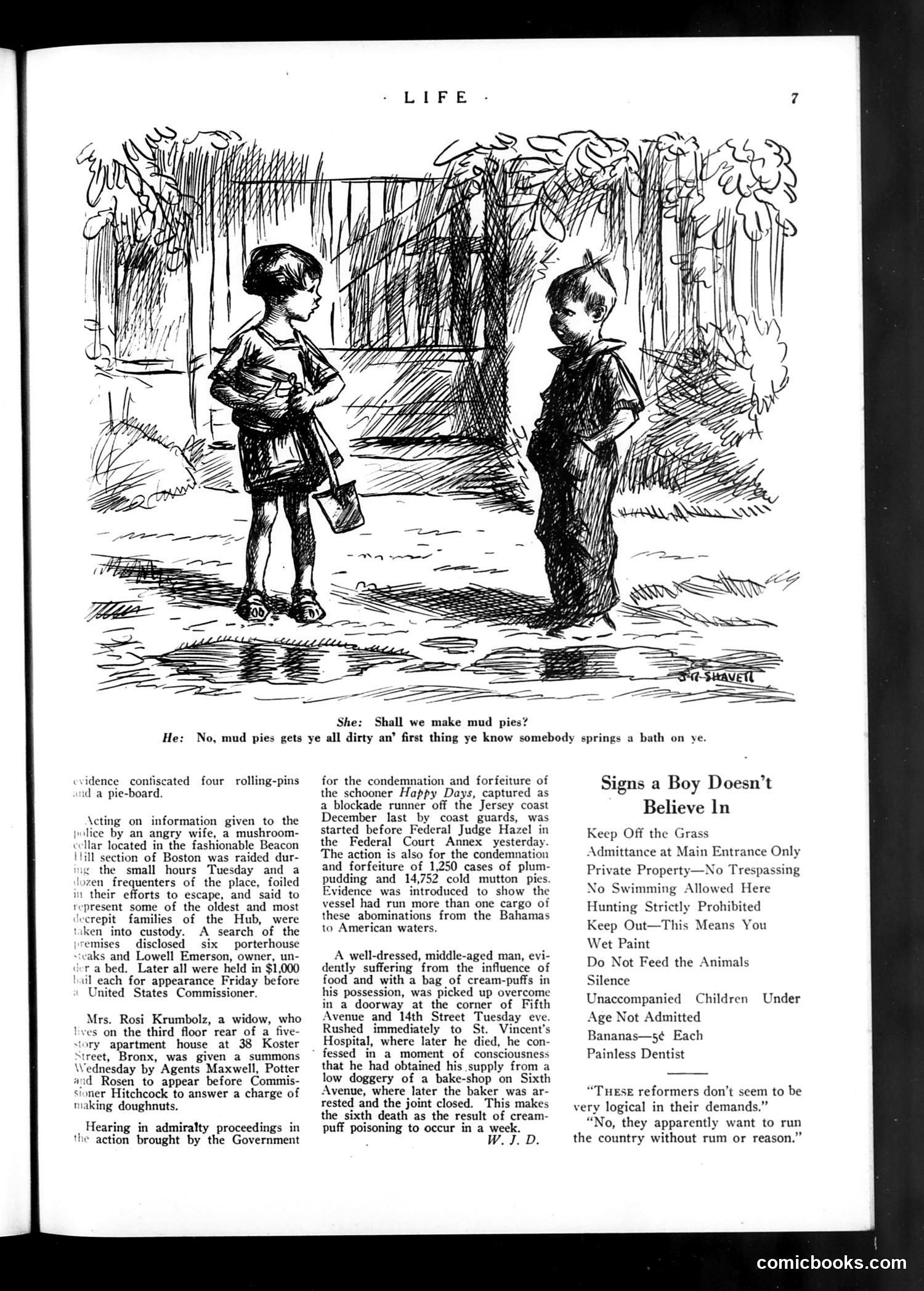
The main cartoon depicts two children debating whether to make mud pies. The girl asks; the boy refuses, warning that mud pies will get them "dirty" and "first thing ye know somebody springs a bath on ye." The joke targets early 20th-century sanitation reform movements. Progressive reformers promoted bathing and hygiene as moral imperatives. The boy's fear of bathing reflects children's genuine resistance to the era's frequent enforced washing—which involved heating water and was genuinely uncomfortable. The satire mocks both the reformers' zeal and parental enforcement of cleanliness standards. The humor lies in the child's logic: avoiding mess to escape the consequences (a bath), suggesting reformers' hygiene campaigns created unintended resistance among their targets. The page's right column lists various prohibition signs, likely satirizing overcautious property management or municipal restrictions of the period.
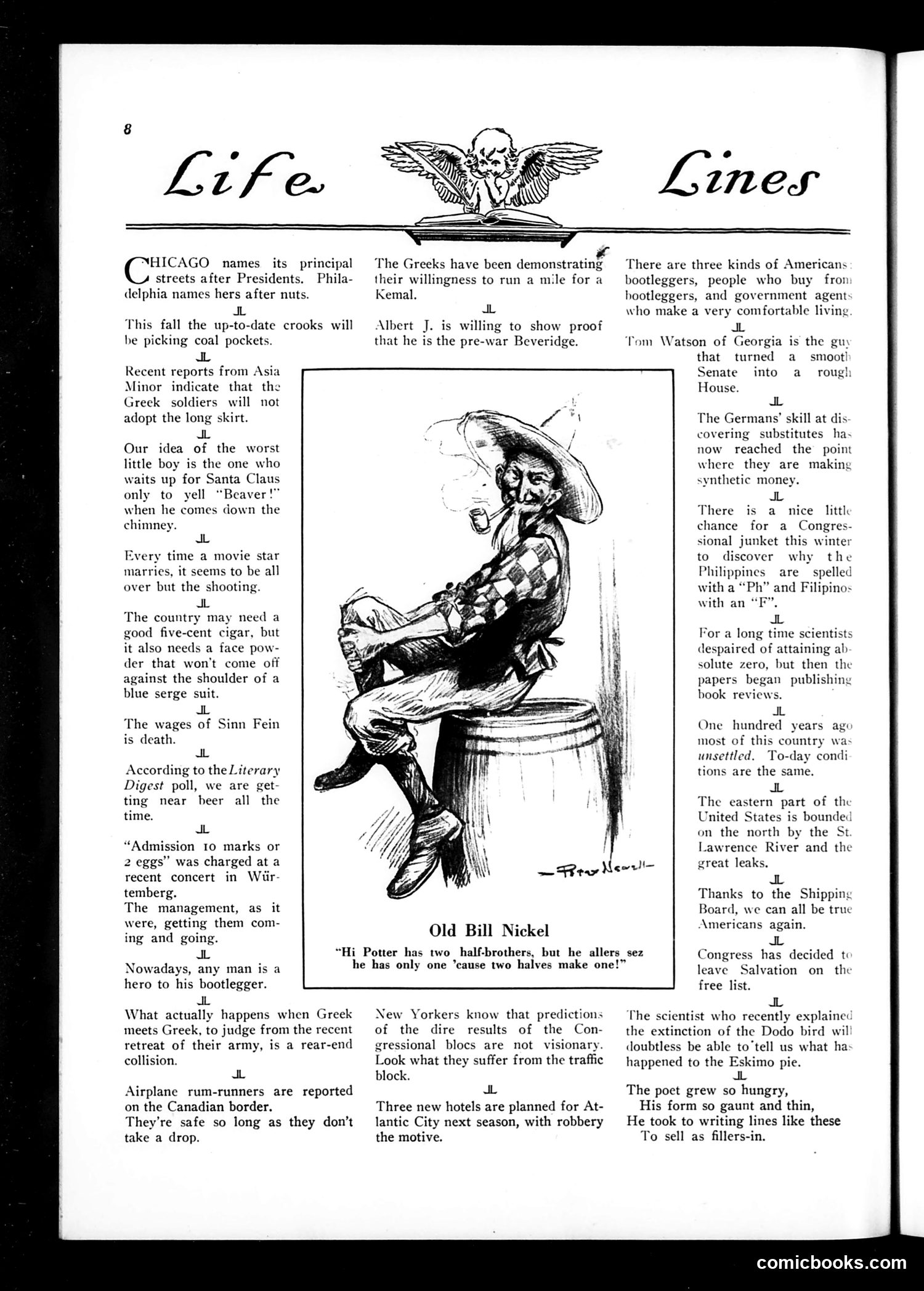
The central illustration depicts a caricatured figure labeled "Old Bill Nickel" sitting atop a barrel, appearing to be a vagrant or hobo. The caption reads: "Hi Potter has two half-brothers, but he alters sez he has only one 'cause two halves make one!" This appears to be a play on words satirizing someone named Potter (possibly a public figure of the era), making a joke about mathematics and family relations. The hobo character "Old Bill Nickel" may represent common people or underclass commentary. The surrounding "Life Lines" are brief satirical quips on various American topics: Greek soldiers, coal thieves, movie stars, beer consumption, and admission prices. Without precise historical context, the specific targets remain unclear, though the tone suggests general social criticism typical of *Life* magazine's satirical mission.
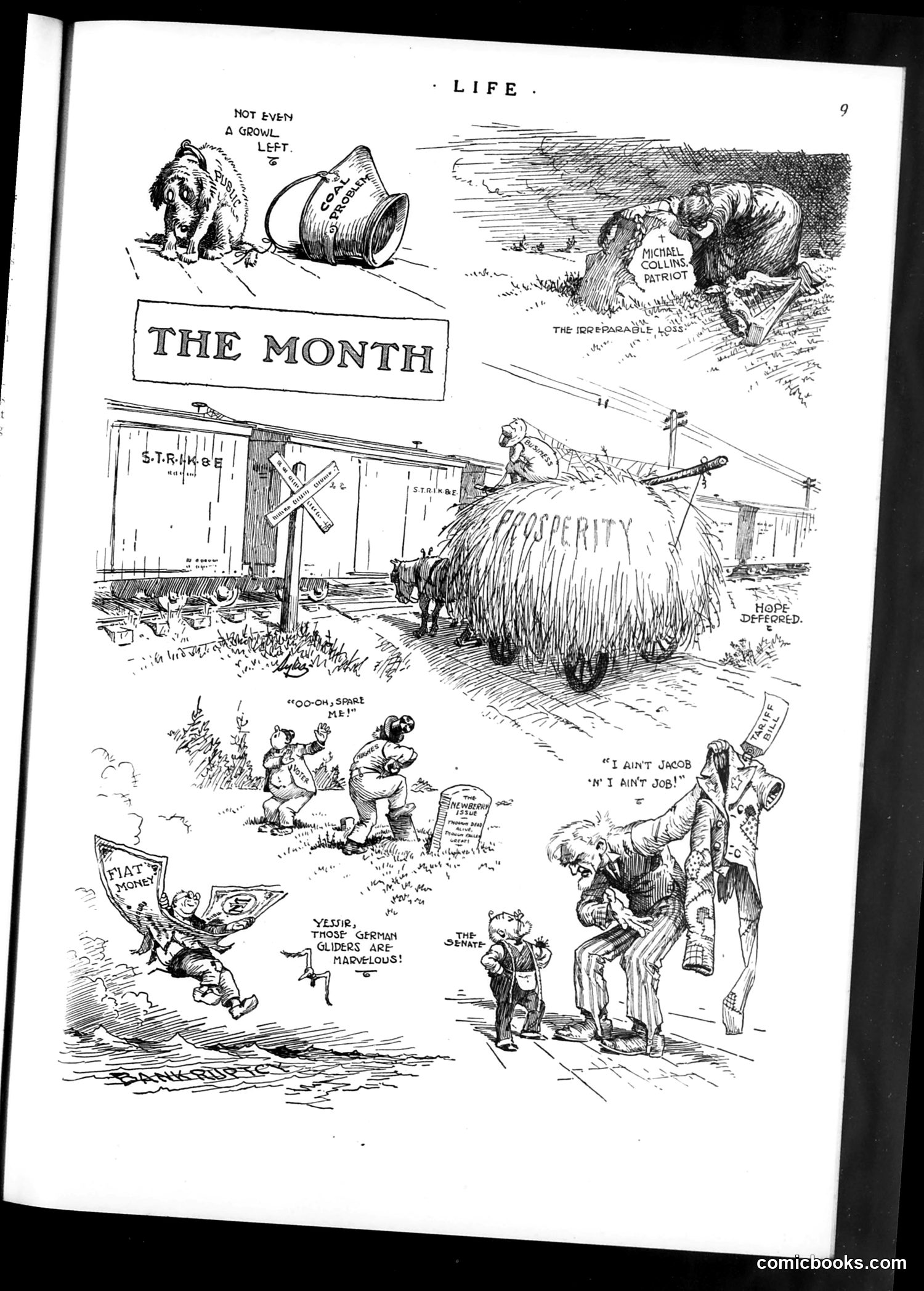
This page presents multiple political cartoons commenting on contemporary events. The central image shows a massive haystack labeled "PROSPERITY" being hauled by oxen, with "HOPE DEFERRED" noted—satirizing unfulfilled promises of economic prosperity, likely during an economic downturn. Upper panels mock a growling dog and overturned bucket labeled "CODFISH," suggesting "not even a growl left." Lower sections include references to "German gliders" being "marvelous," commentary on Senate actions, and a figure declaring "I AIN'T JACOB 'N' I AIN'T JOB!"—biblical allusions to suffering and patience. The cartoons collectively critique political failures, broken economic promises, and the gap between official optimism and citizens' actual hardship during what appears to be a Depression-era publication.
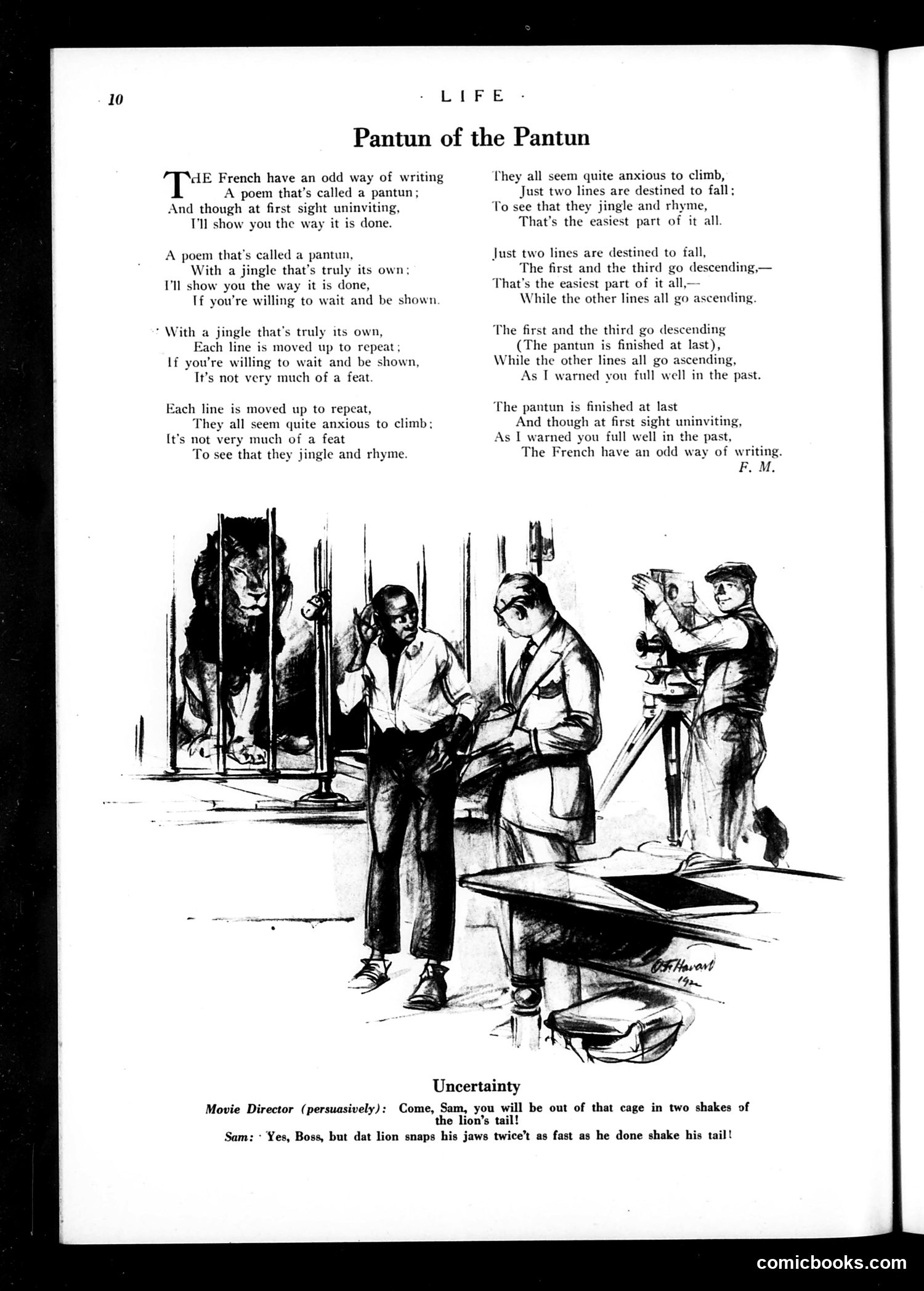
This cartoon satirizes early Hollywood filmmaking. A movie director (center-left) attempts to film a lion in a cage with actors, promising one actor ("Sam") he'll escape safely. Sam expresses doubt, noting the lion snaps its jaws faster than it shakes its tail—making the timing unreliable. The humor targets the improvised, dangerous nature of early cinema, where safety precautions were minimal and directors made bold assurances about stunts. The "uncertainty" of the title reflects both the unpredictable animal and the dubious promise of survival. The page also includes "Pantun of the Pantun," a poem explaining the French poetic form, demonstrating the magazine's literary content alongside humor.
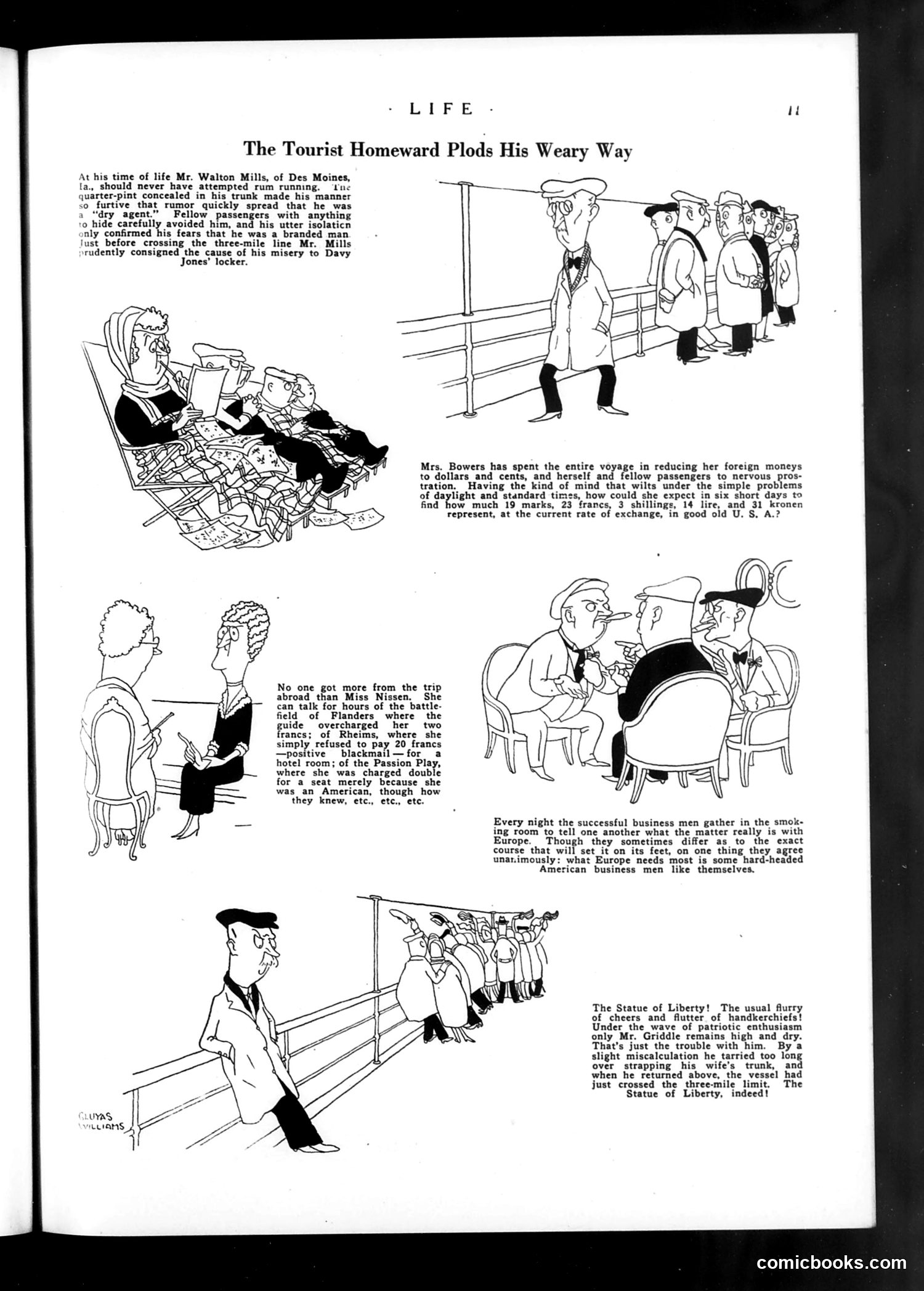
This satirical piece mocks American tourists returning from European travel. The main character, Mr. Walton Mills of Des Moles (likely Des Moines), is depicted as exhausted and financially drained—illustrated sitting surrounded by foreign currency and exchange rate confusion. The cartoon ridicules several stereotypes: Mrs. Bowers obsessing over currency conversions; Mrs. Nissen endlessly recounting European anecdotes; and American businessmen gathering nightly to complain that Europe lacks proper American-style business practices. The final panel shows a man struggling with souvenirs, having crossed some "three-mile limit," implying he's overloaded with purchases. The satire targets American tourists' contradictory behavior: complaining about European customs while over-consuming European goods and experiences, then returning home boastful and broke.
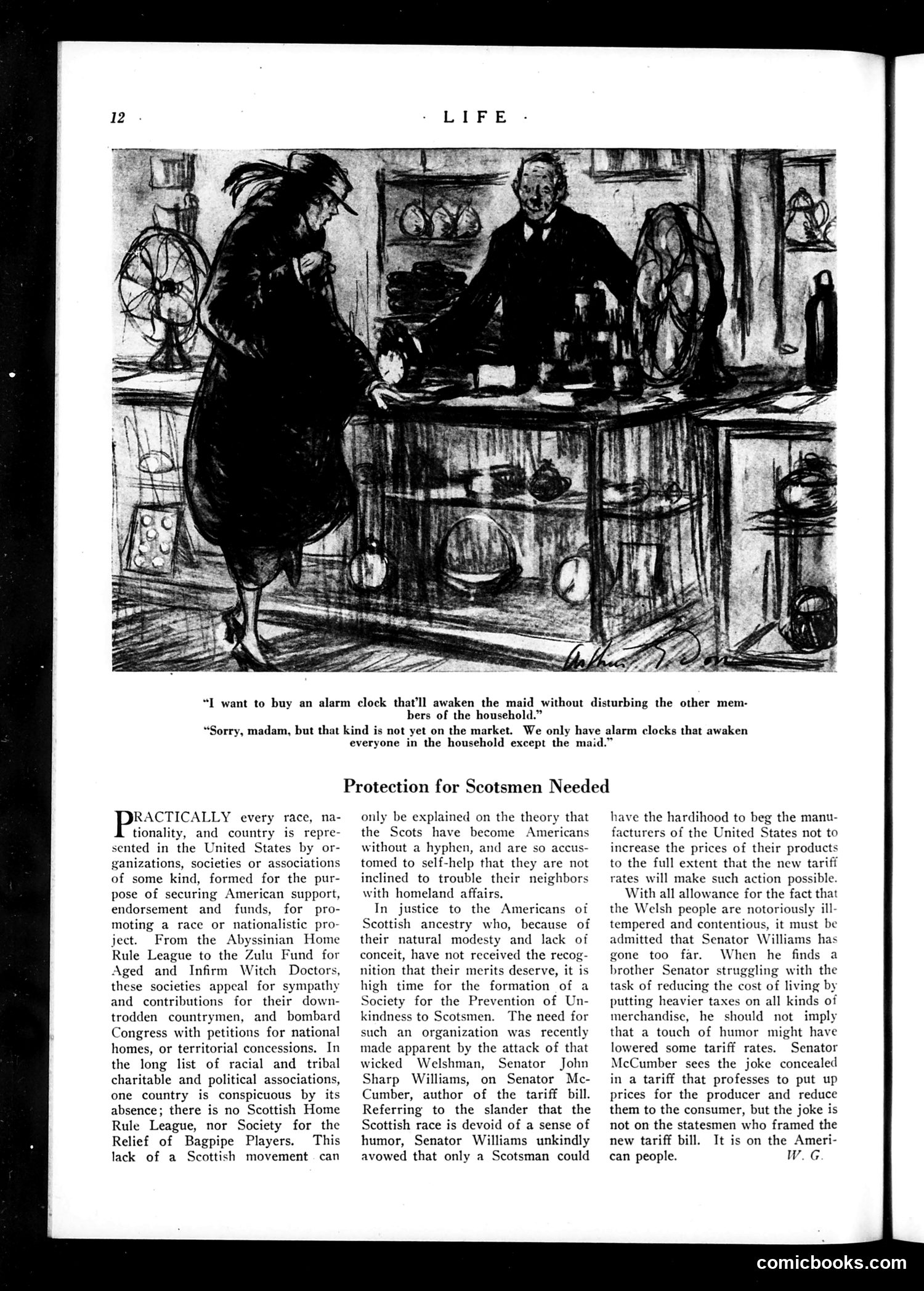
**The Cartoon (top):** A woman customer asks a shopkeeper for an alarm clock that will wake only the maid without disturbing other household members. The shopkeeper replies that no such product exists—all alarm clocks wake everyone. The joke satirizes an absurd, self-centered consumer demand: the woman wants technology to solve a problem that requires reasonable behavior instead. **The Article (bottom):** "Protection for Scotsmen Needed" discusses Scottish-American organizations seeking tariff protection and federal support. The author mocks their complaints, noting Senator Williams made a joke that "only a Scotsman could" understand the new tariff bill's complexity. The satire targets Scottish-Americans' perceived lack of humor and their perceived oversensitivity to slights, while critiquing their lobbying efforts for special economic treatment.
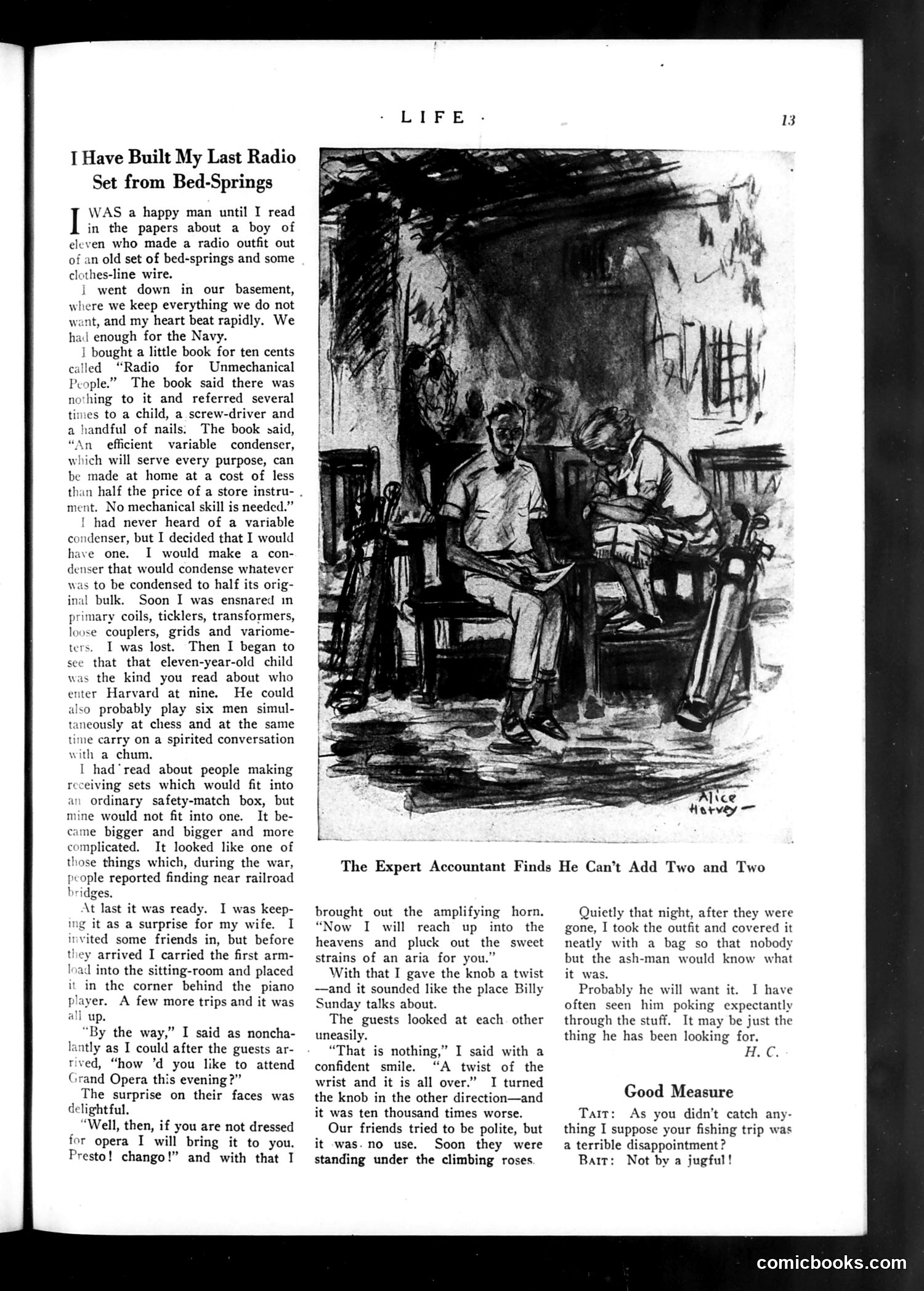
This page contains three distinct pieces of humorous content: 1. **"I Have Built My Last Radio Set from Bed-Springs"** — A first-person narrative about an amateur radio enthusiast whose homemade receiver (made from scrap materials) grows uncontrollably complex, ultimately becoming an embarrassing surprise when guests arrive. 2. **The illustration** by Alice Harvey shows a man with his elaborate radio contraption, depicting the absurdity of DIY electronics during an era when radio was still novel technology. 3. **"The Expert Accountant Finds He Can't Add Two and Two"** and **"Good Measure"** — Brief humorous anecdotes at page bottom, poking fun at professional incompetence and mismanaged expectations. The satire targets the amateur radio craze and domestic pretensions of the era, mocking both technological enthusiasm and social embarrassment.
This page discusses Rudyard Kipling's controversial statements about American intervention in WWI. The article critiques Kipling for claiming the U.S. was reluctant to enter the war and needed British/French persuasion—a narrative the author says is factually incorrect. The text references a London *Times* interview where Kipling allegedly made these claims. The author argues Kipling was wrong: America entered willingly, and the U.S. actually pushed for the war's end sooner than Britain wanted. The illustration at top (though small) appears to show figures related to this diplomatic/political controversy, though specific identities are unclear from the image quality. The piece defends American independence and decision-making during WWI against what it presents as Kipling's revisionist account.
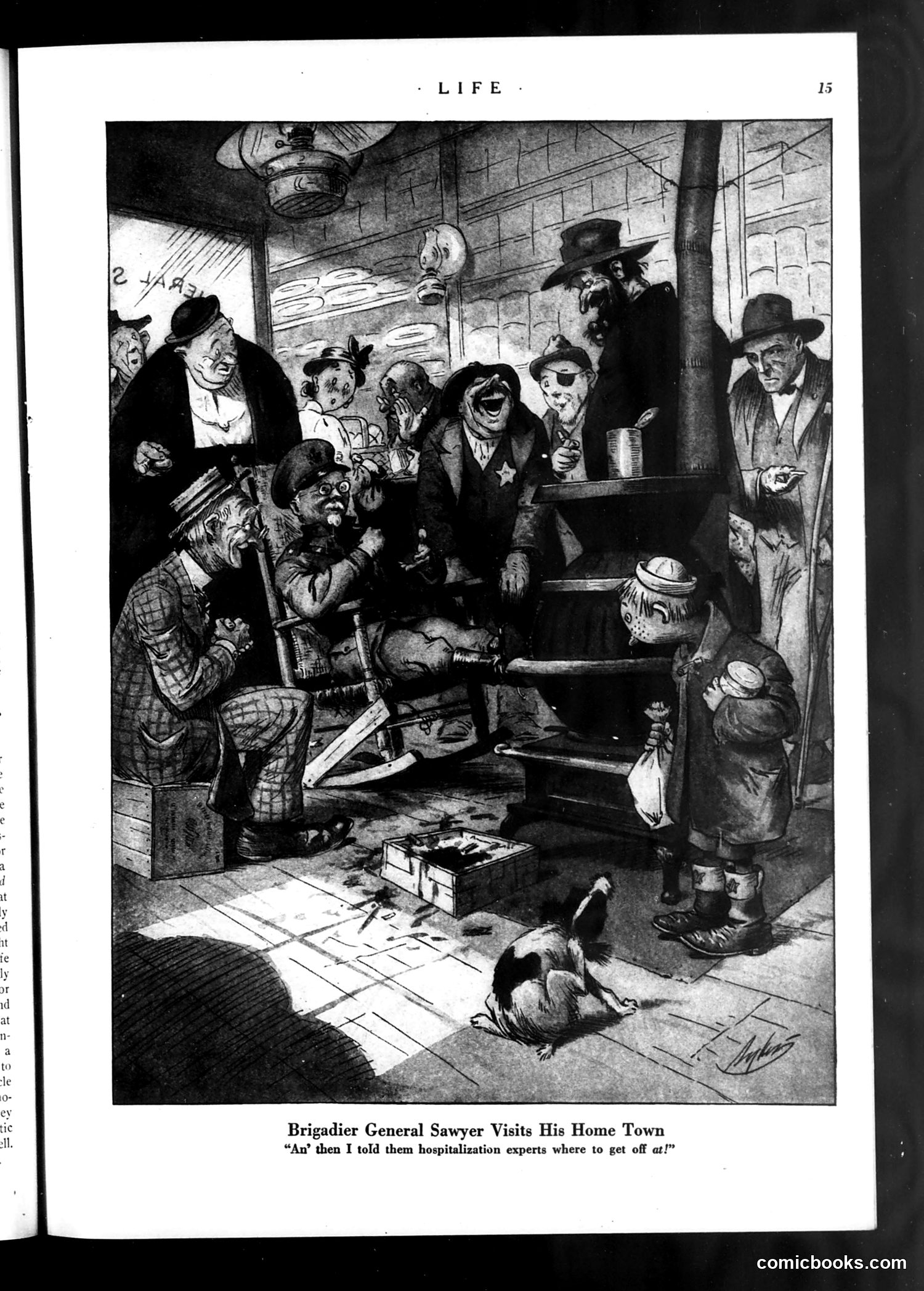
This appears to be a satirical cartoon from *Life* magazine depicting a military officer (Brigadier General Sawyer) returning to his hometown. The scene shows him in what looks like a public gathering or tavern, surrounded by working-class townspeople and small children, addressing an audience. The humor centers on his boastful claim: "An' then I told them hospitalization experts where to get off at!" — suggesting he's bragging about confronting medical or military bureaucrats. The satire likely mocks either inflated military pretension, small-town braggadocio, or perhaps tensions between military authority and civilian medical administration. The caricatured expressions and crowded, humble setting emphasize the disconnect between his apparent self-importance and his ordinary hometown context. The specific historical reference remains unclear without additional context about when this was published.
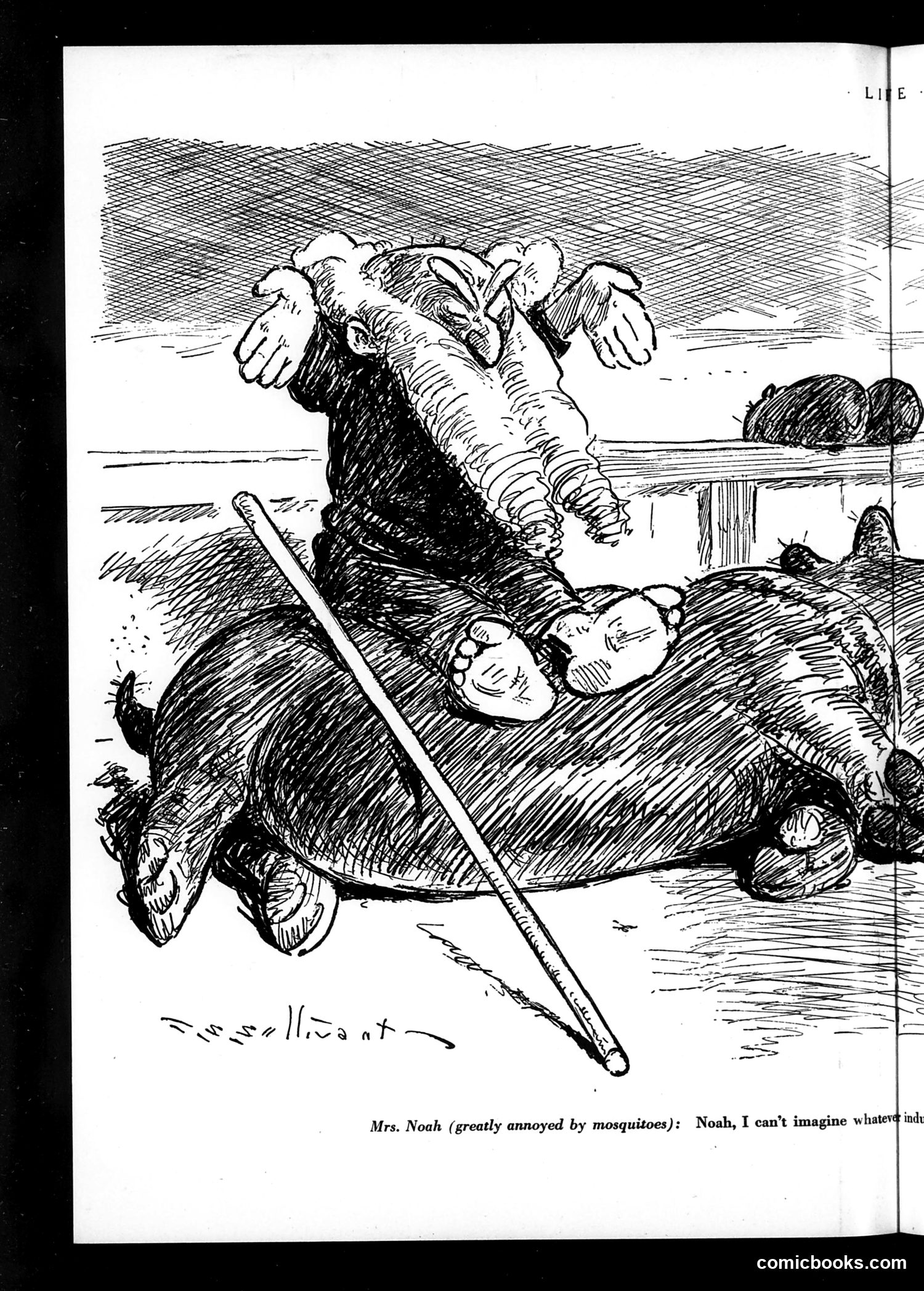
This is a satirical cartoon from *Life* magazine depicting Mrs. Noah (wife of the biblical Noah) swatting at mosquitoes aboard the Ark. The caption reads: "Mrs. Noah (greatly annoyed by mosquitoes): Noah, I can't imagine whatever induced you to bring those things aboard!" The satire operates on multiple levels: it humorously questions Noah's judgment in preserving every creature during the Flood, particularly the insects. The cartoon suggests that even in fulfilling divine duty, some creatures seem more trouble than they're worth. The domestic scene—a nagging wife confronting her husband—adds comedic tension to the biblical narrative, treating the Ark's passenger list as if it were a practical household decision rather than a religious mandate. The joke reflects common frustrations with mosquitoes while poking gentle fun at biblical literalism.
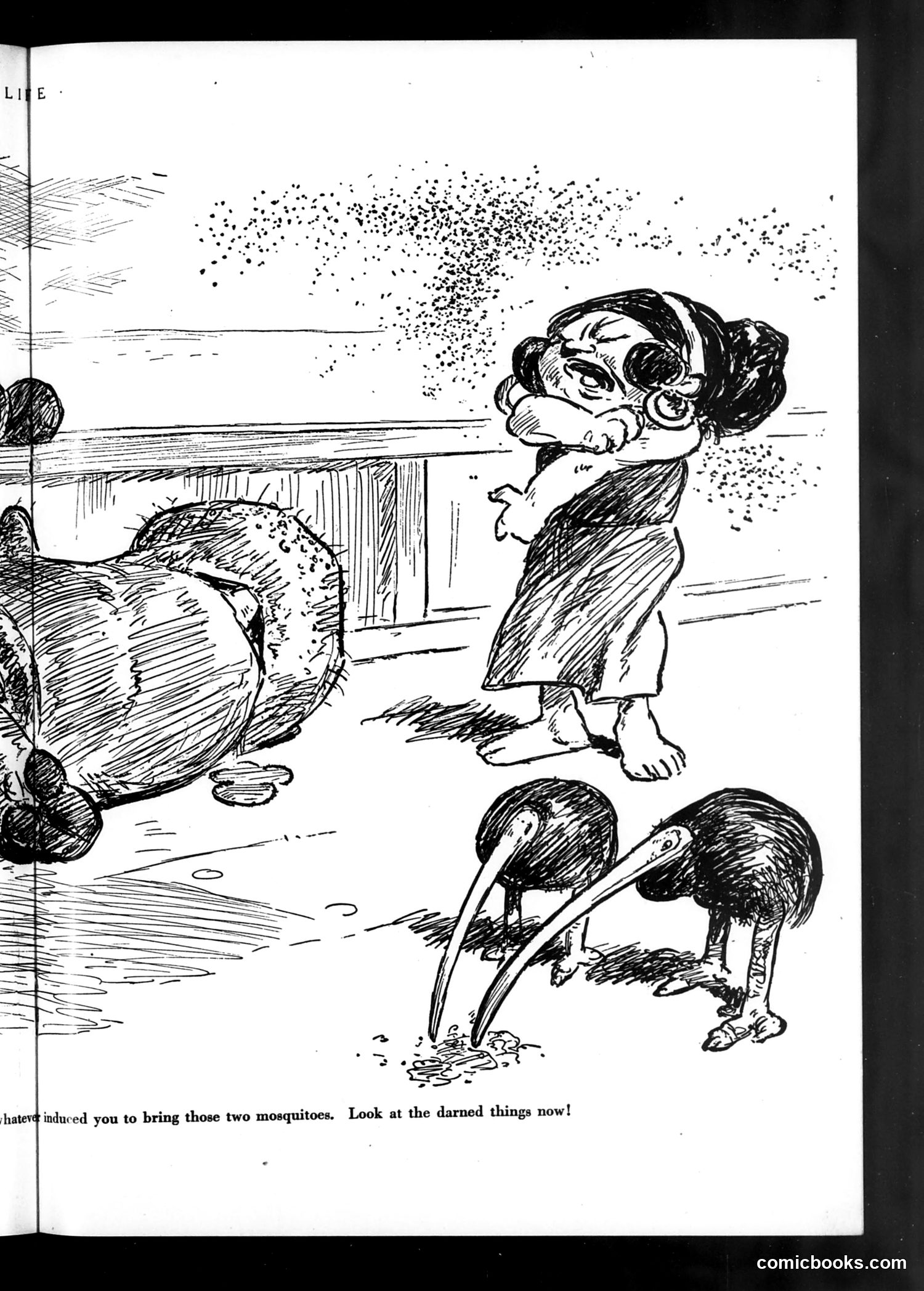
This appears to be a satirical cartoon from Life magazine showing a confrontation between a person and two birds (likely kiwis, based on their distinctive long beaks and round bodies). The figure seems distressed, gesturing upward at what looks like dispersing insects or particles in the air above. The caption suggests someone brought "two mosquitoes" to this setting, and they've now multiplied or caused problems—"Look at the darned things now!" The specific political or social reference is unclear from the image alone. This could satirize rapid proliferation of pests, consequences of poor judgment, or possibly commentary on introducing problems to a situation. Without additional context about Life magazine's publication date or surrounding content, the exact target of satire remains uncertain.
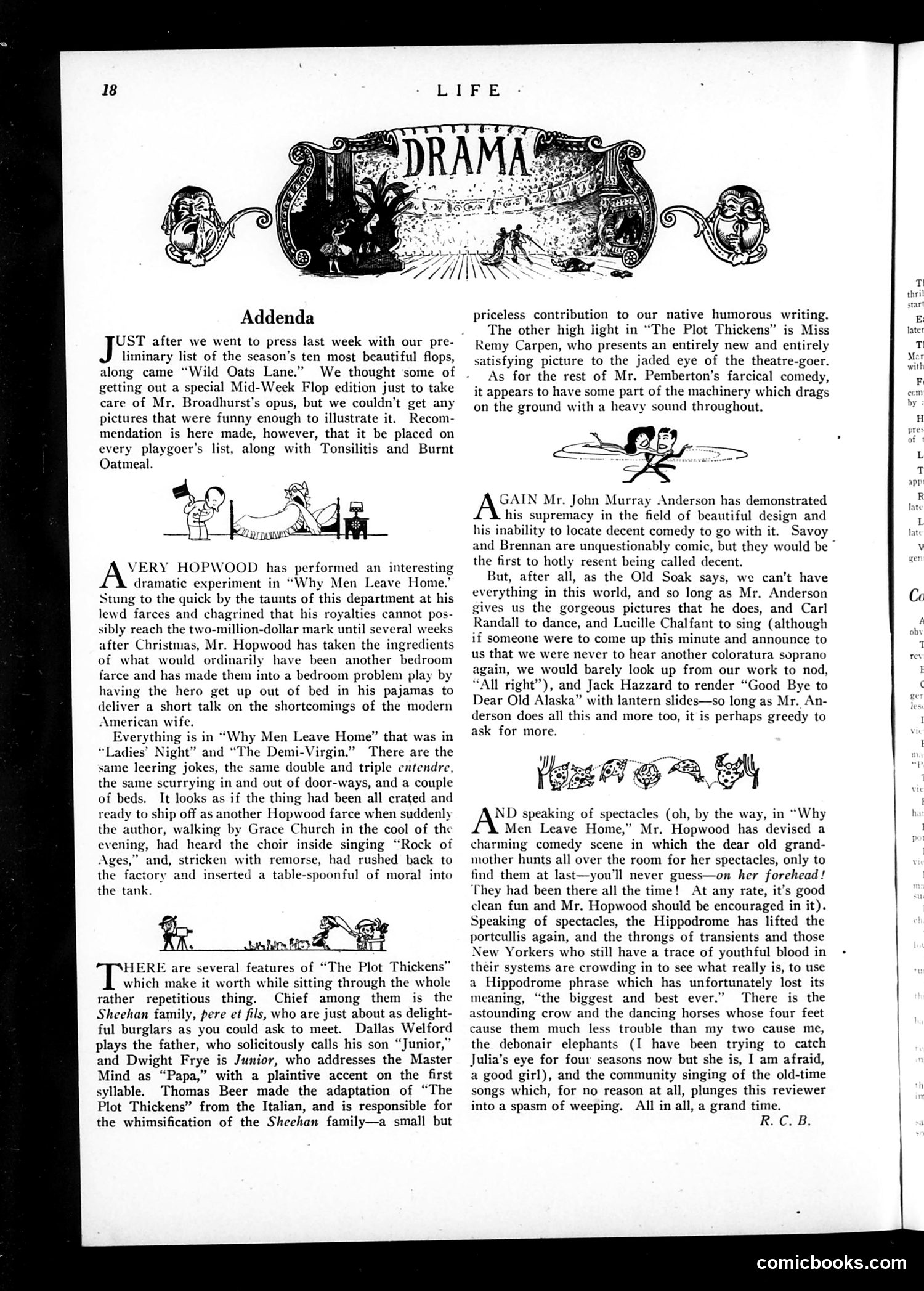
This is a theater review section critiquing several Broadway productions. The author savagely mocks playwright Avery Hopwood's *"Why Men Leave Home,"* suggesting he cynically added moral messaging (a "table-spoonful of moral") to an otherwise conventional bedroom farce—comparing it to his earlier similar comedies with identical plot mechanics and "leering jokes." The review also praises *"The Plot Thickens"* for its charming Sheehan family characters (played by Dallas Welford and Dwight Frye) while dismissing the rest as dragging. Director John Murray Anderson receives backhanded praise: his visual design is "gorgeous," but the comedy is weak. The reviewer sarcastically notes that performers like dancer Carl Randall and soprano Lucille Chalfant compensate, though admits losing a coloratura soprano wouldn't particularly upset him. The opening "Addenda" section jokes that *"Wild Oats Lane"* was so unfunny it deserved listing alongside illnesses ("Tonsilitis") as a seasonal affliction.
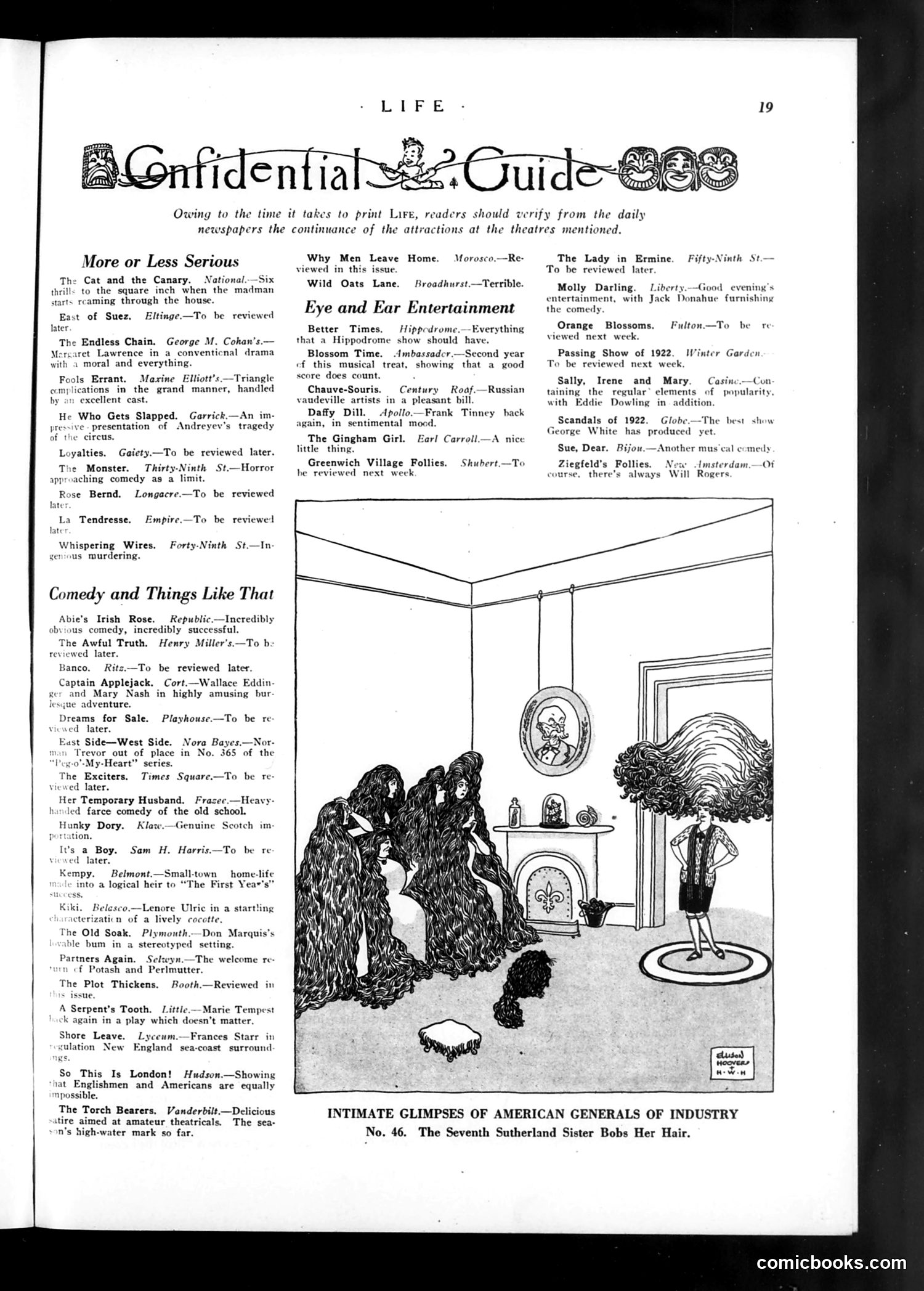
This is a theater guide from *Life* magazine listing Broadway shows with brief reviews. The main illustration depicts "The Seventh Sutherland Sister" bobbing her hair—a significant social moment captured in satire. The Sutherland Sisters were a famous Victorian-era performing group known for their extraordinarily long hair, which they promoted as a beauty ideal through their own hair tonic business. By the 1920s, the "bob" (short haircut) represented modern women rejecting Victorian conventions—a major cultural flashpoint of the era. The cartoon shows an older woman (representing the traditional Sutherland Sister aesthetic) observing a younger woman with bobbed hair in a modern interior, suggesting generational conflict over femininity and modernity. The caption labels this "Intimate Glimpses of American Generals of Industry"—likely ironic, treating hair fashion as seriously as industrial leadership. The satire mocks both outdated beauty standards and the dramatic shock value of the bob to conservative society.
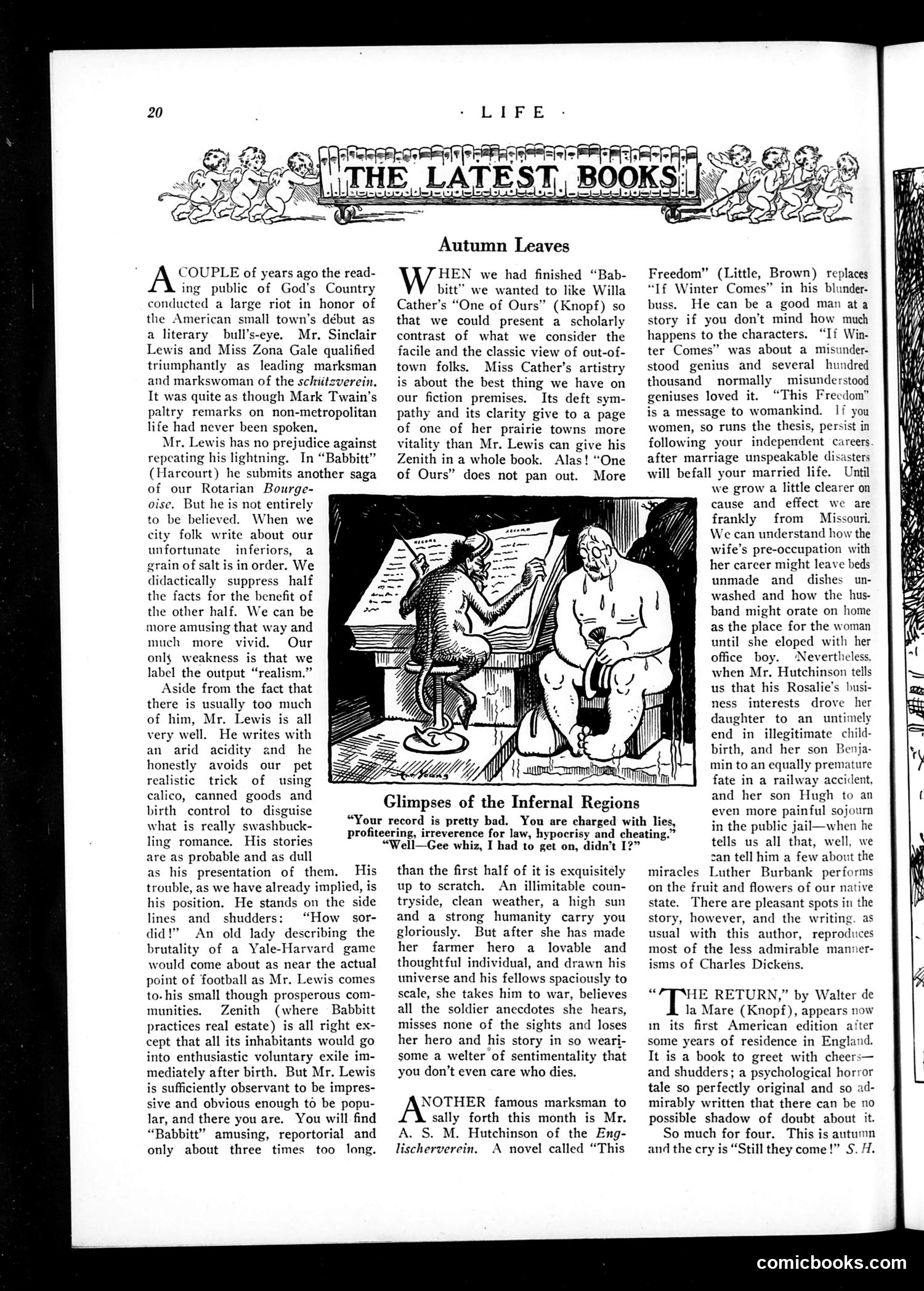
This is a literary review section of *Life* magazine discussing three recent novels. The central cartoon labeled "Glimpses of the Infernal Regions" depicts a courtroom scene where a defendant is accused of lies, irreverence, and hypocrisy—he responds defensively that "I had to get on, didn't I?" The satire likely comments on human moral compromise. The reviews critique Sinclair Lewis's *Babbitt* (about small-town businessmen) for being obvious satire that exaggerates reality, Willa Cather's *One of Ours* for losing artistic quality when its narrative shifts to World War I, and A.S.M. Hutchinson's *This Freedom* for being didactic social messaging to women about independence. The author employs caustic wit throughout, dismissing these works as "probable and dull" while acknowledging their popularity. The tone is typical of *Life's* urbane, acerbic cultural commentary.
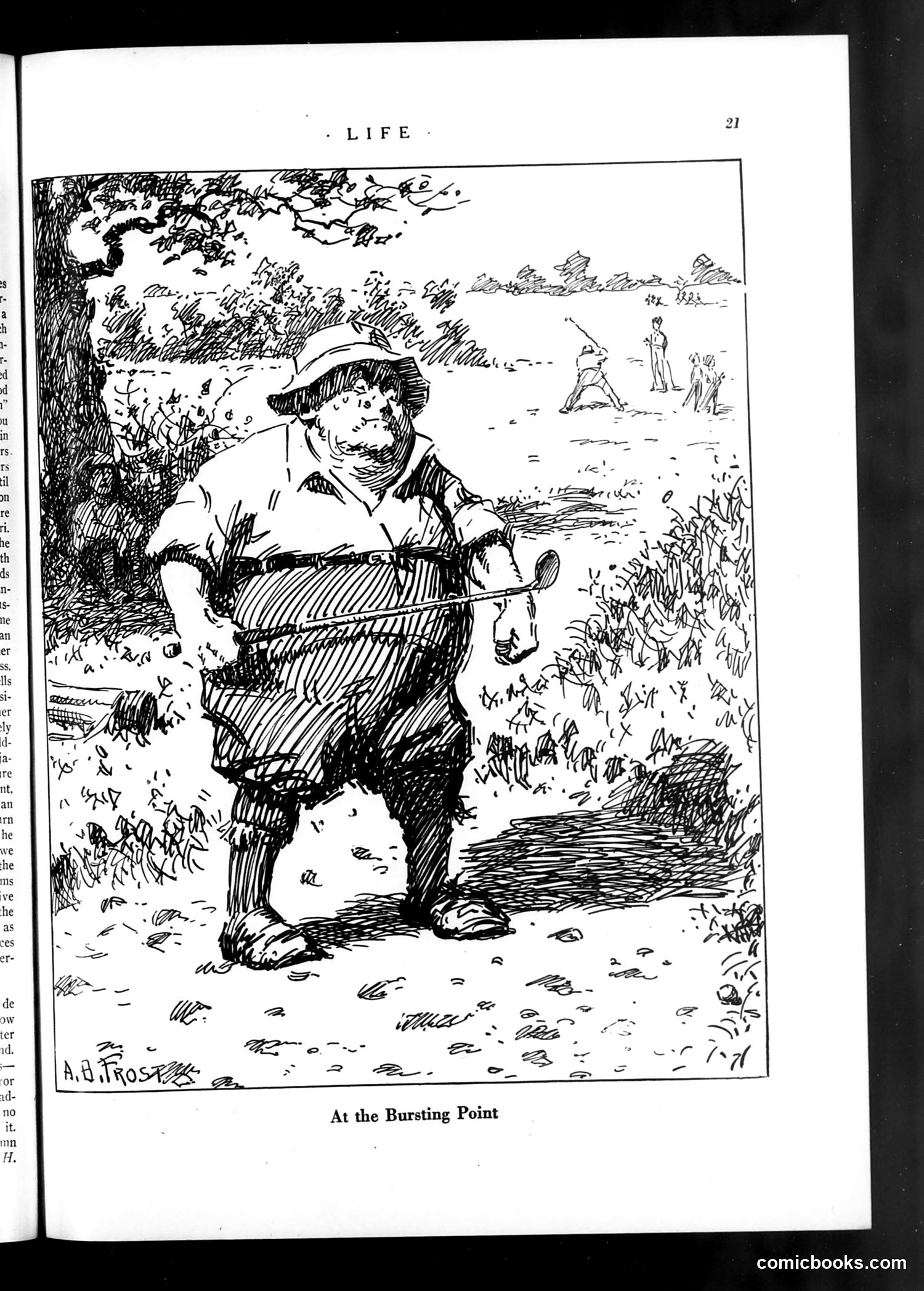
This cartoon depicts a rotund man in a straw hat and striped pants, straining visibly as he appears ready to explode from overindulgence or excess. He's clutching his midsection in distress while standing in a pastoral setting with other figures visible in the background. The title "At the Bursting Point" suggests satirical commentary on overconsumption or excess—likely economic, physical, or political. The exaggerated physique and visual strain convey the cartoon's message that someone or something has gone too far and is about to reach a breaking point. Without additional context or byline legibility, the specific target of the satire remains unclear, though the image clearly mocks excess and its inevitable consequences.
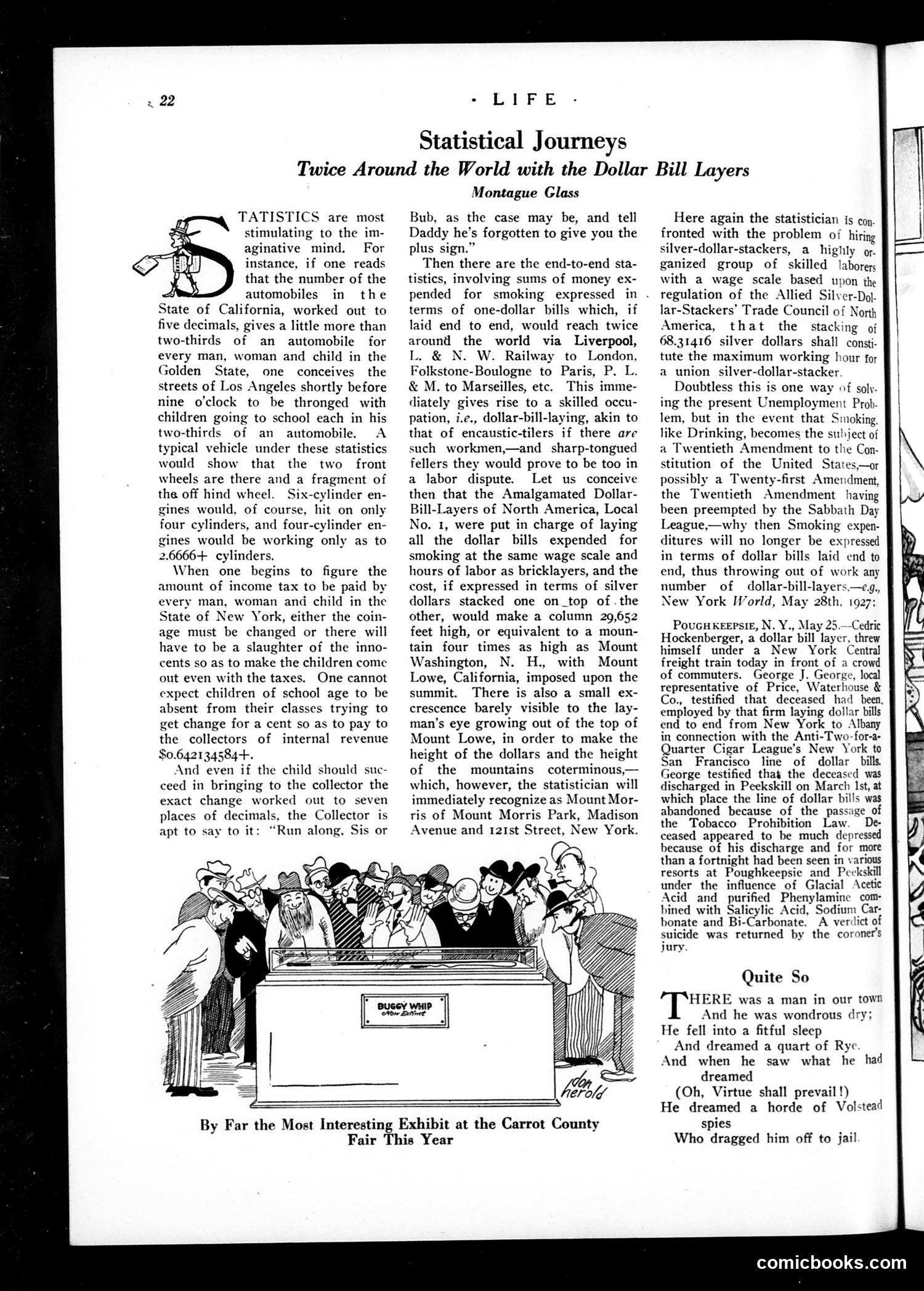
This satirical article by Montague Glass mocks the absurdity of statistics by imagining ridiculous professions created to visualize data. The central joke: if all dollar bills spent on smoking were laid end-to-end, they'd reach twice around the world—so Glass imagines hiring a union of "dollar-bill-layers" (like bricklayers) to actually stack silver dollars, creating a column 29,652 feet high, equivalent to Mount Washington with Mount Lowe piled on top, plus a tiny "Mount Morris Park" for precision. The cartoon below shows people examining this absurd exhibit at a county fair, titled "By Far the Most Interesting Exhibit." The satire targets two things: the meaninglessness of statistical comparisons (trying to visualize large numbers through ridiculous physical analogies), and labor unions' rigid work rules and wage scales. Glass suggests that creating actual jobs from statistical visualizations would solve unemployment—a tongue-in-cheek criticism of both statistical pretension and union rigidity during the early twentieth century.
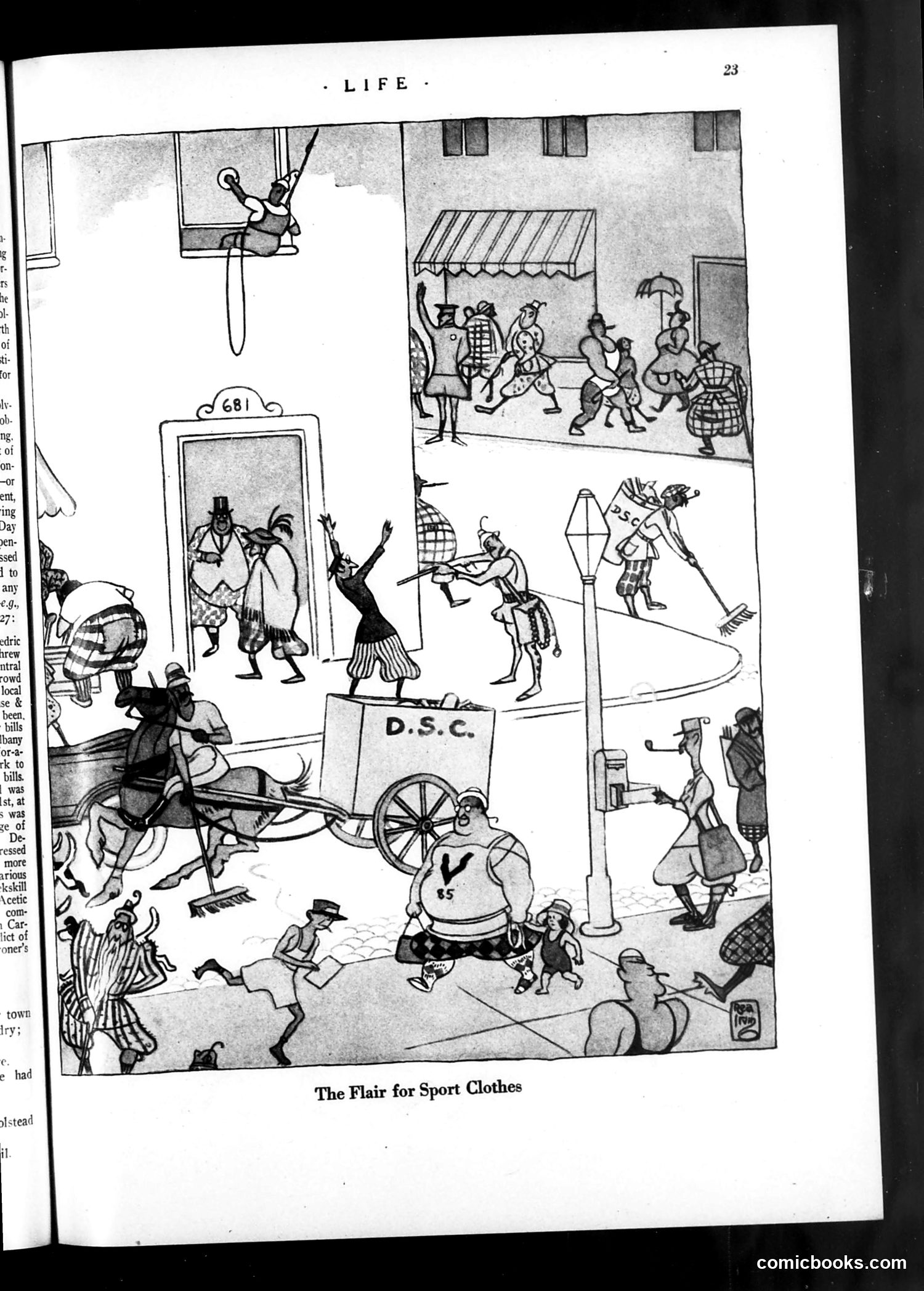
This satirical cartoon depicts a chaotic street scene centered on fashion. A large figure wearing "D.S.C." (unclear what this acronym represents) stands prominently amid various people engaged in athletic activities—swinging, jumping rope, playing sports under an awning. The satire appears to mock the trend of wearing specialized "sport clothes" in everyday public settings. The scene suggests that fashionable people dress in athletic wear not for actual athletic purposes, but as a style statement or social display. The cartoon criticizes this performative aspect of fashion—people parading in sporty outfits while engaging in exaggerated, sometimes absurd activities in plain view. The title's "flair" suggests pretension: the joke is that wearing sport clothes has become more about appearing stylish and fashionable than about genuine athletic participation. This reflects early 20th-century social commentary on how fashion trends influence behavior and public display.
This article by Robert E. Sherwood critiques film industry executive Adolph Zukor's claim that box-office returns alone measure a film's greatness. Sherwood argues this is backwards: he lists commercially successful but artistically mediocre films ("The Sheik," "Fool's Paradise") against artistic masterpieces that flopped commercially ("Broken Blossoms," "Dr. Jekyll and Mr. Hyde"). Sherwood proposes that true greatness should be judged by influence on filmmakers themselves—citing German director Ernst Lubitsch's artistic influence despite poor public reception. He critiques both profit-obsessed studio heads and movie critics, arguing only practicing directors and actors can properly evaluate cinema. The piece reflects early 1920s debates about art versus commerce in emerging film industry. The decorative illustrations at the bottom appear to be animal silhouettes, unrelated to the article's argument.
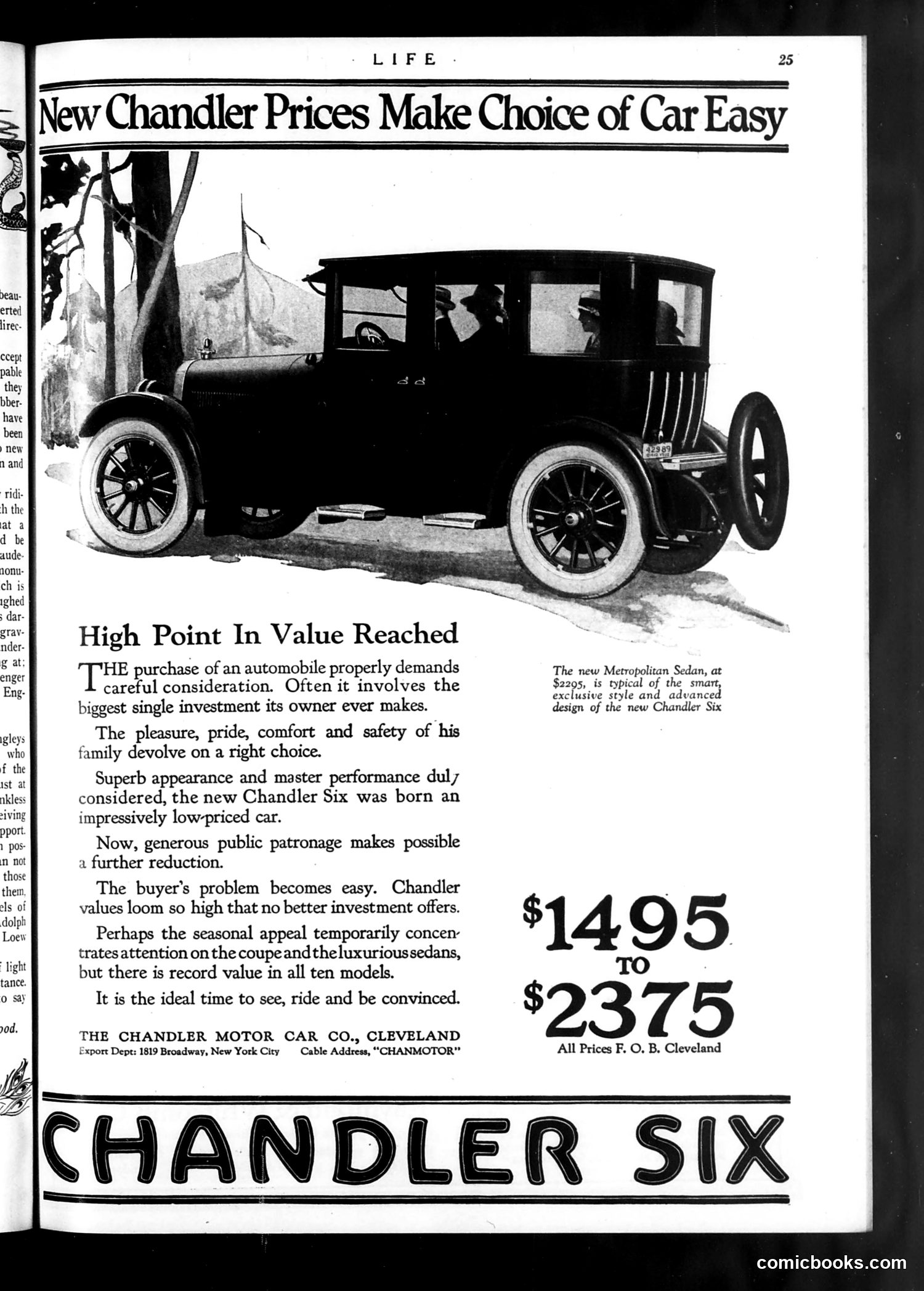
This is **not a cartoon or satire** — it's a straightforward automobile advertisement from Life magazine's early period (likely 1920s, based on the car style and pricing). The page advertises the **Chandler Six**, an American car manufactured in Cleveland. The ad emphasizes that purchasing a car is a major financial decision deserving careful consideration. Its pitch is that the Chandler Six offers exceptional value: it features superior design and performance at a low price ($1,495-$2,375), and recent "generous public patronage" has enabled further price reductions. The ad targets middle-class car buyers by framing automobile purchase as an investment in "pleasure, pride, comfort and safety" for one's family. It notes the car comes in ten models, including luxury sedans. There is no political commentary or satirical intent here — Life magazine during this era ran both serious articles and advertisements alongside humor and satire on other pages.
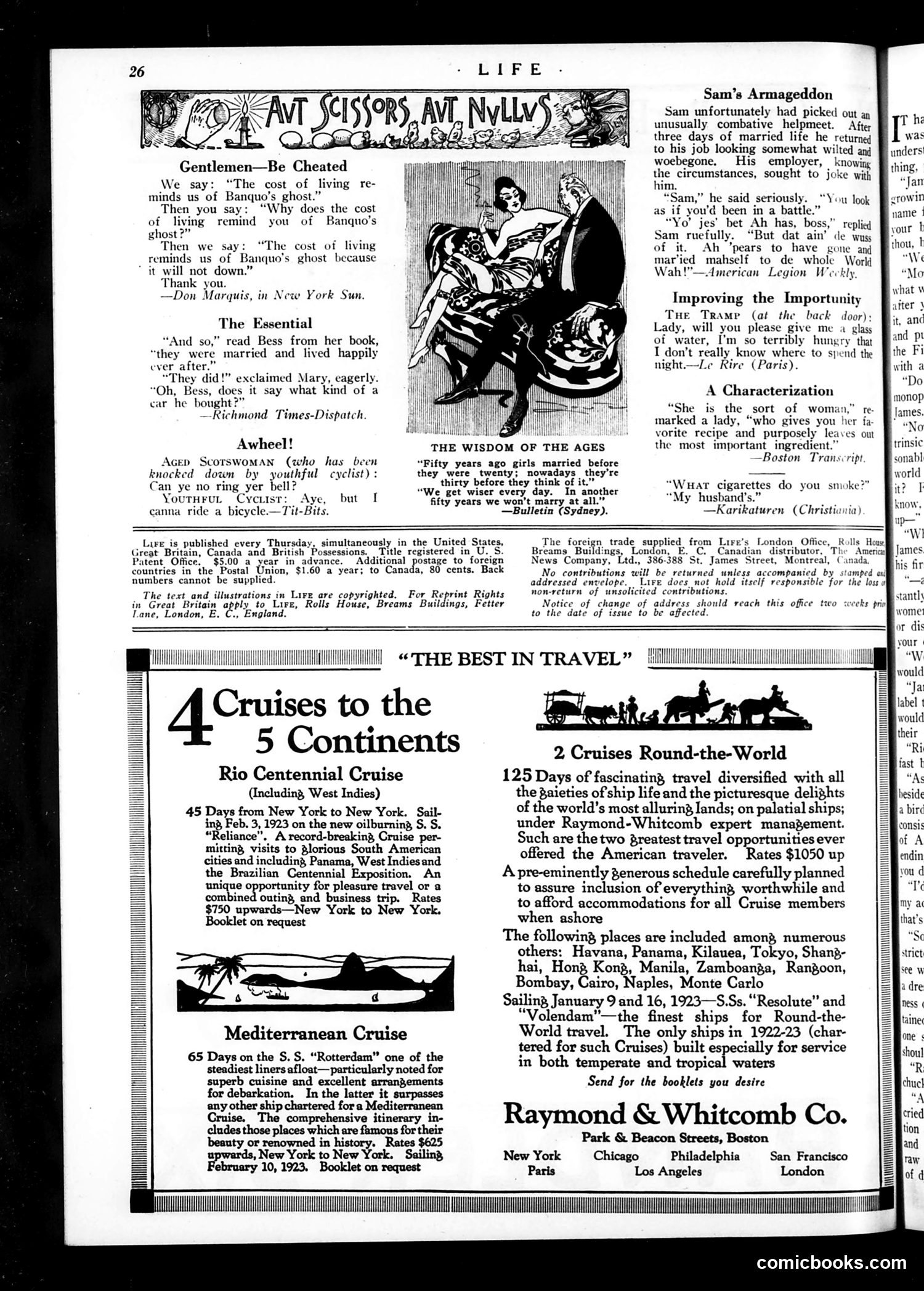
This page from *Life* magazine contains several brief satirical pieces typical of early 1920s American humor: **"Gentlemen—Be Cheated"** (by Don Marquis): A joke playing on *Macbeth*'s ghost of Banquo—the humor rests on the pun that the cost of living, like the ghost, "will not down" (won't go away). It's topical commentary on post-WWI inflation. **"Sam's Armageddon"**: A dialect-humor piece where "Sam" complains his new wife is so combative she resembles "de whole Worl' Wah'"—comparing marital conflict to World War I. The humor relies on African-American vernacular typical (though offensive by modern standards) of the era's popular entertainment. **"The Wisdom of the Ages"**: Brief observations about changing courtship customs and consumer behavior, presented as witty observations rather than developed jokes. The page is primarily advertising for Raymond & Whitcomb luxury cruises. The cartoons reflect common themes: wartime references, marital discord, and inflation anxiety.
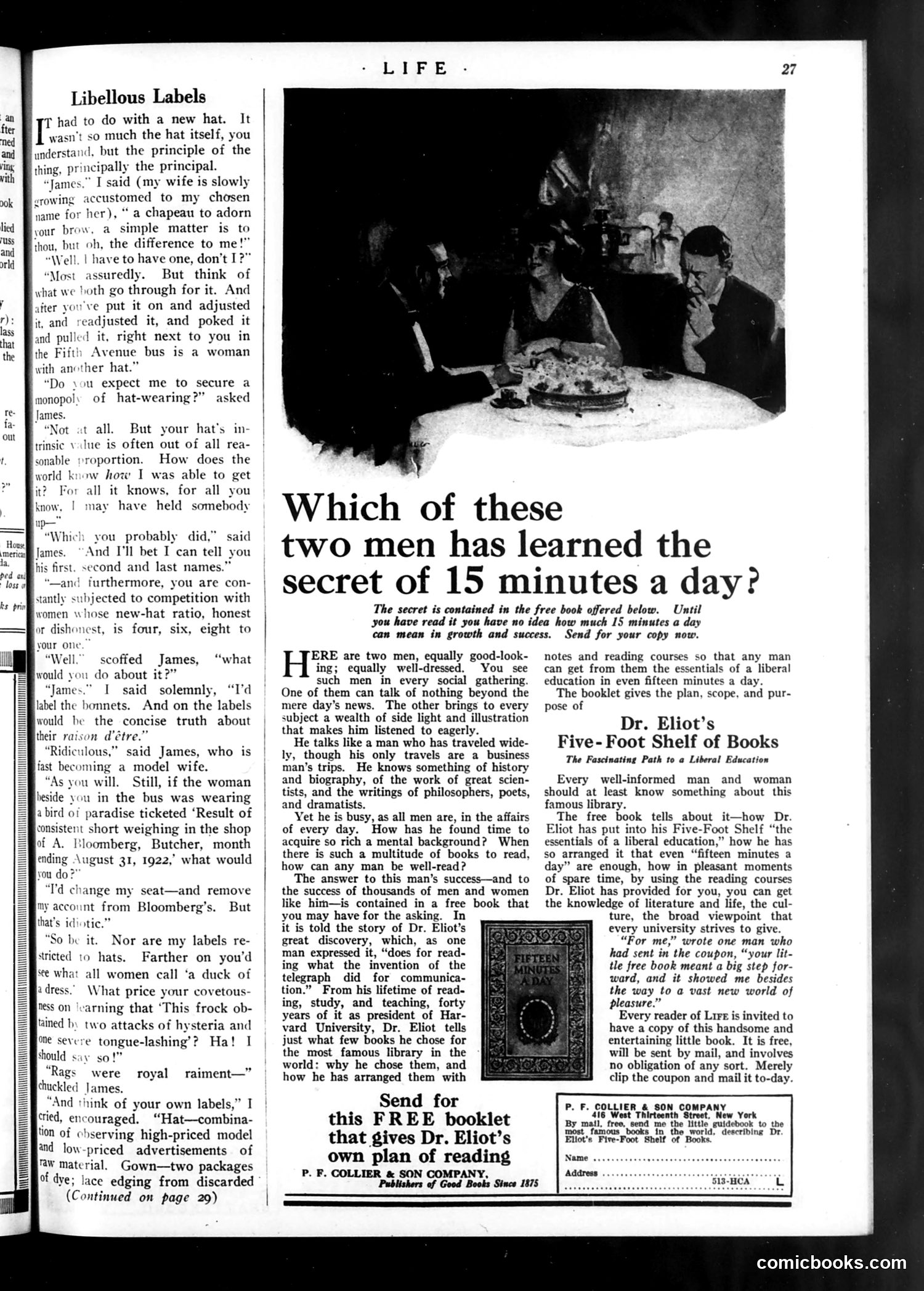
This page contains two distinct pieces: **"Libellous Labels"** (left): A humorous domestic dialogue between a husband and wife about labeling consumer goods with their true origins. The husband proposes sarcastically labeling women's hats and clothing with honest descriptions of their production—like a hat marked with the butcher's short-weighing scheme or a dress labeled with its cheap components ("two packages of dye"). The satire targets consumer culture and the gap between product presentation and reality, mocking both commercial dishonesty and conspicuous consumption in the 1920s. **Advertisement (right)**: A pitch for Dr. Eliot's "Five-Foot Shelf of Books"—a famous curated reading list. The ad contrasts two men: one boring, one cultured through reading. It promises that 15 minutes daily of reading from Eliot's selection provides a liberal education. This reflects early 20th-century optimism about self-improvement through literature and the marketing of cultural refinement as achievable for ordinary men. Both pieces reflect 1920s concerns: consumer fraud, class aspiration, and the democratization of knowledge.
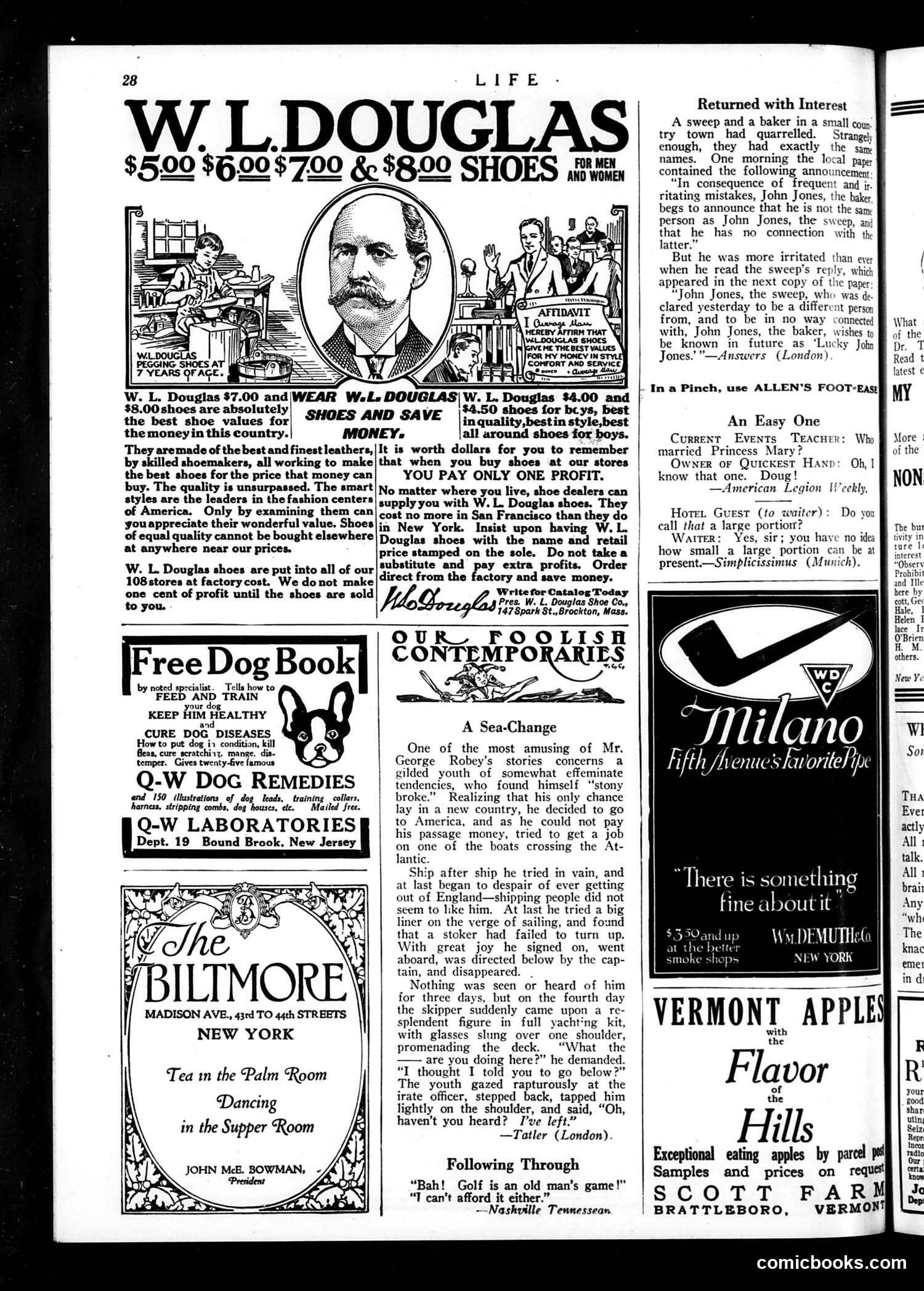
This page is primarily **advertising**, dominated by a large W.L. Douglas Shoes advertisement featuring a portrait of the company's founder and claims about direct-to-consumer factory pricing ("one cent of profit until shoes are sold to you"). The satirical content consists of three brief humor pieces: 1. **"Returned with Interest"**: A small-town joke about two men named John Jones (a baker and a sweep/chimney cleaner) whose names were so frequently confused that the baker had to publish a newspaper notice denying any connection to the other. 2. **"An Easy One"**: A hotel humor snippet about a waiter with no arms serving food. 3. **"Following Through"**: A golf joke where someone claims golf is "an old man's game," and another replies "I can't afford it either"—mocking golf's expense. These are typical *Life* magazine light humor pieces—quick, pun-based jokes requiring no political or historical context beyond understanding early 20th-century social conventions (class distinctions, occupational humor, golf as wealthy-man's sport).
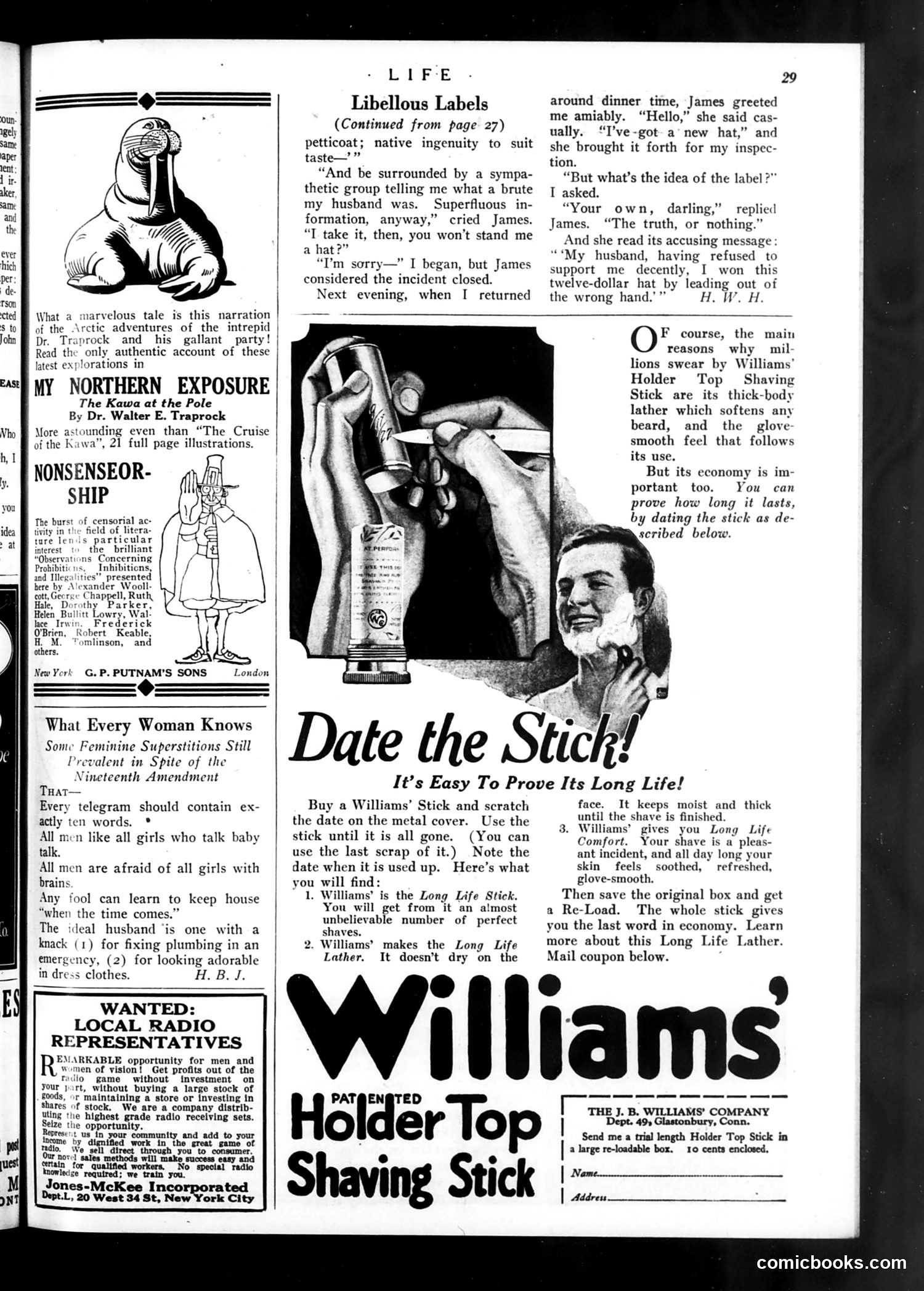
This page contains **satirical fiction and period advertising** from early 20th-century Life magazine. The main story, "Libellous Labels," depicts a marital quarrel where a wife secretly sews a label into a hat her husband refused to buy her, reading: "My husband, having refused to support me decently, I won this twelve-dollar hat by leading out of the wrong hand." The satire mocks both **spousal financial disputes and the performative grievance culture** of married life—she seeks sympathy from friends while her husband discovers her public humiliation of him. The page also includes period advertisements for shaving products and radio sales opportunities, reflecting consumer marketing of the 1920s-30s era. The sidebar "What Every Woman Knows" ironically lists contemporary **gender stereotypes**—that women believe all men fear intelligent women, that ideal husbands fix plumbing, and that telegrams must contain exactly ten words. The satire targets persistent superstitions *despite* the recent Nineteenth Amendment granting women's suffrage, suggesting social attitudes lagged behind legal changes.
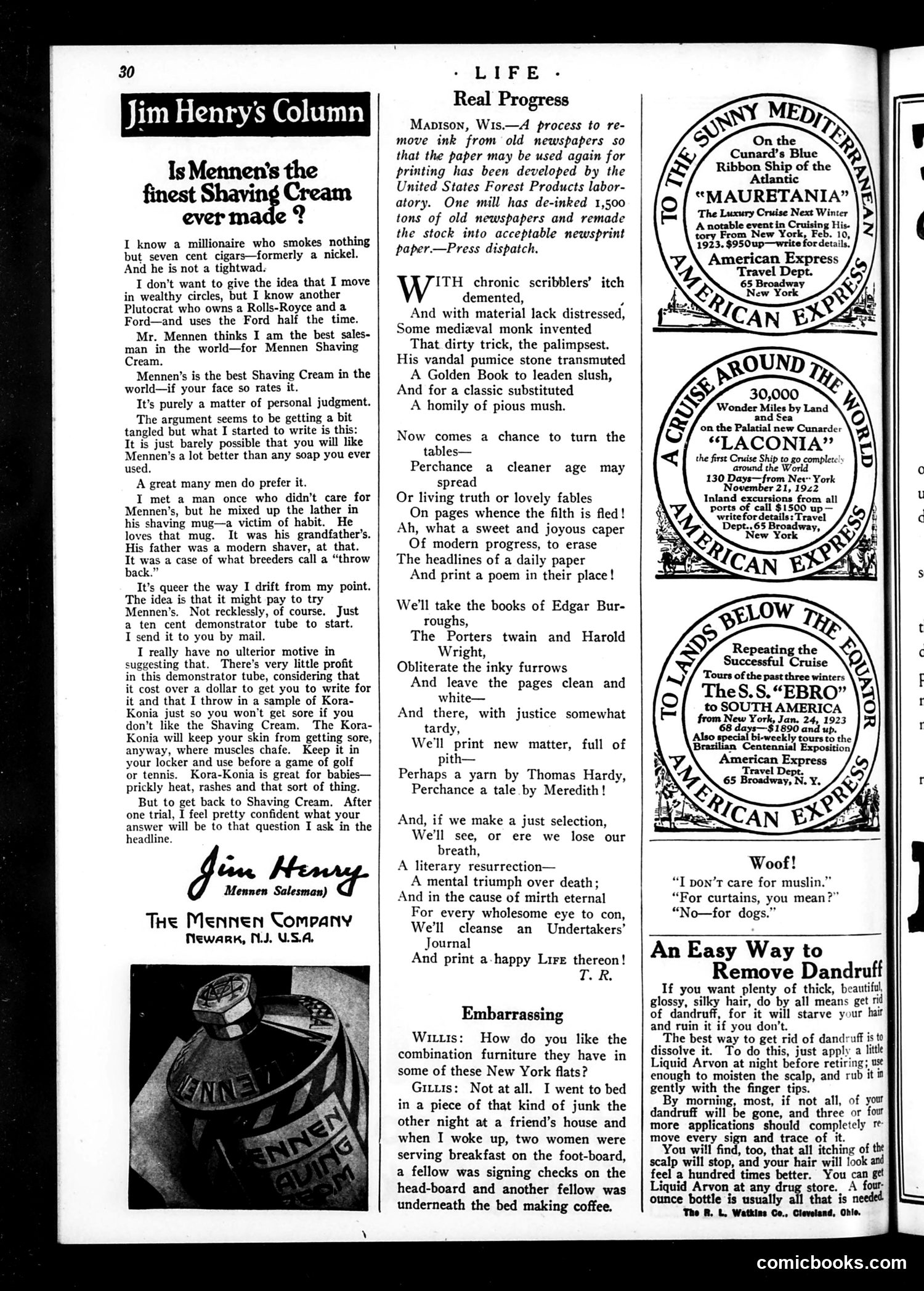
This page contains **Jim Henry's column** promoting Mennen's Shaving Cream—a humorous, conversational advertisement disguised as personal advice. Henry uses a folksy, digressive style to argue that Mennen's is superior based on "personal judgment" rather than hard sales pitch. The page also features a poem titled **"Real Progress"** by T.R., which satirizes the newly-developed process of de-inking old newspapers for reuse. The satire is gentle: while praising this technological advancement, the poem laments that pulp fiction (Edgar Burroughs, Harold Wright) will be erased, only to be replaced by supposedly "better" literary works (Thomas Hardy, Meredith). It's ironic commentary on modern progress—celebrating technological innovation while mock-mourning what gets sacrificed. The remaining content includes American Express travel advertisements and a brief joke ("Woof!") about furniture, plus an advertisement for Liquid Arvon dandruff treatment.
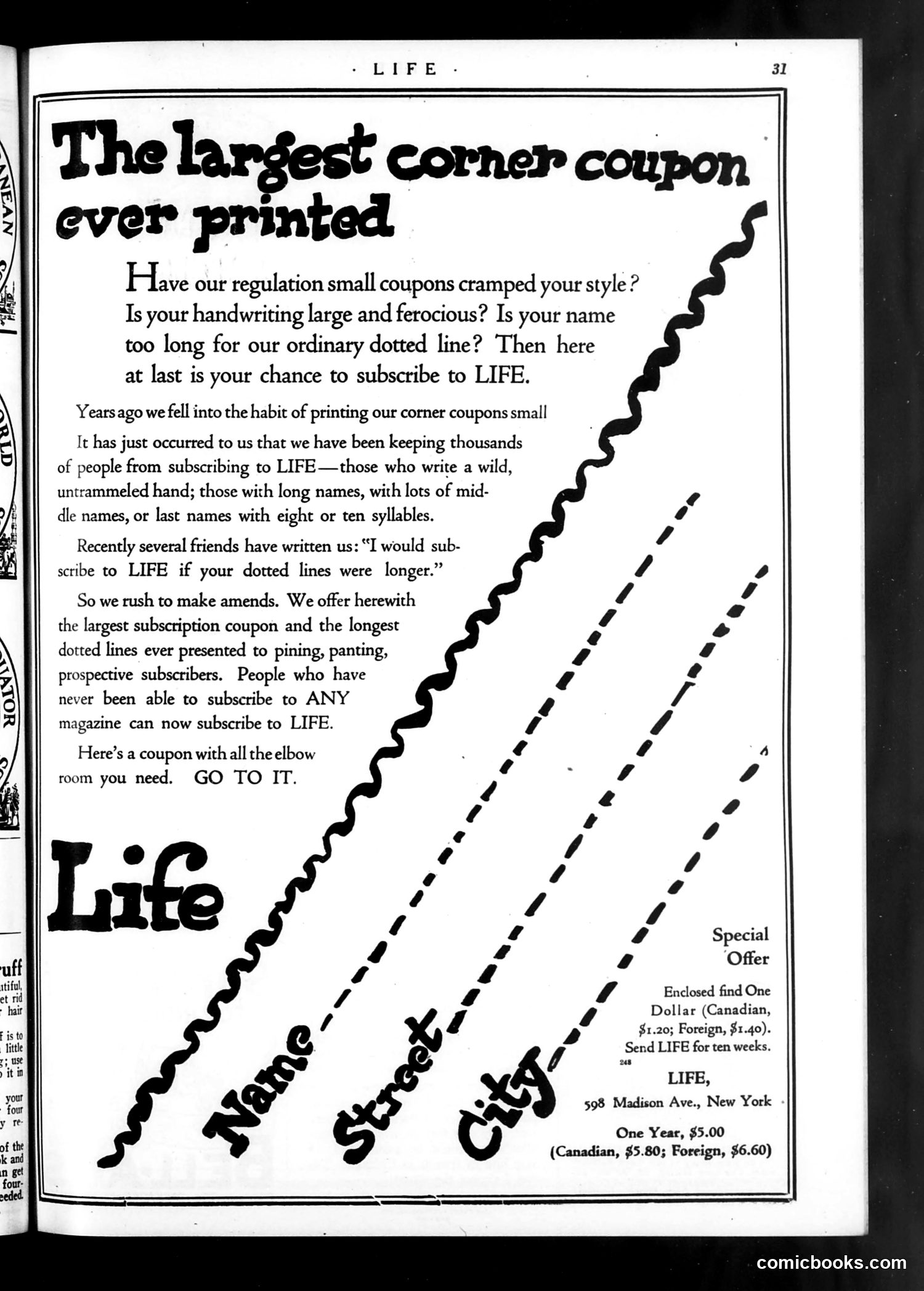
This is a humorous advertisement for *Life* magazine's subscription coupon. The satire targets a practical frustration: the magazine's previous subscription coupons were too small, with dotted lines too short to accommodate readers with large handwriting or long names (particularly those with multiple middle names or lengthy surnames—possibly referencing ethnic names common in early 20th-century America). The joke is self-deprecating: *Life* claims it has been "keeping thousands of people from subscribing" simply because they couldn't fit their names on the form. The advertisement offers an oversized coupon with extra space as a solution, positioning it as a generous accommodation. This reflects the era's humor about conformity and bureaucratic inconvenience, while also subtly acknowledging America's diverse immigrant population with longer, non-Anglo names.
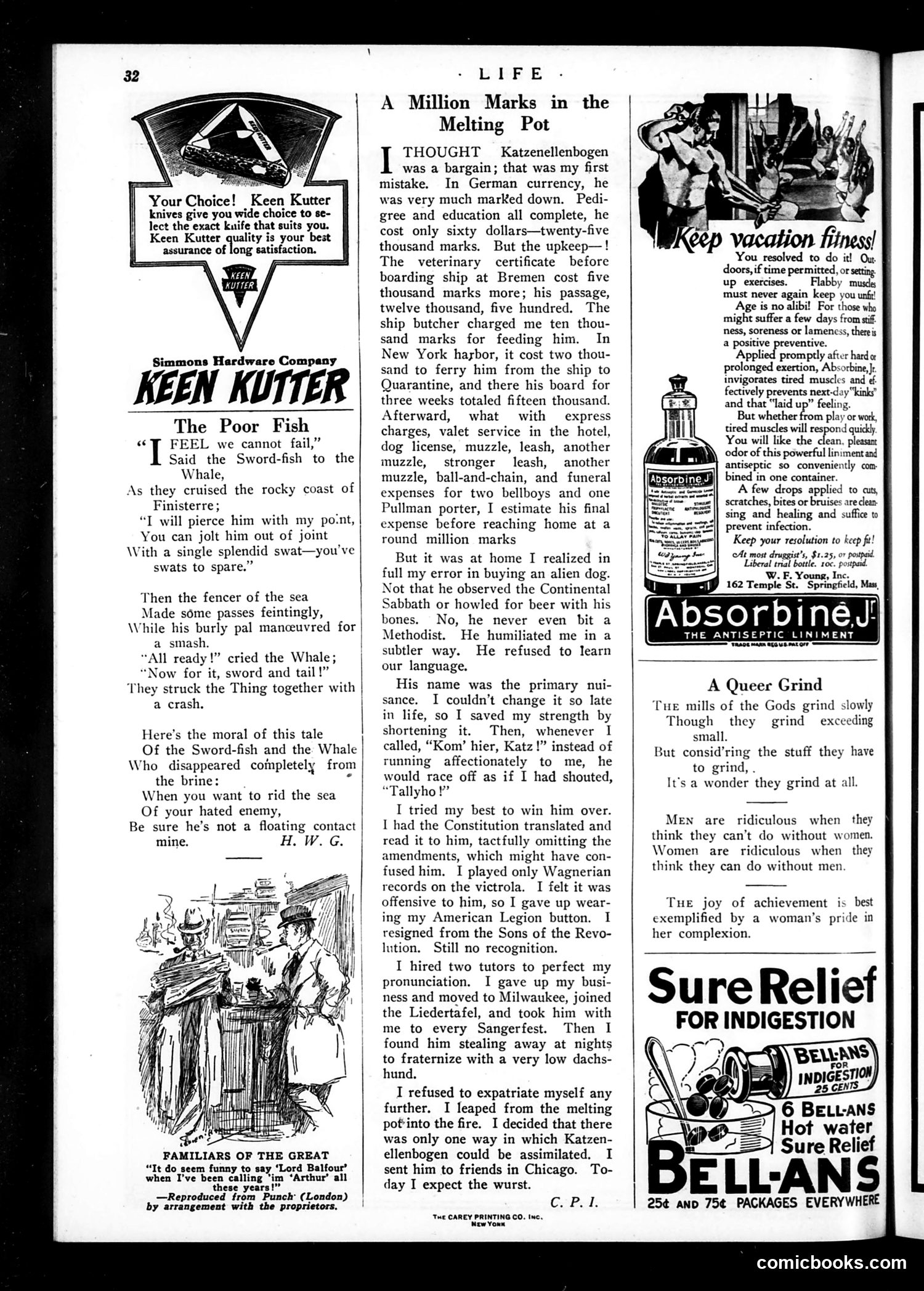
This satirical article mocks post-WWI German hyperinflation and American assimilation anxieties. The narrator purchases a German dog named "Katzenellenbogen" cheaply (25,000 marks) but incurs astronomical costs in transportation and care that total "a round million marks"—illustrating how German currency became worthless. The humor escalates when the dog refuses to adopt American ways despite the owner's desperate efforts: learning German, playing Wagner, joining German-American clubs, and abandoning his American Legion membership. The dog's ultimate "sin" is fraternizing with a low-class dachshund. The punchline—"I expect the wurst"—is a dark pun playing on both the German sausage and the dog's fate, suggesting the narrator will give up and return the unassimilable immigrant to Chicago. This reflects 1920s American nativism: anxiety about foreign immigration and the belief that some "alien" elements resist American integration, no matter the investment.
This is **not a cartoon or satirical piece**, but rather **sponsored advocacy content** — explicitly published "in co-operation with The American Association of Advertising Agencies." The text argues that economic hardship creates opportunity: by discovering that consumer demand can be artificially created through advertising, American business can control its own markets. The author frames advertising as a tool to manufacture desire for products, positioning this as beneficial during difficult economic times (likely post-WWI or early Depression era). Modern readers should recognize this as **early corporate propaganda** — a straightforward pitch that advertising isn't merely informative but fundamentally creates demand where none existed. The piece celebrates this manipulative capacity as an "asset," essentially arguing businesses can now manufacture their own prosperity through sophisticated marketing. This represents foundational thinking in modern consumer capitalism.
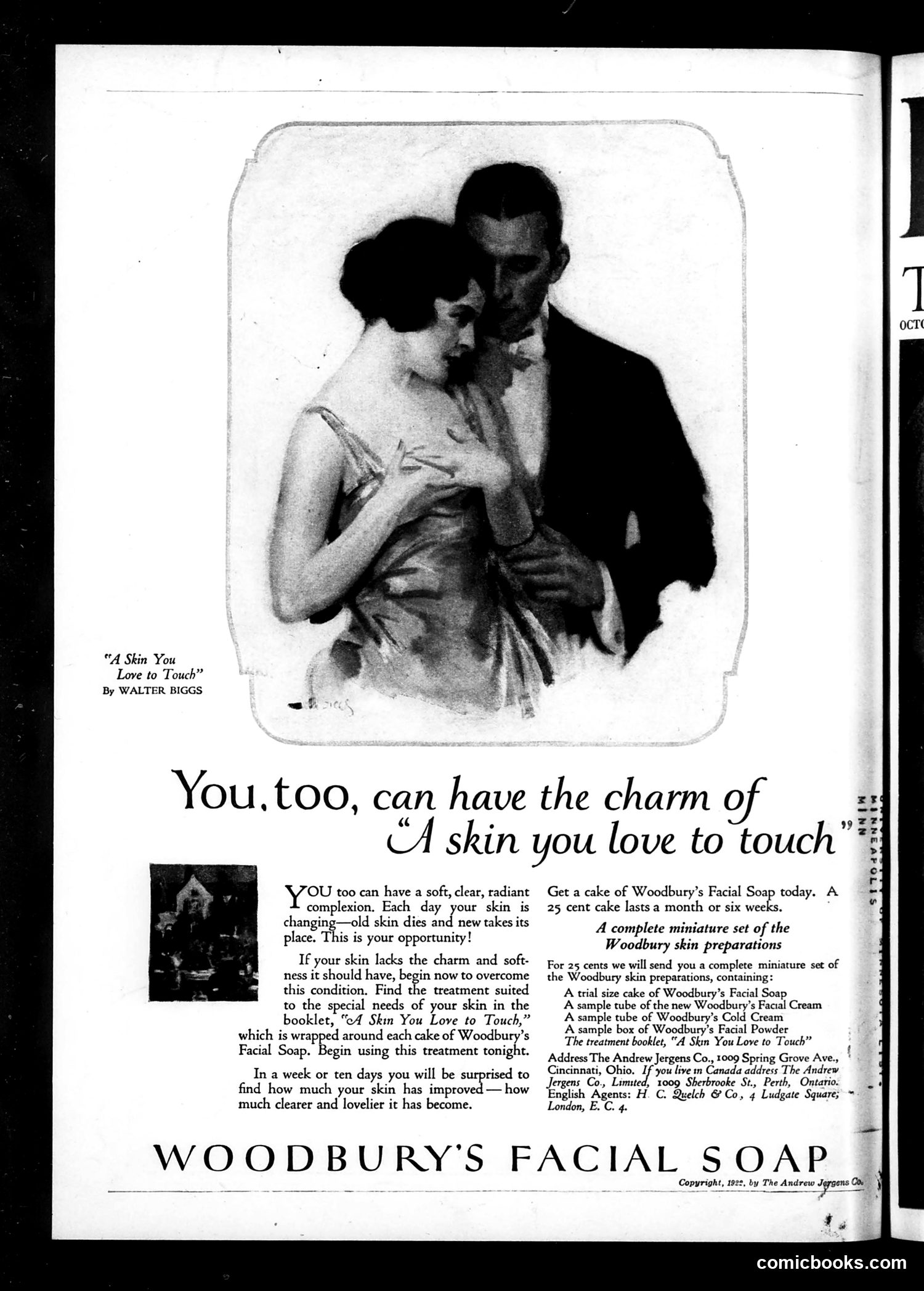
This is a **product advertisement**, not political satire. The page promotes Woodbury's Facial Soap using a romantic illustration and the famous advertising slogan "A Skin You Love to Touch." The image shows an intimate moment between a man and woman—the visual appeal is designed to suggest that using this soap will make one attractive and desirable. The text emphasizes that skin naturally regenerates daily, presenting soap use as a routine self-improvement opportunity. The phrase "You, too, can have the charm" addresses readers directly, promising that they can achieve similar romantic appeal through proper skincare. This represents early 20th-century marketing psychology: associating a mundane product with attractiveness, romance, and social success. The advertisement also offers a miniature product sampler for 25 cents, a common promotional strategy. There is no satire here—this is straightforward commercial messaging from 1922.