
Life, 1922-09-28 · page 26 of 36
Life — September 28, 1922 — page 26: what you’re looking at
What you’re looking at
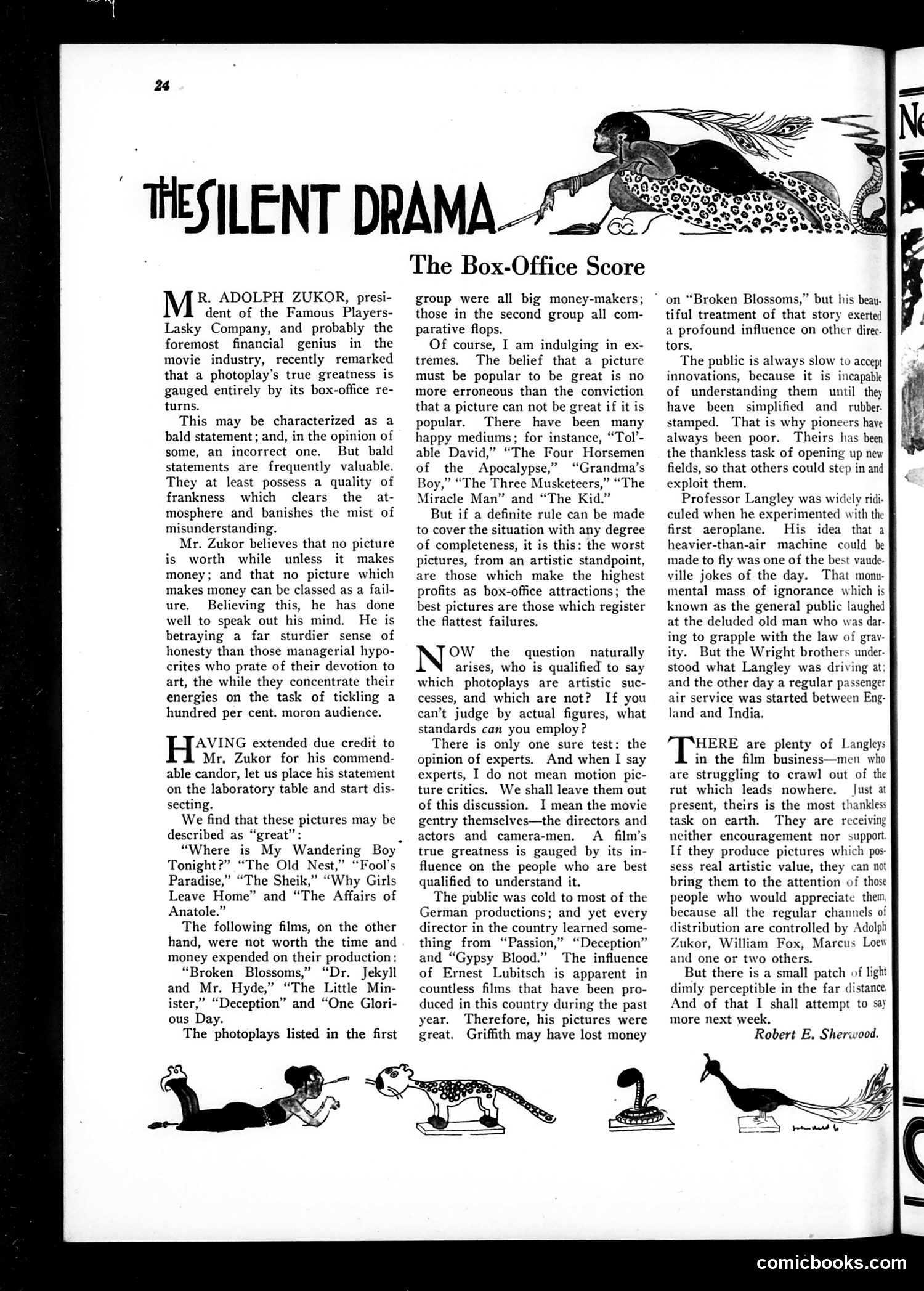
This article by Robert E. Sherwood critiques film industry executive Adolph Zukor's claim that box-office returns alone measure a film's greatness. Sherwood argues this is backwards: he lists commercially successful but artistically mediocre films ("The Sheik," "Fool's Paradise") against artistic masterpieces that flopped commercially ("Broken Blossoms," "Dr. Jekyll and Mr. Hyde"). Sherwood proposes that true greatness should be judged by influence on filmmakers themselves—citing German director Ernst Lubitsch's artistic influence despite poor public reception. He critiques both profit-obsessed studio heads and movie critics, arguing only practicing directors and actors can properly evaluate cinema. The piece reflects early 1920s debates about art versus commerce in emerging film industry. The decorative illustrations at the bottom appear to be animal silhouettes, unrelated to the article's argument.
📄 Transcribed text from this page (OCR, searchable)
Machine-transcribed from the original scan — historical spelling and the odd misread are preserved.
~TRESILENT DRAMA R. ADOLPH ZUKOR, presi- dent of the Famous Players- Lasky Company, and probably the foremost financial genius in the movie industry, recently remarked that a photoplay’s true greatness is gauged entirely by its box-office re- turns. This may be characterized as a bald statement ; and, in the opinion of some, an incorrect one. But bald statements are frequently valuable. They at least possess a quality of frankness which clears the at- mosphere and banishes the mist of misunderstanding. Mr. Zukor believes that no picture is worth while unless it makes money; and that no picture which makes money can be classed as a fail- ure. Believing this, he has done well to speak out his mind. He is betraying a far sturdier sense of honesty than those managerial hypo- crites who prate of their devotion to art, the while they concentrate their energies on the task of tickling a hundred per cent. moron audience. AVING extended due credit to Mr. Zukor for his commend- able candor, let us place his statement on the laboratory table and start dis- secting. We find that these pictures may be described as “great”: “Where is My Wandering Boy" Tonight?” “The Old Nest,” ‘Fool's Paradise,” “The Sheik,” “Why Girls Leave Home” and “The Affairs of Anatole.” The following films, on the other hand, were not worth the time and money expended on their production: “Broken Blossoms,” “Dr. Jekyll and Mr. Hyde,” “The Little Min- ister,” “Deception” and “One Glori- ous Day. The photoplays listed in the first é@ Ad The Box-Office Score group were all big money-makers; those in the second group all com- parative flops. Of course, I am indulging in ex- tremes. The belief that a picture must be popular to be great is no more erroneous than the conviction that a picture can not be great if it is popular. There have been many happy mediums; for instance, “Tol’- able David,” “The Four Horsemen of the Apocalypse,” ‘“Grandma’s Boy,” “The Three Musketeers,” “The Miracle Man” and “The Kid.” But if a definite rule can be made to cover the situation with any degree of completeness, it is this: the worst pictures, from an artistic standpoint, are those which make the highest profits as box-office attractions; the best pictures are those which register the flattest failures, OW the question naturally arises, who is qualified to say which photoplays are artistic suc- cesses, and which are not? If you can’t judge by actual figures, what standards can you employ? There is only one sure test: the opinion of experts. And when I say experts, I do not mean motion pic- ture critics. We shall leave them out of this discussion. I mean the movie gentry themselves—the directors and actors and camera-men. A _ film's true greatness is gauged by its in- fluence on the people who are best qualified to understand it. The public was cold to most of the German productions; and yet every director in the country learned some- thing from “Passion,” “Deception” and “Gypsy Blood.” The influence of Ernest Lubitsch is apparent in countless films that have been pro- duced in this country during the past year. Therefore, his pictures were great. Griffith may have lost money * on “Broken Blossoms,” but his beau- tiful treatment of that story exerted a profound influence on other direc. tors. The public is always slow to accept innovations, because it is incapable of understanding them until they have been simplified and rubber. stamped. That is why pioneers have always been poor. Theirs has been the thankless task of opening up new fields, so that others could step in and exploit them. Professor Langley was widely ridi- culed when he experimented with the first aeroplane. His idea that a heavier-than-air machine could be made to fly was one of the best vaude. ville jokes of the day. That monu- mental mass of ignorance which is known as the general public laughed at the deluded old man who was dar- ing to grapple with the law of grav- ity. But the Wright brothers under- stood what Langley was driving at; and the other day a regular passenger air service was started between Eng- land and India. HERE are plenty of Langleys in the film business—men who are struggling to crawl out of the rut which leads nowhere. Just at present, theirs is the most thankless task on earth. They are receiving neither encouragement nor support. If they produce pictures which pos- sess real artistic value, they can not bring them to the attention of those people who would appreciate them, because all the regular channels of distribution are controlled by Adolph Zukor, William Fox, Marcus Loew and one or two others. But there is a small patch of light dimly perceptible in the far distance. And of that I shall attempt to say more next week. Robert E. Sherwood. comicbooks.com