
Life, 1922-09-28 · page 22 of 36
Life — September 28, 1922 — page 22: what you’re looking at
What you’re looking at
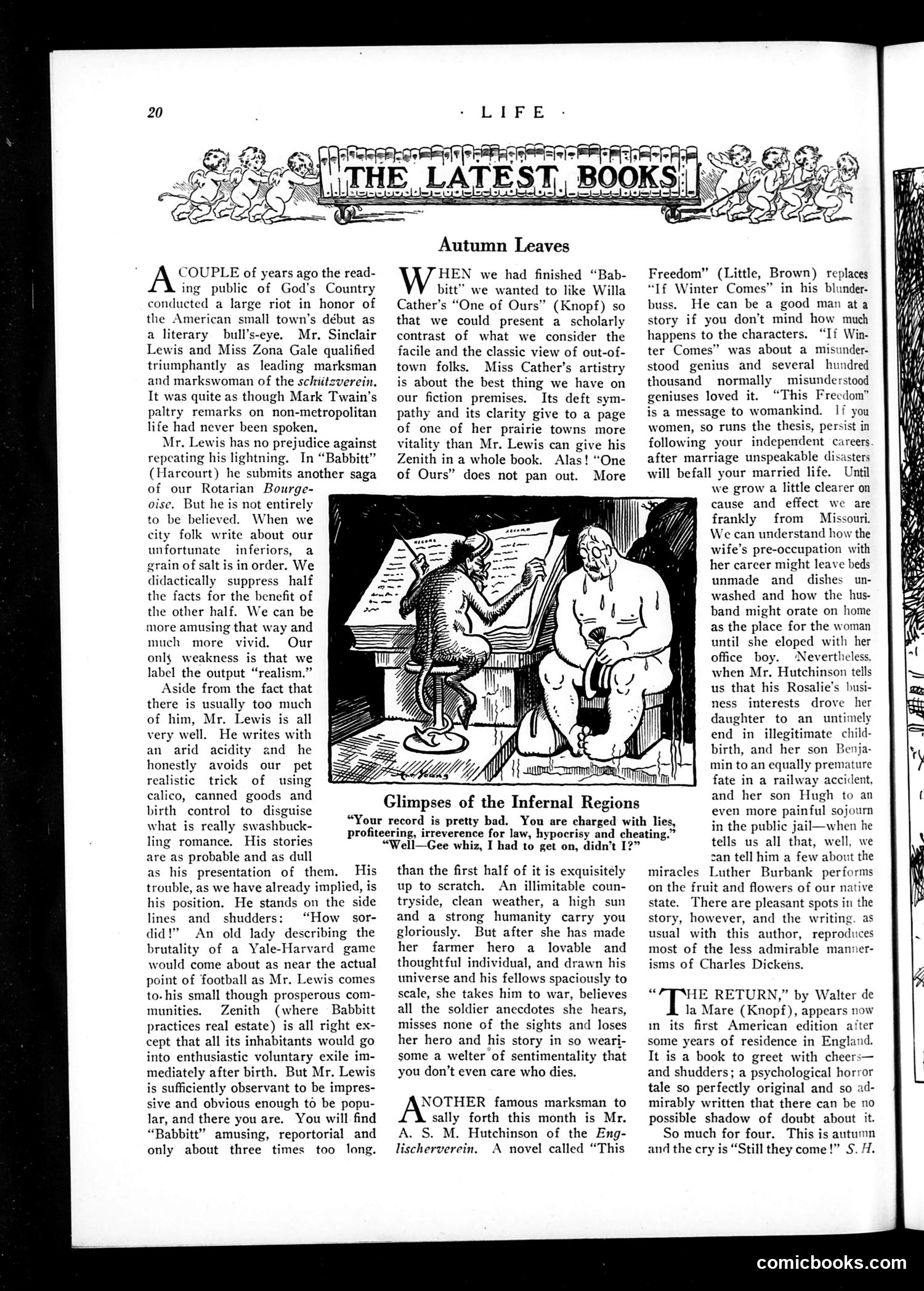
This is a literary review section of *Life* magazine discussing three recent novels. The central cartoon labeled "Glimpses of the Infernal Regions" depicts a courtroom scene where a defendant is accused of lies, irreverence, and hypocrisy—he responds defensively that "I had to get on, didn't I?" The satire likely comments on human moral compromise. The reviews critique Sinclair Lewis's *Babbitt* (about small-town businessmen) for being obvious satire that exaggerates reality, Willa Cather's *One of Ours* for losing artistic quality when its narrative shifts to World War I, and A.S.M. Hutchinson's *This Freedom* for being didactic social messaging to women about independence. The author employs caustic wit throughout, dismissing these works as "probable and dull" while acknowledging their popularity. The tone is typical of *Life's* urbane, acerbic cultural commentary.
📄 Transcribed text from this page (OCR, searchable)
Machine-transcribed from the original scan — historical spelling and the odd misread are preserved.
A COUPLE of years ago the read- ing public of God’s Country conducted a large riot in honor of the American small town’s début as a literary bull’s-eye. Mr. Sinclair Lewis and Miss Zona Gale qualified triumphantly as leading marksman and markswoman of the schiitsverein, It was quite as though Mark Twain’s paltry remarks on non-metropolitan life had never been spoken. Mr. Lewis has no prejudice against repeating his lightning. In “Babbitt” (Harcourt) he submits another saga of our Rotarian Bourge- oise. But he is not entirely to be believed. When we city folk write about our unfortunate inferiors, a grain of salt is in order. We didactically suppress half the facts for the benefit of the other half. We can be more amusing that way and much more vivid. Our only weakness is that we label the output “realism.” Aside from the fact that there is usually too much of him, Mr. Lewis is all very well. He writes with an arid acidity and he honestly avoids our pet realistic trick of using calico, canned goods and birth control to disguise what is really swashbuck- ling romance. His stories are as probable and as dull as his presentation of them. His trouble, as we have already implied, is his position. He stands on the side lines and shudders: “How sor- did!” An old lady describing the brutality of a Yale-Harvard game would come about as near the actual point of football as Mr. Lewis comes to-his small though prosperous com- munities. Zenith (where Babbitt practices real estate) is all right ex- cept that all its inhabitants would go into enthusiastic voluntary exile im- mediately after birth. But Mr. Lewis is sufficiently observant to be impres- sive and obvious enough to be popu- lar, and there you are. You will find “Babbitt” amusing, reportorial and only about three times too long. profiteeri: Autumn Leaves HEN we had finished “Bab- bitt” we wanted to like Willa Cather’s “One of Ours” (Knopf) so that we could present a scholarly contrast of what we consider the facile and the classic view of out-of- town folks. Miss Cather’s artistry is about the best thing we have on our fiction premises. Its deft sym- pathy and its clarity give to a page of one of her prairie towns more vitality than Mr. Lewis can give his Zenith in a whole book. Alas! “One of Ours” does not pan out. More Glimpses of the Infernal Regions “Your record is pretty bad. You are charged with lies, than the first half of it is exquisitely up to scratch. An illimitable coun- tryside, clean weather, a high sun and a strong humanity carry you gloriously. But after she has made her farmer hero a lovable and thoughtful individual, and drawn his universe and his fellows spaciously to scale, she takes him to war, believes all the soldier anecdotes she hears, misses none of the sights and loses her hero and his story in so weari- some a welter of sentimentality that you don’t even care who dies. NOTHER famous marksman to sally forth this month is Mr. A. S. M. Hutchinson of the Eng- lischerverein. A novel called “This ing, irreverence for law, hypocrisy and cheating.” ‘Well—Gee whiz, I had to get on, didn’t 1?” Freedom” (Little, Brown) replaces “If Winter Comes” in his blunder. buss. He can be a good man ata story if you don’t mind how much happens to the characters. “If Win- ter Comes” was about a misunder- stood genius and several hundred thousand normally misunderstood geniuses loved it. “This Freedom” is a message to womankind. If you women, so runs the thesis, persist in following your independent careers after marriage unspeakable disasters will befall your married life. Until we grow a little clearer on cause and effect we are frankly from Missouri. We can understand how the wife’s pre-occupation with her carcer might leave beds unmade and dishes un- washed and how the hus- band might orate on home as the place for the woman until she eloped with her office boy. ‘Nevertheless, when Mr. Hutchinson tells us that his Rosalie’s busi- ness interests drove her daughter to an untimely end in illegitimate child- birth, and her son Benja- min to an equally premature fate in a railway accident, and her son Hugh to an even more painful sojourn in the public jail—when he tells us all that, well, we can tell him a few about the miracles Luther Burbank performs on the fruit and flowers of our native state. There are pleasant spots in the story, however, and the writing. as usual with this author, reproduces most of the less admirable mani isms of Charles Dickens. st HE RETURN,” by Walter de la Mare (Knopf), appears now in its first American edition a/ter some years of residence in England. It is a book to greet with cheers— and shudders; a psychological horror tale so perfectly original and so ad- mirably written that there can be no possible shadow of doubt about it. So much for four. This is autumn and the cry is “Still they come!” S. 1. comicbooks.com