
Life, 1922-09-28 · page 20 of 36
Life — September 28, 1922 — page 20: what you’re looking at
What you’re looking at
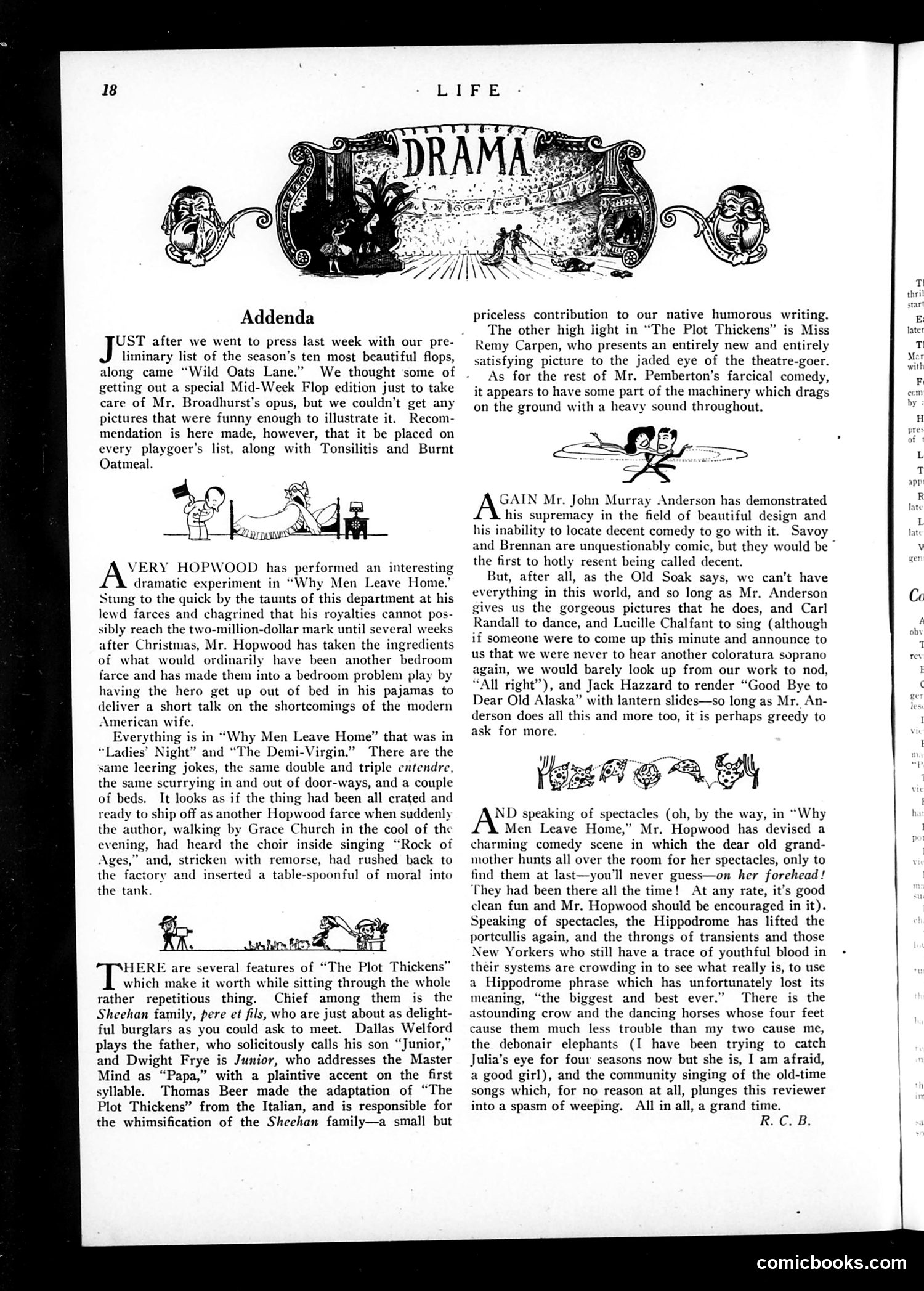
This is a theater review section critiquing several Broadway productions. The author savagely mocks playwright Avery Hopwood's *"Why Men Leave Home,"* suggesting he cynically added moral messaging (a "table-spoonful of moral") to an otherwise conventional bedroom farce—comparing it to his earlier similar comedies with identical plot mechanics and "leering jokes." The review also praises *"The Plot Thickens"* for its charming Sheehan family characters (played by Dallas Welford and Dwight Frye) while dismissing the rest as dragging. Director John Murray Anderson receives backhanded praise: his visual design is "gorgeous," but the comedy is weak. The reviewer sarcastically notes that performers like dancer Carl Randall and soprano Lucille Chalfant compensate, though admits losing a coloratura soprano wouldn't particularly upset him. The opening "Addenda" section jokes that *"Wild Oats Lane"* was so unfunny it deserved listing alongside illnesses ("Tonsilitis") as a seasonal affliction.
📄 Transcribed text from this page (OCR, searchable)
Machine-transcribed from the original scan — historical spelling and the odd misread are preserved.
Addenda UST after we went to press last week with our pre- liminary list of the season’s ten most beautiful flops, along came “Wild Oats Lane.” We thought some of getting out a special Mid-Week Flop edition just to take care of Mr. Broadhurst's opus, but we couldn’t get any pictures that were funny enough to illustrate it. Recom- mendation is here made, however, that it be placed on every playgoer’s list, along with Tonsilitis and Burnt Oatmeal. A ERY HOPWOOD has performed an interesting dramatic experiment in “Why Men Leave Home.’ Stung to the quick by the taunts of this department at his lewd farces and chagrined that his royalties cannot pos- sibly reach the two-million-dollar mark until several weeks after Christnias, Mr. Hopwood has taken the ingredients of what would ordinarily have been another bedroom farce and has made them into a bedroom problem play by having the hero get up out of bed in his pajamas to deliver a short talk on the shortcomings of the modern American wife. Everything is in “Why Men Leave Home” that was in “Ladies’ Night” and “The Demi-Virgin.” There are the same leering jokes, the same double and triple entendre, the same scurrying in and out of door-ways, and a couple of beds. It looks as if the thing had been all crated and ready to ship off as another Hopwood farce when suddenly the author, walking by Grace Church in the cool of the evening, had heard the choir inside singing “Rock of Ages,” and, stricken with remorse, had rushed back to the factory and inserted a table-spoonful of moral into the tank. HERE are several features of “The Plot Thickens” which make it worth while sitting through the whole rather repetitious thing. Chief among them is the Sheehan family, pere et fils, who are just about as delight- ful burglars as you could ask to meet. Dallas Welford plays the father, who solicitously calls his son “Junior,” and Dwight Frye is Junior, who addresses the Master Mind as “Papa,” with a plaintive accent on the first syllable. Thomas Beer made the adaptation of “The Plot Thickens” from the Italian, and is responsible for the whimsification of the Sheehan family—a small but priceless contribution to our native humorous writing. The other high jight in “The Plot Thickens” is Miss Remy Carpen, who presents an entirely new and entirely satisfying picture to the jaded eye of the theatre-goer. As for the rest of Mr. Pemberton’s farcical comedy, it appears to have some part of the machinery which drags on the ground with a heavy sound throughout. GAIN Mr. John Murray Anderson has demonstrated his supremacy in the field of beautiful design and his inability to locate decent comedy to go with it. Savoy and Brennan are unquestionably comic, but they would be ” the first to hotly resent being called decent. But, after all, as the Old Soak says, we can’t have everything in this world, and so long as Mr. Anderson gives us the gorgeous pictures that he does, and Carl Randall to dance, and Lucille Chalfant to sing (although if someone were to come up this minute and announce to us that we were never to hear another coloratura soprano again, we would barely look up from our work to nod, “All right”), and Jack Hazzard to render “Good Bye to Dear Old Alaska” with lantern slides—so long as Mr. An- derson does all this and more too, it is perhaps greedy to ask for more. ee Ba Bh AN speaking of spectacles (oh, by the way, in “Why Men Leave Home,” Mr. Hopwood has devised a charming comedy scene in which the dear old grand- mother hunts all over the room for her spectacles, only to find them at last—you'll never guess—on her forehead! ‘They had been there all the time! At any rate, it’s good clean fun and Mr. Hopwood should be encouraged in it). Speaking of spectacles, the Hippodrome has lifted the portcullis again, and the throngs of transients and those New Yorkers who still have a trace of youthful blood in their systems are crowding in to see what really is, to use a Hippodrome phrase which has unfortunately lost its meaning, “the biggest and best ever.” There is the astounding crow and the dancing horses whose four feet cause them much less trouble than my two cause me, the debonair elephants (I have been trying to catch Julia’s eye for four seasons now but she is, I am afraid, a good girl), and the community singing of the old-time songs which, for no reason at all, plunges this reviewer into a spasm of weeping. All in all, a grand time. RC Be comicbooks.com