
A complete issue · 34 pages · 1922
Life — June 22, 1922
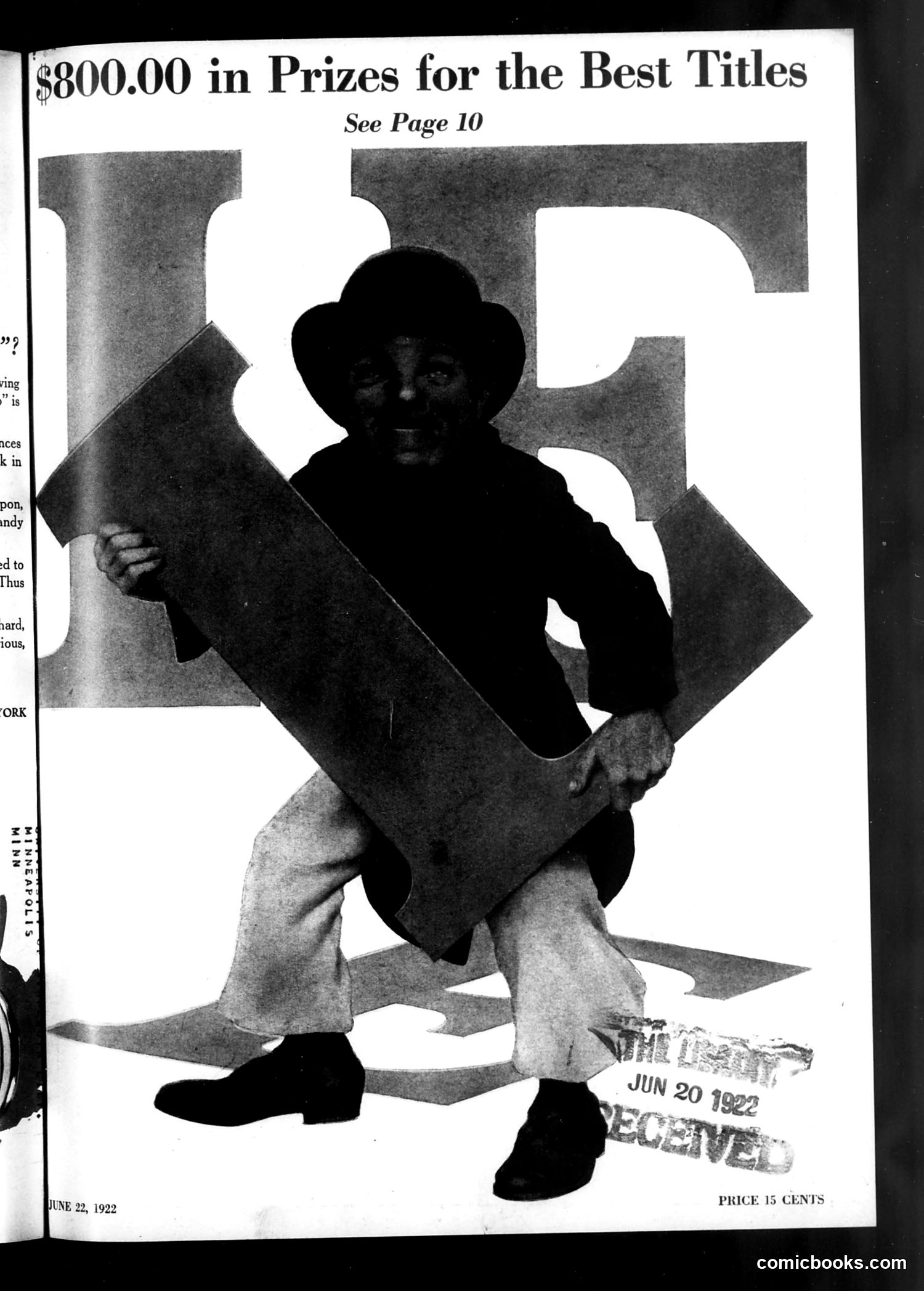
This page advertises "$800.00 in Prizes for the Best Titles" (details on Page 10), with a price of 15 cents. The large illustration shows a figure in a cowboy hat and dark clothing crouching within oversized letters spelling "LIFE." The figure appears to be a caricature, though the specific identity is unclear from the image alone. The posture and styling suggest this is likely promoting a contest or story featured in that issue of Life magazine. The date (JUN 20 1922) is stamped on the illustration. This appears to be a cover or promotional image designed to encourage readers to purchase the magazine and participate in the advertised title-writing contest.
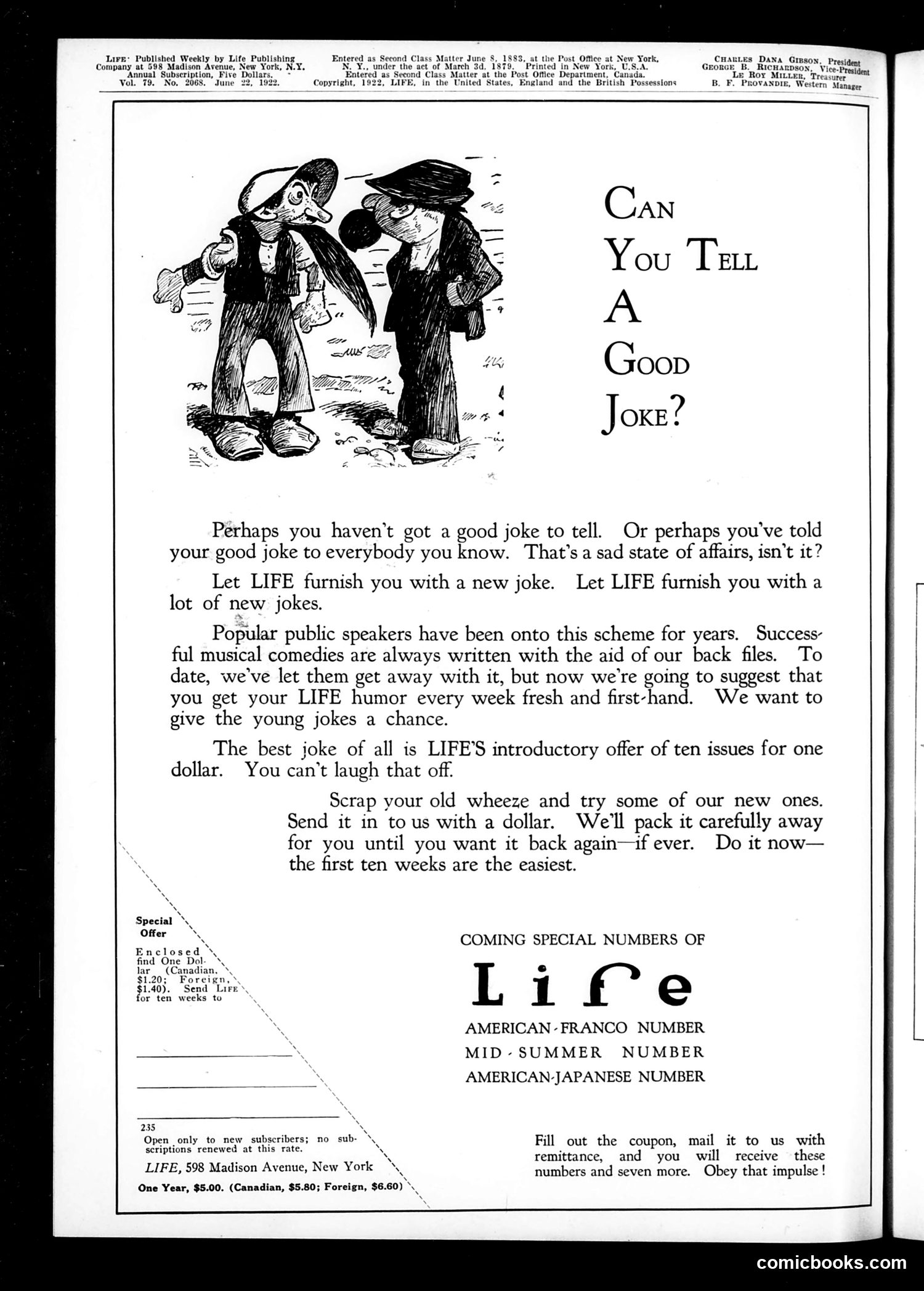
This page is primarily an **advertisement for Life magazine subscriptions**, not political commentary. The cartoon shows two men in conversation, illustrating the magazine's pitch to readers. The ad promotes Life's humor content, specifically encouraging subscribers to submit and receive jokes weekly. It emphasizes that "popular public speakers" and successful comedies rely on humor archives—suggesting Life provides fresh material for people seeking jokes to tell others. The "special offer" advertises ten weeks of Life for one dollar, targeting new subscribers. The page concludes by promoting upcoming special issues: American-Franco, Mid-Summer, and American-Japanese numbers. Rather than satire, this is straightforward commercial messaging using a simple cartoon to make the subscription pitch more engaging and accessible to potential readers.
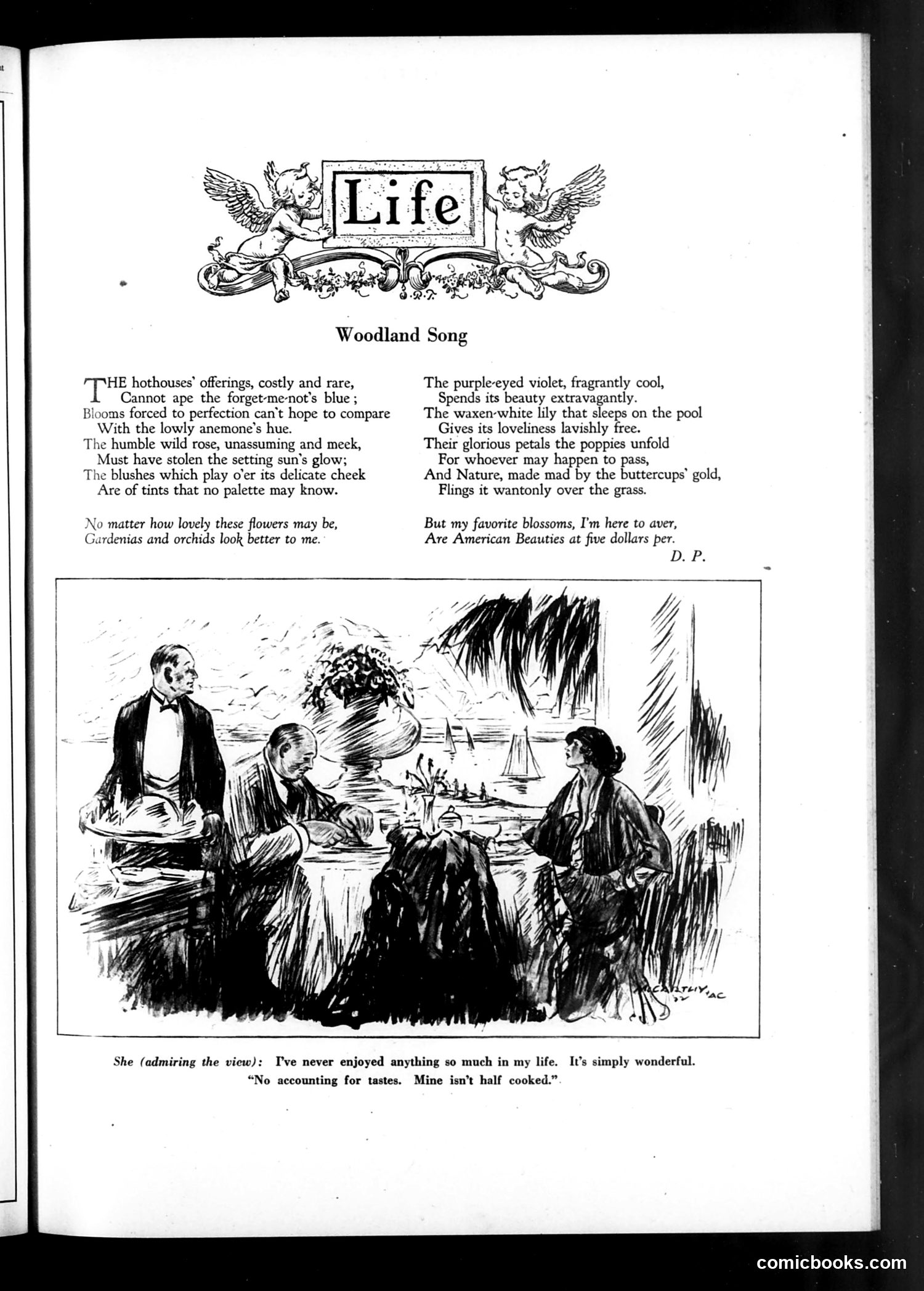
This page presents a poem satirizing expensive hothouse flowers sold as luxury items, contrasted with native American wildflowers available cheaply ("five dollars per"). The accompanying sketch depicts a social scene at what appears to be an upscale waterfront dining establishment. A woman admires an elaborate floral arrangement while two men (one serving) and another woman observe. Her dialogue—praising the view and the meal's quality—suggests she's being treated to an expensive outing. The satire targets wealthy consumers' pretension: they purchase rare, costly hothouse blooms and dine expensively to appear refined, when affordable native alternatives exist. The poem's final couplet emphasizes this absurdity—paying premium prices for flowers that lack the genuine beauty of freely available American wildflowers. It's social commentary on class performance and wasteful consumption among the affluent.
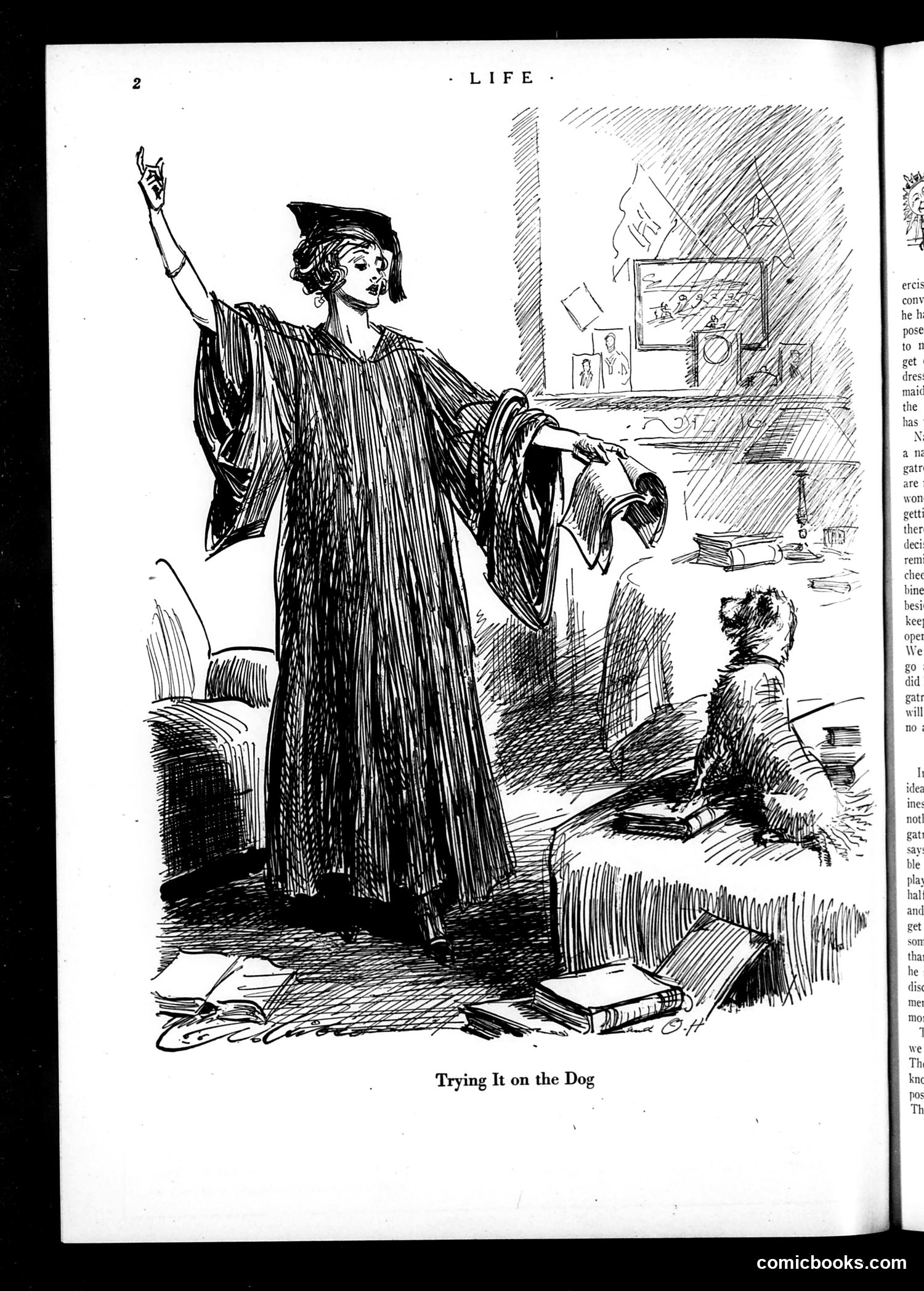
This illustration depicts a woman in an elegant robe striking a dramatic pose with her fist raised, while a small dog sits attentively before her. The caption "Trying It on the Dog" appears to be a satirical commentary on women's behavior or rhetoric. The phrase likely refers to testing ideas or arguments on an uncritical audience—the dog being the most receptive listener. Given Life magazine's focus on social satire, this probably mocks women who practice speeches, dramatic gestures, or persuasive techniques on their pets before using them on actual people. The woman's theatrical pose and the scattered books suggest she's rehearsing arguments or preparing for public speaking. The humor relies on the absurdity of treating a dog as an audience for human rhetoric.
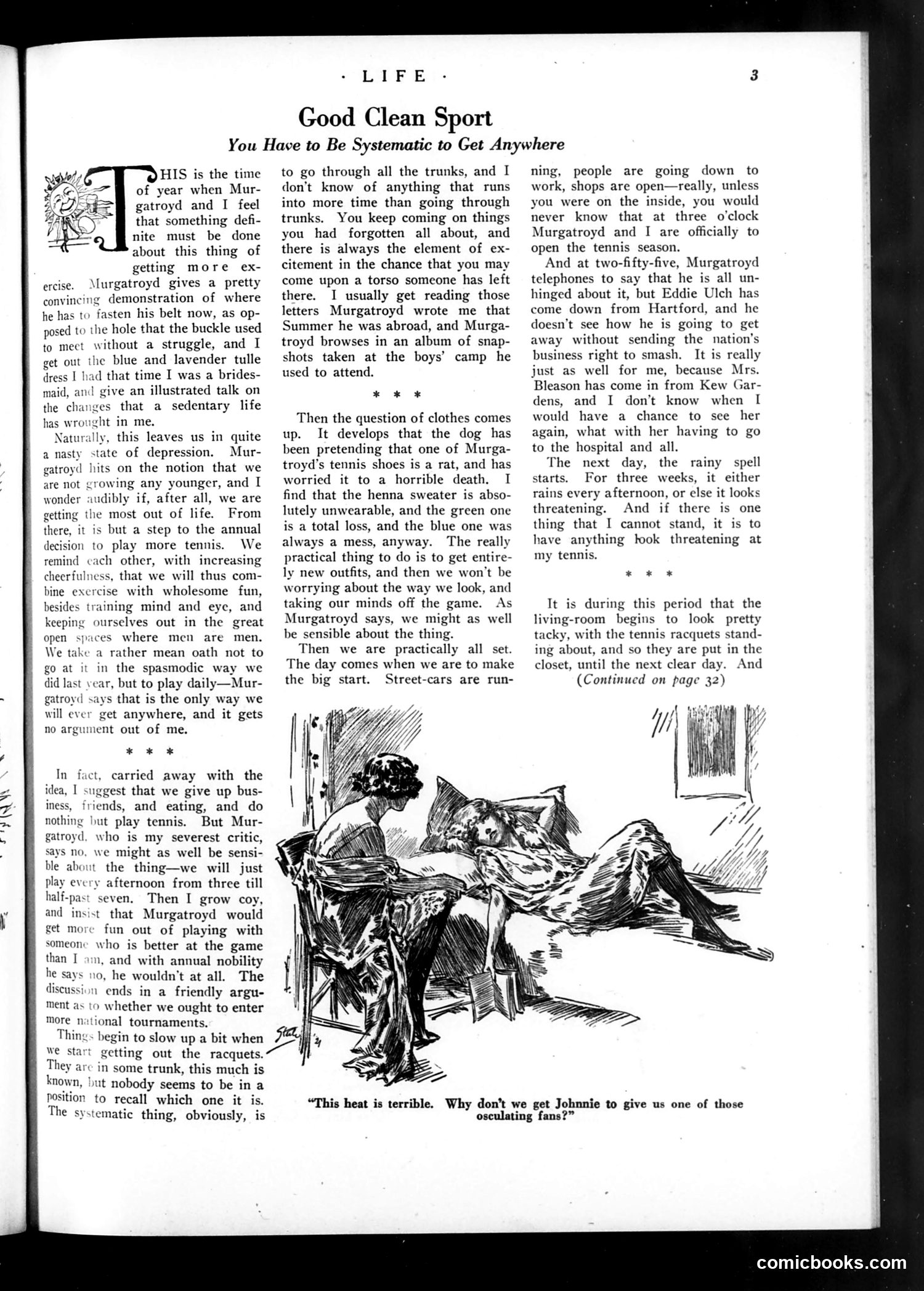
This satirical piece mocks the obsessive organization required for amateur tennis. The author (likely humorously exaggerating) describes Murgatroyd's systematic approach to the sport—organizing equipment, managing clothing, scheduling practice—suggesting that becoming competitive at tennis demands exhausting logistical effort rather than simple enjoyment. The accompanying sketch shows a woman and man discussing tennis logistics, with the woman complaining about heat and requesting a fan. The caption reads: "This heat is terrible. Why don't we get Johnnie to give us one of those osculating fans?" The joke plays on "osculating" (kissing) fans—a pun suggesting they'd rather have romantic attention than practical cooling. It satirizes how tennis etiquette and organization consume participants' time and focus, leaving them miserable despite supposedly engaging in recreational "sport."
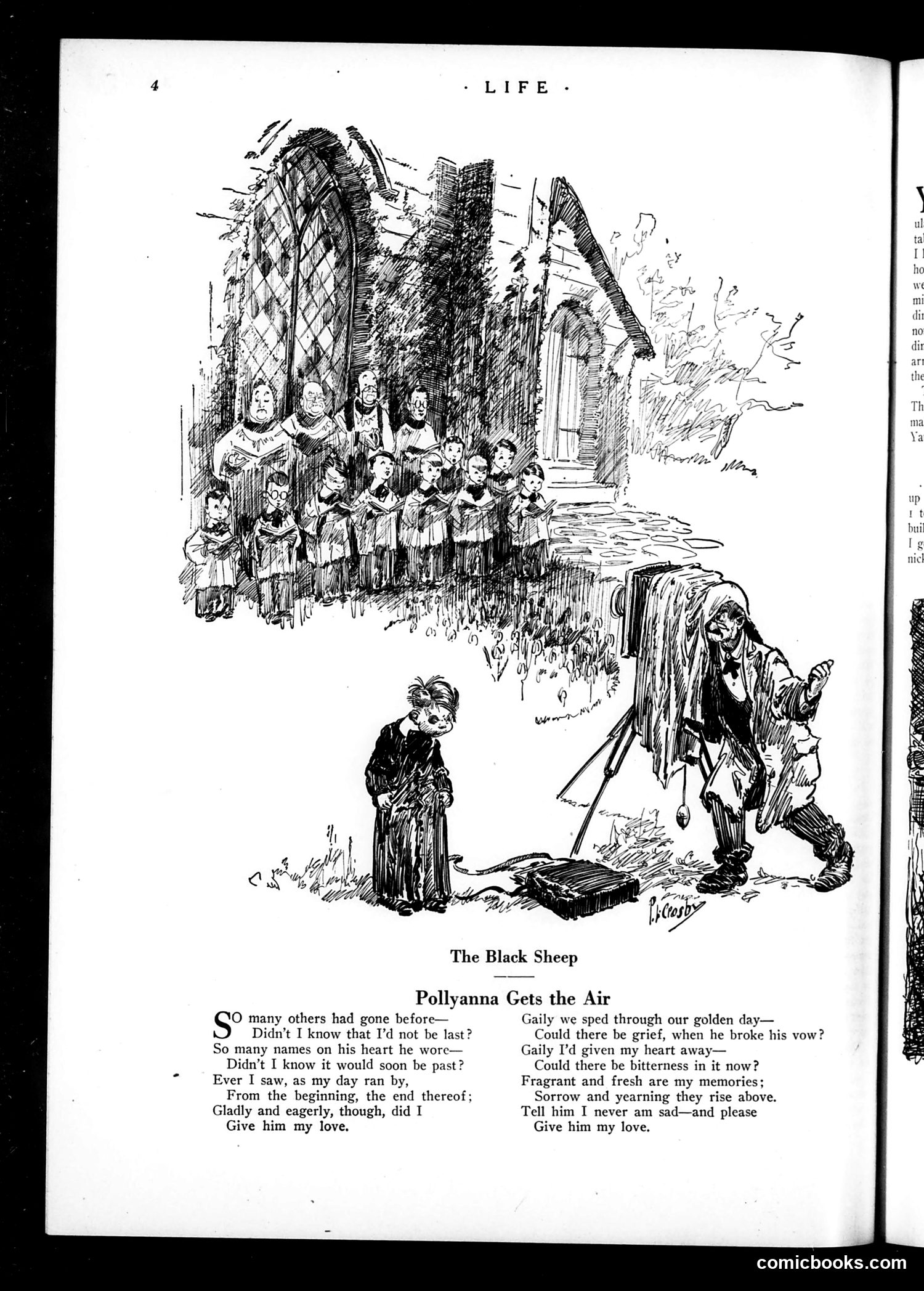
This page contains two separate literary illustrations. The top image depicts a church choir or group of children in religious garments, with two figures (an adult and child) standing apart below—visualizing "The Black Sheep," a common metaphor for a family outcast or social reject. Below is a poem titled "Pollyanna Gets the Air," referencing Eleanor Porter's popular 1913 character known for relentless optimism. The poem's speaker appears to be Pollyanna (or someone like her) who maintained cheerful devotion despite hardship, now seemingly rejected ("gets the air" = is dismissed/abandoned). The text contrasts her past blind optimism with present sorrow, suggesting satire of naive positivity when faced with real suffering or betrayal.
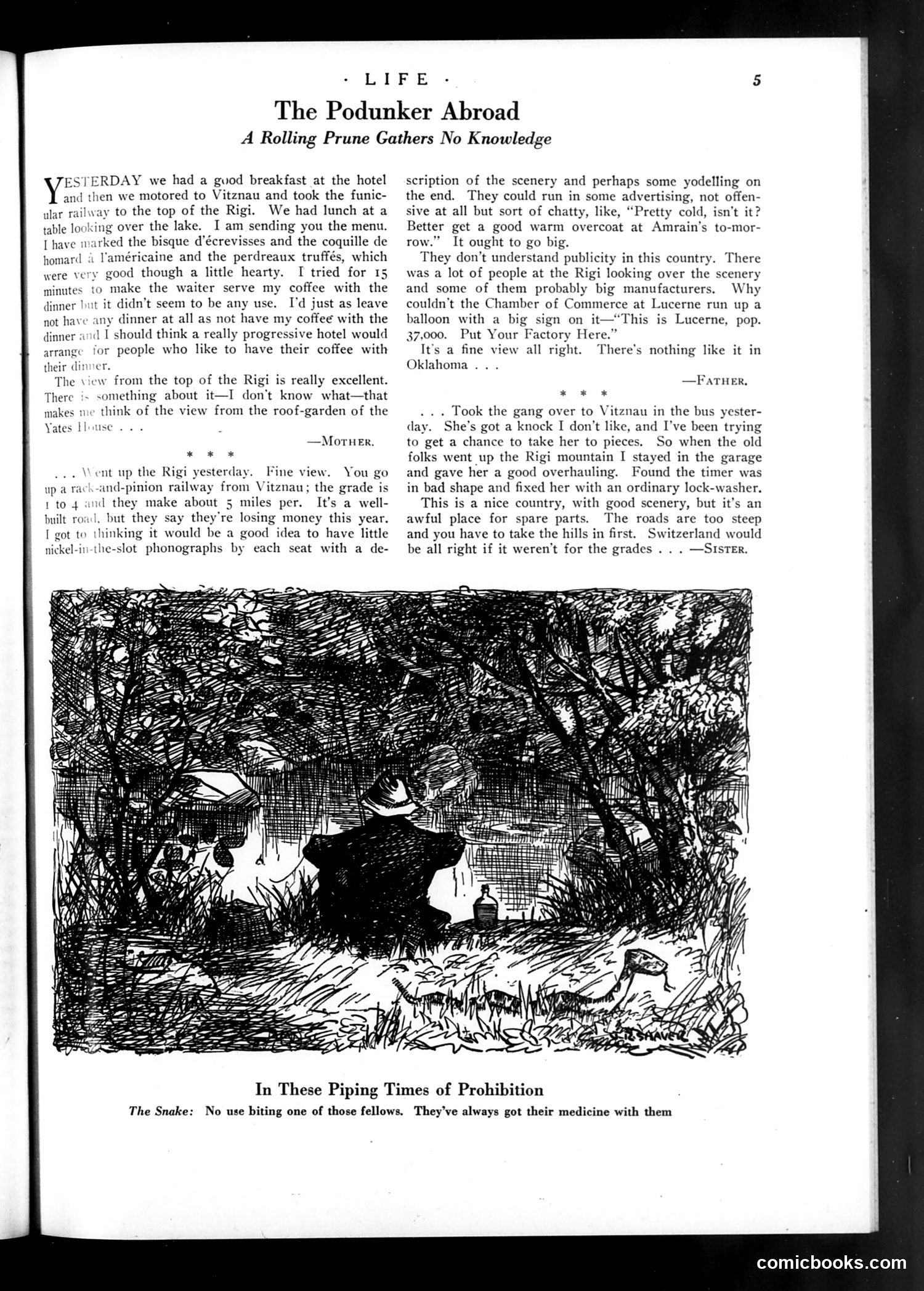
This page presents travel anecdotes from what appears to be an American tourist visiting Europe (likely Austria, given references to Vitznau and the Rigi mountain railway). The satire mocks both American provincial attitudes and European puzzlement at American Prohibition. The cartoon depicts a figure smoking a pipe beside a lake or water body. The caption "The Snake: No use biting one of those fellows. They've always got their medicine with them" suggests Americans were smuggling alcohol despite Prohibition laws. The accompanying text ridicules American ignorance of European culture—tourists wanting American-style coffee service and preferring familiar comforts. The humor targets American insularity and the absurdity of Prohibition-era travelers attempting to circumvent alcohol bans while abroad. The "Snake" likely represents Europe itself, wary of American visitors.
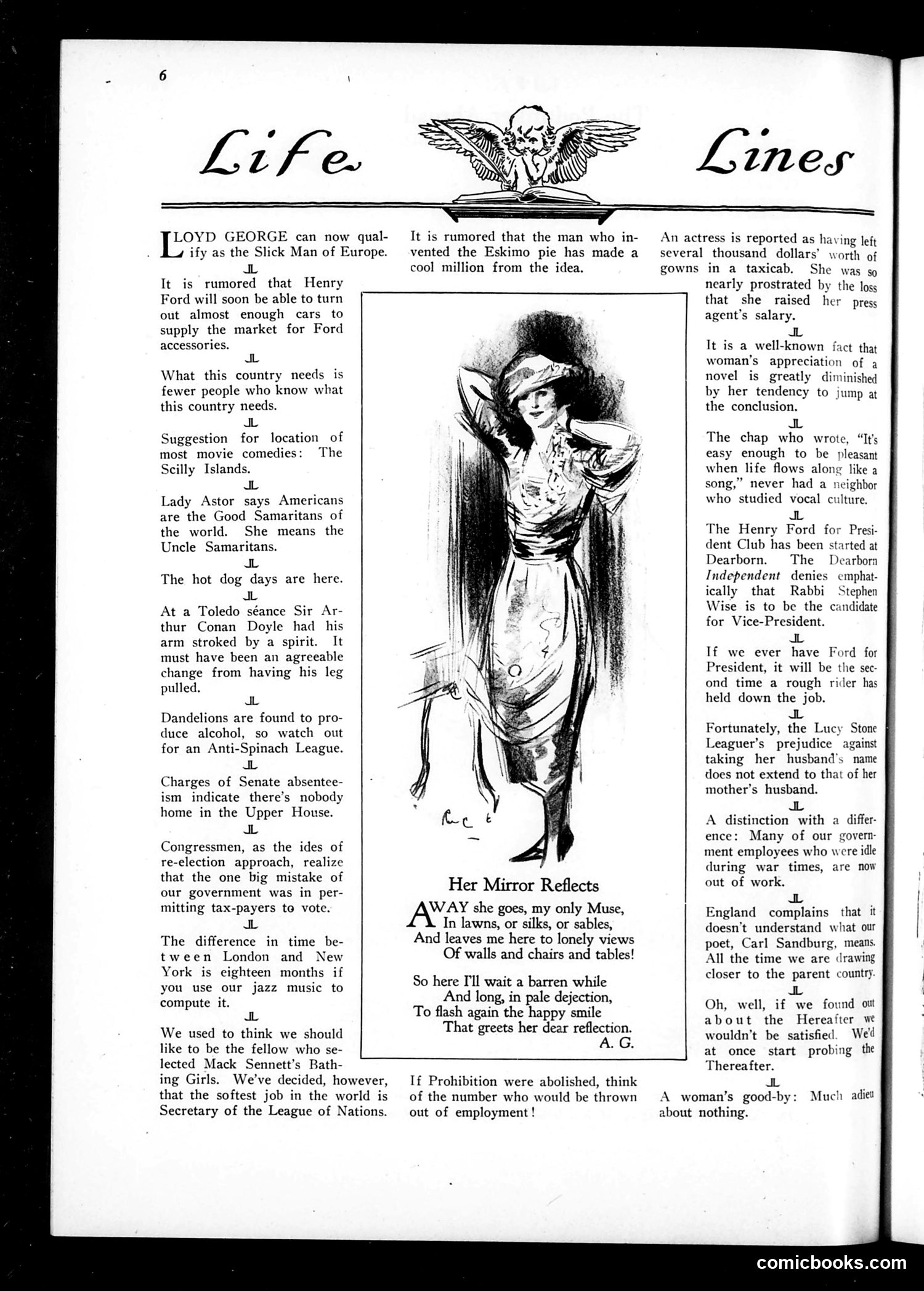
The central illustration depicts a fashionably dressed woman admiring herself, accompanying a poem titled "Her Mirror Reflects" by A.G. The verse satirizes feminine vanity, contrasting her glamorous appearance ("lawns, or silks, or sables") with her actual isolation at home during what appears to be wartime ("barren while / And long, in pale dejection"). The surrounding "Life Lines" section offers brief satirical commentary on contemporary issues: Henry Ford's industrial capacity, the Eskimo pie controversy, American Good Samaritanism, and political matters including Senate absenteeism and Prohibition's employment effects. The page exemplifies Life magazine's signature blend of social commentary and gentle mockery of American culture, targeting vanity, politics, and consumer culture circa the 1920s era.
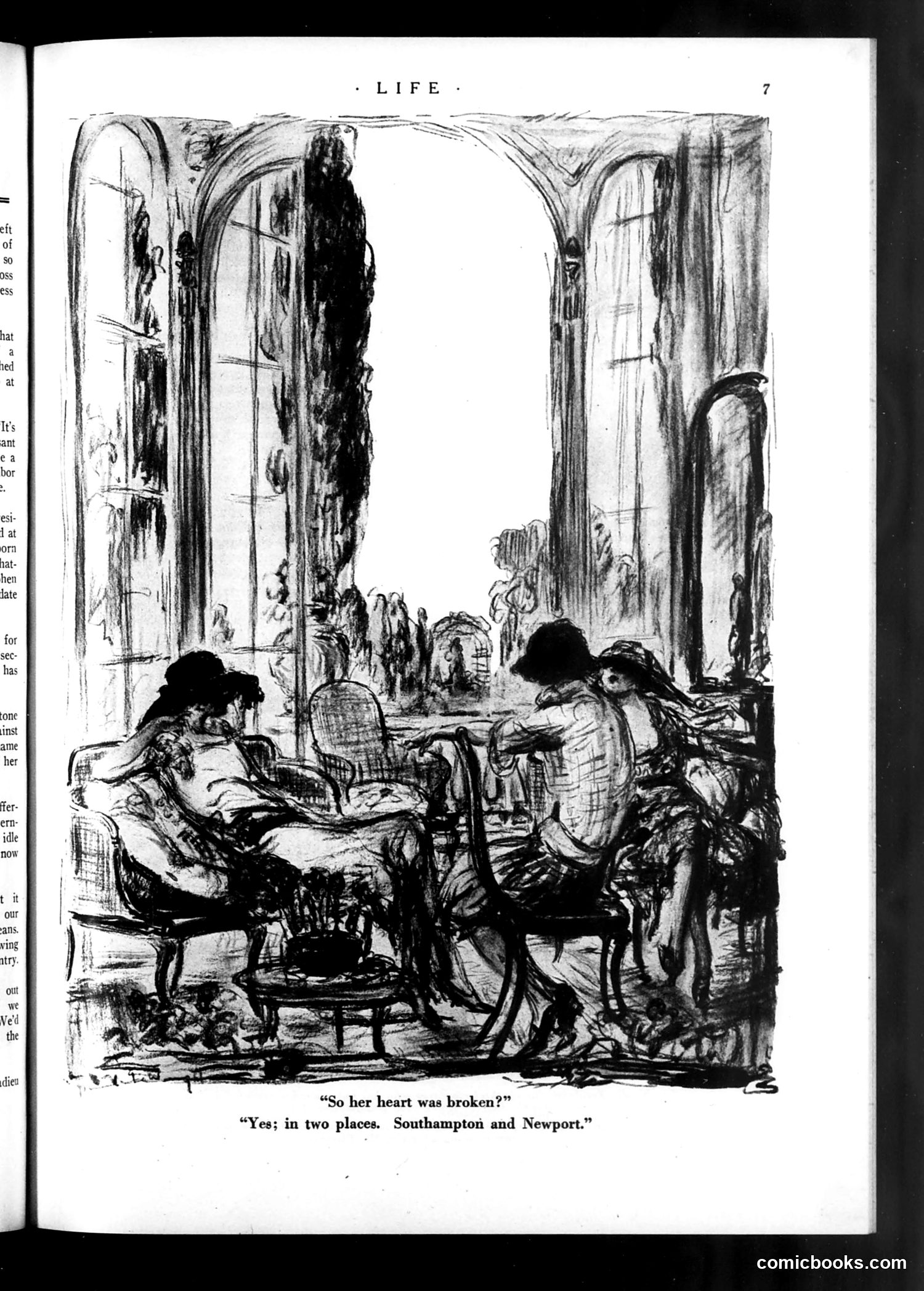
This sketch shows two elegantly dressed women in an interior setting, likely a drawing room, seated and conversing. The caption reveals a joke about romantic heartbreak: one woman asks "So her heart was broken?" and the other responds "Yes; in two places. Southampton and Newport." The satire references these as fashionable seaside resort destinations for wealthy Americans (Southampton on Long Island, Newport in Rhode Island). The joke suggests a woman's romantic disappointment occurred in multiple locations—implying either a prolonged affair across venues or that she was "broken-hearted" repeatedly at different fashionable destinations. It's social commentary on the leisure and romantic escapades of the wealthy elite, mocking their tendency to conduct romantic affairs while traveling between exclusive resort towns.
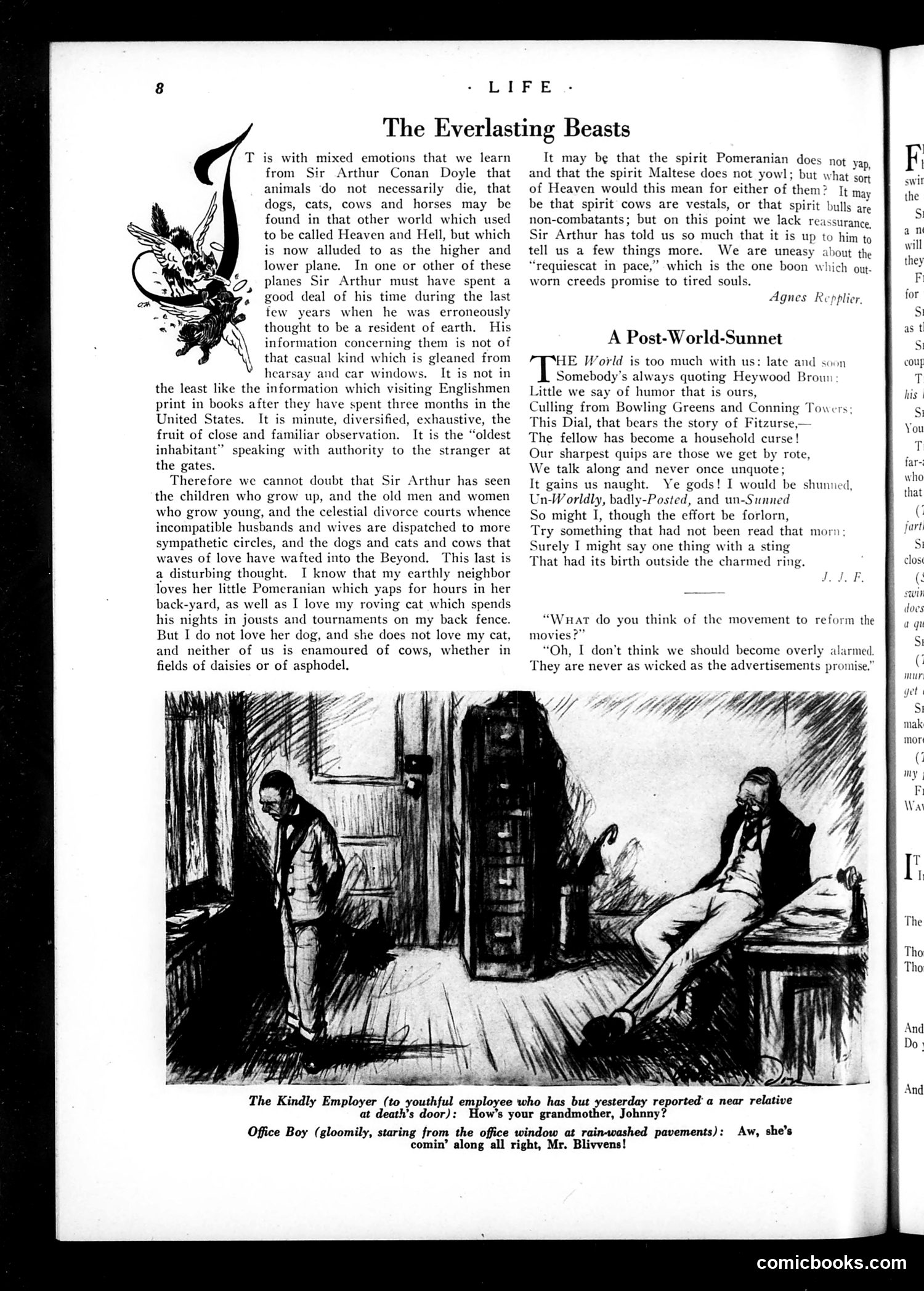
This page contains two separate pieces of satirical content: **"The Everlasting Beasts"** (top): An article by Sir Arthur Conan Doyle discussing whether animals have souls and an afterlife. The author references his own observations of pets and spiritual experiences, suggesting animals may inhabit "higher and lower planes" alongside humans. **"A Post-World-Sunset"** (middle): A poem by J.J.F. satirizing post-war disillusionment and the decline of traditional values. It mocks modern entertainment and advertising culture as corrupting influences. **Bottom Cartoon**: The main cartoon satirizes workplace dynamics. A sympathetic young employee reports a relative's death; his employer callously dismisses this, concerned only that the employee arrive on time. The office boy's deadpan response—"she's comin' along all right, Mr. Blivvens!"—emphasizes the employer's obliviousness to human suffering, critiquing callous capitalism.
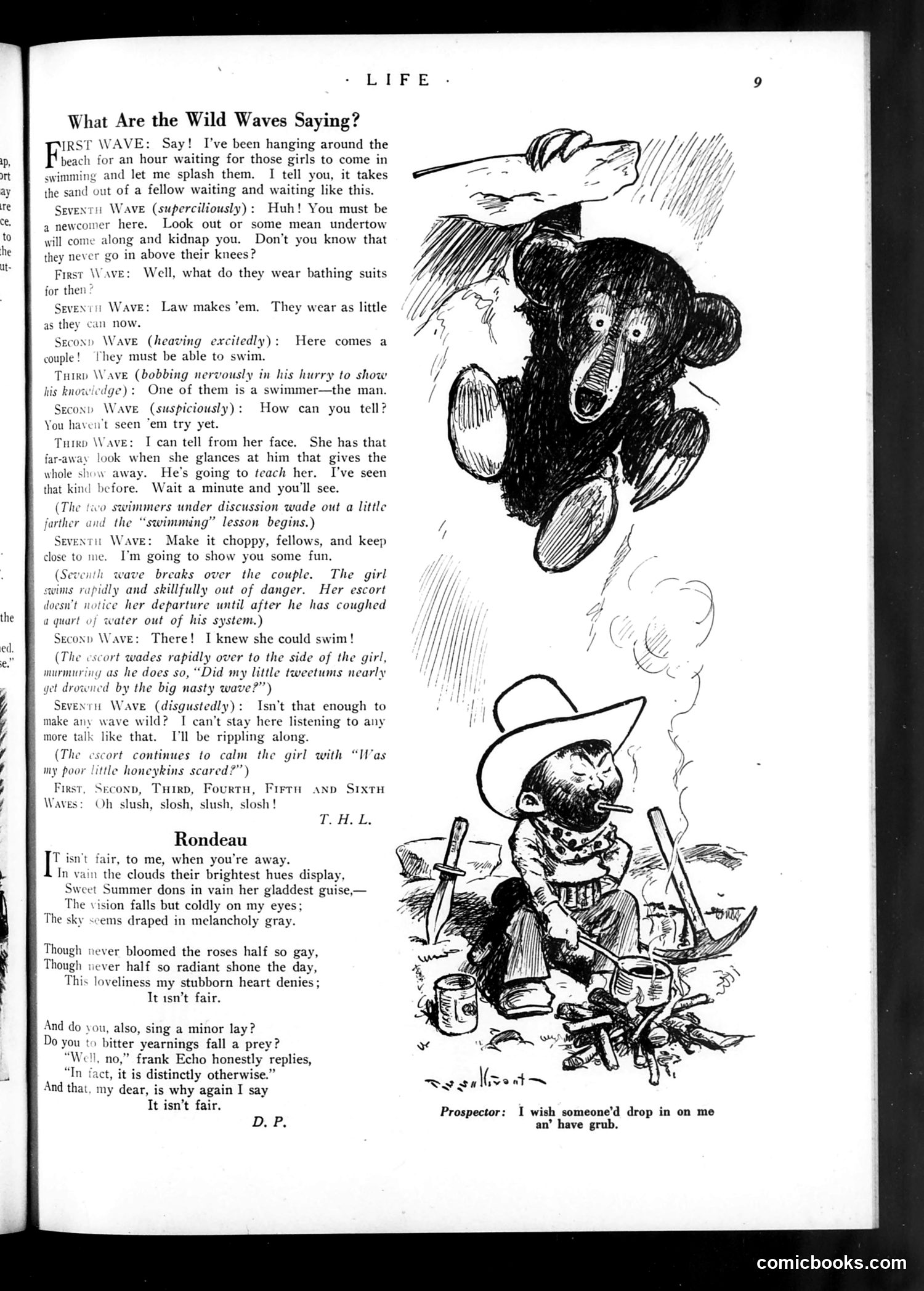
This page contains two distinct pieces of humorous content: **"What Are the Wild Waves Saying?"** is a comedic dialogue among personified ocean waves warning each other about dangers to swimmers—undertows, the need to swim properly, and a woman they plan to "teach" by nearly drowning her. The humor relies on treating waves as gossips with malicious intent. **"Rondeau"** is a poem by D.P. expressing romantic melancholy about a absent lover, complaining that nature's beauty seems diminished without them. The accompanying illustration shows a prospector or cowboy figure, apparently unrelated to the poem's sentiment, with a caption expressing hunger ("I wish someone'd drop in on me an' have grub"). The prospector cartoon appears to be satirizing the disconnect between romantic poetry and harsh frontier reality, or offering visual comedy through incongruity.
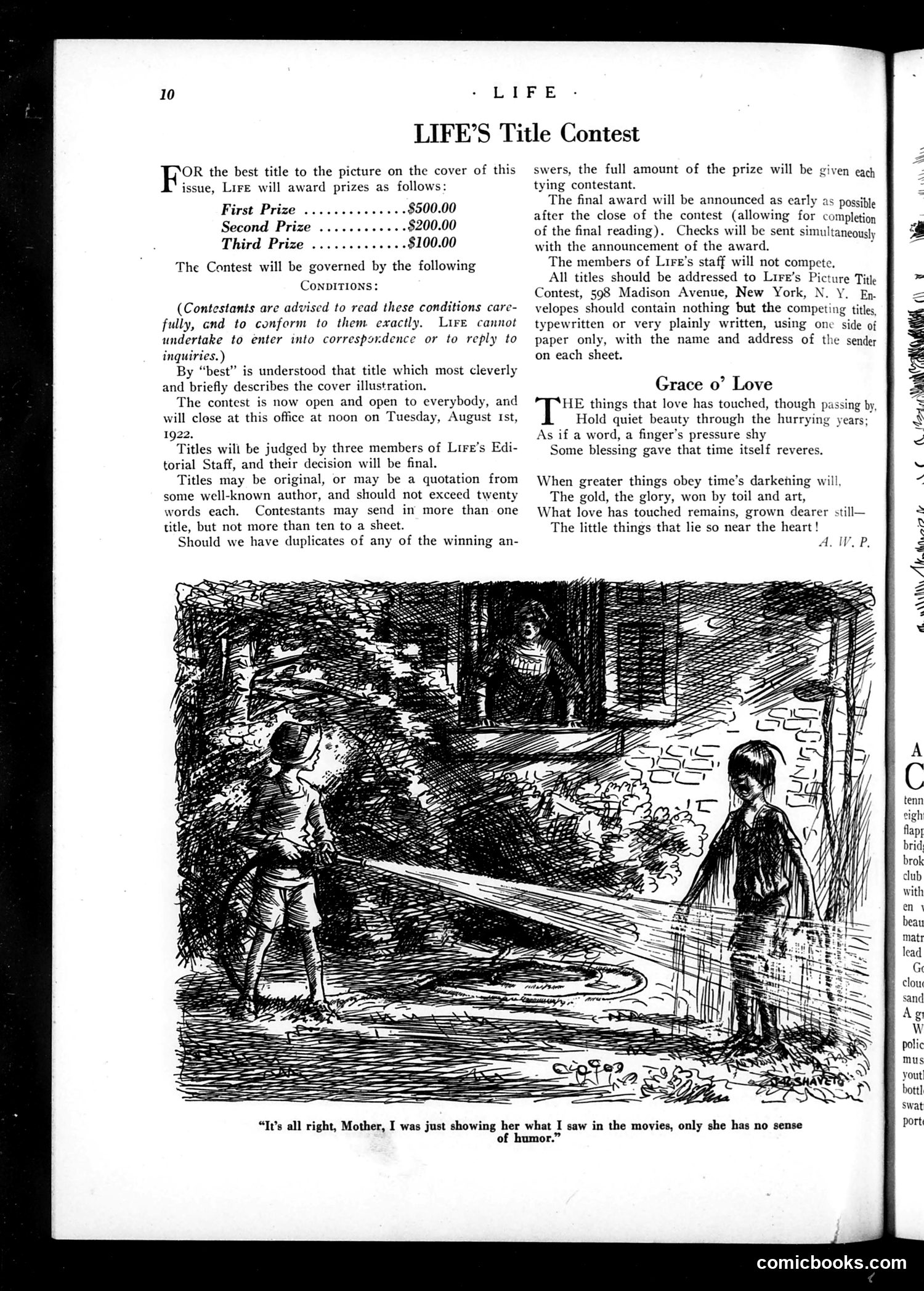
This page contains two distinct elements: **Top section:** A contest announcement for LIFE magazine readers to submit titles for a cover picture, with prizes ($500, $200, $100). Standard contest rules follow. **Bottom section:** A single-panel cartoon showing two children and an adult (likely a mother) in what appears to be a home setting. One child is explaining to the mother: "It's all right, Mother, I was just showing her what I saw in the movies, only she has no sense of humor." The joke's satire targets **parental anxiety about cinema's influence on children**—a genuine concern in the 1920s. The cartoon mocks both the child's casual dismissal of the mother's worry and the assumption that movie content automatically corrupts young viewers. The punchline suggests the other child simply lacks appreciation rather than moral corruption, undercutting fears about film's corrupting power through gentle comedy.
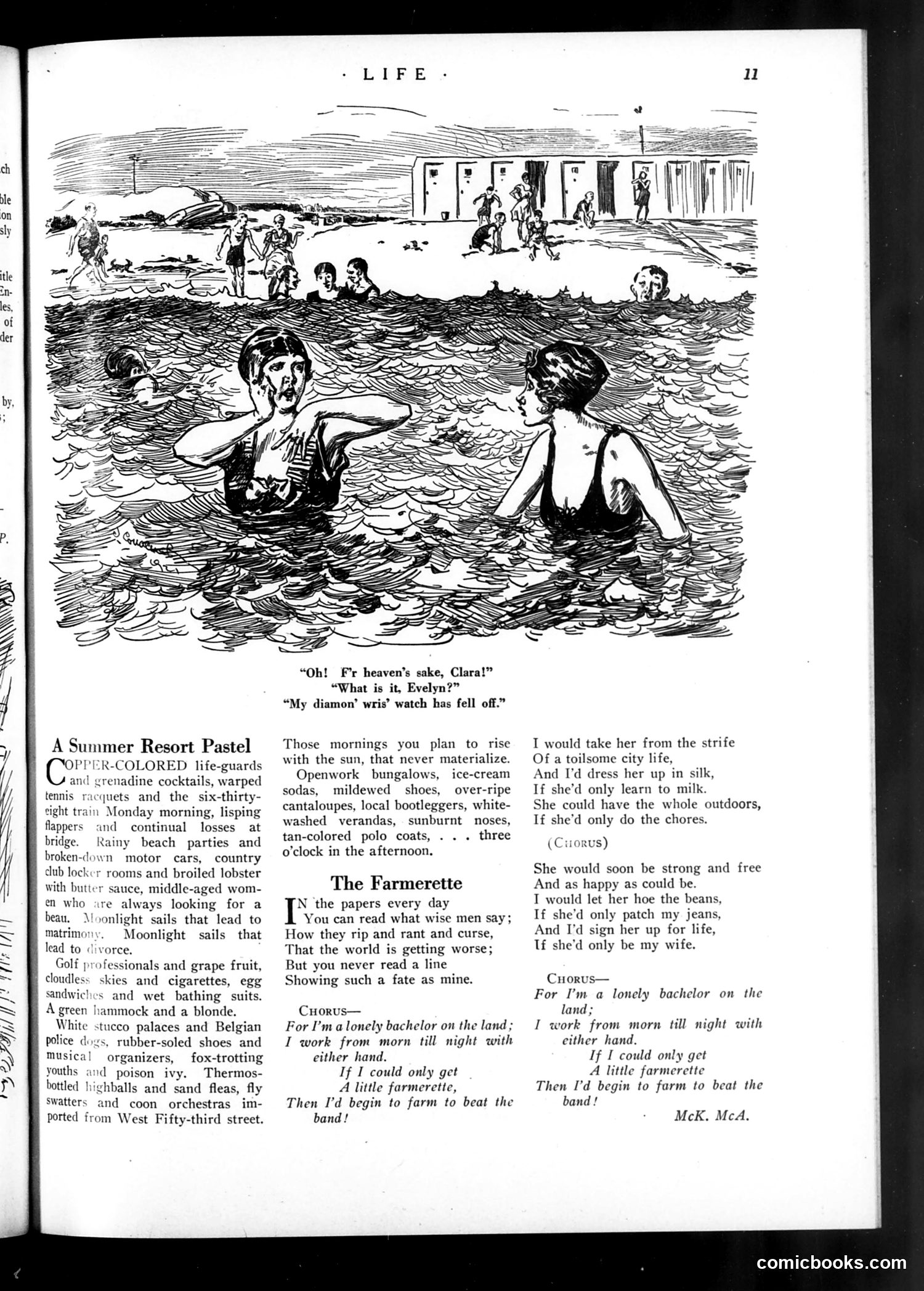
This page contains a beach scene illustration accompanied by two poems about leisure and labor. **The Cartoon**: The sketch shows two women in a swimming pool or beach area, with one exclaiming "Oh! Fr heaven's sake, Clara!" about a lost diamond wrist watch. The humor is social satire—it mocks wealthy leisure-class women whose concerns are frivolous luxury goods rather than substantive matters. One woman's distress over losing an expensive piece of jewelry while swimming captures the satirical point about upper-class excess and materialism. **The Poems**: "A Summer Resort Pastel" and "The Farmerette" offer contrasting perspectives. The first describes idle wealthy resort life (golf, cocktails, lounging). The second presents a farmer's romantic fantasy about escaping to domestic rural life with a woman. Together, they satirize both wealthy idleness and working-class escapism—mocking different classes' unrealistic dreams.
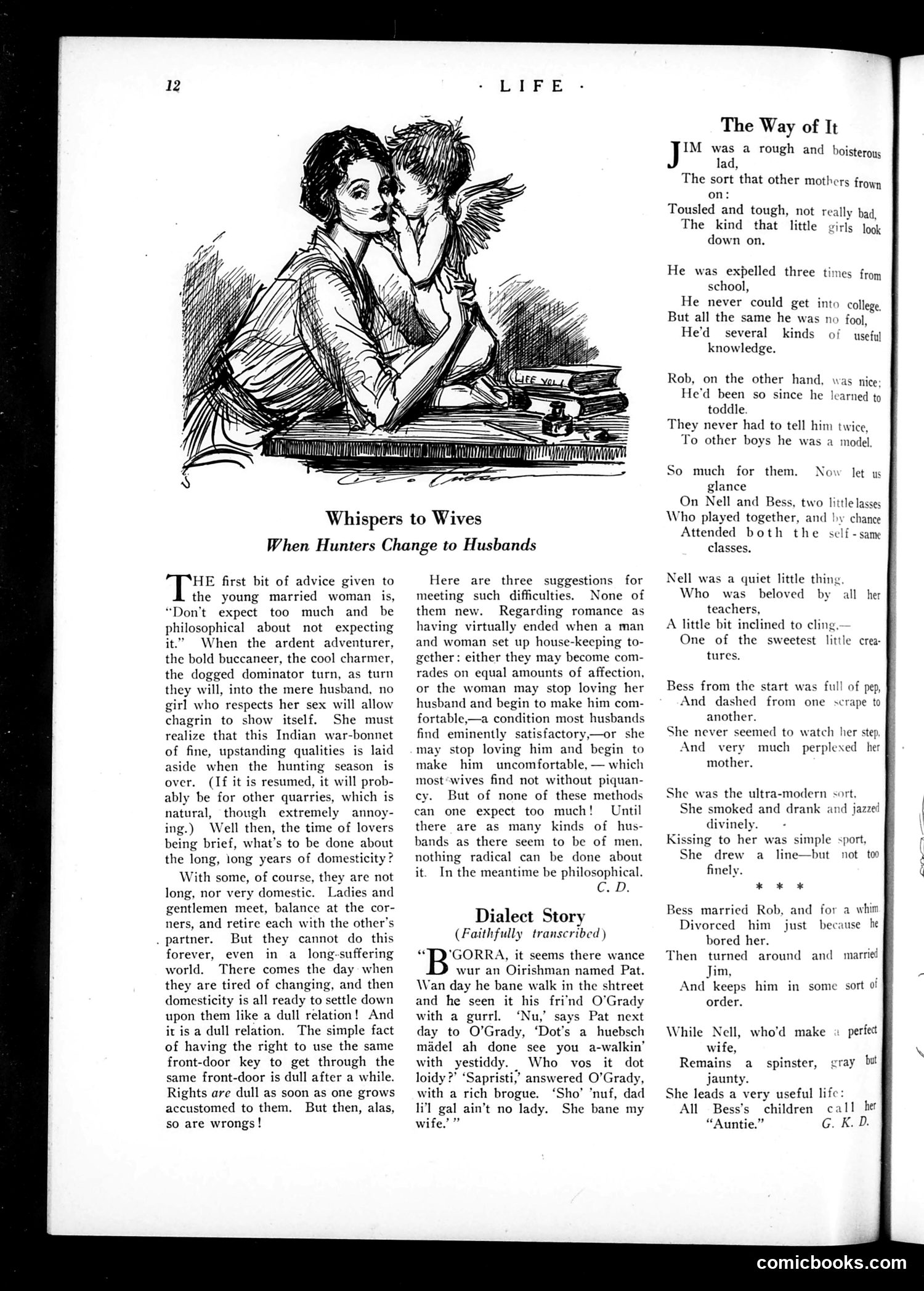
This page contains three distinct pieces of social commentary: **"Whispers to Wives"** offers advice to newly married women about managing husbands during the transition from courtship to domestic life. It humorously suggests that wives should accept their husbands' need for independence and occasional roughness—particularly during hunting season—rather than expect constant romantic attention. **"The Way of It"** presents contrasting character sketches: Jim, a rough troublemaker, and Rob, a well-behaved boy. The narrative suggests that respectability doesn't guarantee success or happiness, while misbehavior doesn't guarantee failure—a commentary on Victorian assumptions about morality and social outcomes. **"Dialect Story"** is a brief humorous anecdote featuring Irish characters using phonetic dialect humor, common in early 20th-century American comedy. Overall, the page satirizes marriage expectations and social stereotypes of the era.
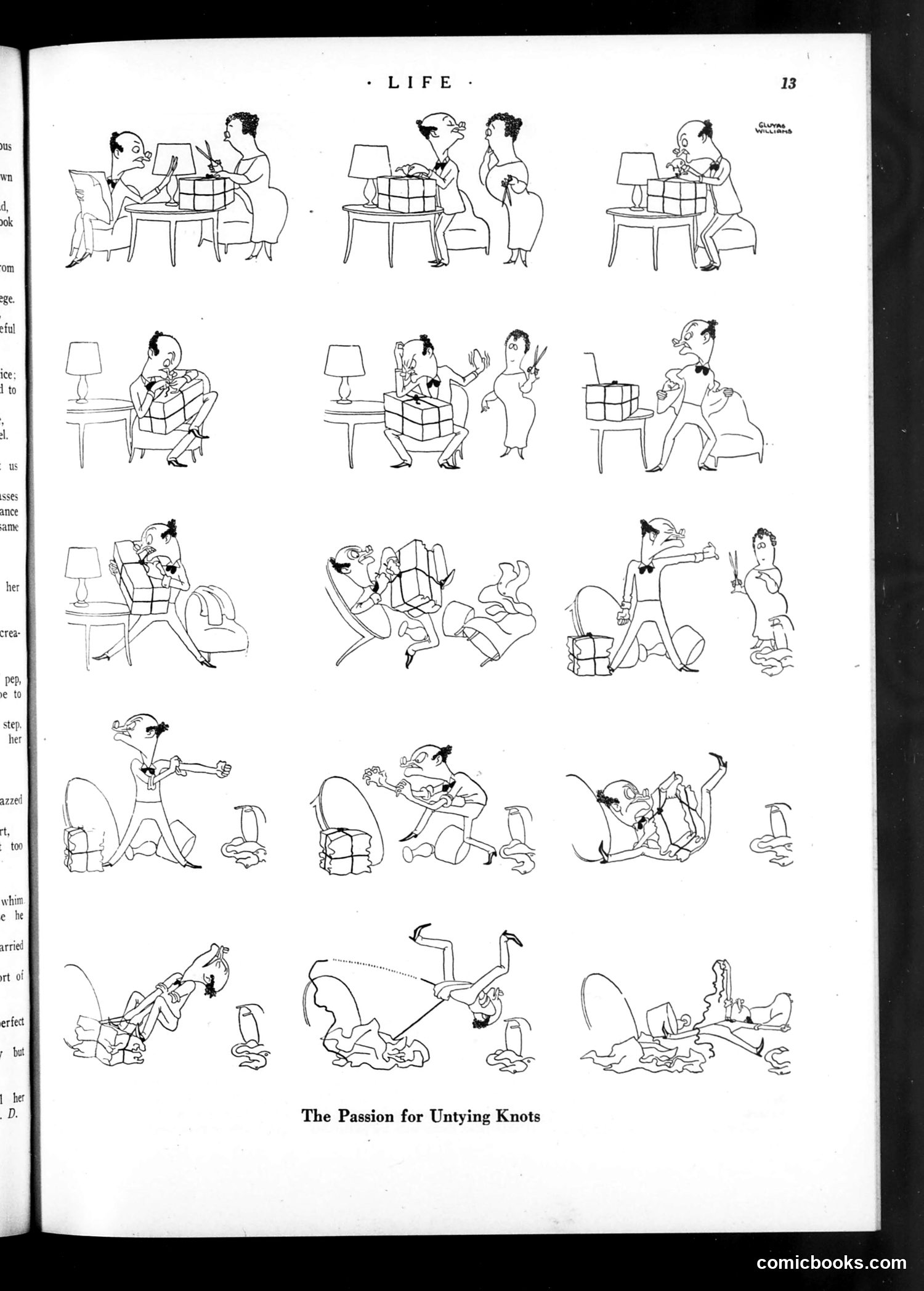
This page presents a humorous comic strip showing a couple exchanging wrapped gifts. The narrative follows a predictable pattern: the man excitedly gives the woman increasingly elaborate packages tied with bows and knots. Rather than opening them properly, the woman becomes obsessed with untying the knots themselves—struggling, contorting, and eventually collapsing in frustration as the knots prove increasingly difficult to undo. The satire targets the stereotypical behavior of gift-givers and recipients, particularly gendered expectations around gift-giving and receiving. The joke suggests that some people become so focused on the wrapping's presentation that they miss the point of the gift itself, turning a simple pleasure into exhausting frustration.
The page contains two opinion articles rather than illustrated cartoons. The header illustration is decorative, showing a classical figure and landscape. **Content Summary:** The first article criticizes Harvard College for over-enrollment and insufficient oversight, suggesting the university has become too commercialized through aggressive advertising campaigns by "Associated Harvard Clubs." The author argues overcrowding compromises educational quality and proposes limiting student intake. The second brief article discusses Unitarianism's historical role in attracting students away from Harvard in earlier centuries, suggesting this represents a business competition metaphor—universities "selling" themselves like commercial products. Both pieces critique institutional management through satirical social commentary rather than visual satire, reflecting 1920s concerns about American higher education's expansion and commercialization.
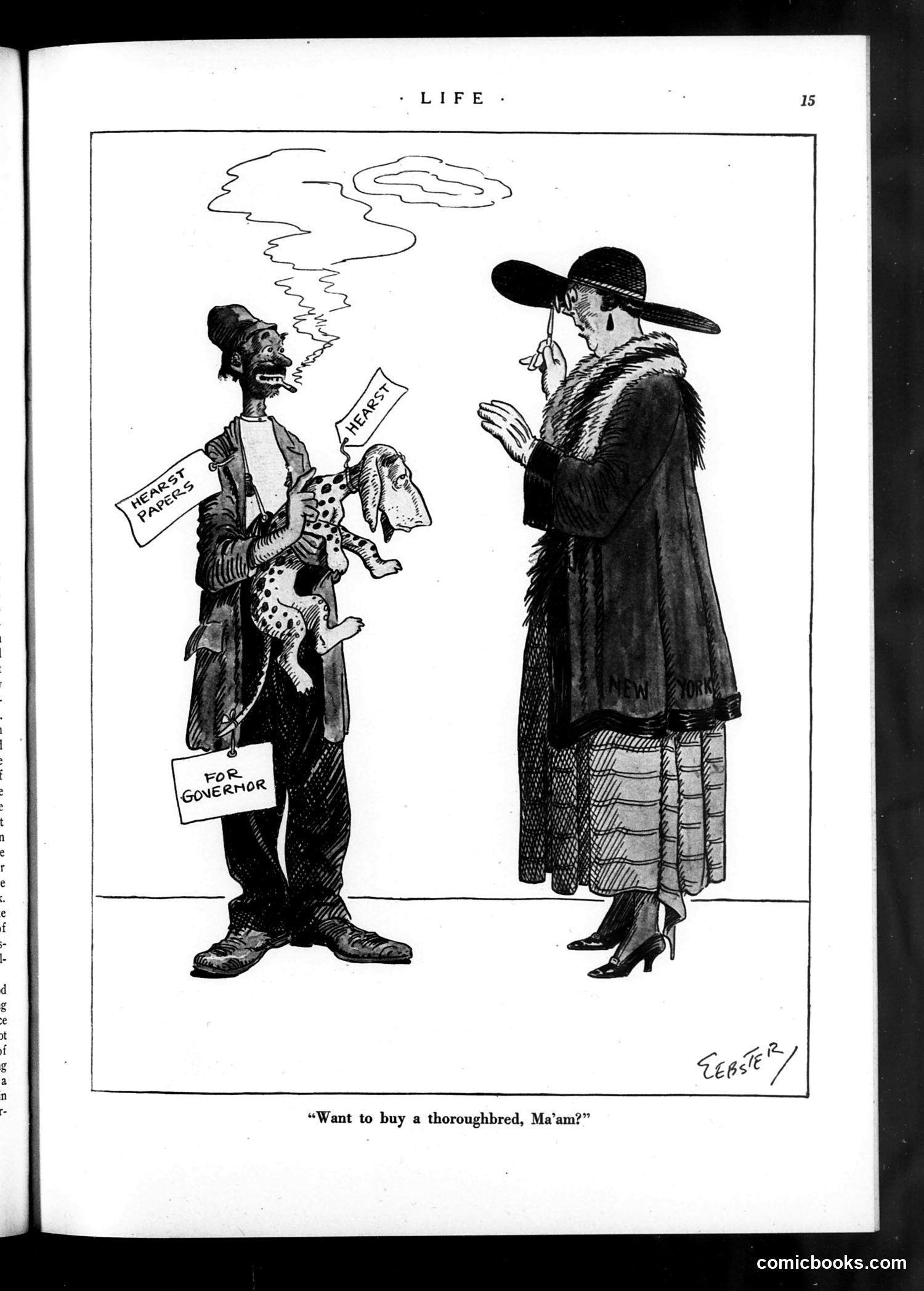
This cartoon satirizes political corruption and vote-buying during election season. On the left, a caricatured politician (marked "FOR GOVERNOR") holds papers labeled "HEARTS" and "HEARTS PAPERS," while literally juggling what appears to be a leopard or spotted animal. The exaggerated facial features suggest ethnic stereotyping common to early 20th-century satire. The woman on the right represents a voter being pitched a "thoroughbred"—likely a metaphor for a political candidate being sold like livestock. The thought cloud above shows her considering this transaction. The cartoon's point: politicians peddle candidates to voters like animal dealers, reducing elections to crude commercial transactions. It mocks both the cynical manipulation of the political process and the gullibility of voters who accept candidates uncritically.
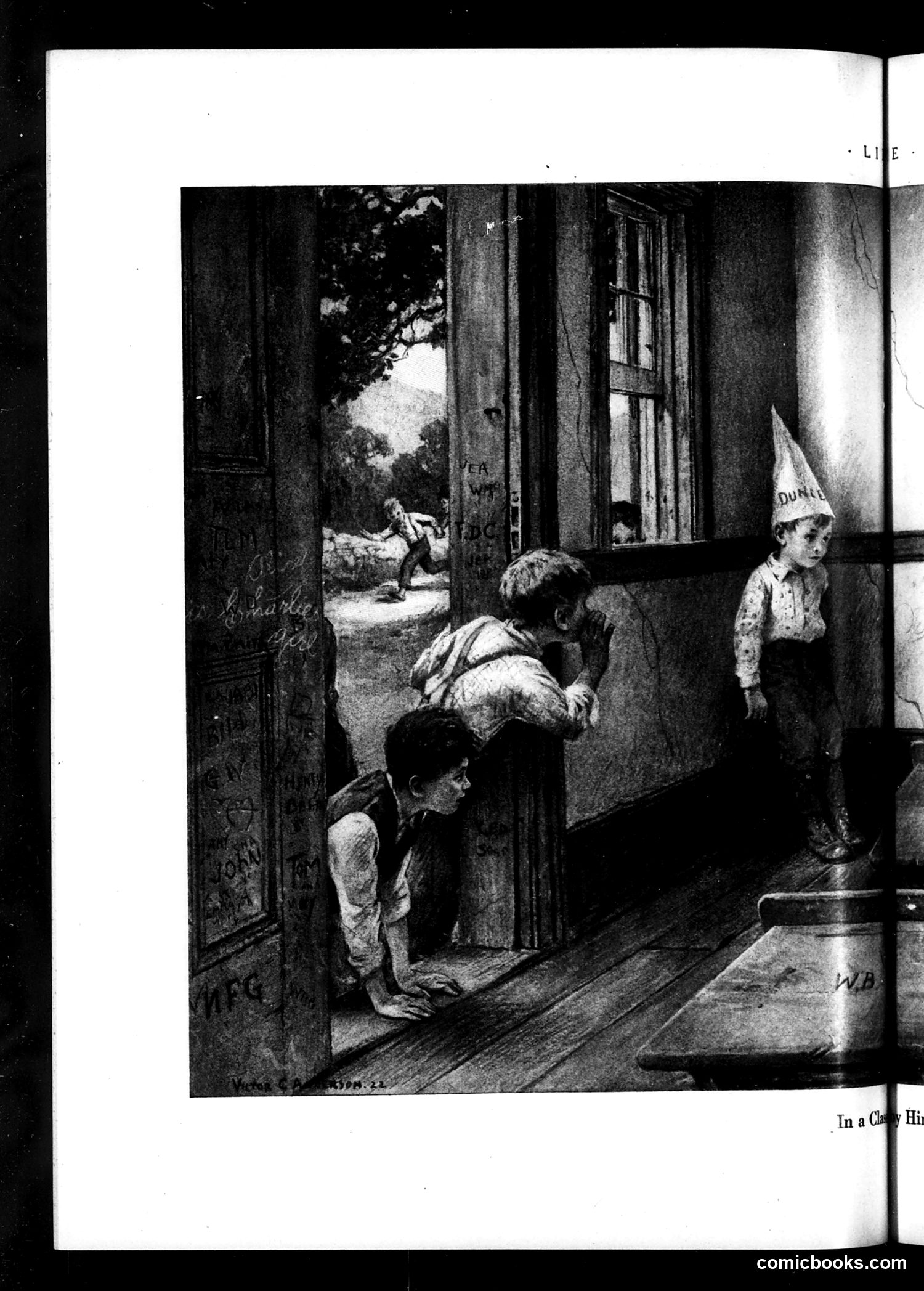
This black and white illustration depicts children playing in a cramped, poverty-stricken urban alley or tenement corridor. The scene shows barefoot or poorly-clothed children in a narrow space between buildings, with one child crawling on the floor and others standing nearby. One child wears what appears to be a dunce cap. The image appears to be social commentary on urban poverty and child welfare conditions, likely from the early-to-mid 20th century. The cramped, dark setting and depiction of children in such conditions suggest the illustration critiques inadequate housing, poverty, or neglectful living situations affecting children. The overall mood is bleak, emphasizing the grim realities of underprivileged urban life that Life magazine's satirical content often highlighted for its educated readership.
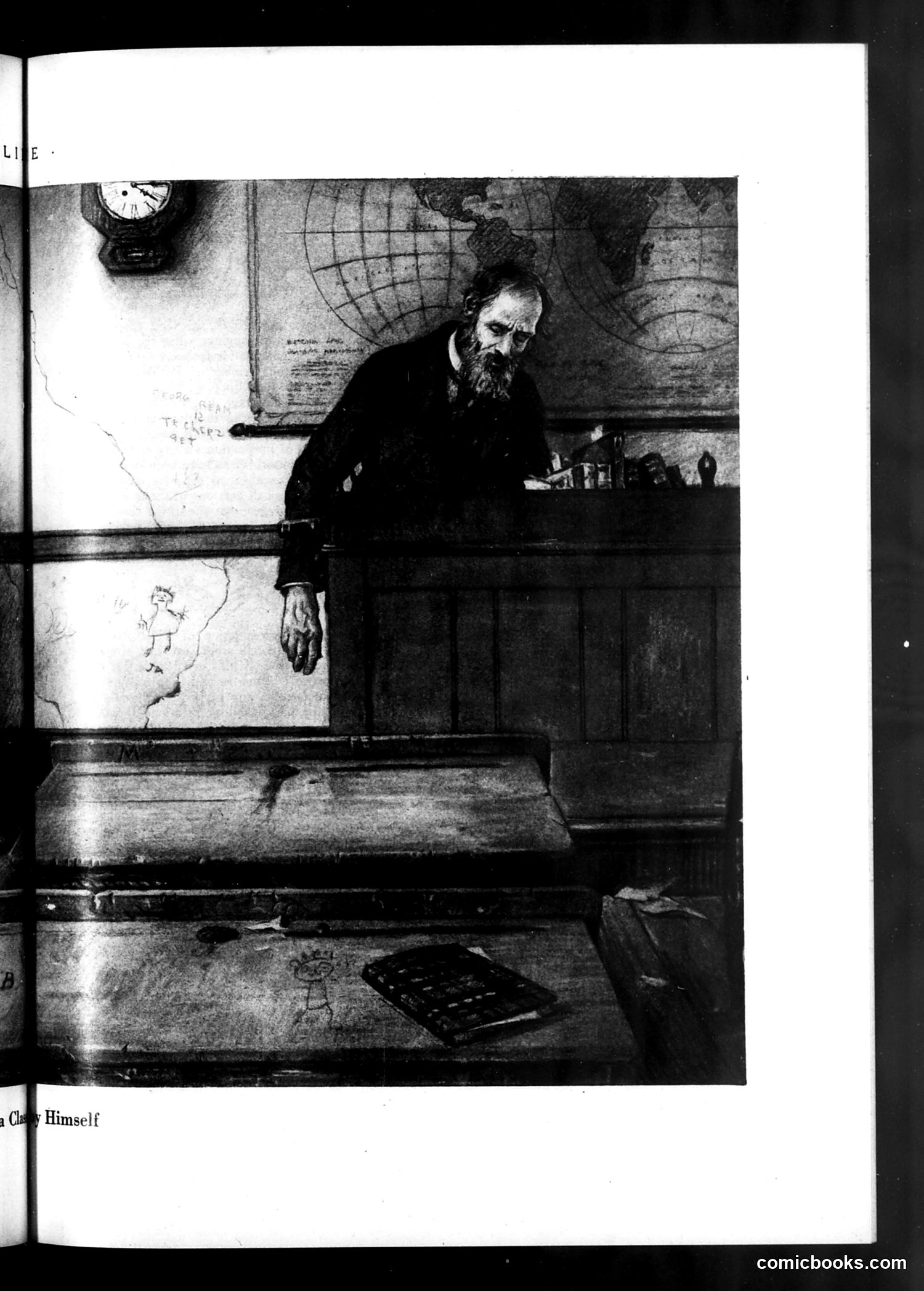
This appears to be a satirical photograph or illustration from *Life* magazine showing a bearded man in formal attire standing at what looks like a desk or workstation. Behind him are maps or charts on the wall, and a clock is visible above. The caption "A Class Himself" suggests the figure is being portrayed as someone of distinctive or notable character. Without additional context visible in the image or OCR text, I cannot definitively identify who this person is meant to represent or what specific political or social situation the satire references. The formal setting and maps suggest a position of authority or expertise, but the exact point of the satire remains unclear from this page alone.
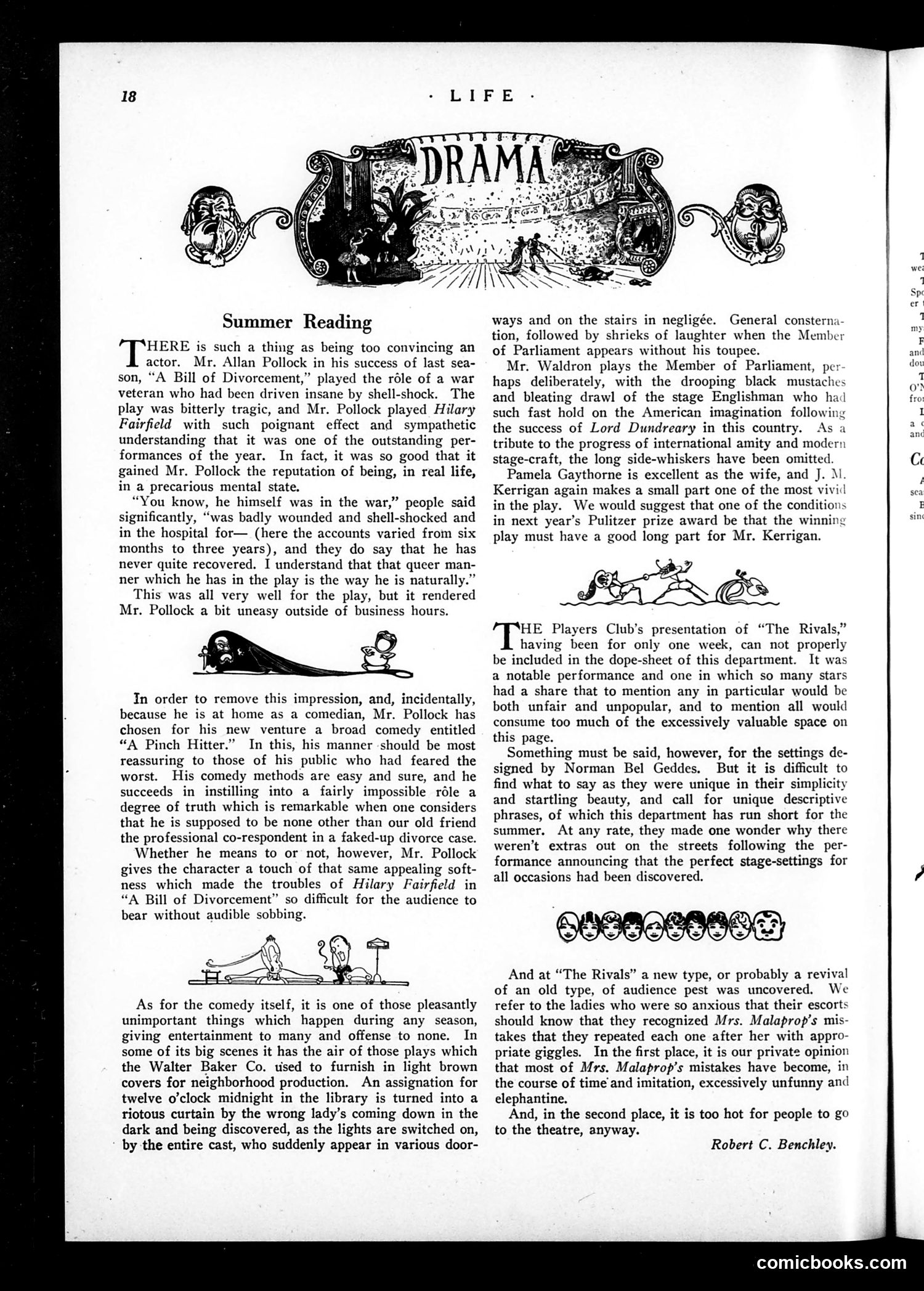
This is a theater review column discussing two Broadway productions. The main subject is actor Allan Pollock, who became so convincing playing a shell-shocked WWI veteran in "A Bill of Divorcement" that the public believed him genuinely unstable in real life. The reviewer notes this damaged Pollock's social reputation, prompting him to take a light comedy role in "A Pinch Hitter" to reassure audiences of his mental stability. The satire is gentle: Pollock's very success as a tragic actor backfired, creating an unwanted real-world persona. The reviewer praises his new comedic work while gently mocking the supporting players' stock characterizations—particularly Mr. Waldron's stereotypical "stage Englishman" performance (referencing the dated "Lord Dundreary" theatrical type). The brief mention of "The Rivals" notes it ran too short to review properly. The small illustrated vignettes show theatrical humor but lack specific political content.
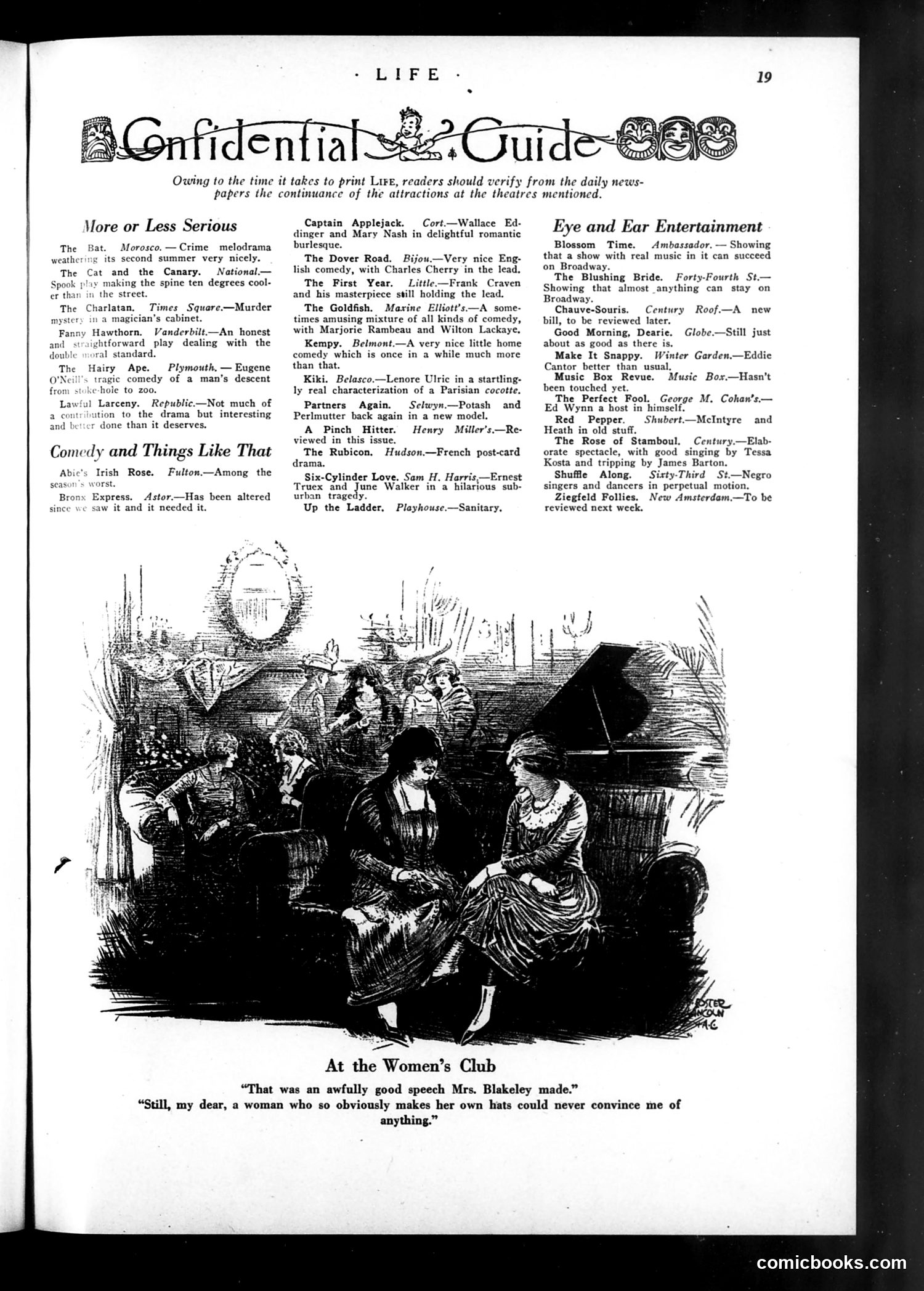
This single-panel cartoon satirizes class-based prejudice and superficial judgment among women. The scene shows two women at a women's club discussing a speech by Mrs. Blakeley. One woman dismisses the speaker's credibility entirely—not because of her arguments, but because Mrs. Blakeley "obviously makes her own hats." The joke targets the social snobbery of the era: making one's own clothing was associated with lower economic status or lack of leisure time. A "respectable" upper-class woman would have a milliner make her hats. The cartoon mocks how wealthy women could be so preoccupied with visible markers of class distinction that they'd ignore substance entirely. It's satirizing the vapidity and rigid class consciousness of female social circles, suggesting that even a good speech counts for nothing if the speaker's clothing betrays insufficient wealth.
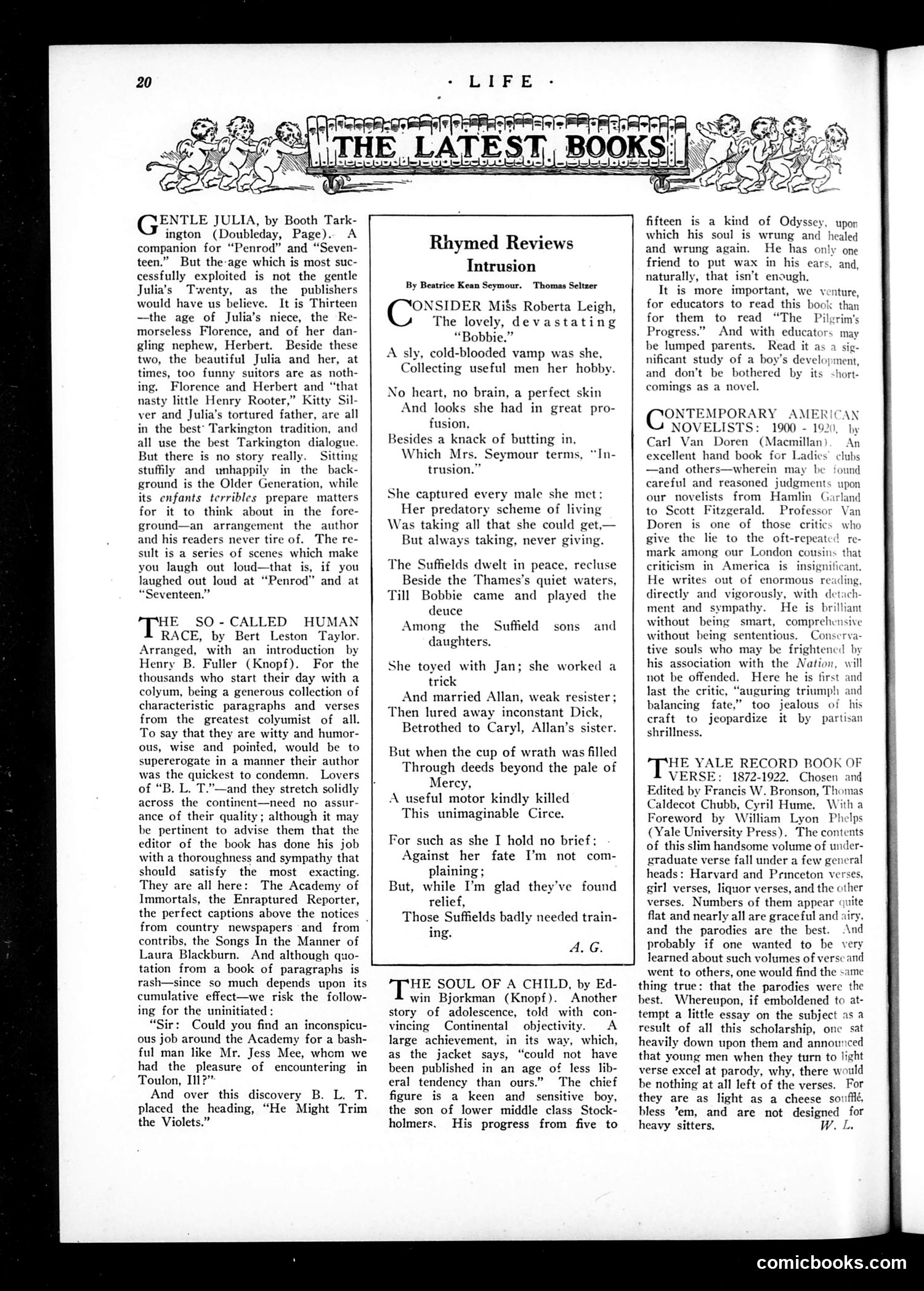
This page features literary reviews from Life's book section, circa early 1920s. The reviews discuss three works: Booth Tarkington's "Gentle Julia" (praised for its comic depiction of mischievous teenagers rather than the titular adult heroine), a collection of columns by humorist Bert Leston Taylor called "The So-Called Human Race," and Edwin Bjorkman's "The Soul of a Child." The "Rhymed Reviews" section offers verse commentary on a novel called "Intrusion" about a morally corrupt woman ("Bobbie") who seduces multiple men in a peaceful family before meeting her demise via motor accident. The reviewer expresses no sympathy for the character's fate. This represents typical early-20th-century literary criticism emphasizing moral judgment of characters alongside aesthetic assessment—the destructive woman receives narrative punishment the critic approves.
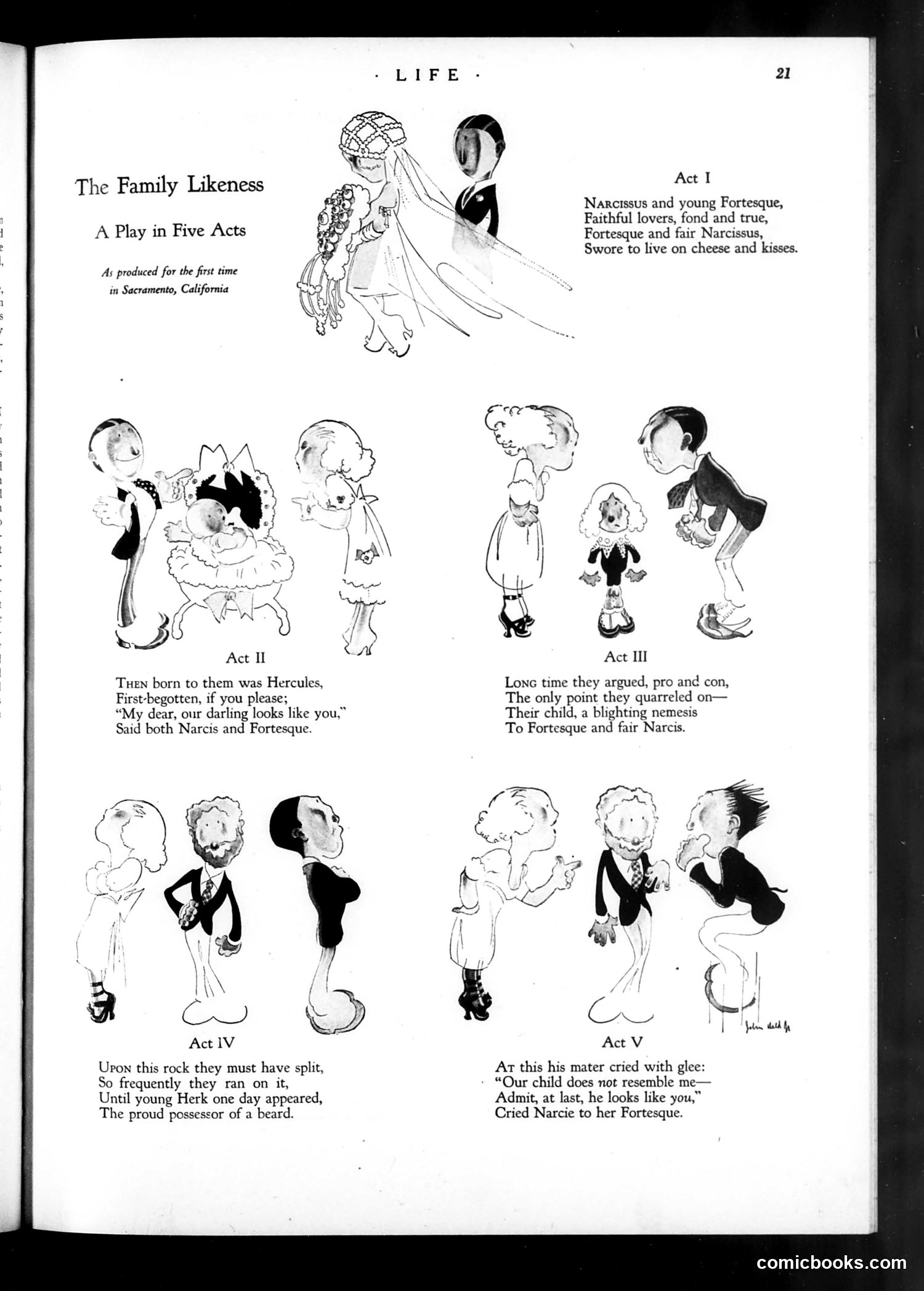
This five-act comic play satirizes a same-sex couple (Narcissus and Fortesque) and their adopted son Hercules. The joke structure follows a classic comedic arc: the couple swears eternal devotion, has a child they can't agree resembles either parent, argues constantly about this point, and finally resolves the conflict when the child grows a beard—making him look masculine enough that each parent can claim he resembles the other. The satire appears to mock both same-sex relationships (treating them as inherently absurd) and vanity/narcissism (characters named after mythological narcissists). The beard's appearance as a "solution" suggests contemporary anxieties about masculine identity and legitimacy. The publication location (Sacramento, California) and magazine context suggest this reflects early 20th-century American attitudes toward non-traditional families as ridiculous fodder for humor.
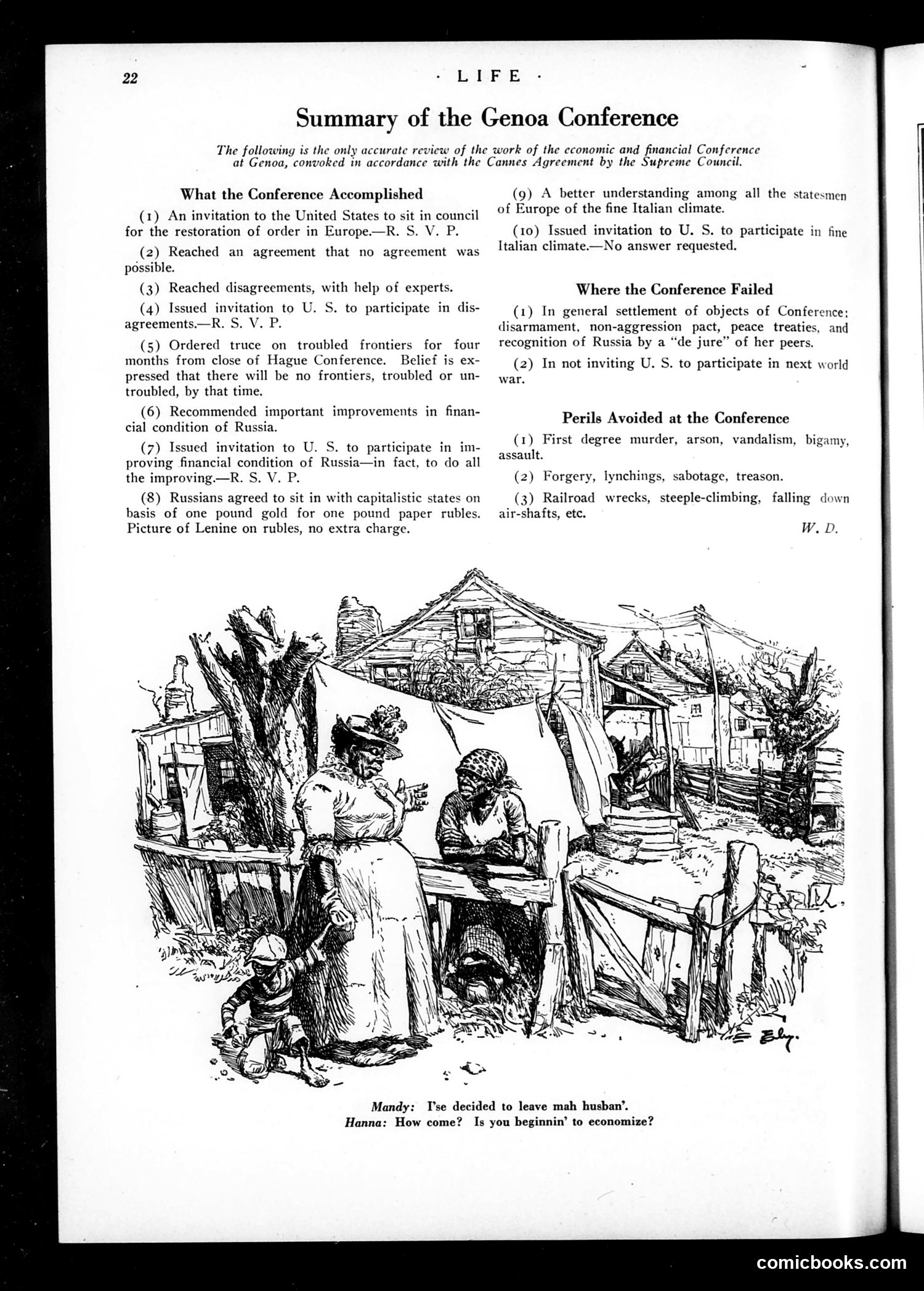
This 1922 *Life* magazine page satirizes the Genoa Conference, a post-WWI economic summit attempting European reconstruction. The text mockingly summarizes the conference's accomplishments as essentially inviting the United States to participate in doing nothing—repeatedly extending "R.S.V.P." invitations while achieving no actual agreements. The satire targets European diplomatic failure: the conference accomplished "disagreements" rather than peace treaties, disarmament, or Russian recognition. The piece particularly ridicules how much effort was spent simply getting the U.S. involved in inevitable failure. The cartoon below depicts rural poverty, likely commenting on European economic devastation. The dialogue joke—a woman leaving her husband to "economize"—suggests economic desperation has reduced marriage to financial calculation, reinforcing the satire's point about Europe's dire financial condition the conference failed to address.
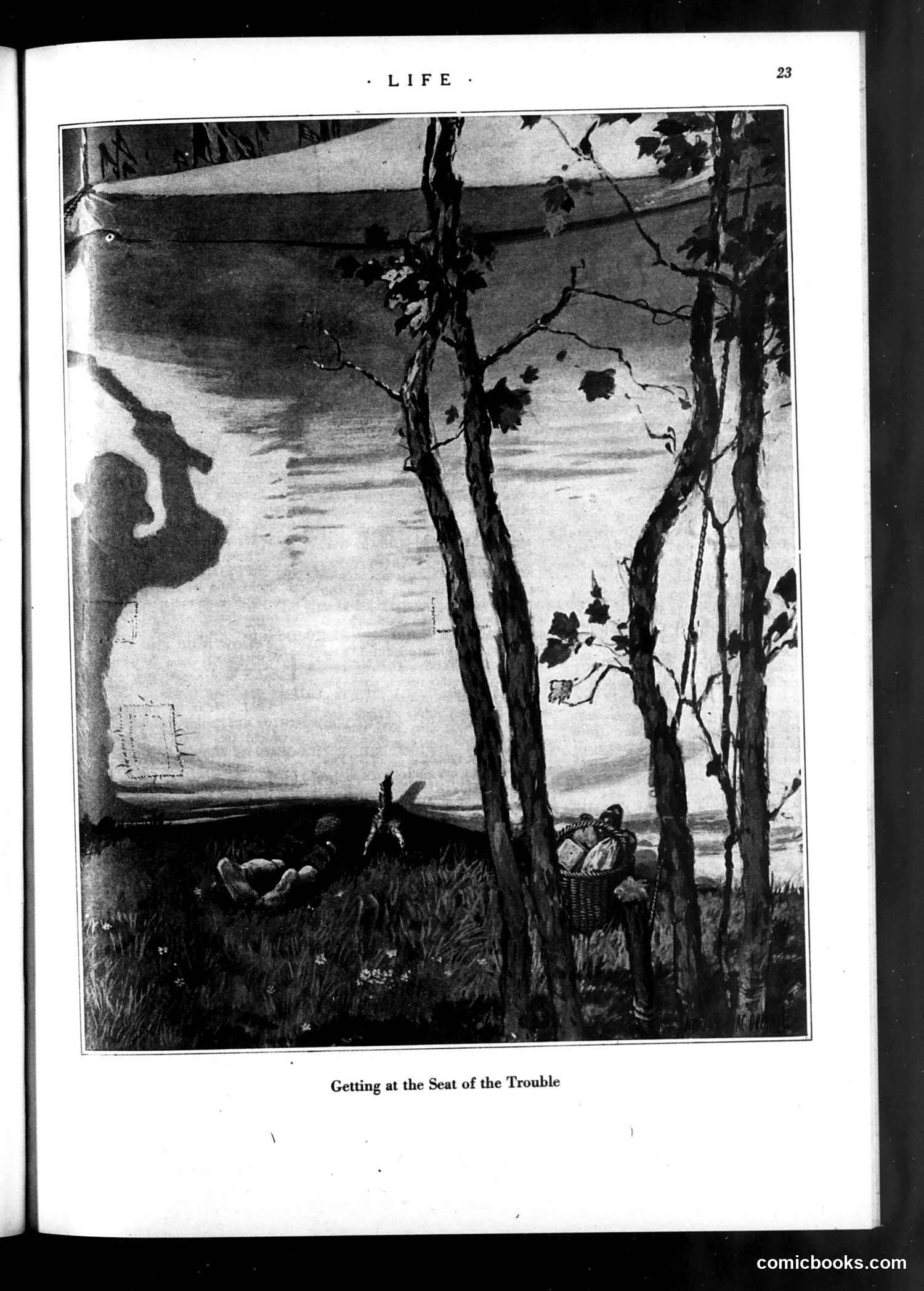
This satirical illustration shows a figure examining or investigating something by a riverbank, with trees framing the scene. The caption "Getting at the Seat of the Trouble" is a visual pun—"seat" referring both to the location/root cause of a problem and literally to the posterior, suggested by the figure's posture bending down to investigate. The cartoon appears to use this double meaning for humorous effect, common in early 20th-century Life magazine satire. Without additional context about the specific historical moment or who the figure represents, the exact political or social reference remains unclear, but the composition suggests commentary on someone attempting to address or expose an underlying issue, whether literal or metaphorical.
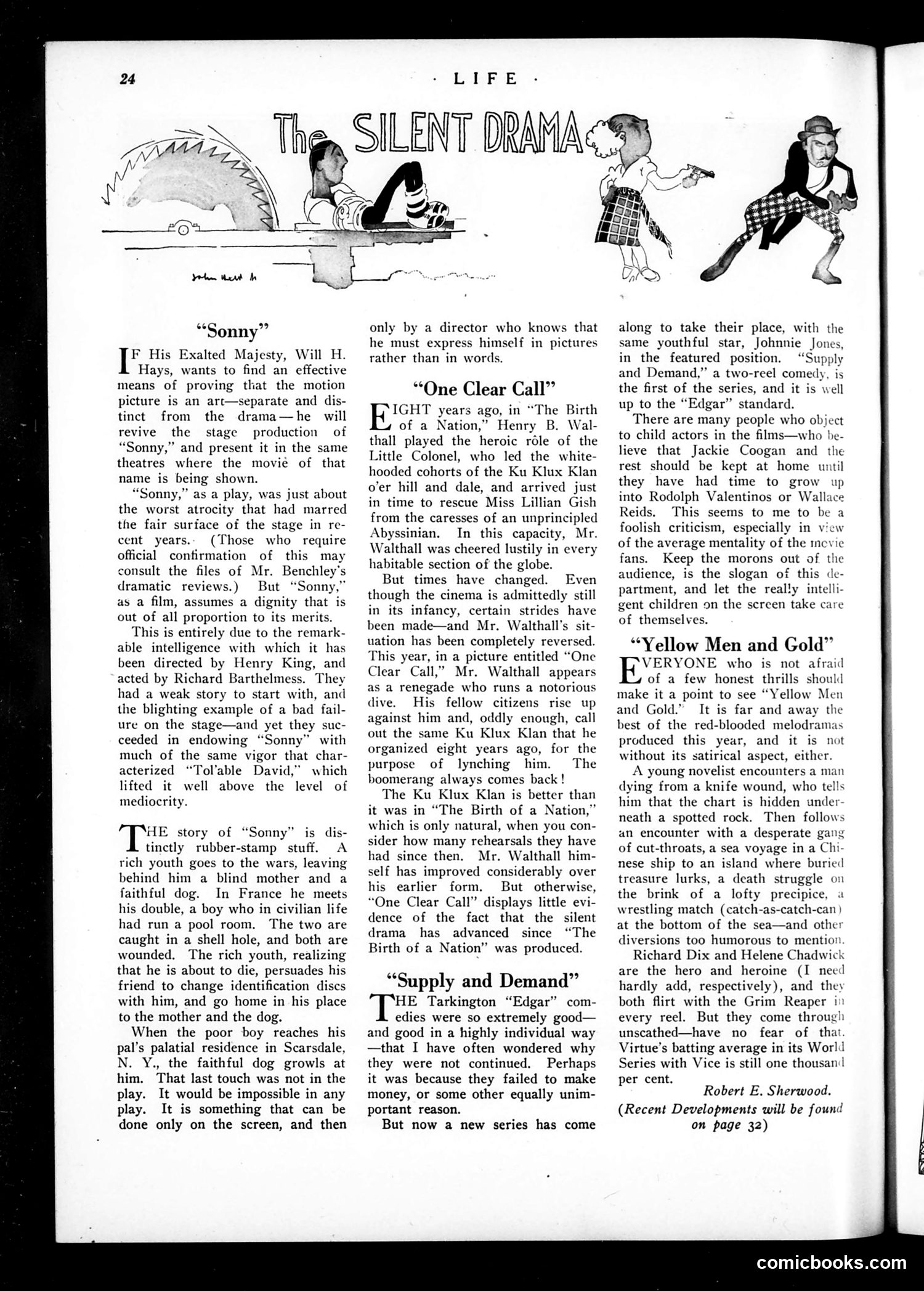
This page reviews three silent films, satirizing how cinema evolved from stage drama. The key critique concerns **Henry B. Walthall's career reversal**: eight years prior, he heroically led the Ku Klux Klan in D.W. Griffith's controversial "Birth of a Nation" (1915), cheered worldwide. Now in "One Clear Call," he plays a disreputable dive owner whom *the same Klan* attempts to lynch—the reviewer dryly notes "the boomerang always comes back!" The page contrasts cinema's artistic potential with theatrical mediocrity. Director Henry King elevated the weak stage play "Sonny" through film technique (notably, a dog refusing to recognize an impostor—impossible on stage). The reviewer credits cinema's superiority to directors who "express himself in pictures rather than in words." The piece gently mocks Will Hays' efforts to legitimize film as distinct art from theater, while questioning Hollywood's moral progress given its continued embrace of KKK imagery.
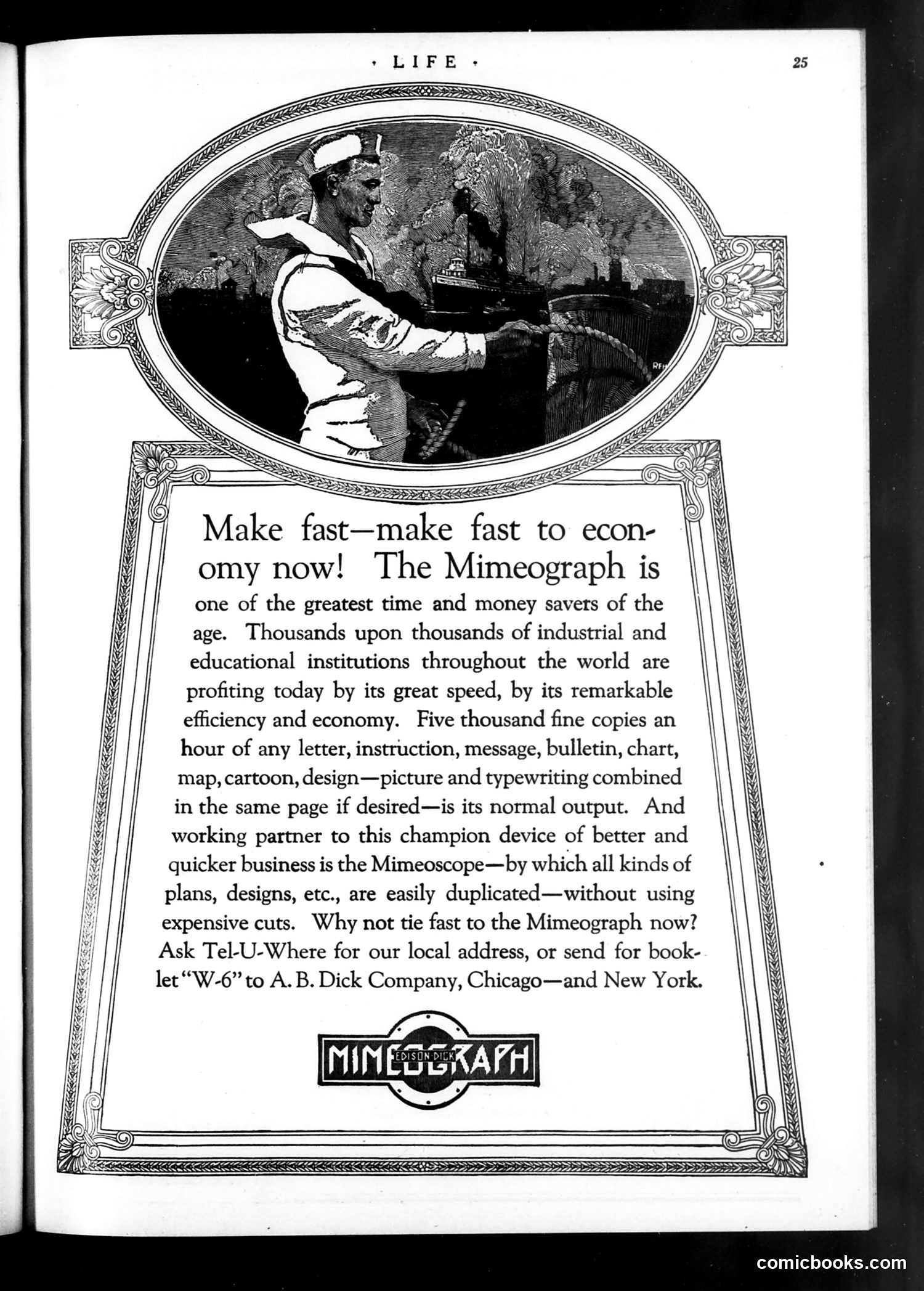
This is a **commercial advertisement**, not political satire. The A.B. Dick Company promotes the Mimeograph—an early photocopying device that could produce 5,000 copies per hour. The illustration shows a sailor or worker operating the machine, suggesting it's a reliable, efficient tool for modern business. The ad's headline "Make fast—make to economy now" urges adoption of this time-saving technology. The accompanying **Mimeoscope** allowed duplication of designs without expensive printing cuts. The ad targets industrial and educational institutions, emphasizing speed, efficiency, and cost savings—key selling points during the early-to-mid twentieth century when such copying technology was revolutionary. This reflects the era's enthusiasm for mechanization and automation improving business productivity.
This page contains several short humorous pieces typical of early 20th-century satirical magazines: **Main Cartoons/Jokes:** - "Fancy Work": Backwoods settlers mock cookbook recipes for being overly complicated ("too much fancy work") - "An Impossible Person": A suitor claims he'll attempt the impossible to win a lady's esteem; she responds by asking him to become young, handsome, and intelligent—mocking his pretensions - "Things to Remember": A husband-wife exchange about forgiveness, with domestic irony - "No man is a hero to his bootlegger": A Depression-era reference mocking prohibition-era drinking **Context for Modern Readers:** These jokes reflect early 20th-century American attitudes: rural skepticism toward urban sophistication, gender dynamics in courtship, marital tension, and Prohibition-era alcohol culture. The "bootlegger" reference indicates illegal alcohol dealers during Prohibition (1920-1933). The page is predominantly **advertising**: a large Alcorub alcohol rub advertisement (marketed as medicinal) and a Life magazine subscription pitch, reflecting the era's different standards regarding alcohol marketing and magazine promotion.
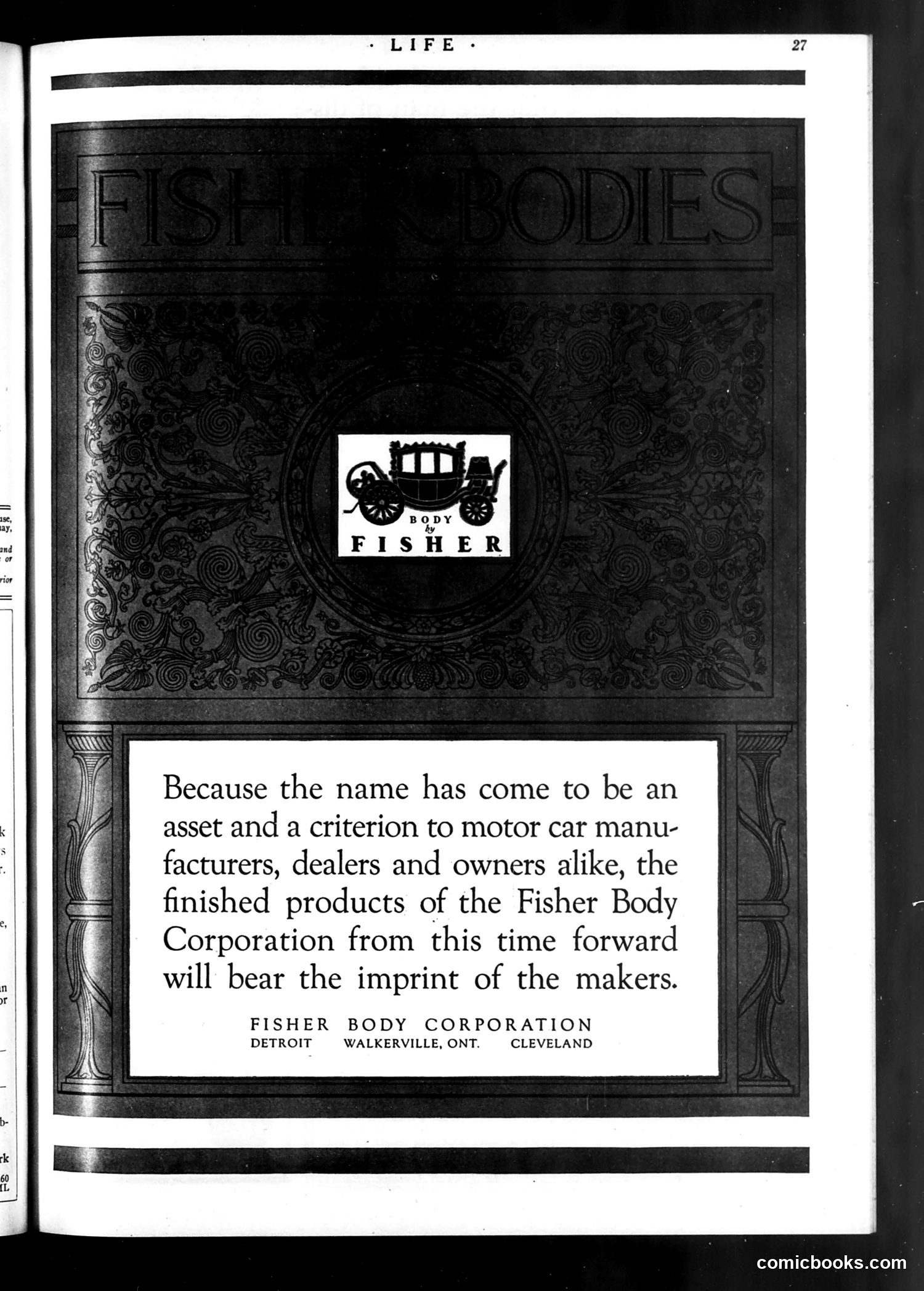
This is a **Fisher Body Corporation advertisement**, not satire or political content. The page announces that Fisher Body—a major automotive body manufacturer—will henceforth mark its products with the company's imprint/logo (visible as a carriage emblem in the circular seal). The text explains this branding decision: the Fisher name has become valuable enough to manufacturers, dealers, and car owners that the company now wants visible credit on finished vehicles. This represents a significant moment in automotive history when component suppliers began receiving prominent brand recognition rather than remaining anonymous parts makers. The ornate decorative border and formal presentation suggest this was a prestige advertisement in *Life* magazine, aimed at the automotive industry and affluent readers.
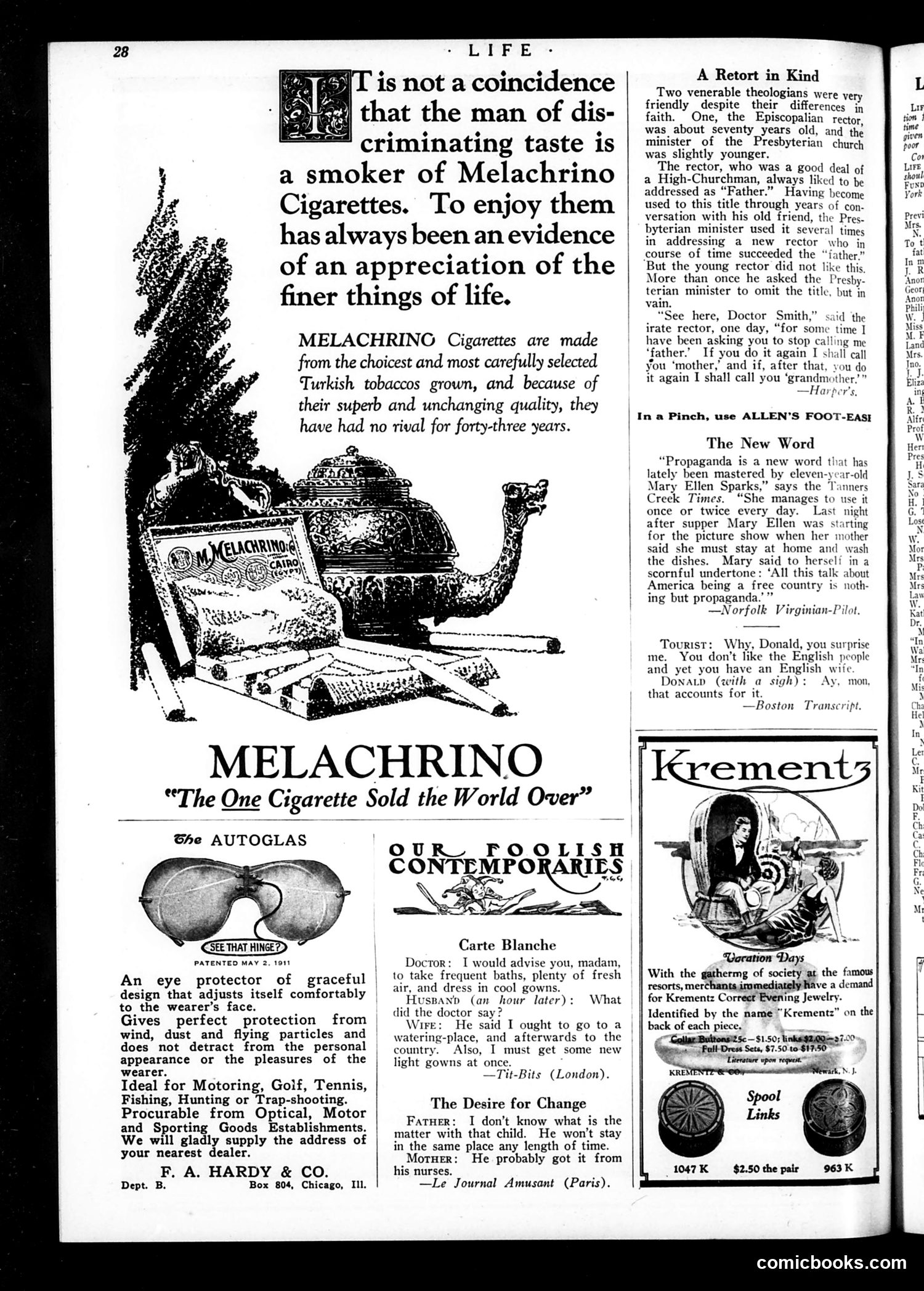
This page is primarily **advertising** interspersed with brief satirical humor pieces typical of Life magazine's format. The dominant advertisement promotes **Melachrino Cigarettes**, claiming discriminating taste correlates with smoking them—a now-jarring assertion given modern health knowledge. The ad features a camel (the brand's mascot) and emphasizes 43 years of quality. Other advertisements include eye protectors (Autoglas) and jewelry (Krementz cufflinks). The satirical content consists of short jokes: - "A Retort in Kind": Two theologians dispute over titles (Father vs. Doctor) - "The New Word": A child overuses "propaganda," suggesting this term was recently entering common American vocabulary - Brief comedic exchanges about English wives and doctor's advice The page reflects **1920s-era advertising practices** where cigarette smoking signified refinement, and demonstrates how "propaganda" was still novel enough to be humorous when misapplied by children.
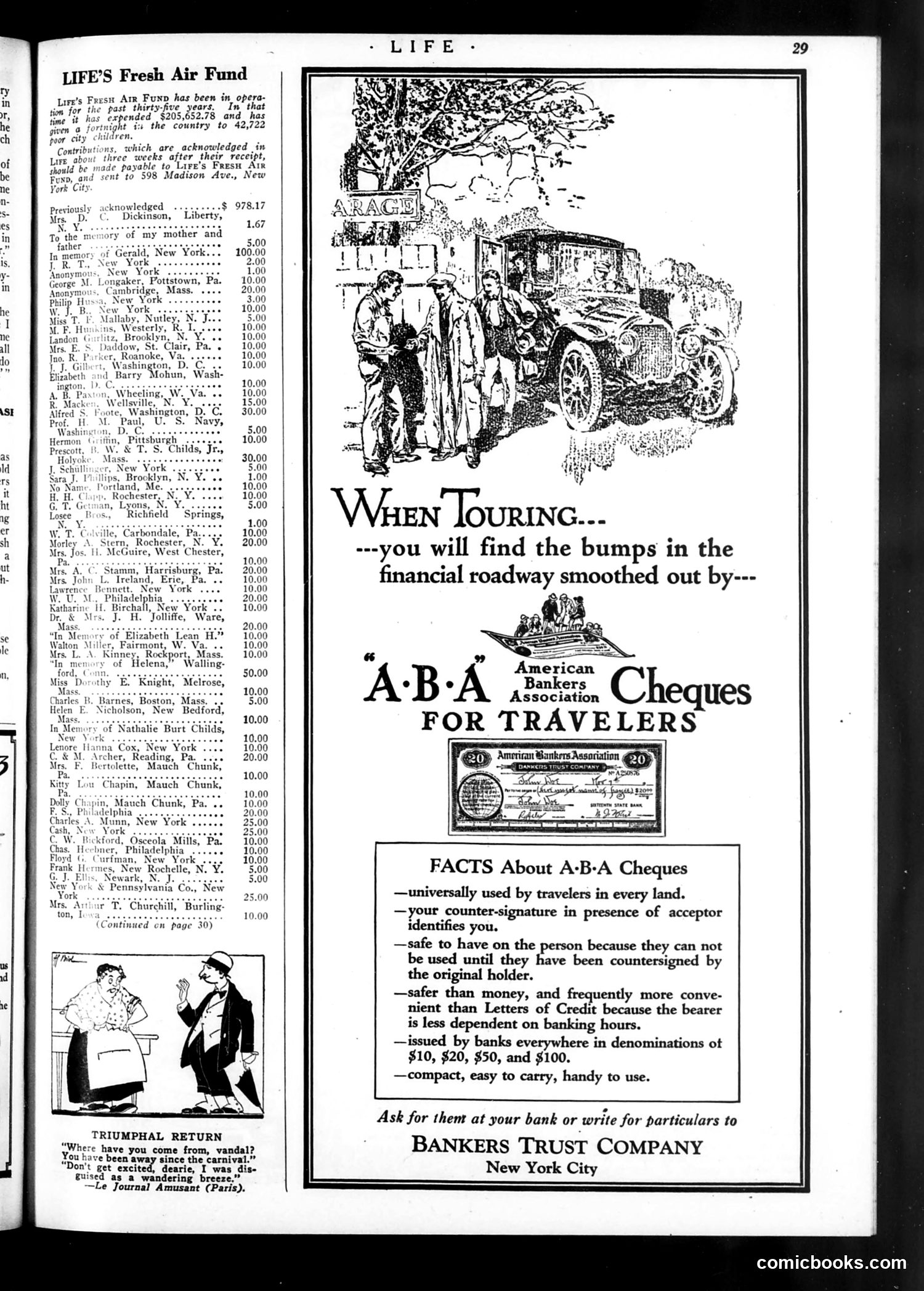
This page contains two distinct elements: **Left side:** A fundraising list for Life's Fresh Air Fund, which has operated for thirty-five years, sending poor city children to the countryside. The list acknowledges donations totaling over $205,000. **Bottom left cartoon:** A brief satirical joke about a husband returning from Carnival, claiming he was "disguised as a wandering breeze" to excuse his absence. The humor is in the implausible excuse. **Right side:** A full-page advertisement for A-B-A (American Bankers Association) traveler's cheques. The ad uses a touring car scene to suggest that these cheques smooth out financial difficulties while traveling, just as good roads smooth out physical bumps. The ad emphasizes the cheques' safety, universal acceptance, and convenience compared to cash or letters of credit—key selling points for early 20th-century travelers. The page juxtaposes philanthropy and consumer finance advertising.
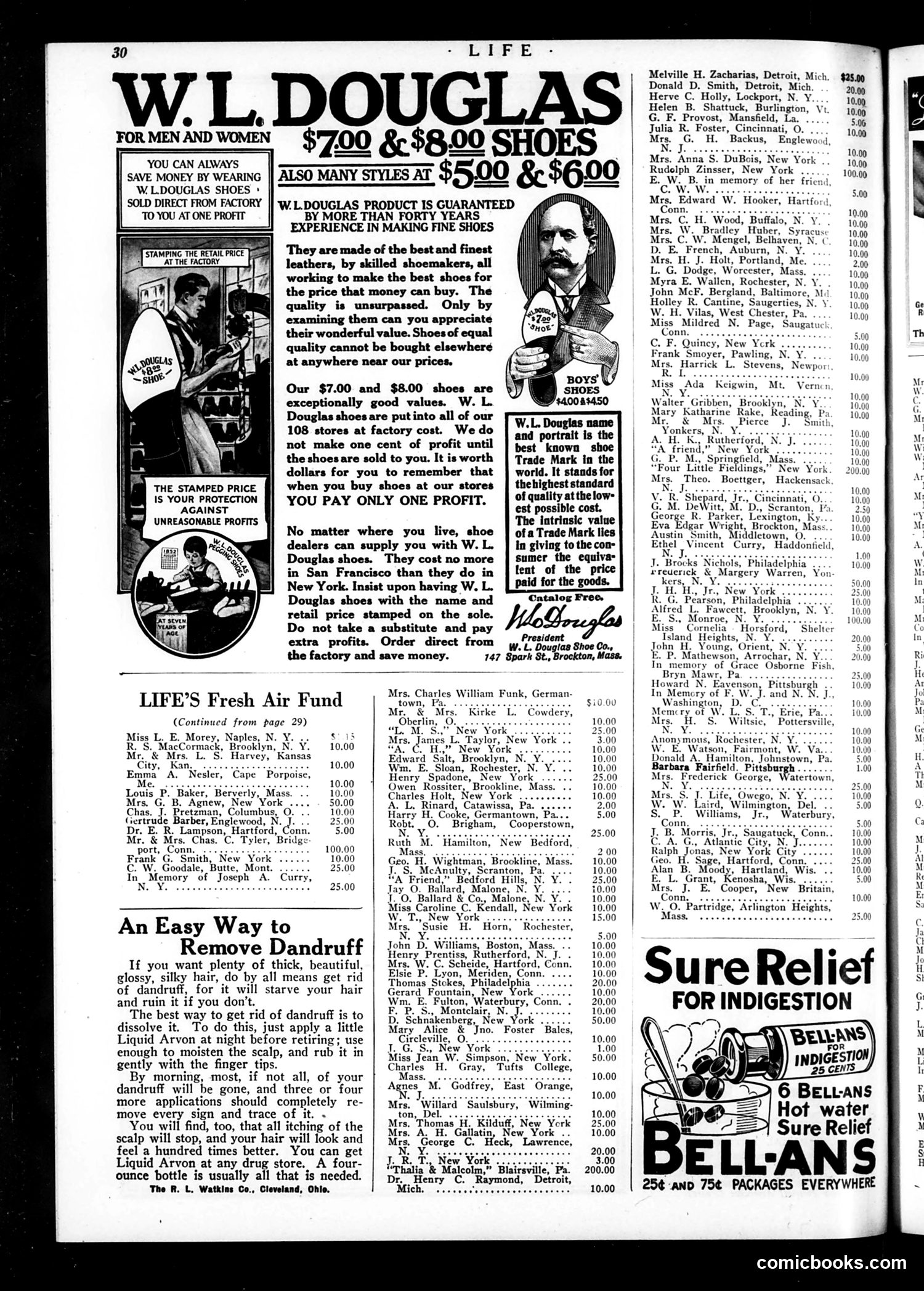
This page is primarily **advertising** rather than political or editorial content. The dominant feature is a major advertisement for **W.L. Douglas shoes** (a real shoe company), highlighting direct factory-to-consumer sales that bypass retail markups. The ad emphasizes that customers "PAY ONLY ONE PROFIT," positioning this as consumer protection against exploitation by middlemen. The imagery shows shoe factory workers and a portrait of W.L. Douglas himself, appealing to working-class concerns about fair pricing. Below is a list of donors to **Life's Fresh Air Fund** (a charitable initiative providing outdoor relief to poor children), followed by miscellaneous period advertisements for dandruff removal and indigestion relief. This appears to be a typical Life magazine page from the early 20th century, mixing editorial philanthropy with commercial advertising. There is no overt political satire or cartoon analysis required here.
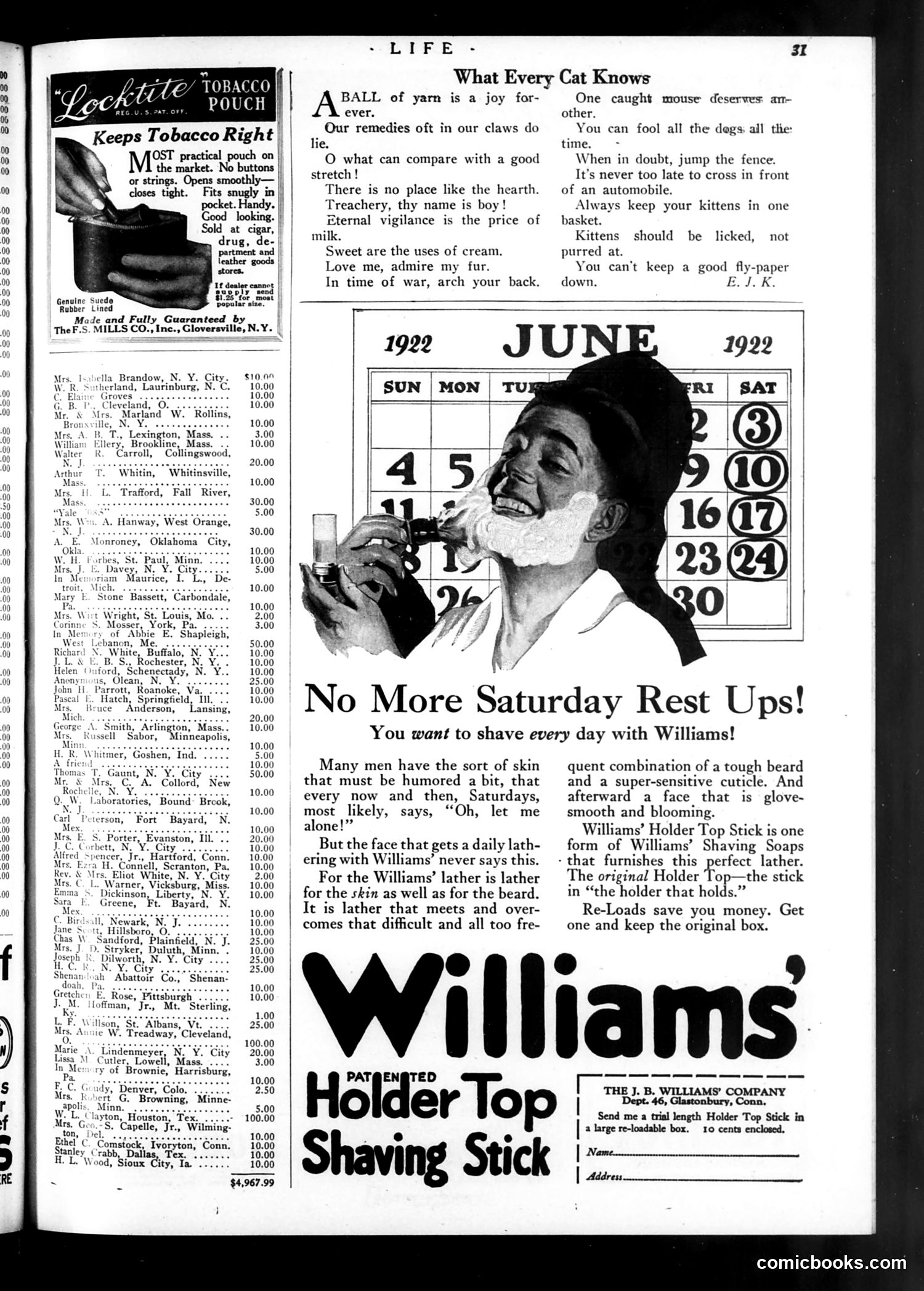
This page contains three distinct items: **"What Every Cat Knows"** — A humorous essay presenting feline wisdom in mock-philosophical style. It parodies Shakespeare and other serious literature ("Treachery, thy name is boy!" echoes Hamlet) by applying grandiose language to mundane cat behaviors: yarn-chasing, stretching, milk obsession, and mouse-catching. The satire lies in treating cats' simple instincts as profound moral principles. **Locktite Tobacco Pouch Advertisement** — A practical product ad emphasizing the pouch's convenience and design. **"No More Saturday Rest Ups!" — Williams' Shaving Soap Advertisement** — This ad addresses men's grooming concerns, specifically facial sensitivity. It promotes daily shaving rather than the common practice of taking weekends off from shaving. The advertisement emphasizes that Williams' lather protects both tough beards and sensitive skin, targeting men who previously avoided daily shaving due to skin irritation. The page is primarily commercial, with the cat essay serving as light editorial content between advertisements.
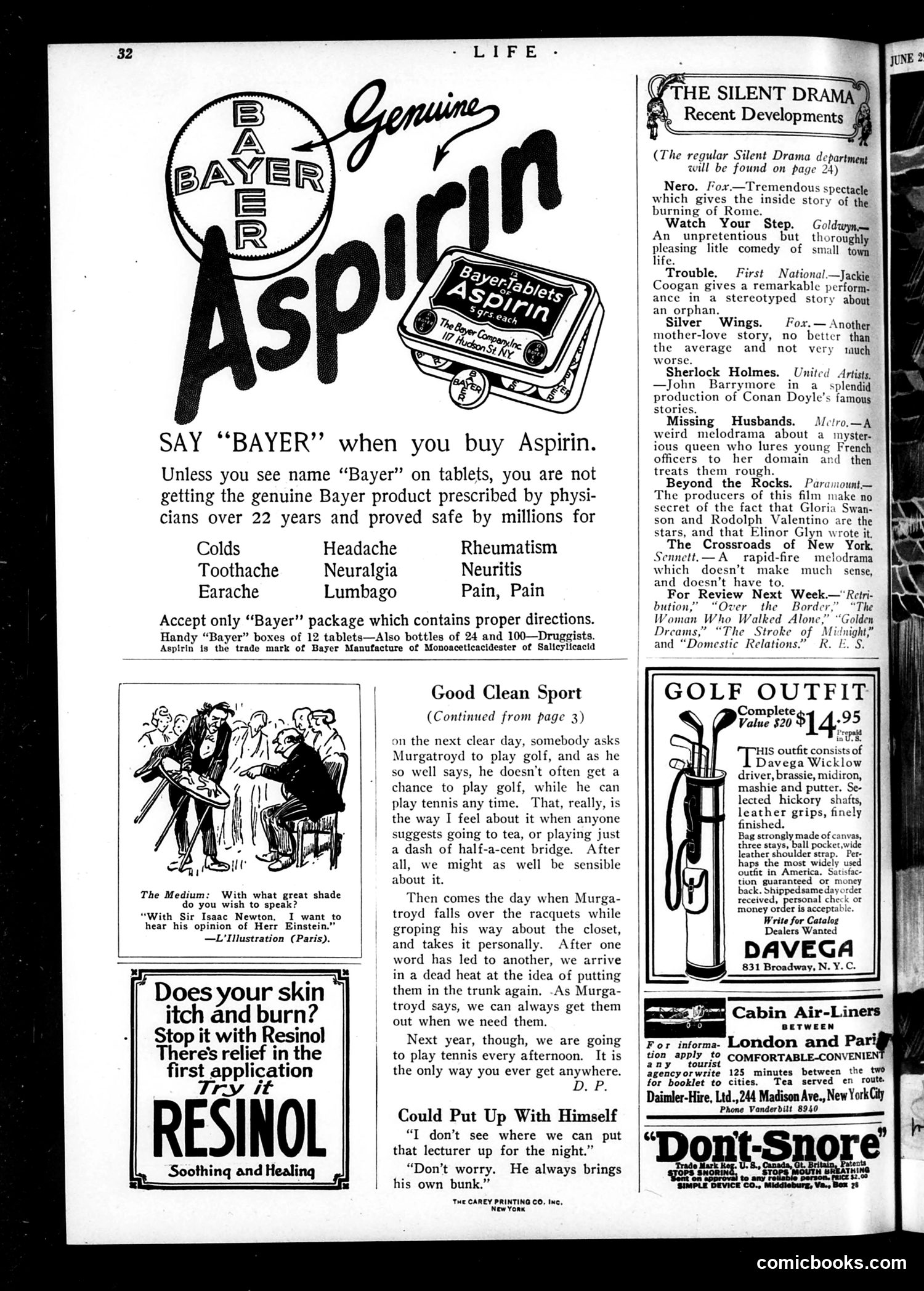
This page is primarily **advertising** with minimal satirical content. The main items are: 1. **Bayer Aspirin ad** (dominant): A straightforward commercial emphasizing that "Bayer" is the genuine, branded aspirin—a trademark protection message. This reflects early 20th-century consumer marketing when brand names needed legal distinction from generic competitors. 2. **Small cartoon** (middle-left): A medium gag about a spiritualist séance where someone wants to ask Sir Isaac Newton his opinion of Einstein—a light joke about consulting historical scientific figures on modern physics. 3. **Film reviews section**: Lists silent movies currently playing, including notable titles like *Nero* and *Sherlock Holmes*. 4. **"Good Clean Sport"** article: A humorous essay (continued from page 3) about reluctantly playing golf and tennis, concluding people make annual resolutions about sports they never keep. The page is typical of *Life* magazine circa 1920s: mixed entertainment advertising, film notices, and light humor rather than political satire.