
Life, 1922-06-22 · page 26 of 34
Life — June 22, 1922 — page 26: what you’re looking at
What you’re looking at
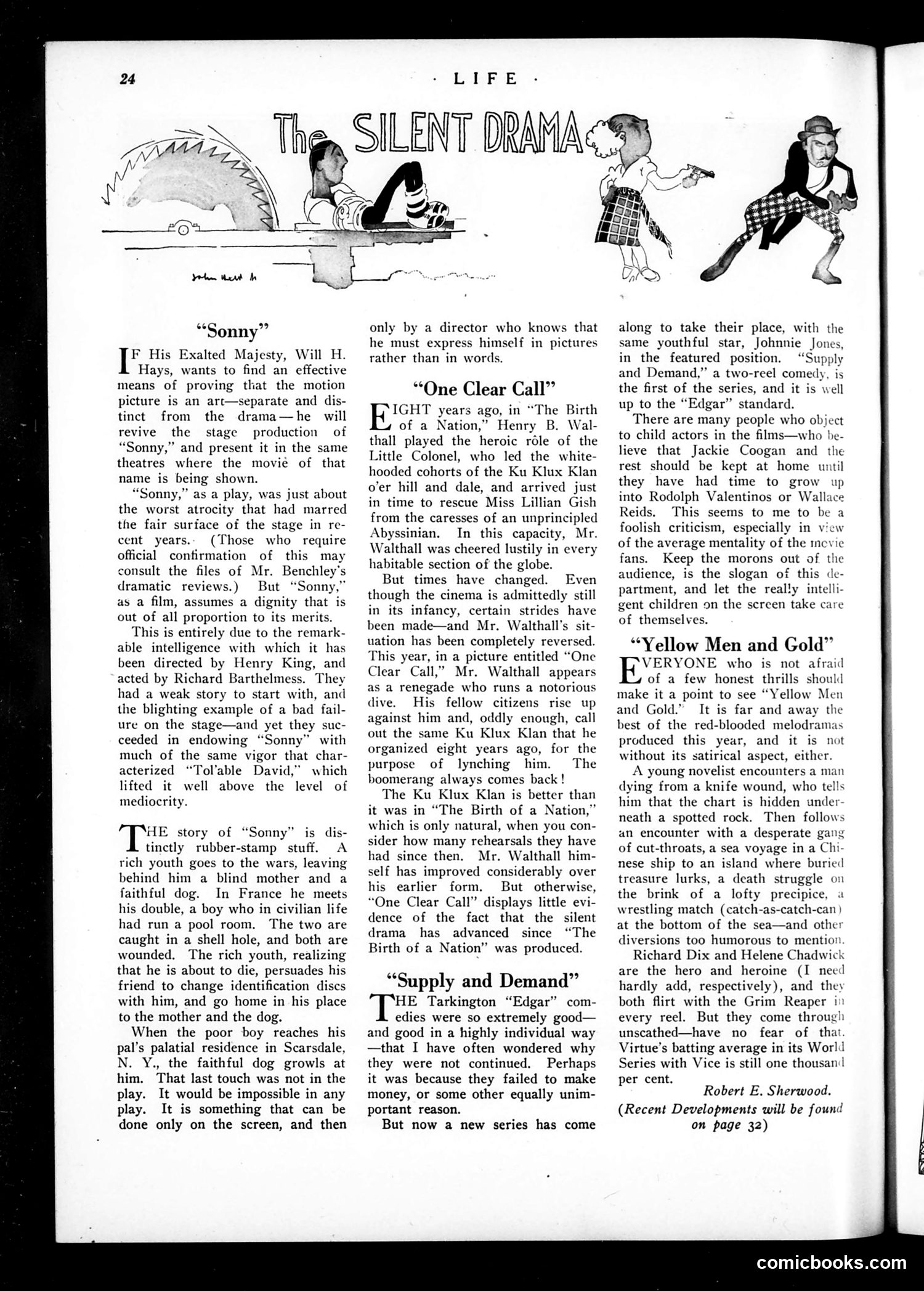
This page reviews three silent films, satirizing how cinema evolved from stage drama. The key critique concerns **Henry B. Walthall's career reversal**: eight years prior, he heroically led the Ku Klux Klan in D.W. Griffith's controversial "Birth of a Nation" (1915), cheered worldwide. Now in "One Clear Call," he plays a disreputable dive owner whom *the same Klan* attempts to lynch—the reviewer dryly notes "the boomerang always comes back!" The page contrasts cinema's artistic potential with theatrical mediocrity. Director Henry King elevated the weak stage play "Sonny" through film technique (notably, a dog refusing to recognize an impostor—impossible on stage). The reviewer credits cinema's superiority to directors who "express himself in pictures rather than in words." The piece gently mocks Will Hays' efforts to legitimize film as distinct art from theater, while questioning Hollywood's moral progress given its continued embrace of KKK imagery.
📄 Transcribed text from this page (OCR, searchable)
Machine-transcribed from the original scan — historical spelling and the odd misread are preserved.
LIFE “Sonny” F His Exalted Majesty, Will H. Hays, wants to find an effective means of proving that the motion picture is an art—separate and dis- tinct from the drama—he will revive the stage production of “Sonny,” and present it in the same theatres where the movie of that name is being shown. “Sonny,” as a play, was just about the worst atrocity that had marred the fair surface of the stage in re- cent years.. (Those who require official confirmation of this may consult the files of Mr. S dramatic reviews.) But * as a film, assumes a dignity that is out of all proportion to its merits. This is entirely due to the remark- able intelligence with which it has been directed by Henry King, and acted by Richard Barthelmess. They had a weak story to start with, and the blighting example of a bad fail- ure on the stage—and yet they suc- ceeded in endowing “Sonny” with much of the same vigor that char- acterized “Tol'able David,” which lifted it well above the level of mediocrity. HE story of “Sonny” is dis- tinctly rubber-stamp stuff. A rich youth goes to the wars, leaving behind him a blind mother and a faithful dog. In France he meets his double, a boy who in civilian life had run a pool room. The two are caught in a shell hole, and both are wounded, The rich youth, realizing that he is about to die, persuades his friend to change identification discs with him, and go home in his place to the mother and the dog. When the poor boy reaches his pal’s palatial residence in Scarsdale, N. Y., the faithful dog growls at him. That last touch was not in the play. It would be impossible in any play. It is something that can be done only on the screen, and then only by a director who knows that he must express himself in pictures rather than in words. “One Clear Call” IGHT years ago, in “The Birth of a Nation,” Henry B. Wal- thall played the heroic role of the Little Colonel, who led the white- hooded cohorts of the Ku Klux Klan o’er hill and dale, and arrived just in time to rescue Miss Lillian Gish from the caresses of an unprincipled Abyssinian. In this capacity, Mr. Walthall was cheered lustily in every habitable section of the globe. But times have changed. Even though the cinema is admittedly still in its infancy, certain strides have been made—and Mr. Walthall’s sit- uation has been completely reversed. This year, in a picture entitled “One Clear Call,” Mr. Walthall appears as a renegade who runs a notorious dive. His fellow citizens rise up against him and, oddly enough, call out the same Ku Klux Klan that he organized eight years ago, for the purpose of lynching him. The boomerang always comes back ! The Ku Klux Klan is better than it was in “The Birth of a Nation,” which is only natural, when you con- sider how many rehearsals they have had since then. Mr. Walthall him- self has improved considerably over his earlier form. But otherwise, “One Clear Call” displays little evi- dence of the fact that the silent drama has advanced since “The Birth of a Nation” was produced. “Supply and Demand” HE Tarkington “Edgar” com- edies were so extremely good— and good in a highly individual way —that I have often wondered why they were not continued. Perhaps it was because they failed to make money, or some other equally unim- portant reason. But now a new series has come along to take their place, with the same youthful star, Johnnie Jones, in the featured position. “Supply and Demand,” a two-reel comedy, is the first of the series, and it is well up to the “Edgar” standard. There are many people who object to child actors in the films—who be- lieve that Jackie Coogan and the rest should be kept at home until they have had time to grow up into Rodolph Valentinos or Walla Reids. This seems to me to be foolish criticism, especially in of the average mentality of the mevie fans. Keep the morons out of the audience, is the slogan of this de- partment, and let the really intelli- gent children on the screen take care of themselves. “Yellow Men and Gold” VERYONE who is not afraid of a few honest thrills should make it a point to see “Yellow Men and Gold.” It is far and away the best of the red-blooded melodramas produced this year, and it is not without its satirical aspect, either. A young novelist encounters a man dying from a knife wound, who tells him that the chart is hidden under- neath a spotted rock. Then follows an encounter with a desperate gang of cut-throats, a sea voyage in a Chi- nese ship to an island where buried treasure lurks, a death struggle on the brink of a lofty precipice, a wrestling match (catch-as-catch-can ) at the bottom of the sea—and other diversions too humorous to mention Richard Dix and Helene Chadwick are the hero and heroine (I need hardly add, respectively), and they both flirt with the Grim Reaper in every reel. But they come through unscathed—have no fear of that Virtue’s batting average in its World Series with Vice is still one thousan per cent. Robert E. Sherwood. (Recent Developments will be found on page 32) comicbooks.com