
Life, 1922-06-22 · page 20 of 34
Life — June 22, 1922 — page 20: what you’re looking at
What you’re looking at
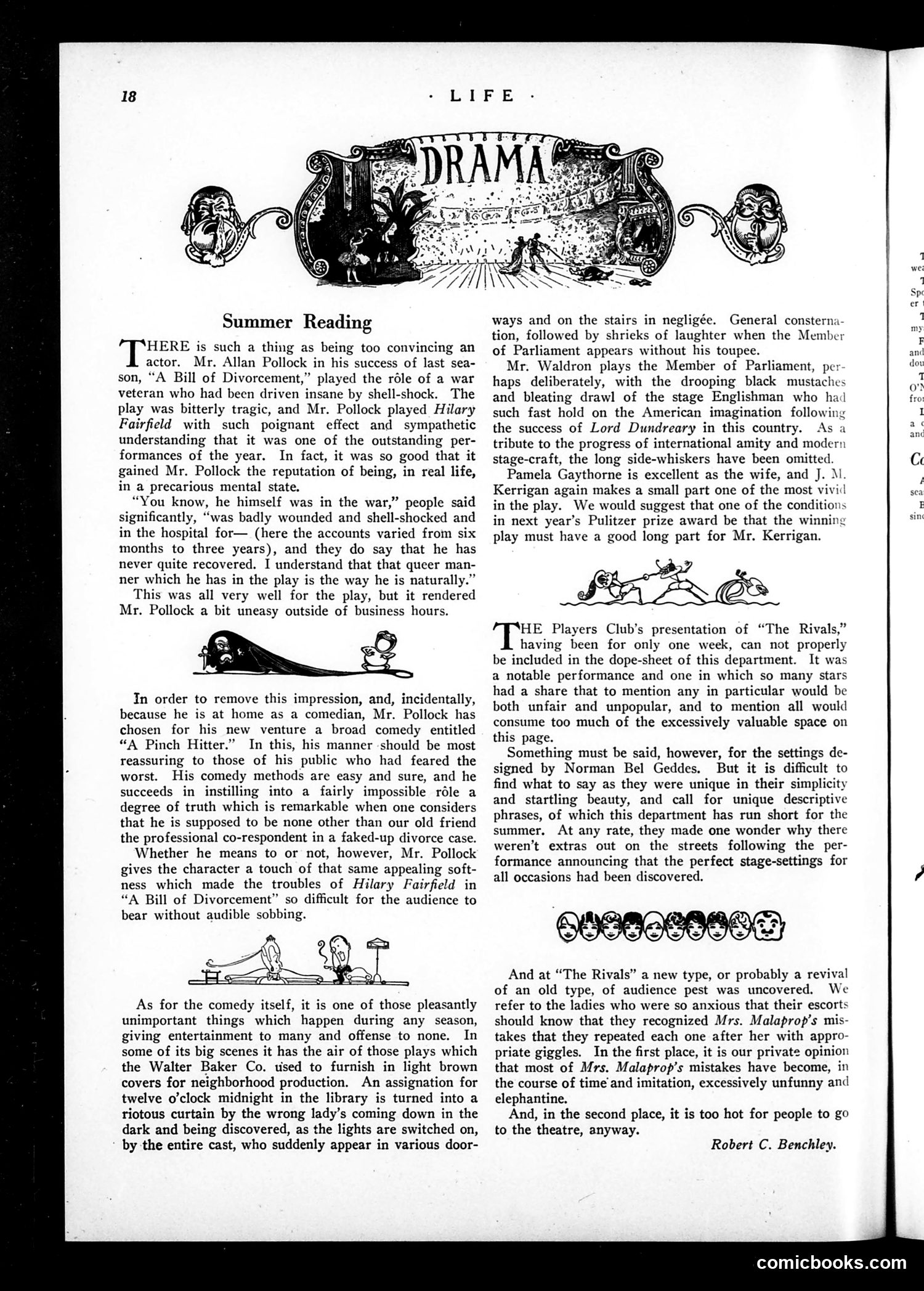
This is a theater review column discussing two Broadway productions. The main subject is actor Allan Pollock, who became so convincing playing a shell-shocked WWI veteran in "A Bill of Divorcement" that the public believed him genuinely unstable in real life. The reviewer notes this damaged Pollock's social reputation, prompting him to take a light comedy role in "A Pinch Hitter" to reassure audiences of his mental stability. The satire is gentle: Pollock's very success as a tragic actor backfired, creating an unwanted real-world persona. The reviewer praises his new comedic work while gently mocking the supporting players' stock characterizations—particularly Mr. Waldron's stereotypical "stage Englishman" performance (referencing the dated "Lord Dundreary" theatrical type). The brief mention of "The Rivals" notes it ran too short to review properly. The small illustrated vignettes show theatrical humor but lack specific political content.
📄 Transcribed text from this page (OCR, searchable)
Machine-transcribed from the original scan — historical spelling and the odd misread are preserved.
Summer Reading HERE is such a thing as being too convincing an actor. Mr. Allan Pollock in his success of last sea- son, “A Bill of Divorcement,” played the réle of a war veteran who had been driven insane by shell-shock. The play was bitterly tragic, and Mr. Pollock played Hilary Fairfield with such poignant effect and sympathetic understanding that it was one of the outstanding per- formances of the year. In fact, it was so good that it gained Mr. Pollock the reputation of being, in real life, in a precarious mental state. “You know, he himself was in the war,” people said significantly, “was badly wounded and shell-shocked and in the hospital for— (here the accounts varied from six months to three years), and they do say that he has never quite recovered. I understand that that queer man- ner which he has in the play is the way he is naturally.” This was all very well for the play, but it rendered Mr. Pollock a bit uneasy outside of business hours. Ba In order to remove this impression, and, incidentally, because he is at home as a comedian, Mr. Pollock has chosen for his new venture a broad comedy entitled “A Pinch Hitter.” In this, his manner should be most reassuring to those of his public who had feared the worst. His comedy methods are easy and sure, and he succeeds in instilling into a fairly impossible réle a degree of truth which is remarkable when one considers that he is supposed to be none other than our old friend the professional co-respondent in a faked-up divorce case. Whether he means to or not, however, Mr. Pollock gives the character a touch of that same appealing soft- ness which made the troubles of Hilary Fairfield in “A Bill of Divorcement” so difficult for the audience to bear without audible sobbing. As for the comedy itself, it is one of those pleasantly unimportant things which happen during any season, giving entertainment to many and offense to none. In some of its big scenes it has the air of those plays which the Walter Baker Co. used to furnish in light brown covers for neighborhood production. An assignation for twelve o’clock midnight in the library is turned into a riotous curtain by the wrong lady’s coming down in the dark and being discovered, as the lights are switched on, by the entire cast, who suddenly appear in various door- ways and on the stairs in negligée. General consterna- tion, followed by shrieks of laughter when the Member of Parliament appears without his toupee. Mr. Waldron plays the Member of Parliament, per- haps deliberately, with the drooping black mustaches and bleating drawl of the stage Englishman who had such fast hold on the American imagination following the success of Lord Dundreary in this country. As a tribute to the progress of international amity and modern stage-craft, the long side-whiskers have been omitted. Pamela Gaythorne is excellent as the wife, and J. M. Kerrigan again makes a small part one of the most viviil in the play. We would suggest that one of the conditions in next year’s Pulitzer prize award be that the winning play must have a good long part for Mr. Kerrigan. SEE Ce HE Players Club’s presentation of “The Rivals,” having been for only one week, can not properly be included in the dope-sheet of this department. It was a notable performance and one in which so many stars had a share that to mention any in particular would be both unfair and unpopular, and to mention all would consume too much of the excessively valuable space on this page. Something must be said, however, for the settings de- signed by Norman Bel Geddes. But it is difficult to find what to say as they were unique in their simplicity and startling beauty, and call for unique descriptive phrases, of which this department has run short for the summer. At any rate, they made one wonder why there weren’t extras out on the streets following the per- formance announcing that the perfect stage-settings for all occasions had been discovered. SSSIOSSHIOE} And at “The Rivals” a new type, or probably a revival of an old type, of audience pest was uncovered. We refer to the ladies who were so anxious that their escorts should know that they recognized Mrs. Malaprop’s mis- takes that they repeated each one after her with appro- priate giggles. In the first place, it is our private opinion that most of Mrs. Malaprop’s mistakes have become, in the course of time’and imitation, excessively unfunny and elephantine. And, in the second place, it is too hot for people to go to the theatre, anyway. Robert C. Benchley. comicbooks.com