
Life, 1922-06-22 · page 14 of 34
Life — June 22, 1922 — page 14: what you’re looking at
What you’re looking at
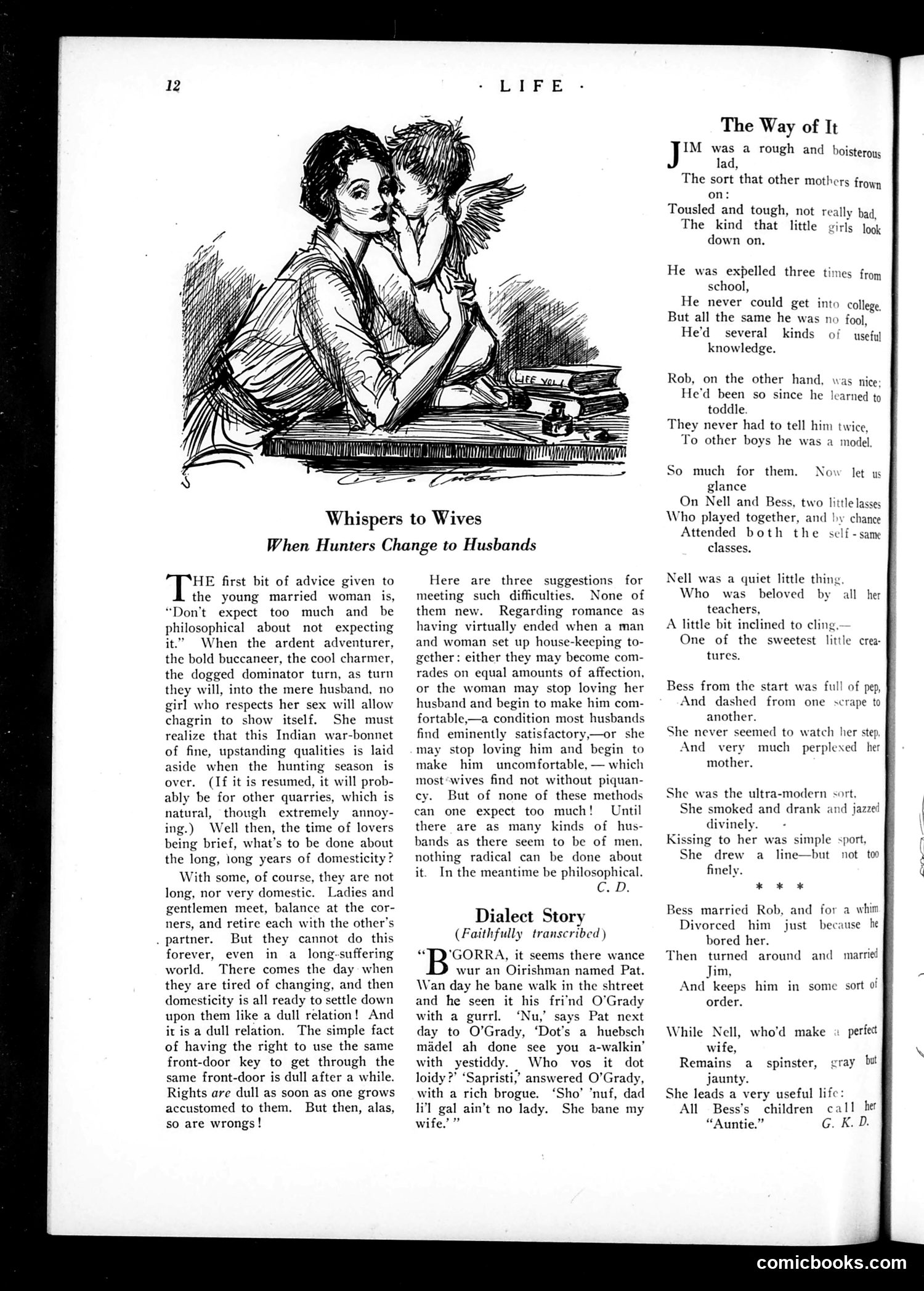
This page contains three distinct pieces of social commentary: **"Whispers to Wives"** offers advice to newly married women about managing husbands during the transition from courtship to domestic life. It humorously suggests that wives should accept their husbands' need for independence and occasional roughness—particularly during hunting season—rather than expect constant romantic attention. **"The Way of It"** presents contrasting character sketches: Jim, a rough troublemaker, and Rob, a well-behaved boy. The narrative suggests that respectability doesn't guarantee success or happiness, while misbehavior doesn't guarantee failure—a commentary on Victorian assumptions about morality and social outcomes. **"Dialect Story"** is a brief humorous anecdote featuring Irish characters using phonetic dialect humor, common in early 20th-century American comedy. Overall, the page satirizes marriage expectations and social stereotypes of the era.
📄 Transcribed text from this page (OCR, searchable)
Machine-transcribed from the original scan — historical spelling and the odd misread are preserved.
Whispers to Wives When Hunters Change to Husbands HE first bit of advice given to the young married woman is, “Don't expect too much and be philosophical about not expecting it.” When the ardent adventurer, the bold buccaneer, the cool charmer, the dogged dominator turn, as turn they will, into the mere husband, no girl who respects her sex will allow chagrin to show itself. She must realize that this Indian war-bonnet of fine, upstanding qualities is laid aside when the hunting season is over. (If it is resumed, it will prob- ably be for other quarries, which is natural, though extremely annoy- ing.) Well then, the time of lovers being brief, what’s to be done about the long, long years of domesticity? With some, of course, they are not long, nor very domestic. Ladies and gentlemen meet, balance at the cor- ners, and retire each with the other's . partner. But they cannot do this forever, even in a_ long-suffering world. There comes the day when they are tired of changing, and then domesticity is all ready to settle down upon them like a dull relation! And it is a dull relation. The simple fact of having the right to use the same front-door key to get through the same front-door is dull after a while. Rights are dull as soon as one grows accustomed to them. But then, alas, so are wrongs! Here are three suggestions for meeting such difficulties. None of them new. Regarding romance as having virtually ended when a man and woman set up house-keeping to- gether: either they may become com- rades on equal amounts of affection, or the woman may stop loving her husband and begin to make him com- fortable,—a condition most husbands find eminently satisfactory—or she may stop loving him and begin to make him uncomfortable, — which most ‘wives find not without piquan- cy. But of none of these methods can one expect too much! Until there are as many kinds of hus- bands as there seem to be of men, nothing radical can be done about it. In the meantime be philosophical. Cc. D. Dialect Story (Faithfully transcribed ) “T)'GORRA, it seems there wance wur an Oirishman named Pat. Wan day he bane walk in the shtreet and he seen it his frind O'Grady with a gurrl. ‘Nu,’ says Pat next day to O’Grady, ‘Dot's a huebsch madel ah done see you a-walkin’ with yestiddy. Who vos it dot loidy?’ ‘Sapristi,’ answered O'Grady, with a rich brogue. ‘Sho’ ‘nuf, dad li'l gal ain’t no lady. She bane my wife.’” The Way of It IM was a rough and boisterous lad, ; The sort that other mothers frown on: Tousled and tough, not really bad, The kind that little girls look down on. He was expelled three times from school, He never could get into college, But all the same he was no fool, He'd several kinds of useful knowledge. Rob, on the other hand, was nice: He'd been so since he learned to toddle. They never had to tell him twice, To other boys he was a model, So much for them. glance On Nell and Bess, two little lasses Who played together, and hy chance Attended both the sel classes. let us Nell was a quiet little thing, Who was beloved by all her teachers, A little bit inclined to cling, One of the sweetest little crea tures. Bess from the start was full of pep, And dashed from one scrape to another. She never seemed to watch her step. And very much perplexed her mother. She was the ultra-modern sort. She smoked and drank and jazzed divinely. Kissing to her was simple sport, She drew a line—but not too finely. ee * Bess married Rob, and for a whim Divorced him just because he bored her. turned around Jim, And keeps him in some sort of order. Then and married While Nell, who'd make « perfec wife, Remains a jaunty. She leads a very useful life: All Bess's children call ker “Auntie.” G. K. D. spinster, gray but comicbooks.com