
Life, 1922-06-22 · page 16 of 34
Life — June 22, 1922 — page 16: what you’re looking at
What you’re looking at
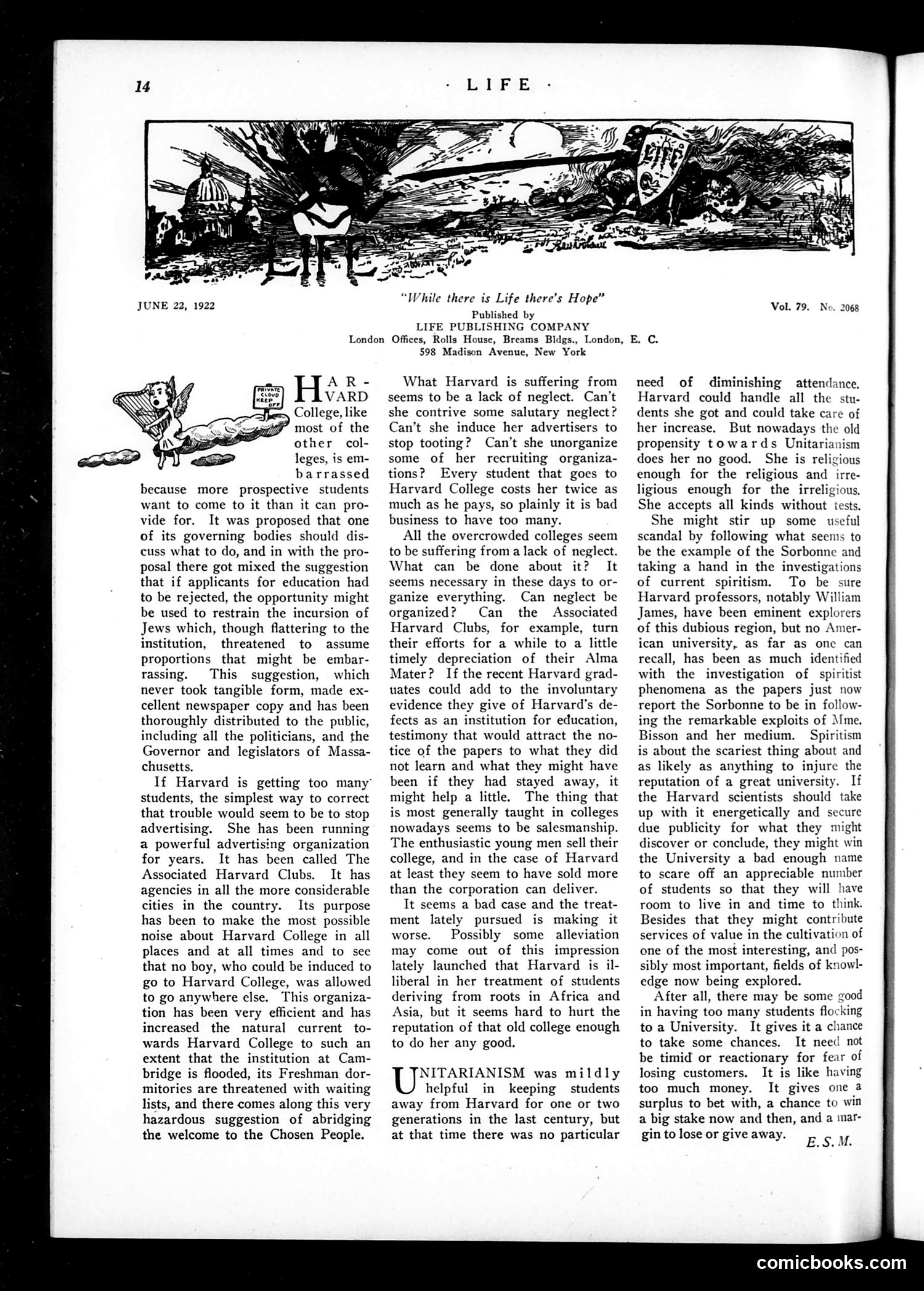
The page contains two opinion articles rather than illustrated cartoons. The header illustration is decorative, showing a classical figure and landscape. **Content Summary:** The first article criticizes Harvard College for over-enrollment and insufficient oversight, suggesting the university has become too commercialized through aggressive advertising campaigns by "Associated Harvard Clubs." The author argues overcrowding compromises educational quality and proposes limiting student intake. The second brief article discusses Unitarianism's historical role in attracting students away from Harvard in earlier centuries, suggesting this represents a business competition metaphor—universities "selling" themselves like commercial products. Both pieces critique institutional management through satirical social commentary rather than visual satire, reflecting 1920s concerns about American higher education's expansion and commercialization.
📄 Transcribed text from this page (OCR, searchable)
Machine-transcribed from the original scan — historical spelling and the odd misread are preserved.
JUNE 22, 1922 London Offices, Rolls House, Breams Bldgs., London, ee) VARD College, like F most of the other col- leges, is em- barrassed because more prospective students want to come to it than it can pro- vide for. It was proposed that one of its governing bodies should dis- cuss what to do, and in with the pro- posal there got mixed the suggestion that if applicants for education had to be rejected, the opportunity might be used to restrain the incursion of Jews which, though flattering to the institution, threatened to assume proportions that might be embar- rassing. This suggestion, which never took tangible form, made ex- cellent newspaper copy and has been thoroughly distributed to the public, including all the politicians, and the Governor and legislators of Massa- chusetts. If Harvard is getting too many” students, the simplest way to correct that trouble would seem to be to stop advertising. She has been running a powerful advertising organization for years. It has been called The Associated Harvard Clubs. It has agencies in all the more considerable cities in the country. Its purpose has been to make the most possible noise about Harvard College in all places and at all times and to see that no boy, who could be induced to go to Harvard College, was allowed to go anywhere else. This organiza- tion has been very efficient and has increased the natural current to- wards Harvard College to such an extent that the institution at Cam- bridge is flooded, its Freshman dor- mitories are threatened with waiting lists, and there comes along this very hazardous suggestion of abridging the welcome to the Chosen People. “While there is Life there’s Hope” Published by LIFE PUBLISHING COMPANY 598 Madison Avenue, New York What Harvard is suffering from seems to be a lack of neglect. Can't she contrive some salutary neglect? Can’t she induce her advertisers to stop tooting? Can’t she unorganize some of her recruiting organiza- tions? Every student that goes to Harvard College costs her twice as much as he pays, so plainly it is bad business to have too many. All the overcrowded colleges seem to be suffering from a lack of neglect. What can be done about it? It seems necessary in these days to or- ganize everything. Can neglect be organized? Can the Associated Harvard Clubs, for example, turn their efforts for a while to a little timely depreciation of their Alma Mater? If the recent Harvard grad- uates could add to the involuntary evidence they give of Harvard's de- fects as an institution for education, testimony that would attract the no- tice of the papers to what they did not learn and what they might have been if they had stayed away, it might help a little. The thing that is most generally taught in colleges nowadays seems to be salesmanship. The enthusiastic young men sell their college, and in the case of Harvard at least they seem to have sold more than the corporation can deliver. It seems a bad case and the treat- ment lately pursued is making it worse. Possibly some alleviation may come out of this impression lately launched that Harvard is il- liberal in her treatment of students deriving from roots in Africa and Asia, but it seems hard to hurt the reputation of that old college enough to do her any good. NITARIANISM was mildly helpful in keeping students away from Harvard for one or two generations in the last century, but at that time there was no particular Vol. 79. No. 2068 need of diminishing attendance. Harvard could handle all the stu- dents she got and could take care of her increase. But nowadays the old propensity towards Unitariani does her no good. She is religious enough for the religious and irre- ligious enough for the irreligious, She accepts all kinds without tests. She might stir up some useful scandal by following what seems to be the example of the Sorbonne and taking a hand in the investigations of current spiritism. To be sure Harvard professors, notably William James, have been eminent explorers of this dubious region, but no Amer- ican university, as far as one can recall, has been as much identified with the investigation of spiritist phenomena as the papers just now report the Sorbonne to be in follow- ing the remarkable exploits of Mme. Bisson and her medium. Spiritism is about the scariest thing about and as likely as anything to injure the reputation of a great university. If the Harvard scientists should take up with it energetically and secure due publicity for what they might discover or conclude, they might win the University a bad enough name to scare off an appreciable number of students so that they will have room to live in and time to think. Besides that they might contribute services of value in the cultivation of one of the most interesting, and pos- sibly most important, fields of knowl- edge now being explored. After all, there may be some good in having too many students flocking to a University. It gives it a chance to take some chances. It need not be timid or reactionary for fear of losing customers. It is like having too much money. It gives one @ surplus to bet with, a chance to win a big stake now and then, and a mar- gin to lose or give away. E.S.M. comicbooks.com