
Life, 1922-06-22 · page 10 of 34
Life — June 22, 1922 — page 10: what you’re looking at
What you’re looking at
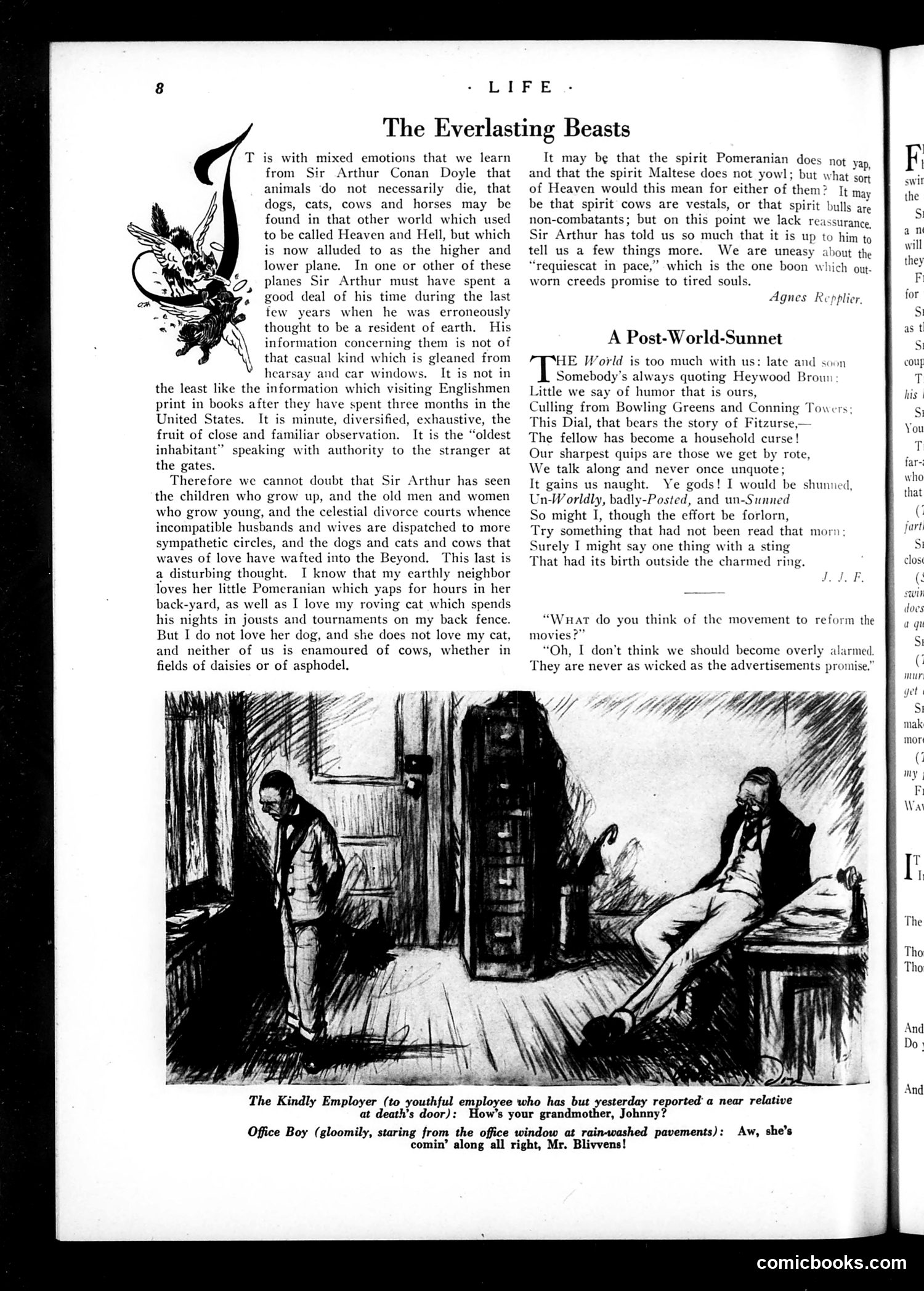
This page contains two separate pieces of satirical content: **"The Everlasting Beasts"** (top): An article by Sir Arthur Conan Doyle discussing whether animals have souls and an afterlife. The author references his own observations of pets and spiritual experiences, suggesting animals may inhabit "higher and lower planes" alongside humans. **"A Post-World-Sunset"** (middle): A poem by J.J.F. satirizing post-war disillusionment and the decline of traditional values. It mocks modern entertainment and advertising culture as corrupting influences. **Bottom Cartoon**: The main cartoon satirizes workplace dynamics. A sympathetic young employee reports a relative's death; his employer callously dismisses this, concerned only that the employee arrive on time. The office boy's deadpan response—"she's comin' along all right, Mr. Blivvens!"—emphasizes the employer's obliviousness to human suffering, critiquing callous capitalism.
📄 Transcribed text from this page (OCR, searchable)
Machine-transcribed from the original scan — historical spelling and the odd misread are preserved.
- LIFE - The Everlasting Beasts is with mixed emotions that we learn from Sir Arthur Conan Doyle that animals ‘do not necessarily die, that dogs, cats, cows and horses may be found in that other world which used to be called Heaven and Hell, but which is now alluded to as the higher and lower plane. In one or other of these planes Sir Arthur must have spent a good deal of his time during the last few years when he was erroneously thought to be a resident of earth. His information concerning them is not of that casual kind which is gleaned from hearsay and car windows. It is not in the least like the information which visiting Englishmen print in books after they have spent three months in the United States. It is minute, diversified, exhaustive, the fruit of close and familiar observation. It is the “oldest inhabitant” speaking with authority to the stranger at the gates. Therefore we cannot doubt that Sir Arthur has seen the children who grow up, and the old men and women who grow young, and the celestial divorce courts whence incompatible husbands and wives are dispatched to more sympathetic circles, and the dogs and cats and cows that waves of love have wafted into the Beyond. This last is a disturbing thought. I know that my earthly neighbor loves her little Pomeranian which yaps for hours in her back-yard, as well as I love my roving cat which spends his nights in jousts and tournaments on my back fence. But I do not love her dog, and ske does not love my cat, and neither of us is enamoured of cows, whether in fields of daisies or of asphodel. It may be that the spirit Pomeranian does not yap, and that the spirit Maltese does not yowl; but what ‘sort of Heaven would this mean for either of them? It may be that spirit cows are vestals, or that spirit bulls are non-combatants; but on this point we lack reassurance, Sir Arthur has told us so much that it is up to him to tell us a few things more. We are uneasy about the “requiescat in pace,” which is the one boon which out. worn creeds promise to tired souls. Agnes Repplier, A Post-W orld-Sunnet HE World is too much with us: late and soon Somebody's always quoting Heywood Brow Little we say of humor that is ours, Culling from Bowling Greens and Conning Towers: This Dial, that bears the story of Fitzurse,— The fellow has become a household curse! Our sharpest quips are those we get by rote, We talk along and never once unquote; It gains us naught. Ye gods! I would be shunned, Un-Worldly, badly-Posted, and un-Sunned So might I, though the effort be forlorn, Try something that had not been read that morn; Surely I might say one thing with a sting That had its birth outside the charmed ring. “Wat do you think of the movement to reform the movies?” “Oh, I don’t think we should become overly alarmed. They are never as wicked as the advertisements promise.” The Kindly Employer (to youthful employee who has but yesterday reported’ a near relative at death’s door): How’s your grandmother, Johnny? Office Boy (gloomily, staring from the office window at rain-washed pavements): Aw, she’s comin’ along all right, Mr. Blivvens! far- who that (6 jart C mur. Bye S b mak mor The Tho Tho And Do And comicbooks.com