
Life, 1922-06-22 · page 22 of 34
Life — June 22, 1922 — page 22: what you’re looking at
What you’re looking at
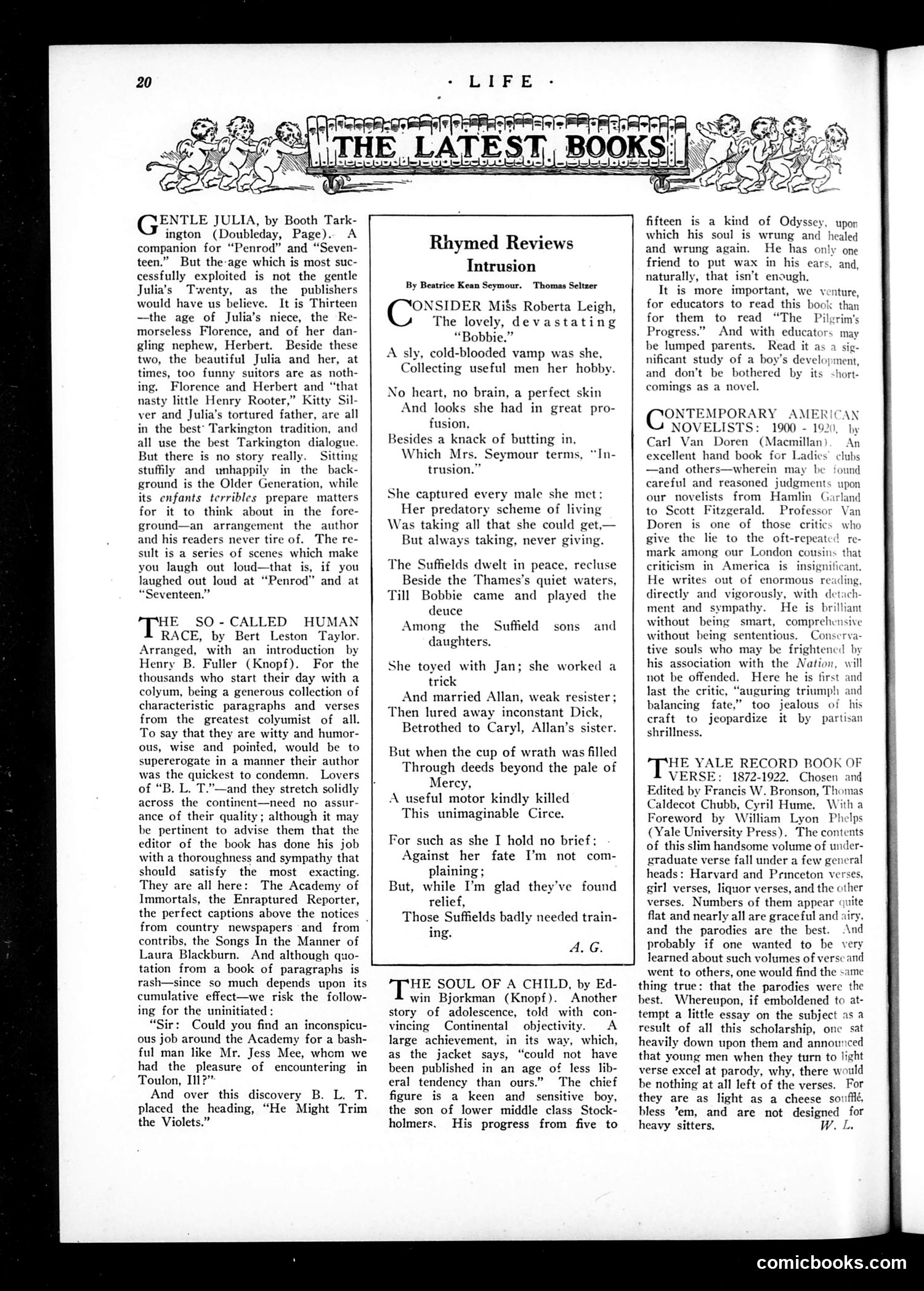
This page features literary reviews from Life's book section, circa early 1920s. The reviews discuss three works: Booth Tarkington's "Gentle Julia" (praised for its comic depiction of mischievous teenagers rather than the titular adult heroine), a collection of columns by humorist Bert Leston Taylor called "The So-Called Human Race," and Edwin Bjorkman's "The Soul of a Child." The "Rhymed Reviews" section offers verse commentary on a novel called "Intrusion" about a morally corrupt woman ("Bobbie") who seduces multiple men in a peaceful family before meeting her demise via motor accident. The reviewer expresses no sympathy for the character's fate. This represents typical early-20th-century literary criticism emphasizing moral judgment of characters alongside aesthetic assessment—the destructive woman receives narrative punishment the critic approves.
📄 Transcribed text from this page (OCR, searchable)
Machine-transcribed from the original scan — historical spelling and the odd misread are preserved.
GET JULIA, by Booth Tark- ington (Doubleday, Page). companion for “Penrod” and “Seven- teen.” But the:age which is most suc- cessfully exploited is not the gentle Julia’s Twenty, as the publishers would have us believe. It is Thirteen —the age of Julia’s niece, the Re- morseless Florence, and of her dan- gling nephew, Herbert. Beside these two, the beautiful Julia and her, at times, too funny suitors are as noth- ing. Florence and Herbert and “that nasty little Henry Rooter,” Kitty - ver and Julia’s tortured father, are all in the best’ Tarkington tradition, and all use the best Tarkington dialogue. But there is no story really. Sitting stuffily and unhappily in the back- ground is the Older Generation, while its enfants terribles prepare matters for it to think about in the fore- ground—an arrangement the author and his readers never tire of. The re- sult is a series of scenes which make you laugh out loud—that if you laughed out loud at “Penrod” and at “Seventeen.” ‘HE SO-CALLED HUMAN RACE, by Bert Leston Taylor. Arranged, with an introduction by Henry B. Fuller (Knopf). For the thousands who start their day with a colyum, being a generous collection of characteristic paragraphs and verses from the greatest colyumist of all. To say that they are witty and humor- ous, wise and pointed, would be to supererogate in a manner their author was the quickest to condemn. Lovers of “B. L. T.”—and they stretch solidly across the continent—need no assur- ance of their quality; although it may be pertinent to advise them that the editor of the book has done his job with a thoroughness and sympathy that should satisfy the most exacting. They are all here: The Academy of Immortals, the Enraptured Reporter, the perfect captions above the notices from country newspapers and from contribs, the Songs In the Manner of Laura Blackburn. And although quo- tation from a book of paragraphs is rash—since so much depends upon its cumulative effect—we risk the follow- ing for the uninitiated : “Sir: Could you find an inconspicu- ous job around the Academy for a bash- ful man like Mr. Jess Mee, whom we had the pleasure of encountering in Toulon, 111?” And over this discovery B. L. T. placed the heading, “He Might Trim the Violets.” Rhymed Reviews Intrusion By Beatrice Kean Seymour. Thomas Seltzer IONSIDER Mis Roberta Leigh, The lovely, devastating “Bobbie.” A sly, cold-blooded vamp was she, Collecting useful men her hobby. No heart, no brain, a perfect skin And looks she had in great pro- fusion, Besides a knack of butting in, Which Mrs. Seymour terms, “In- trusion. She captured every male she me Her predatory scheme of living Was taking all that she could get,— But always taking, never giving. The Suffields dwelt in peace, recluse Beside the Thames’s quiet waters, Till Bobbie came and played the deuce Among the daughters. Suffield sons and She toyed with Jan; she worked a trick And married Allan, weak resister ; Then lured away inconstant Dicl Betrothed to Caryl, Allan’s sister. But when the cup of wrath was filled Through deeds beyond the pale of Mercy, A useful motor kindly killed This unimaginable Circe. For such as she I hold no brief; Against her fate I’m not com- plaining; But, while I’m glad they've found relief, Those Suffields badly needed train- ing. 4, G. | se SOUL OF A CHILD, by Ed- win Bjorkman (Knopf). Another story of adolescence, told with con- vincing Continental _ objectivi large achievement, in its way, which, as the jacket says, “could not have been published in an age of less lib- eral tendency than ours.” The chief figure is a keen and _ sensitive boy, the son of lower middle class Stock- holmers. His progress from five to fifteen is a kind of Odyssey, upon which his soul is wrung and healed and wrung again. He only one friend to put wax in his ears, and, naturally, that isn’t enough. It is more important, we venture, for educators to read this book than for them to read “The Pilgrim's Progress.” And with educators may be lumped parents. a nificant study of a boy’s development, and don’t be bothered by its short- comings as a novel. AMERIC 1900 - 1920, Carl Van Doren (Macmillan) excellent hand book for Ladies’ clubs —and others—wherein may be found careful and reasoned judgments upon our novelists from Hamlin Garland to Scott zgerald. Professor Van Doren is one of those critics who give the lie to the oft-repeated re- mark among our London cousins that criticism in America is insignificant. He writes out of enormous reading, directly and vigorously, with detach- ment and sympathy. He is brilliant without being smart, comprehensive without being sententious. Conserva- tive souls who may be frightened by his association with the Nation, will not be offended. Here he is first and last the critic, “auguring triumph and balancing fate,” too jealous of his craft to jeopardize it by partisan shrillness. HE YALE RECORD BOOK OF VERSE: 1872-1922. Chosen and Edited by Francis W. Bronson, Thomas Caldecot Chubb, Cyril Hume. With a Foreword by William Lyon Phelps (Yale University Press). The contents of this slim handsome volume of under- graduate verse fall under a few general heads: Harvard and Princeton verses, girl verses, liquor verses, and the other verses. Numbers of them appear quite flat and nearly all are graceful and airy, and the parodies are the best. .\nd probably if one wanted to be very learned about such volumes of verse went to others, one would find the same thing true: that the parodies were the best. Whereupon, if emboldened to at- tempt a little essay on the subject as a result of all this scholarship, one sat heavily down upon them and announced that young men when they turn to light verse excel at parody, why, there would be nothing at all left of the verses. For they are as light as a cheese souifilé, bless ’em, and are not designed for heavy sitters. W.L. comicbooks.com