
Life, 1922-06-22 · page 21 of 34
Life — June 22, 1922 — page 21: what you’re looking at
What you’re looking at
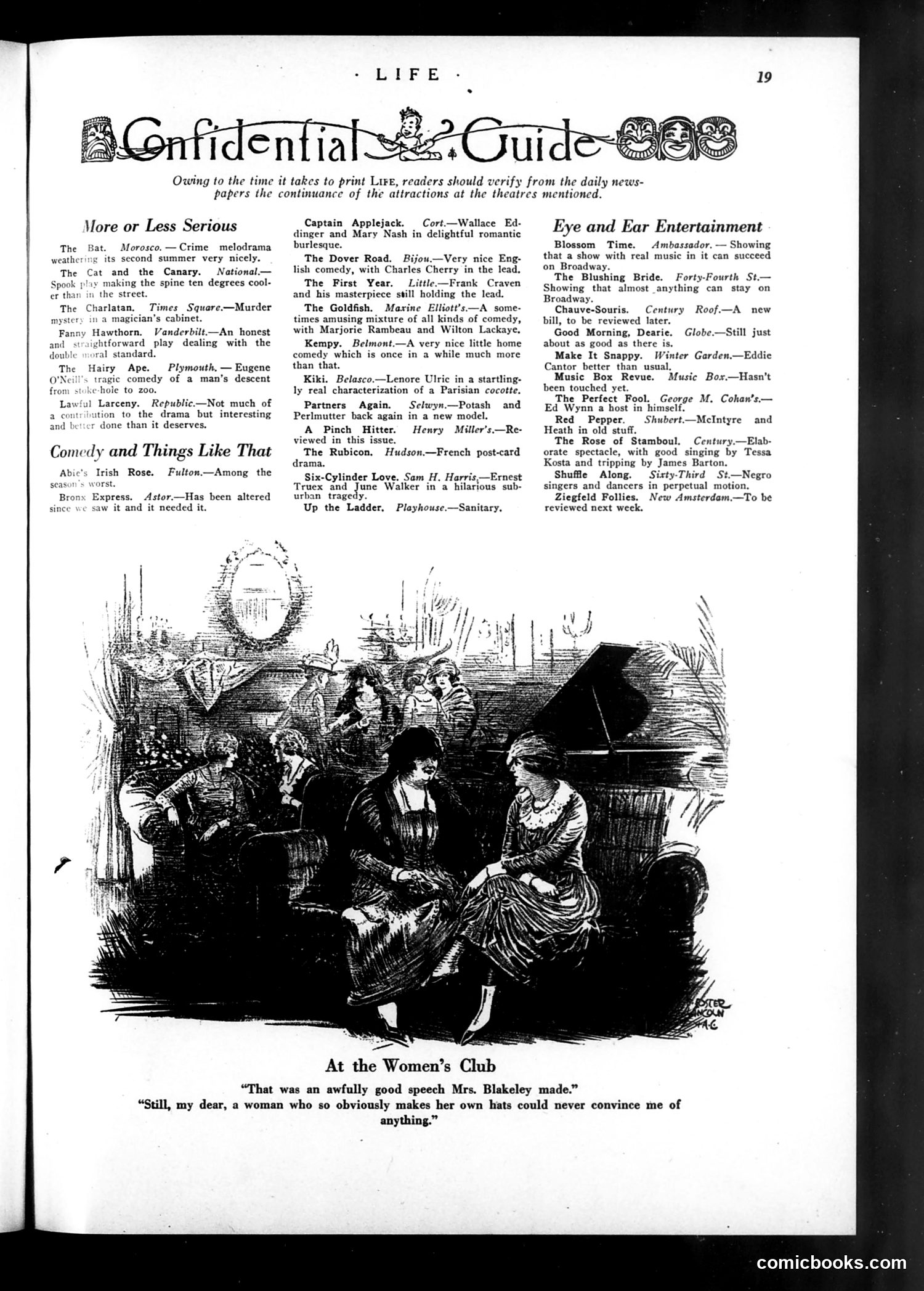
This single-panel cartoon satirizes class-based prejudice and superficial judgment among women. The scene shows two women at a women's club discussing a speech by Mrs. Blakeley. One woman dismisses the speaker's credibility entirely—not because of her arguments, but because Mrs. Blakeley "obviously makes her own hats." The joke targets the social snobbery of the era: making one's own clothing was associated with lower economic status or lack of leisure time. A "respectable" upper-class woman would have a milliner make her hats. The cartoon mocks how wealthy women could be so preoccupied with visible markers of class distinction that they'd ignore substance entirely. It's satirizing the vapidity and rigid class consciousness of female social circles, suggesting that even a good speech counts for nothing if the speaker's clothing betrays insufficient wealth.
📄 Transcribed text from this page (OCR, searchable)
Machine-transcribed from the original scan — historical spelling and the odd misread are preserved.
Owing to the time it takes to print Lire, readers should verify from the daily news- papers the continuance of the attractions at the theatres mentioned. More or Less Serious The Bat. Morosco.—Crime melodrama weathering its second summer very nicely. The Cat and the Canary. National Spook | king the spine ten degrees cool- er than in eet. The Charlatan, Times Square-—Murder tery in a magician’s cabinet. y Hawthorn, Vanderbilt—An_ honest ghtforward play dealing with the double ral standard, The Hairy Ape. Plymouth, — Eugene tragic comedy of a man’s descent e-hole to zoo. Lawful Larceny. Republic.—Not much of ition to the drama but interesting done than it deserves. ac and ti Comedy and Things Like That Abie's Irish Rose. sea orst. Bronx Express. Astor.—Has been altered since saw it and it needed it. Fulton—Among the Captain Applejack. Cort.—Wallace Ed- dinger and Mary Nash in delightful romantic burlesque. The Dover Road. Bijou.—Very nice Eng- lish comedy, with Charles Cherry in the lead, The First Year. Little—Frank Craven and his masterpiece still holding the lead. The Goldfish. Marine Elliott’s—A some- times amusing mixture of all kinds of comedy, with Marjorie Rambeau and Wilton Lackaye. Kempy. Belmont.—A very nice little home comedy which is once in a while much more than that. Kiki. Belasco.—Lenore Ulric in a startling- ly real characterization of a Parisian cocotte. Partners Again. Sclwyn.—Potash and Perlmutter back again in a new model. A Pinch Hitter. Henry Miller’s—Re- viewed in this issue. The Rubicon. Hudson.—French post-card drama. Six-Cylinder Love. Sam H. Harris—Ernest Truex and June Walker in a hilarious sub- urban tragedy. Up the Ladder, Playhouse.—Sanitary, At the Women’s Club Eye and Ear Entertainment Blossom Time. Ambassador. — Showing that a show with real music in it can succeed on Broadway. The Blushing Bride. Forty-Fourth St.— Showing that almost anything can stay on Broadway. Chauve-Souris. Century bill, to be reviewed later. Good Morning, Dearie. about as good as there is. Make It Snappy. Winter Garden.—Eddie Cantor better than usual, Music Box Revue. Music Box.—Hasn't been touched yet. The Perfect Fool. George M. Cohan’s— Ed Wynn a host in himself. Red Pepper. Shubert. Heath in old stuff. The Rose of Stamboul. Century.—Elab- orate spectacle, with good singing by Tessa Kosta and tripping by James Barton. Shuffle Along. Sixty-Third St—Negro singers and dancers in perpetual motion. Ziegfeld Follies. New Amsterdam.—To be reviewed next week. Roof.—A new Globe.—Still just McIntyre and “That was an awfully good speech Mrs. Blakeley made.” “Still, my dear, a woman who so obviously makes her own hats could never convince me of anything.” comicbooks.com