
A complete issue · 34 pages · 1922
Life — March 16, 1922
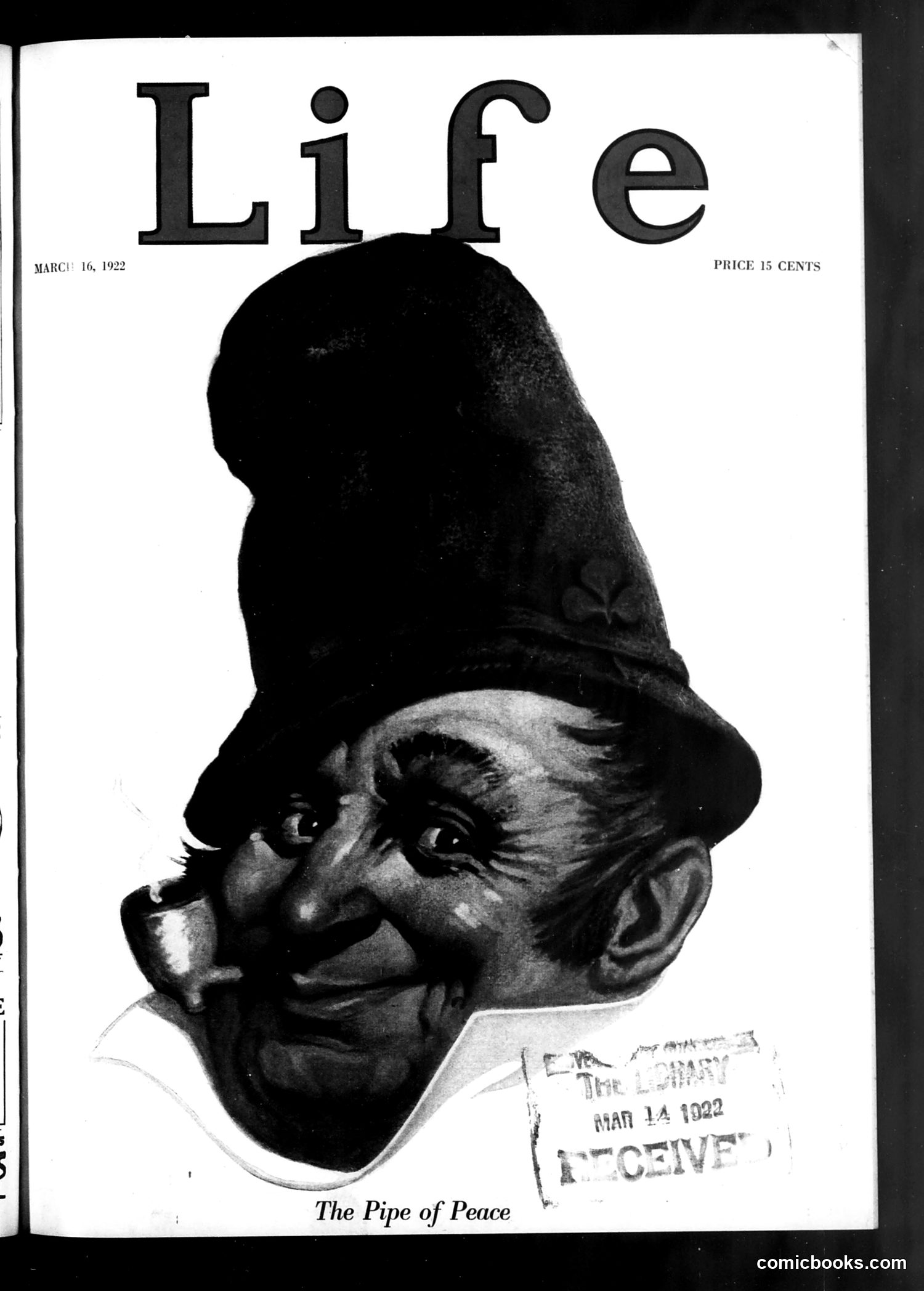
This cover features a caricatured figure wearing a tall black hat, depicted with exaggerated facial features in profile, smoking a pipe. The caption reads "The Pipe of Peace." Without additional context from the magazine's interior, the specific identity of this figure remains unclear, though the imagery suggests a political or diplomatic figure from the early 1920s. The "pipe of peace" reference traditionally evokes Native American diplomatic imagery, here applied satirically to what appears to be a contemporary political negotiation or conflict resolution. The March 1922 date places this during the post-WWI period when various peace treaties and international negotiations were ongoing. The caricature style was typical of Life's political satire of this era.
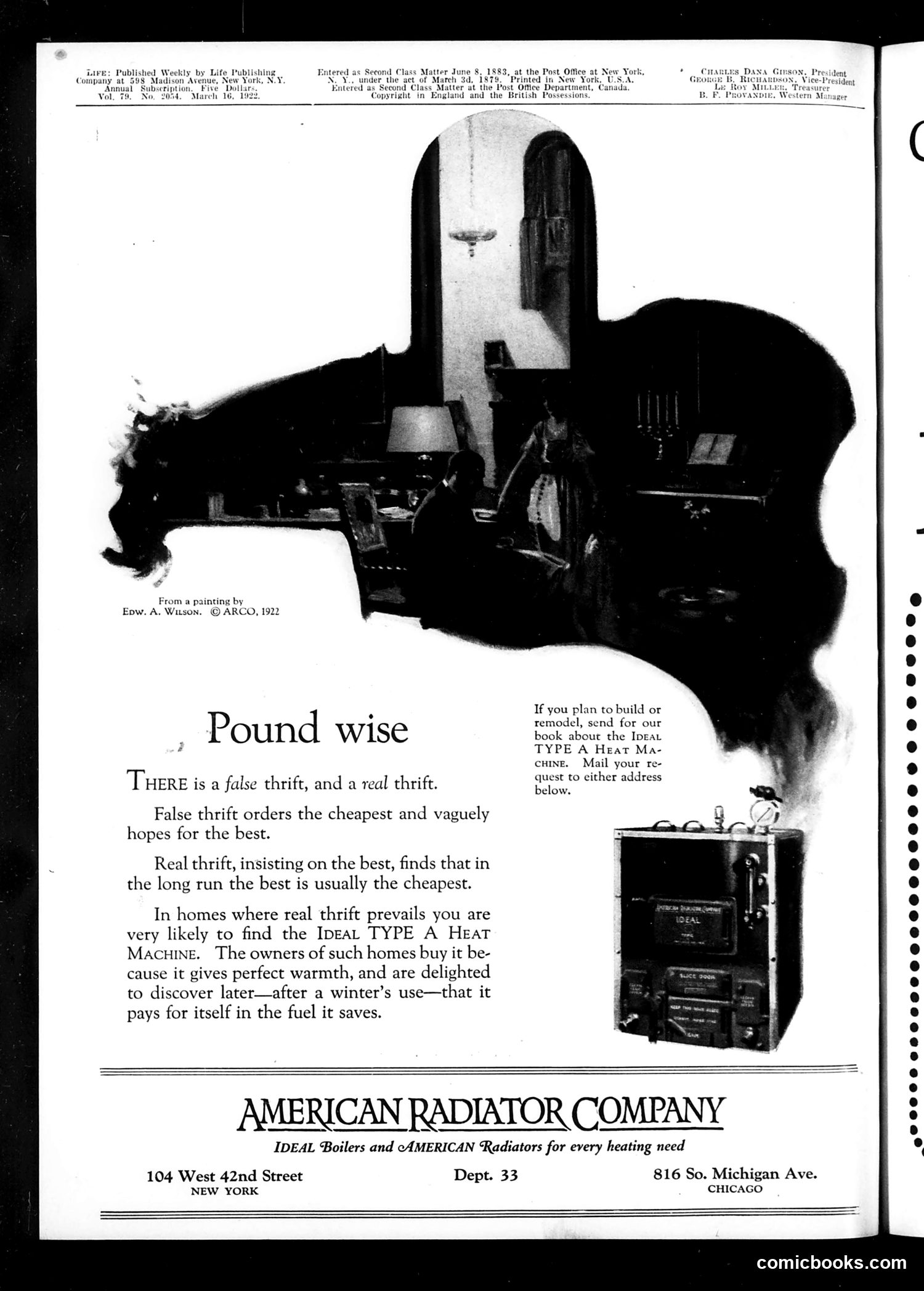
This page is primarily a **1921 advertisement** for the American Radiator Company's heating systems, not political satire. The ad uses the phrase "Pound wise" to argue for "real thrift"—purchasing quality heating equipment despite higher upfront costs, as it saves money long-term through fuel efficiency. This contrasts with "false thrift" (buying cheap, inadequate systems). The imagery shows the **Ideal Type A Heat Machine** (a boiler/radiator unit) alongside an illustration of an interior room with heating equipment. The painting is credited to "Eow. A. Wilson, © ARCO, 1921." This is commercial messaging typical of early 20th-century Life magazine, which mixed satirical content with advertisements. The "pound wise" phrase is wordplay on the common expression "penny wise, pound foolish."
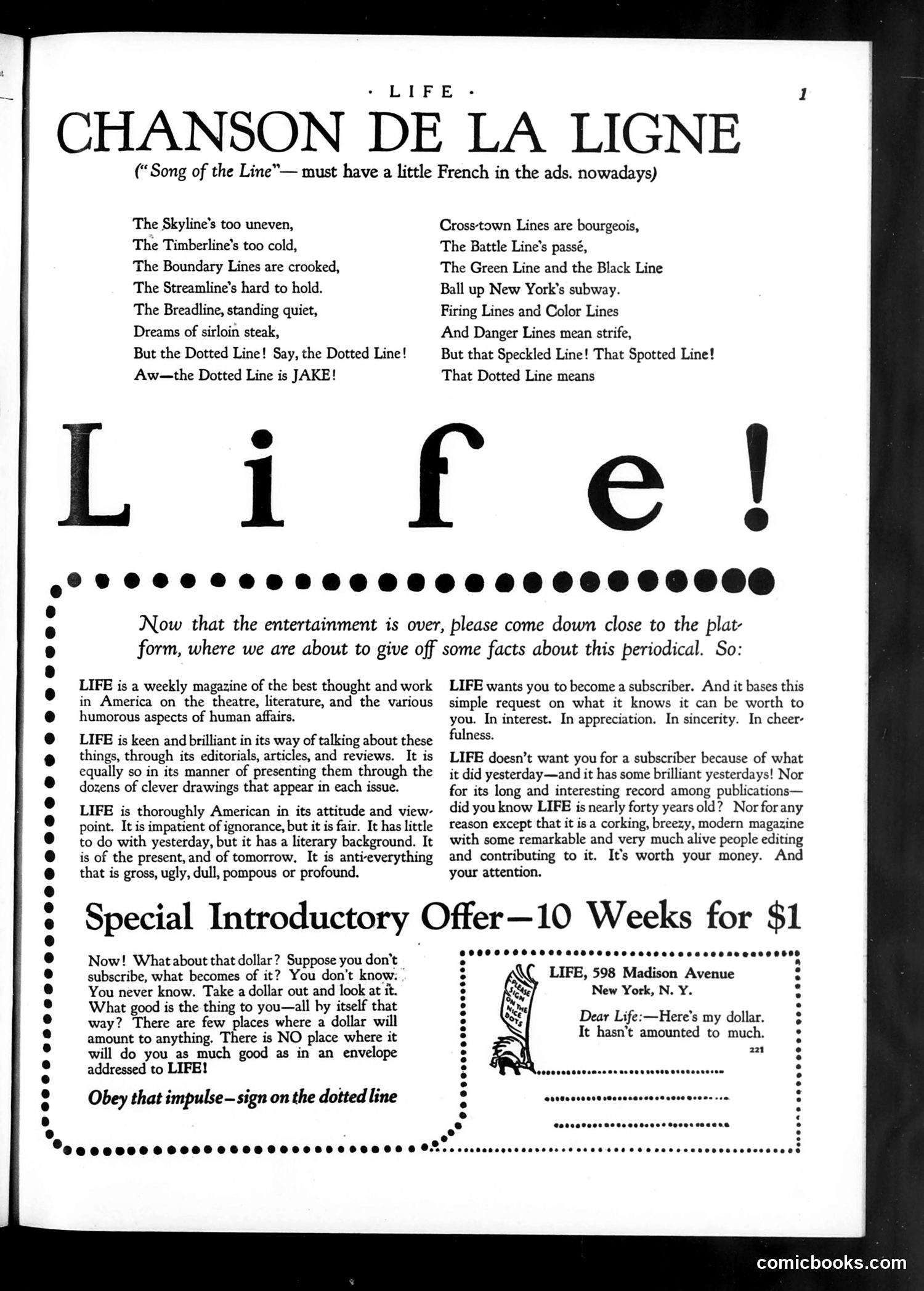
This page is primarily an advertisement for *Life* magazine itself, disguised as satirical poetry and editorial copy. The poem "Chanson de la Ligne" ("Song of the Line") is a humorous take on New York City subway lines—the Skyline, Timberline, Boundary Lines, Streamline, Breadline, and notably the "Dotted Line," which the poem calls "JAKE" (slang for satisfactory/acceptable). The subway references suggest this is from the early-to-mid 20th century when NYC's transit system was expanding. The satire appears gentle: poking fun at the city's infrastructure while celebrating the Dotted Line as superior. The piece then pivots to promoting *Life*'s subscription offer (10 weeks for $1), positioning the magazine as essential urban reading for sophisticated Americans interested in theater, literature, and humor.
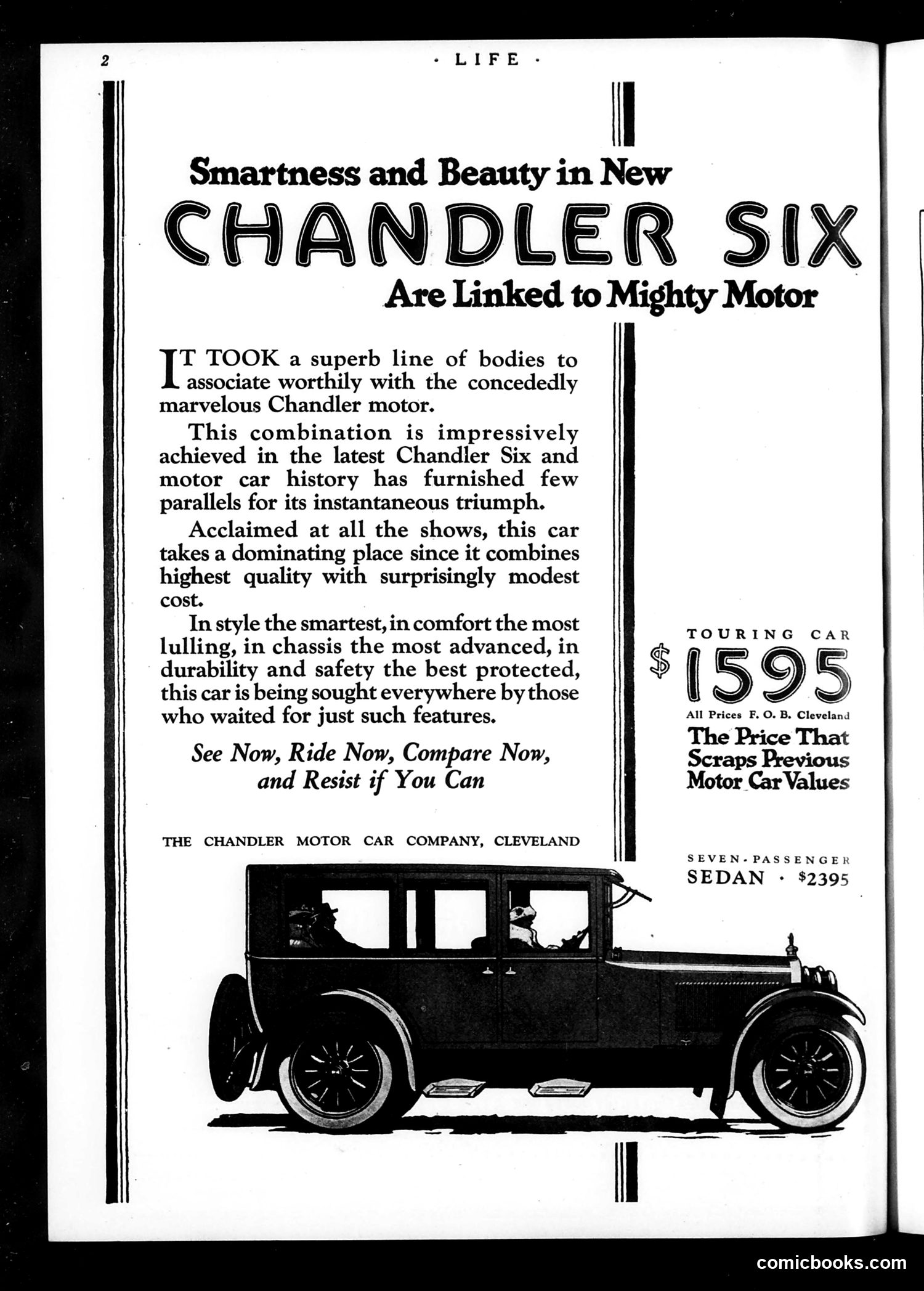
This is **not a cartoon or satire page**, but rather a **automobile advertisement** for the Chandler Six motor car, published in *Life* magazine. The ad promotes the Chandler Six as combining "smartness and beauty" with a powerful motor at a modest price ($1,595 for the touring car). The text emphasizes the car's superior styling, comfort, advanced chassis, and safety features compared to competitors. The only visual element is a **side-profile illustration of the automobile itself**—a typical 1920s sedan with spoke wheels and an open cabin design. There are no political cartoons, caricatures, or satire on this page. This represents how early *Life* magazine mixed editorial content with advertising.
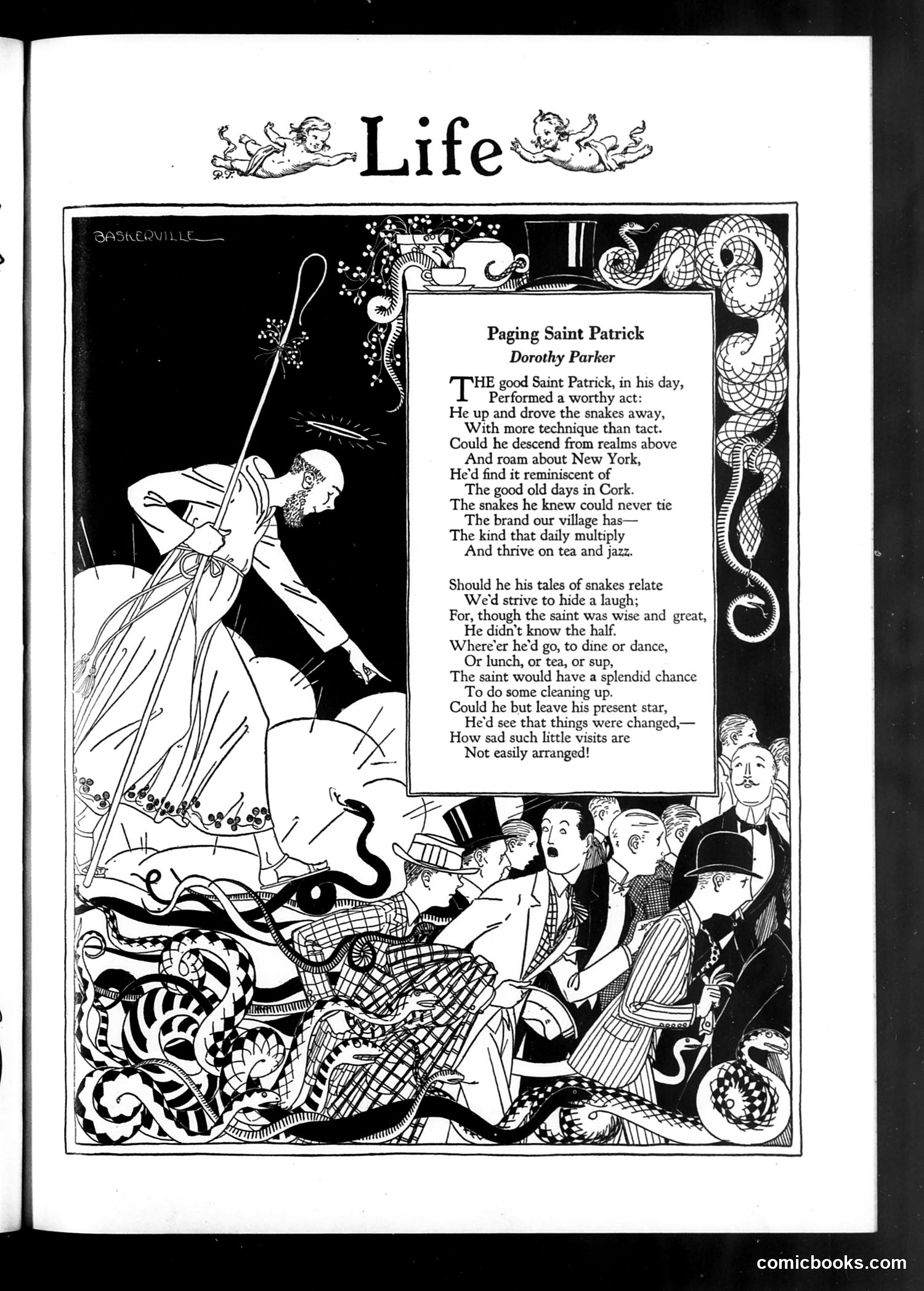
This satirical poem by Dorothy Parker humorously invokes Saint Patrick to address modern New York City problems. The illustration depicts Saint Patrick (upper left, driving out snakes) contrasted with contemporary urban chaos below—a crowded street scene with well-dressed pedestrians and visible serpents among them. The satire suggests that just as the historical Saint Patrick expelled snakes from Ireland, modern New York needs similar divine intervention to eliminate its own "snakes"—likely referring to urban vice, corruption, or social problems of the Jazz Age. The poem's tone is wry: while Saint Patrick was wise and great, he couldn't manage the messy realities of modern city life with its constant social obligations ("tea and jazz"). Parker laments that such miraculous interventions are now impossible to arrange.
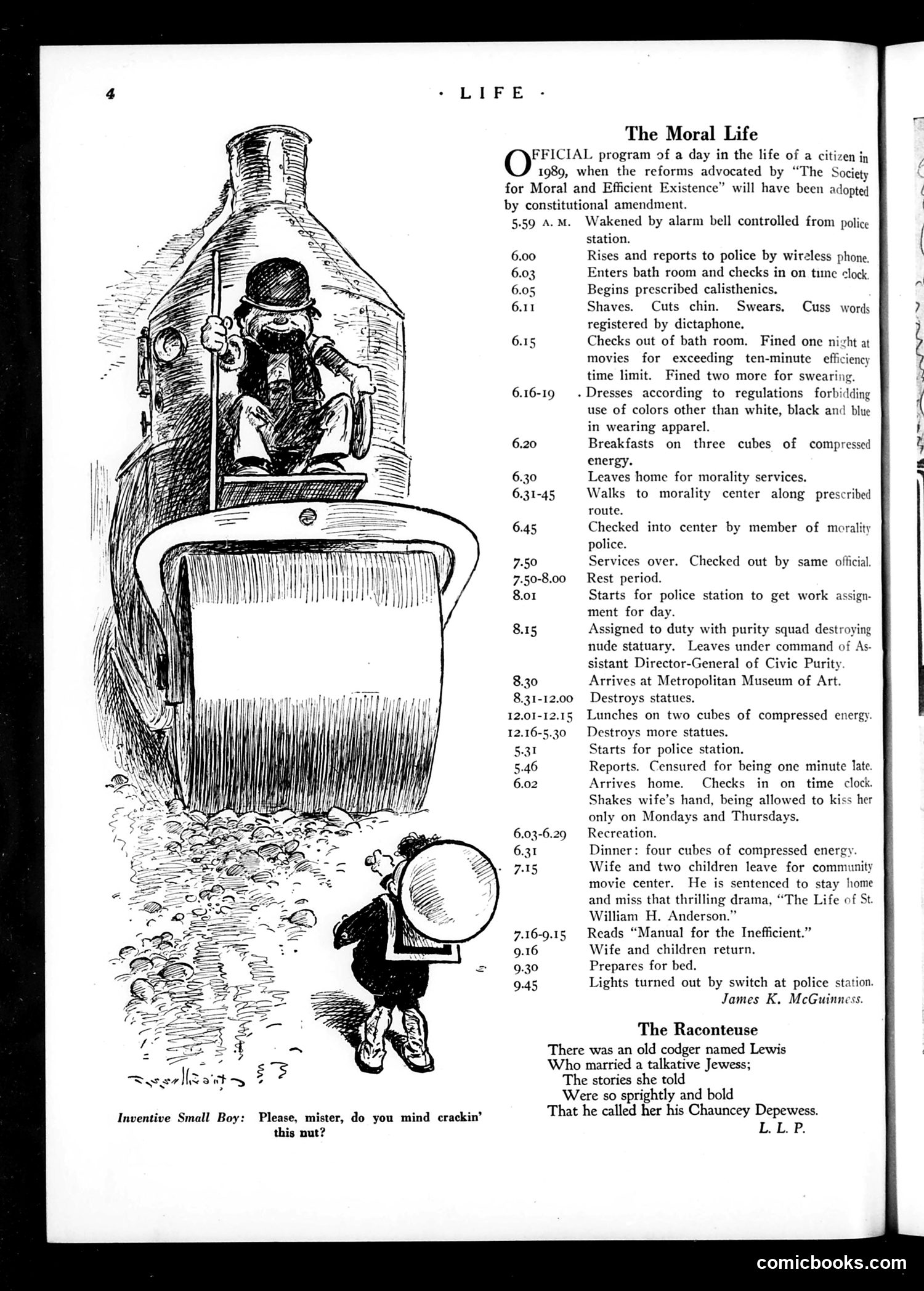
This page satirizes a fictional 1980 dystopian society governed by the "Society for Moral and Efficient Existence." The main cartoon depicts an "Inventive Small Boy" asking "Please, mister, do you mind crackin' this nut?" while a figure appears trapped inside a large mechanical nutcracker device. The satire critiques excessive moral regulation and social control. The detailed schedule ("The Moral Life") mocks authoritarian enforcement of behavior—fines for swearing, mandatory "morality services," surveillance by "morality police," and destruction of artwork deemed immoral. The nutcracker imagery suggests citizens being crushed by oppressive bureaucratic systems. This reflects early 20th-century anxieties about government overreach and loss of individual freedom, satirizing progressive reformist movements as potentially tyrannical.
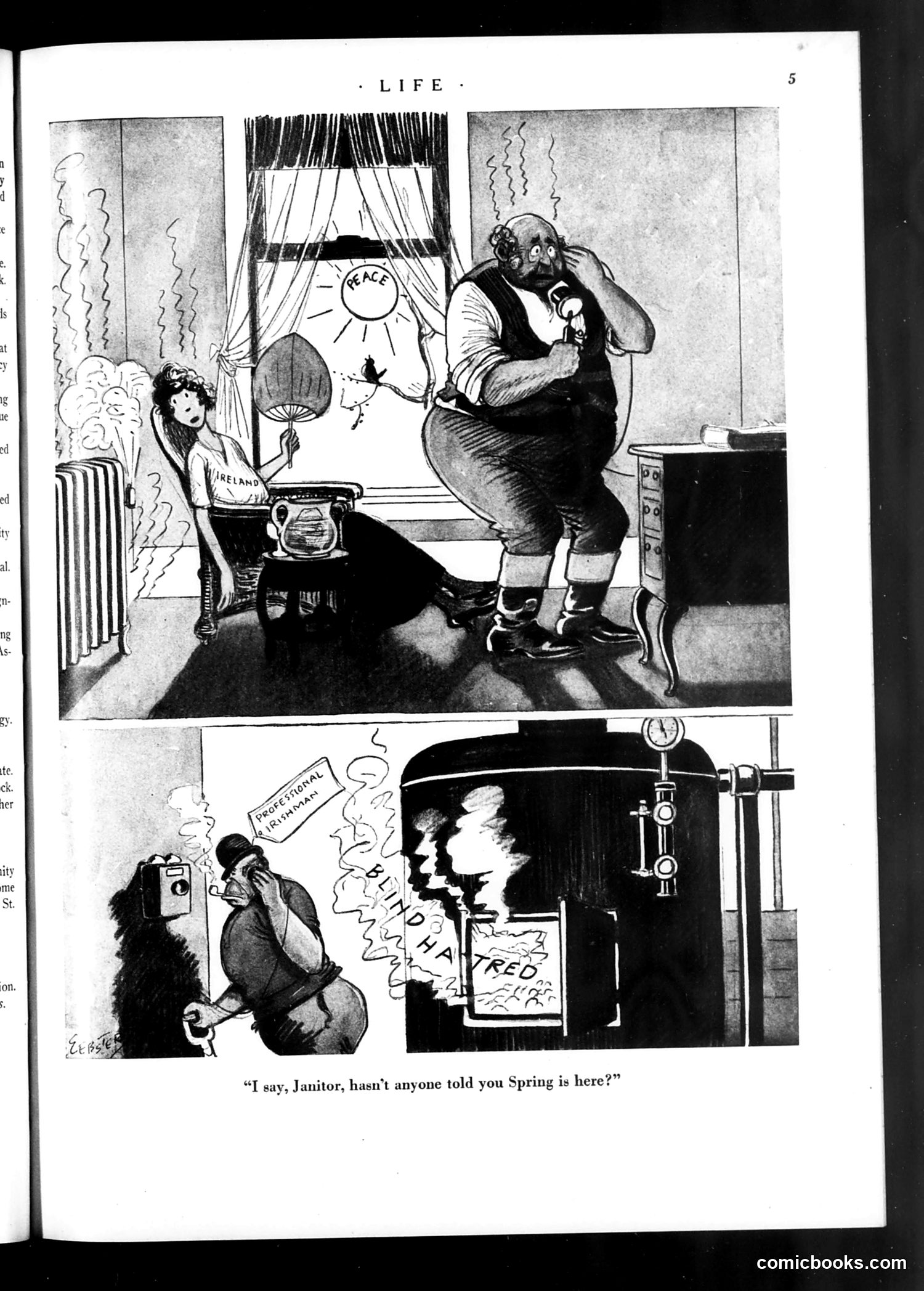
This page from *Life* magazine contains two satirical cartoons about spring arriving in Ireland. **Top cartoon:** A large, heavy man peers anxiously out a window labeled "PEACE," while a woman labeled "IRELAND" holds a fan, suggesting discomfort with the warm season. Steam rises from radiators and a window, indicating overheating. **Bottom cartoon:** The caption reads, "I say, Janitor, hasn't anyone told you Spring is here?" A janitor continues stoking a furnace despite spring's arrival, while papers labeled "RENT" and what appears to be heating-related notices are visible. The satire appears to mock Ireland's political situation—suggesting that despite peaceful conditions ("spring"), authorities continue aggressive policies unnecessarily, like a janitor heating when warmth already exists. The humor relies on the contrast between seasonal change and institutional stubbornness.
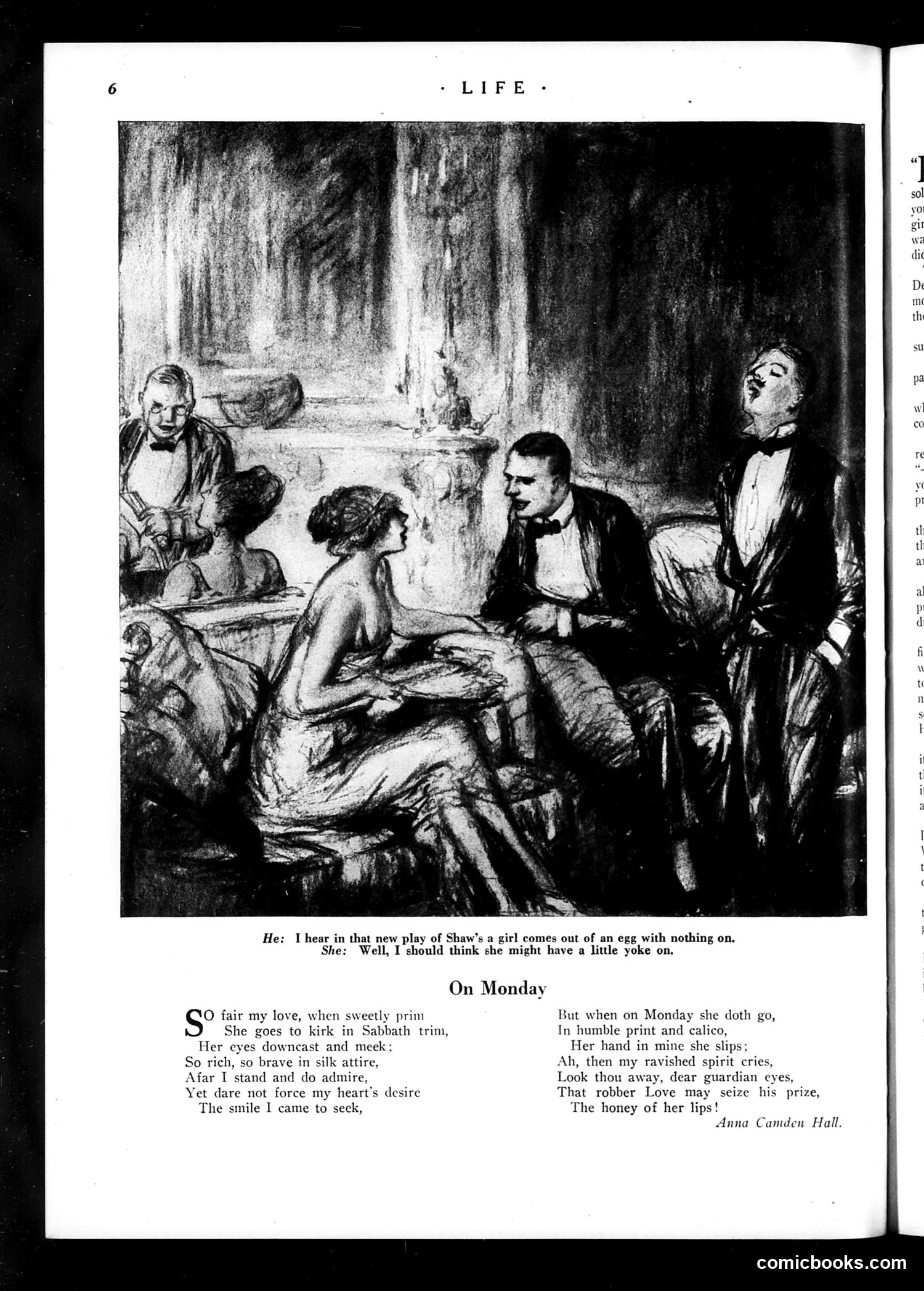
This page contains a satirical joke about Shaw's theater and a romantic poem. The cartoon caption references a new play by George Bernard Shaw where "a girl comes out of an egg with nothing on"—the male character notes she might have "a little yoke on," a pun on "yolk." This jokes about both Shaw's avant-garde theatrical provocations and the woman's minimal clothing. Below, the poem "On Monday" by Anna Camden Hall depicts contrasting behavior: a woman is prim and proper on Sunday ("meek," "silk attire"), but Monday she becomes bold and flirtatious ("humble print and calico," "hand in mine she slips"). The satire mocks Victorian hypocrisy about propriety and courtship rituals.
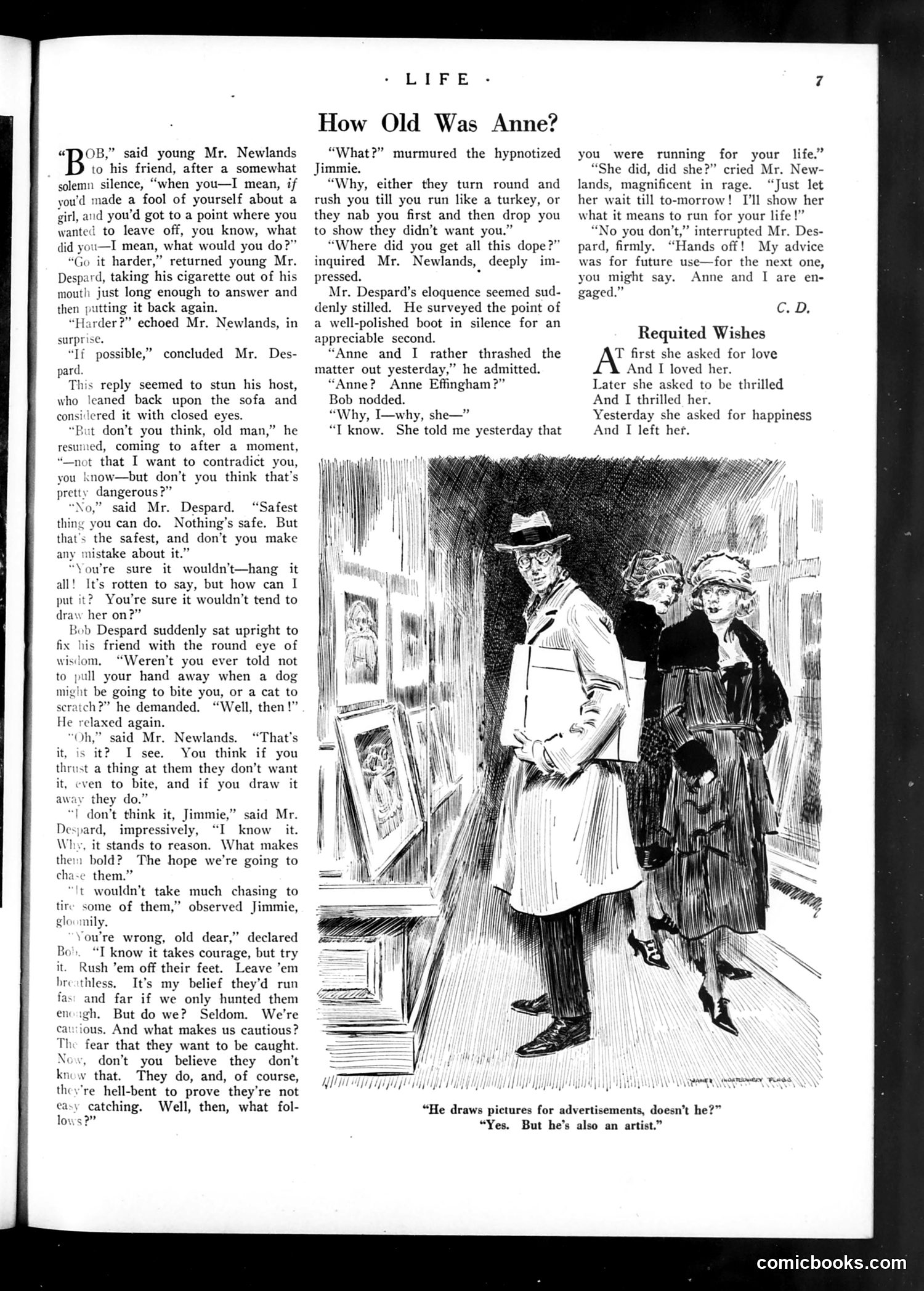
This page contains a humorous short story and illustration about two men debating whether to propose to a woman named Anne. The dialogue centers on whether it's "safe" to ask someone to marry you—the men argue about whether directness or caution is better when proposing. The accompanying illustration shows a man in a hat and coat speaking with two women on a street, likely depicting a scene from the story. Below the illustration is a caption joke: "He draws pictures for advertisements, doesn't he?" "Yes. But he's also an artist."—a mild satire on commercial illustrators who consider themselves above commercial work. The page reflects early 20th-century attitudes toward courtship and marriage proposals, presenting romance as a somewhat anxious, strategic endeavor.
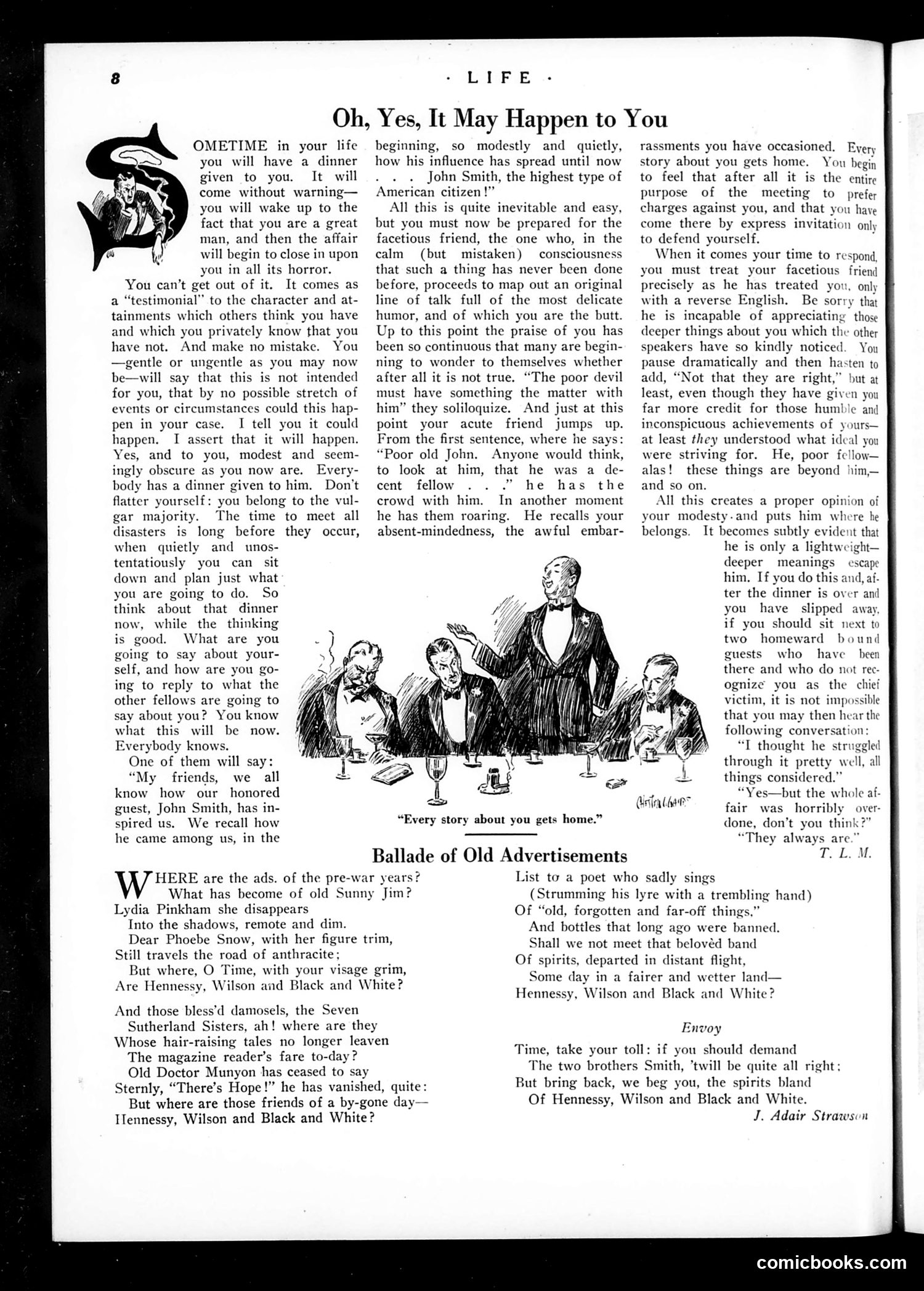
This article advises readers on handling social embarrassment at dinner parties. The accompanying illustration shows a well-dressed man at a formal dinner surrounded by other guests, captioned "Every story about you gets home." The piece warns that unflattering stories and gossip about you will inevitably circulate among your social circle, no matter how private you thought your indiscretions were. It counsels readers to prepare responses and maintain composure when facing such situations. The article also includes "Ballad of Old Advertisements," a nostalgic poem lamenting vanished pre-war advertising figures like "Sunny Jim," "Phoebe Snow," and brand mascots ("Hennessy, Wilson and Black and White"), reflecting on how advertising icons fade from cultural memory over time.
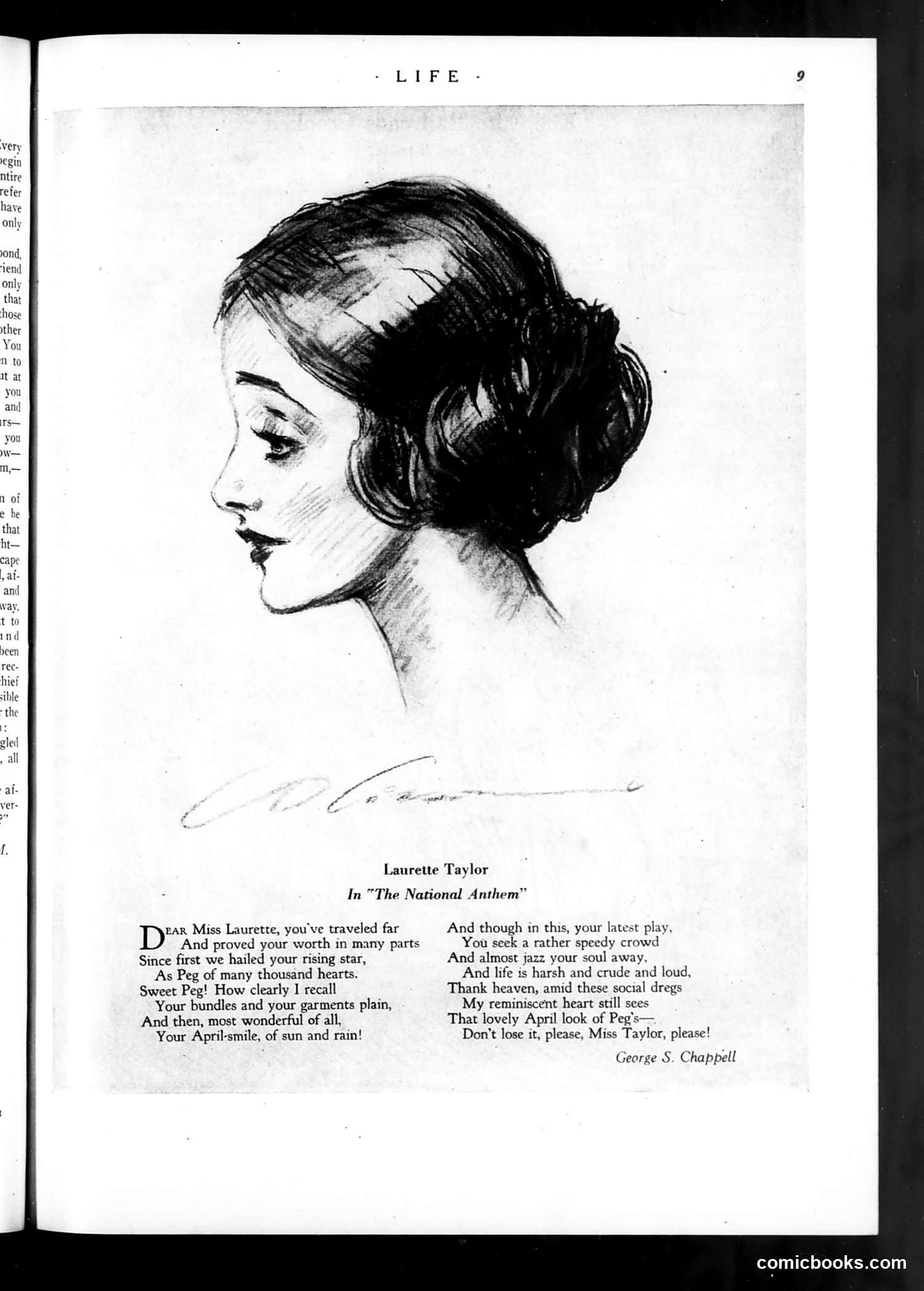
This page from *Life* magazine features a portrait sketch of actress **Laurette Taylor**, accompanied by a poem by **George S. Chappell** titled "In 'The National Anthem.'" The poem is a congratulatory tribute to Taylor on her theatrical success. It references her "rising star" and early career ("Sweet Peg!"), praising her costumes and stage presence. The final lines suggest she's in a recent play where she performs jazz-influenced material ("almost jazz your soul away"), and the speaker urges her to retain her charm and youthful spirit ("that lovely April look of Peg's"). This appears to be a straightforward celebrity tribute rather than political satire—a common *Life* magazine feature celebrating prominent entertainers of the era.
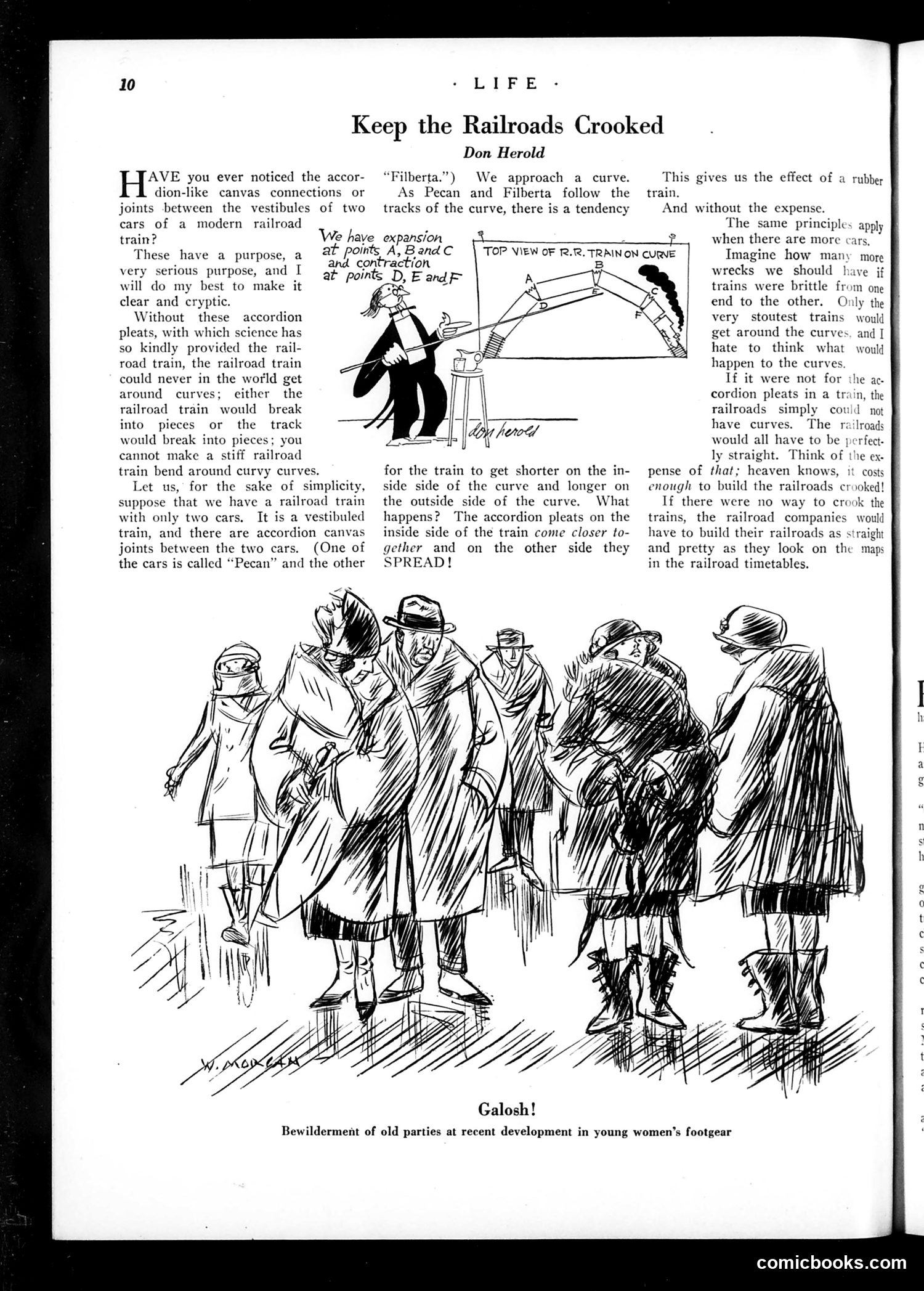
This article by Don Herold explains railroad accordion pleats—the canvas joints between train cars that allow expansion and contraction on curves. The top diagram illustrates how these pleats work: the inner side of a curved track compresses while the outer side extends, causing the pleats to "spread." The bottom cartoon, captioned "Galosh!" shows bewilderment among older party-goers at young women's new fashionable footwear—apparently galoshes or similar rubber overshoes were a surprising fashion development that contrasted with previous styles. The page combines technical railroad explanation with social satire about changing fashion trends, juxtaposing industrial innovation with contemporary cultural shifts.
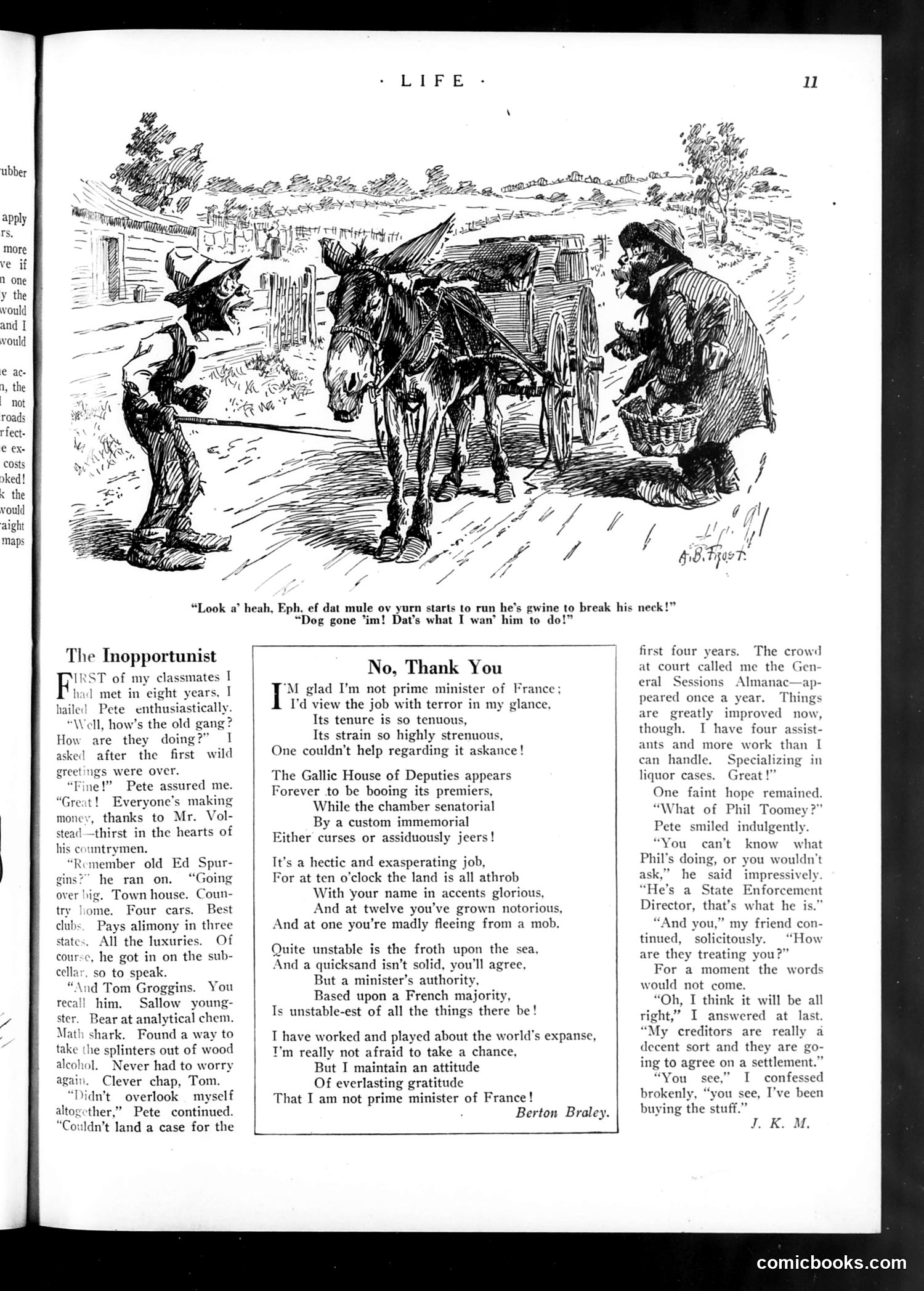
The top cartoon depicts a rural scene where a woman and child observe a mule-drawn cart, with dialogue about the mule "starting to run" and breaking its "neck." This appears to be a simple rustic humor sketch without obvious political content. Below is a poem titled "No, Thank You" by Barton Blakey, attributed to someone declining the position of French Prime Minister. The poem satirizes the job as exhausting and thankless—referencing the "Gallic House of Deputies" constantly "booing its premiers" and the strain of the role. The right column contains "The Inopportunist," a humorous anecdote about someone's unsuccessful job applications, mentioning court positions and a "State Enforcement Director" role. These pieces reflect early 20th-century American satirical commentary on political instability and employment frustrations.
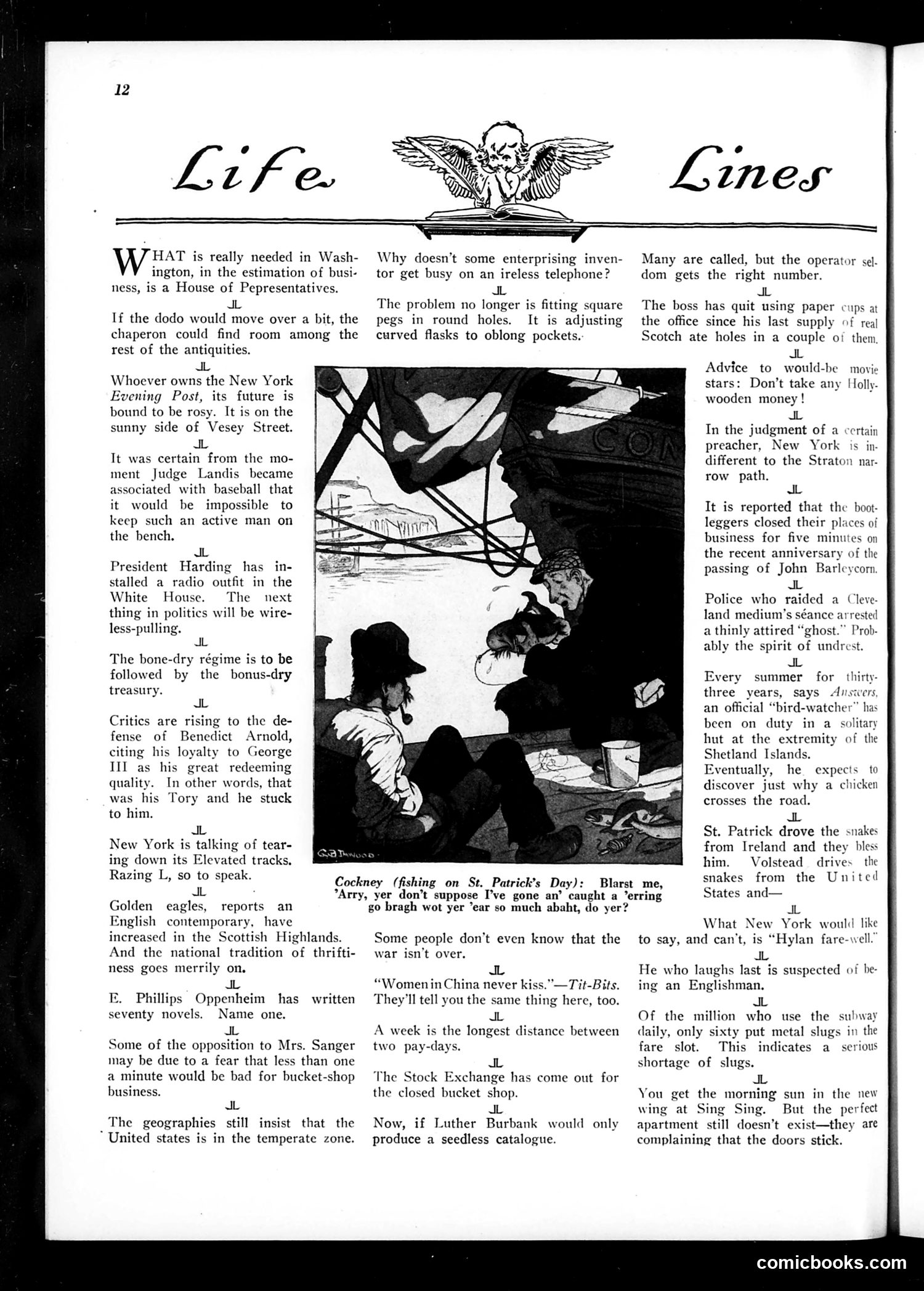
This page contains a satirical humor column with a central illustration titled "Cockney (Fishing on St. Patrick's Day)" showing two figures fishing. The caption reads: "Arry, yer don't suppose I've gone an' caught a 'erring go brugh wot yer 'ear so much abaht, eh, yer?" The joke plays on Irish stereotypes: "go brugh" (from Irish "go brách," meaning "forever") sounds like "herring" to the cockney speaker, conflating Irish nationalism with fish. It's a dated ethnic humor piece common to early 20th-century American satire. The surrounding text contains brief satirical observations about American politics, business, and culture—typical of Life's "Life Lines" section offering commentary on contemporary issues like Washington politics, New York real estate, and social trends.
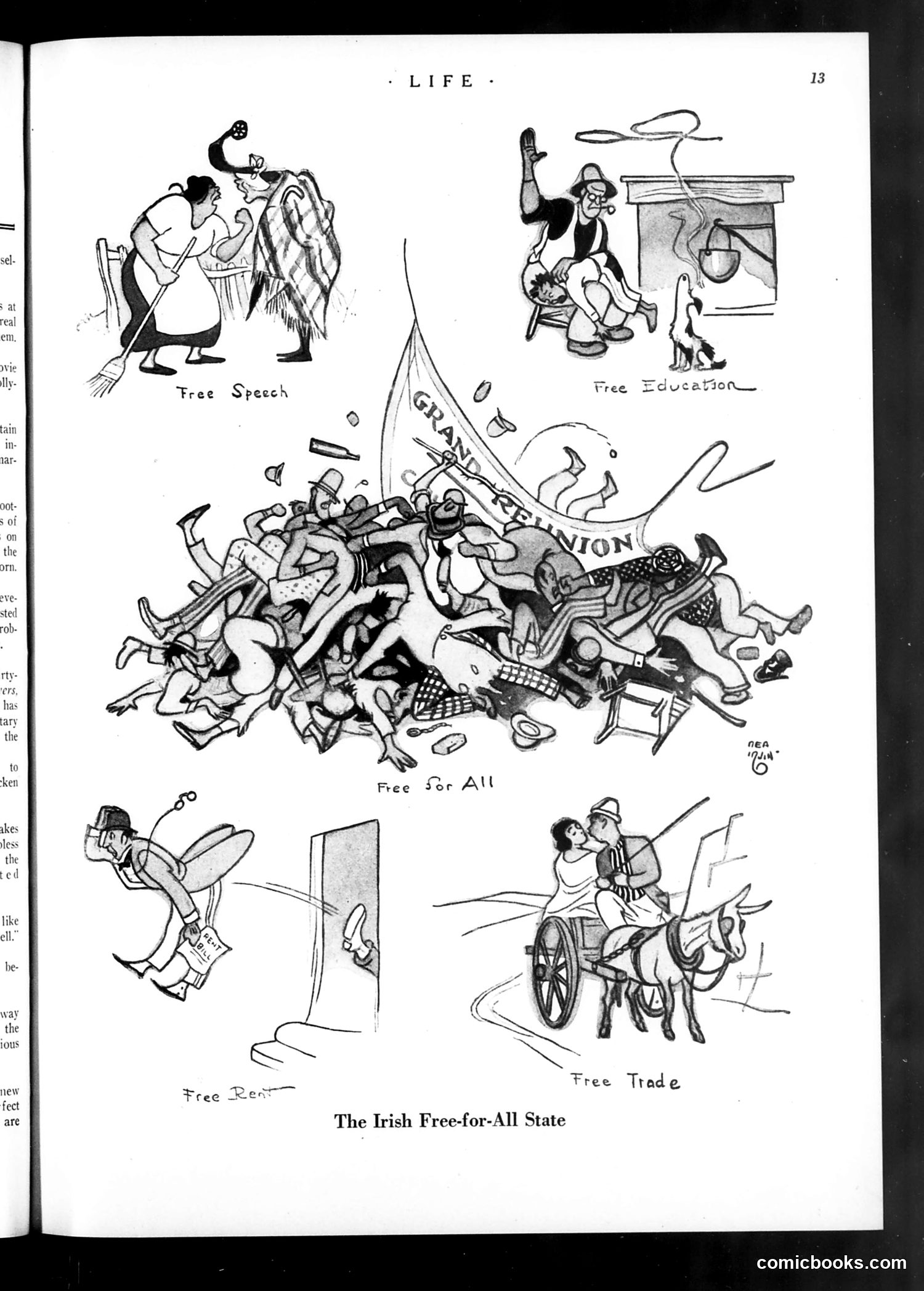
This satirical cartoon about the Irish Free State depicts it as chaotic anarchy. The central image shows a chaotic melee of figures fighting over a banner labeled "GRAND UNION," symbolizing the disorder accompanying Irish independence and the partition question. The surrounding smaller panels satirize various "freedoms" the new state supposedly offers: "Free Speech" (violent argument), "Free Education" (mayhem in a classroom), "Free for All" (the central brawl), "Free Rent" (eviction), and "Free Trade" (disorder on wheels). The satire suggests that Irish independence has devolved into lawlessness rather than creating functional governance—a common American political cartoon trope mocking Irish political instability during the Free State period (1922 onward).
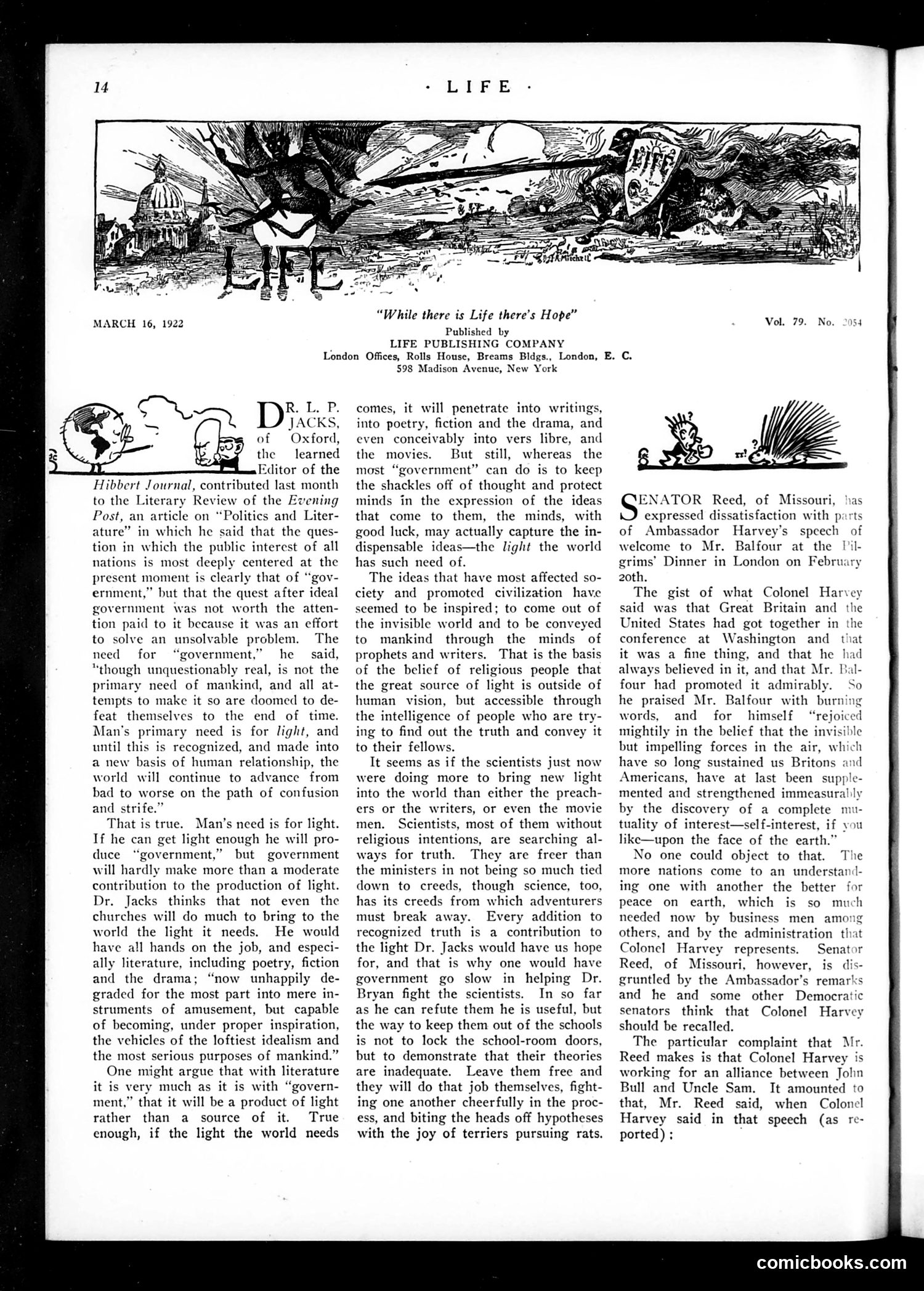
This page features an editorial by Dr. L.P. Jacks discussing the public's need for "light" — both literal illumination and intellectual/spiritual enlightenment. The article argues that literature, poetry, and drama should convey truth and inspire civilization rather than merely entertain. The piece critiques slow government support for scientific advancement and education, contrasting this with religious institutions' historical role in spreading knowledge. It advocates for freeing schools from restrictive theory and allowing intellectual experimentation. The final section addresses Senator Reed of Missouri's criticism of Colonel Harvey's pro-British remarks at a London dinner, suggesting political disagreement over Anglo-American relations. The cartoon header depicts a symbolic landscape with "LIFE" lettering, reinforcing themes of hope and illumination.
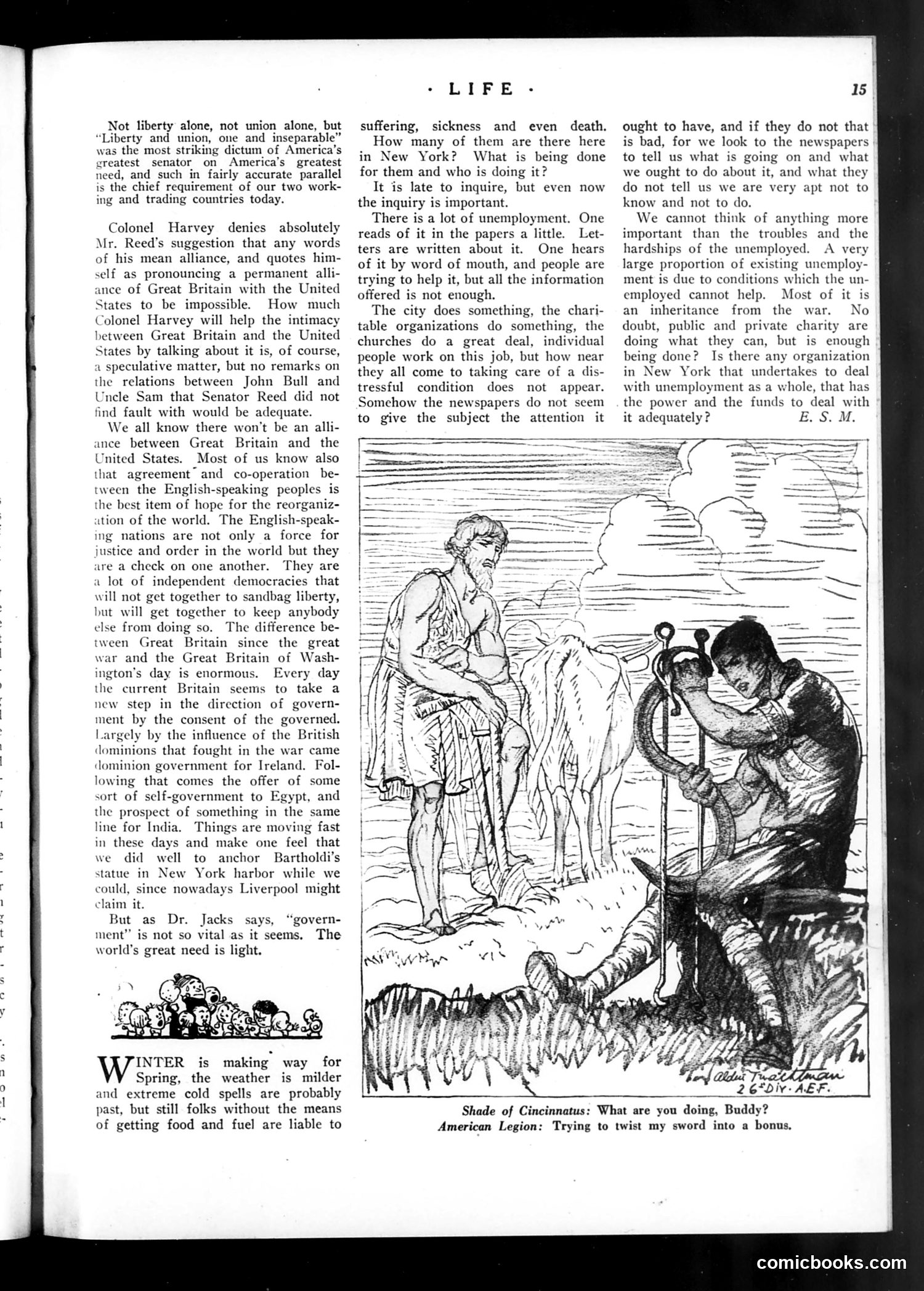
This *Life* magazine page addresses post-WWI American concerns through editorial commentary and a single cartoon. **The Editorial Content** discusses Anglo-American relations, praising cooperation between Britain and the United States while denying any formal alliance. It references Senator Reed's skepticism and Colonel Harvey's diplomatic efforts. The piece also pivots to unemployment and poverty in New York City, criticizing newspapers for insufficient coverage of winter hardship affecting jobless citizens. **The Cartoon** ("Shade of Cincinnati") depicts the American Legion (a veterans' organization founded after WWI) attempting to convert military swords into bonuses—referring to the actual bonus payment controversy. An apparition representing Cincinnati (invoking revolutionary patriotism) questions this action. The satire suggests the Legion's pursuit of financial compensation betrays military/patriotic ideals. **Context**: This reflects post-war veteran tensions, economic hardship, and debates over government responsibility versus private charity—issues dominating American discourse in the early 1920s.
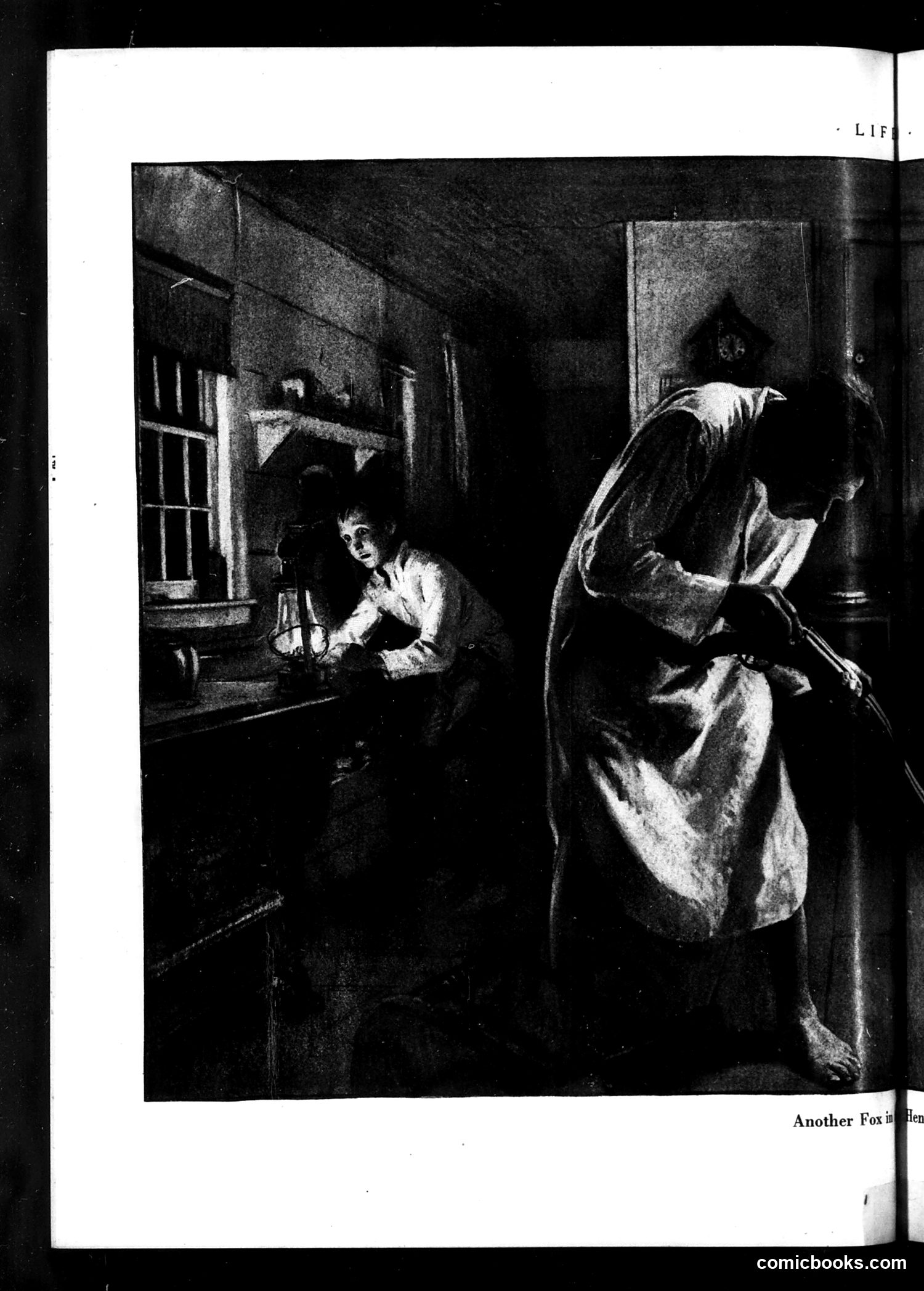
This appears to be a dramatic black-and-white illustration from *Life* magazine showing two figures in what seems to be a prison or jail cell setting. One figure sits at a barred window on the left, while another stands on the right in profile. The caption reads "Another Fox in..." (text cut off). Without the complete caption or additional context visible on the page, I cannot definitively identify which specific political or social scandal this references. The "Fox" reference suggests it may involve a notable figure with that surname, but determining the exact satirical point—whether this depicts arrest, imprisonment, or another consequence—requires the full caption and publication date, neither of which are clearly legible here.
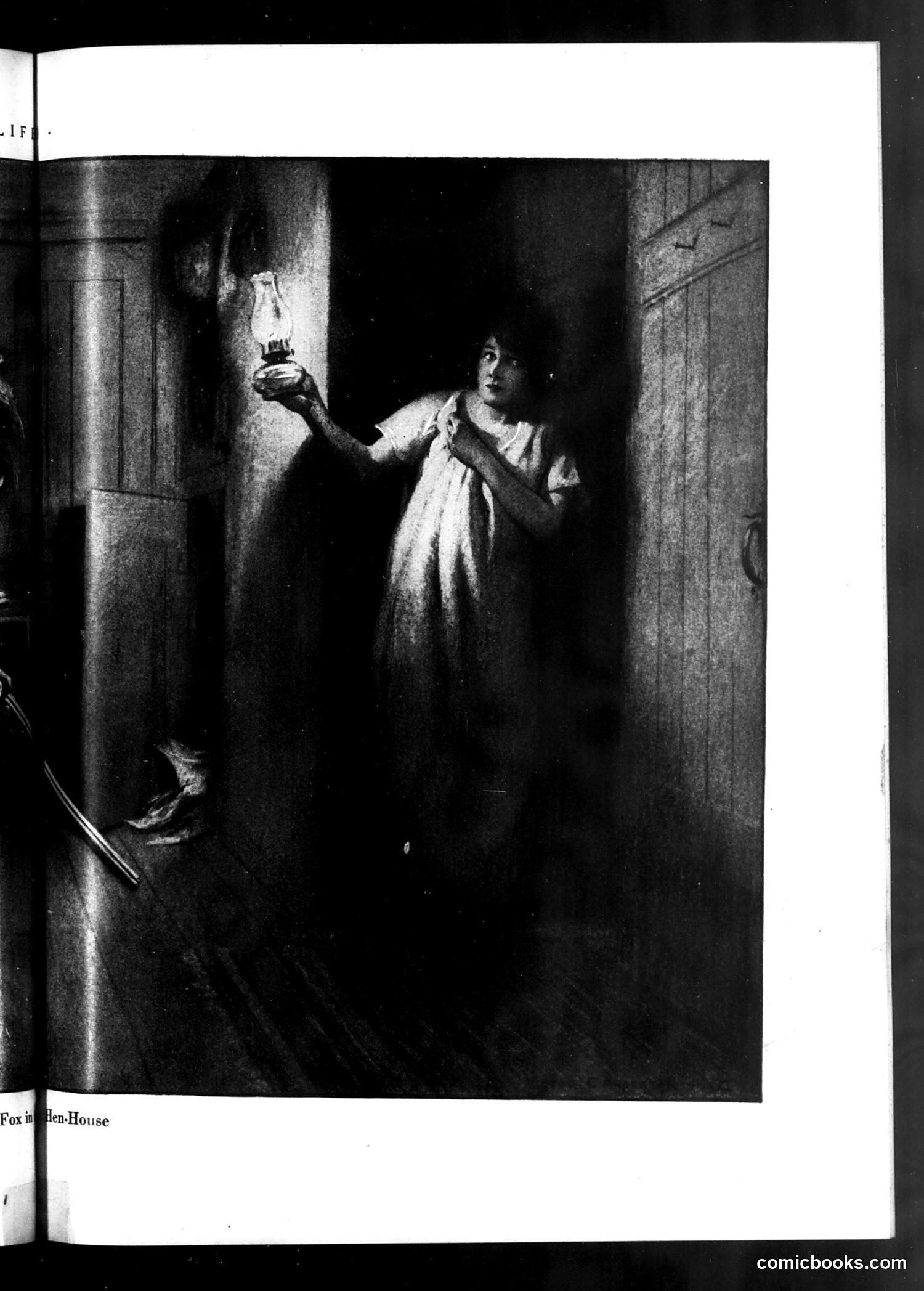
This appears to be a still from a silent film rather than a political cartoon. The image shows a figure in light clothing holding up an oil lamp in a dark, shadowy corridor or passageway, with classical columns visible. The caption reads "Fox [illegible]-House," suggesting this is from a Fox Film production. The dramatic lighting and composition—a solitary figure illuminating darkness—suggests a scene of mystery or suspense typical of early cinema. Without additional context from the page or clearer caption text, I cannot identify the specific film, character, or any satirical intent. The image appears to be a publicity still or promotional photograph rather than editorial commentary.
This is a satirical theater review of George Bernard Shaw's "Back to Methuselah," which the Theatre Guild divided into three weekly installments. The reviewer mocks both Shaw's verbose, tedious writing and the pretentious audience behavior it attracts. The satire targets Shaw enthusiasts who attend plays feeling "duty bound" to murmur appreciation at every intellectual line, fearing others will think them unsophisticated. The reviewer ridicules a specific moment where Adam asks the Serpent for a word meaning "procrastination"—a deliberately mundane philosophical exchange that causes audience members to "faint" with overwrought appreciation. The piece also praises the political caricatures of Lloyd-George and Asquith (characters in the play), noting their accuracy despite the reviewer's unfamiliarity with the actual statesmen. The overall joke: Shaw's play is tedious, but his devoted followers won't admit it, performing intellectual appreciation to appear cultured.
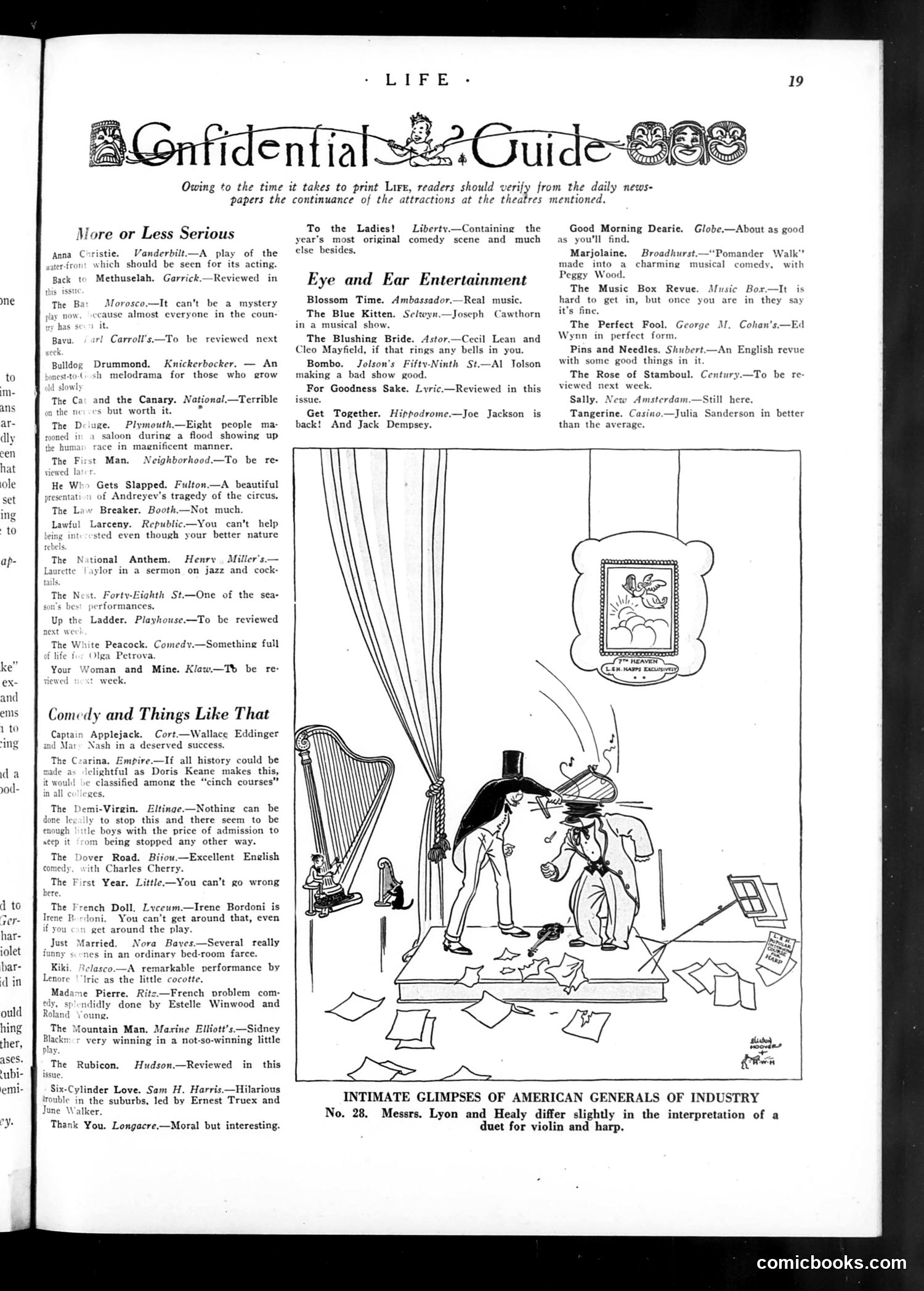
This page from *Life* magazine contains theater reviews and entertainment listings (text) alongside a satirical cartoon titled "Intimate Glimpses of American Generals of Industry." The cartoon depicts **Messrs. Lyon and Healy**, presumably executives or partners of the musical instrument company Lyon & Healy, performing a "duet for violin and harp." The visual humor shows them in physical conflict—one wielding a harp like a weapon while the other plays violin defensively, surrounded by scattered sheet music. This is a visual pun on the phrase "differ slightly," suggesting their disagreement is actually a violent clash. The satire mocks business rivalries and corporate discord by literalizing the conflict through slapstick imagery. The subtitle's mock-formal language ("American Generals of Industry") adds irony, treating petty business squabbles as if they were military campaigns. The page otherwise consists of brief, often sarcastic theater reviews typical of *Life*'s entertainment coverage of the era.
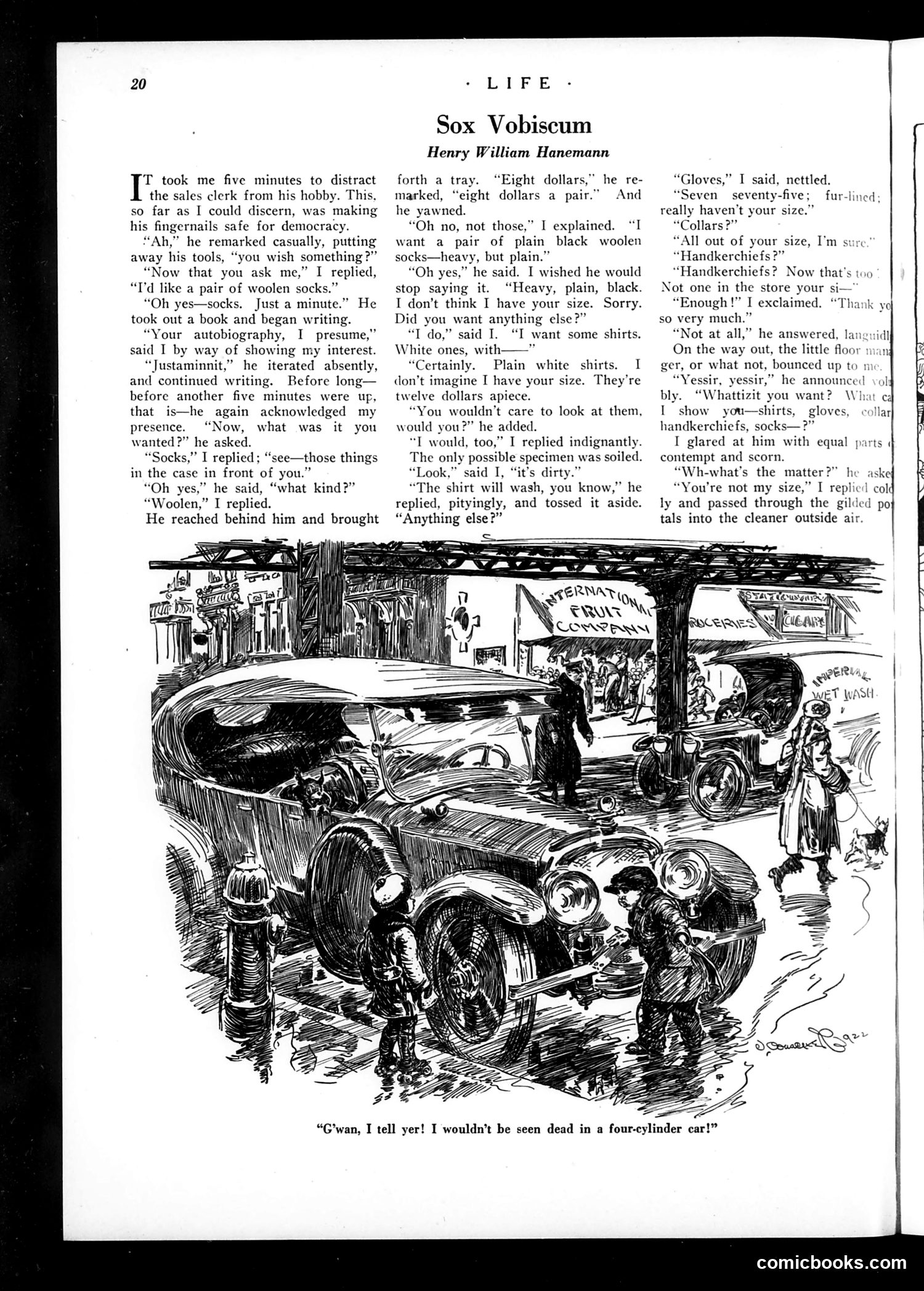
This is a humorous short story by Henry William Hanemann satirizing poor retail service. A customer enters a store seeking simple items—wool socks, white shirts, gloves, handkerchiefs—but encounters an indifferent clerk who: - Is preoccupied with filing his nails ("safe for democracy"—a WWI-era phrase suggesting even trivial tasks serve the nation) - Repeatedly claims items aren't available in the customer's size - Offers only overpriced or soiled merchandise - Shows no genuine interest in helping The title "Sox Vobiscum" is a Latin pun on "Pax Vobiscum" (peace be with you), replacing peace with socks. The accompanying illustration depicts a street scene with an early automobile and pedestrians, accompanying the story's closing dialogue about not being "seen dead in a four-cylinder car"—likely mocking automotive snobbery of the era. The satire targets retail laziness and indifference to customers during what appears to be the 1920s.
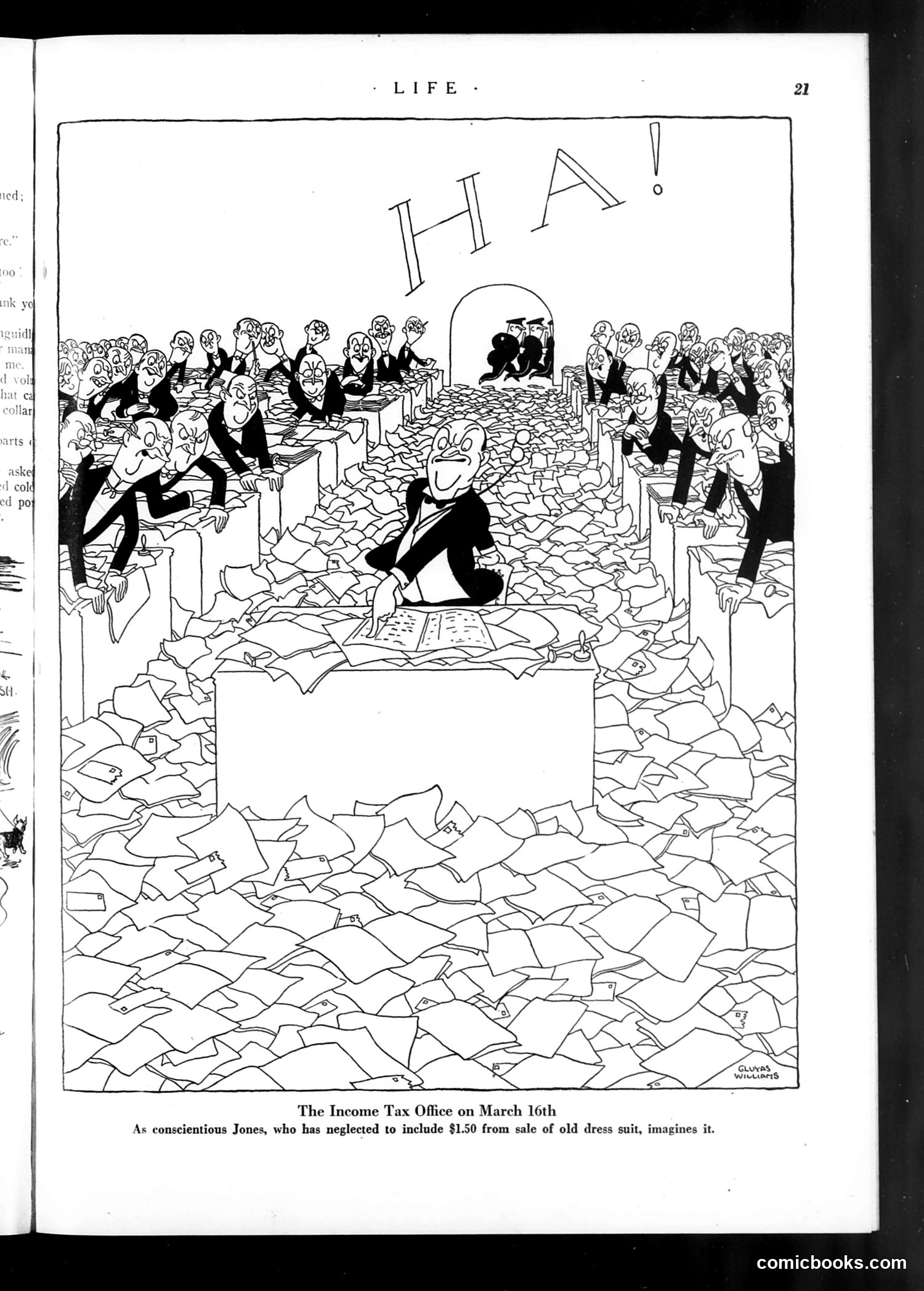
This satirical cartoon depicts "The Income Tax Office on March 16th" as imagined by a conscientious taxpayer named Jones who forgot to report $1.50 from selling an old dress suit. The joke plays on anxiety about tax filing: Jones imagines the tax office overwhelmed with chaos—papers and documents covering the floor, officials buried in bureaucratic paperwork, a surreal scene of governmental dysfunction. The humor is ironic: he's worried that this minor unreported $1.50 will somehow cause massive upheaval. This reflects early 20th-century American attitudes toward income tax (relatively new at this time), depicting both taxpayer guilt and satirizing government inefficiency. The exaggerated nightmare scenario represents the psychological burden of tax compliance, suggesting Jones's conscience is wildly disproportionate to his actual infraction.
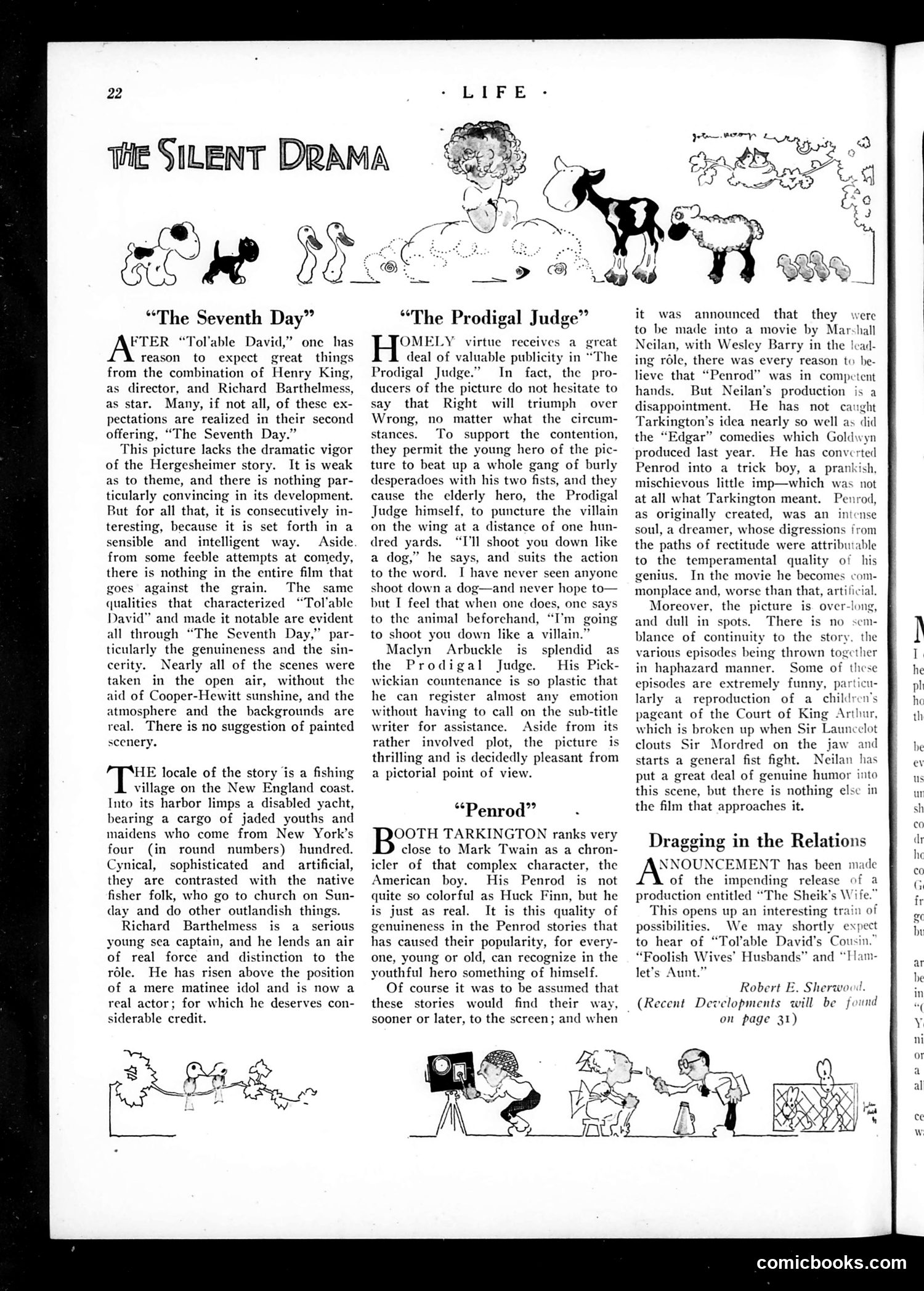
This page contains three film reviews from Life's cinema section, critiquing recent movie releases. **"The Seventh Day"** praises the collaboration of director Henry King and actor Richard Barthelmess, noting the film authentically captures a New England fishing village story. The reviewer appreciates its genuine atmosphere and outdoor cinematography, though finds it dramatically weaker than their previous collaboration "Tol'able David." **"The Prodigal Judge"** satirizes the film's heavy-handed morality—its insistence that Right triumphs over Wrong. The critic jokes about the hero's implausible feats (defeating gangs single-handedly, shooting at impossible distances), while praising actor Maclyn Arbuckle's expressive performance. **"Penrod"** adapts Booth Tarkington's popular boy-character stories. While acknowledging the source material's appeal and the competence of star Wesley Barry, the reviewer finds director Marshall Neilan's adaptation disappoints compared to earlier "Edgar" comedies, missing Tarkington's essential charm.
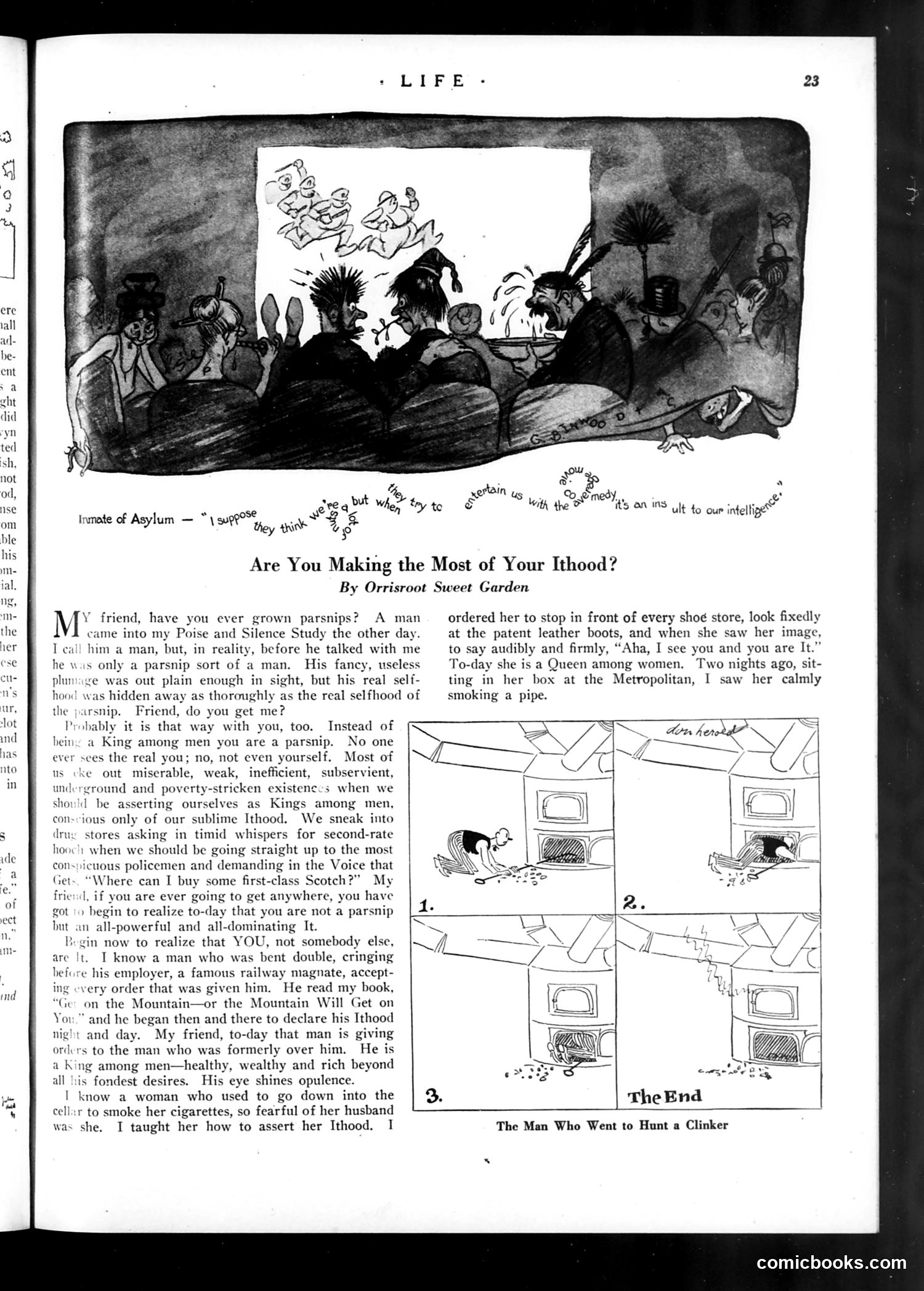
This page contains two distinct pieces: **Top Cartoon:** A satirical drawing of asylum inmates watching a shadow-puppet show. The caption quotes an inmate saying entertainers try to "entertain us with the most it's an insult to our intelligence"—mocking how institutions underestimate patients' intellect. **Main Article & Comic Strip:** "Are You Making the Most of Your Ithood?" by Orrisroot Sweet Garden is self-help satire. The author promotes self-assertion and personal power through the concept of "Ithood"—declaring oneself a commanding "It" rather than a meek "parsnip." The accompanying four-panel comic (titled "The Man Who Went to Hunt a Clinker") illustrates someone chasing what appears to be a small creature or object through increasingly messy situations, ending with "The End." The piece satirizes the early 20th-century self-help movement and pseudo-philosophical motivational literature that promised personal transformation through positive thinking and assertiveness—while the absurd examples (a woman smoking in public to prove power) reveal how ridiculous such claims often were.
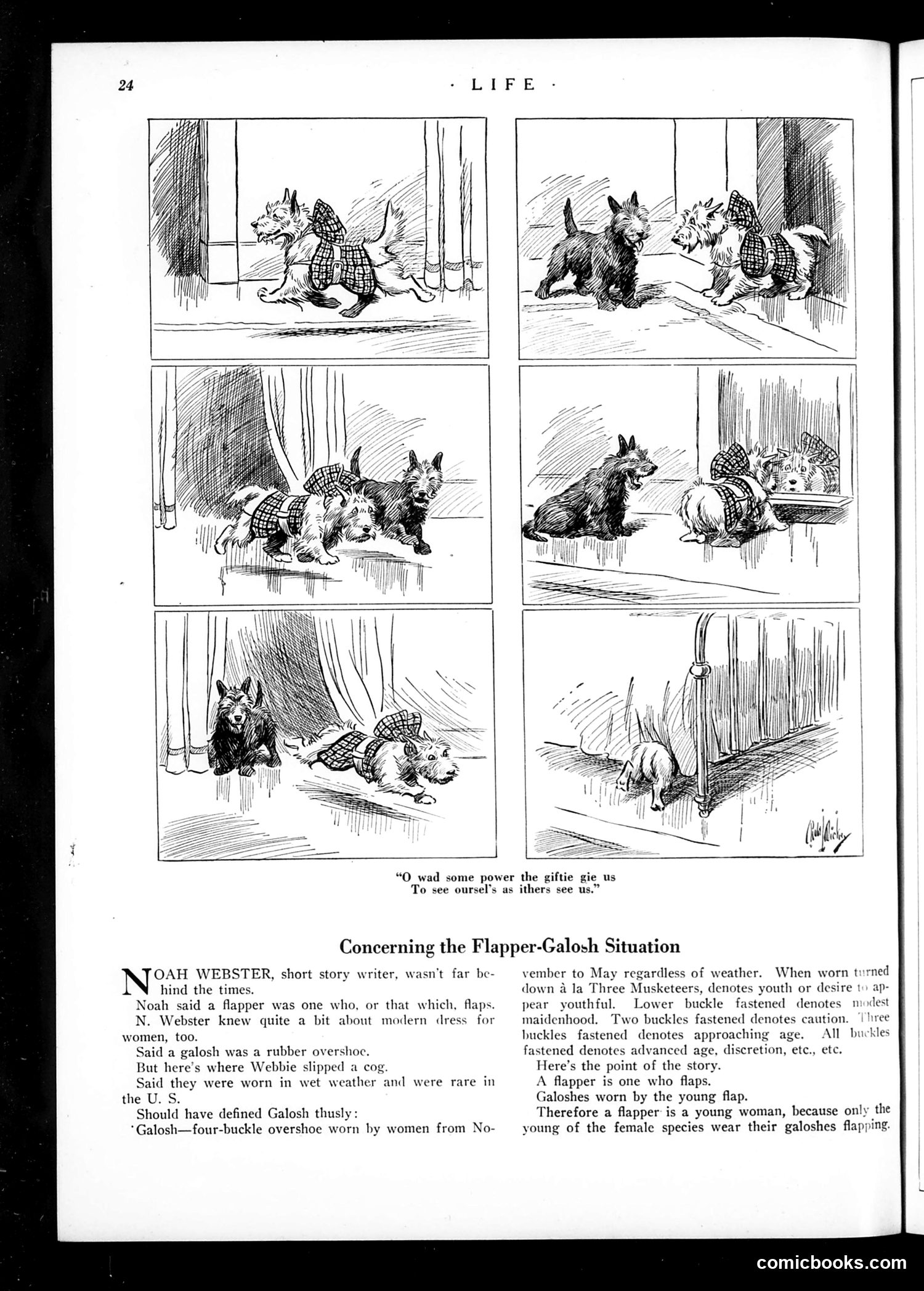
This 1920s satirical piece mocks the "flapper" fashion trend through a humorous redefinition of "galosh" (rubber overshoe). **The Joke:** The comic strip (top) shows small dogs wearing plaid jackets and galoshes, with the text playing on Scottish poet Robert Burns's famous line about seeing ourselves as others see us. The accompanying article humorously "corrects" Webster's Dictionary by redefining galosh based on how young women actually wore them—specifically, unbuckled or partially buttoned, creating a flapping sound as they walked. **The Social Satire:** Flappers were controversial modern young women (1920s) known for rejecting Victorian propriety. The piece gently mocks both the fashion itself and the age-based judgments embedded in how women wore their galoshes: young women flapped theirs fashionably; older women buttoned them properly for modesty and discretion. **The Point:** The absurd logical equation (flappers flap; galoshes flap when young women wear them; therefore flappers are young women) satirizes how trivial fashion choices became markers of generational identity and respectability.
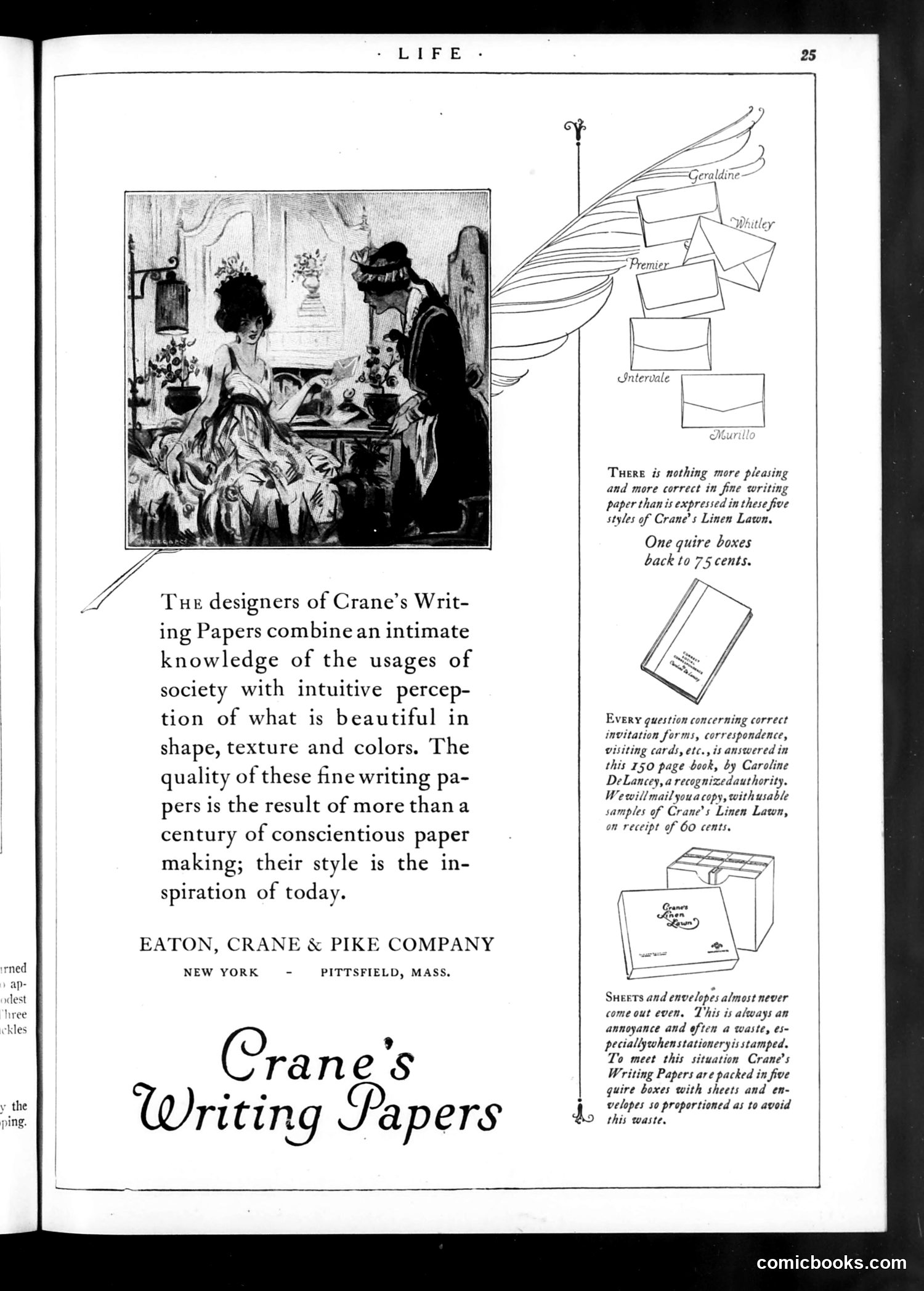
This is **not a cartoon or satire**, but rather a **full-page advertisement** for Crane's Writing Papers, a luxury stationery brand by Eaton, Crane & Pike Company (with locations in New York and Pittsfield, Massachusetts). The left side features an illustration of an elegant woman at her writing desk, establishing an aspirational domestic scene associated with refined correspondence. The right side displays technical diagrams of five linen paper styles (Geraldine, Bluelay, Premier, Intervale, Murillo) and shows product packaging. The ad emphasizes social sophistication: the writing papers reflect "knowledge of the usages of society" and proper etiquette. It targets middle-to-upper-class readers concerned with correct invitation forms and visiting cards. The pricing (75 cents for quire boxes, 60 cents for samples) and reference to a 150-page etiquette guide by Caroline DeLancey reinforces this aspirational positioning. This represents early 20th-century advertising's focus on selling products through appeals to social status and refinement rather than functional benefits alone.
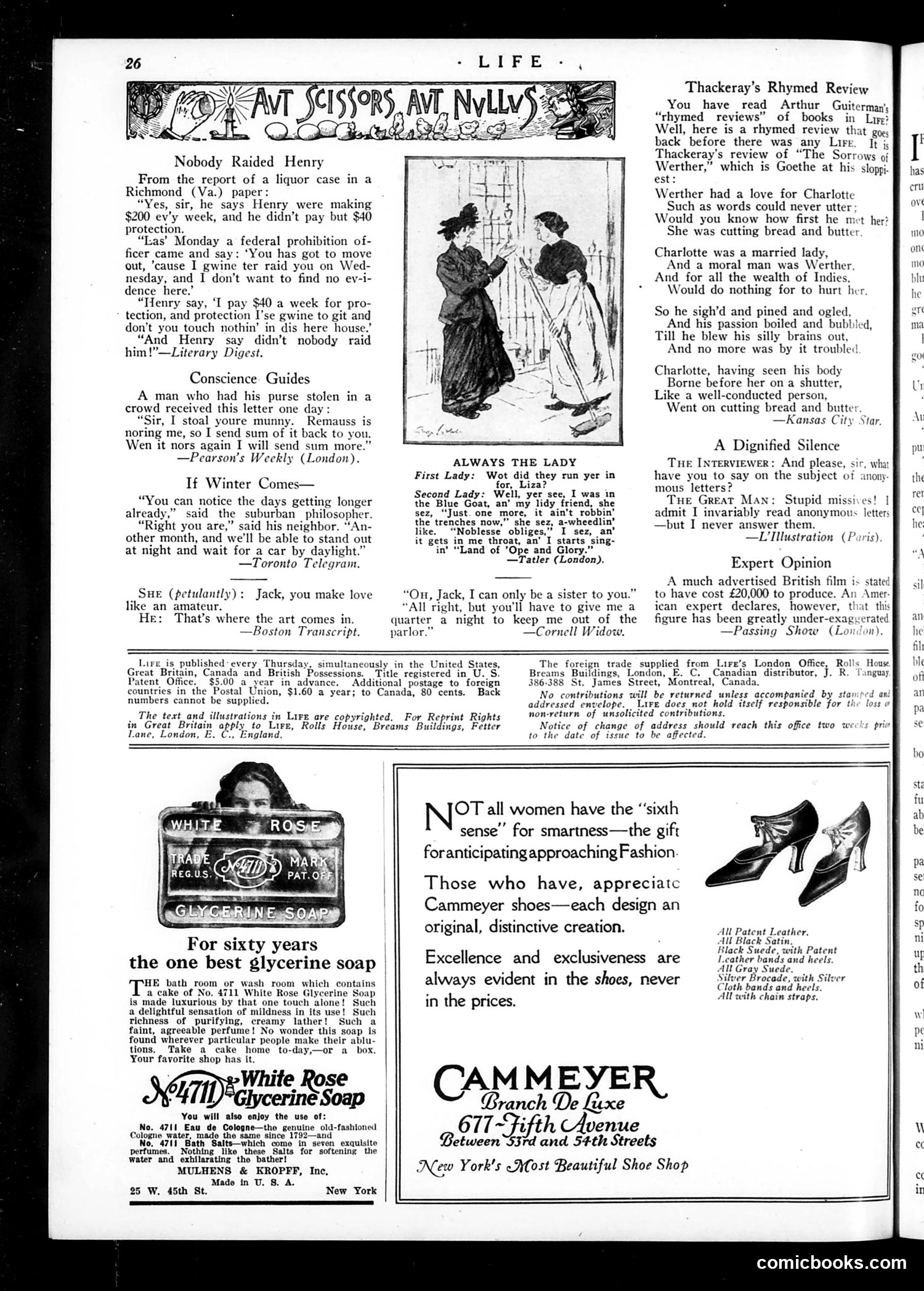
This page from *Life* magazine contains several short humorous pieces and advertisements typical of early 20th-century American satire. **"Nobody Raided Henry"** mocks Prohibition enforcement through a dialect anecdote: a Black bootlegger pays $40 weekly "protection" money to authorities, then when a federal agent warns him of a raid, the bootlegger demands his protection money actually protect him—and it does, because corruption is so endemic that the raid never happens. The satire targets both Prohibition's ineffectiveness and systemic police bribery. **"Always the Lady"** uses working-class British female characters to joke about maintaining propriety: a woman arrested for singing patriotic songs in a pub insists it was "noblesse oblige"—ironically applying aristocratic etiquette to lower-class behavior, lampooning pretension. **"Thackeray's Rhymed Review"** presents a Victorian-era poem mocking Goethe's *Werther* as melodramatic—a meta-joke about old literary criticism applied to Romantic excess. The remaining pieces are light observational humor about winter daylight, romance, and film production costs. The page is primarily advertising space (soap, shoes) with humor filling gaps—typical *Life* magazine format.
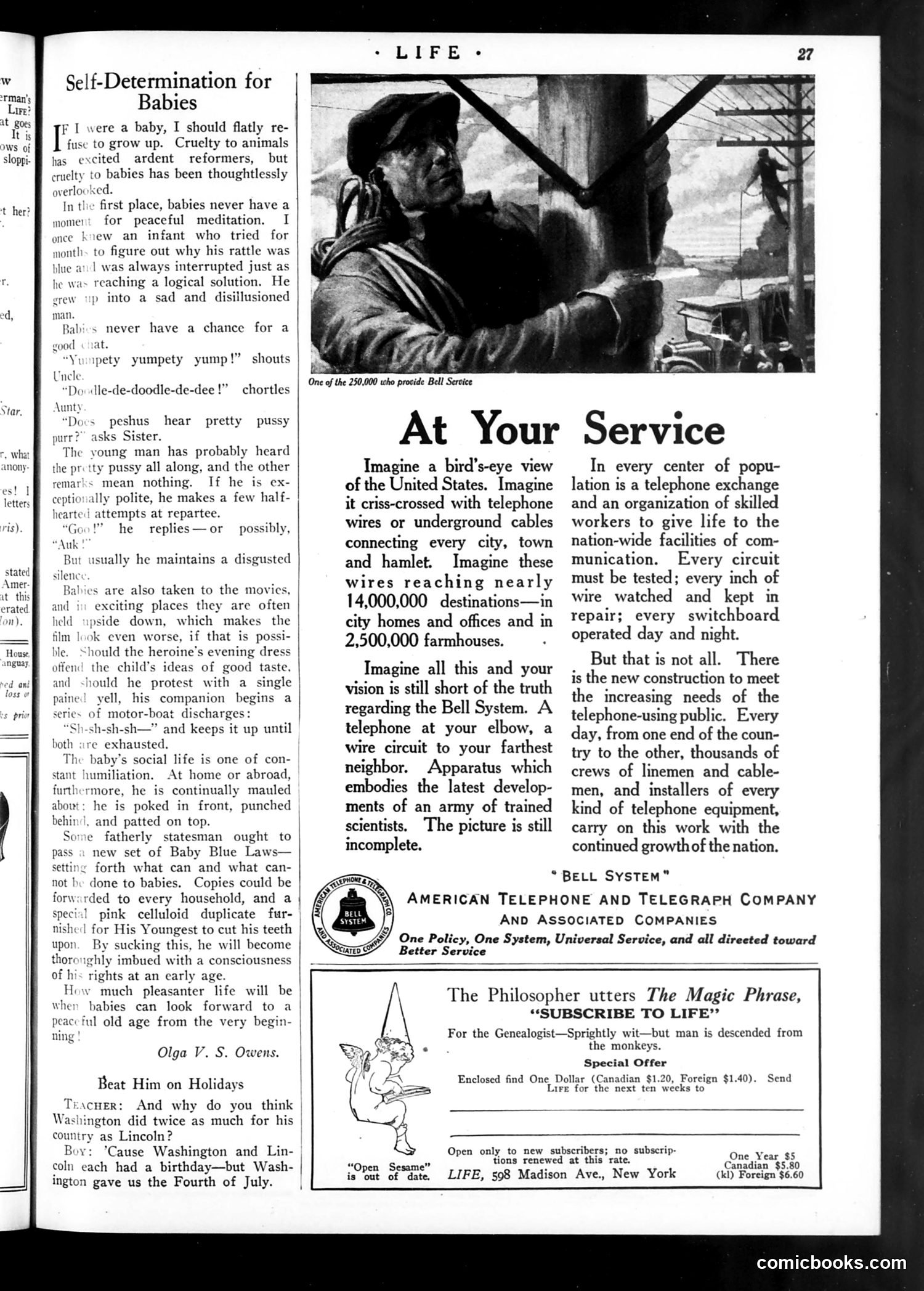
This page contains three distinct pieces: **"Self-Determination for Babies"** (humor essay by Olga V.S. Owens): A satirical complaint about how adults constantly interrupt babies' attempts at thought and peace. The piece mock-seriously proposes "Baby Blue Laws" to protect infants from being poked, patted, taken to movies upside-down, and subjected to annoying baby-talk from relatives. The joke is treating infant mistreatment as a serious civil rights issue worthy of legal protection. **"Beat Him on Holidays"** (joke): A teacher asks why Washington accomplished more than Lincoln. The boy's answer: Washington and Lincoln each had one birthday, but Washington also gave us the Fourth of July—so technically Washington gets celebrated twice. **"At Your Service"** (Bell System advertisement): A corporate advertisement for American Telephone and Telegraph Company, describing the nationwide telephone infrastructure and workforce maintaining it. This is straightforward promotional content, not satire. The page mixes humor with advertising, typical of Life magazine's format during this period.
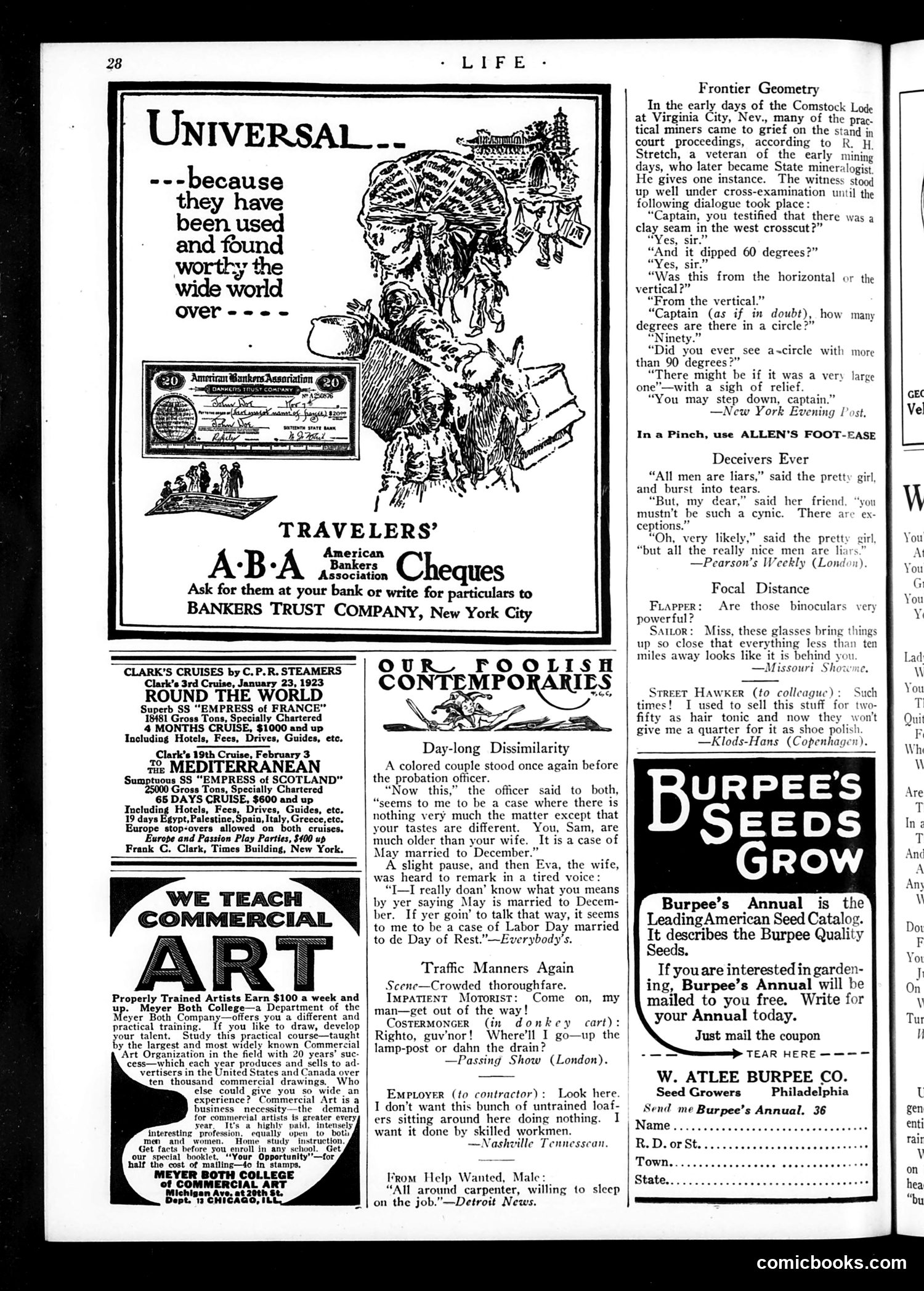
This page from *Life* magazine (circa 1923) is primarily **advertisements and humorous anecdotes** rather than political cartoons. The main content includes: - Travel and banking ads (ABA Cheques, cruises, commercial art school) - Brief comic sketches about everyday life, including: - A "Frontier Geometry" anecdote mocking an illiterate 19th-century Nevada miner who doesn't understand that a circle contains 360 degrees - "Traffic Manners" jokes about rude motorists and stubborn cart-drivers - "Day-long Dissimilarity," a dated racial sketch about a Black couple's marital dispute, using dialect humor - Employment notices with ironic punchlines These pieces reflect 1920s *Life* magazine's style: light satire aimed at urban, educated readers through workplace mishaps, immigrant/dialect humor, and "ignorant character" tropes. The racial content particularly reflects the casual prejudices of the era that modern readers would find offensive.
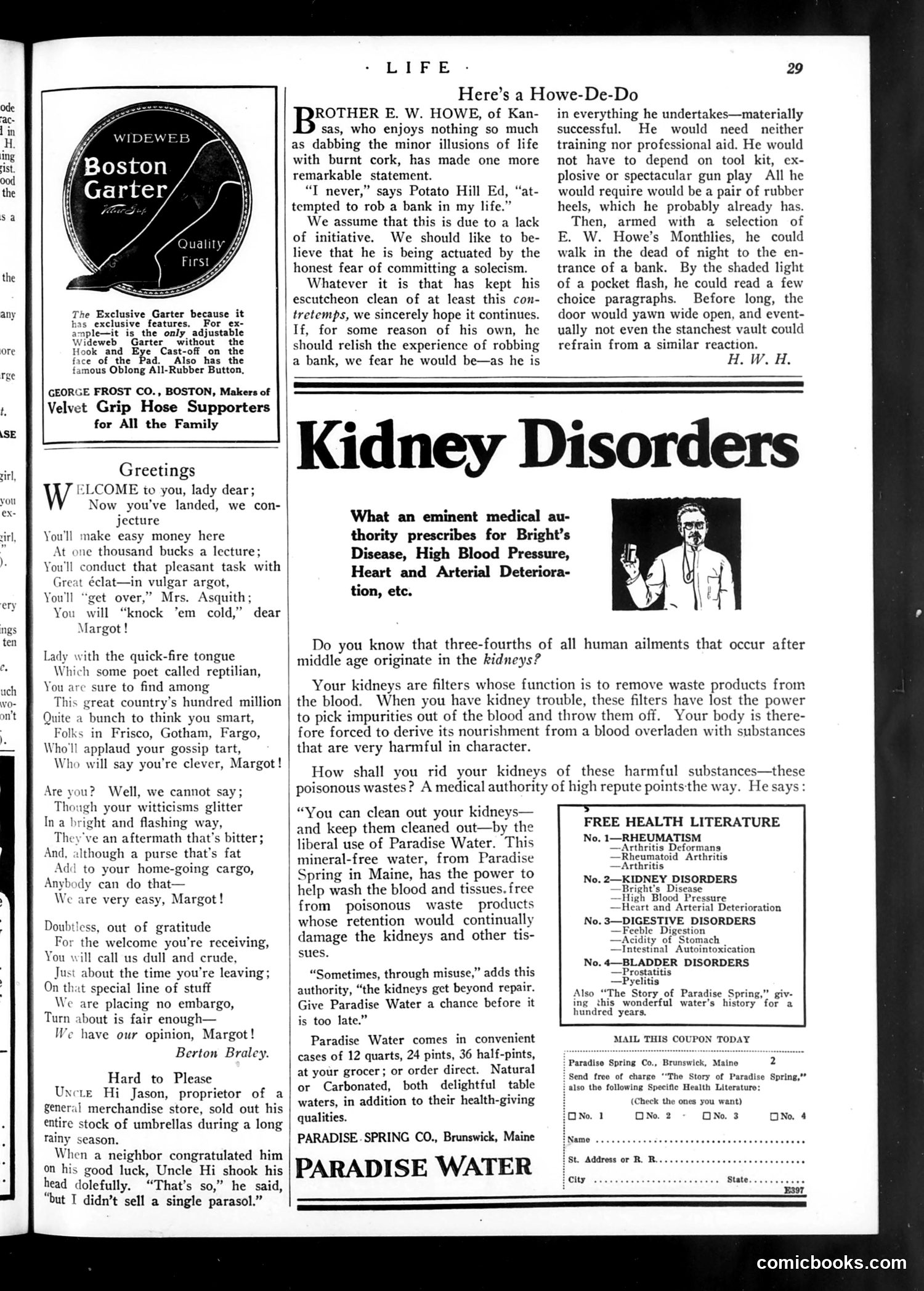
This page contains three distinct sections: **advertisements, satirical poetry, and a medical pitch.** The poem "Greetings" targets **Margot Asquith** (wife of British PM Herbert Asquith), who apparently toured America giving paid lectures. The satire mocks her reputation for quick wit and gossip, suggesting Americans will pay to hear her insult them—yet predicting she'll call Americans "dull and crude" upon leaving. It's gently cynical about both her mercenary tour and American gullibility. "Hard to Please" is a brief joke: Uncle Hi sold all his umbrellas during rain but regrets not selling parasols—a trivial complaint about missing a secondary market. The **"Kidney Disorders"** section is a thinly-veiled advertisement for Paradise Water (a patent medicine), dressed up as medical advice. It claims kidney problems cause most middle-age ailments and promises their mineral water will cure them—a common medicinal scam of this era before FDA regulation. The page reflects early-20th-century Life magazine's mix: satirical commentary on current figures, light humor, and dubious health advertising.
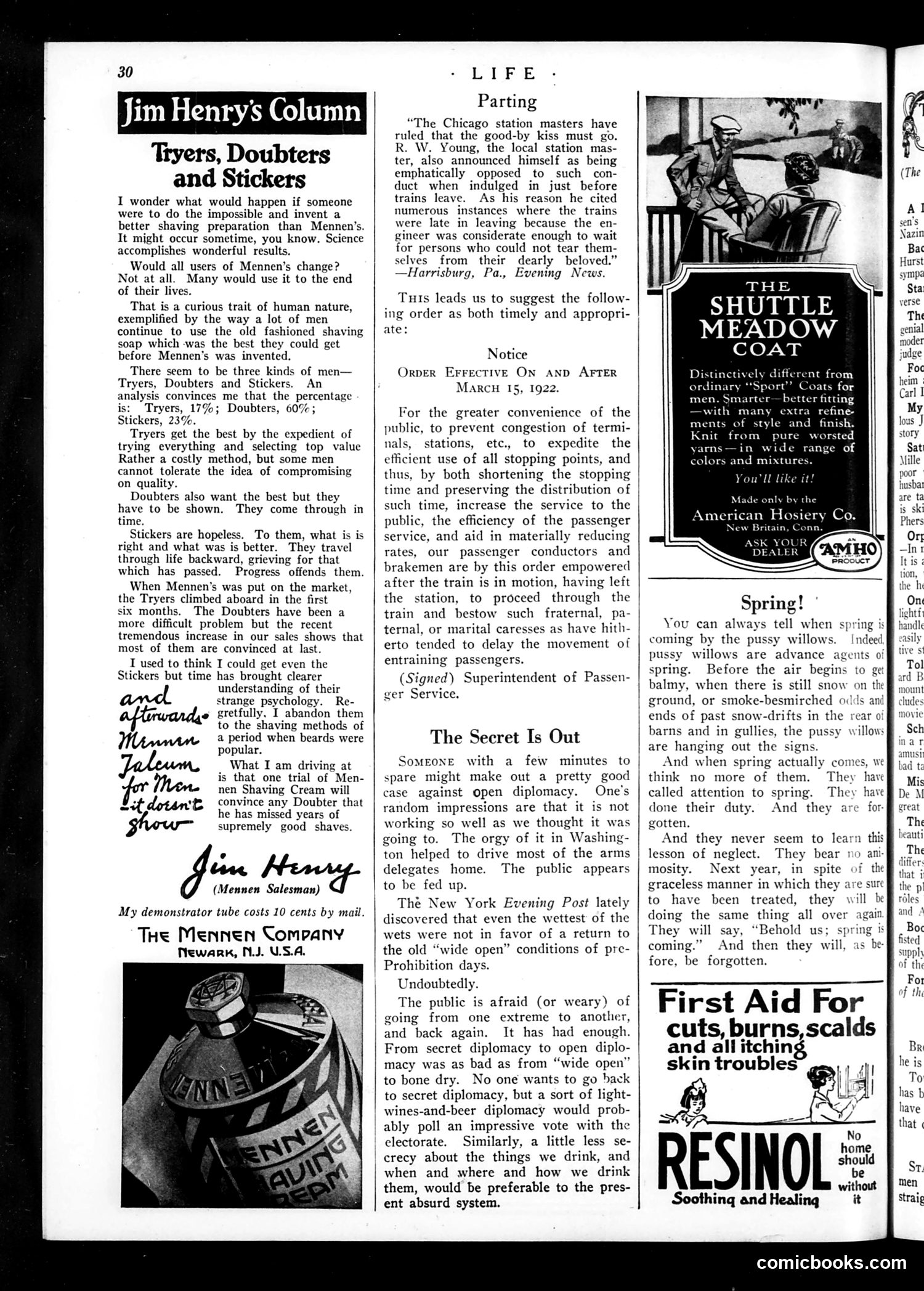
This is a Mennen shaving cream advertisement disguised as editorial commentary. Jim Henry argues that consumers fall into three categories: "Tryers" (17%) who constantly experiment, "Doubters" (60%) who need convincing, and "Stickers" (23%) who resist change and cling to outdated products. The satire targets human nature—specifically, resistance to progress. Henry uses shaving habits as a metaphor: even superior products struggle against consumer inertia. Those loyal to old-fashioned soap represent stubborn traditionalism, while "Stickers" are portrayed as backward-looking and unreasonable. The column's real purpose is persuasive marketing, not genuine social commentary. By framing Mennen's adoption as inevitable progress and resistance as irrational conservatism, the advertisement attempts to shame "Doubters" into trying the product.
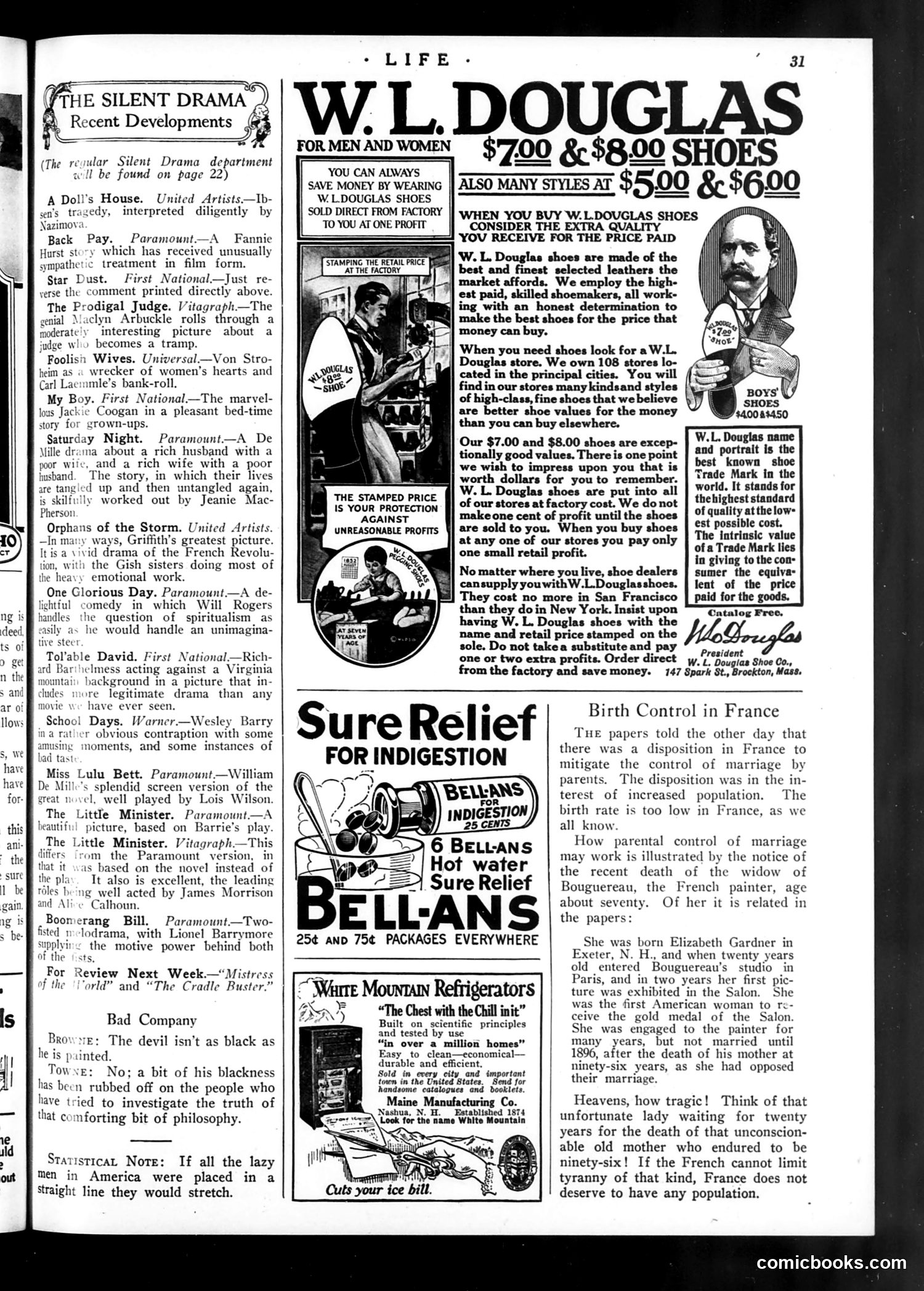
This page is primarily **advertising and film reviews**, not political satire. The dominant content includes: **Film Reviews** (left column): Brief critiques of silent films, including works by D.W. Griffith, featuring actresses like the Gish sisters and actor Jackie Coogan. The reviews are straightforward assessments of movie quality. **W.L. Douglas Shoe Advertisement** (center/right): A major ad featuring the shoe company's founder/president, emphasizing direct factory-to-consumer sales eliminating middleman profits. The pitch highlights affordability and quality. **Minor Satirical Elements**: - A one-line joke about "lazy men in America" - Brief quips in film reviews (e.g., "Just reverse the comment printed directly above") **"Birth Control in France"** (right column): A serious editorial discussing French population concerns and a widow who opposed marriage after losing her husband—not satirical. This is primarily a **commercial publication** mixing entertainment industry coverage with advertisements, not a vehicle for political cartooning or sustained satire.
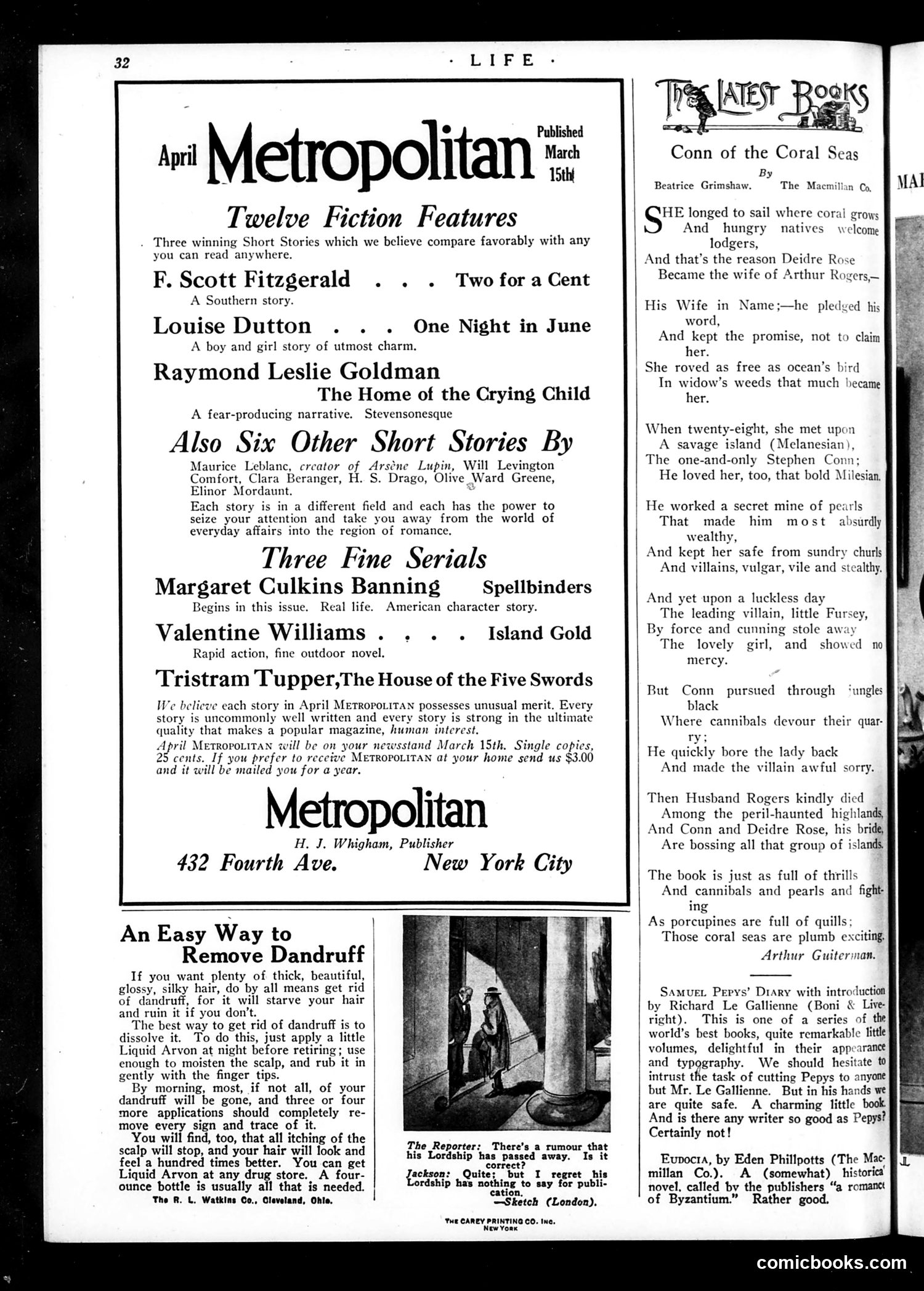
This is primarily a **magazine advertising and contents page**, not a political cartoon. The page announces *Metropolitan* magazine's April issue (published March 15th), featuring twelve fiction pieces by notable authors including F. Scott Fitzgerald and Louise Dutton. Below the main advertisement sits a small **comic sketch from the British publication *Sketch***. It depicts a reporter asking a butler named Jackson whether his lordship has died. Jackson confirms the death but notes the deceased has "nothing to say for publication"—a deadpan joke about how even death won't loosen a nobleman's tight-lipped discretion. The humor relies on British class stereotypes: the stuffy aristocrat remains formally uncommunicative even beyond the grave. The page also includes a book review of *Conn of the Coral Seas* by Beatrice Grimshaw—an adventure novel involving pearls, cannibals, and colonial exoticism typical of early 20th-century popular fiction—and a dandruff-removal advertisement for "Liquid Arvon."